
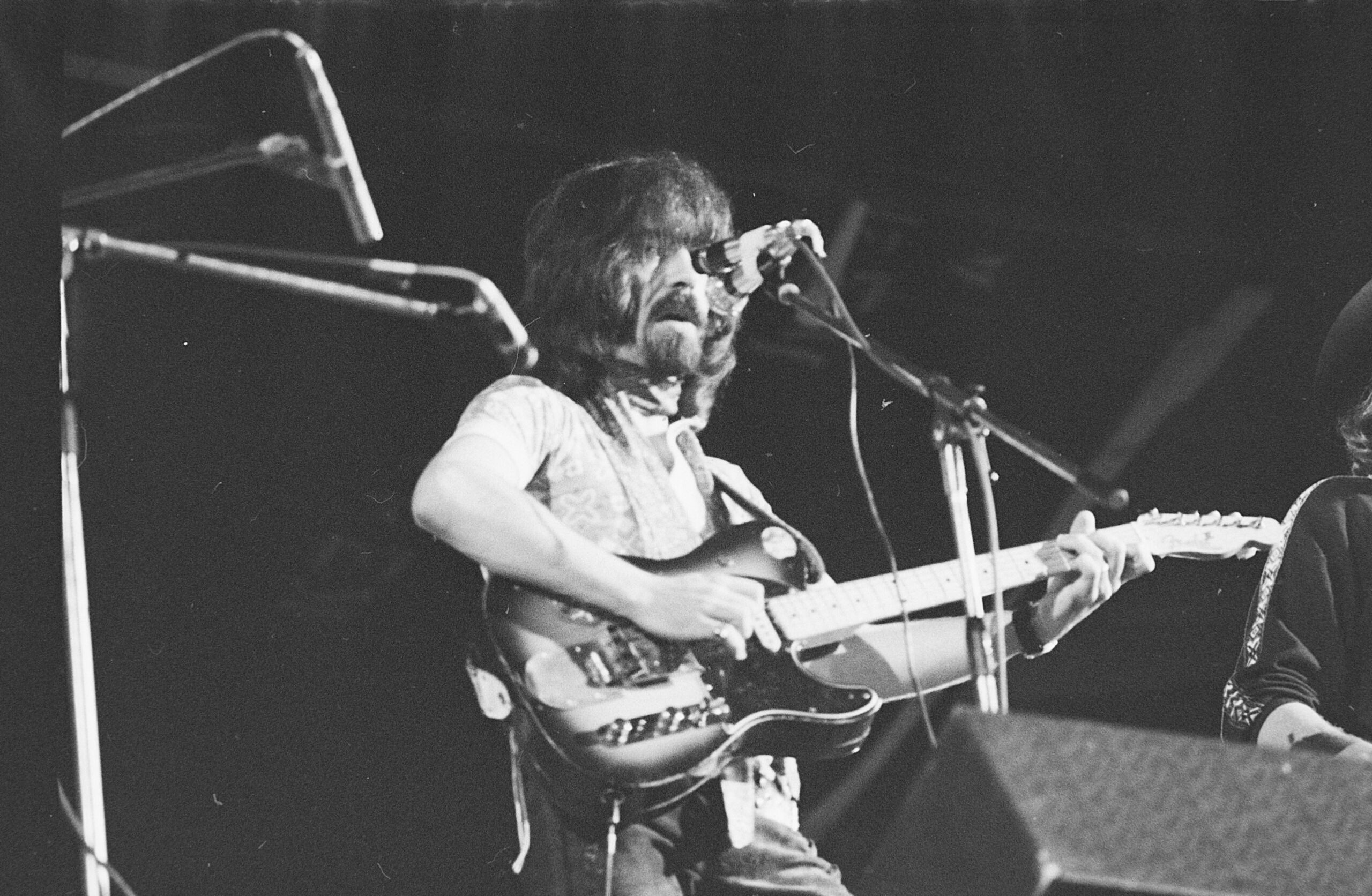
He didn’t want to route out his Telecaster. That was the specific constraint that produced one of the most important innovations in guitar technology history. Clarence White was looking for a way to play pedal-steel-like bends on his Telecaster without taking his hands off the neck. He had tried bending the string behind the nut, but that proved unnecessarily challenging. His Nashville West bandmate Gene Parsons — a machinist as well as a drummer — solved the engineering problem: mount the mechanism on the back of the guitar rather than routing the body. A wooden rim mirroring the Telecaster’s shape was added to the back; a piece of Masonite covered everything and effectively doubled the guitar’s thickness. The B string was connected to a spring-loaded lever that passed through the body; pull down on the guitar neck, and the strap tension raised the B string a full tone. The Parsons/White StringBender — now universally known as the B-Bender — was born in 1968, and the guitar that got it first was White’s 1954 two-tone sunburst Telecaster.
Clarence Joseph LeBlanc was born on June 7, 1944, in Lewiston, Maine, and grew up in Burbank, California. He is known professionally by his mother’s maiden name, Clarence White. He was both a bluegrass flatpicking prodigy — as a teenager with the Kentucky Colonels, the family band he formed with his brothers Eric and Roland, he helped the bluegrass world recognize the guitar as a lead instrument — and a pioneering country rock guitarist with the Byrds (1968-1973) whose invention of the B-Bender built the specific technological bridge between country steel guitar and electric rock guitar. He sold his Martin D-28 Herringbone to buy a Fender Telecaster. The Martin ended up owned by Tony Rice, who has played it ever since as one of his primary instruments. The Telecaster became the first B-Bender guitar in history. Both instruments have ongoing biographies beyond White’s own.
He was struck and killed by a drunk driver on July 14, 1973, while loading gear into his car at 2am in Palmdale, California. He was twenty-nine years old. The loss was felt as an irreplaceable one across both the bluegrass and country rock communities he had inhabited. His 1954 Telecaster with the original B-Bender installation was subsequently acquired by country music archivist Marty Stuart in the early 1980s, who has described the acquisition with the romantic extravagance it deserves: “Susie said, ‘That’s the guitar you really want, isn’t it?’ And I said, ‘Are you kidding!?’ I laid my chequebook on the table and said ‘Within reason, fill in any number you want to.'” The guitar was worth any number within reason. It still is.
Background: From Maine to Burbank to the Byrds
The White family’s musical culture was comprehensive and specific. Clarence’s father taught all the children music; the family formed the Country Boys band when Clarence was in his early teens, with brothers Eric and Roland alongside him. Eric played fiddle; Roland played mandolin; Clarence played guitar. The bluegrass flatpicking vocabulary Clarence developed with the Kentucky Colonels — the family’s eventual name — was self-described as Doc Watson-inspired, a connection that places him in the direct line of the flatpicking tradition whose lineage runs Doc Watson to Clarence White to Tony Rice to Molly Tuttle. Guitar World’s documentation of his specific technique: his acoustic flatpicking incorporated lightning-fast fiddle lines played on a vintage Martin D-28, helping the bluegrass world recognize the guitar as a lead instrument.
The Kentucky Colonels’ 1964 album Appalachian Swing! — recorded when Clarence was twenty years old — is still revered as a foundational bluegrass guitar record. Tony Rice and Norman Blake, two of the most respected bluegrass guitarists of the next generation, cite White as a key influence. The specific quality of the playing on Appalachian Swing! — the flatpicking speed, the note articulation, the specifically bluegrass-idiomatic approach to melody that distinguished White from his contemporaries — represents the acoustic peak of his contribution to the guitar, reached before he was old enough to legally drink in most American states.
The transition to electric guitar — specifically the sale of the Martin D-28 to buy a Telecaster — represents one of the more significant instrument-to-instrument transitions in American roots music history. The Martin went to Tony Rice; Clarence got a Telecaster and subsequently became one of the most innovative electric guitarists of his era. This is not the only biography with dual instruments following their own subsequent paths, but it is the most specifically poignant: the guitar that Tony Rice plays when he represents the flatpicking tradition that White helped establish came from White himself, as a direct transmission across the acoustic-to-electric divide.
The Byrds’ post-Roger McGuinn/David Crosby configuration — the band that White joined in 1968 — was a radically different act from the original folk rock group whose version of “Mr. Tambourine Man” had defined folk rock in 1965. The Sweetheart of the Rodeo album, which White contributed to as a session musician before joining the band full time, was the pivotal document of the transition: a rock band making a country record, using Nashville session musicians alongside the Byrds’ rock credentials to create something that was neither purely country nor purely rock. White’s B-Bender Telecaster was the specific instrument that made the transition musically coherent: a rock guitar (the Telecaster) making sounds associated with country (the steel guitar bends) through a mechanical innovation rather than through stylistic appropriation. The mechanism did the cultural work of bridging two music-industry categories that the business had kept deliberately separate.
His session work in Los Angeles in the mid-1960s — before joining the Byrds as a full member — documented both his specific abilities and his specific range. He appeared on Byrds recordings as far back as Younger Than Yesterday (1966) before joining the band in 1968 for the Sweetheart of the Rodeo album that helped define country rock. The session clients — Everly Brothers, Joe Cocker, Rick Nelson, Randy Newman, Gene Clark, Linda Ronstadt, Arlo Guthrie, Jackson Browne — represent a cross-genre range that few session guitarists could cover with equal authority. His work on these records demonstrates the specific versatility of a musician who had absorbed both the bluegrass flatpicking tradition and the country rock vocabulary that the Nashville West and Byrds contexts were developing simultaneously.
Gene Parsons’ specific contribution to the B-Bender — as a machinist and instrument builder as well as a musician — deserves recognition alongside White’s compositional vision that drove the innovation. Parsons built what White imagined: the engineering behind the spring-loaded lever, the routing of the mechanism through the guitar body, the specific tension and response characteristics that made the device playable rather than merely functional. Early prototypes included benders for multiple strings (E, B, G, and D); White’s decision to simplify to the single B-string bender was the compositional choice that made the device musically practical. Too many bending devices would have been too complex to control during performance; the single B-string focus gave the player one expressive variable to master rather than four. This simplification — a composer’s edit of an engineer’s prototype — is the specific point where White’s musical intelligence shaped the technology’s final form.
The Rig: Clarence White’s Guitars, Amp, and the B-Bender Innovation
Guitars
The guitar that defines Clarence White’s identity — in terms of both historical significance and tonal character — is his 1954 two-tone sunburst Fender Telecaster (possibly an Esquire; the jury is still out on the original configuration). The guitar’s body is alder, with the single-cutaway Telecaster design and the maple neck that characterized mid-1950s Fender production. White used this as his only electric guitar throughout the Byrds period (1968-1973). His only electric guitar throughout this period was his StringBender-equipped Telecaster.
The specific modifications that accumulated on this guitar across White’s tenure with it are multiple and specific. The Parsons/White StringBender, installed in 1968, added the mechanism on the back of the guitar (protected by a Masonite cover that nearly doubled the guitar’s thickness) that pulled the B string up a full tone when the guitar neck was pulled downward — activating the strap tension, which connected to the spring-loaded lever mechanism. Beyond the StringBender: White also had Scruggs pegs on the high E and A strings (allowing them to be tuned down for specific open tuning passages), and a palm pedal that lowered the E string down a half step. Ralph Mooney, the steel guitarist, installed the palm pedal. Marty Stuart, after acquiring the guitar, moved one of the Scruggs pegs to the bass string for his own specific playing requirements. The guitar’s current condition — still functional, still in Stuart’s possession — represents the accumulated work of multiple instrument designers and musicians who contributed to its evolution across fifty-plus years.
Before the Telecaster, White’s primary acoustic guitar was a vintage Martin D-28 Herringbone — the pre-war Martin construction standard with Brazilian rosewood, Adirondack spruce top, and the herringbone purfling that distinguishes the pre-WWII high-end D-28 from subsequent production. When White sold the D-28 to buy his Telecaster, Tony Rice acquired it. Rice has played the guitar extensively as one of his primary instruments, using it to perform the same flatpicking tradition that White had developed. The Martin D-28 thus has a specific ongoing biography as Tony Rice’s guitar, with the tradition that White helped develop continuing through the instrument on which it was partly developed. Premier Guitar documented: One was his battered Martin D-28 Herringbone, now owned — and often played — by Tony Rice.
White’s specific flatpicking technique — developed on acoustic guitar with the Kentucky Colonels and directly applied to his electric guitar work — is the foundation of what both Tony Rice and other bluegrass flatpickers absorbed from his example. Premier Guitar documents this specifically: He incorporated that from his acoustic playing — referring to the way White applied his bluegrass flatpicking vocabulary to the electric Telecaster rather than adopting the conventional country or rock electric guitar approach. The result was a specific hybrid playing style — the bluegrass flatpicker’s right-hand approach (alternating downstroke-upstroke at high velocity, with the specific attack character of acoustic flatpicking) applied to an electric instrument capable of the sustain, distortion, and pedal-steel effects unavailable from acoustic guitar.
White’s specific string and tuning choices — documented through the Scruggs peg and palm pedal modifications on the 1954 Telecaster — reflect the same compositional thinking about tuning as a resource that characterizes Joni Mitchell’s open tuning system and Ry Cooder’s open tuning vocabulary. The Scruggs pegs on E and A strings for open G tuning; the palm pedal for E-to-Eb drop; these are composer’s tools for accessing specific harmonic territories that standard tuning doesn’t provide. On a guitar also equipped with the B-Bender, the combined tuning and pitch-bending resources gave White access to a chromatic and harmonic range that no other Telecaster player of his era had available from a single instrument.
Amps and Electronics
Fender Amplifiers (Various, Throughout Career): White’s amplifiers varied throughout his period with the Byrds — the Premier Guitar documentation specifically notes this: his only electric guitar throughout this period was his StringBender-equipped Telecaster, although his amplifiers varied. The Fender amplifier tradition — Twin Reverb, Deluxe Reverb, Vibroverb — is the natural companion to a Telecaster in country and country rock contexts, providing the clean, bright, American character that complements the Telecaster’s single-coil articulation. For the specific B-Bender pedal-steel simulations, a clean amplifier that doesn’t compress the string-bending dynamics was essential: the steel-like bends require the full dynamic range of the note’s rise and peak to be transmitted clearly, which high-gain amplification would compromise.
Country and Clean Aesthetic (Minimal Effects): The B-Bender’s specific tonal innovation eliminated the need for most effects: the pedal-steel sounds that other guitarists achieved with volume swells, reverb, and echo were produced by White’s mechanical string-bending device on a clean amplifier. The country music context of the Nashville West and Byrds work — even as it incorporated rock elements — generally avoided the heavy effects processing that contemporaneous rock guitarists used. White’s sessions with Joe Cocker, the Everly Brothers, and Jackson Browne demonstrate the specific clean Telecaster character through which his playing translated across contexts.
Jimmy Page’s B-Bender adoption deserves its own documentation. After seeing White use the device with the Byrds, Page had a B-Bender installed on a Telecaster he used for several Led Zeppelin recordings. This specific connection — from the country rock Byrds to Led Zeppelin, from Clarence White to Jimmy Page, from the California country rock scene to British hard rock — is one of the more unexpected cross-genre transmissions in rock guitar history. The device that White and Parsons invented for country pedal-steel simulation became a tool that the most commercially successful hard rock band in history incorporated into their recordings. The bridge that White built between country and rock reached further than even its inventor could have imagined.
Albert Lee, Redd Volkaert, and Marty Stuart — three of the most accomplished country guitar specialists of the generations following White — are all B-Bender players who have directly absorbed his specific innovation into their own playing. Lee’s B-Bender work is perhaps the most celebrated of these direct inheritors: his specific blend of country influences, rockabilly energy, and B-Bender technique has made him one of the most respected country guitarists in the world, with a specific debt to White’s innovation that Lee has consistently acknowledged. Stuart’s ownership of White’s original guitar is the most literal possible inheritance — the physical instrument, with its original mechanism, in the hands of a musician who has committed to preserving and extending what White started.
The Kentucky Colonels’ specific legacy — the Appalachian Swing! album and the flatpicking vocabulary it documents — is worth extended consideration in the context of the subsequent bluegrass guitar tradition. Tony Rice’s direct inheritance of White’s Martin D-28 and his specific study of White’s flatpicking approach created a tonal and technical lineage: Rice heard White’s playing, absorbed it, acquired his guitar, and developed his own specific synthesis from White’s foundation alongside other influences. This is how musical traditions work at their healthiest — not imitation but transformation, each musician finding in the tradition the elements that resonate with their own musical intelligence and developing something genuinely new from those elements. Rice to Norman Blake to Dan Crary to Molly Tuttle: the flatpicking canon that White helped establish continues to evolve.
Playing Style & Tone Philosophy
Clarence White’s playing style combined two specific and normally separate technical vocabularies: the bluegrass flatpicker’s acoustic technique — lightning-fast fiddle lines, syncopated rhythm, the specific bluegrass-idiomatic approach to melody — applied directly to the electric Telecaster’s single-coil articulation, and the pedal-steel-like melodic bends of the B-Bender that gave his electric playing a specifically country character unavailable from any other electric guitarist of his era. The combination — acoustic flatpicking technique producing notes that then bent like a pedal steel — was the specific innovation that bridged country and rock.
Guitar World’s summary: He built the bridge between country and rock in the late Sixties. His work with the Parsons/White StringBender — an ingenious B-string-pulling device — is legendary. This bridge function — the specific cultural and musical work of connecting the country music tradition (steel guitar, open tunings, specific harmonic vocabulary) to the rock music tradition (electric guitar, amplification, rock rhythm) — is what gives White his specific historical significance. The country rock genre that Gram Parsons, the Eagles, Linda Ronstadt, and the entire Americana tradition descends from required someone to build the technical bridge that made it possible. Clarence White built it. The B-Bender was the bridge.
The flatpicking technique itself — which Molly Tuttle and Tony Rice have both explicitly cited as a primary influence — is the acoustic tradition’s most direct transmission from White’s specific playing. The specific syncopations, the incorporation of fiddle lines into the guitar vocabulary, the approach to crosspicking that allows multiple-voice playing on acoustic guitar: these elements of the bluegrass flatpicking canon are shaped by White’s specific innovations on the Martin D-28 before he sold it for the Telecaster. He influenced the flatpicking tradition and then abandoned it for electric guitar — but the tradition he helped establish has continued through every subsequent major flatpicker.
How to Approach Clarence White’s Technique
Approaching White’s specific sounds requires the Telecaster and the B-Bender, combined with the flatpicking-derived right-hand technique he transferred from acoustic to electric playing.
Guitar: A 1950s Fender Telecaster (or quality reissue) with a Parsons/White StringBender or modern B-Bender (available from multiple manufacturers including Hipshot and Parsons/White themselves) installed on the B string. The B-Bender installation requires routing or back-plate modification depending on the specific design. Nashville West-era tones are achievable with any clean Telecaster; the specific steel-like bends require the actual device.
Amplification Reference:
| Element | White’s Choice | Function |
|---|---|---|
| Guitar | 1954 Telecaster | Single-coil clarity for country-rock flatpicking |
| Primary Innovation | Parsons/White B-Bender | Mechanical B-string raise, pedal-steel simulation |
| Acoustic Guitar | Martin D-28 Herringbone | Pre-war construction; now owned by Tony Rice |
| Amplification | Fender (varied) | Clean American character; no compression of bends |
| Secondary mods | Scruggs pegs + palm pedal | Open tuning access + E-half-step-down capability |
The B-Bender technique: Playing B-Bender licks requires learning to push down on the guitar neck at specific moments within a phrase — activating the B string bend while continuing to fret notes normally with the left hand. The coordination of strap tension and neck angle with note fretting and right-hand picking is a specific physical skill that requires dedicated practice. Study the original Byrds recordings — “You Ain’t Going Nowhere,” “Buckaroo,” “Lover of the Bayou” — to hear the specific application of the device in White’s playing. Charlie Starr of Blackberry Smoke has published guitar lesson material on playing B-Bender licks without the physical device, for those who want to approximate the sound without the modification.
Influence & Legacy
Clarence White’s influence on guitar playing is comprehensive and operates through three distinct channels. As a flatpicking innovator, he established vocabulary and technique that Tony Rice, Norman Blake, Dan Crary, and every subsequent bluegrass flatpicker — including Molly Tuttle — absorbed as the foundational canon. As a B-Bender inventor, he created a technology that subsequent generations of guitarists have used to produce the pedal-steel character that defines country rock: Jimmy Page used a B-Bender on Led Zeppelin recordings; Marty Stuart plays White’s original guitar; Gene Parsons continued to build and sell the devices after White’s death. As a country rock pioneer, his work with the Byrds helped establish the specific genre that became Americana, the Eagles, Linda Ronstadt’s country period, and the entire country-influenced rock tradition.
The B-Bender’s legacy specifically extends far beyond White’s own career. After White’s death, Gene Parsons continued to build and sell Parsons/White StringBenders, which are still available. Hipshot and other manufacturers produce their own B-Bender variants. Jimmy Page installed one on a Telecaster he used for several Led Zeppelin recordings — a specific connection between the country rock innovation and the British heavy rock context. Albert Lee, Marty Stuart, Redd Volkaert, and dozens of other country and country rock guitarists have used B-Benders as primary performance devices. The mechanical device that White didn’t want to create by routing his Telecaster became one of the most influential instrument innovations of the twentieth century.
For context on where White fits in the flatpicking tradition he helped establish, the comparison with Molly Tuttle’s contemporary flatpicking inheritance of his tradition shows the direct lineage — Tuttle absorbing the White-to-Tony Rice flatpicking tradition as the foundational canon of contemporary bluegrass guitar. White’s specific innovations in the Kentucky Colonels are the source material from which Rice developed his vocabulary, and from Rice to Tuttle the tradition continues.
The comparison with Doc Watson’s parallel foundational role in the flatpicking tradition shows the shared origin point: Watson and White were both foundational figures in establishing flatpicking as the acoustic guitar’s primary bluegrass vocabulary, each contributing specific technical and stylistic elements that the subsequent tradition absorbed. White’s fiddle-line integration and his later electric guitar innovation are the specific additions to the Watson foundation.
And the comparison with Ry Cooder’s parallel development of the slide and open-tuning tradition illuminates two guitarists working in adjacent traditions at the same historical moment — both contributing to the country rock genre that the late 1960s Los Angeles scene was building, both doing so through specific technical innovations that extended the guitar’s capabilities in directions that hadn’t previously been explored. Cooder’s Coodercaster and White’s B-Bender Telecaster are both mid-1960s California inventions by guitarists who understood that the available instruments couldn’t fully express the music they were hearing.
Clarence White’s guitar is in Marty Stuart’s collection. His Martin D-28 Herringbone is in Tony Rice’s collection. His flatpicking technique is in Molly Tuttle’s hands. His B-Bender innovation is on the Telecasters of dozens of professional guitarists. He died at twenty-nine years old in a parking lot in Palmdale. He was loading gear into his car at 2am after a gig. The gear went into the car; the guitarist did not come home. But the gear is the least of his legacy. The Martin and the Telecaster and the B-Bender and the flatpicking tradition — these did not go anywhere. They are still here, still playing, still producing the music that White had begun. Some lives end young. Some work continues forever.
The short biography problem — the twenty-nine-year lifespan — is one of the difficult aspects of documenting White’s career. Most of the musicians in this series have had decades of recording and touring to examine; White’s professional life as a nationally recognized musician spans approximately fifteen years from the Kentucky Colonels’ first recordings to his death. Within those fifteen years, the contributions are extraordinary by any standard: the Appalachian Swing! bluegrass classic, the B-Bender invention, five Byrds albums, sessions with dozens of major artists. This is a complete career by any reasonable measure. It is also a truncated biography by the measure of what he might have contributed in the decades that were taken from him. Both assessments are true simultaneously, and both deserve acknowledgment.
His influence on the Americana genre — the category that now encompasses the country-rock, folk-rock, and roots music territory he helped define in the late 1960s — is as foundational as any single musician’s contribution to that tradition. Sweetheart of the Rodeo is regularly cited as the document that opened the possibility of combining rock and country aesthetics in commercially viable ways; White’s B-Bender playing on that album is the specific guitar work that made the combination sonically coherent. The Eagles, who define the commercial peak of what Sweetheart of the Rodeo initiated, drew directly from the vocabulary that White helped establish. The Don Henley and Glenn Frey country-rock compositions that became the defining commercial sound of 1970s California rock music are built on the foundation that White’s Telecaster and B-Bender created.
Clarence White’s 1954 Telecaster is in Marty Stuart’s possession. His Martin D-28 Herringbone is in Tony Rice’s possession. His flatpicking technique is in the hands of every serious bluegrass guitarist who has studied Appalachian Swing! The B-Bender mechanism he developed with Gene Parsons is on the guitars of Jimmy Page, Albert Lee, Redd Volkaert, Marty Stuart, and dozens of others. He died at twenty-nine, loading gear into a car at 2am. The gear went into the car. The legacy did not stay in the parking lot in Palmdale. The legacy went everywhere that the Telecaster and the Martin and the flatpicking and the B-Bender went, which is everywhere that American roots guitar went in the fifty years following. Some work outlasts its author by decades. Clarence White’s work has outlasted him for fifty-three years so far, and it is not finished outlasting him yet.
His acceptance of the Byrds invitation — despite being already established as a respected session musician with a growing reputation — was consistent with the specific eclecticism that characterized his entire career. He was not a musician who stayed within any single category: the Kentucky Colonels’ bluegrass, the Nashville West country-rock, the Los Angeles session work across every commercial genre, the Byrds’ country-rock-psychedelic synthesis. The Byrds represented a band willing to go where no successful rock band had gone before — directly into country music territory, with Nashville session musicians and country material — and White’s specific combination of bluegrass technique and country-rock innovation made him exactly the guitarist they needed. He appeared on their sessions before being invited to join; the invitation formalized what the sessions had demonstrated. He was already the right person. It just took the band a while to officially acknowledge it.
The Byrds period (1968-1973) — five studio albums, the most commercially significant country rock recordings of the era — ended with White’s death before the band’s own official dissolution. Roger McGuinn, who outlasted every other Byrd, has described White as having a longer tenure with the band than anyone except McGuinn himself. This longevity — within a band famous for its membership turnover — reflects both the quality of what White contributed and the specific personal and musical compatibility that kept him there across the multiple configurations through which the Byrds passed. He was there when the Byrds were trying to define what country rock was. He helped define it. And then, at twenty-nine, loading gear into a car in Palmdale, he was gone.
The specific B-Bender recordings that document what the device was for — “You Ain’t Going Nowhere,” “Buckaroo,” “Lover of the Bayou” from the Byrds; the Everly Brothers’ “I’m on My Way Home Again”; Joe Cocker’s “Dear Landlord”; Arlo Guthrie’s “Coming Into Los Angeles” — are the primary evidence of the technology’s musical application. Each recording demonstrates the specific sound that White was aiming for: the note bending up a full tone on the B string, simulating the steel guitar’s characteristic note-stretching that country music audiences associated with emotional expression in the instrument’s specific vocabulary. The B-Bender put that vocabulary on a rock guitar player’s Telecaster, accessible in the middle of a rock band performance rather than requiring a separate instrument and a separate performer. This is the specific function of the device: not novelty but access. Not a new sound but a traditionally country sound made available in a rock context without the infrastructure of a pedal steel guitar and a steel guitarist.
Five albums with the Byrds. One album with the Kentucky Colonels that is still revered. A Martin D-28 now in Tony Rice’s hands. A Telecaster now in Marty Stuart’s hands. A B-Bender mechanism on guitars from Burbank to London. A flatpicking technique in the hands of a direct lineage from Tony Rice to Molly Tuttle. And the specific moment in 1968 when Gene Parsons mounted the mechanism on the back of the 1954 Telecaster and Clarence White pulled down on the neck for the first time and the B string rose a full tone, and the sound of a pedal steel guitar came from an instrument that had never previously been able to make that sound. The bridge between country and rock was built by a machinist and a flatpicker from Burbank, California, working in their garage. The bridge has not yet fallen down.
Frequently Asked Questions: Clarence White Guitars & Gear
What guitar did Clarence White play?
Clarence White’s defining electric guitar was his 1954 Fender Telecaster (possibly an Esquire), a two-tone sunburst instrument that he used as his only electric guitar throughout his entire tenure with the Byrds (1968-1973). The guitar is most famous for being the first instrument fitted with the Parsons/White StringBender (B-Bender) — installed in 1968 by Gene Parsons. The guitar also has Scruggs pegs on the E and A strings for open tuning access, and a palm pedal that lowers the E string a half step. After White’s death, the guitar was acquired by Marty Stuart, who still owns and plays it. White’s primary acoustic guitar was a vintage Martin D-28 Herringbone, which he sold to buy the Telecaster; Tony Rice subsequently acquired the Martin and has played it as one of his primary instruments.
What is the B-Bender and who invented it?
The B-Bender (officially the Parsons/White StringBender) is a mechanical guitar device that raises the B string a full tone when the player pushes down on the guitar neck, activating the strap tension connected to a spring-loaded lever mechanism. The device was invented by Clarence White and Gene Parsons (drummer and machinist) for White’s 1954 Telecaster in 1968. White wanted to play pedal-steel-like bends without taking his hands off the neck; Parsons designed the mechanism and installed it on the back of the guitar (with a Masonite cover doubling the guitar’s thickness to protect the mechanism). The B-Bender built the specific technological bridge between country pedal steel guitar and electric rock guitar, enabling the country rock sounds of the late 1960s Byrds recordings.
What happened to Clarence White’s guitar?
Clarence White’s 1954 Telecaster with the original B-Bender installation was acquired by country music archivist and guitarist Marty Stuart in the early 1980s. Stuart has described the acquisition: “Susie said, ‘That’s the guitar you really want, isn’t it?’ And I said, ‘Are you kidding!?’ I laid my chequebook on the table and said ‘Within reason, fill in any number you want to.'” Stuart plays and performs with the guitar, maintaining the modifications that White and Gene Parsons originally installed (with one adjustment: Stuart moved one of the Scruggs pegs to the bass string for his own playing requirements). The guitar remains fully functional and represents one of the most historically significant instruments in country music history.
What happened to Clarence White’s Martin D-28?
Clarence White’s vintage Martin D-28 Herringbone — the acoustic guitar he used with the Kentucky Colonels for the foundational flatpicking recordings including Appalachian Swing! (1964) — was sold by White to buy his Fender Telecaster. Tony Rice subsequently acquired the guitar. Rice has described it as an essential instrument in his playing life and has used it for many of his most celebrated recordings. The Martin D-28’s biography thus continues through Tony Rice as one of the most direct transmissions of the flatpicking tradition in acoustic guitar history: the guitar on which part of the tradition was established continues to represent the tradition in the hands of its next major practitioner.
How did Clarence White influence country rock?
Clarence White influenced country rock through both his playing and his invention. As the Byrds’ primary electric guitarist from 1968-1973, his B-Bender Telecaster provided the pedal-steel sounds that defined the country rock aesthetic on albums including the pivotal Sweetheart of the Rodeo. His session work with artists including the Everly Brothers, Joe Cocker, Rick Nelson, Arlo Guthrie, Linda Ronstadt, and Jackson Browne spread the specific Telecaster-and-B-Bender vocabulary across a wide range of artists. Guitar World’s assessment: White built the bridge between country and rock in the late Sixties. The entire country rock genre — the Eagles, Linda Ronstadt’s country period, the Americana tradition — descends from the specific musical vocabulary he helped establish.
Who influenced Clarence White?
Clarence White’s primary acoustic guitar influence was Doc Watson — the North Carolina flatpicker whose work established the flatpicking tradition as the primary acoustic guitar vocabulary for bluegrass and traditional American music. Guitar World documented that White’s acoustic flatpicking incorporated lightning-fast fiddle lines played on a vintage Martin D-28, Doc Watson-inspired, helping the bluegrass world recognize the guitar as a lead instrument. His transition to electric guitar was shaped by the country music of the 1950s and the steel guitar tradition he was trying to emulate mechanically through the B-Bender. His Byrds period absorbed the rock and British Invasion influences that the band had been incorporating since their founding.
Is Clarence White in the Rock and Roll Hall of Fame?
As of 2026, Clarence White has not been individually inducted into the Rock and Roll Hall of Fame. The Byrds — the band he was a member of from 1968 to 1973 — were inducted into the Rock and Roll Hall of Fame in 1991. White was a post-founding member of the Byrds whose tenure produced some of the band’s most critically regarded recordings; whether the Hall’s Byrds induction effectively covers him as a former member is unclear. He was inducted into the International Bluegrass Music Association Hall of Fame in 2016, recognizing his foundational contribution to the bluegrass flatpicking tradition through his Kentucky Colonels work. His B-Bender invention specifically is recognized as one of the most important mechanical innovations in guitar history.