
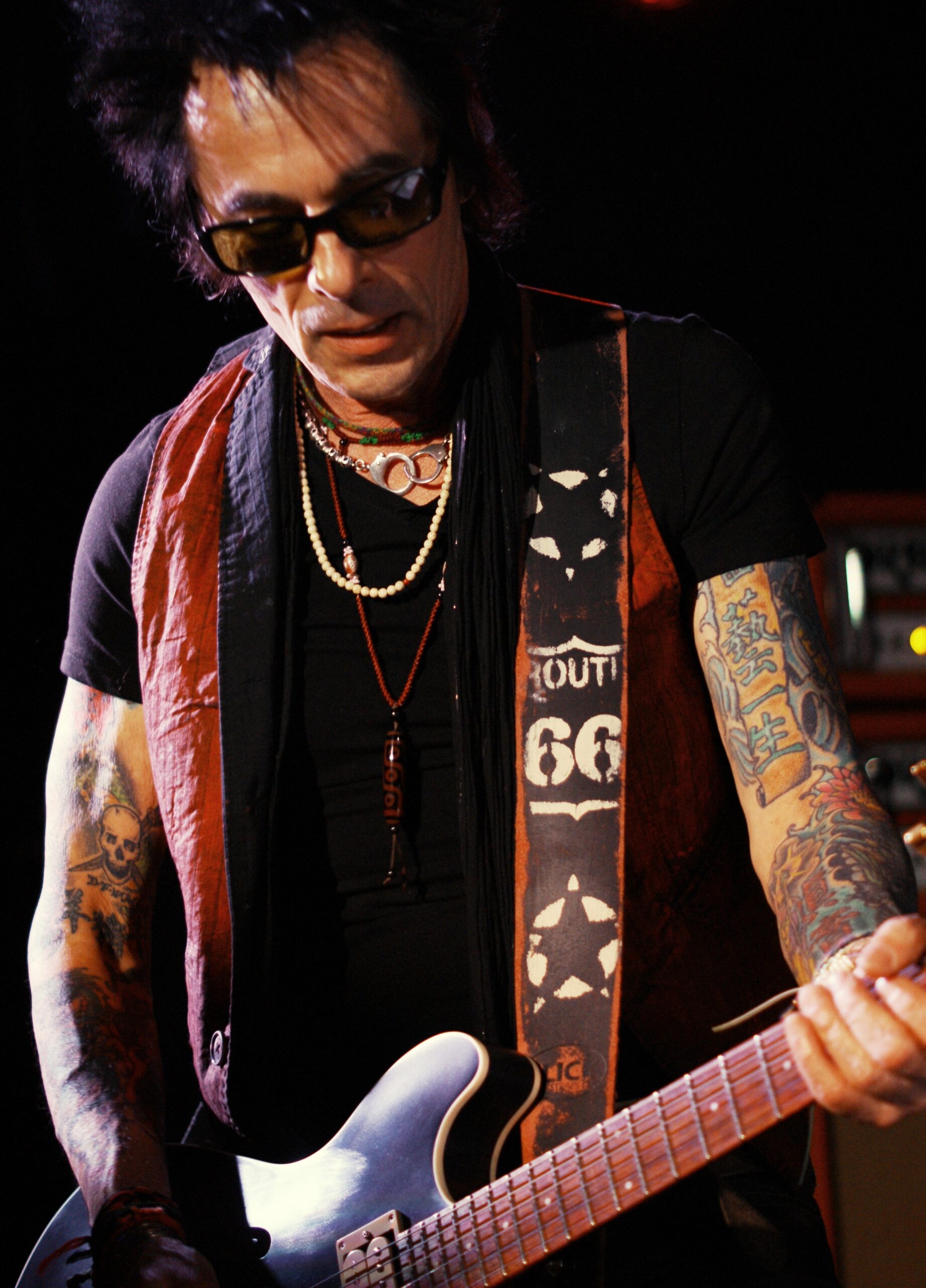
Investigate Earl Slick guitars gear and you find the equipment of one of rock and roll’s most consistently excellent and most stylistically versatile sideman guitarists — a Brooklyn-born musician who served as David Bowie’s primary guitarist across multiple pivotal periods of Bowie’s career, who brought to each association a specific combination of raw guitar power and musical intelligence that served Bowie’s theatrical rock vision with complete authenticity, and who maintained a parallel career of solo recording and band work that documented his guitar range beyond the specific Bowie context. Slick played the guitar with the specific quality of rock and roll conviction — the sense that every note mattered and that the music’s physical impact was as important as its artistic statement — that made him not merely a technically accomplished sideman but a genuine musical partner whose contributions shaped the Bowie recordings he appeared on as directly as any more credited element. His Les Pauls and Stratocasters through Marshall amplification gave him the specific combination of warmth and aggression that served everything from Bowie’s glam rock to his soul-influenced “plastic soul” period and beyond.
This guide covers Slick’s complete equipment picture: the Gibson and Fender guitars that defined his diverse tonal palette, the Marshall amplification that gave his playing its driven rock authority, his effects chain, and the playing philosophy of a musician who understood that the best sideman work was as musically demanding as any solo career and that serving another artist’s vision with complete conviction was an artistic achievement equal to expressing your own. Understanding Earl Slick’s gear is understanding how rock and roll guitar served one of the most theatrically ambitious rock careers in history.
Background
Frank Madeloni was born on October 1, 1952, in Brooklyn, New York. His early musical formation encompassed the full range of rock and roll, blues rock, and the early heavy rock that defined his formative years — the British Invasion, Hendrix, Clapton, the early Rolling Stones — and he developed his guitar approach through the New York metropolitan area music scene before his most significant professional associations.
His first major association with David Bowie came in 1974 for the Diamond Dogs tour — one of Bowie’s most elaborate theatrical productions, a dystopian rock spectacle based loosely on George Orwell’s Nineteen Eighty-Four that featured elaborate staging and Slick’s guitar as one of the primary sonic weapons. He appeared on Bowie’s Young Americans (1975) and Station to Station (1976) albums — two of Bowie’s most musically ambitious and most commercially successful recordings — and subsequently on the 1983 Serious Moonlight tour and the 1990 Sound + Vision tour.
His later career included Bowie’s Reality tour (2003-2004) — one of the most successful arena rock tours of its decade — and work with John Lennon (appearing on the Double Fantasy sessions in 1980), the Phantom Rocker & Slick project, and extensive solo recording work. His career represented one of the more extraordinary accumulations of significant musical associations available in rock and roll, and his guitar work on each association showed the same quality of genuine musical contribution rather than merely professional execution.
Earl Slick Guitars Gear: The Complete Rig
Guitars
Slick’s guitar collection was oriented toward the warm, sustaining instruments that suited his driven rock approach — Gibson and Fender designs that gave him the specific combination of warmth and attack that the theatrical rock context required.
His most associated guitar was a Gibson Les Paul Standard — the mahogany and maple solid body with PAF-spec or later humbucker pickups that had been the definitive hard rock guitar since the late 1960s. The Les Paul’s warm, sustaining humbucker character gave his playing the specific combination of warmth and sustain that served both the melodic passages in Bowie’s music and the more aggressive rock-driving passages. He favoured late-1950s Les Paul Standards — the legendary “Burst” models with PAF pickups that commanded extreme collector prices but were also genuinely superior playing instruments with specific acoustic qualities that later versions didn’t replicate exactly.
He also played a Fender Stratocaster — particularly for the more funk and soul-influenced material on recordings like Young Americans, where the Stratocaster’s single-coil brightness suited the specific musical character of Bowie’s plastic soul period better than the Les Paul’s warmer humbucker character.
Various Gibson SG models appeared for specific applications where the SG’s lighter weight and slightly different tonal character suited the material better than the heavier Les Paul.
A Gibson ES-335 appeared for specific applications where the semi-hollow warmth was more appropriate than either the solid body Les Paul or the Stratocaster’s brighter character.
String gauges were typically medium — .010–.046 or similar — appropriate for the diverse playing styles across the varied Bowie material.
Amps
Slick’s amplification was primarily Marshall — the British EL34 designs that gave his rock guitar playing its specific combination of warmth, power, and driven authority across the theatrical rock contexts he worked within.
His primary amplifiers were Marshall Super Lead heads and later Marshall JCM800 designs — the vintage Plexi character for earlier work and the more gain-accessible JCM800 for the 1980s and later recordings and tours. The specific choice between the two reflected both the specific period of the work and the specific tonal requirements of different Bowie musical contexts — the Plexi’s natural output saturation for the rawer rock material, the JCM800’s preamp gain for the more controlled, cleaner character of specific later work.
He ran the Marshalls into Marshall 4×12 cabinets with appropriate Celestion speakers — the standard professional arena rock configuration that gave the guitar its specific combination of focused projection and acoustic authority in large performance environments.
Various other amplifiers appeared across his diverse career — Fender designs for specific cleaner applications and boutique alternatives for specific recording contexts where different tonal characters were more appropriate.
Effects
Slick’s effects chain was developed and musically motivated — serving the theatrical, dynamic Bowie music with specific tools for specific expressive purposes.
A wah pedal — Vox or Dunlop Cry Baby — for the specifically expressive passages where the vocal guitar quality suited Bowie’s theatrical rock approach. His wah use reflected genuine musical understanding of the effect’s expressive vocabulary rather than habitual deployment.
An Ibanez Tube Screamer or similar smooth overdrive for front-end boost — the standard approach of pushing the Marshall’s natural saturation harder without changing the fundamental EL34 character. His boost approach was consistent with the broader blues rock tradition’s understanding of how to achieve the most musical overdrive character from valve amplification.
A delay pedal for atmospheric depth on specific passages — Bowie’s music frequently used spatial effects for the theatrical dimension of its sound design, and Slick’s delay use served this aesthetic rather than simply adding echo to lead lines.
Various other effects — chorus, flanger, and additional modulation for specific textures in specific Bowie musical contexts where these effects served the overall production aesthetic.
Playing Style & Tone Philosophy
Earl Slick’s playing style was defined by the specific combination of raw rock energy and musical intelligence that made him effective across the theatrical rock contexts he inhabited. His guitar work for Bowie ranged from the driving, riff-based rock of the Diamond Dogs period through the funk and soul-influenced plastic soul passages of Young Americans to the sophisticated rock of Station to Station — each requiring different specific playing approaches and different specific tonal characters, and each served with complete conviction.
His lead playing showed the full range of rock guitar vocabulary — the blues-rooted pentatonic approach, the specific attack quality of someone who had absorbed the British rock guitar tradition through its American interpreters, and the specific theatricality of playing that served a theatrical rock vision without becoming theatrical itself. The guitar’s role in Bowie’s music was always to serve the theatrical and musical vision — to provide the sonic dimension of the theatrical experience rather than to create a parallel guitar narrative that competed with the overall theatrical statement.
His rhythm playing showed the same musical intelligence — voicings chosen for their harmonic appropriateness to the specific Bowie compositions, rhythmic placements that served the groove rather than displaying the guitarist’s rhythmic capabilities, and the overall orientation toward the song’s requirements rather than the guitarist’s preferences.
Tonally, his philosophy was the experienced sideman’s comprehensive philosophy: the right instrument for the specific musical context, the right amplifier for the specific energy level required, and the effects that served the specific production aesthetic. The Les Paul for the heavier rock material; the Stratocaster for the soul and funk-influenced material; Marshall for the driven passages; clean Fender for the more atmospheric passages. Each choice in service of the music rather than of a consistent personal tonal signature.
How to Sound Like Earl Slick
Guitar Approach
A Gibson Les Paul Standard — vintage late-1950s PAF-spec or quality modern reproduction — for the primary rock material. A Fender Stratocaster for the more soul-influenced material. Medium strings (.010–.046). The playing approach requires understanding both the rock and roll tradition of physical commitment and the musical intelligence of serving a theatrical rock vision — the combination of raw power and artistic service that defines the best sideman guitar playing.
Amp Approach
A Marshall Super Lead or JCM800 into a 4×12 cabinet — working volume for natural EL34 saturation. Tube Screamer boost for the most driven passages. The Les Paul’s PAF humbucker output through the Marshall’s natural saturation was Slick’s primary tonal statement for the Bowie rock material.
| Control | Setting | Notes |
|---|---|---|
| Volume (Input 1) | 7–9 | Natural EL34 saturation — Bowie rock territory |
| Treble | 6 | Moderate — Les Paul provides warmth, treble adds presence |
| Middle | 6 | Present mids for rock authority in the theatrical mix |
| Bass | 4–5 | Controlled — Les Paul warmth needs bass management |
| Presence | 5–6 | Moderate definition without harshness |
Influence & Legacy
Earl Slick’s legacy was the specific legacy of a musician whose guitar work on some of the most significant rock recordings of the 1970s and 1980s was as central to those recordings’ specific character as any more credited element — a sideman whose contribution to the music was as musically significant as his professional credit made it appear, and whose decades of sustained professional engagement with some of rock’s most important artists gave him a specific place in the tradition’s history that his public profile has never fully reflected.
His Diamond Dogs period work, his Young Americans and Station to Station contributions, his Serious Moonlight tour, the Reality tour, and his work with John Lennon on Double Fantasy each represented individually significant professional achievements — and together they constituted a career resume of remarkable distinction that placed him alongside the most accomplished sideman guitarists in rock history.
For players exploring the theatrical hard rock and glam rock tradition that Slick served so distinctly, the rigs of Mick Ronson — whose Spiders from Mars work with Bowie showed how the glam rock guitar role had been initially defined before Slick extended it — and Steve Jones, whose Sex Pistols work showed how similar raw rock energy was deployed in a completely different theatrical context, provide illuminating comparison. The Bowie sideman tradition reaches toward Carlos Alomar‘s work, which shows how the same Bowie musical context — some of the same albums — shaped a different specific guitar role and a different specific guitar approach from within the same theatrical rock framework.
Station to Station: The Album Where Slick’s Guitar Was Most Essential
Station to Station (1976) — widely considered one of Bowie’s most musically ambitious and most artistically complete albums — featured Slick’s guitar in perhaps its most central and most musically essential role in any Bowie recording. The album’s specific musical vision — the combination of European art rock, Krautrock influence, soul, and Bowie’s “Thin White Duke” theatrical persona — created a musical context that required a specific guitar approach: powerful enough to drive the rock passages with genuine authority, restrained enough to serve the atmospheric passages without overwhelming them, and intelligent enough to navigate the specific harmonic language of arrangements that moved between funk grooves and extended art rock passages within single songs.
The title track — the album’s ten-minute opening piece — showed Slick’s guitar at its most complete and most musically sophisticated: the specific way the guitar built from the quiet opening through the progressively more intense middle section to the explosive climax, serving the song’s structural arc rather than maintaining a consistent energy level throughout. The Les Paul’s sustaining warmth was appropriate for the extended passages where the guitar needed to maintain a presence over long durations; the Marshall’s natural EL34 saturation at working volume gave the explosive passages their specific driven authority; and the overall playing showed a musician who understood the difference between serving a piece of music and performing within it.
The guitar tones on Station to Station — captured at Cherokee Studios in Los Angeles with the production team of David Bowie and Harry Maslin — showed the specific quality of recorded guitar that the album’s production required: warm, present, and alive in the mix without the clinical quality of over-produced studio guitar. The Les Paul through the Marshall, captured with appropriate microphone placement and appropriate acoustic environment, gave the recordings the specific character of genuine rock guitar in a genuine performance environment rather than an elaborate production construct.
Diamond Dogs: Theatre Meets Rock Guitar
The Diamond Dogs period — Slick’s first major Bowie association, beginning with the 1974 tour that gave the album its theatrical staging — showed his guitar work in the most explicitly theatrical context of his Bowie career. Understanding what this theatrical context demanded from the guitar gives a more complete picture of what Slick’s specific musical capabilities brought to the association.
The Diamond Dogs tour’s specific theatrical staging — the elaborate set pieces, the hydraulic cherry picker, the theatrical costume design, and the overall dystopian science fiction visual environment — created specific acoustic and musical requirements for the guitar. In a theatrical context where the music served a visual and narrative purpose as well as a purely musical one, the guitar’s specific role was to provide sonic character that reinforced and enhanced the theatrical statement rather than merely providing musical satisfaction independent of the theatrical context.
Slick’s Les Paul through the Marshall served this theatrical requirement with specific appropriateness: the warmth and sustain of the Les Paul giving the guitar passages their quality of dramatic weight, and the Marshall’s natural saturation at working volume giving the more aggressive passages their specific quality of physical force that suited the dystopian theatrical context. The guitar was not merely accompanying the theatrical production; it was as much a part of the theatrical experience as the visual elements, providing sonic character that was as deliberately designed for theatrical effect as any costume or stage set element.
Young Americans: From Glam to Soul
The Young Americans album represented Bowie’s most explicit engagement with American soul music — a deliberate stylistic shift from the European art rock and glam rock of the preceding albums toward the Philadelphia soul sound of the mid-1970s. Slick’s guitar adaptation to this specific musical context — shifting from the Les Paul’s heavier rock character to the Stratocaster’s brighter, more appropriate-for-soul character — showed the instrumental flexibility that made him effective across Bowie’s diverse musical territory.
The specific Philadelphia soul context — Sigma Sound Studios, the classic Philadelphia International Records sound, the specific rhythm section of drum kit, bass, and multiple keyboard instruments that gave Philadelphia soul its characteristic wall-of-sound warmth — required a guitar approach that was quite different from the rock guitar role of the Diamond Dogs period. The guitar in soul music typically served a more rhythmic and textural role than in rock — providing specific funk and rhythm contributions that served the groove rather than providing the melodic and harmonic foundation that rock guitar typically occupied.
Slick’s Stratocaster through appropriate cleaner amplification for the soul material gave the guitar its specific character of bright, rhythmic definition that suited the Philadelphia soul context better than the heavier Les Paul-and-Marshall combination. The specific adaptation — instrument change, amplifier approach change, playing style change — to serve the different specific musical tradition was as complete a demonstration of his musical intelligence as his rock guitar work, showing that his versatility was genuine rather than superficial.
The John Lennon Connection: Double Fantasy
Slick’s appearance on John Lennon’s Double Fantasy sessions in 1980 — the album that marked Lennon’s return to recording after a five-year hiatus — gave him a specific connection to one of rock history’s most significant and most emotionally weighted recordings. Understanding the context of the Double Fantasy sessions and what Slick’s guitar contributed gives a more complete picture of his professional range beyond the specific Bowie context.
Double Fantasy was recorded at the Hit Factory in New York during the summer and autumn of 1980, with Lennon and Yoko Ono working with producer Jack Douglas on a double album that alternated Lennon songs with Ono songs. The album’s musical character — polished pop rock with specific production values of the early 1980s — was different from both the Bowie theatrical rock and the raw rock and roll of Lennon’s earlier recordings, requiring a guitar approach that served the specific production aesthetic of the sessions.
Slick’s guitar on the album served this production aesthetic with the same professional intelligence that characterised his Bowie work — the right tonal character for the specific material, the right playing approach for the specific production context, and the overall orientation toward service of the recording’s specific musical and artistic requirements. The Les Paul’s warmth gave the heavier passages their appropriate guitar character; the cleaner approach gave the more pop-oriented material its appropriate bright definition. The Double Fantasy sessions showed Slick functioning in a completely different creative environment from the Bowie context, and his ability to serve Lennon’s specific musical vision with the same quality of professional conviction showed the breadth of his professional musical intelligence.
Earl Slick’s complete career — from the Brooklyn beginning through the Diamond Dogs association, the Station to Station contribution, the plastic soul period, the extended return to Bowie in the 1980s, the Lennon sessions, and the sustained professional activity across four decades of significant rock and roll — was one of the more extraordinary collections of significant professional associations available in rock guitar history. The equipment he used: the vintage Les Paul Standards through the Marshall’s natural EL34 saturation, the Stratocasters for the soul and funk contexts, the effects chain serving the specific theatrical and production aesthetics of each specific association — was always in service of a musical vision larger than any single guitar player’s personal expression, and serving that larger vision with complete conviction was itself the most significant artistic achievement of his career. The gear served the music; the music served the vision; and the vision produced some of rock and roll’s most significant and most theatrically ambitious recordings.
The late-1950s Les Paul Standard’s specific acoustic properties — the “Burst” models with their specific combination of mahogany body, carved maple top, and PAF humbucking pickups — and why Slick favoured these specific instruments over later Les Paul versions or contemporary reproductions, reflected genuine acoustic understanding of what distinguished the original “Burst” instruments from alternatives. The PAF humbucker in the late-1950s context was wound with Alnico II or Alnico V magnets (variations between examples were common even from the same production period) and with specific wire gauges and winding densities that gave it a specific combination of output level and frequency response that later patent-number humbuckers and subsequent production variations didn’t exactly replicate. The mahogany body’s specific grade and the maple top’s specific acoustic properties — which varied significantly between individual instruments even from the same production year — combined with the PAF’s specific electrical characteristics to give the best Burst instruments a specific quality of harmonic richness and tonal warmth that was genuinely different from later production’s more consistent but somewhat less characterful output. Slick’s preference for these specific vintage instruments reflected both the collector’s awareness of their market value and the working musician’s genuine appreciation for their specific acoustic virtues — the warmth, the sustain, and the specific harmonic complexity that gave the Les Paul Burst its specific tonal character.
The Mick Ronson comparison — the guitarist whose Spiders from Mars work with Bowie had defined the glam rock guitar role before Slick extended it — illustrated both what Slick inherited from the Bowie guitar tradition and what he brought to it that Ronson’s approach hadn’t provided. Ronson’s guitar work with Bowie from The Man Who Sold the World through Aladdin Sane and Pin Ups was characterised by a specific combination of heavy, sustaining Les Paul warmth, melodic sophistication that drew on both classical music training and rock and roll vocabulary, and a specific theatrical quality of playing that served Bowie’s glam rock persona with complete conviction. Slick’s approach — when he took over the Bowie guitar role for the Diamond Dogs period — maintained the Les Paul-centred warmth of the Ronson tradition while bringing a different specific energy: rawer, more rock and roll in the traditional sense, less melodically ornate than Ronson but with a specific quality of forward rock momentum that served the darker, more dystopian character of the Diamond Dogs material.
The Reality tour (2003-2004) — Slick’s most recent major Bowie tour at the time of Bowie’s decision to withdraw from touring following a health crisis in 2004 — documented his guitar work in the most contemporary and most fully developed context of his Bowie career. By this point, nearly three decades of professional association with Bowie had given him a specific musical knowledge of Bowie’s musical values and performance approach that no amount of technical preparation could have produced without the shared experience of those decades. His guitar in the Reality tour shows showed a musician whose playing served Bowie’s specific theatrical rock vision from the inside — through genuine knowledge of the vision and genuine musical empathy with its specific requirements — rather than from the outside through professional execution of specified guitar parts. This quality of musical empathy — developed through decades of shared musical experience — was as much a professional achievement as any specific technical capability, and it was the quality that made the Reality tour’s guitar work as distinguished as any of the earlier Bowie periods despite the decades of elapsed time and the changed musical landscape.
The Phantom Rocker and Slick project — Slick’s primary extra-Bowie association, with drummer Slim Jim Phantom of the Stray Cats — gave his guitar work a context that was simultaneously more straightforward rock and roll and more personally expressive than the Bowie sideman role had allowed. The duo’s specific approach — stripped-down, physical, direct — allowed Slick’s guitar the kind of prominent feature role that the more elaborate Bowie theatrical context had rarely provided, and the resulting music showed the full range of his rock and roll guitar capabilities in a context where his personal musical vision was the primary subject rather than a supporting element of someone else’s larger theatrical statement. The equipment for the Phantom Rocker context — similar Les Paul and Marshall fundamentals as the Bowie work — was in service of a different specific musical purpose: not theatrical rock statement but direct, physical rock and roll playing where the guitar was the primary voice and the playing’s physical commitment was the primary aesthetic value.
The Brooklyn origin of Slick’s musical formation — and how the specific New York musical culture of the late 1960s and early 1970s shaped his approach — gave his rock and roll a specific urban directness that distinguished it from the more regionally rooted Southern rock or the more specifically British character of the English glam rock tradition he subsequently served. New York in the early 1970s was simultaneously the centre of glam rock’s American expression (the New York Dolls, Lou Reed’s post-Velvet Underground work), the home of the blues rock that had filtered through the British blues boom into the American rock mainstream, and the crucible of the proto-punk that would reshape rock in the late 1970s. Slick absorbed all of these New York influences alongside the broader British rock guitar tradition — Clapton, Beck, Page — that had been the primary guitar education for serious rock musicians of his generation, and the combination gave his playing its specific quality of urban directness combined with British rock guitar technique.
The Guitar work on Station to Station‘s “TVC 15” — one of the more musically unusual tracks on an already unusual album — showed Slick’s ability to serve music that moved outside conventional rock guitar contexts with the same conviction he brought to the more straightforwardly rock material. “TVC 15” was built on a New Orleans-influenced groove with a theatrical science fiction theme, requiring guitar work that served the groove without imposing rock guitar conventions that would have been inappropriate for the specific musical character. Slick’s guitar on the track showed genuine musical understanding of what the groove required — the rhythmic placement, the tonal character, and the overall orientation toward the music’s specific personality — rather than merely applying his rock guitar vocabulary regardless of context. This specific quality of musical adaptation — not merely technical versatility but genuine musical intelligence about what each specific context required — was as central to his contribution to the Bowie recordings as any specific guitar technique or equipment choice.
The specific relationship between the Les Paul’s PAF humbucker output and the Marshall Super Lead’s gain characteristic — at the specific operating point where Slick typically set his volume — was the foundation of the specific guitar tone that appeared on the Bowie recordings of the Station to Station era. The PAF humbucker’s output level (approximately 7.5k to 8.5k ohms DC resistance for the original Gibson examples) drove the Marshall’s preamp input to a specific point in the amplifier’s gain structure that placed the operating point in the natural transition zone between the clean linear range and the beginning of preamp saturation. At this specific operating point, the amplifier’s response was both warm (from the beginning of natural compression and harmonic enrichment) and clear (the harmonic content not yet so complex that individual note definition was obscured). The EL34 output stage added its own specific compression and harmonic content at the working volume levels of arena performance, giving the overall amplified guitar sound its specific character of warm, harmonically rich, naturally sustained tone that was the primary sonic identity of Slick’s work on these recordings.
The Carlos Alomar comparison — Alomar being the rhythm guitarist who anchored the Bowie band across many of the same albums and tours where Slick appeared — illustrated the specific division of guitar roles within the Bowie ensemble and how Slick’s lead and feature guitar work related to Alomar’s rhythm contribution. Alomar’s guitar approach — rooted in his studio session musician background and his specific understanding of how rhythm guitar served sophisticated pop and rock productions — was fundamentally different from Slick’s rock lead guitar approach: more harmonically specific, more rhythmically precise, and more consistently in service of the groove and the chord structure. The two guitars in the Bowie ensemble context served completely different musical purposes, and understanding both of them together gives the most accurate picture of how the guitar was deployed in the Bowie musical framework. Slick’s lead guitar was the expressive, dramatic element; Alomar’s rhythm guitar was the structural, harmonic foundation. Together they gave the Bowie ensemble its specific guitar character — more complete and more musically sophisticated than either dimension alone could have provided.
Earl Slick’s sustained professional relationship with David Bowie — spanning nearly three decades from the 1974 Diamond Dogs tour through the 2003-2004 Reality tour — was one of the more extraordinary musician-to-musician relationships in rock and roll history. The specific quality of musical trust and mutual understanding that sustained this relationship across so many years — through the different musical periods, the different stylistic territories, and the different personal and professional circumstances — reflected both Slick’s consistent professional quality and Bowie’s specific recognition of the musical value that Slick brought to each association. The equipment that served this relationship across all those years — the Les Paul warmth, the Marshall authority, the Stratocaster flexibility for different specific musical contexts — was consistent in its fundamental character even as it adapted to the different specific requirements of different specific Bowie musical periods. The gear was right for the music; the music was right for the relationship; and the relationship was one of rock and roll history’s more quietly distinguished sustained professional partnerships.
The specific way the Gibson Les Paul Standard’s maple top contributed to Slick’s specific tonal character — and how the maple’s acoustic properties complemented the mahogany body’s warmth — was one of the more interesting and less commonly discussed dimensions of the Les Paul’s acoustic character. The maple cap’s specific hardness and density, carved into the distinctive arched shape that gave the Les Paul its visual identity, added a specific quality of brightness and attack definition to the mahogany body’s warmth — the harder maple resonating at slightly higher frequencies than the softer mahogany and giving the combined instrument’s acoustic character the specific combination of warm, full low-midrange (from the mahogany) and present, articulate upper-midrange (from the maple). This specific tonal combination — warm but articulate, full but defined — was as central to the Les Paul Standard’s character as the PAF humbucker’s electrical properties, and together they produced the specific acoustic signature that had made the instrument the defining choice for hard rock and blues rock guitar since the British Invasion brought it into mainstream rock’s consciousness. Slick’s consistent preference for the Les Paul Standard — and particularly the vintage “Burst” examples with their specific grade of materials and their specific PAF pickup character — reflected genuine appreciation for this specific combination of acoustic properties and why it served his specific musical purposes more completely than alternatives.
The wah pedal’s role in Slick’s Bowie work — deployed selectively for the passages where the vocal guitar quality suited the theatrical rock context — was as much a theatrical tool as a musical one in the specific Bowie performance context. The wah’s ability to give guitar notes a quality of vowel-like vocal articulation — the consonant-vowel approximation of the filter movement through the frequency spectrum — was particularly appropriate in a theatrical context where the guitar was understood as one voice within a multi-voice theatrical statement. Bowie’s theatrical approach had always treated the performers and their instruments as voices in a collective theatrical statement, and the guitar’s specifically vocal quality when played through the wah was as much a contribution to the theatrical performance’s vocal dimension as a purely musical effect. Slick’s understanding of this theatrical dimension of the wah’s expressive vocabulary — and his selective use of it for moments where this theatrical vocal quality was most appropriate — showed genuine theatrical intelligence alongside genuine musical intelligence, reflecting his complete integration into the specific theatrical rock vision that made Bowie’s performances so distinctive.
The Sound and Vision tour (1990) — Bowie’s retrospective tour that revisited his back catalogue without new material — gave Slick’s guitar the specific challenge of serving music that had originally been recorded with different specific players and different specific guitar approaches, and making those performances convincingly live without merely copying the original recordings. This specific challenge — recreating the essence of diverse recorded performances in a live context with different equipment and different specific circumstances — required the same comprehensive musical intelligence that had always characterised Slick’s approach to the Bowie work. The Les Paul’s warmth served the Station to Station-era material; the Stratocaster served the soul-influenced Young Americans passages; and the Marshall’s versatility through its different gain structures served the full dynamic range of a retrospective tour that encompassed three decades of Bowie’s musical evolution. His ability to serve this retrospective with complete musical conviction across all the different specific Bowie periods it revisited was as demanding a professional achievement as any individual studio recording, and it showed the full breadth of his comprehensive knowledge of the Bowie musical legacy.
Frequently Asked Questions: Earl Slick Guitars & Gear
What guitars does Earl Slick play?
Earl Slick’s primary guitars include Gibson Les Paul Standards (particularly late-1950s vintage examples with PAF pickups for the primary rock material), Fender Stratocasters (for soul and funk-influenced material), Gibson SG models, and Gibson ES-335. His diverse instrument collection reflected the musical range of the Bowie material and his broader solo and sideman work across different musical contexts.
What amp does Earl Slick use?
His primary amplifiers are Marshall Super Lead heads (vintage Plexi designs for the natural EL34 output saturation character) and Marshall JCM800 (for the 1980s and later work). He runs into Marshall 4×12 cabinets. His consistent use of Marshall amplification reflected both the authentic character of the hard rock and glam rock tradition and the specific tonal requirements of the Bowie theatrical rock context.
When did Earl Slick first work with David Bowie?
Slick first worked with Bowie for the Diamond Dogs tour in 1974 — one of Bowie’s most elaborate theatrical productions. He subsequently appeared on Young Americans (1975) and Station to Station (1976) albums, the Serious Moonlight tour (1983), the Sound + Vision tour (1990), and the Reality tour (2003-2004). His multiple returns to the Bowie context across three decades showed the mutual respect and genuine musical compatibility that sustained the long professional relationship.
What was Earl Slick’s contribution to Young Americans?
Young Americans (1975) was Bowie’s “plastic soul” album — a deliberate engagement with American soul and funk music recorded at Sigma Sound Studios in Philadelphia with a roster of Philadelphia soul session musicians. Slick’s guitar on the album bridged the gap between Bowie’s rock persona and the soul musical context, providing guitar work that served the soul aesthetic without abandoning the rock guitar sensibility. The Stratocaster’s single-coil character was more appropriate for the soul material than the Les Paul’s warmer humbucker, and his playing on the album showed the instrumental flexibility that made him effective across Bowie’s diverse musical territory.
What effects does Earl Slick use?
His key effects include a wah pedal (for expressive passages in the theatrical rock context), an Ibanez Tube Screamer in boost mode (front-end drive for the Marshall), delay (for atmospheric depth in specific Bowie productions), and various modulation effects (chorus, flanger) for specific textural requirements. His effects use was always in service of the specific production aesthetic of the Bowie work rather than of a consistent personal tonal signature.
What was the Double Fantasy connection?
Slick appeared on John Lennon’s Double Fantasy sessions in 1980 — the album that marked Lennon’s return to recording after a five-year hiatus and that was released just weeks before his assassination. His guitar contributions to the Double Fantasy sessions gave him a specific connection to one of rock history’s most significant and most tragic recordings, and the specific quality of his contributions to those sessions showed the same musical intelligence and professional conviction that characterised his Bowie work.
What was the Diamond Dogs tour?
The Diamond Dogs tour (1974) was one of David Bowie’s most elaborate theatrical productions — a massive arena tour built around the Diamond Dogs album’s dystopian science fiction themes, featuring elaborate stage sets including a hydraulic cherry picker that lifted Bowie above the stage. The tour’s theatrical ambition was unprecedented in rock at the time, and Slick’s guitar was one of the primary sonic elements that gave the theatrical production its specific rock power.
Genre:
Hard Rock / Glam
Decades:
1970s | 1980s | 1990s | 2000s
Related stories
Vernon Reid Guitars & Gear: The Complete Guide to Living Colour’s Guitar Genius’s Rig
Vernon Reid's guitars, amps, and effects — the complete guide. Parker MaxxFly, PRS Vela VR, Mesa Dual Rectifiers, Roland VG-99, Eventide H9, Living Colour gear guide.
Warren DeMartini Guitars & Gear: The Complete Guide to Ratt’s Torch Guitarist’s Rig
Warren DeMartini guitars & gear: Ratt's Torch guitarist. Charvel Bomber, snakeskin, Jose-modded Plexi, Fender Super Champ, RTM pickup, slapback echo — the complete rig.
Warren Haynes Guitars & Gear: The Complete Guide to Gov’t Mule’s Guitar Master’s Rig
Warren Haynes' guitars, amps, and effects — the complete guide. Gibson Les Paul Chester, Soldano SLO-100 modified, Klon Centaur, Emma Discombobulator, and how to nail that Gov't Mule blues-rock tone.