
Gear Timeline
There is a chord. You know it before it finishes ringing. A single chord in a specific guitar tuning through a specific combination of amplifiers, and before the verse has started you know exactly who is playing and you know that whatever comes next will matter. The Smiths, 1983-1987: four studio albums and an extraordinary run of singles that redefined what independent guitar music could be, what it could say, and how it could say it. And at the center of all of it — every arrangement, every interlocking guitar part, every perfectly placed riff and harmonic idea — was a kid from Manchester named Johnny Marr who had spent his entire teenage life becoming one of the finest guitar players his generation would produce.
What Marr achieved with The Smiths was not loudness, not technical display, not the kind of guitar heroism that fills arenas with the smell of pyrotechnics. It was something rarer and, in its way, more difficult: complete harmonic and rhythmic service of the song. His guitar parts — always melodic, always busy without being cluttered, always advancing the arrangement rather than competing with it — gave Morrissey’s uniquely tortured and funny lyrics the exact musical environment they required. The guitars chimed, jangled, arpeggiated, shimmered through chorus, swelled with tremolo, and occasionally — on “How Soon Is Now?” specifically — became something so atmospheric and singular that it transcended the category of guitar playing entirely and became a sound event.
Born in Ardwick, Manchester, on October 31, 1963 — Halloween, which is either irrelevant or extremely appropriate — John Martin Maher (he anglicized the surname to Marr to avoid confusion with The Buzzcocks’ drummer, also John Maher) grew up in a working-class Irish immigrant family where music was constant and serious. He got his first guitar at seven, started gigging locally in his early teens, and formed The Smiths with Morrissey in 1982 after knocking on the singer’s door in Stretford with a specific and fully-formed musical vision. He was eighteen years old. The Smiths were critically acclaimed within months, globally influential within years, and among the most important British bands of the twentieth century by the time they dissolved in 1987.
His gear — the guitars, the amps, the effects chain that produced those specific sounds — has been documented with unusual thoroughness for a player of his modesty about self-promotion. Marr is an equipment obsessive who has written extensively about his instruments, published a book (Marr’s Guitars) cataloguing his collection, and given detailed interviews about specific setups on specific recordings. He is, in the guitar world’s parlance, a gear nerd — which is appropriate, because understanding his tone requires specific knowledge about specific instruments used in specific ways, and that knowledge is worth having.
He left The Smiths in 1987, has collaborated with an extraordinary range of subsequent artists (The The, Modest Mouse, The Pretenders, The Cribs, Electronic, solo work, and more), and remains one of the most revered and actively working guitar players in British music. He is sixty-one years old. He still sounds, unmistakably, like himself.
Background: Manchester, Morrissey, and the Making of a Guitar Legend
The Manchester of Johnny Marr’s childhood and adolescence was not the tourist-destination, music-capital city it has since become. It was post-industrial, economically difficult, and culturally alive in the specific way that difficult circumstances sometimes produce cultural ferment. Marr’s parents were Irish immigrants who had moved to England with the wave of migration that followed the economic difficulties of mid-twentieth-century Ireland. The family settled in Ardwick and later Wythenshawe, working-class areas of Manchester where music was part of the social fabric of immigrant community life.
Marr received his first guitar at seven — a cheap but real instrument — and began the obsessive relationship with the instrument that would define his life. By his early teens he was playing in local Manchester bands, absorbing influences with the comprehensive appetite of someone who understood intuitively that breadth of musical knowledge was a resource rather than a distraction. He listened to Keith Richards and Bowie, to Nile Rodgers and the funk tradition, to reggae, to Northern Soul, to the rock and roll canon and the emerging post-punk scene simultaneously. He did not choose between these influences — he synthesized them into an approach that was eclectic without being incoherent, sophisticated without being academic.
The meeting with Morrissey in 1982 was not accidental. Marr had been asking around Manchester’s music scene about writers who could supply lyrics for the music he was hearing in his head, and Morrissey — a music obsessive living with his mother, writing essays about forgotten pop stars and compiling an extraordinary internal library of mid-century popular culture — was the name that kept coming up. Marr knocked on his door in Stretford with a complete musical vision: a guitar-based band that would sound like nothing else in British pop. Morrissey opened the door. The Smiths began.
The band’s rise was rapid by any standard and particularly so by the standards of the post-punk independent scene. Rough Trade Records signed them in 1983; “Hand in Glove” was the first single; by the end of 1983, with “This Charming Man” and “What Difference Does It Make,” The Smiths were the most important new band in British music. The guitar sound — Marr’s jangle, the Rickenbacker brightness, the Fender Twin’s clean power, the chorus layers — was immediately recognizable and immediately influential. Every indie band in Britain immediately adjusted what they were doing.
The Smiths’ catalog produced four studio albums — The Smiths (1984), Meat Is Murder (1985), The Queen Is Dead (1986), Strangeways, Here We Come (1987) — and a body of singles that stand among the finest examples of pop songwriting in the British tradition. Marr wrote all the music; Morrissey wrote all the words. The combination was, as long as it lasted, one of the most creatively productive partnerships in rock history. When Marr left in 1987 — unable to continue under the pressures of the partnership’s creative and personal dynamics — the band dissolved. There has never been a reunion, despite periodic speculation and occasional public disagreement between the principals about why not.
His post-Smiths career has been, by any measure, remarkable: Electronic (with New Order’s Bernard Sumner), The The (with Matt Johnson), Modest Mouse, The Pretenders, The Cribs, solo albums (The Messenger, Playland, Call the Comet, Fever Dreams Pts 1-4), session work for Billie Eilish, Hans Zimmer, Noel Gallagher, and others. He has remained, through all of it, primarily a guitarist — not a frontman, not a celebrity, but a craftsman whose guitar playing is the constant in an otherwise varied career trajectory. The guitars have changed somewhat. The sound has evolved. The fundamental approach — harmonic intelligence, melodic richness, rhythmic precision, emotional directness — has not changed at all.
The Rig: Johnny Marr’s Guitars, Amps, and Effects
Johnny Marr’s gear history is unusually well-documented for a British indie guitarist of the 1980s, in part because he is both a guitar enthusiast who collects and preserves his instruments and a communicative interviewee who has discussed specific setups on specific recordings with unusual precision. What follows draws on his own accounts as well as the documentary record.
Guitars
Marr bought his first Rickenbacker 330 at A1 Repairs on Oxford Road in Manchester with money from The Smiths’ first Rough Trade advance. It became the sound of The Smiths’ debut album and the early single period — the guitar on “What Difference Does It Make,” “Reel Around the Fountain,” and most of the debut album. In his own words: “This is my 1983 Black Rickenbacker 330 that I used throughout The Smiths. I got it from A1 Repairs on Oxford Road in Manchester and it was my main guitar at all the early gigs. It’s the sound of the riff on ‘What Difference Does It Make’ and ‘Reel Around The Fountain’, all of the first album and on other albums too.” He noted that it was a difficult guitar that he specifically chose because he wanted to challenge himself: “He bought the Rickenbacker in an attempt to make himself a better songwriter, the ‘Rick’ being known as a difficult guitar to play.” The guitar had Grover tuners — unusual for a 330, which typically came with Kluson-style units. He retired it from live use in early 1985, though it was later used by Craig Gannon (The Smiths’ temporary second guitarist in 1986).
The Rickenbacker 330’s tonal character — the specific “jangle” associated with The Smiths’ early period — comes from its Rick-O-Sound stereo wiring capability, its bright single-coil pickups (which, in the post-1970s models Marr used, had higher-gain single-coil pickups different from the vintage Rick sound), and the resonant semi-hollow body construction. Run through a combination of Fender Twin and Roland JC-120, the Rickenbacker produced the ringing, chimey, slightly compressed sound that defined indie rock’s sonic palette for the following decade. Every British indie band of the 1985-1995 period either owned a Rickenbacker or wanted one primarily because of what Marr did with it.
The revelation that most people don’t know about The Smiths’ sound is that the Rickenbacker they associate with Marr was often not what they were actually hearing. Producer John Porter’s 1954 Fender Telecaster was the guitar on numerous classic Smiths recordings — including “This Charming Man,” which most listeners assume to be a Rickenbacker. Marr himself confirmed this: “A lot of ‘The Smiths’ was actually recorded with a ’54 Telecaster belonging to John Porter. I used a Rickenbacker 360 12-string as well, and that was the guitar which subsequently got all the attention, but in fact it was mainly the Tele, and a bit of Les Paul. ‘This Charming Man’ was the first record where I used those highlife-sounding runs in 3rds. I’m tuned up to F# and I finger it in G, so it comes out in A. There are about 15 tracks of guitar. People thought the main guitar was a Rickenbacker, but it’s really a ’54 Tele.” Porter himself confirmed: “I brought in the refin, and Johnny really loved it. So every record I did with the Smiths, on every single song, most of the chiming Rickenbackers are in fact the Tele!”
The tuning approach Marr used on “This Charming Man” is worth noting: tuned up to F#, fingering the shapes in G, which transposes to an A-based sound. This unconventional tuning raised the string tension and changed the harmonic character of the guitar — a deliberately calculated decision to achieve a specific tonal result rather than playing in standard tuning. The approach of tuning up to achieve brighter, tauter string response was a regular tool in his arsenal.
Marr acquired this semi-hollow body Gibson — the more upmarket sibling of the ES-335, with stereo capability and a Varitone circuit — around the time of “Heaven Knows I’m Miserable Now” and “Girl Afraid.” He wrote both songs on the day he got the guitar. The ES-355’s combination of warmth, sustain, and the Varitone’s tonal options gave him a different palette from the Rickenbacker’s brightness — the “Girl Afraid” intro, for example, has a more rounded, sustained quality that differs from the jangle of the earlier singles. The Varitone circuit — which the Mixdown Magazine rundown noted “introduces a top-end roll off or EQ changes before the guitar’s output” — gave Marr additional tonal flexibility within a single guitar. The guitar also had stereo capabilities that he explored in recording applications.
For The Smiths’ US and UK tours of 1986, Marr used a 1963 L-Series Fender Stratocaster — the three single-coil pickup configuration giving him access to a wider tonal range on stage than the Les Paul or Rickenbacker. He was deliberately expanding his sonic vocabulary for live performance, and the Strat’s versatility — from the bright bridge pickup’s crisp attack to the neck pickup’s warmth to the characteristic “out of phase” quack of the in-between positions — suited the wide range of material in The Smiths’ set by that point.
For the Meat Is Murder live period and subsequent touring, Marr moved away from the Rickenbacker to a harder, heavier Les Paul-based sound. Les Paul models — both vintage and custom versions — gave him more sustain and a different attack character suited to the heavier material. He described the approach directly: the Les Paul provided “a more direct, heavier sound” for the live context. He used both a Les Paul Custom and standard models, including a Roger Giffin-built custom Tele-type guitar with a green quilted-maple finish that also saw use in this period.
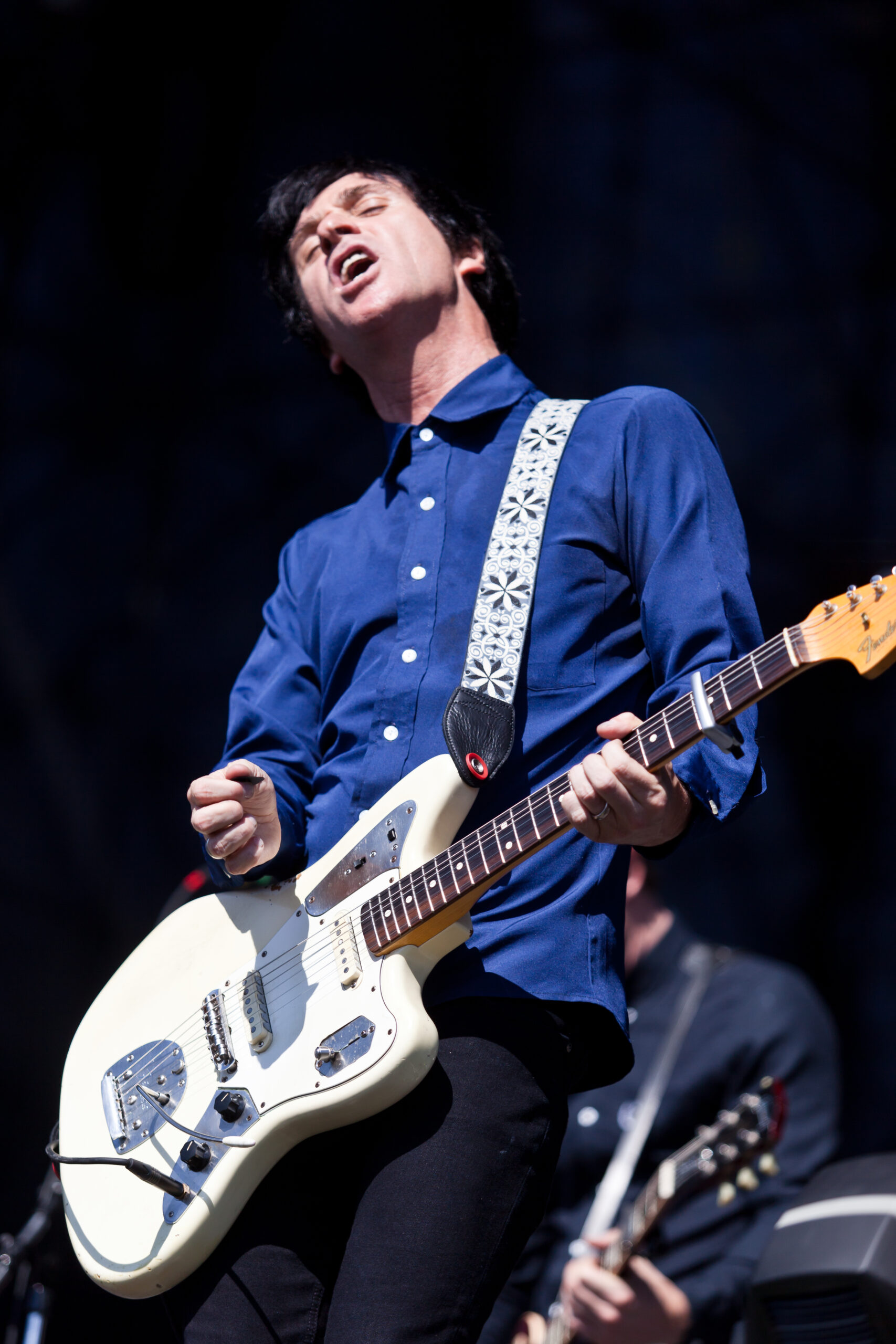
If the Rickenbacker defines the early Smiths sound, the Fender Jaguar defines Johnny Marr’s post-Smiths and solo career identity. The Jaguar’s offset body, dual-circuit electronics, and rhythm/lead switching system offered the flexibility that his increasingly varied post-Smiths work required. The jangle that the Rickenbacker provided was approximated by the Jaguar’s single-coil pickups and the particular resonant character of the offset body construction, but with improved playability — the Rickenbacker, as Marr acknowledged, was a difficult instrument. Fender eventually produced the Johnny Marr Signature Jaguar, based on his preferred specifications: specific neck profile, Mustang bridge saddles (an upgrade from the traditionally noisy Jaguar bridge), and the tonal combination that suited his evolved playing approach. The Jaguar with upgraded saddles became his primary touring and recording guitar for much of the 2000s and 2010s.
One of the more romantically significant instruments in Marr’s collection: a 1964 Rickenbacker 360/12 twelve-string that had previously belonged to Pete Townshend. The harmonic saturation of twelve strings — each string doubled with a string tuned an octave higher — added an additional dimension to his chord voicings and arpeggiated runs during The Smiths’ middle period. He used it on “The Headmaster Ritual” while “attempting to channel George Harrison” — the Harrison connection to Rickenbacker twelve-string being the specific inspiration.
Confirmed in Marr’s own account of the “How Soon Is Now?” recording, a 1963/4 Epiphone Casino was used in the creating of the song’s famous tremolo guitar atmosphere alongside the Twin Reverbs. The Casino’s fully hollow body — producing a particularly warm, resonant character — contributed to the unique sonic character of that specific record.
For his work with Modest Mouse — specifically writing and recording “Satellite Skin” — a Gretsch Country Gentleman built for him in 2008 was the primary instrument. The Country Gentleman’s Filter’Tron pickups and hollow body produced the clean, slightly twangy, full-frequency character suited to the Modest Mouse material’s more expansive sonic palette.
Amps
The foundational amplifier of The Smiths’ sound was a Fender Twin Reverb — initially the Silverface version (the later, post-1967 cosmetic revision of the Blackface circuit) that Marr used for the debut album and early tours. The Twin Reverb’s two 12-inch speakers, 85-100 watts of 6L6 tube power, and the particular clean, bright, reverb-rich character of the Fender American design gave the Rickenbacker and Telecaster their specific recorded quality. The Twin was large enough to provide clean headroom at significant volume without breaking up — crucial for maintaining the clarity and definition of complex, layered guitar arrangements.
The dual-amp setup that defines The Smiths’ live sound combined the Fender Twin’s warmth and power with the Roland JC-120’s crystalline top-end clarity and built-in stereo chorus. Marr’s description of this combination is precise: “With my amp setup, the Rickenbacker’s just perfect as it goes through a Fender twin and a JC120. The Fender twin has got loads of power, and that handles the bottom to mid range. The Fender has also got the best reverb, so I just let the Roland handle the top end most of the time; it’s a dream and sounds great.” This division of tonal labor — Fender for warmth and power, Roland for sparkle and chorus — produced the full, three-dimensional guitar sound that characterized The Smiths’ live recordings and sound check tapes.
For The Queen Is Dead and Strangeways, Here We Come, Marr upgraded to a Blackface Twin — the earlier, more tonally sophisticated circuit — which became his primary studio amp. He has noted: “My Blackface Twin was used from the Queen Is Dead onwards.” The Blackface’s more musical response — warmer at lower volumes, slightly different saturation character — suited the more complex and varied material of The Smiths’ final albums.
A Fender Brownface Pro amplifier was “on a lot of the early Smiths records” per Marr’s own account and was documented in a 2019 auction by someone who acquired it through his guitar tech Richard Henry. The Brownface Pro’s particular character — a 15-inch speaker, 6L6 tubes, a brown Tolex covering — gave it a slightly different frequency emphasis from the Twin, with more warmth in the low-mids and a particular saturation character that suited specific recording applications.
The most famous amplifier configuration in Johnny Marr’s career, and perhaps one of the most famous in British rock history, was the four Fender Twin Reverb setup used for “How Soon Is Now?” The song’s distinctively pulsing, tremolo-saturated rhythm guitar sound was created by re-amping a simple rhythm track through four Twin Reverbs simultaneously, with the tremolo circuits set to different rates: 125bpm and 375bpm in stereo pairs, producing the two interlocking tremolo patterns that give the track its characteristic hypnotic pulse. An AMS-DMX 15-80 digital delay created the “train horn” effect that opens the track. The result was a guitar sound unlike anything that had been recorded before it — not because of technological complexity, but because of an extremely specific and creative use of standard equipment applied with unusual intelligence.
Effects
The Boss CE-2 chorus pedal was the central effect in Johnny Marr’s signal chain throughout The Smiths. He used it consistently on stage — it is visible in photographs from the band’s earliest documented gigs through to their final touring period — and in the studio. The CE-2’s analog chorus circuit produced a smooth, musical modulation that added the shimmering, slightly wavy quality to his already bright guitar tone that gave The Smiths their specific sonic warmth. The Roland JC-120 also had its own high-quality built-in chorus, giving Marr two excellent chorus sources to blend or choose between. As the Mixdown rig rundown noted: the CE-2 was “seen plugged into Marr’s Fender Twin Reverb on stage” — the standard configuration for maximum effect in the live sound.
A Boss GE-6 six-band graphic equalizer was visible on Marr’s setup from at least the Tube TV performance in 1984, sitting on top of the Twin Reverb alongside the CE-2. The GE-6 allowed frequency-specific shaping of the guitar tone before or after the amplifier, enabling the kind of fine-tuned tonal adjustments that the specific resonance of different guitars required. Used to boost or cut specific frequencies in the recording or live chain to optimize the tone for a given song or context.
For the moments where a slightly driven tone was needed, Marr occasionally used a Boss OD-2 overdrive pedal. The OD-2’s turbo setting provided a useful boost to the clean amp for specific passages, and it was visible during The Smiths’ memorable performance on Old Grey Whistle Test in 1986. The use was subtle — Marr’s aesthetic was fundamentally clean and defined rather than overdriven — and the OD-2 was deployed for specific effects rather than as a primary tone source.
In the studio, Marr used what he described as “one of the old Roland stereo-split choruses” — an older Roland unit that “had a great vibrato” with separate buttons for vibrato and chorus. He used both effects “on nearly all the sessions.” This studio unit provided more control and flexibility than the live CE-2, enabling the specific modulation character that appears throughout The Smiths’ studio recordings.
The AMS-DMX 15-80 digital delay/reverb processor was used specifically for the “How Soon Is Now?” recording to create the train-horn-like delay effect that opens the track. This studio-grade outboard processor, standard in high-end recording facilities of the mid-1980s, provided the specific delay character that no guitar-level pedal available at the time could have produced.
To reproduce the complex delay elements of “How Soon Is Now?” live — where Marr was splitting his signal to create the two interlocking tremolo parts simultaneously — a Bel BD40 rack delay unit was used. One signal path went through a vibrato effect into the BD40 rack delay, creating the layered, modulated delay effect that approximated the studio version’s complexity in a live performance context.
Visible in the 1986 Nottingham gig pedalboard photograph — a Boss BCB-6 pedalboard case containing, from right to left: PSM-5 power supply, GE-6 equalizer, OD-2 overdrive, TW-1 (Touch Wah), HM-2 (Heavy Metal), and CE-2 chorus. This comprehensive pedalboard represented the full range of effects Marr deployed in later Smiths touring, from the basic (CE-2 chorus, GE-6 EQ) to the occasionally deployed specialties (TW-1 wah, HM-2 for heavier textures).
Playing Style & Tone Philosophy
Johnny Marr’s playing style is built on one central principle that he has articulated explicitly and demonstrated consistently: the guitar serves the song. This is not a modest statement — it is, in practice, the most demanding discipline in guitar playing, because it requires suppressing the ego-driven desire to demonstrate technique in favor of the more difficult task of finding exactly the right note, voicing, or texture for what the song requires at each moment.
His chord vocabulary is unusually sophisticated for a player operating in a pop-rock context. He draws on jazz chord extensions, uses inversions that give familiar harmonies unexpected tonal colors, and constructs arrangements where multiple guitar parts interlock to create a composite sound richer than any single part in isolation. The famous layering of his studio recordings — “This Charming Man” involved “about 15 tracks of guitar” — is not indulgence but orchestration: each guitar part serving a specific harmonic or rhythmic function in the total sound.
The use of non-standard tunings is characteristic and deliberate. The F# tuning on “This Charming Man” — fingering G shapes to produce A-based sounds — is one example. Open tunings, capo use, and specific transpositions were regular tools in his compositional and arranging work, chosen for the tonal character they produced rather than for convenience. The raised string tension of upward tunings gave specific brightness and response characteristics to the guitars.
His fingerpicking approach — combining flat-picking with finger technique depending on the specific tonal need — gave him access to a wider range of attack characters than a purely flatpicking approach would provide. The intricate picking patterns of “Please, Please, Please Let Me Get What I Want” and “Back to the Old House” demonstrate a right-hand sophistication that goes beyond strumming, and that contributes directly to the textural variety of The Smiths’ sound across different musical contexts.
His tone philosophy prioritizes clarity above all. The clean amp approach — Fender Twin’s clean headroom, Roland JC-120’s crystalline top end — ensured that the complex harmonic structures of his guitar arrangements were audible in their full detail. Chorus added shimmer and width without obscuring definition. Overdrive was used sparingly, as color rather than as the primary tonal character. The guitar needed to be heard clearly at all times, because the arrangement depended on everything being audible. This is the philosophy of an arranger who plays guitar, not a guitar soloist who also arranges.
How to Sound Like Johnny Marr
The Johnny Marr tone is one of the most sought-after and surprisingly achievable tones in British guitar history — the core components are accessible, the approach is learnable, and the fundamental tonal character can be approximated at any budget level.
Guitar: A Fender Jaguar (Marr’s own signature choice) or a Rickenbacker 330 (the historic choice) will get you closest. The Jaguar’s single-coil pickups, offset body, and particular resonance approximate the Smiths jangle effectively and are considerably more playable than the Rickenbacker. For budget options, a Fender Vintera Jaguar or a Squier Vintage Modified Jazzmaster (similar pickup and body character) will work. A Fender Telecaster is historically correct for much of The Smiths’ studio work and is excellent for the purpose. Avoid thick-sounding humbuckers for the classic Smiths sound — single-coils or P90s are the appropriate starting point.
Amp: Fender Twin Reverb or equivalent clean, powerful American-voiced tube amp. The “how clean can you get” approach is the key. Roland JC-120 for the second amp — running two amps simultaneously, one handling warmth and bottom-end (Twin) and one handling brightness and chorus (Roland), is the full historic approach. For single-amp approximation: a Fender Twin Reverb with a Boss CE-2 or similar chorus pedal captures most of what’s needed.
Amp Settings (Fender Twin Reverb):
| Control | Setting (0–10) | Notes |
|---|---|---|
| Volume | 5–7 | Clean — no breakup at all |
| Bass | 4–5 | Moderate — present but not boomy |
| Mid | 5–6 | Forward — the harmonic richness lives here |
| Treble | 7–8 | Bright — the jangle depends on treble presence |
| Presence | 6–7 | Adds definition without harshness |
| Reverb | 3–5 | Moderate spring reverb — adds spatial depth |
Chorus Settings (Boss CE-2 or equivalent):
| Control | Setting | Notes |
|---|---|---|
| Rate | Medium-slow | Smooth sweep, not fast vibrato |
| Depth | Medium-high | Wide enough to add shimmering width |
| Placement | After amp or in effects loop | Post-amp chorus is warmer and more musical |
The tuning trick: For “This Charming Man” and similar bright, high-register Smiths sounds, tune up to F# and play your shapes in G fingering. The raised tension and transposition produce the specific bright, ringing character Marr achieved. A capo at the second fret in standard tuning achieves a similar result if retuning is inconvenient.
Influence & Legacy
Johnny Marr’s influence on British guitar music is so comprehensive that it functions as ambient background radiation — present everywhere, measured precisely by no one, foundational to the entire post-1983 indie and alternative guitar tradition. Every band that picked up a Rickenbacker or Jaguar after The Smiths broke through did so at least partly in his shadow. Every guitarist who prioritized melodic richness and harmonic sophistication over technical display — who chose to serve the song rather than demonstrate the fingers — was working in a tradition he substantially established in British pop music.
The specific roster of players who cite him as a primary influence includes Noel and Liam Gallagher (Oasis), Bernard Butler (Suede), Jonny Greenwood (Radiohead), Graham Coxon (Blur), and effectively the entire Britpop generation of the 1990s. The Britpop movement of the 1990s — which produced some of the most commercially and culturally significant British pop of the decade — was built on a foundation that Marr had largely constructed. Beyond Britpop, his influence extends into American indie rock, through the bands who heard The Smiths in the 1980s and built American alternative music from what they understood.
The “How Soon Is Now?” sound — four Twin Reverbs with interlocking tremolo rates — has been widely studied and imitated, and the track has been sampled, covered, and referenced so extensively that it has achieved the status of cultural shorthand for a specific emotional register. It appears in films, television, and advertising with sufficient frequency to have become genuinely ubiquitous. The fact that it was produced by a specific, replicable combination of equipment rather than studio wizardry is part of its appeal — it can, in principle, be made by anyone with the right amps and the right idea. The idea is the hard part.
For context on where Marr’s style sits in relation to the broader tradition of British guitar-based pop, the comparison with The Edge’s approach to guitar texture and production is instructive — two players of the same era who developed unusually sophisticated approaches to guitar as a textural and atmospheric instrument rather than a lead instrument in the conventional sense. Different aesthetics, different technologies, the same underlying conviction that the guitar can do more than play scales.
The connection to the broader songwriting tradition runs through George Harrison’s approach to guitar in service of song — the specific tradition of the British guitarist who subordinates technical display to melodic and harmonic service of the ensemble. Marr acknowledged Harrison’s influence directly in his comments about attempting to channel Harrison on “The Headmaster Ritual.” The lineage is real and audible.
And for understanding how the jangle tradition Marr established in Britain relates to its American counterpart, the comparison with Tom Petty’s Heartbreakers rhythm guitar approach and specifically with players who built the American indie tradition, represents the transatlantic conversation that Marr’s influence enabled. The guitar he played is still being played. The approach he established is still being practiced. He is sixty-one and still touring. The Smiths are still exactly the right antidote to whatever is wrong with the world today.
Frequently Asked Questions: Johnny Marr Guitars & Gear
What guitar did Johnny Marr play in The Smiths?
Johnny Marr played several guitars with The Smiths, though the most historically significant are the 1982 Rickenbacker 330 in Jetglo (the sound of the debut album and early singles), a borrowed 1954 Fender Telecaster from producer John Porter (used on most of the recorded catalog including “This Charming Man,” despite the common assumption that it was a Rickenbacker), and a 1959 Gibson ES-355 in cherry red (which inspired “Heaven Knows I’m Miserable Now” and “Girl Afraid”). A Rickenbacker 360/12 twelve-string (previously owned by Pete Townshend) was used for specific recordings. A 1963 Fender Stratocaster was used on the 1986 tours. His current signature guitar is a Fender Jaguar, for which he has multiple signature production models.
How was the “How Soon Is Now?” guitar sound created?
The famous tremolo guitar sound on “How Soon Is Now?” was created by re-amping a simple rhythm guitar track through four Fender Twin Reverb amplifiers simultaneously, with their built-in tremolo effects set to two different rates: 125bpm and 375bpm in stereo pairs. The four amps were recorded and blended, creating the interlocking tremolo pulse that gives the track its hypnotic quality. An AMS-DMX 15-80 digital delay/reverb processor created the “train horn” or wailing effect that opens the track. The guitars used were Epiphone Casino and/or Rickenbacker 330, run through this four-amp configuration. The result was achieved not through complexity of effects or processing but through creative application of standard equipment with specific rate settings.
What amps did Johnny Marr use with The Smiths?
Johnny Marr’s primary amp combination with The Smiths was a Fender Twin Reverb paired with a Roland JC-120 Jazz Chorus. He ran these simultaneously, using the Twin for warmth, power, and reverb in the lower and middle frequencies, and the Roland for the top-end clarity and built-in chorus. Initially a Silverface Twin was used, upgrading to a Blackface Twin from The Queen Is Dead (1986) onward. A Fender Brownface Pro amplifier was also used on early Smiths recordings. The famous “How Soon Is Now?” used four Fender Twin Reverbs simultaneously for the interlocking tremolo effect. Marr has reflected that in retrospect, the Fender Twin alone would have been his preferred choice, with a separate Roland chorus pedal for the top-end sparkle the Roland JC-120 provided.
What effects pedals did Johnny Marr use?
Johnny Marr’s primary effects throughout The Smiths were the Boss CE-2 Chorus Ensemble (visible at virtually every documented live performance), the Boss GE-6 graphic equalizer (for frequency-specific tone shaping), and occasionally the Boss OD-2 Overdrive for mild drive in specific contexts. His 1986 Nottingham gig pedalboard also included a Boss TW-1 Touch Wah and a Boss HM-2 Heavy Metal alongside these standard units. In the studio, a Roland stereo-split chorus/vibrato unit was used on most Smiths sessions. An AMS-DMX 15-80 digital delay was used specifically for “How Soon Is Now?”. For live reproduction of delay effects, a Bel BD40 rack delay was used in splitting his signal for the “How Soon Is Now?” performance. Post-Smiths, his effects have included the Electro-Harmonix Memory Man, MXR Dyna Comp, ProCo RAT, and various other units.
Why is Johnny Marr important to guitar history?
Johnny Marr is important to guitar history for three primary reasons. First, he established the template for indie rock guitar tone — the combination of Rickenbacker/Jaguar brightness, clean Fender amplification, Boss chorus, and sophisticated harmonic playing that has influenced virtually every British and American indie guitarist since 1983. Second, he demonstrated that guitar playing of genuine complexity and sophistication could work within a pop songwriting context without the usual trade-offs between accessibility and musical depth. Third, his approach to layered guitar arrangements — treating the guitar as an orchestral element rather than a lead instrument — expanded the vocabulary of what a rock guitarist could contribute to a band sound. His influence on the Britpop generation of the 1990s (Oasis, Suede, Blur, Radiohead) was direct and acknowledged by all parties.
What was Johnny Marr’s signature guitar tone?
Johnny Marr’s signature tone is described as “jangle-rock” — a bright, clean, chorus-enriched electric guitar sound characterized by chiming single-coil pickup character, extensive harmonic voicings, and the particular shimmer of analog chorus through a clean tube amplifier. The core components are: a Rickenbacker 330 or Fender Jaguar/Telecaster (single-coil pickup brightness and definition), Fender Twin Reverb (clean power and spring reverb), Roland JC-120 (crystal top-end and chorus), and Boss CE-2 chorus (the essential modulation effect). Marr’s harmonic approach — using complex chord voicings and multiple interacting guitar parts — adds the musical depth that makes the tone more than just a tonal character but an entire compositional language.
Is Johnny Marr still making music?
Yes. Johnny Marr has remained active as a recording and touring musician since leaving The Smiths in 1987. His post-Smiths career includes work with Electronic (with Bernard Sumner of New Order), The The, Modest Mouse, The Pretenders, The Cribs, and numerous solo albums including The Messenger (2013), Playland (2014), Call the Comet (2018), and the four-part Fever Dreams (2022). He has also done session work for Billie Eilish, Hans Zimmer, and Noel Gallagher, among others. He tours regularly, primarily performing Smiths material alongside solo work. He published a book (Marr’s Guitars) documenting his guitar collection and his relationship with specific instruments across his career. As of 2026, he remains one of the most active and respected guitarists in British music.
Related stories
Tosin Abasi Guitars & Gear: The Complete Guide to Animals as Leaders’ Guitar Innovator’s Rig
Tosin Abasi's guitars, amps, and effects — the complete guide. Abasi Concepts Larada 8, Fractal Axe-FX, Fishman Fluence, thumping technique, and how to nail that Animals as Leaders progressive metal tone.
Vernon Reid Guitars & Gear: The Complete Guide to Living Colour’s Guitar Genius’s Rig
Vernon Reid's guitars, amps, and effects — the complete guide. Parker MaxxFly, PRS Vela VR, Mesa Dual Rectifiers, Roland VG-99, Eventide H9, Living Colour gear guide.
Warren DeMartini Guitars & Gear: The Complete Guide to Ratt’s Torch Guitarist’s Rig
Warren DeMartini guitars & gear: Ratt's Torch guitarist. Charvel Bomber, snakeskin, Jose-modded Plexi, Fender Super Champ, RTM pickup, slapback echo — the complete rig.