
It’s the late ’80s in Los Angeles — the air smells like hairspray, whiskey, and ambition.
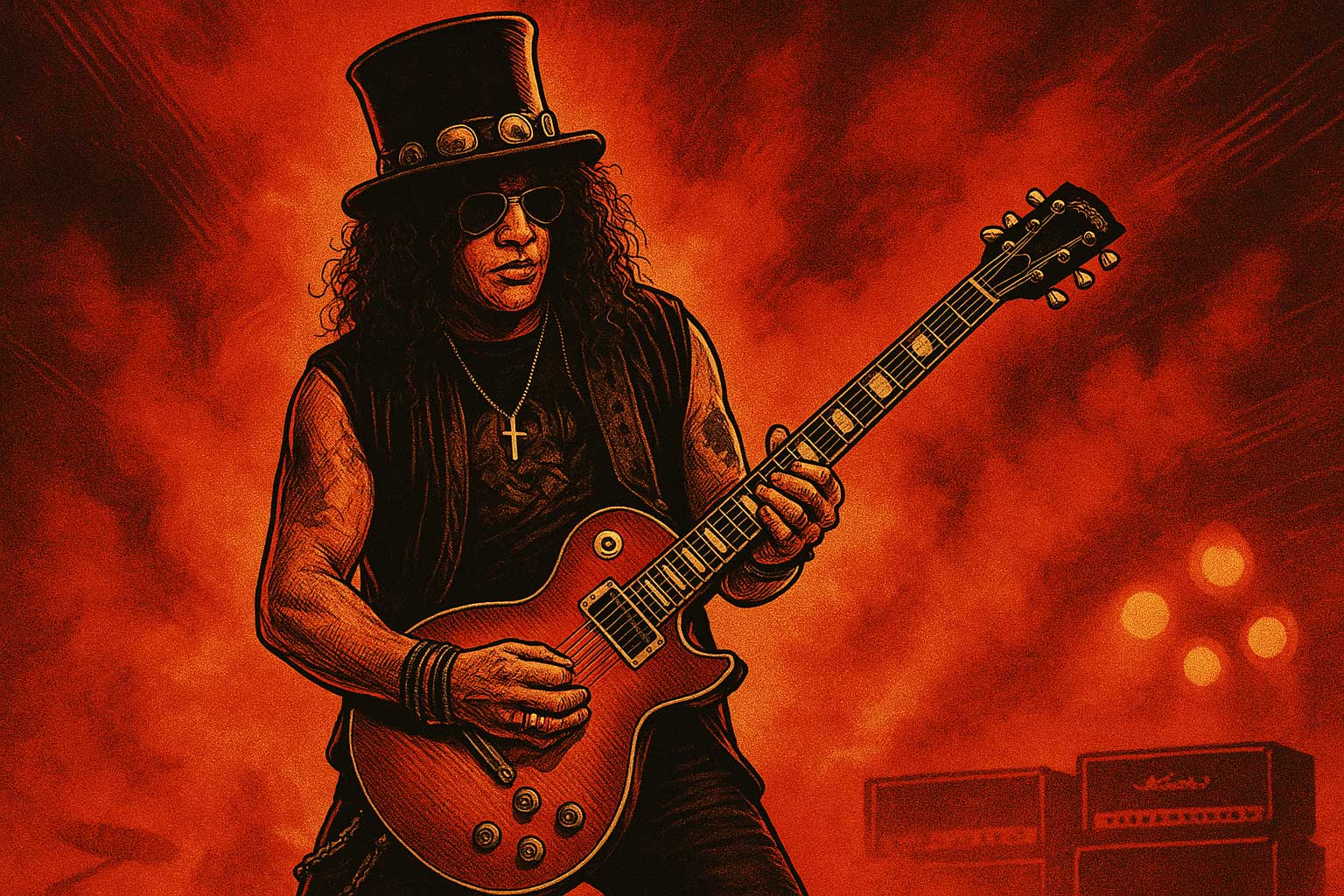
Every bar on the Sunset Strip is a warzone of riffs, and in the middle of it all stands one man with a top hat, a cigarette, and a Les Paul slung so low it might as well scrape the stage.
That man is Saul Hudson — better known as Slash.
The guitarist who didn’t just play rock ’n’ roll — he defined how it should sound, look, and feel.
While the glam bands were chasing flashy tones and neon guitars, Slash went the other way.
He wanted something dirtier. Meaner. More human.
Something that growled when you hit a chord and screamed when you bent a note.
So he grabbed a guitar that wasn’t even a real Gibson at first — a Kris Derrig-built ’59 Les Paul replica, wired with Seymour Duncan Alnico II Pro pickups, running through a cranked Marshall 1959 T Super Lead head.
When he hit that opening riff of “Welcome to the Jungle”, the world changed.
A Tone That Bleeds Attitude
Slash didn’t rely on effects or computers — just wood, wire, and raw touch.
His tone was the sound of electricity barely under control: warm mids, a hint of danger, and sustain that lasted longer than most bands’ careers.
That sound became the voice of Appetite for Destruction, and, let’s be honest — we’ve all spent years chasing it.
More Than a Guitar Hero
What makes Slash legendary isn’t just chops — it’s feel.
He bends notes like they’re screaming for mercy and vibratos like he’s trying to make the amp cry.
He’s one of the few players who can make a Les Paul sing the blues, snarl like punk, and soar like classic rock — sometimes all in the same solo.
This is the story of the man who kept the blues alive in hard rock, who made the Les Paul cool again, and who reminded the world that tone isn’t in your pedals — it’s in your hands.
The Rise – From the Jungle to Global Domination
When Appetite for Destruction dropped in 1987, it didn’t just sell records — it detonated like a Marshall stack in a phone booth.
Every riff on that album — from the snarl of “Nightrain” to the haunting bends in “Sweet Child O’ Mine” — came straight from Slash’s hands, through a battered Les Paul replica, and into a modded Marshall Super Tremolo 1959T that sounded like it was on the verge of combustion.
The Secret Sauce — The Appetite Rig
Slash’s tone on Appetite wasn’t some polished, high-end studio trickery.
It was raw, dangerous, and full of mistakes that somehow made it perfect.
Here’s what built that wall of tone:
-
Guitar: 1959 Les Paul Standard replica by Kris Derrig
(loaded with Seymour Duncan Alnico II Pro pickups) -
Amp: Marshall 1959T Super Lead (modded by Tim Caswell)
-
Cab: 4×12 cabinet with Celestion Greenbacks
-
Strings: Ernie Ball Power Slinky (.011–.048)
-
Pick: Dunlop Tortex 1.14 mm
-
Pedals: Dunlop Cry Baby Wah, MXR 10-Band EQ, Boss CE-2 Chorus (sparingly)
That’s it. No complex signal chains, no fancy multi-FX.
Just a Les Paul, a Marshall, and a pair of hands that knew exactly what they wanted.
Turning Chaos Into Control
What makes Slash’s tone so addictive is the balance between control and chaos.
He rides the edge — his notes are never too clean, never too dirty.
Listen to “Paradise City”: the rhythm guitars snarl like tigers in a cage, while the solos cut through with molten precision.
Slash doesn’t pick hard — he leans in. He uses his pick like a painter’s brush, coaxing bite or warmth with micro-adjustments most players never think about. That’s why his Les Paul seems to talk back — it’s not a fight, it’s a conversation.
Stage Mayhem and Studio Magic
Onstage, Slash’s rig was stripped-down but deadly.
He ran dual Marshall Silver Jubilee 2555 heads, switching between them for rhythm and lead.
The tone was thicker live, more saturated, but it never lost that raw punch.
In the studio, engineers barely had to EQ him — they’d just mic the cab, hit record, and pray the building didn’t catch fire.
By the end of the Appetite tour, Slash wasn’t just a guitar player.
He was a force of nature — the new face of Gibson, the savior of rock tone, and the reason thousands of kids started saving for a Les Paul.
Slash’s Rig – The Fire Behind the Top Hat
If tone had a face, it would be wearing a top hat.
Slash’s entire rig is built around one idea: simplicity with soul.
He doesn’t chase perfection — he chases feel.
And that’s why his gear, while deceptively straightforward, has more character than most racks of boutique pedals ever will.
The Guitars – Les Paul Royalty
Let’s start where every Slash story begins — with a Les Paul.
But here’s the twist: the legendary Appetite for Destruction tone didn’t come from a Gibson at all.
It came from a Kris Derrig-built 1959 Les Paul replica, one of a handful of luthier-built instruments floating around Hollywood in the mid-’80s.
That guitar — with its flamed amber top, Alnico II Pro pickups, and slightly thinner neck — became the sound of late-’80s hard rock. Slash calls it “the best guitar I ever played,” and it’s easy to see why: it sang, snarled, and screamed on command.
After the original Derrig Les Paul was retired, Gibson stepped in to make things official.
Over the years, they’ve collaborated with Slash on an entire Slash Collection, including:
-
Gibson Les Paul Standard “Appetite Burst” – modern recreation of the Derrig tone.
-
Gibson Les Paul “Jessica” – Slash’s warm, honeyburst favorite from Use Your Illusion.
-
Gibson Les Paul Goldtop 1957 Reissue – his backup for heavier live songs.
-
Epiphone Slash Collection – affordable versions with the same Alnico II pickups and slim neck profiles.
And yes — he occasionally brings out a B.C. Rich Mockingbird, Guild Crossroads double-neck, and a Gibson Firebird for specific tours. But make no mistake — the Les Paul is his Excalibur.
“There’s just something about a Les Paul through a Marshall.
It’s the most honest sound you can get — it either rocks or it doesn’t.”
— Slash, Guitar World interview
The Pickups – Alnico II, the Secret Weapon
Slash’s signature Seymour Duncan Alnico II Pro pickups are the heart of his tone.
They’re underwound and soft, giving that sweet midrange bloom without ice-pick treble.
It’s what lets him go from the creamy warmth of Sweet Child O’ Mine to the chainsaw bite of You Could Be Mine — just by rolling the volume knob.
He once said he hates over-compressed tones:
“I want the amp to react to me. Not the other way around.”
Those Alnico II Pros make sure of that — dynamic, responsive, and brutally honest.
The Amps – British Thunder
Slash and Marshall go together like whiskey and rock clubs.
His tone has always come from British tubes and ridiculous volume.
-
Studio: Marshall 1959T Super Lead (modded by Tim Caswell)
-
Touring: Marshall Silver Jubilee 2555 (his go-to live head since ’87)
-
Modern: Marshall AFD100 & SL5 signature heads (Slash + Marshall collaboration)
The settings? Almost comically simple:
-
Presence: 5
-
Bass: 7
-
Mid: 6–7
-
Treble: 5
-
Gain: 7–8
-
Volume: “As loud as possible.”
Slash’s tone is less about EQ and more about power — the way the tubes start to scream when they’re cooking at full tilt.
Pedals and Accessories – Less Is More
Slash doesn’t believe in overcomplicating tone.
He’s famously said, “If you need more than a wah and a cable, you’re probably doing it wrong.”
His essentials:
-
Dunlop Cry Baby Wah (his signature model, tuned for extra range)
-
MXR EQ 10-band (to fine-tune live rooms)
-
Boss CE-2 Chorus (used sparingly, mostly for solos)
-
Dunlop Tortex 1.14 mm picks
-
Ernie Ball Power Slinky .011–.048 strings
That’s it. No frills. No digital processors. Just pure analog power.
Modern Slash – The Refined Rig
Today, Slash still tours with his Marshall Silver Jubilees, but with a refined tech setup — dual heads for redundancy, wireless systems for clean signal, and a few discreet rack EQs to tame venue differences.
His tone hasn’t changed much since Appetite — because, frankly, why mess with perfection?
He summed it up best in a 2024 interview:
“The gear’s the same. I’m the variable. That’s the fun part.”
The Style – Feel Over Flash
Slash isn’t a shredder. He never wanted to be.
In an era where guitarists were racing up and down the fretboard faster than you could blink, Slash went the other way — slower, dirtier, more emotional.
His solos don’t just show off — they speak. Every bend, every slide, every squeal has intention.
The Blues Beneath the Leather
What most people miss about Slash is that beneath the distortion and attitude, he’s a blues player at heart.
His phrasing comes straight from B.B. King, Paul Kossoff, and Eric Clapton, but filtered through the chaos of Hollywood.
He bends notes slightly sharp — on purpose — creating that uneasy tension that makes your stomach twist.
And his vibrato? Wide, slow, and perfectly human.
That’s the secret. Slash doesn’t play on the beat — he plays around it.
He’ll drag behind just enough to make a riff swagger, then snap ahead in a solo like a coiled spring.
That’s why even his simplest licks groove harder than most players’ entire solos.
The Right Hand Rules
Slash’s right hand is where the magic happens.
He’s got this loose, swinging wrist motion that gives every note a pulse — almost like a drummer’s groove turned into a picking pattern.
His muting technique is subtle too — palm just barely touching the strings so they growl instead of choke.
He’s also a master at controlling feedback.
Onstage, he’ll lean into the amp, find that sweet spot, and ride the sustain like a surfer catching a wave.
That’s not luck — that’s years of instinct and muscle memory.
Less Theory, More Feel
Slash once admitted he barely knew scales when Appetite was recorded.
He played by ear, chasing melodies that felt right.
That’s why his solos sound like they’re telling a story — they build, breathe, and explode.
You can hum almost every one of them.
Listen to Sweet Child O’ Mine. That intro wasn’t even meant to be serious — it was a warm-up exercise.
But the way he played it — with tone, phrasing, and emotion — turned it into one of the most iconic riffs in rock history.
“I never cared about speed. I cared about making it sound good.
If the hair on your arms stands up, you’re doing something right.”
— Slash, Guitar Player interview
Controlled Chaos
Slash’s playing is imperfect — and that’s the point.
He slides a bit out of tune, drags bends too far, hits open strings accidentally — but it all works.
It’s the human messiness that makes it real.
While others chase sterile precision, Slash gives you blood, sweat, and noise — and that’s why it hits harder.
The Modern Slash Feel
Even today, you can hear that same reckless precision in everything he plays — whether it’s with Myles Kennedy & The Conspirators or guest solos on other artists’ records.
It’s always the same recipe: tone, touch, and just enough danger to make you grin.
Slash doesn’t need to prove anything anymore.
He just plugs in, hits a chord, and suddenly — it’s 1987 again.
The Legacy – Keeping Rock Alive
There’s a reason every kid who picks up a Les Paul still ends up learning Sweet Child O’ Mine.
Slash didn’t just play rock ’n’ roll — he redefined it for an entire generation.
When the ’80s were drowning in digital reverb and neon spandex, he brought it back to where it belonged: loud amps, dirty fingers, and real emotion.
The Man Who Saved the Les Paul
In 1987, Gibson’s golden age was a memory.
Pointy superstrats ruled the world — until Slash showed up.
Suddenly every kid wanted a sunburst Les Paul again.
Sales exploded. Gibson literally credits him with saving the Les Paul from extinction.
When Gibson launched the Slash Collection, it wasn’t just a marketing move — it was a tribute.
Few players in history have been so tied to one instrument.
From the Appetite Burst to the Jessica Les Paul, each one tells part of his story — a living timeline of riffs, sweat, and cigarette burns.
Influence That Outlived the Era
Slash’s tone became the blueprint for post-’80s rock guitar.
You can hear him in everyone from Velvet Revolver to Alter Bridge, from Myles Kennedy to The Darkness.
He bridged the gap between blues phrasing and metal power — proving that melody and aggression don’t have to fight each other.
Every time a modern guitarist talks about “feel,” “warmth,” or “human tone,” they’re chasing what Slash already mastered.
Even in the AI-era of perfect sound modeling, his tone still stands out — because it’s not perfect. It’s alive.
The Eternal Image
Slash isn’t just a sound — he’s a symbol.
That top hat, the Les Paul hanging low, the cigarette dangling mid-solo — it’s become the universal language of rock.
No brand campaign could ever manufacture what he built naturally: authenticity.
He doesn’t talk much, doesn’t need to.
When he plugs in and hits that first note, the message is clear:
Rock isn’t dead — it just needed someone to keep it breathing.
Still Bleeding Through the Strings
Even after four decades, Slash’s hunger hasn’t faded.
He still tours relentlessly, still records, still tweaks his Marshalls until they sound just dangerous enough.
And when he steps into that familiar spotlight, Les Paul glowing under the stage lights, you know what’s coming — that unmistakable roar that started in 1987 and never stopped.
“It’s not about nostalgia,” he once said.
“It’s about chasing the same rush every night. That’s what keeps me doing it.”
Slash Lives On
Slash is proof that feel will always outlive flash.
His legacy isn’t about speed or precision — it’s about heart, imperfection, and tone that hits like a freight train.
Every time you crank a Marshall, bend a note too far, or lose yourself in a solo — a little bit of Slash is right there with you.
FAQ – Slash, Tone & Legacy
What guitar does Slash use?
Slash’s main weapon is the Gibson Les Paul Standard, modeled after his original Kris Derrig 1959 replica.
He also tours with his signature models — the Appetite Burst, Jessica, and Goldtop ’57 Reissue — all loaded with Seymour Duncan Alnico II Pro pickups for that warm, singing tone.
What amp does Slash use?
He’s a Marshall man through and through.
From the modded 1959T Super Lead used on Appetite for Destruction to his Silver Jubilee 2555 and signature AFD100 heads, Slash’s sound is pure British firepower: mids forward, gain around 7, volume = dangerous.
What pedals are in Slash’s setup?
He keeps it simple — Dunlop Cry Baby Wah, MXR 10-Band EQ, and a Boss CE-2 Chorus for the occasional shimmer.
No digital trickery, no massive pedalboards — just tone born from the fingers.
What strings and picks does Slash use?
Ernie Ball Power Slinky .011–.048 strings and Dunlop Tortex 1.14 mm picks.
That combo gives the perfect blend of slinky feel and tight response for his trademark bends and vibrato.
What makes Slash’s tone unique?
Dynamic touch. He plays with the amp instead of against it.
His tone breathes — rolling the volume knob for crunch, digging in for sustain, and letting the guitar howl just before feedback takes over.
Can you sound like Slash without his gear?
Almost.
Plug any Les Paul-style guitar into a British-voiced amp, roll the tone back a touch, boost the mids, and most importantly — play like you mean it.
The rest is attitude.
The Last True Rock Hero
Slash isn’t nostalgia. He’s proof that raw, human tone still beats any plugin or preset.
He bridged the gap between blues and metal, between chaos and control — and made millions of us believe that the right riff could still change the world.
Four decades on, he’s still chasing the same thrill: guitar, amp, volume at 10.
No filters. No safety nets. Just heart, smoke, and soul.
So the next time you plug in, light one up (figuratively, at least), and hit that open E — because somewhere out there, Slash is probably doing the same thing.