
Gear Timeline
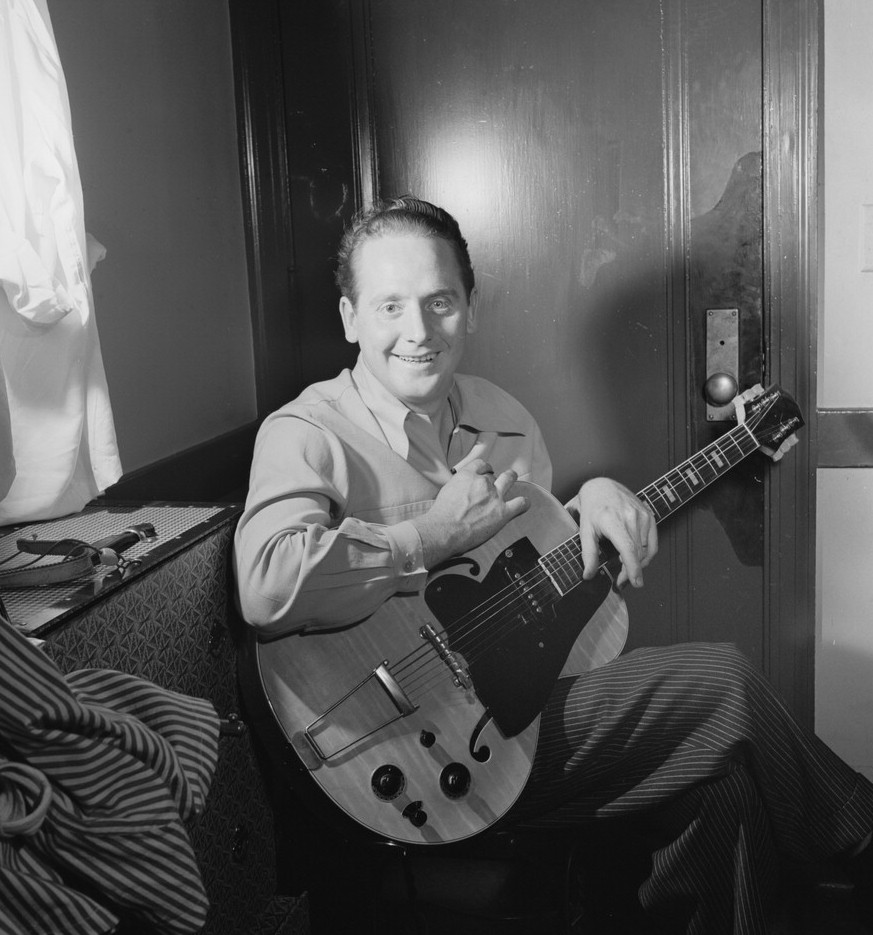
Somewhere in Nashville’s Country Music Hall of Fame, there is a piece of wood. It is a four-by-four inch block of solid pine, approximately four feet long, to which a Gibson neck, some homemade pickups, a bridge, and a vibrato tailpiece have been attached. Two halves of a sawed-in-half Epiphone hollow-body guitar flank it, glued to the sides — not for any acoustic purpose but simply to make the contraption look, from a distance, like it might be a guitar. The thing is called “The Log.” It was built in 1939 or 1940 in a New York rehearsal space after hours by a man who wanted a solid-body electric guitar and couldn’t find one because nobody had made one yet. That man was Les Paul. And “The Log” is, depending on how you measure these things, one of the most consequential objects in the history of Western music.
Without the Log — without the principle it embodied (that sustain and feedback resistance required a dense, solid body rather than an acoustic resonating chamber) — there is no Gibson Les Paul. Without the Gibson Les Paul, there is no Clapton Beano tone, no Slash, no Jimmy Page, no Duane Allman, no Gary Moore, no Zakk Wylde, no Neil Young (who plays a modified Goldtop), no SRV-adjacent Les Paul-through-Marshall tradition that shaped the entire history of electric blues-rock. But Les Paul the inventor is only one of the three distinct and equally extraordinary things that Lester William Polsfuss of Waukesha, Wisconsin, actually was. He was also the man who invented multitrack recording, overdubbing, tape delay, reverb, phasing, and sound-on-sound recording — technologies that between them define how literally every record you’ve ever heard was made. And he was also, by any fair measure, one of the finest guitarists who ever played the instrument — a fluid, technically brilliant, rhythmically sophisticated player who sold millions of records with his wife Mary Ford through the 1950s and who continued performing into his nineties.
He was born on June 9, 1915, in Waukesha, Wisconsin, and died on August 12, 2009, at the age of ninety-four, in White Plains, New York. Between those dates, he invented the future of music twice — once with the solid-body electric guitar and once with the multitrack recording studio — and played some of the finest jazz-pop guitar anyone in the twentieth century produced. He was inducted into the Rock and Roll Hall of Fame in 1988, when Jeff Beck delivered the induction speech with the words: “I’ve copied more licks from Les Paul than I’d like to admit.” He was inducted into the National Inventors Hall of Fame in 2005 for the solid-body electric guitar. He received the Grammy Trustees Award for lifetime achievement in 1983, Grammy Awards in 1976, 2005 (two), and a Technical Grammy in 2001. Rolling Stone ranked him the eighteenth greatest guitarist of all time.
This is the complete guide to his guitars, his gear, his inventions, and the playing style that makes him relevant not just as a historical figure but as an actual musician who, if you’ve never heard him play, will surprise you completely with how good he was.
Background: From Waukesha to the Future of Music
Lester William Polsfuss was a tinkerer from the moment his fingers could hold a tool. He built his own harmonica holder at twelve — a wire hanger arrangement that let him play guitar and harmonica simultaneously, a device that Bob Dylan would reinvent decades later without knowing the precedent. He strung a two-foot piece of rail from a train track like a guitar. He built a recording machine using parts from a car and a dentist drill. The impulse to understand how things worked and then make them work better was constant from childhood and never left him.
He started performing semi-professionally at thirteen, playing country music in local restaurants and taverns in Waukesha. By seventeen he had dropped out of high school to play in country bands. By nineteen he had a radio show in Chicago, where he performed country music under the name “Rhubarb Red.” The double identity — “Rhubarb Red” for country, “Les Paul” for jazz — reflected his genuine mastery of both idioms, a versatility unusual enough that the eventual crossover between them in his commercial recordings felt natural rather than forced.
His encounter with Django Reinhardt’s playing was transformative. Paul sought out and made friends with Reinhardt after World War II, deeply influenced by his jazz vocabulary, his melodic sensibility, and his physical approach to the instrument. When Reinhardt died in 1953, Paul paid for part of the funeral. One of his prized possessions was a Selmer acoustic guitar given to him by Reinhardt’s widow — a guitar he treasured not for its commercial value but for its connection to the guitarist he considered the greatest he had encountered. The influence is audible in Paul’s jazz recordings: the melodic flow, the sophisticated chord substitutions, the ability to maintain both rhythmic drive and harmonic interest simultaneously in improvised single-note lines.
The New York years — Paul moved his trio there in 1938, landing a featured spot with Fred Waring’s radio show — are when the inventive and the musical came together most productively. While jamming in his apartment basement in 1941, Paul was electrocuted and nearly died when he accidentally grabbed a live microphone cable. He survived. The near-death experience, by his account, did not particularly slow him down. He kept working on the Log and the multitrack recording experiments simultaneously, the two threads of invention running in parallel.
Gibson had already rejected the Log when he took it to them in 1941. Their response to his solid-body prototype was, allegedly, to call it “a broomstick with pickups.” They weren’t interested. The concept of a solid-body electric guitar seemed unnecessary when hollow-body electrics were selling perfectly well. It took Leo Fender’s success with the Telecaster in 1950-51 to change Gibson’s institutional mind — when solid-body guitars started eating into the electric guitar market, Gibson’s Ted McCarty went looking for Les Paul and found him ready to collaborate. The Gibson Les Paul went on sale in 1952. The “broomstick with pickups” became one of the most iconic musical instruments in history.
His commercial peak came with the recordings he and Mary Ford made through the early 1950s — a run of thirteen consecutive singles that each sold half a million copies, by Variety’s accounting. These records were made using the multitrack recording and overdubbing techniques Paul had pioneered, and they sounded like nothing else being produced: layered guitar tracks, Ford’s voice harmonized with itself, echo effects and reverb and the shimmer of Les Paul’s playing against a sound-bed of his own design. They were pop records as architectural constructions, built rather than performed, and they established the model for studio production that the entire subsequent history of recorded music followed.
His divorce from Ford in 1962, combined with the arthritis that increasingly affected his hands, led to a prolonged semi-retirement. He continued to tinker, to experiment, to perform occasionally. The late 1980s resurgence — Monday night residencies at clubs in New York City, where prominent rock musicians came to pay tribute — brought him back to the wider public eye and demonstrated that his playing, even diminished by arthritis, retained the clarity, humor, and harmonic intelligence that had always distinguished it. He played these residencies until near the end of his life, at ninety-three still performing.
The Rig: Les Paul’s Guitars, Equipment, and Inventions
Writing about Les Paul’s “rig” is genuinely unusual among the one hundred guitarists in this series, because the “rig” in his case includes the invention of the instrument category itself, the invention of the recording technology through which he used it, and the physical modifications he made to specific instruments. The gear is inseparable from the invention.
Guitars
The Log is both Les Paul’s most important instrument and the most important single object in the history of the solid-body electric guitar. Built in the rehearsal space of Epiphone’s New York factory — Paul had permission to use the space on weekends and after hours — it consists of a 4×4 inch piece of solid pine approximately four feet long, to which Paul attached a Gibson neck, a set of homemade pickups, a bridge, and a vibrato tailpiece. To make the instrument look enough like a guitar to be taken seriously by audiences, he sawed an Epiphone hollow-body in half lengthwise and attached the two halves to the sides of the pine block. This was purely cosmetic — the wings added no acoustic function, since the solid pine block was the entire resonating structure. The Log is now enshrined in Nashville’s Country Music Hall of Fame.
The principle the Log embodied was simple but radical: a dense, solid body vibrates differently from a hollow acoustic chamber. A solid body sustains string vibrations longer, feeds them back to the pickup more consistently, and eliminates the acoustic resonance of the hollow body that created feedback problems at high amplifier volumes. Paul wanted sustain. He wanted to eliminate the uneven harmonic response produced by an amplified hollowbody guitar. The solid body solved both problems simultaneously. Gibson initially called it a broomstick. Fender later made it commercially viable. Gibson eventually contracted Les Paul’s name for it. The principle behind the Log is now present in essentially every solid-body electric guitar ever manufactured.
The production guitar that Gibson built from Paul’s concept and Ted McCarty’s design went on sale in 1952 featuring a solid mahogany body with a carved maple top (McCarty’s refinement over the Log’s blunt pine block — the maple cap added tonal complexity and resonance characteristics different from solid mahogany), P-90 single-coil pickups in both neck and bridge positions, a trapeze-style tailpiece (Paul’s specific contribution to the design — the tailpiece he had pioneered on the Log), a gold finish (inspired by the look of Gibson’s premium jazz guitars), and a price point around $210 new. Les Paul’s only specific design contribution was the tailpiece, which produced the specific muting character he associated with his playing style. Gibson’s Ted McCarty designed the rest — the maple top cap, the body shape, the proportions. The resulting instrument was immediately recognizable, immediately prestigious, and immediately associated with Les Paul’s specific playing approach.
The Les Paul the man played professionally, of course, was the Les Paul the guitar — he was contractually obligated to play Gibson instruments exclusively and did so throughout his peak commercial period. His playing on the early Les Paul goldtop established the sonic template for what the instrument could do: fluid jazz lines with unusual sustain, chord melodies that exploited the pickup’s warm midrange, and the specific articulation of the P-90’s single-coil clarity combined with the mahogany body’s warmth.
Les Paul himself was less associated with the iconic “Burst” configuration — the 1958-1960 sunburst Les Paul with PAF humbuckers — than with the earlier goldtop models. The humbucking pickup (invented by Seth Lover at Gibson in 1957) replaced the P-90 single-coils in 1957, and the sunburst finish replaced the goldtop in 1958. The resulting instrument — two PAF humbuckers, mahogany body, maple cap, sunburst finish — is today the most collectible and valuable production electric guitar in history, with pristine originals selling for hundreds of thousands of dollars. But Les Paul the man was not primarily associated with this specific configuration in his performing years; it was the rock guitarists of the late 1960s — Clapton, Bloomfield, Green — who elevated the Burst to its current mythological status.
The Les Paul Custom — a more upscale variant with binding on the body and neck, block inlays, and (in the three-pickup version) a full sweep of tonal options — appeared in Les Paul’s touring collection at various points. The Custom’s ebony fretboard and upgraded hardware gave it a different tonal character from the Standard: slightly brighter, with the ebony’s harder surface producing crisper note attack. Visually, the Custom’s black finish (in the most famous variant) and gold hardware were among the most elegant guitar aesthetics of the era.
One of the gentler biographical details in Paul’s story: he gave his bandmate Jim Atkins (Chet Atkins’s older half-brother) a Gibson archtop that eventually found its way to young Chet. Chet Atkins later wrote that it was the first professional-quality instrument he ever owned. The chain of influence — Paul to the Atkins brothers to one of the most significant figures in country and pop guitar — is a small illustration of how pervasively Les Paul’s influence radiated even through secondary channels.
One of Paul’s prized possessions was the Selmer acoustic guitar given to him by Django Reinhardt’s widow after Reinhardt’s death in 1953. The Selmer — the instrument so closely associated with Django that understanding one is impossible without the other — in Paul’s possession represents the personal connection between two of the greatest figures in jazz guitar history. Paul had sought Reinhardt out after the war, the two had become friends, and the guitar’s transfer to Paul was an act of personal tribute from a bereaved widow to someone who had genuinely loved her husband’s music and paid part of his funeral costs.
Amps
Unlike most guitarists in this series, Les Paul’s relationship with amplifiers was primarily mediated through his recording studio setup rather than through commercial live performance amplification. He built his own studio — first in the family garage in Mahwah, New Jersey, and later in expanded forms — specifically to allow the kind of recording experimentation that led to his innovations. The specific amplifiers he used in this studio context were chosen for their recording characteristics rather than their stage performance qualities.
Paul was contractually obligated to use Gibson amplifiers during his commercial peak years, in the same way that his guitar contract specified Gibson instruments exclusively. This constraint was not particularly limiting given that Gibson made adequate amplifiers for the recording and performance contexts of the era, but it does explain why Paul’s amplifier history is less richly documented than his guitar and recording equipment history. Gibson’s amplifiers of the late 1940s and 1950s were typically tube-driven combos producing clean, warm tones appropriate for jazz and pop performance.
The most significant piece of amplification-adjacent equipment in Paul’s story is not a guitar amplifier at all — it is the Ampex 200 tape recorder that Bing Crosby gave him in 1948 (or that he acquired from Crosby, depending on which account you follow). Crosby had adopted tape recording for his radio programs because it allowed him to time-shift broadcasts — to record shows in advance rather than perform live. The tape recorder he used was among the first Ampex units in America, and when Crosby finished using it, it found its way to Les Paul.
What Paul did with the Ampex 200 changed recording forever: he modified it. Specifically, he added a second recording head between the erase and record/playback heads, creating a machine that could record a new signal while simultaneously playing back a previously recorded one. This modification — adding one extra head — made multitrack recording mechanically possible. The ability to layer performance over performance, to build a record track by track rather than capturing everything in one take, is the foundation of virtually all popular music production for the past seventy years. Les Paul built it out of a single Ampex machine and some mechanical ingenuity.
Recording Innovations — The Real “Effects Chain”
For Les Paul, the recording studio was not a place where finished music was captured. It was an instrument he played — an additional creative tool, as important to his final sound as any guitar or amplifier. His specific innovations define the technology of modern music production:
Multitrack Recording: The technique of recording separate musical elements on separate tracks, enabling independent mixing, editing, and layering, was pioneered by Les Paul through his modified Ampex recorder. Before multitrack recording, virtually all records were made by gathering musicians in a room and capturing their simultaneous performance in a single take. Paul’s multitrack approach meant that he could record guitar, then record more guitar over it, then record Mary Ford’s voice, then harmonize that voice with itself — building the final recording as an architectural construction rather than a performance event. This approach is now so universal that recording without it would be unrecognizable to any contemporary producer.
Sound-on-Sound (Overdubbing): The specific application of multitrack recording most associated with Paul is sound-on-sound — recording a new performance while hearing a previous one, combining the two onto the same medium. His commercial recordings with Mary Ford (particularly “How High the Moon” in 1951) featured multiple guitar tracks layered through this process, creating the specific thick, shimmering guitar texture of his recordings. “How High the Moon” has been entered into the Grammy Hall of Fame. The overdubbing technique it pioneered is present in literally every commercial recording made since.
Tape Delay: Paul discovered that by running tape from one recorder to another at a specific distance, he could create a delay effect — the signal heard on the second machine arriving slightly after the original, creating an echo. The tape delay he developed was one of the first systematic uses of electronics for musical effect rather than merely for capture. Echo and delay are now ubiquitous in music production and performance; their historical origin lies partly with Paul’s experiments in his New Jersey garage.
Phasing and Flanging: Paul experimented with running two tape machines in close synchrony and then introducing slight variations in their relative speed — pressing a finger against the flange of the tape reel to slow one machine slightly. The result was the comb-filter effect of phasing and flanging — a sweeping, whooshing modulation that has become a standard effect in recording and live performance. He is credited with discovering this technique empirically, through experiment rather than through prior theoretical knowledge of what was happening acoustically.
Reverb: While reverb as a phenomenon predates Paul, his systematic development of reverb effects for recorded music — combining natural room reverb with the specific acoustic properties of his studio — contributed to the technique’s development as a musical tool rather than merely an acoustic artifact of recording environments.
The Guitar’s Own Innovations: Paul was also an inventor at the level of guitar-playing technique. His specific contributions include: a muting technique using the palm of his right hand against the strings at the bridge, producing the characteristic “chunky” rhythm sound; a fretting approach that involved the thumb wrapping over the top of the neck to fret low notes (unusual for jazz players trained in the classical thumb-behind-neck position); and specific approaches to string bending and vibrato that influenced subsequent generations of players. Jeff Beck, in his 1988 Rock and Roll Hall of Fame induction speech, explicitly acknowledged how much of his technique he had copied from Paul’s recordings.
Playing Style & Tone Philosophy
Les Paul’s playing style occupied a specific and distinctive position in the jazz guitar tradition — technically accomplished enough to satisfy the most demanding jazz listeners but melodically direct and harmonically accessible enough to communicate to popular audiences who had no particular background in jazz harmony. He was not the most harmonically abstract player of his era; he was the most immediately communicative while remaining genuinely sophisticated.
His rhythm guitar playing — documented in ensemble recordings and in the backing tracks of his duo work with Mary Ford — was built on the big band tradition of the 1930s and 1940s: tight, precise, rhythmically supportive, harmonically full without being overbearing. This tradition, absorbed from Fred Waring’s orchestra and the New York jazz scene, gave him the ensemble discipline that balanced his more flamboyant solo tendencies.
His lead playing was built on Charlie Christian’s single-note vocabulary and Django Reinhardt’s melodic sophistication, filtered through Paul’s own harmonic intelligence and his physical approach to the fretboard. The licks, trills, chording sequences, fretting techniques, and timing he developed set him apart from his contemporaries — that set of specific technical elements constituted a vocabulary that subsequent players actively sought to learn and copy. Beck’s admission was not unusual; it was simply unusually honest.
One specific technique that Paul developed and that has been widely influential is his approach to playing melody and chords simultaneously — what jazz guitarists call “chord melody” playing, where a single guitarist voices a harmonized melody without requiring any other accompanist for harmonic support. Paul’s versions of popular songs with Mary Ford used this approach in the rhythm guitar parts, while his lead lines played over the top. The interaction between the chord melody rhythm foundation and the single-note lead created a self-contained musical texture that influenced the approach of every jazz guitarist who played duo or solo contexts after him.
His physical approach to the guitar was also distinctive. He frequently used his thumb to wrap over the top of the neck and fret bass notes — a technique associated with blues guitarists like Hendrix but unusual in jazz contexts. This gave him access to specific left-hand chord voicings that conventional thumb-behind-neck classical positioning doesn’t allow, and it contributed to the particular warmth of his lower-register playing. The technique required a specific neck thickness and profile to be comfortable, which is one reason Paul was particular about the specifications of his Gibson guitars.
His tone philosophy was defined by the goal that drove the Log’s construction: maximum sustain, minimum unwanted resonance, maximum control over the recorded sound. The solid body guitar eliminated the acoustic body’s unpredictable resonance. The multitrack studio eliminated the need to capture everything in a single unrepeatable moment. Both inventions gave him more control over the final result — and more control, in Paul’s view, was always better. He was a maximalist about technology and a minimalist about sonic clutter.
How to Sound Like Les Paul
Capturing Les Paul’s playing style requires understanding that he was a jazz guitarist operating in a pop commercial context — the clarity, the precise articulation, the melodic directness, and the harmonic sophistication are all jazz characteristics deployed in service of immediately accessible music.
Guitar: A Gibson Les Paul is historically and tonally correct — specifically with P-90 pickups for the early-era sound. For the jazz-inflected Les Paul tone, the neck pickup with tone rolled back slightly approximates his warm, full, moderately compressed clean sound. A hollowbody Gibson archtop (L-5, L-7, or similar) also matches recordings from his pre-goldtop period.
Amp: Clean. No overdrive, no distortion. Paul’s recordings are clean throughout his commercial period — the warmth comes from tube amp character (mild compression, harmonic richness) rather than any kind of saturation. A Fender Deluxe Reverb or any clean tube combo at moderate volume produces the correct territory.
Amp Settings (Clean Jazz Tone):
| Control | Setting (0–10) | Notes |
|---|---|---|
| Volume | 4–6 | Clean — no breakup. Tube warmth but no saturation |
| Bass | 5–6 | Full but not muddy — warm jazz foundation |
| Mid | 5–6 | Present — the vocal midrange of the P-90 neck pickup |
| Treble | 4–5 | Controlled — not bright, but clear |
| Reverb | 2–3 | Light — just enough room feel |
Echo/Delay: A short tape-style delay — 100-200ms, one or two repeats, subtle — approximates the tape delay character of the commercial recordings. A warm, analog-sounding delay or a dedicated tape echo unit like the EP-3 Echoplex approximates the Paul recording texture.
Picking style: Clean articulation is everything. Paul’s notes are clearly defined, never blurred together. Practice single-note lines with absolute picking accuracy before attempting his faster runs. His muting technique — palm muting against the bridge for specific rhythm parts — is also worth studying for the rhythmic articulation it provides in ensemble contexts.
Influence & Legacy
There are very few figures in the history of music about whom you can say: everything you’ve ever heard was shaped by this person’s work. Les Paul is one of them. The solid-body electric guitar and multitrack recording are not niche contributions to a specific genre — they are the foundational technologies of essentially all popular music produced since 1950. Every electric guitar player in every genre owes something to the Log. Every recorded musician who has ever overdubbed, edited, or layered tracks owes something to the Ampex 200 modifications Paul made in his New Jersey garage.
As a guitarist specifically — separating the inventor from the player — his influence runs through Jeff Beck (who said so explicitly), through the entire jazz-pop guitar tradition of the 1950s, and through the recording techniques that shaped what a guitar could sound like on record. He demonstrated that the guitar was not merely an acoustic instrument captured by a microphone but a sound source that could be transformed, multiplied, and architecturally arranged in the studio. Every guitarist who has ever heard themselves with reverb, with delay, with overdubbed harmonies, with the spatial depth of a multitrack recording — is experiencing the world Les Paul built.
His work as a guitarist directly influenced Chet Atkins’s approach to guitar virtuosity at #71 — Atkins received his first professional guitar through the Les Paul connection (via Jim Atkins), and the tradition of technically sophisticated, clean-toned, jazz-influenced guitar playing that Atkins developed shares significant DNA with Paul’s approach. The Nashville guitar tradition that Atkins built is not unconnected to the foundation Paul laid.
The guitar that bears his name has had perhaps the most wide-ranging influence of any single instrument design in rock history. The Gibson Les Paul — in its 1958-1960 Burst configuration especially — has been played by Eric Clapton at the peak of his blues-rock period at #9, producing the Beano tone that defined British blues-rock; by Jimmy Page across the entire Led Zeppelin catalog at #3; by Slash as his primary instrument at #8; by Duane Allman, Gary Moore, Mark Tremonti, and hundreds of others. The instrument is, at this point, synonymous with a certain kind of guitar authority — the thick, sustaining, mahogany-and-maple warmth that the Log’s basic principle made possible.
Les Paul died at ninety-four in 2009, still performing weeks before his death, still curious about new technology, still the most consequential individual in the history of the instrument he helped create. Jeff Beck was right in 1988. The licks Paul invented were still circulating, still being copied, still surprising guitarists who encountered them for the first time and felt them arrive in the chest with the force of something entirely original. That’s the mark of a genuine innovator: not just that other people copy the work, but that the work, decades later, still feels like it couldn’t possibly have existed before the person who made it.
The Monday Night Residencies: An Old Man With a Young Guitar
One of the most remarkable chapters in Les Paul’s career — and one that is often glossed over in favor of the Log and the multitrack innovations — is the twenty-plus years of Monday night performances he gave at various New York City clubs beginning in the late 1980s. Paul was in his early seventies when these residencies began. His arthritis had significantly affected his hand function. He played anyway, and the performances attracted a continuous parade of prominent rock musicians who came not as celebrities seeking association with an icon but as guitarists paying genuine tribute to someone whose licks they had spent years trying to understand.
The residencies began at Fat Tuesday’s in New York in the late 1980s, moved to Iridium Jazz Club, and continued there for years — Monday after Monday, Paul on stage with his working trio, playing his jazz and pop repertoire with whatever technical facility his arthritis permitted on a given evening. On any Monday, you might find Jeff Beck, Slash, Steve Miller, Peter Frampton, Joe Perry, or any other prominent guitarist in the audience or on stage alongside Paul. The attraction was not nostalgia or celebrity — it was the opportunity to be in the room with someone who had played the instrument in ways that had not been fully decoded and who was still doing it, diminished but recognizable, with the same melodic intelligence and harmonic instinct intact.
The Iridium residencies became something of an informal institution of rock and jazz guitar — a place where the industry’s most distinguished players came to listen rather than to perform, to learn rather than to be seen. Paul’s capacity to attract this continuous respectful attendance into his nineties speaks to the depth of his musical influence beyond the biographical facts of his inventions. The Log made the solid-body guitar possible. The Ampex modifications made multitrack recording possible. But the Monday night audiences came for the playing — for the specific melodic approach, the harmonic intelligence, the humor and lightness of a man who had been playing guitar since 1928 and who still found things in the instrument that could surprise him.
He played his final Monday night show at Iridium on August 3, 2009. He died nine days later. The funeral was attended by guitar luminaries from across the full spectrum of music he had influenced — rock, jazz, country, pop. The family guitar that defined the instrument category sat with him.
Frequently Asked Questions: Les Paul Guitars & Gear
Did Les Paul invent the electric guitar?
Les Paul did not invent the electric guitar — electromagnetic pickups applied to hollow-body acoustic guitars existed before his work, and players like Charlie Christian were already performing on electric guitars by the late 1930s. What Les Paul invented was the first playable solid-body electric guitar, which he called “The Log” — built around 1939-1940 using a 4×4 inch piece of solid pine, a Gibson neck, homemade pickups, and a bridge. He later attached the halves of a sawed-in-half Epiphone hollow-body to the sides purely for visual aesthetics. The Log demonstrated that a solid, dense body could sustain string vibrations longer and eliminate the feedback problems of hollow-body electrics at high volume. This principle is the foundation of every solid-body electric guitar ever manufactured. Les Paul is in the National Inventors Hall of Fame specifically for the solid-body electric guitar.
What is “The Log”?
The Log is Les Paul’s prototype solid-body electric guitar, built around 1939-1940 in the rehearsal space of Epiphone’s New York factory (which Paul had permission to use after hours). It consists of a four-by-four inch piece of solid pine approximately four feet long, to which Paul attached a Gibson neck, homemade pickups, a bridge, and a vibrato tailpiece. He added the two halves of a sawed-in-half Epiphone hollow-body to the sides to make it look more like a guitar. When Paul took the Log to Gibson hoping for production interest, they called it a “broomstick with pickups” and declined. It took Fender’s commercial success with the Telecaster in 1950-51 to convince Gibson to reconsider. The Log is now preserved in Nashville’s Country Music Hall of Fame.
What recording techniques did Les Paul invent?
Les Paul’s recording innovations include: multitrack recording (building records track by track by modifying an Ampex 200 tape recorder to add a second recording head between the erase and playback heads), sound-on-sound recording (overdubbing new performances over existing recordings), tape delay (creating echo effects by running tape between two machines at a measured distance), phasing and flanging (discovered empirically by pressing a finger against the tape reel flange to create synchronized speed variations between two machines), and systematic approaches to reverb as a musical effect. These innovations collectively define how virtually all popular music has been recorded since 1950. The Grammy Hall of Fame has entered two of his recordings as technological milestones.
How did the Gibson Les Paul guitar come about?
Les Paul approached Gibson with the Log concept in 1941, and they declined. When Fender’s solid-body Telecaster became commercially successful beginning in 1950-51, Gibson president Ted McCarty reconsidered. McCarty designed a solid-body guitar with a carved maple top (a refinement over the Log’s rough pine block), mahogany body and neck, and contracted Les Paul’s name for the instrument as a marketing partnership. Paul’s specific contribution to the final design was the trapeze-style tailpiece, which produced the muting character he’d developed on the Log. The guitar went on sale in 1952. Initially featuring P-90 pickups, it received Seth Lover’s new humbucking pickups in 1957, producing the 1958-1960 “Burst” configuration that became the most sought-after and valuable production electric guitar in history.
What guitar did Les Paul actually play?
Les Paul played various instruments across his career but was contractually obligated to use Gibson instruments exclusively during his commercial peak. He played Gibson Les Paul goldtop models fitted with P-90 pickups for his 1950s recordings with Mary Ford. Earlier in his career he played hollow-body Gibson archtops (L-5, L-7 models) for jazz performances. He also played hollow-body guitars before the solid-body revolution — his jazz work with Fred Waring and others used the conventional jazz archtop instruments of the era. One of his prized possessions was a Selmer Maccaferri acoustic guitar given to him by Django Reinhardt’s widow, which he kept as a personal tribute to his friend and influence. His playing on the early Les Paul goldtop established what the instrument was capable of tonally.
What records did Les Paul and Mary Ford make?
Les Paul and Mary Ford recorded a series of enormously successful records through the early 1950s that exploited Paul’s multitrack and overdubbing innovations. Their recording “How High the Moon” (1951) — featuring multiple layered guitar tracks and harmonized vocals — reached number one on the pop charts and has been entered into the Grammy Hall of Fame as a landmark recording. They subsequently produced thirteen consecutive singles that each sold at least half a million copies, by Variety’s accounting. Major hits included “The World Is Waiting for the Sunrise,” “Vaya Con Dios,” “Tiger Rag,” and “How High the Moon.” These records were unprecedented in their use of studio technology as a creative tool — they were built in layers rather than performed in real time, and the resulting sound was richer and more elaborate than anything their contemporaries were producing.
Is Les Paul in the Rock and Roll Hall of Fame?
Yes. Les Paul was inducted into the Rock and Roll Hall of Fame in 1988. His induction speech was delivered by guitarist Jeff Beck, who said “I’ve copied more licks from Les Paul than I’d like to admit” — a statement that was received both as tribute and as genuine guitar-world confession. He was also inducted into the National Inventors Hall of Fame in 2005 for the solid-body electric guitar, the Songwriters Hall of Fame in 2005, the Big Band & Jazz Hall of Fame in 1990, and multiple other halls of recognition. He received Grammy Awards in 1976 (Best Country Instrumental, with Chet Atkins), 1983 (Grammy Trustees Award for lifetime achievement), 2001 (Technical Grammy Award), and 2005 (Best Pop Instrumental and Best Rock Instrumental). Rolling Stone ranked him the eighteenth greatest guitarist of all time.
Related stories
Tosin Abasi Guitars & Gear: The Complete Guide to Animals as Leaders’ Guitar Innovator’s Rig
Tosin Abasi's guitars, amps, and effects — the complete guide. Abasi Concepts Larada 8, Fractal Axe-FX, Fishman Fluence, thumping technique, and how to nail that Animals as Leaders progressive metal tone.
Vernon Reid Guitars & Gear: The Complete Guide to Living Colour’s Guitar Genius’s Rig
Vernon Reid's guitars, amps, and effects — the complete guide. Parker MaxxFly, PRS Vela VR, Mesa Dual Rectifiers, Roland VG-99, Eventide H9, Living Colour gear guide.
Warren DeMartini Guitars & Gear: The Complete Guide to Ratt’s Torch Guitarist’s Rig
Warren DeMartini guitars & gear: Ratt's Torch guitarist. Charvel Bomber, snakeskin, Jose-modded Plexi, Fender Super Champ, RTM pickup, slapback echo — the complete rig.