
Andy McKee Guitars & Gear: The Complete Guide to the “Drifting” Viral Guitar Sensation’s Acoustic Rig
In late 2006, a video called “Drifting” was uploaded to YouTube by a guitarist from Topeka, Kansas. The video went viral, achieving millions of views by early 2007. At one point, Andy McKee held the #1, #2, and #3 positions on YouTube’s Top Rated Videos of All Time — the three most highly-rated videos on the entire platform simultaneously, in a year when YouTube had already become the world’s primary video sharing service. The guitar that produced those three videos was a Greenfield G4, strung in DADGAD tuning, played with overhand fretting, percussive body slaps, harmonic taps, and the specific combination of techniques that Guitar World summarized as “over-the-top acoustic techniques.” The “Drifting” video was “inspired by the great Preston Reed” — the same Preston Reed who McKee had seen perform live at age sixteen, whose instructional videotape he subsequently purchased, and from whose playing he learned “many of his acoustic guitar techniques.” He had quit high school at sixteen (obtaining his GED with his mother’s permission) to play more guitar. He taught guitar for years while releasing albums independently, “flying under the radar, making ends meet as a guitar teacher.” Then the Drifting video. Then millions of views. Then hundreds of concerts per year in over forty countries. He still plays Greenfield guitars — the G4, the G4 Baritone, the G2 Baritone, the Harp Guitar. He uses K&K Pure Mini pickups and a D-TAR Solstice preamp for live performance. He hosts the annual “Andy McKee’s Musicarium” fingerstyle guitar camp. He is forty-six years old. The Greenfield G4 is still in DADGAD.
Andy McKee was born on April 4, 1979, in Topeka, Kansas. He played his first guitar — an Aria nylon-string bought by his father — at age thirteen. Initially underwhelmed by formal guitar lessons, he began teaching himself, learning shred guitar music including songs by Metallica, Eric Johnson, and Joe Satriani. His electric guitar-playing cousin inspired him to continue; at age sixteen, his cousin took him to see Preston Reed perform live at a clinic. He purchased an instructional videotape from Reed and learned Reed’s acoustic guitar techniques from it. That same year, with his mother’s permission, he obtained his GED and quit high school to play more guitar. He was placed third at the National Fingerstyle Guitar Competition in Winfield, Kansas in 2001 — the same year he independently released his first album, Nocturne. He released subsequent albums through CandyRat Records (Art of Motion, Joyland, Guitar for Mortals, Christmas). The 2006 viral moment with “Drifting” changed everything. He has since collaborated with Josh Groban (playing guitar on the Grammy-nominated NOEL Christmas album), Lee Ritenour, and Don Ross. In 2024, he formed the acoustic guitar trio supergroup “tripliciti” with Trevor Gordon Hall and Calum Graham.
Background: Topeka Kansas, GED at 16, Preston Reed Clinic, Winfield Competition, “Drifting” 2006 Viral, #1/#2/#3 YouTube All Time
The Preston Reed revelation — seeing Reed perform live at a clinic at age sixteen, purchasing the instructional tape, learning the techniques — is the specific biographical event that oriented McKee’s entire subsequent career. Preston Reed is the American guitarist who pioneered the specific combination of two-handed playing techniques on acoustic guitar that McKee subsequently developed: overhand fretting (fretting with the picking hand from above the strings, leaving the picking-hand fingers free for additional note-playing), percussive body tapping, and the specific integration of rhythmic and melodic elements that makes the most sophisticated fingerstyle guitar appear to be performed by more than one musician simultaneously. McKee is not the first Preston Reed student, but he is the most commercially successful one — the guitarist who brought Reed’s specific technical tradition to a global audience through the YouTube viral moment.
The decision to quit high school at sixteen for guitar is the most specifically committed biographical statement of musical dedication in this guide. Most musicians who leave conventional education to pursue music do so at a later point — after high school, after college, after the professional world has already determined that music is the priority. McKee made the decision at sixteen, with his mother’s permission, obtaining his GED as the legal substitute for a diploma. The specific boldness of this decision — at sixteen, in Topeka, Kansas, for acoustic guitar — reflects the specific commitment that subsequently produced hundreds of concerts per year in forty countries.
The YouTube moment (2006-2007) has a specific quantitative dimension that contextualizes his cultural impact: holding the #1, #2, and #3 positions on YouTube’s Top Rated Videos of All Time simultaneously means that three of the most universally positively-received videos in the history of the world’s primary video platform were acoustic guitar performances from a self-taught guitarist from Topeka, Kansas. This is not a small achievement. The specific quality of the videos — intimate, solo, a single guitarist playing technically extraordinary music in a simple studio setting — communicated something universally accessible despite being technically demanding: you could watch “Drifting” without understanding any of the technique and still find it beautiful.
The Rig: Andy McKee’s Guitars and Gear
Guitars
Greenfield G4 (Primary Guitar, “Drifting” Guitar, Signature Model): Andy McKee’s primary guitar is the Greenfield G4 — confirmed by Guitar World (“McKee strings his Greenfield G4 acoustic in an alternate tuning referred to as DADGAD”) and by the Greenfield Guitars artist page: “Andy McKee plays Greenfield acoustic guitar models G4, G4 baritone, G2 baritone, Harp Guitar and model G5.” Michael Greenfield is a Canadian luthier (Montreal-based) whose handbuilt acoustic guitars are known for their exceptional tonal balance, projection, and playability. The G4’s specific character — the particular combination of top wood, back and sides, bracing pattern, and scale length that Greenfield chooses — produces the specific clarity and sustain that McKee’s two-handed playing techniques require: when both hands are simultaneously contributing to melody, bass line, and percussion, the guitar must be capable of producing three distinct sonic layers simultaneously from a single instrument. The Greenfield G4’s specific projection and clarity make it possible to hear all three layers distinctly in a solo performance without amplification.
The Greenfield G4 Andy McKee Signature Guitar represents his collaboration with Greenfield on the specific specifications he requires: the scale length, nut width, neck profile, pickup system integration, and tonal voicing that suits his specific technical approach. The signature model makes available to other players the specific configuration that McKee has developed over years of performing with the instrument.
Greenfield G4 Baritone and G2 Baritone (Extended Range Models): The Greenfield artist page confirms G4 Baritone and G2 Baritone models as part of McKee’s documented guitar collection. Baritone guitars are tuned lower than standard — typically B to B (a perfect fourth below standard) or A to A (a fifth below) — providing an extended bass range without the additional strings of a bass guitar or harp guitar. For McKee’s compositional approach, the baritone’s lower pitch range enables bass lines that go deeper than a standard guitar allows while maintaining the single-instrument fingerstyle technique that his performances employ.
Greenfield Harp Guitar and Dyer Harp Guitar (Extended Bass Range Specialty Instruments): Both a Greenfield Harp Guitar and a Dyer Harp Guitar are documented in McKee’s collection. The Equipboard entry confirms: “In the video ‘Into the Ocean’ by Andy McKee, available on AndyMcKeeVEVO, Andy McKee plays a Dyer Harp Guitar.” The Dyer Harp Guitar is a vintage American instrument — Dyer (the William J. Dyer company) produced harp guitars in the early 20th century that are now highly sought-after collector’s instruments. The additional bass strings of the harp guitar provide the sub-bass resonance that extends the bass range of a standard guitar, allowing deeper pedal tones and open-string sympathetic resonance that enriches the harmonic texture of McKee’s compositions.
Lowden Guitars and McPherson Guitars (Additional Documented Luthiers): The fretskills.com documentation confirms that McKee “occasionally plays guitars made by other luthiers, such as Lowden Guitars and McPherson Guitars.” Lowden — the Northern Ireland luthier founded by George Lowden — produces guitars associated with sensitive players who value tonal complexity and dynamic range. McPherson — the American luthier known for their unconventional “offset soundhole” design — produces guitars with a specific tonal character that McKee’s documentation includes as occasional performance instruments. Both brands reflect his engagement with high-quality luthier-built instruments across different construction philosophies.
Alternate Tunings — DADGAD Primary, Multiple Altered Tunings: McKee’s most famous composition “Drifting” uses DADGAD tuning (the strings tuned D-A-D-G-A-D from low to high) — a tuning that provides specific resonant sympathies between open and fretted strings, enabling particular chord voicings and harmonic textures unavailable in standard tuning. DADGAD is associated with Celtic music (Davey Graham’s 1960s adoption for “She Moved Through the Fair” popularized it), Irish fingerstyle, and contemporary acoustic guitar. Beyond DADGAD, McKee uses multiple altered tunings for different compositions — each tuning enabling the specific harmonic and textural vocabulary the composition requires. His Shubb Capo is documented in use for both full-capo and partial-capo applications within these alternate tunings.
Pickups and Amplification
K&K Pure Mini (Primary Pickup System, YouTube Documentation): The Equipboard entry confirms: “In a YouTube video by jmlakes, Andy McKee discusses his guitar setup, mentioning the use of the K&K Pure Mini for his acoustic guitar.” The K&K Pure Mini is a three-transducer undersaddle pickup system that mounts inside the guitar body, with three small transducer elements contacting the bridge plate. Unlike a traditional undersaddle piezo (which contacts only the saddle), the K&K Pure Mini’s three-point contact with the bridge plate produces a more naturalistic, full-bodied acoustic guitar sound — less of the “quacky” or compressed piezo character of single-element undersaddle systems. For McKee’s percussive playing, the K&K’s ability to capture both string vibration and body percussion (the transducers pick up the physical vibration of the guitar top when it is struck) is essential: the percussive body slaps and taps that define his technique need to be captured by the pickup system as well as the string-produced notes.
D-TAR Solstice Preamp (Live Performance Preamp): The Equipboard entry from a MusicRadar interview confirms: “In an interview with MusicRadar, Andy McKee discusses using the D TAR SOLSTICE preamp for live performances.” The D-TAR Solstice is a professional acoustic preamp with blending capability — designed to mix signals from two different pickup systems (for example, an undersaddle transducer and an internal microphone) into a single balanced output suitable for direct connection to a PA or recording interface. For a guitarist using the K&K Pure Mini in combination with other pickup elements, the Solstice’s blending capability provides independent level control over each signal before they are combined into the final live output.
Fender Acoustic SFX Guitar Combo Amplifier (Documented Historical): The Gemtracks documentation notes the Fender Acoustic SFX Guitar Combo Amplifier in McKee’s documented gear — a Fender-made combo designed specifically for acoustic guitar amplification, with stereo imaging capability and specific acoustic guitar EQ. The Acoustic SFX’s stereo imaging (using two speakers at different angles to create a wider acoustic guitar sound) provides spatial width appropriate for solo acoustic performance.
Strings and Accessories
Ernie Ball Paradigm Light Phosphor Bronze (11-52, Current String Choice): The Equipboard entry from the “Andy McKee Performs Acoustic Guitar Live at NAMM 2020” video confirms: “Andy McKee discusses his switch from Ernie Ball Aluminum Bronze strings to the Paradigm Light Phosphor Bronze Acoustic Guitar Strings (11-52 Gauge) after the former were discontinued.” McKee and Antoine Dufour both used Ernie Ball Aluminum Bronze strings before the formula was discontinued; McKee transitioned to the Ernie Ball Paradigm Light Phosphor Bronze as his replacement string choice. The Paradigm series features a reinforced core wire and special coating for extended string life — important for a guitarist who plays 200+ shows per year and who uses percussive techniques that accelerate string wear.
Shubb Capo (Full and Partial Capo): “Andy McKee is shown using a Shubb Capo in a photo provided by Shubb, highlighting his use of both full and partial capos in his performances.” The Shubb Capo — the American capo brand known for their locking cam mechanism that provides quick installation without pitch alteration — is used by McKee for both conventional full-capo applications (raising all strings equally to a specific fret position) and partial-capo applications (capo-ing specific strings while leaving others open for the specific harmonic configurations that his alternate-tuning compositions require).
Playing Style & Tone Philosophy
Andy McKee’s playing style is the most technically ambitious and the most YouTube-famous in the acoustic fingerstyle tradition — the approach of a musician who absorbed Preston Reed’s two-handed techniques, Michael Hedges’s harmonic and compositional innovations, and Don Ross’s compositional complexity, and developed these into a distinctly personal style that communicates both technical marvel (you watch McKee play and you understand that what he is doing is technically extraordinary) and genuine musical emotion (the beauty of the melody, the warmth of the harmony, the rhythmic satisfaction of the synchronized bass, melody, and percussion).
His tone philosophy is the Greenfield philosophy: a guitar built by a master luthier, in the specific configuration that his technique requires, with pickup systems that capture the full range of his technique (string vibration, body percussion, harmonics), preamplified faithfully, and reproduced accurately. Where electric guitarists in this guide spend thousands of words discussing amp settings, pedal chains, and pickup configurations, McKee’s tone is primarily the guitar’s own acoustic voice — the Greenfield G4’s specific tonal character, captured by the K&K Pure Mini and preamplified by the D-TAR Solstice, is the complete signal chain.
Yamaha’s characterization of his skills: “altered tunings, syncopated rhythm guitar taps, and his textural use of polyphonic tones and drones” captures the specific compositional vocabulary — the alternate tunings that provide harmonic richness unavailable in standard tuning, the syncopated tapping that creates rhythmic complexity, and the polyphonic drones (sustained open strings providing ongoing harmonic context while other strings play melody) that give the music its specific depth.
How to Sound Like Andy McKee
Guitar: Greenfield G4 Andy McKee Signature or comparable high-quality luthier-built acoustic guitar — the specific projection, tonal balance, and playability of the Greenfield are essential for the two-handed playing approach. DADGAD tuning for “Drifting” and related compositions (D-A-D-G-A-D from low to high). Various alternate tunings for other compositions.
Pickup System: K&K Pure Mini (three-transducer internal mounting at bridge plate) for naturalistic acoustic guitar capture. D-TAR Solstice preamp for live blending and preamplification. Ernie Ball Paradigm Light Phosphor Bronze (11-52) for string longevity and consistent tone across heavy use.
Acoustic Performance Settings (General Guidelines):
| Component | Setting | Notes |
|---|---|---|
| K&K Pure Mini output | Full — no attenuation | The natural transducer signal to the D-TAR Solstice |
| D-TAR Solstice preamp | Neutral EQ — minor room correction | Faithful reproduction of the K&K’s signal without heavy EQ |
| PA output volume | Appropriate to venue size | Solo acoustic performance; clarity over volume |
| String gauge | 11-52 Paradigm Light | Light gauge for percussive techniques and alternate tunings |
Technique: DADGAD or alternate tuning → overhand fretting (fretting with the picking hand from above the strings, palm of the picking hand facing away from the guitar face) while playing bass notes and percussion with the same hand. Picking-hand finger independence: thumb on bass strings, index/middle/ring on treble strings. Body percussion: thumb slap on the guitar body below the soundhole for bass drum, finger tap on the body for snare. Harmonic taps: left-hand touch above the 12th fret (octave harmonic) while right hand plucks the string. Shubb capo for pitch adjustment and partial-capo configurations.
Influence & Legacy
Andy McKee’s influence on the YouTube-era fingerstyle guitar community is foundational — he is the specific guitarist whose viral moment defined what a guitar performance video could achieve on a global platform. The specific combination of technical virtuosity and emotional accessibility in “Drifting,” “Rylynn,” “Into the Ocean,” and his other most-viewed videos demonstrated that acoustic fingerstyle guitar could reach a global audience of hundreds of millions without any commercial infrastructure beyond a YouTube account and a good camera.
His connection to Antoine Dufour as fellow CandyRat guitarists who were filmed in the same studio and whose careers developed in parallel reflects the specific community within which both musicians built their audiences. His connection to Don Ross and Michael Hedges as the primary generational influences reflects the specific transmission of the fingerstyle tradition. His “Musicarium” guitar camp — with guest instructors including Tommy Emmanuel, Eric Johnson, Antoine Dufour, Billy McLaughlin, Preston Reed, Jon Gomm, Don Ross, and others — is the institutional expression of his role within the fingerstyle community.
Related reading:
- Antoine Dufour, McKee’s CandyRat label-mate and fellow YouTube fingerstyle pioneer filmed in the same studio
- Don Ross, one of McKee’s primary generational influences whose “Passion Session” album inspired him
- Michael Hedges, whose radical two-handed fingerstyle approach directly influenced McKee’s technique
- Jesse Cook, a fellow acoustic guitarist signed to CandyRat-adjacent labels with a similarly large online following
Frequently Asked Questions: Andy McKee Guitars & Gear
What guitar does Andy McKee play?
McKee’s primary guitar is the Greenfield G4 — a handbuilt acoustic guitar by Canadian luthier Michael Greenfield, with a signature model (Greenfield G4 Andy McKee Signature Guitar) built to his specific specifications. He also plays the Greenfield G4 Baritone, G2 Baritone, and Greenfield Harp Guitar. The Dyer Harp Guitar (a vintage American instrument) is documented in the “Into the Ocean” video. He occasionally plays Lowden Guitars and McPherson Guitars. His most famous guitar is the Greenfield G4 used for “Drifting” in DADGAD tuning.
What pickup system does Andy McKee use?
McKee’s primary pickup is the K&K Pure Mini — a three-transducer internal mounting pickup that contacts the bridge plate at three points for naturalistic acoustic guitar tone capture. Documented in a YouTube video where he discusses his guitar setup. For live performance, he uses the D-TAR Solstice preamp (confirmed in a MusicRadar interview), which blends multiple pickup signals and provides balanced DI output suitable for PA connection.
What strings does Andy McKee use?
McKee switched from Ernie Ball Aluminum Bronze strings (his previous choice, shared with Antoine Dufour) to Ernie Ball Paradigm Light Phosphor Bronze (11-52 gauge) after the Aluminum Bronze formula was discontinued — documented in the “Andy McKee Performs Acoustic Guitar Live at NAMM 2020” Ernie Ball video. The Paradigm series features a reinforced core wire and coating for extended string life — important for a guitarist playing 200+ shows per year with percussive techniques that accelerate string wear.
What is DADGAD tuning?
DADGAD tuning (strings tuned D-A-D-G-A-D from low to high) is the specific alternate tuning that McKee uses for “Drifting” — the composition that launched his YouTube career. DADGAD was popularized by British guitarist Davey Graham in the 1960s for Celtic and world music applications; it provides specific resonant sympathies between open and fretted strings (the D strings on strings 1 and 6 create an octave open-string drone) and enables specific chord voicings and harmonic textures unavailable in standard tuning. McKee’s use of DADGAD in “Drifting” created a specific harmonic environment — the suspended, modal character of the tuning’s open strings — that defined the composition’s distinctive atmospheric quality.
How did “Drifting” become a viral YouTube sensation?
“Drifting” was uploaded to YouTube in late 2006. Guitar World: “In late 2006, Topeka, Kansas-based acoustic guitarist Andy McKee burst onto the global guitar scene with a solo acoustic video of ‘Drifting,’ a two-handed fingerstyle affair, oozing with percussive slaps, tasty taps and harmonic slaps. The video went viral on YouTube, achieving millions of views by early 2007.” At its peak, McKee held the #1, #2, and #3 positions on YouTube’s Top Rated Videos of All Time — three of his videos simultaneously ranked as the most positively-rated videos on the entire platform.
What is Andy McKee’s connection to Preston Reed?
McKee’s guitar approach was directly inspired by Preston Reed — an American acoustic guitarist who pioneered the overhand fretting technique (fretting with the picking hand from above the strings) and specific percussive acoustic guitar approaches. At age sixteen, McKee’s cousin took him to see Preston Reed perform live at a clinic. McKee subsequently purchased Reed’s instructional videotape and learned many of his acoustic guitar techniques from it. “Drifting,” McKee’s most famous composition, was specifically described by Guitar World as “inspired by the great Preston Reed.” McKee subsequently hosted Reed as a guest instructor at his Musicarium guitar camp.
What is Andy McKee’s Musicarium?
Andy McKee’s Musicarium is an annual modern fingerstyle guitar camp that McKee has hosted since 2015 at various locations in the United States. Guest instructors have included Tommy Emmanuel, Eric Johnson, Antoine Dufour, Billy McLaughlin, Preston Reed, Muriel Anderson, Jon Gomm, Trevor Gordon Hall, Calum Graham, Mike Dawes, Stanley Jordan, Stephen Bennett, Don Ross, Gretchen Menn, and others — essentially a summit of the contemporary acoustic fingerstyle community that McKee has helped build through his YouTube presence and touring career. It represents the institutional expression of his role within the fingerstyle guitar tradition.
Related stories
Sylvain Sylvain Guitars & Gear: The Complete Guide to the New York Dolls’ Gretsch, Les Paul Junior & Automatic Guitar Proto-Punk Rig
Sylvain Sylvain guitars & gear: New York Dolls guitarist. Les Paul Junior 'automatics', Gretsch Golden Anniversary, white Les Paul Custom stolen by Steve Jones — proto-punk tone.
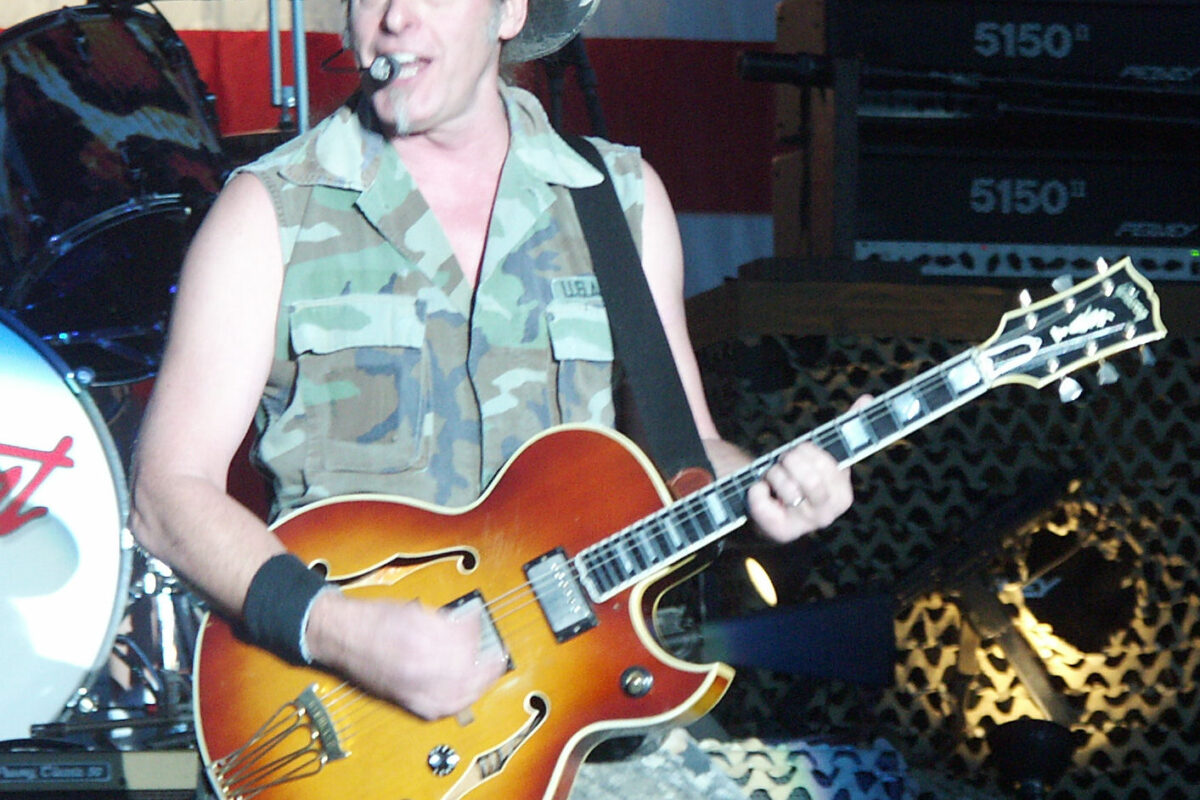
Ted Nugent Guitars & Gear: The Complete Guide to the Motor City Madman’s Byrdland Rig
Ted Nugent guitars & gear: the Motor City Madman's Byrdland rig. 12 vintage Gibson Byrdlands, Fender Twin Reverbs, Peavey 6505, zero effects, and the Stranglehold tone.
Ted Turner Guitars & Gear: The Complete Guide to Wishbone Ash’s Twin Guitar Pioneer’s Rig
Ted Turner guitars & gear: Wishbone Ash's twin-lead pioneer. Stratocasters, Firebird, Orange amps, and the Argus-era tone fully explained.