
Gear Timeline
There is a moment in every Derek Trucks performance — you’ve experienced it if you’ve ever been in the room — where the guitar stops being a guitar. It becomes a voice. Not a metaphor for a voice, not something that sounds like a voice, but an actual human vocal expression produced by a piece of wood and wire that somehow bypasses every cognitive filter and lands directly in the emotional center of your chest. The note bends upward, hangs in the air with a vibrato of perfect width and speed, and then resolves into something so musically inevitable that you feel like you’ve always known it was coming. It was always coming. Derek Trucks just found it and showed it to you.
Born in Jacksonville, Florida, on June 8, 1979, Derek Trucks grew up in a household where the Allman Brothers Band was not just background music but a living tradition — his uncle, Butch Trucks, was the band’s drummer, and the music of Duane Allman, Dickey Betts, and the original Brothers was the sonic environment of his childhood. He started playing guitar at eight. By nine he was performing professionally in his father’s band. By his early teens, Sonny Landreth — himself one of the finest slide guitarists alive — saw early footage of the kid playing and told his bassist: “That kid’s got it.” He was right. At twenty, Derek joined the Allman Brothers Band as their lead guitarist. He was younger than the original band members had been when they formed, and he was already extraordinary.
What makes Trucks genuinely remarkable — and what makes his gear story unusually instructive — is the radical simplicity of his approach. He is one of the most technically gifted guitarists of his generation, operating in a musical context that embraces world music, jazz, blues, rock, and Indian classical music simultaneously. His signal chain is: guitar, cord, amp. Occasionally a tuner. That’s it. No overdrive. No reverb pedal. No chorus. No delay. One glass slide. The guitar’s volume and tone knobs. The physical mechanics of his right hand. From these elements, he produces sounds of extraordinary variety, emotional depth, and technical precision. It is among the most complete demonstrations in modern guitar of the principle that tone lives in the hands, not the gear.
He is married to singer-guitarist Susan Tedeschi. The Tedeschi Trucks Band — a twelve-piece ensemble with two drummers, multiple horn players, backing vocalists, and an organ — is the vehicle through which he currently operates, producing music of enormous ambition and equally enormous soul. He plays the Allman Brothers repertoire with the authority of a man who grew up inside it. He plays everything else with the authority of a man who has spent his entire adult life following the music wherever it goes, without regard for genre or convention. Derek Trucks does not stop at the fences. He goes where the music lives.
Background: A Kid From Jacksonville Who Grew Up Inside the Music
The Trucks household in Jacksonville was a place where music was not a hobby but an atmosphere. Butch Trucks — Derek’s uncle and the Allman Brothers Band’s drummer from the beginning — was a constant presence, and the records that shaped the Southern rock canon were the soundtrack of Derek’s childhood. But the specific musical obsession that would define his career came from a single image: a photograph of Duane Allman playing a Gibson SG. The visual — a man with a guitar that looked aggressive and angular, using it to produce sounds of transcendent beauty — imprinted on young Derek with the force of a calling. He later discovered that Johnny Jenkins had also played an SG on the early Otis Redding records, where it sounded, as Trucks described it, “like a cross between a Stratocaster and a Les Paul.” The SG became his guitar not because it was fashionable but because it was his connection to the players who had made the music that mattered to him before he was old enough to understand why it mattered.
He started on guitar at eight, guided early by his father and by the records his family owned. The education was eclectic in the best possible sense: not just the Allman Brothers but John Coltrane, Howlin’ Wolf, Hubert Sumlin, Elmore James, Robert Johnson, Ravi Shankar. That last name is significant. Trucks’ absorption of Indian classical music — its vocabulary of micro-tonal inflection, its approach to melody as a sustained, evolving expression rather than a series of licks, its philosophical relationship between the player and the instrument — shaped his slide playing in ways that separated it from virtually every other American guitarist working in the tradition. He didn’t just learn to play slide. He learned to sing through the slide, the way a trained vocalist learns to shape breath into meaning.
The precocity was genuinely extraordinary and genuinely earned. He was nine years old and playing professionally. By his early teens, the footage of him performing was circulating among serious guitarists in a way that footage of child prodigies rarely does — because serious guitarists tend to be skeptical of child prodigies, correctly recognizing that technical facility at a young age often substitutes for the emotional depth that only life experience can provide. With Trucks, it was different. The depth was already there. The technique would continue to develop, but the musicianship — the understanding of what a note is for, what silence is for, how a phrase creates and releases tension — was present from the beginning.
He joined the Allman Brothers Band in 1999 at the age of twenty, initially as a touring member and eventually as a full member. The position came with enormous expectations: he was playing the guitar parts that Duane Allman had played on Eat a Peach and the Live at Fillmore East recordings, music that had been elevated by critics and fellow musicians to the status of near-mythology. He met those expectations not by imitating Allman — an approach that would have produced a technically impressive but ultimately lifeless tribute — but by understanding what Allman had been doing and doing his own version of the same thing. There is Trucks’s playing of “Whipping Post” and “In Memory of Elizabeth Reed” and “Dreams,” and it sounds like Derek Trucks, not Duane Allman. This is exactly right. The highest tribute to a great player is to carry the tradition forward in your own voice, not to preserve it like a museum exhibit.
The Derek Trucks Band, which ran parallel to his Allman Brothers tenure, produced a series of albums that explored his interest in world music, Indian classical influences, and jazz-inflected blues with increasing confidence and ambition. Songlines (2006) won the Grammy for Best Contemporary Blues Album. Already Free (2009) continued the expansion. When the Allman Brothers Band finally dissolved in 2014, the Derek Trucks Band merged with Susan Tedeschi’s band to become the Tedeschi Trucks Band, which has become one of the most impressive and successful live acts in American music — a twelve-piece ensemble that can do anything and does most things extraordinarily well.
His approach to his own development is characteristically direct and unsatisfied: “You’re always trying to find new things, keep pushing, keep searching. It could be scary that I try to never play the same thing twice, but most of my heroes played that way.” He also has a particularly clear-eyed view of gear’s role in all of this: “It’s in your hands. Good guitars, good amps — all that stuff helps. But it doesn’t make a player.” He demonstrated this point directly when he encountered Hubert Sumlin — whose tone with Howlin’ Wolf was legendary — backstage at a festival, playing through a brand-new, off-the-shelf Fender amp with a Gibson that still had the store tag on it, sounding exactly like Hubert Sumlin. The gear doesn’t make the player. But the player can make almost any gear sing.
The Rig: Derek Trucks’ Guitars, Amps, and Effects
Derek Trucks’ gear philosophy is minimalism in service of maximum expression. Every element of his setup has been chosen with extreme deliberateness, and every element that has been eliminated has been eliminated because it got between him and the music. The result is one of the simplest professional rigs in contemporary guitar — and one of the most immediately recognizable sounds.
Guitars
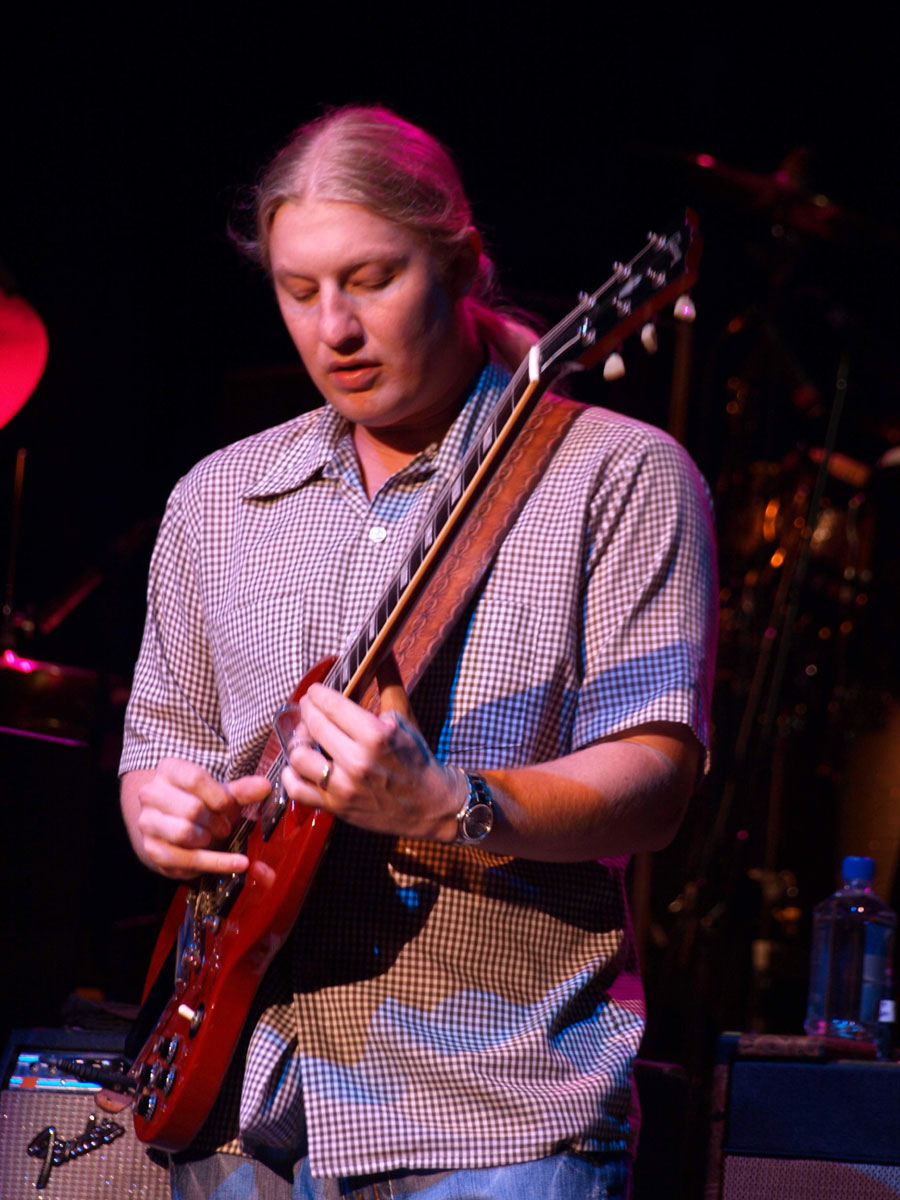
The guitar that Derek Trucks has played as his primary instrument for most of his professional career is not — despite the obvious Allman Brothers connection — a Duane Allman guitar. It is a Dickey Betts guitar. In 2001, Gibson produced a limited run of Dickey Betts signature SGs, and Betts gave Trucks Artist Proof #4 directly — a passing of the torch between the two men who had carried the Allman Brothers’ guitar legacy across different generations. The guitar subsequently became even more personally significant when Duane Allman’s daughter gave it to Derek. As he described it: “Duane Allman’s daughter gave me this one so that’s pretty great, pretty special. It’s been our main guitar since I got it.” This layering of connection — Dickey Betts’ design, Duane Allman’s daughter’s gift, Derek’s use — gives the instrument a kind of accumulated gravity that goes beyond its physical properties.
The guitar’s specifications are central to understanding Trucks’ tone. The Dickey Betts SG features vintage PAF-style humbuckers with a clear, articulate, moderate-output character — not high-gain modern pickups, but the early-style Patent Applied For design that prioritizes clarity and harmonic richness over raw output. The neck profile measures .818 inches at the first fret and .963 at the twelfth — a specific dimension that Trucks describes as “the perfect slide guitar neck.” The aged cherry finish uses thin nitrocellulose lacquer, which many players believe allows the wood to resonate more freely than the heavier polyurethane finishes used on modern instruments. The guitar is extremely light — a quality Trucks values highly, noting that in his experience, the lighter Gibson SGs consistently sound better than heavier ones. The pickup winding, per a later MusicRadar interview, has been customized: Thomas “Toneshaper” Neilson in Norway wound replacement pickups based on a 1959 Les Paul (“Spot,” formerly owned by Joe Bonamassa) that Trucks had played and loved. These unwaxed, unpotted pickups provide maximum microphonic sensitivity and harmonic bloom. The guitar has artificial routing holes — now genuinely worn and contributed to by years of play. “We’ve been messing with the pickups quite a bit,” Trucks noted. “And maybe the volume pots were changed too.”
Based on his 2000-era ’61 SG Reissue — which was his primary guitar for approximately a decade before the Dickey Betts SG took over — the Derek Trucks Signature SG features grade-A mahogany body and neck, Heritage Cherry high-gloss finish, a slim “true D” neck profile from the early 1960s, rosewood fretboard with 22 medium-jumbo frets, and the PAF 57 Classic humbuckers with Alnico II magnets and 42 AWG enamel-coated wire. The pickups run through 500k potentiometers for both volume and tone — a specification Trucks specifically requested to maximize the pickup’s natural character. This guitar is used as a backup and, in specific circumstances, as a primary instrument when the Dickey Betts SG needs repairs or when a slightly different weight or response is needed.
Before the Dickey Betts SG, Trucks played a ’62 SG Reissue throughout most of the 1990s. This was then replaced by a ’61 SG Reissue — a guitar he used for approximately ten years. The ’61 Reissue originally came with a tremolo tailpiece, which Trucks removed and replaced with a stop-bar tailpiece for better tuning stability and a slightly different resonance characteristic. The SG format — double-cutaway, extremely light mahogany construction, twin humbuckers — has been consistent throughout his career. No Telecasters, no Stratocasters, no Les Pauls as primary instruments. The SG is the guitar.
For specific recording applications where the SG’s brightness and directness would be too aggressive — particularly on Tedeschi Trucks Band material requiring more warmth and tonal complexity — Trucks turns to a 1965 ES-335. The semi-hollow body’s additional resonance and warmth fill out the lower frequencies in a way the SG doesn’t, making it ideal for the fuller, more orchestrated arrangements that the TTB sometimes employs. He used this guitar on several tracks from the band’s 2013 album Made Up Mind.
One of the more endearing entries in Trucks’ collection — a Silvertone 1457, the department store guitar sold through the Sears catalog from 1964 to 1966 with a built-in amp in the case. It costs approximately $500. Trucks loves it. He used it to inspire the track “Down in the Flood” and describes it as a “banger” with “personality” that probably contains plywood. It sounds magnificent when he plays it, which tells you everything you need to know about his relationship with gear. He holds nothing sacred except the music.
For acoustic performances and specifically for the pre-war Delta blues repertoire that informs Trucks’ musical education — Robert Johnson, Elmore James, the tradition that fed into everything that came after — a 1930s National Steel resonator appears. The metal body and resonating cone produce the authentic pre-amplification slide blues sound that no modern acoustic guitar can approximate. This is historically correct use of historically correct equipment.
The Firebird makes occasional appearances in the Tedeschi Trucks Band’s touring rotation for specific tonal applications — its pickup configuration and body resonance produce a character distinctly different from the SG’s. Documented specifically for the TTB song “Come See About Me.”
The slide itself deserves extended discussion because it is the element of Trucks’ setup that most directly shapes his tone, and it is the element that most clearly connects to the tradition he inhabits. Trucks uses a Dunlop 215 Pyrex glass slide — thick-walled, heavy, with a smooth exterior surface. He wears it on his ring finger. Glass slides produce a warmer, rounder tone than metal slides — the molecular properties of glass interact differently with the string’s vibration, producing less metallic brightness and more of the vocal, liquid quality that is the defining characteristic of Trucks’ sound. He was drawn initially to Duane Allman’s use of a Coricidin medicine bottle (a glass pharmaceutical container that became legendary in blues slide history), and the Coricidin’s properties — heavy glass, smooth surface — are essentially what the Dunlop 215 was designed to replicate in a purpose-built instrument. Trucks has his own signature slide from Dunlop. He uses it on his ring finger, which leaves the index and middle fingers free for fingerpicking while the pinky stabilizes the slide on the string. This configuration — slide on ring finger, fingers free for picking — is the technical foundation that allows him to play both slide and conventional passages within the same phrase without removing the slide.
Trucks plays exclusively in open E tuning — E, B, E, G#, B, E (low to high) — for virtually all of his slide work. Open E produces a major chord with no fingers on the frets, and barre positions at any fret produce a major chord in that key. This is the tuning Duane Allman used, the tuning associated with Delta slide blues in the tradition of Robert Johnson and Elmore James, and the tuning that is most naturally suited to the kind of melodic, vocally-inspired slide playing that Trucks practices. He keeps the guitar’s action relatively low — lower than most slide players, who typically raise the action to prevent the slide from touching the frets. Low action with a well-controlled slide hand is more difficult to execute cleanly but produces a faster, more fluid feel that enables the melodic velocity of his playing.
Amps
The amplifier most associated with Derek Trucks’ core tone is the Fender Super Reverb — a four ten-inch speaker blackface combo with approximately forty-five watts of output from its 6L6 tubes. The Super Reverb was also a favorite of Stevie Ray Vaughan’s, and for the same general reasons: it is a clean, warm, full-frequency tube amp with a natural compression quality at moderate to high volumes that gives slide guitar the sustain and bloom it requires without resorting to artificial distortion. Trucks ran vintage Super Reverbs as his primary amp for years, and his tone during this period was defined by their specific character — the way four ten-inch speakers in an open-back cabinet produce a wide, dimensional, slightly loose low-end response that twelve-inch speakers in a closed-back cabinet simply don’t match. When his original Super Reverb was stolen, the loss was significant enough that — according to his tech at the time — multiple guitarists donated their own vintage Super Reverbs to him, and he couldn’t find one that matched the original’s character. This single anecdote tells you how specifically attuned to his amplifier’s properties Derek Trucks actually is, despite his philosophical position that tone is in the hands.
For his touring rig with the Allman Brothers Band and subsequently with the Tedeschi Trucks Band, Trucks adopted a custom Alessandro amplifier head — described by him as a “suped-up Super” with approximately 20% more power than a standard Super Reverb. Alessandro amplifiers are boutique, hand-wired tube designs that maintain the Fender tonal philosophy (clean, warm, American) while offering improved construction quality and slightly modified circuit characteristics. The Alessandro gave Trucks the Super Reverb character he needed at the volumes required for larger venues, with the reliability demanded by professional touring. He ran the Alessandro into custom cabinets and typically paired it with a Fender Super Reverb for a dual-amp setup.
After years of the Alessandro setup, Trucks began using PRS amplifiers — specifically the PRS Original Sewell 100-watt head and subsequently the PRS Dallas 50-watt tube head. His assessment of the transition was characteristically direct: “I tried using a lot of different things, and up until this year when I started using this head, it was just a constant battle. We tried this out at a rehearsal in New York City early this year, and it was just volume and tone, pretty simple, and immediately fit pretty well. It’s been such a blessing to not fight the tone war all night. I can get down to just really playing.” The PRS amps don’t have built-in reverb, which meant adding an external reverb unit — a 1963 Fender Reverb tank, run before the amp input, to preserve the amp’s character while adding the spatial dimension that the Super Reverb’s spring reverb had previously provided.
Since the PRS amps lack onboard reverb, Trucks’ signal passes through a vintage 1963 Fender standalone Reverb unit before hitting the amplifier. This outboard spring reverb adds the ambient depth and spatial character that the Super Reverb’s built-in reverb had previously provided, and the vintage unit’s specific spring tank character — slightly splashy, with a warm decay that complements the amp’s tube compression — is preferable to modern digital reverb alternatives for the organic, live-feeling sound Trucks is after.
Trucks has articulated a specific approach to amp volume that is worth understanding: he treats 8 on the dial as his maximum for both the guitar’s volume control and the amp’s master volume. “You just think it’s time to go, floor it! Flooring it is eight.” Not ten, not eleven — eight. This counter-intuitive restraint is deliberate: at 8, the amp has headroom to respond dynamically to his picking intensity. When he digs in, the amp responds with more volume and saturation. When he plays lightly, the amp backs off. This dynamic range — the amp responding to his hands rather than simply operating at a fixed saturation point — is where much of the expressiveness of his playing lives. At 10, the amp is at its ceiling and can no longer respond dynamically. At 8, it still has room to breathe.
Effects
Derek Trucks’ effects list is, by any measure, absurdly short for a player of his caliber and influence. This is not an accident. It is a philosophy.
The baseline of Derek Trucks’ signal chain is guitar — cord — amp. He has stated explicitly that he can sometimes hear the difference in tone even when running through a tuner pedal, and that on nights when the signal chain feels wrong, his first troubleshooting step is to remove the tuner and run the cable directly into the amp: “I’ll unplug the tuner and make sure the cable is just going right into the amp. Because I want to know that if that isn’t right, then it’s a tube or something else. You’re always trying to find that connection between your hands, what you’re hearing, and the amp, and for me, any time I plug into anything I hear it. Even through a tuner. It knocks it down.” This level of signal chain sensitivity is rare and reflects how completely dependent his playing is on the direct relationship between his hands and the amplifier’s response.
The one documented exception to his no-effects approach came in the specific circumstance of the stolen Super Reverb — a period when he couldn’t find an amp that gave him the natural compression and drive he needed. During a show at the Handlebar in Greenville, South Carolina, he ran an Ibanez TS-808 on top of the unfamiliar amp to approximate the compression and mild saturation his stolen amp had provided. This is not a standard part of his setup — it was a pragmatic response to an emergency. The TS-808’s use was transparent: a very mild boost with minimal tone coloring, enough to push the replacement amp’s tubes into the compression zone he needed.
The Analogman King of Tone — a dual-channel overdrive pedal renowned for its natural, amp-like response — has been documented in Trucks’ contemporary setup for specific applications. When used, it is set at minimum gain for a very subtle push rather than as a distortion source. Consistent with his general philosophy, it functions as an invisible enhancement rather than a noticeable effect.
Trucks keeps this unit on top of his amplifier for what his Instagram documentation describes as “on-the-fly tone adjustments for each song” — a tone-shaping device used between songs to optimize the amp response for different material. This represents the most active effects-adjacent tool in his regular setup.
Confirmed by his guitar tech Bobby Tis in the rig rundown video, the AmpRX BrownBox — a power conditioning and voltage reduction unit — is used to stabilize the amp’s operating voltage and, when reduced, to allow the amp to compress and saturate at lower overall volumes. This is a utility device rather than a tone-shaping effect, but its impact on the amp’s behavior is real and significant.
Trucks makes more active and deliberate use of his guitar’s volume and tone controls than almost any other contemporary guitarist. He uses the volume pot for swells — gradually increasing or decreasing the signal level mid-phrase to create dynamics that no effect pedal replicates with the same organic feel. He uses the tone pot to shift between brighter and warmer voicings within a single song, rolling it back for the “woman tone” (all-neck pickup, tone fully rolled off, producing a thick, dark, cello-like sound) and opening it for presence and cut when the passage demands it. The guitar’s controls, in his hands, are as expressive as a set of effects pedals — more expressive, because they respond to his touch in real time rather than operating at a preset parameter.
Playing Style & Tone Philosophy
Derek Trucks’ playing style synthesizes a wider range of influences than any other guitarist working in the blues-rock tradition, and the synthesis is complete rather than patchwork. He is not a player who quotes from his influences — he has absorbed them so thoroughly that they emerge transformed, recognizable as roots but unrecognizable as quotations.
The Indian classical music influence is the most distinctive and least commonly discussed. Ravi Shankar and the North Indian classical tradition — specifically the concept of raga, of melody as a sustained exploration of a specific emotional and spiritual space, of micro-tonal inflection as the primary vehicle of expression — shaped Trucks’ understanding of what a melodic line is for. In Indian classical music, a melody is not a sequence of notes heading somewhere. It is an atmosphere to inhabit. Notes are placed with attention to their relationships with each other and with the silence between them. Inflection — the bend up to pitch, the ornamentation between notes, the vibrato width and speed — carries as much meaning as the notes themselves. This is exactly how Trucks plays. His slide lines are not licks in sequence. They are sustained melodic environments that the listener enters and inhabits for their duration.
His approach to vibrato is the specific technical element that most directly expresses this influence. He describes his vibrato as more like “a singer’s natural voice modulation” than the aggressive shaking of conventional guitar vibrato. It is subtle, wrist-generated, with a naturalness that takes years to develop. His slide rests on the string with controlled pressure — enough to make clean contact, not enough to push the intonation flat — and the vibrato comes from micro-movements of the entire hand rather than isolated wrist mechanics. The result sounds effortless. It is not effortless. It is the product of years of practice in which “decent results” — by the assessment of experienced slide players — typically take three to five years to achieve.
The fingerpicking approach — playing without a pick, using the thumb and fingers directly on the strings — gives him the same independent-voice capability that Freddie King’s hybrid picking provided: bass strings with the thumb for rhythmic foundation, treble strings with the fingers for melody. But where King’s metal fingerpick created a hard, biting attack, Trucks’ bare fingers produce a softer, warmer, more vocal quality. This matches the glass slide’s rounded tone to create a total sonic environment that is warm, fluid, and human in a way that pick-plus-metal-slide playing never quite achieves.
His tone philosophy is the most explicit and unsentimental of any guitarist in this series: it’s in the hands. Not in the gear. The gear matters only insofar as it gets out of the way and allows the hands to communicate directly with the amplifier. Any element that introduces friction between that communication — an effect that colors the signal, a pedal that compresses the dynamics, an amplifier that imposes its own character too strongly — is a liability. His ideal signal chain has zero friction. Just hands, strings, and amp, with nothing in between that changes what the hands are saying.
How to Sound Like Derek Trucks
Getting anywhere near Derek Trucks’ tone requires accepting from the outset that most of the work is in the technique, not the gear. But the gear still matters, and there are specific choices that make the technique work better.
Guitar: Gibson SG, as light as you can find. The SG’s combination of lightweight mahogany, close-to-the-body neck joint (which affects resonance differently than a Les Paul’s longer neck-to-body transition), and twin humbuckers produces the specific tonal foundation Trucks works from. Look for PAF-style pickups with Alnico II or Alnico V magnets — moderate output, high clarity, sensitive to picking dynamics. The SG Standard is the entry point; the SG Standard ’61 reissue gets you to period-correct specifications.
Slide: Dunlop 215 Pyrex glass slide, worn on the ring finger. Thick, heavy, smooth. The glass produces the warmer, less metallic tone that distinguishes Trucks’ sound from metal-slide players. Set the guitar’s action as low as possible while still allowing clean slide contact — Trucks runs lower action than most slide players, accepting the technical challenge as the price of speed and fluidity.
Tuning: Open E (E, B, E, G#, B, E, low to high). Learn the major, minor, and dominant chord positions in this tuning. Practice scales and melodic lines in open E before attempting Trucks-style phrasing.
Amp: Clean Fender tube amp with as much headroom as possible. Fender Super Reverb is the historically correct choice and still the best sounding option if you can find a good one. Fender Hot Rod DeVille, Blues DeVille, or ’65 Super Reverb reissue are practical modern alternatives. The key is clean, warm, American tube sound with enough power to compress naturally at medium-high volume. Avoid solid-state amps and high-gain settings.
Amp Settings (Fender Super Reverb or equivalent):
| Control | Setting (0–10) | Notes |
|---|---|---|
| Volume | 6–8 | Never past 8 — headroom for dynamic response |
| Bass | 4–5 | Warm but controlled — open E has natural low-end weight |
| Mid | 5–6 | Present — the vocal quality lives in the mids |
| Treble | 5–6 | Clear but not harsh — the glass slide softens top-end |
| Presence | 4–5 | Moderate — definition without brightness |
| Reverb | 2–4 | Light to moderate spring reverb — adds spatial depth |
Guitar controls: Use the neck pickup primarily. Roll the volume back to 7–8 rather than maximum — this preserves dynamic headroom. Use the tone pot actively: full open for bright, cutting slide tones; rolled back to 3–4 for the warm “woman tone” in quieter passages. Practice making these adjustments mid-song with the slide still on your finger.
The crucial practice advice: Play melodically, not lick-based. Think in phrases that breathe and resolve, not in patterns that display technique. The standard recommendation among experienced slide teachers is three to five years before Trucks-style results emerge, regardless of prior experience. This is not discouraging — it is accurate information that lets you calibrate your expectations and practice accordingly.
Influence & Legacy
Derek Trucks occupies a specific and unusual position in the guitar world: he is the clearest living link between the original era of slide guitar blues — Robert Johnson, Elmore James, the Delta tradition — and the contemporary concert and recording world. Not a museum piece, not a revivalist, but a player who has taken the tradition’s vocabulary and extended it in directions that Robert Johnson couldn’t have imagined while remaining recognizably in the same family of music.
His influence on younger slide guitarists is the most direct and measurable dimension of his impact. Players who discovered slide guitar through Trucks’ playing have subsequently worked backward through his acknowledged influences — Allman, Duane Allman specifically, then back to the blues tradition Allman absorbed. Trucks functions as a gateway into the history of the instrument, a contemporary access point to a tradition that might otherwise seem intimidating or remote to younger players. His Grammy-winning Songlines album reached audiences that had never heard of Robert Johnson or Elmore James and gave them a reason to find out.
The Tedeschi Trucks Band’s commercial and artistic success has expanded the audience for serious, skill-driven, tradition-rooted guitar playing in an era when guitar’s cultural centrality has been repeatedly questioned. The band’s live show — three hours of music across an enormous stylistic range, executed at the highest level by twelve exceptional musicians — is a demonstration that the blues-rock tradition is not exhausted. It is simply waiting for players who have done the work to find something genuinely new within it.
The direct lineage comparison — Trucks to Duane Allman, Allman to the blues tradition — is the most important context for understanding his place in guitar history. Duane Allman’s approach to slide guitar and tone is the immediate predecessor to what Trucks does, and understanding how Trucks both inherits and departs from Allman’s approach is a study in how musical lineage actually works. The tradition is not preserved unchanged — it is carried forward by players who have absorbed it and then contributed their own perspective to it.
Similarly, the comparison with Gary Moore’s emotional blues playing illuminates the different paths that commitment to blues expression can take — Moore’s passionate, sometimes overwhelming intensity contrasted with Trucks’ more controlled, more meditatively patient approach, both arriving at genuine emotional depth through entirely different means.
And for those who want to understand how Indian classical music’s influence on Western guitar has produced different results in different hands, the contrast with Carlos Santana’s sustained tone and spiritual approach is revealing — two players who both absorbed Shankar’s influence, both of them made guitars sing in ways that guitars aren’t supposed to, and produced sounds of genuine transcendence from instruments that can produce transcendence only when someone exceptional is playing them.
Derek Trucks is forty-six years old. He has been playing professionally for thirty-seven years. He is in the middle of his career, not approaching its end. The music he is making now — with the Tedeschi Trucks Band, on records like I Am the Moon (2022) — is as ambitious and as good as anything he has ever made. The glass slide keeps singing. The SG keeps answering. The amp keeps telling the truth about what the hands are saying. The tone is in the hands. The hands, it turns out, are extraordinary.
Frequently Asked Questions: Derek Trucks Guitars & Gear
What guitar does Derek Trucks play?
Derek Trucks plays Gibson SG guitars almost exclusively. His primary instrument is the Gibson Custom Dickey Betts SG Artist Proof #4 — a guitar from a limited 2001 run that Dickey Betts personally gave to Trucks, subsequently gifted again by Duane Allman’s daughter. The guitar features vintage PAF-style humbuckers, a specific neck profile (0.818 inches at the first fret) that Trucks considers ideal for slide playing, and an extremely light weight that he values for its effect on resonance and tone. He also plays the Gibson Derek Trucks Signature SG (based on his earlier ’61 Reissue), and maintains a collection that includes a 1965 Gibson ES-335, a Gibson Firebird, a National Steel resonator, and a Silvertone 1457 catalog guitar that he bought for approximately $500 and loves unreservedly.
What slide does Derek Trucks use?
Derek Trucks uses a Dunlop 215 Pyrex glass slide, worn on his ring finger. He was initially drawn to Duane Allman’s use of a Coricidin medicine bottle (a glass pharmaceutical container), and the Dunlop 215’s thick, heavy glass construction approximates the Coricidin’s properties in a purpose-built instrument. Glass slides produce a warmer, less metallic tone than steel slides — the glass interacts with string vibration differently, producing more of the vocal, liquid quality that defines Trucks’ sound. He wears it on his ring finger, leaving his index and middle fingers free for fingerpicking while his pinky helps stabilize the slide on the string. He has his own signature slide model from Dunlop.
What amps does Derek Trucks use?
Derek Trucks has used several amplifiers throughout his career. His foundational amp — the one he credits with establishing his core tone — is the vintage Fender Super Reverb, a four-10-inch-speaker blackface combo. For touring, he subsequently adopted a custom Alessandro AZZ head (described as a “suped-up Super Reverb” with about 20% more power). From 2009 onward, he transitioned to PRS amplifiers — the Original Sewell 100-watt head and later the Dallas 50-watt head. Since the PRS amps lack built-in reverb, he routes his signal through a vintage 1963 Fender Reverb unit before the amp. He consistently runs his amp volume at maximum 8 rather than full, preserving dynamic headroom for expressive response to his playing intensity.
What effects does Derek Trucks use?
Derek Trucks uses almost no effects. His standard signal chain is guitar — cord — amp. He has expressed sensitivity to signal degradation even through a tuner pedal, and his first troubleshooting step when tone feels wrong is to remove any inline devices and run the cable directly into the amp. He occasionally uses an Ibanez TS-808 Tube Screamer for mild boost in specific circumstances (most notably when his vintage Super Reverb was stolen and replacement amps couldn’t provide the natural compression he needed). An Analogman King of Tone appears sparingly for subtle drive. A PCE-FX Aluminum Falcon sits on his amp for between-song tone adjustments. An AmpRX BrownBox manages power conditioning. His guitar’s volume and tone pots, manipulated actively during performance, function as his primary dynamic and tonal controls.
What tuning does Derek Trucks use?
Derek Trucks plays in open E tuning — E, B, E, G#, B, E (low to high) — for virtually all of his slide work. This tuning produces a major E chord with no fingers on the frets and a major chord at any barre position. It is the tuning associated with Delta slide blues, used by Duane Allman and the tradition Allman inherited. Open E allows the kind of droning, ringing chord textures and melodic slide phrasing that defines Trucks’ approach. He keeps the guitar’s action relatively low compared to most slide players — accepting the technical challenge of clean intonation as the price of the fluid, fast-feeling response he needs for his melodic style. He typically keeps one backup guitar tuned one whole step down in Drop D for specific material.
How is Derek Trucks influenced by Indian classical music?
Derek Trucks’ absorption of Indian classical music — particularly through Ravi Shankar and the North Indian raga tradition — fundamentally shaped his understanding of melody and phrasing. In Indian classical music, melody is not a sequence of notes but an atmosphere to inhabit, with micro-tonal inflection (bends, ornaments, vibrato) carrying as much expressive weight as the notes themselves. Trucks applies this philosophy to slide guitar: his phrases are sustained melodic environments rather than lick sequences, each note placed with attention to its relationship with surrounding notes and the silence between them. His vibrato — subtle, wrist-generated, modeled on vocal vibrato rather than aggressive guitar technique — directly reflects this influence. He describes it as “like a singer’s natural voice modulation.” This is the element most responsible for the “vocal” quality that listeners consistently identify in his playing.
Is Derek Trucks related to Allman Brothers drummer Butch Trucks?
Yes. Derek Trucks is the nephew of Butch Trucks, who was the Allman Brothers Band’s drummer from the band’s founding in 1969 until his death in 2017. This family connection gave Derek early and intimate exposure to the Allman Brothers’ music and the Southern rock tradition, but his incorporation into the band as lead guitarist at age twenty was earned entirely on musical merit. As slide guitar maestro Sonny Landreth noted after seeing footage of the teenage Derek playing: “Any sense of Southern rock nepotism evaporated as he ascended through the ranks on his own merits.” Derek joined the Allman Brothers Band in 1999 and remained a member until the band’s dissolution in 2014. He is married to singer-guitarist Susan Tedeschi, and the Tedeschi Trucks Band, which they co-lead, is their primary performing and recording vehicle.
Related stories
Vernon Reid Guitars & Gear: The Complete Guide to Living Colour’s Guitar Genius’s Rig
Vernon Reid's guitars, amps, and effects — the complete guide. Parker MaxxFly, PRS Vela VR, Mesa Dual Rectifiers, Roland VG-99, Eventide H9, Living Colour gear guide.
Warren DeMartini Guitars & Gear: The Complete Guide to Ratt’s Torch Guitarist’s Rig
Warren DeMartini guitars & gear: Ratt's Torch guitarist. Charvel Bomber, snakeskin, Jose-modded Plexi, Fender Super Champ, RTM pickup, slapback echo — the complete rig.
Warren Haynes Guitars & Gear: The Complete Guide to Gov’t Mule’s Guitar Master’s Rig
Warren Haynes' guitars, amps, and effects — the complete guide. Gibson Les Paul Chester, Soldano SLO-100 modified, Klon Centaur, Emma Discombobulator, and how to nail that Gov't Mule blues-rock tone.