
Gear Timeline
“Simple Man” was written about Gary Rossington. Not specifically — Ronnie Van Zant’s mother contributed the lyrics about a mother’s advice to her son, and the song has the universal quality that makes it genuinely applicable to anyone who hears it and recognizes the advice within it. But Van Zant explained it himself: “That one was about Gary.” The boy with his old guitar who’s got a dream that will never die. The man whose presence through Lynyrd Skynyrd’s many incarnations was essential — the last rebel, the only founding member to be part of the group’s entire active career from its 1964 formation to his death on March 5, 2023, at the age of seventy-one. The guitar player described by his friend and guitar tech as a “guitars as tools” musician: “Choosing gear for a tour, he’d say, ‘Where’s my SG? Where’s my Les Paul? Let’s go!'” He didn’t do guitar safaris on tour stops. He didn’t chase collectible pieces. He didn’t obsess over tones. He played the guitar, and the guitar played the music, and the music was Lynyrd Skynyrd. That’s the Gary Rossington gear philosophy in its most complete form: the instrument is the vehicle, the music is the destination, and you can stop worrying about the vehicle as long as it gets you where you’re going.
The Journey
Gary Rossington was born on December 4, 1951, in Jacksonville, Florida — a year before Allen Collins, three years before Ronnie Van Zant — and co-founded the band that would become Lynyrd Skynyrd in 1964 at age thirteen with Van Zant and Collins, forming the original creative triangle around which the Southern rock institution built its sound. Where Collins was the primary lead guitar voice, Rossington was the rhythm guitar foundation, the slide guitar voice, and the songwriter whose chord progressions underpinned some of the most celebrated songs in American rock. He developed the banjo/steel guitar-style fingerpicked D-C-G progression that became “Sweet Home Alabama” — described modestly in his own account as “I had this little riff” — and came up with the chord progression at the end of “Free Bird” that Allen Collins then played over: “Ronnie said, ‘Why don’t you do something at the end of that so that I can take a break for a few minutes.’ So I came up with the ending chord progression and Allen played over them, then I soloed and then he soloed — it all evolved out of a single jam we had one night.”
The guitar approach that produced these specific riffs — the fingerpicked D-C-G of “Sweet Home Alabama,” the slide guitar of “Free Bird,” the rhythm foundation of the entire Lynyrd Skynyrd catalog — is fundamentally different from the lead guitar approach of Allen Collins or the technical virtuosity of Steve Gaines. Rossington’s specific musical intelligence was rhythmic and harmonic rather than melodic and improvisational: he thought in chord progressions, in the relationship between the guitar and the song’s rhythmic foundation, in the specific quality of how a guitar part supports a vocal melody and a lyrical statement. “Simple Man” exists as a song because of the chord progression that Gary Rossington played; the chord progression has the specific warmth and Southern weight that Ronnie Van Zant’s lyric required. The guitar serves the song. This is the Rossington philosophy.
His survival through the October 1977 plane crash — the crash that killed Van Zant, Steve Gaines, and Cassie Gaines, and that injured Collins and other band members — is the biographical fact that positioned him as the carrier of the Lynyrd Skynyrd legacy through the subsequent forty-six years. He was the surviving founder. He was the one who could tell the story. As he said in his final years: “I’m the only one left that gets to tell about it.” This responsibility — the specific burden and honor of being the last original member — shaped his subsequent career in ways that go beyond the purely musical. He continued the band when continuation was difficult; he maintained the name and the legacy when others might have retired; he played “Free Bird” and “Sweet Home Alabama” every night for decades because those songs deserved to be played and he was the one who remained to play them.
He died on March 5, 2023, after long-term health issues, primarily heart-related — the same organ that had failed so many of his Skynyrd brothers before him. The band announced: “Gary is now with his Skynyrd brothers and family in heaven and playing it pretty, like he always does.” The boy with the old guitar. The dream that never died. The “guitars as tools” musician who never stopped reaching for the SG and the Les Paul, choosing the music over the mythology, until the heart gave out.
Background: Hell House, the Riffs That Built Southern Rock, and the Last Rebel
Hell House — the lake cabin outside Jacksonville where Lynyrd Skynyrd lived and rehearsed in the early 1970s, so named for the rigorous rehearsal schedule that Ronnie Van Zant imposed — is where the foundational Lynyrd Skynyrd catalog was written. “Simple Man,” “Tuesday’s Gone,” “Sweet Home Alabama,” “Don’t Ask Me No Questions,” “Gimme Three Steps” — the songs that defined Southern rock as a genre emerged from the specific creative environment of Hell House, where the band lived together, rehearsed constantly, and developed the collaborative songwriting approach that produced the Pronounced Leh-nerd Skin-nerd debut album and Second Helping within a year of each other. Rossington’s guitar playing was central to this creative environment: his chord progressions provided the harmonic structure that Van Zant’s lyrics and vocal melodies inhabited, and the specific Southern warmth and blues inflection of his guitar parts gave the songs their tonal identity.
The “Sweet Home Alabama” riff — Rossington’s “little riff” that became one of the most recognized guitar figures in American rock — emerged from a collaborative studio moment on the Second Helping sessions. “Gary had been playing his riff for 15 minutes when I walked in and threw mine in to bounce off of what Gary was doing,” Ed King recalled of the session. “That was what you know as the ‘Sweet Home’ riff, and when Ronnie heard it, he locked in and wrote the words.” The casual collaborative process — Rossington playing a riff for fifteen minutes, King adding to it, Van Zant writing lyrics in response — is the specific creative environment from which Lynyrd Skynyrd’s best work emerged, and Rossington’s guitar was always at the center of that environment as the rhythmic and harmonic foundation on which everything else was built.
His survival of the 1977 plane crash came with its own cost: a 1976 car accident had already seriously injured him before the plane crash added further physical damage, and subsequent cardiac events across the following decades — he underwent multiple heart surgeries — created the pattern of health challenges that the Guitar Player tribute described as triumphing over catastrophe “numerous times.” The Premier Guitar profile called him “a cat on its ninth life.” This physical resilience — surviving accidents, crashes, surgeries, and the accumulated physical demands of fifty-plus years of professional touring — was matched by a specific creative and emotional resilience: the willingness to continue playing the same songs night after night, across decades, with the specific commitment that the songs’ emotional content demanded rather than the mechanical repetition of routine performance.
His slide guitar playing is one of Southern rock’s most distinctive and most underappreciated guitar voices. The slide work on “Free Bird” — the first solo section of the extended outro, before Collins’s lead lines take over — represents Rossington’s most immediately audible lead guitar contribution to the song, and it has the specific qualities of the best electric slide playing: warmth, expressiveness, and the specific quality of a sustained note that seems to inhabit the space between pitches rather than occupying any single one. He used a standard glass or metal slide and played primarily on the upper strings, with the specific tone of his Les Paul or SG through the Peavey or Marshall providing the warm, natural saturation that electric slide guitar requires.
The Rig: Gary Rossington’s Guitars, Amps, and Effects
Guitars
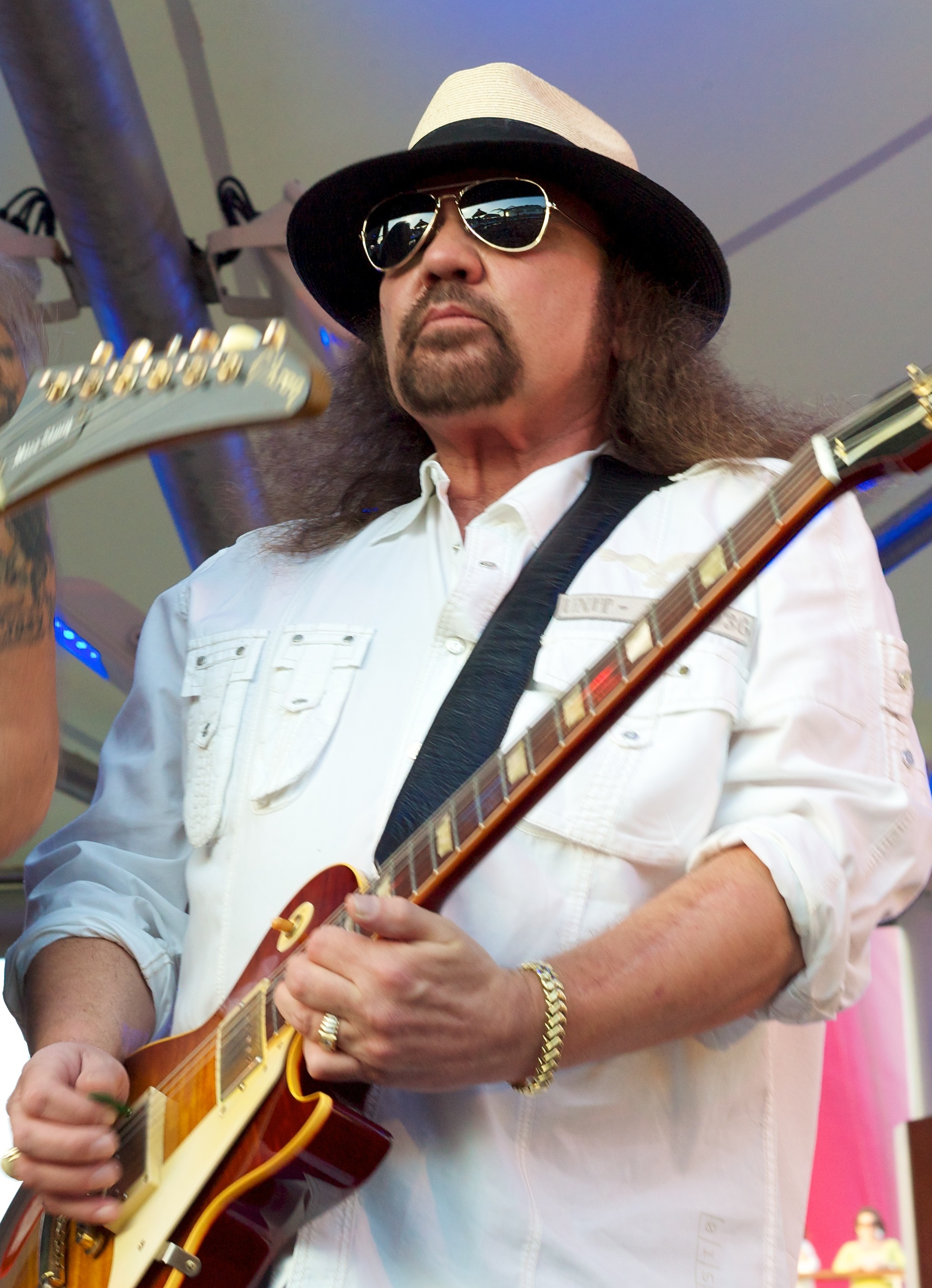
The Gibson SG Standard is Rossington’s primary stage guitar for the modern Lynyrd Skynyrd period — confirmed in multiple sources and in the descriptions from his guitar tech and friend Yonke. The “guitars as tools” philosophy is epitomized by the SG choice: it is a lighter, more comfortable instrument than the Les Paul for extended live performance, with the double-cutaway design providing easy upper-fret access and the reduced weight reducing physical strain across long sets. The SG Standard features PAF-style humbucker pickups in the neck and bridge positions — the same Gibson humbucker family that Rossington has used throughout his career — with the SG’s mahogany body providing warm, resonant fundamental tone and the thinner profile producing a slightly brighter, more cutting character than the thicker Les Paul body. His ’61 Les Paul SG Standard and ’66 SG Standard are among the historically significant instruments in his collection, documented by Chicago Music Exchange after his death — vintage guitars that he used as working instruments rather than as collectibles, consistent with the “guitars as tools” philosophy that defined his relationship with equipment throughout his career.
The Gibson Les Paul Standard is Rossington’s primary recording guitar — the heavier, thicker-sounding Gibson that he favored for studio work where the additional warmth and sustain of the full-thickness mahogany/maple-top construction served the recording context better than the SG’s more cutting character. The Les Paul Standard’s PAF-style humbuckers and the specific combination of mahogany body warmth and maple cap brightness produce the classic Gibson electric guitar character — warm, sustaining, with the harmonic complexity that makes a chord progression sound complete rather than merely functional. For the “Sweet Home Alabama” rhythm guitar, for the “Simple Man” chord work, and for the slide guitar passages that appear across the Lynyrd Skynyrd catalog, the Les Paul’s specific acoustic character is the appropriate vehicle. Rossington’s approach — cranking up the preamp on his Peavey or Marshall and controlling the distortion with his guitar’s volume pot — particularly suits the Les Paul’s controls, where rolling back the volume produces a genuinely clean tone from a high-gain amplifier setting, and pushing the volume forward produces the specific natural crunch that Southern rock guitar requires.
Gibson released a Gary Rossington signature SG model in 2011 — a specific production signature based on his primary performing SG. The signature features a mahogany body with ’57 Classic humbuckers, a rosewood fingerboard, and the specific hardware configuration of Rossington’s personal instrument. The ’57 Classics are Gibson’s vintage-voiced PAF-style humbucker that replicates the character of the original Patent Applied For pickups — warm, harmonically complex, with the specific midrange character and natural compression of the low-output vintage design. The Rossington signature SG represents the Gibson Custom and standard production division’s recognition of his status as a defining SG player in Southern rock history, placing him alongside other SG-associated guitarists whose musical identity is inseparable from the instrument’s specific character.
Rossington also has Gibson Les Paul signature models in his documented relationship with the brand — reflecting his dual-guitar identity as both an SG player (live) and a Les Paul player (recording and specific applications). The Les Paul signature models carry the same vintage-voiced humbucker configuration as the SG signature, with the Les Paul’s heavier body and maple cap providing the instrument’s characteristic combination of warmth and brightness. Both signature lines confirm Rossington’s status as one of Gibson’s most associated artists in the Southern rock tradition.
A 1964 Fender Stratocaster is referenced in the Lynyrd Skynyrd band equipment documentation alongside the Gibson Les Paul Standard as representative of the guitar family used by the band. In the Skynyrd triple-guitar context, the Stratocaster’s single-coil brightness contributed a different tonal color from the humbucking warmth of the Gibson instruments, and different Skynyrd guitarists used Stratocasters for specific songs — Ed King’s “Sweet Home Alabama” intro riff was played on a Stratocaster, providing the specific bright, jangly character that distinguishes it from the warmer Gibson rhythm parts.
Amps
Peavey amplifiers were the primary touring amplification for Lynyrd Skynyrd across the band’s commercial peak period — supplied to the band as they gained commercial momentum, with the Peavey’s specific character of reliable, high-volume performance suiting the demanding touring schedule of one of America’s most active live acts. “As Skynyrd gained steam, they were supplied Peavey amps that served them well,” as the Vintage Guitar account of Rossington’s guitars describes the Skynyrd amplification history. Peavey’s American-made valve and solid-state amplification had a specific character different from the British Marshall family — more transparent, with a different harmonic character in the overdrive, and the specific kind of reliability that sustained touring demanded. Rossington’s approach — cranking up the preamp and controlling distortion with the guitar’s volume pot — worked particularly well with Peavey’s clean headroom, which gave the guitar’s volume control a wide dynamic range from clean to crunch. His Peavey amplifiers from the Skynyrd touring era are documented as part of the back line equipment that was stored at Chicago Music Exchange after his death, alongside the Marshall stacks from the band’s earliest days at Hell House.
Marshall amplifiers — specifically the Marshall stacks from the band’s earliest days at Hell House — are documented alongside the Peavey amplification in the Rossington equipment history. The Premier Guitar profile confirms that Rossington “cranks up the pre-amps on his Peaveys or Marshalls” — confirming both brands as part of his amplification history. The Marshall back line stacks from the Hell House era represent the amplification through which the foundational Lynyrd Skynyrd songs were written and first performed: “Simple Man,” “Tuesday’s Gone,” “Sweet Home Alabama,” “Don’t Ask Me No Questions,” and “Gimme Three Steps” were developed through the Marshall amplification of the early-1970s Skynyrd rehearsal and performance environment. The specific Marshall character — EL34-powered British warmth and midrange — provided the warm, natural saturation that suited Rossington’s slide guitar and rhythm work in ways that aligned with the Southern rock tonal tradition.
For live performance, Rossington used standard 4×12 speaker cabinets — paired with the Peavey or Marshall heads for the specific acoustic projection that arena and theater-level Southern rock performance required. The specific speaker loading is not as precisely documented as some other players in this series, but the standard Celestion or equivalent speaker loading appropriate for the amplifier brands used is consistent with the “guitars as tools” pragmatic approach that characterized his entire equipment philosophy.
Effects
The most significant “effect” in Gary Rossington’s signal chain is not a pedal but a component of the guitar itself: the volume pot that he uses to control the distortion level of his cranked Peavey or Marshall amplifier. Rossington cranks up the pre-amps on his Peaveys or Marshalls and controls the distortion with his guitars’ volume pots. This approach — setting the amplifier to high-gain saturation and using the guitar’s own volume control to regulate between clean and overdriven — is the specific technique that gives Southern rock guitar its characteristic dynamic quality: roll the volume back and the guitar cleans up; push it forward and the natural crunch appears. The Les Paul and SG’s volume pots behave differently from each other in this application — the Les Paul’s standard taper pot cleaning up in a specific way, the SG’s slightly different. Both suit the approach, but both require the guitarist to understand that the volume control is a dynamic tool rather than a set-and-forget switch.
Rossington’s slide guitar technique is his most distinctive personal guitar voice and the element of his playing that most specifically distinguishes his contribution from Allen Collins’s lead guitar work. The slide work in “Free Bird” — the initial solo section of the song’s extended outro, before Collins’s lead lines — represents Rossington’s most widely heard slide playing, and it demonstrates the specific qualities of his approach: warmth, expressiveness, the ability to make a sustained note feel like it’s searching for something rather than simply arriving at a pitch. The slide technique requires a separate physical discipline from standard fretting — the glass or metal slide replaces finger pressure with the slide’s contact pressure, and the intonation is entirely the player’s responsibility rather than the fret’s — and Rossington’s slide playing demonstrates the development of this separate discipline alongside his standard fretting technique across decades of professional playing.
Rossington’s effects philosophy is documented explicitly: he does not use many effect pedals but relies on the built-in effects of his amps. The “guitars as tools” approach extends to the signal chain: what serves the music is what’s used, and what the music requires is the guitar’s fundamental tone through a good amplifier. The built-in reverb of the Peavey or Marshall amplifiers provides the spatial dimension appropriate for Southern rock guitar; no additional processing is required. This minimal approach is consistent with the blues-rock tradition that Southern rock extends — the tradition in which the guitar, the amplifier, and the player’s technique are sufficient for complete musical communication without additional signal processing.
The Guitar World amp settings recommendation for the Gary Rossington tone includes reverb at 3 — a gentle room-sound reverb from the amplifier’s built-in spring or digital reverb that adds natural spatial dimension without introducing the obvious wetness of heavy reverb treatment. This amp-provided reverb is the only atmospheric processing in Rossington’s documented signal chain, consistent with the minimal-effects philosophy and with the Southern rock tradition’s preference for natural, unprocessed guitar tone with just enough spatial dimension to feel live rather than clinical.
The Rossington-Collins Band — the post-crash project he formed with Allen Collins, with Dale Krantz as vocalist — produced two albums that demonstrated the continuing creative partnership between the two guitarists even in the absence of the Skynyrd context. Rossington and Krantz fell in love making music together and eventually married — one of the more affecting personal consequences of the post-crash musical reconstruction. The Rossington-Collins albums contain guitar work of the same quality as the Skynyrd records, with Rossington’s rhythm and slide guitar providing the same foundational warmth and Collins’s leads the same directness and emotional architecture. The dissolution of the band in 1982 following Collins’s health issues ended the most direct continuation of the original Skynyrd creative partnership.
His cardiac health — the multiple heart surgeries across the decades following the crash — is a biographical constant that adds weight to the later career. Each cardiac event was survived; each round of touring continued after recovery. The Premier Guitar profile’s observation that he was a cat on its ninth life is both metaphorically apt and literally remarkable: the physical accumulation of the 1976 car accident, the 1977 plane crash injuries, and multiple subsequent cardiac events did not prevent him from maintaining the touring schedule until the health issues finally ended it. He played until he could not. The guitar was always the tool and the music always the destination.
Playing Style & Tone Philosophy
Gary Rossington’s guitar playing is the foundation of the Lynyrd Skynyrd sound in the most literal sense: his chord progressions are the structure on which the songs stand, his rhythm guitar is the engine that drives them forward, and his slide guitar is the melodic voice that expresses them in their most emotionally direct form. Unlike the more lead-oriented guitarists who co-occupied the Skynyrd stage — Collins, Gaines, later Rickey Medlocke — Rossington’s primary identity was as a rhythm player, a chord architect, a musician whose specific contribution was creating the harmonic and rhythmic environment in which the other guitars, the bass, the keyboard, the drums, and the vocal could all find their places.
The “guitars as tools” philosophy is the most complete expression of his musical identity. He was not interested in the guitar as a cultural object, as a collectible, as a status symbol, or as a demonstration of refined taste in vintage instruments. He was interested in the guitar as the means by which the music was made, and he chose instruments — the SG, the Les Paul — that worked reliably and consistently for that purpose. The specific warmth of Gibson humbuckers through a cranked Peavey or Marshall, with the distortion controlled by the guitar’s own volume pot, provided all the tonal range he needed: clean for the verse chord progressions, crunchy for the heavier sections, warm and sustaining for the slide passages. The guitar’s volume pot was his tone control, his dynamics processor, and his primary expressive tool beyond the physical technique of the picking hand and the slide.
His tone is described by Guitar World as “pretty smooth, a lightly overdriven sound rather than a crunchy one, which puts it somewhere between classic rock, blues, and country sound.” This characterization — smooth, lightly overdriven, between genres — is the most accurate available description of the specific tonal quality that makes Rossington’s rhythm and slide guitar immediately identifiable within the Lynyrd Skynyrd context. It is not the aggressive crunch of hard rock rhythm guitar; it is not the clean sparkle of country guitar; it is the specific Southern rock quality that sits between all of these, warm and present and entirely in service of the song.
How to Sound Like Gary Rossington
The Gary Rossington tone requires: a Gibson SG or Les Paul (humbuckers, volume pot used as dynamic control); a Peavey or Marshall amplifier cranked on the preamp with the master volume at performance level; no effects beyond amp reverb; the guitar’s volume pot used to control the clean/crunch transition; and the specific rhythmic approach of a guitarist who is playing for the song rather than for the solo. The slide guitar requires a glass or metal slide, the Le Paul or SG’s warm tone, and the patience to develop the intonation precision that slide guitar demands.
| Control | Setting (0–10) | Notes |
|---|---|---|
| Amp Gain / Preamp | 5–6 | Per Guitar World: Gain 5. Moderate preamp — the guitar’s volume pot controls the actual distortion level. Set the amp to moderate gain and let the guitar’s volume control do the dynamic work. At full guitar volume: light crunch appropriate for Southern rock rhythm. At lower guitar volume: clean chord work. This is the Rossington approach. |
| Bass | 6 | Per Guitar World: Bass 6. Moderate bass — Rossington’s tone is described as “not thick at all, without much low-end range.” The Gibson humbucker’s natural warmth provides bass character without requiring amp bass boosting. Controlled rather than boosted. |
| Mid | 7 | Per Guitar World: Middle 7. Present midrange — the heart of the Southern rock guitar character. Rossington’s tone is described as “quite bright, creating a great contrast with his Les Paul, as these guitars are quite warm by default.” Present mid at 7 combined with amp treble creates the specific brightness against the Les Paul’s warmth. |
| Treble | 7 | Per Guitar World: Treble 7. Moderate-to-present treble for the specific brightness of the Rossington tone. Higher than many Les Paul players set it — compensating for the instrument’s natural warmth to produce the specific Southern rock clarity. |
| Reverb | 3 | Per Guitar World: Reverb 3. Gentle amp reverb — natural spatial dimension without obvious wetness. The only processing in the Rossington signal chain beyond the guitar-amp combination. Built into the amp rather than a separate pedal. |
| Guitar Volume Pot | 7–10 (dynamic control) | This is the primary dynamic control. At 10: the light crunch of a moderately gained amp driven by the Les Paul or SG’s full output. At 7: noticeably cleaner, appropriate for chord passage transitions. The specific taper of the Gibson volume pot enables this dynamic range. Use the guitar’s volume control while playing — not as a set-and-forget control but as a real-time dynamic tool. |
| Slide Technique | Glass or metal; upper strings; warm open tuning | For the “Free Bird” slide intro and other Skynyrd slide passages: use a glass or metal slide, work primarily on the upper strings, and use the Les Paul’s warm humbucker tone with the amp at the moderate gain setting. Open tunings (open E or open D) suit Rossington’s slide approach. Intonation is entirely the player’s responsibility — the slide must be placed precisely above the fret for correct pitch. This requires patient, deliberate practice. |
Influence & Legacy
Gary Rossington’s influence on Southern rock and American rock guitar is foundational in the specific way that a rhythm guitarist’s influence is always foundational: less visible than the lead guitarist’s, less immediately audible in any single note, but structurally essential to everything that the music is. The chord progression that became “Sweet Home Alabama,” the rhythm guitar foundation of “Simple Man,” the slide guitar intro of “Free Bird” — these contributions are not lead guitar showcases but architectural decisions that made it possible for the songs to be what they are. Remove Rossington’s guitar from any of these recordings and the songs do not work the same way. His presence was the structure; the other guitars built on it.
The Black Crowes and Metallica — cited by Guitar World as among the groups who took inspiration from Rossington and Lynyrd Skynyrd — represent the breadth of the Skynyrd influence across genres. The Black Crowes absorbed the Southern rock guitar approach most directly, applying its warmth and blues-rock vocabulary to their own albums in ways that acknowledge the Skynyrd tradition explicitly. Metallica’s connection is less obvious but documented: the specific quality of rhythm guitar discipline, the commitment to the song over the solo, the understanding that the foundational guitar work is as important as the showcase playing — these Rossington values are audible in James Hetfield’s rhythm guitar approach in ways that Southern rock and thrash metal don’t often share but demonstrably do.
“Simple Man” was written about him. The boy with his old guitar who’s got a dream that will never die. He lived the song across a fifty-nine-year career, from the My Backyard band in 1964 to the final Skynyrd touring before his death in 2023. He was the last one left to tell about it. He told it every night. For the Allen Collins lead guitar partnership that defined the Skynyrd classic sound, see Allen Collins’s gear history — the lead voice to Rossington’s rhythmic foundation. The broader Southern rock tradition that Rossington helped create connects to Charlie Starr’s Blackberry Smoke continuation. And the Gibson SG tradition that Rossington inhabits runs through the broader Gibson dual-humbucker rhythm guitar approach documented throughout this series, most directly through the British blues-rock players who established the SG as a rock rhythm guitar instrument — including Tony Iommi’s foundational SG work in this series’s broader context.
The boy with his old guitar. The last original member. The dream that never died — until the heart gave out on March 5, 2023, and Gary Rossington went to play it pretty with his Skynyrd brothers. The SG is in the case. The Peavey is silent. The chord progression of “Sweet Home Alabama” plays on every radio in the South, and in the North, and everywhere that Southern rock has reached — which is everywhere that American music has reached. That is the Gary Rossington legacy. It is not measured in solos. It is measured in songs. In riffs. In the specific warmth of a Gibson humbucker through a cranked Peavey with the volume pot doing the work that the amp won’t quite do on its own. Simple, man.
Frequently Asked Questions: Gary Rossington Guitars & Gear
What guitar did Gary Rossington use?
Gary Rossington primarily used Gibson guitars throughout his career — both the SG Standard for live performance and the Les Paul Standard for recording. His guitar tech described him as a “guitars as tools” musician: “Choosing gear for a tour, he’d say, ‘Where’s my SG? Where’s my Les Paul? Let’s go!'” Gibson released a Gary Rossington Signature SG in 2011, featuring mahogany body, ’57 Classic humbuckers, and rosewood fingerboard. Gibson also produced Les Paul signature models. His historically significant guitars include vintage ’61 Les Paul SG Standards and a ’66 SG Standard, documented by Chicago Music Exchange after his death. He also used a 1964 Fender Stratocaster in specific Lynyrd Skynyrd contexts.
What amplifiers did Gary Rossington use?
Rossington’s primary amplification was Peavey — supplied to Lynyrd Skynyrd as the band gained commercial momentum, and serving them well through the peak touring years. His guitar tech confirmed that Marshall stacks from the band’s earliest days at Hell House (the lake cabin where they wrote “Simple Man,” “Sweet Home Alabama,” and “Tuesday’s Gone”) were also significant early amplification. The Premier Guitar profile confirms he “cranks up the pre-amps on his Peaveys or Marshalls and controls the distortion with his guitars’ volume pots” — the specific volume-pot-as-dynamic-control approach that defines his tonal philosophy. His effects were minimal: he relied on the built-in effects of his amps, primarily a gentle reverb, rather than external pedals.
What is “Simple Man” about and how does it connect to Gary Rossington?
Ronnie Van Zant confirmed that “Simple Man” — the song whose lyrics speak of a mother’s advice to “be a simple kind of man” and the “boy with his old guitar” who’s “got a dream that will never die” — was written about Gary Rossington. Van Zant explained: “That one was about Gary.” The Guitar Player tribute called Rossington “the Last Rebel” and described his presence through Lynyrd Skynyrd’s many incarnations as essential. The song’s chord progression — a warm, gentle acoustic and electric guitar arrangement — reflects Rossington’s specific guitar style: simple, direct, in service of the lyric and the emotion rather than demonstrating technical virtuosity. “Simple Man” is, in this sense, not just a song about Rossington but a musical demonstration of his approach.
What is Gary Rossington’s role in “Sweet Home Alabama”?
Rossington developed the banjo/steel guitar-style fingerpicked D-C-G progression that became the foundational chord movement of “Sweet Home Alabama.” He described the origin modestly: “I had this little riff.” His account of the recording session — “Gary had been playing his riff for 15 minutes when I walked in and threw mine in,” as Ed King recalled — confirms that Rossington’s progression was the starting point that Ed King’s lead guitar figure and Ronnie Van Zant’s lyrics were then built upon. The “Sweet Home Alabama” intro riff is primarily Ed King’s lead guitar contribution played on a Stratocaster, but the underlying chord progression is Rossington’s foundational contribution without which the song as we know it would not exist.
What is Gary Rossington’s slide guitar technique?
Rossington’s slide guitar is his most distinctive personal lead guitar voice — most prominently heard in the initial solo section of “Free Bird”‘s extended outro, before Allen Collins’s lead lines take over. He uses a standard glass or metal slide on the upper strings, with the warm Les Paul or SG humbucker tone through the Peavey or Marshall amplifier providing the sustaining, warm character that electric slide guitar requires. He typically used open tunings for slide work. His approach is warm, expressive, and emotionally direct — in the blues-rock slide tradition rather than the country slide tradition — with the sustained notes having the specific quality of searching expressiveness that characterizes the best electric slide playing.
When did Gary Rossington die and what was his role in Lynyrd Skynyrd’s later years?
Gary Rossington died on March 5, 2023, at the age of seventy-one, from long-term health issues primarily related to his heart. He was the final surviving member from Lynyrd Skynyrd’s original lineup — the last of the founding members who had co-formed the band in Jacksonville in 1964. His role in the post-1977 crash years was as the carrier of the Lynyrd Skynyrd legacy: after forming the Rossington-Collins Band with Allen Collins in the immediate aftermath of the crash, he subsequently co-led the reformed Lynyrd Skynyrd beginning in 1987, serving as the band’s constant — the only original founding member who remained part of the active band throughout its entire existence from 1964 to his death. As he said in his final years: “I’m the only one left that gets to tell about it.”
What was Hell House and how did it shape Lynyrd Skynyrd’s sound?
Hell House was the nickname for a lake cabin outside Jacksonville, Florida, where Lynyrd Skynyrd lived and rehearsed in the early 1970s under Ronnie Van Zant’s strict rehearsal discipline. The cabin’s nickname reflected the intense, demanding rehearsal schedule Van Zant imposed. It was at Hell House, with Marshall stacks in the rehearsal space, that the band wrote and developed the foundational Lynyrd Skynyrd catalog: “Simple Man,” “Tuesday’s Gone,” “Sweet Home Alabama,” “Don’t Ask Me No Questions,” “Gimme Three Steps,” and other songs that would define Southern rock as a genre. Rossington’s guitar work — the chord progressions, the rhythm guitar parts — was central to the creative environment at Hell House, providing the harmonic structure that Van Zant’s lyrics and the other musicians’ parts inhabited.
Related stories
Yngwie Malmsteen Guitars & Gear: The Complete Guide to the Shred Master’s Rig
Yngwie Malmsteen's guitars, amps, and effects — the complete guide. The Duck Stratocaster, scalloped fretboard, Marshall wall, DiMarzio HS3, and how to nail that neoclassical metal tone.
Sylvain Sylvain Guitars & Gear: The Complete Guide to the New York Dolls’ Gretsch, Les Paul Junior & Automatic Guitar Proto-Punk Rig
Sylvain Sylvain guitars & gear: New York Dolls guitarist. Les Paul Junior 'automatics', Gretsch Golden Anniversary, white Les Paul Custom stolen by Steve Jones — proto-punk tone.
Ted Nugent Guitars & Gear: The Complete Guide to the Motor City Madman’s Byrdland Rig
Ted Nugent guitars & gear: the Motor City Madman's Byrdland rig. 12 vintage Gibson Byrdlands, Fender Twin Reverbs, Peavey 6505, zero effects, and the Stranglehold tone.