
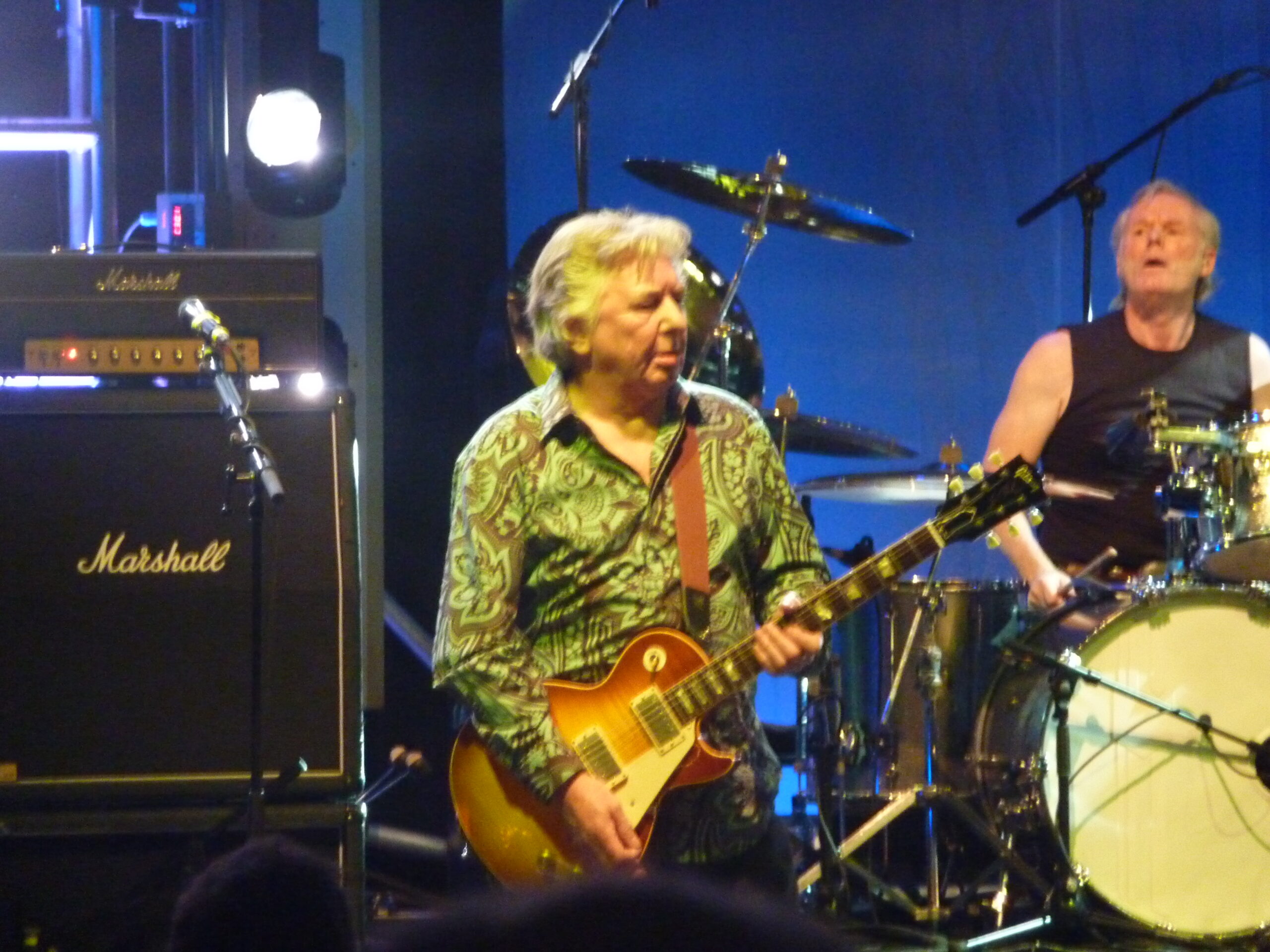
Gear Timeline
Here is a sentence that contains an entire philosophy of rock guitar: “Keep it simple — let it sing.” That was Mick Ralphs, in an interview that a generation of guitarists subsequently committed to memory, summing up a creative approach that produced some of the most enduring riffs in 1970s British rock. The man who wrote “Can’t Get Enough,” who wrote the guitar intro to “All the Young Dudes” that Joe Elliott of Def Leppard called “the lick of all licks,” who anchored Mott the Hoople’s glam-rock turbulence and then helped build Bad Company into one of the biggest rock acts of the decade — that man distilled his entire tonal and creative philosophy into six words. Keep it simple. Let it sing. If you understand those six words, you understand Mick Ralphs.
The Journey
Michael Geoffrey Ralphs was born on March 31, 1944, in Herefordshire, England — the rural English west country, about as far from the rock and roll zeitgeist of London as you can get while still being in the same country. He started on guitar as a teenager, inspired by the early rock and roll and rhythm and blues arriving from America, and his first guitar was a Rosetti Lucky 7 — the same budget instrument that a young Paul McCartney had taken to Hamburg with the not-yet-famous Beatles. Both men went on to somewhat more significant instruments. Ralphs graduated from the Rosetti through a Burns guitar with Tri-Sonic pickups to a 1966 Fender Telecaster, then into the Gibson territory that would define his sound, all while gigging his way through the Herefordshire music scene and eventually landing a spot in the band that would become Mott the Hoople.
His role in Mott the Hoople was specific and vital: he was the rhythm foundation. In a band with Ian Hunter’s Dylan-channeling vocals and piano, Pete Watts’s melodic bass playing, and Dale Griffin’s drumming, Ralphs recognized early that his job was to create a “heavy, chunky rhythm to lay down a foundation for the rest of it.” He was not the flashiest player in any room he ever entered. He was the one who made the room hold together. His rhythm playing was the architectural spine of Mott the Hoople’s sound — the thing that kept the whole elaborate, slightly chaotic, brilliantly entertaining structure standing.
Then in 1973, creatively frustrated by the constraints of a band where David Bowie’s “All the Young Dudes” had become their biggest hit despite being someone else’s song, Ralphs departed Mott the Hoople and co-founded Bad Company alongside Free’s former vocalist Paul Rodgers, Free’s drummer Simon Kirke, and King Crimson bassist Boz Burrell. The new band signed to Led Zeppelin’s Swan Song label — an endorsement that doesn’t get much more significant in the world of 1970s heavy rock — and released their self-titled debut in 1974. It contained “Can’t Get Enough,” which Ralphs had written in open-G tuning, transposed to open-C when Paul Rodgers needed a different key, and which became one of the defining riffs of the decade. Bad Company sold more than forty million albums in the original lineup’s run. Ralphs was not the frontman, not the voice, not the name casual listeners would first reach for. He was the guitar. Everything depended on the guitar.
He suffered a debilitating stroke in November 2016, just days after Bad Company concluded a UK tour at London’s O2 Arena, and the stroke forced his retirement from active performing. He passed away on June 23, 2025, at the age of eighty-one — a death that came, with particularly bitter timing, just months before Bad Company’s induction into the Rock and Roll Hall of Fame. The tributes that followed reflected the genuine and widespread affection in which Ralphs was held by fellow musicians and dedicated fans alike: a guitarist’s guitarist, a songwriter’s songwriter, a fundamentally decent man who understood that the best thing a guitar can do in a rock band is make everyone around you sound better. He was right. And he proved it every night for five decades.
Background: The Herefordshire Rhythm Machine and the Riff That Changed a Key
Understanding Mick Ralphs requires understanding the specific musical culture of Mott the Hoople — one of the stranger and more wonderful bands in British rock history. Formed in Hereford in 1969 and signed to Island Records by the legendarily eccentric manager Guy Stevens (who would later produce the Clash’s London Calling), Mott the Hoople occupied a unique position in the early-1970s rock landscape. They were too heavy for the pop mainstream, too melodically sophisticated for the emerging hard rock scene, and too much fun for the prog crowd. They had Ian Hunter’s magnificent rock star persona and Dylan-ish lyrical approach. They had the music hall theatrics that made them a live draw. And they had Mick Ralphs, providing the guitar foundation that the whole structure stood on.
The story of how Ralphs acquired his most iconic guitar — the Les Paul Junior that defined his Mott years and the early Bad Company recordings — involves another guitar hero’s influence, a pawn shop, and a hundred dollars. Mott the Hoople opened for Mountain on their 1972 American tour, and Ralphs was, by his own account, absolutely blown away by what Leslie West could do with a Les Paul Junior. West’s enormous, authoritative tone from what was essentially a stripped-down, budget-range Gibson — slab mahogany body, single P-90 pickup, no frills — convinced Ralphs that he needed exactly that guitar. He found one in a junk store for approximately $100. “It was like a hunk of wood with two knobs on it,” he told Guitar Player in 1979. “Even though it had one pickup, it was real ballsy. I loved it because it was like a hunk of wood with two knobs on it.” The Junior became his primary instrument for the remainder of Mott the Hoople and the early Bad Company sessions.
The Bad Company genesis story is one of rock’s more satisfying creative partnerships. Ralphs had met Paul Rodgers when Free — Rodgers’ band — supported Mott on a UK tour, and the musical and personal chemistry was immediate. When Ralphs left Mott in 1973, he and Rodgers began writing together with the shared understanding that they were building a band around a specific, focused, unpretentious rock sound. The “Can’t Get Enough” origin story encapsulates that process perfectly: Ralphs wrote the riff in open-G tuning, Rodgers liked the song but needed a different key for his voice, Ralphs figured out how to retune to open-C (C-C-G-C-E-C, tuned high enough to pop strings), and the result was one of the most immediately recognizable guitar riffs in rock history. “It never really sounds right in standard tuning,” Ralphs noted about the song — which is both a practical observation about what open tunings do to the character of a riff and a perfect expression of his willingness to do whatever the song needed, regardless of whether it was conventional.
The Bad Company debut on Swan Song Records in 1974 was a statement of intent that held nothing back. The band’s name, inspired by a 1972 Robert Benton film, captured the brand identity precisely: no frills, no pretension, maximum swagger, and songs that worked. Ralphs contributed “Can’t Get Enough,” co-wrote “Feel Like Makin’ Love” and “Deal with the Preacher” with Rodgers, and provided the guitar framework within which Rodgers’ extraordinary voice could do its work. Bad Company was one of the biggest rock acts of the 1970s — more than forty million albums sold in the original lineup’s run — and the guitar architecture Ralphs built underneath all of it was as important as Rodgers’ voice in creating the band’s identity. You just had to know where to look.
His biography includes one particularly poignant note that deserves addressing directly: the stroke he suffered in November 2016 robbed him of the ability to perform, effectively ending a performing career that had spanned more than five decades. He was seventy-two years old and had just completed a full UK tour. Bad Company’s subsequent induction into the Rock and Roll Hall of Fame, confirmed for the November 2025 ceremony, happened after his passing — a recognition that arrived too late for him to experience in person. The music, however, endures without any such temporal limitation.
The Rig: Mick Ralphs’s Guitars, Amps, and Effects
Guitars
The guitar most closely associated with Mick Ralphs’s most enduring work is the Gibson Les Paul Junior — specifically a 1957 sunburst Les Paul Junior that he acquired from a junk store on an American tour after watching Leslie West demonstrate what the same basic instrument could do in the hands of someone who understood it. The Les Paul Junior is Gibson’s most stripped-back interpretation of the Les Paul concept: a slab mahogany body without the arched maple top of the Standard or the Custom, a single P-90 soapbar pickup, two knobs (volume and tone — hence Ralphs’s “hunk of wood with two knobs” description), and a wraparound combination bridge-tailpiece that is both simpler and, many players argue, tonally superior to the separate bridge-and-stoptail combination of more elaborate models. The single P-90 produces a biting, aggressive, midrange-forward tone with a harmonic complexity that sits between a single-coil Strat and a full-size humbucker — more output and grit than a Strat, more clarity and edge than a PAF humbucker. Through a cranked Marshall at volume, a Junior with a P-90 produces exactly the kind of raw, authoritative, no-nonsense rock tone that Ralphs described West achieving and decided he needed for himself. He used this guitar “constantly for the rest of Mott the Hoople, usually through a 100-watt Marshall amp” and on the lead tracks for the early Bad Company recordings. The pickguard was removed — a common modification among players who find the standard configuration visually cluttered — and period photographs show Ralphs with this guitar regularly from 1972 through the mid-1970s.
The guitar responsible for the most recognizable Mick Ralphs moment in music — the open-C riff of “Can’t Get Enough” — was not a Gibson at all. It was a 1952 Fender Esquire, acquired from a pawn shop in Los Angeles for approximately $100 on the same American Mott the Hoople tour that produced the Les Paul Junior purchase. Someone had already modified the Esquire by installing a Gibson humbucker between the original Fender single-coil pickup and the neck — a hybrid configuration that gave the guitar additional tonal options while preserving the fundamental character of the single-pickup Telecaster-family instrument. Ralphs tuned this guitar to open-C (C-C-G-C-E-C) — originally writing “Can’t Get Enough” in open-G and transposing to C when Paul Rodgers needed a different key — and the specific combination of the Esquire’s single-pickup tonality, the open-C tuning’s resonant chime, and Ralphs’s right-hand attack produced one of rock’s most immediately identifiable guitar sounds. He used the Esquire for rhythm parts on the early Bad Company recordings (“Can’t Get Enough,” “Movin’ On”) while using the Les Paul Junior for lead work — a clear division of labor that exploited the tonal strengths of each instrument. Ralphs also replaced the original white pickguard with a black one: “I thought it looked cooler, like Jeff Beck or whatever.” Priorities, correctly established. He used Ernie Ball .009–.042 sets on the open-tuned Esquire, and he noted that the high tuning made it “quite a tight guitar to play” — strings approaching their breaking point at the elevated open-C tension, which was apparently an acceptable trade-off for the specific ring and sound the tuning produced.
Before the Junior and the Esquire, Ralphs’s primary Gibson was a 1961 SG/Les Paul — one of the transition-era instruments from the period when Gibson had redesigned the Les Paul body into the thinner, double-cutaway SG shape but was still putting Les Paul’s name on the headstock before the endorsement deal expired. This guitar featured the sideways vibrola tailpiece — a notorious device that achieved tuning instability through a mechanism so counterintuitive that it became an inadvertent vintage curiosity — and the two-pickup SG/Les Paul configuration. Ralphs described it candidly: “the one with the sideways vibrato.” He used it on Mott the Hoople’s debut album before trading it to their manager Guy Stevens for a 1954 Gibson Les Paul Goldtop. The exchange was initiated by Stevens, who asked Ralphs whether better gear would make him play better, and upon receiving the obvious answer, immediately took action — going to a London shop and trading the SG/Les Paul plus £100 for the Goldtop. This generosity from the notoriously mercurial Stevens was both typical and atypical of the man.
The guitar Ralphs received through the Guy Stevens exchange was a 1954 Les Paul Goldtop — one of the earlier Les Paul production models, featuring P-90 soapbar pickups rather than the PAF humbuckers of the 1957–1960 “Burst” era that has become the most sought-after period of Les Paul production. The Goldtop was modified with a stop tailpiece — replacing whatever original tailpiece configuration it came with — which improved its tuning stability and altered the break angle of the strings over the bridge, affecting the sustain and tone character. Ralphs used the Goldtop on Mott the Hoople’s Mad Shadows album, which represents a darker, heavier period in the band’s output compared to the debut. The P-90’s character through the Marshall of the Mad Shadows sessions — aggressive, midrange-rich, with an edge that PAF humbuckers don’t quite replicate — contributed to the heavier, rawer sound of that record.
By 1974, Ralphs had begun favoring Les Paul Standard guitars, and a 1959 Les Paul Standard became one of his prized possessions — described in a Vintage Guitar interview as “a great player, although it doesn’t look that great.” This instrument, with its vintage PAF humbuckers and figured maple top over mahogany body, represents the most revered period of Les Paul production. The 1959 Standard’s tonal character — warm, complex, with that specific combination of midrange depth and high-end clarity that comes from aging PAF pickups in resonant vintage wood — is the reference standard for British rock guitar tone, the thing that every humbucker-equipped guitar made since has been trying to equal. Ralphs’s matter-of-fact assessment (“a great player, although it doesn’t look that great”) reflects his consistent prioritization of how a guitar sounds and feels over how it presents to onlookers — the same philosophy expressed in his “hunk of wood with two knobs” description of the Junior.
As Bad Company’s run extended through the late 1970s, Ralphs developed an increasing affinity for Fender Stratocasters alongside his Gibson primary instruments. By the later Bad Company years, he was reportedly using five Stratocasters onstage simultaneously — two tuned to open-C, two in standard tuning, and one in open-G — a configuration that allowed him to switch guitars rather than retune between songs, maintaining the specific tonal character of each tuning without pausing for string adjustment in the middle of a live set. The Strat’s three single-coil pickups produce a brighter, more chiming character than the Les Paul’s humbuckers, and plugged through his Roland Boss Chorus and Echoplex setup (see Effects section), the combination provided a more atmospheric, layered quality for the cleaner passages in Bad Company’s repertoire.
A Gibson Flying V appears in documented footage and photographs of Ralphs — most notably in the “Feel Like Makin’ Love” promotional video. The Flying V’s aggressive, projecting character and striking visual profile made it a natural choice for specific live and promotional contexts, even if it was never Ralphs’s primary instrument in the way it was for players like Andy Powell. Its presence in his guitar collection reflects the broader Gibson loyalty that characterized his career across all periods.
A single-pickup Gibson Firebird also features in the documented Mott the Hoople gear history. The Firebird, with its reverse-body design and mini-humbucker pickups, produces a tonal character that is distinctly different from either the Les Paul or the SG — brighter than a full-size humbucker, with a snappy attack and a distinctive resonance from the unique body construction. The single-pickup configuration — maximum simplicity, in keeping with Ralphs’s overall aesthetic — further reduces the instrument to its essential elements. Like his enthusiasm for the Junior and the single-pickup Esquire, the single-pickup Firebird reflects a guitarist whose instinct consistently pushed toward the simplest, most direct connection between player and amplified sound.
In 1975, the Japanese guitar manufacturer Greco produced the MR-1000 — a signature model for Mick Ralphs, documented in a period photograph of him performing with Bad Company. Japanese signature models of this era occupy an interesting position in guitar history: Greco, Tokai, and other Japanese manufacturers were producing high-quality instruments at prices significantly below the American originals, and their mid-1970s output has subsequently been reappraised as genuinely excellent rather than merely acceptable copies. The Greco MR-1000’s specific specifications reflected Ralphs’s guitar preferences at the time — essentially a Les Paul-style instrument built to his requirements. Its existence in his live lineup in 1975 suggests it was more than a promotional arrangement.
Ralphs’s first professional-caliber guitar was a Burns — the British-made electric guitar brand that produced instruments used by the Shadows and countless other British rock and beat groups of the 1960s. Burns guitars feature the distinctive Tri-Sonic single-coil pickups that gave 1960s British rock guitar its characteristic bright, slightly glassy quality. Ralphs upgraded from the Burns as soon as his career enabled better options, but the Burns years were where he learned to play in a professional context, and that foundation informed everything that followed.
Amps
Mick Ralphs’s core amplifier throughout the Mott the Hoople years and the early Bad Company era was a Marshall 100-watt non-master-volume head — the pre-master-volume Super Lead or Plexi-style amplifier that defined British hard rock in the first half of the 1970s. He upgraded to Marshall 100-watt stacks by 1969 with Mott the Hoople, having previously used Vox AC30 amplifiers in his mid-1960s work. The 100-watt Marshall run without a master volume — driven from the preamp into a hot output stage — produces the natural EL34 power-amp saturation that is the foundation of the classic Ralphs tone: warm, harmonically complex, with a natural bloom on sustained notes that no preamp-gain-driven amp fully replicates. Ralphs used the Junior “usually through a 100-watt Marshall, usually without effects” for the early Bad Company recordings — a formula as simple and as difficult to replicate as Kossoff’s Les Paul-into-Marshall setup. The simplicity is the challenge. When the only variable is the relationship between guitar and amp, there is nowhere to hide.
For the Mott the Hoople reunion shows in the 2000s and 2010s, Ralphs’s guitar tech managed to source hand-wired Marshall JTM45 amplifiers — the earliest Marshall design, based on a modified Fender Bassman circuit, which Ralphs described as “the closest thing you can get to the old Marshall heads.” The JTM45 runs at 45 watts rather than the 100-watt Super Lead’s output, which means it reaches natural saturation at lower absolute volumes — a practical advantage for studio and smaller-venue work — while preserving the fundamental character of the EL34 valve sound. Ralphs used two of these heads for the reunion shows, and his enthusiasm for them — “they’re really, really good” — reflects a guitarist who, even late in his career, was genuinely engaged with the specific tonal qualities of the equipment rather than simply demanding a rider-compliant generic setup.
Before graduating to Marshall stacks, Ralphs used Vox AC30 combo amplifiers — the iconic British valve amp that defined the sound of the British Invasion, used by the Beatles, the Shadows, Tom Petty, and countless others. The AC30’s alnico-speakered, EL84-powered character produces a chiming, slightly compressed clean tone with a sweet natural breakup when pushed — quite different from the Marshall’s more aggressive, midrange-forward saturation. The AC30 period corresponds to Ralphs’s very early professional work before Mott the Hoople, and while it’s not the tone most associated with his legacy, it was the foundation on which his understanding of valve amplification was built.
For specific high-gain solo applications on the Bad Company album Desolation Angels (1979), Ralphs experimented with a Mesa/Boogie amplifier — a significant departure from the Marshall-centric approach that had defined his sound through the first five years of Bad Company’s run. The Mesa/Boogie’s compressed, mid-forward, high-gain character produces a different kind of sustain and saturation from the Marshall EL34 approach, and for the specific solos on Desolation Angels where Ralphs needed maximum gain and sustain, the Boogie delivered what the Marshall alone couldn’t. This reflects the same pragmatic, song-first approach that characterized his choice of different guitars for different musical functions — use whatever serves the moment, within a consistent overall sonic identity.
For specific studio applications, Ralphs was also documented running a Les Paul through a Fender Bassman head into a Marshall cabinet — a hybrid setup that combines the Bassman’s particular preamp character (cleaner, more open, with a different gain structure from the Marshall head) with the familiar tonal color of Marshall’s 12-inch speaker cabinets. This kind of cross-brand pairing is common in serious studio work and reflects a player who understood the tonal contributions of both the amplifier circuit and the speaker cabinet, and was willing to mix and match to find the specific combination that served a particular recording.
Effects
For the recordings most closely associated with his enduring legacy — the early Bad Company albums and the peak Mott the Hoople period — Ralphs ran essentially no effects. The formula was Les Paul Junior for lead (or Esquire for rhythm/open-C parts) into a 100-watt Marshall, usually without anything between guitar cable and amp input. He was explicit about this preference, describing his approach as “usually without effects” and expressing the philosophy clearly: “I never appreciated the effects that messed with the natural tone. Give me a Les Paul and a loud amp, and I’m good.” This is not a conservative position — it’s a sophisticated one. Ralphs understood that the specific tonal character he was after was the product of the relationship between guitar and amp, and that inserting additional circuit elements between them would change that relationship in ways he didn’t want. Every overdrive pedal, every modulation unit, every signal processor is a filter that alters the guitar signal before it reaches the amp’s input stage, changing what the amp hears and therefore what it produces. By removing all of these variables, Ralphs preserved the purity of the guitar-amp interaction.
The Morley wah pedal appears in Ralphs’s documented studio setup for specific tracks — most notably the song “Bad Company,” where he used the Morley to produce a Leslie speaker-like sweeping effect without physically using a rotating Leslie cabinet. The Morley company was known for their optical-based (rather than potentiometer-based) wah pedals, which offered a smoother, more reliable frequency sweep than conventional wah designs. The Leslie-like effect Ralphs achieved on “Bad Company” adds an atmospheric, swirling quality to his guitar tone that is quite distinct from his usual straight-amp approach, and it’s one of the more distinctive textural moments in Bad Company’s catalog. He also used the Morley wah on “Movin’ On,” adding a conventional dynamic wah-wah effect to the track’s blues-rock energy.
For live performance in the Bad Company era, Ralphs’s onstage effects were modest: an MXR Phase 90 or Phase 100 set at a very slow speed was his primary modulation tool. The MXR phase pedals, used at minimum speed settings, add a gentle textural shimmer to the guitar signal — barely perceptible as a distinct effect but contributing to the overall warmth and depth of the tone in ways that become apparent when the pedal is switched off. This use of a phaser as an “always on” background texture rather than an identifiable effect is consistent with Ralphs’s overall philosophy: enhance the natural guitar tone rather than imposing artificial effects on top of it.
In later live work with Bad Company, Ralphs’s Stratocaster setup incorporated a Roland Boss Chorus — the Japanese manufacturer’s widely used chorus pedal, adding a gentle stereo shimmer and widening the guitar’s apparent presence in the mix. The chorus was particularly suited to the Stratocaster’s bright, single-coil character, adding warmth and dimension without muddying the treble-rich natural voice of the guitar. Combined with the Echoplex tape echo, the chorus-through-Echoplex Strat setup gave Ralphs a distinctive atmospheric texture quite different from the more direct Les Paul Junior/Marshall combination that defined his earlier work.
Alongside the chorus in Ralphs’s later live setup was an Echoplex tape echo — one of the most celebrated tape-delay units in rock history, used by Jimmy Page, Eddie Van Halen, and countless other major players. The Echoplex uses a loop of magnetic tape to record and play back the guitar signal with a natural delay, and the tape-based degradation of each repeat — the way each echo becomes slightly darker and warmer than the one before — produces an organic quality that digital delay units have struggled to replicate convincingly. For the atmospheric, cleaner passages in Bad Company’s later catalog, the Echoplex added depth and dimension without cluttering the harmonic arrangements that Rodgers’ voice required space to inhabit.
Ralphs’s use of open tunings — particularly open-C for “Can’t Get Enough” and “Movin’ On,” and open-G as a starting point for songwriting — deserves specific mention as a fundamental part of his tonal approach. Open tunings change everything about how a guitar resonates: the strings interact differently with each other when several or all of them are tuned to notes of the same chord, creating a richer, more complex harmonic resonance on strummed or fingerpicked passages that is simply not available in standard tuning. The specific chime of “Can’t Get Enough” — that quality that Ralphs noted “never really sounds right in standard tuning” — is the direct product of the open-C tuning’s sympathetic string resonance, amplified by the Esquire’s single-pickup clarity and the Marshall’s natural warmth. The tuning is not an effect in the pedal sense, but it functions as a fundamental tonal tool that shaped the character of Bad Company’s most celebrated recordings.
On the guitars tuned to open-C, Ralphs used Ernie Ball .009–.042 Super Slinky sets — the lightest standard Ernie Ball gauge. The reason is practical and important: tuning to open-C requires raising the pitch of several strings above standard tuning, which significantly increases string tension. Using lighter strings at this elevated tension brings them back to something approaching the playability of standard-gauge strings at standard pitch — without which the string tension at open-C would be uncomfortably stiff and the risk of string breakage substantially higher. This is the same pragmatic, song-first thinking that characterizes all of Ralphs’s equipment choices: figure out what the music needs, then find the gear solution that provides it.
Playing Style & Tone Philosophy
Mick Ralphs plays guitar from the rhythm section out. His primary instinct — developed from his earliest days with Mott the Hoople and never abandoned — was to serve the groove, to create the rhythmic and harmonic foundation on which everything else could stand. “Me being me, I felt I needed some sort of heavy, chunky rhythm to lay down a foundation for the rest of it,” he said about his Mott years, and that description applies across his entire career. Even in Bad Company, nominally a band with a vocalist as dominant as Paul Rodgers, Ralphs’s guitar work is fundamentally rhythmic in its sensibility — the riffs drive rather than decorate, the chord work grooves rather than embellishes, and the solos, when they appear, feel like organic extensions of the rhythmic energy rather than departures from it.
His relationship to Leslie West was formative and acknowledged. When Mott toured with Mountain in 1972, Ralphs watched West extract an enormous, ballsy, authoritative tone from an instrument that everyone else considered a budget option — the Les Paul Junior — and understood immediately that the quality of a guitar tone comes from the player’s relationship to the instrument and the amplifier, not from the number of pickups or the expense of the wood. The Junior’s simplicity — two knobs, one pickup, no frills — was a feature rather than a limitation. It forced complete commitment to the direct relationship between guitar and amp, with no tonal safety nets. West had understood this. Ralphs learned from watching him and applied the same philosophy to his own playing. The resulting Les Paul Junior tone on the Bad Company debut — raw, ballsy, direct, with the P-90’s specific bite and clarity — is one of the most honest guitar sounds of the era.
His songwriting approach reflects the same philosophy as his playing. “Can’t Get Enough” is built on a riff so simple that it seems obvious — until you try to write something equally effective and discover that obviously great riffs are the rarest thing in music. The open-C tuning provides the specific harmonic resonance that makes the riff work at that level of immediacy; the Esquire’s single pickup provides the clarity that allows every note in the riff to be heard distinctly; and the Marshall provides the warmth and drive that makes the whole thing feel inevitable. Simple ingredients, perfectly combined. Keep it simple. Let it sing.
Joe Elliott’s description of the “All the Young Dudes” intro as “the lick of all licks” is worth examining, because it captures something essential about Ralphs’s musical intelligence. The intro to “All the Young Dudes” is not technically demanding. It does not require advanced technique or rare physical ability. What it requires is a guitarist who understands that a song’s first notes establish its entire emotional world, and who has the taste and restraint to choose notes that do exactly that — nothing more, nothing less. Ralphs consistently demonstrated that understanding, across hundreds of songs and more than five decades of professional playing.
How to Sound Like Mick Ralphs
The Mick Ralphs tone recipe is one of the most democratically accessible in classic British rock, and one of the most difficult to execute convincingly — not because the gear is exotic but because the approach is so unforgiving. A Les Paul Junior (or a well-made single-P-90 equivalent) into a non-master-volume Marshall 100-watt head is the entire formula. There is nowhere to hide. The P-90 pickup’s output is the most expressive variable: bridge P-90 for bite and aggression, neck P-90 for warmth and singing sustain. The Marshall’s natural EL34 saturation provides the warmth and harmonic richness. Right-hand attack — chunky, rhythmic, precise — provides the foundational groove. That’s the whole game.
For the “Can’t Get Enough” approach specifically, you also need a single-pickup Telecaster-family guitar in open-C tuning (C-C-G-C-E-C), with lighter strings than you’d normally use to manage the elevated tension. Through the same Marshall — clean-to-slightly-broken — with no effects, the open-C guitar’s harmonic resonance does most of the work. Don’t fight it; let the open strings ring sympathetically and the riff will emerge from the instrument more naturally than anything you could engineer with effects processing.
| Control | Setting (0–10) | Notes |
|---|---|---|
| Gain / Preamp Volume | 6–8 | Ralphs ran Marshalls hard but not at maximum. The P-90 pickup’s output is higher than a PAF humbucker, which pushes the Marshall’s preamp stage harder than a Les Paul Standard would. Set the preamp to produce a chunky, rhythmically responsive crunch — not smooth high-gain saturation. The EL34 output stage does the heavy lifting. |
| Bass | 6 | Moderate bass — the P-90’s natural character provides midrange bite and output without excessive low-end weight. Too much bass on a P-90-equipped guitar through a Marshall muddies the rhythmic precision that is the foundation of Ralphs’s playing. |
| Mid | 7 | Mid-forward. The P-90 pickup lives in the midrange, and the Marshall’s natural character supports this. This is where the “ballsy” quality of the Les Paul Junior tone comes from — that assertive, cutting, “hunk of wood” quality that Ralphs prized. Never scoop. |
| Treble | 6 | Moderate treble — enough for attack and pick definition on rhythm work, not so much that the P-90’s slightly harder top end becomes harsh at volume. The Junior’s bridge P-90 has natural clarity; support rather than boost it. |
| Presence | 5 | Middle of the road. Ralphs’s tone has presence and cut without the ice-pick quality of excessive presence control boost. The Marshall’s natural character and the P-90’s output provide enough definition; the presence control stays near neutral. |
| Master Volume | 7–10 | Wide open if using a pre-master-volume amp. This is non-negotiable for the authentic Ralphs tone — the power-amp saturation of EL34 tubes working hard is the source of the warmth and harmonic richness. A cranked Marshall 100-watter into a 4×12 is a loud thing. Accept this or use an attenuator. |
| Pickup Selection (Les Paul Junior) | Bridge (only option) | The Junior has one pickup. This is the point. The bridge P-90 gives you everything you need. No switching, no tonal second-guessing, no mid-song adjustments. One pickup, two knobs. “Hunk of wood.” |
| Open-C Tuning (Can’t Get Enough approach) | C-C-G-C-E-C | Single-pickup Telecaster or Esquire, tuned up to open-C from the low string. Use lighter gauge strings (.009 set) to manage the increased tension. Let the open strings ring — the harmonic resonance of the open-C tuning is doing most of the work. Play the riff and get out of the way. |
| MXR Phase 90/100 (if used) | Speed: 7–8 o’clock (minimum) | Barely perceptible speed setting. The phase should be a texture, not an effect — a slight harmonic shimmer that adds warmth and depth without obviously modulating. Always on, functionally inaudible as a distinct effect. |
| Pedals (lead work) | None to minimal | For the Les Paul Junior/Marshall lead tone: nothing. The amp does everything. For live Strat work in later years: chorus and Echoplex at moderate settings. For the studio “Bad Company” sound: Morley wah used as a Leslie simulator, slow and smooth. |
Influence & Legacy
Mick Ralphs’s influence on rock guitar is of the most practical and durable kind: he demonstrated, repeatedly and across different band contexts, that the simplest approach executed with complete commitment and excellent taste produces music that outlasts everything more elaborate. “Can’t Get Enough” is still on classic rock radio. “All the Young Dudes” is still the song that every British rock fan of a certain age knows start to finish. “Bad Company” is still the song that makes a certain kind of person feel nineteen years old regardless of their actual age. These songs work because Ralphs understood what they needed from a guitar, provided exactly that, and did not provide anything more.
The specific lesson of the Les Paul Junior — acquired for a hundred dollars in a junk store, used on some of the most enduring recordings of the 1970s — is one that never goes out of date. Great gear helps, but it doesn’t make great music. Great music comes from understanding what a song needs and having the taste and discipline to provide it. Leslie West had taught Ralphs that lesson by example, Ralphs internalized it, and two generations of guitarists have learned it from his recordings. The lineage from West’s Mountain Junior through Ralphs’s Mott Junior to the British hard rock guitar tradition is one of the cleanest and most instructive in rock history. For more on this specific Les Paul Junior tradition and its influence on British heavy rock, see Leslie West’s gear history, where the Junior’s extraordinary career as a tool of rock giants is examined in full. The broader tradition of British blues-rock guitar that Ralphs inhabited alongside contemporaries like Kossoff and Marsden is explored through Paul Kossoff’s Free-era gear — another master of the Les Paul into Marshall formula — and through Bernie Marsden’s Whitesnake approach, where the same British blues-rock values are applied to a different band context.
The last word on Ralphs belongs to his former bandmate, Def Leppard’s Joe Elliott, on the intro lick of “All the Young Dudes”: “Bowie gave them the song, but Mick wrote the intro — the lick of all licks.” Coming from a man who knows something about guitar licks and their power to define a song, that’s an assessment worth sitting with. Ralphs spent his career writing licks of that caliber and never attracting the individual guitar-hero attention that flashier players commanded. He didn’t need it. The music was enough. Keep it simple. Let it sing.
Frequently Asked Questions: Mick Ralphs Guitars & Gear
What guitar did Mick Ralphs use on “Can’t Get Enough”?
The guitar on “Can’t Get Enough” was a 1952 Fender Esquire tuned to open-C (C-C-G-C-E-C), which Ralphs had acquired from a Los Angeles pawn shop on an American Mott the Hoople tour for approximately $100. The guitar had been modified by a previous owner with a Gibson humbucker installed between the original Fender single-coil and the neck, giving it additional tonal options. Ralphs tuned it to open-C — originally having written the song in open-G and transposing when Paul Rodgers needed a different vocal key — and the combination of the single-pickup clarity, the open-C tuning’s harmonic resonance, and the Marshall’s natural warmth produced the instantly recognizable chime of the track. He replaced the original white pickguard with a black one (“I thought it looked cooler, like Jeff Beck”). The guitar was strung with Ernie Ball .009–.042 Super Slinkys to manage the increased string tension at the elevated open-C tuning. He acknowledged that the song “never really sounds right in standard tuning” — the open-C resonance is fundamental to its character.
How did Mick Ralphs come to use a Les Paul Junior?
The Les Paul Junior acquisition story is one of rock’s better gear origin stories. Mott the Hoople opened for Mountain on their 1972 American tour, and Ralphs was immediately struck by the enormous, authoritative tone Leslie West extracted from a Les Paul Junior — essentially a budget-range Gibson with a slab mahogany body and a single P-90 pickup. The fact that West was producing such powerful, distinctive tone from an instrument that most players regarded as a student guitar was revelatory. Ralphs found his own Les Paul Junior in a junk store for approximately $100 on the same tour and immediately understood why it worked: “It was like a hunk of wood with two knobs on it. Even though it had one pickup, it was real ballsy.” He used the Junior constantly for the remainder of Mott the Hoople and on the lead tracks of the early Bad Company recordings, always through a 100-watt Marshall, usually without effects.
What was Mick Ralphs’s approach to effects pedals?
His approach was emphatically minimal. For the recordings most closely associated with his legacy — the early Bad Company albums and the peak Mott the Hoople period — the formula was guitar straight into Marshall, no effects. He was explicit: “I never appreciated the effects that messed with the natural tone. Give me a Les Paul and a loud amp, and I’m good.” The exceptions were specific and purposeful: a Morley wah used to create a Leslie-like sweeping effect on the studio recording of “Bad Company”; a Morley wah on “Movin’ On” for a conventional dynamic wah-wah effect; and an MXR Phase 90 or 100 set to minimum speed as a barely perceptible “always on” texture in live performance. In later career, his Stratocaster live setup incorporated a Roland Boss Chorus and an Echoplex tape echo — but these were additions to a later, different configuration, not part of the classic Ralphs/Bad Company sound.
Why did Mick Ralphs leave Mott the Hoople?
Ralphs had come to feel creatively constrained in Mott the Hoople — a band where the biggest hit (“All the Young Dudes”) was a David Bowie composition given to them as an act of rock charity, and where the collaborative dynamic had made it difficult for Ralphs to develop his own musical direction fully. He had also met Paul Rodgers when Free supported Mott on a UK tour, and the musical chemistry between them was immediately apparent. When Ralphs departed in 1973, he and Rodgers began writing together and recruited Simon Kirke (Free’s drummer) and Boz Burrell (formerly of King Crimson) to complete the Bad Company lineup. The resulting band was, in creative terms, exactly what Ralphs had been seeking: a stripped-back, unpretentious rock outfit where his guitar riffs could be the central architectural element rather than one component in a more complex arrangement.
What open tunings did Mick Ralphs use?
Ralphs was an avid user of open tunings throughout his career. Open-C (C-C-G-C-E-C) was his most famous, used for “Can’t Get Enough” and “Movin’ On” on the Bad Company debut. He had originally written “Can’t Get Enough” in open-G — a more standard open tuning used by Keith Richards and others — and transposed to open-C when Paul Rodgers needed a different key, solving the tuning problem by simply retuning the guitar higher. By the later Bad Company years, his live setup reportedly included five Stratocasters simultaneously — two in open-C, two in standard tuning, and one in open-G — allowing him to switch between configurations without pausing to retune onstage. Open-G was also his primary songwriting tool, providing the resonant, chord-based starting points from which many of his riff ideas developed.
What was the guitar on the “All the Young Dudes” intro?
The “All the Young Dudes” intro — “the lick of all licks” in Joe Elliott’s description — was played on Ralphs’s Les Paul Junior through a Marshall amp, consistent with his standard setup for the Mott the Hoople period. The song was given to Mott the Hoople by David Bowie (who wrote and produced it for them), but the guitar arrangement — particularly the opening melody line that sets up the song’s emotional world before a single lyric has been sung — was Ralphs’s contribution. The Junior’s single P-90 through the Marshall produces that specific combination of warmth, bite, and directness that makes the opening phrase immediately compelling. Ian Hunter confirmed that Ralphs “was mainly a Les Paul man” during the Mott years, and engineer Bill Price’s work at Abbey Road gave the recordings a clarity and impact that the setup — great as it was — needed expert capture to fully realize.
What happened to Mick Ralphs in 2016?
On November 2, 2016 — just days after Bad Company concluded a UK tour at the O2 Arena in London — Ralphs suffered a severe stroke that left him unable to perform. The stroke ended his active touring and recording career at age seventy-two. He passed away on June 23, 2025, at the age of eighty-one, from complications of the stroke. His death came months before Bad Company’s induction into the Rock and Roll Hall of Fame, confirmed for the November 2025 ceremony — a recognition that arrived too late for him to experience in person. Fellow musicians and dedicated fans paid tribute to a guitarist who had, over more than five decades of professional playing, consistently demonstrated that great music requires taste and restraint as much as it requires technique or equipment, and that the simplest approach executed with complete commitment is frequently the most enduring one.
Related stories
Wayne Kramer Guitars & Gear: The Complete Guide to MC5’s Proto-Punk Guitar Insurrectionist’s Rig
Wayne Kramer guitars & gear: MC5's proto-punk guitar insurrectionist. Star-spangled Strat, Big Muff Triangle, Marshall stacks, MXR Jail Guitar Doors Drive — the complete rig.
Wes Montgomery Guitars & Gear: The Complete Guide to the Jazz Master’s Rig
Wes Montgomery's guitars, amps, and effects — the complete guide. Gibson L-5 CES, Standel amps, thumb picking technique, flatwound strings, and how to nail that warm jazz tone.
Yngwie Malmsteen Guitars & Gear: The Complete Guide to the Shred Master’s Rig
Yngwie Malmsteen's guitars, amps, and effects — the complete guide. The Duck Stratocaster, scalloped fretboard, Marshall wall, DiMarzio HS3, and how to nail that neoclassical metal tone.