
Gear Timeline
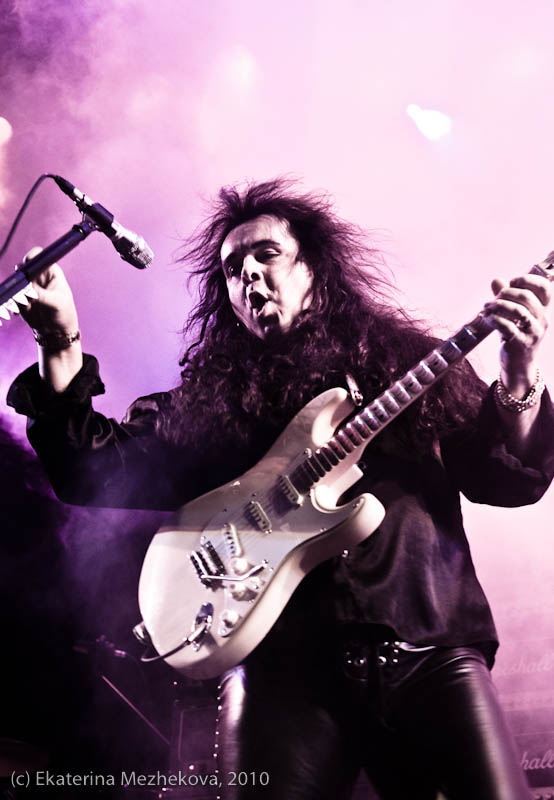
There is a wall. Not a metaphorical wall, not a wall in the sense of a dense tonal presence or an overwhelming sonic mass. A literal wall — a physical structure of Marshall amplifiers so vast that Yngwie Malmsteen, standing in front of it with his blonde Fender Stratocaster, compares it to the Great Wall of China as one of the two man-made objects visible from outer space. He said this. He continues to say it. He is not joking, and he is not entirely wrong: the Yngwie Malmsteen wall of Marshalls is genuinely one of the most impressive physical guitar rigs ever assembled for live performance. At peak configuration, thirty-six Marshall heads and twenty-two cabinets. On stage. In operation. Making noise simultaneously.
Yngwie Johan Malmsteen — born Lars Johan Yngve Lannerbäck on June 30, 1963, in Stockholm, Sweden — is the man who took the neoclassical metal guitar style from a theoretical possibility to a fully realized musical tradition. Before him, the intersection of Baroque classical music’s scalar vocabulary and heavy metal’s volume and aggression was a novelty. After him, it was a genre with its own technical standards, its own community of players, its own economic infrastructure, and its own Hall of Fame moments. He arrived in America from Sweden in 1983 carrying one guitar — a vintage white Fender Stratocaster — and within two years had released Rising Force (1984), the album that changed the definition of possible in electric guitar technique and spawned an entire generation of imitators, none of whom quite got there.
The gear that makes all of this work is simultaneously more complex and more straightforward than it appears. Complex because the modifications Malmsteen makes to his Stratocasters — the scalloped fretboard, the brass nut, the specific pickup configuration, the rewired tone circuit, the precise setup — represent an exceptionally specific set of physical requirements. Straightforward because the amplification is, by his account, the simplest possible arrangement: vintage Marshall heads with everything at 10. “The main sound is straight through the Marshalls with everything set full up. They’re all old amps from the ’60s and early ’70s, with four inputs and no master volume. They’re very primitive, but they have the most organic sound.” Thirty-six Marshall heads, all knobs at 10, all simultaneously engaged. Yngwie Malmsteen is not interested in subtlety.
He is also — and this is the part that tends to get lost in discussions of his technical ferocity — a genuinely great musician. The neoclassical approach he developed is not merely a speed demonstration: it is an application of Baroque compositional logic (the sequences, the arpeggiated harmonies, the voice-leading) to the electric guitar that requires deep familiarity with the classical tradition as well as with rock guitar technique. His knowledge of Paganini, Bach, and Vivaldi is not decorative. It is the foundation on which every note of his playing rests. He is the first neoclassical metal guitarist not because he was the fastest but because he understood the music most completely.
Background: From Stockholm to Shredmaster General
The origin story of Yngwie Malmsteen begins, as many guitar legend origin stories do, with a televised death. On September 18, 1970, television news in Sweden broadcast footage of Jimi Hendrix smashing and burning his guitar at the 1967 Monterey Pop Festival. Yngwie, who was seven years old and watching in his family’s Stockholm apartment, had the reaction that one guitar legend’s death provoked in another future guitar legend: he thought it was really cool. Not the death — the guitar. The instrument capable of being played like that, treated like that, and destroyed like that. He wanted one.
He taught himself to play, initially experimenting with whatever instruments were available in the family household. The formal musical education was limited; the informal obsession was total. By his early teens, two primary influences had established themselves: Ritchie Blackmore, whose playing with Deep Purple combined technical precision with visual and sonic drama in ways that gave Malmsteen a rock template; and above all, Niccolò Paganini, the nineteenth-century Italian violin virtuoso whose compositions pushed the technical limits of the instrument to their absolute maximum. Paganini’s violin figurations — the sequences of rapid scalar passages, the arpeggiated patterns across multiple strings, the dramatic dynamic contrasts — translated to the electric guitar with extraordinary naturalness once Malmsteen understood the connection. He was, by his own account, not influenced by blues or by conventional rock guitar. He was translating Paganini into the electric guitar medium. This is precisely what Rising Force sounds like when you understand the source material.
He was discovered via a demo tape that reached Shrapnel Records’ Mike Varney in early 1982 — specifically the “Powerhouse” demo recorded when Malmsteen was fifteen. Guitar Player magazine published the demo for their February 1983 edition, and the response from the American guitar community was immediate and overwhelming. Here was something genuinely new: the application of Baroque classical compositional technique to high-gain electric guitar with a level of technical execution that had no precedent in rock. Varney brought Malmsteen to the United States to record with Steeler in 1983, then connected him with Graham Bonnet’s band Alcatrazz. By 1984, Malmsteen had left Alcatrazz to begin his solo career. Rising Force, recorded in 1984, was nominated for a Grammy Award for Best Rock Instrumental Performance in 1986. It reached number 60 on the Billboard 200. It changed the guitar world.
The subsequent career has been continuous, prolific, and increasingly self-referential: twenty-two studio albums, an ongoing touring schedule that deploys the wall of Marshalls in venues from Tokyo to São Paulo, and a reputation for imperious self-confidence that has generated as much commentary as the music itself. He is simultaneously one of the most technically advanced guitarists alive and one of the most certain that this is true. He is also right, which is what makes the confidence not merely irritating but at least defensible. Nobody else does quite what Malmsteen does. The wall of Marshalls continues to be visible from wherever you happen to be standing.
The Rig: Yngwie Malmsteen’s Guitars, Amps, and Effects
Guitars
The most important guitar in Yngwie Malmsteen’s career and the instrument most closely associated with his sound is a 1972 Fender Stratocaster nicknamed “The Duck” — the name derived from the Donald Duck stickers on its headstock — or alternatively “Play Loud,” a name that came from a sticker that Malmsteen’s friend Anders Johansson put on the upper horn of the guitar at Rockshire Studios in 1984. The “Play Loud” nickname is unambiguous in its programmatic intent. Fender made 100 replica copies of this guitar and marketed it as the “Play Loud Guitar.” Malmsteen has used this guitar throughout his musical career and has had Fender make several copies of it.
The Duck is a 1972 vintage Stratocaster — part of the CBS era that is generally considered inferior to the pre-CBS instruments but which Malmsteen specifically prefers for the larger headstock introduced in 1968. The large “CBS” headstock, he maintains, provides more sustain than the smaller pre-1968 headstock, a claim whose acoustic physics can be debated but whose tonal consequences are audible. The guitar has been extensively modified from its original configuration:
The most famous modification is the scalloped fretboard — the wood between the frets has been carved away in concave “U” shapes, so that the player’s fingers contact only the string and the frets, not the fretboard wood. Malmsteen got the idea from working on a seventeenth-century lute whose fretboard was scalloped in this manner. He initially thought it looked cool. He discovered quickly that it fundamentally changed how the guitar played: with no wood contact, there is no friction against the bending finger, allowing for wider bends and more expressive vibrato with significantly less physical effort. His hero Ritchie Blackmore was also a notable early adopter of scalloped fretboards. The fretboard was also refretted with Dunlop 6000 super-jumbo fretwire — extremely tall and wide frets that give even more bending clearance and a specific contact character when fretting. A brass nut replaced the original plastic or bone unit, adding sustain and brightness. The middle string tree was removed. A Wilkinson tremolo spring system replaced the original. DiMarzio HS3 stack-coil hum-canceling single-coil pickups replaced the original Fender single-coils, providing the high-output, hum-free character needed at the extreme volumes he runs. Later, these were replaced with Seymour Duncan STK-S10 YJM “Fury” pickups. The tone circuit was initially bypassed entirely — the tone pots and capacitors removed from the signal path so the pickup signal went directly to the output jack. Later instruments use a “no-load” tone pot that functions from positions 1-9 but at position 10 engages a true bypass mode.
Alongside The Duck, “Number One” is Malmsteen’s other primary instrument — another 1970s Stratocaster with broadly similar specifications (scalloped fretboard, brass nut, large CBS headstock, Dunlop 6000 frets, Seymour Duncan YJM pickups) but with different specific character. Unlike The Duck, Number One retains its original Fender tremolo system. It features Ferrari stickers and the number “one” on the back. Both guitars are ash-bodied with maple necks and scalloped maple fretboards. Together, The Duck and Number One constitute the primary guitar tools that have been responsible for essentially all of Malmsteen’s recorded and performed output across four decades.
Malmsteen and Eric Clapton were the first two artists to be honored by Fender with signature Stratocaster models. In late 1988, Malmsteen’s signature Fender Stratocaster was released, making him and Eric Clapton the first artists to be honored by Fender. The original 1986/1988 model was based almost entirely on his heavily modified 1971 Strat, featuring the scalloped maple fretboard, vintage white finish, brass nut, and Dunlop 6000 fret wire. It allowed Malmsteen’s legions of fans to mimic his guitar acrobatics at home — specifically making the scalloped fretboard modification accessible to players who couldn’t have their own guitars converted. The current version features Seymour Duncan STK-S10 YJM “Fury” pickups from 2010, three-way pickup selector, 9.5-inch radius, vintage tremolo, and the no-load tone pot. The signature model has been the standard starting point for players attempting to develop neoclassical technique in Malmsteen’s style.
According to Fender, Yngwie has one of the most impressive collections of vintage Fender Stratocasters known — well over 200 instruments, including a March 1954 Strat (the first month and year of Stratocaster production), various 1955 and 1956 models, a 1967 with a maple cap neck and large headstock (normally unavailable in that year, suggesting a factory one-off), and multiple Burgundy Mist and other finish variants across the CBS era. He particularly values guitars from the 1968-1972 period for their large headstocks. Many vintage examples are kept in original condition; others are scalloped and modified for playing. He stopped actively collecting after acquiring his most significant pieces: “I’d rather spend money on something else. Also, the ones I really like are just not around.”
The complete list of modifications Malmsteen applies to each guitar he plays: scalloped maple or rosewood fretboard; refret with Dunlop 6000 (super-jumbo) fretwire; brass nut; Wilkinson tremolo springs; 3-bolt to 4-bolt neck conversion where needed; DiMarzio HS3 or Seymour Duncan YJM Fury pickups; removal of middle string tree; tone circuit bypass or no-load pot; multiple Ferrari stickers (mandatory for aesthetic reasons); and string action set higher than typical — 4/64″ to 5/64″ at the 12th fret, versus the 2/64″-3/64″ standard — which, combined with the scalloped fretboard, allows string deflection without wood contact.
Malmsteen uses a custom hybrid string set: .008, .011, .014, .022, .032, .046. The ultra-light top strings (.008 high E) allow the extreme bending and vibrato that define his technique, while the heavier lower strings (.046 low E) provide body and rhythm tonal weight. Combined with the lower-than-standard tuning he often uses (A=430Hz rather than 440Hz) and the scalloped fretboard, this setup creates extraordinarily low string tension on the treble strings — the physical conditions under which his technique becomes possible.
Amps
Malmsteen’s amplification foundation is vintage Marshall JMP heads from the 1960s and early 1970s — specifically the models with four inputs and no master volume control. “The main sound is straight through the Marshalls with everything set full up. They’re all old amps from the ’60s and early ’70s, with four inputs and no master volume. They’re very primitive, but they have the most organic sound.” The four-input layout (two high-sensitivity, two low-sensitivity) allows the “jumping” technique — connecting the two channels with a patch cable to blend them, producing a richer, more complex tone than either channel alone. “Everything full up” on a Marshall with no master volume means the preamp and power amp stages are both operating at their maximum saturation level — every component contributing its characteristic harmonic content simultaneously.
The specific Marshall characteristic that Malmsteen exploits is the EQ’s subtractive nature in the vintage 1959 SLP specification: “There’s a characteristic about old 1959 SLP heads. The EQ is subtractive, which means anything below 10 is taking away from the sound. In other words, everything on 10 means everything on 0.” This is a technical description of how the Marshall’s tone stack circuit operates: at position 10, the tone controls are at their minimum impedance, taking away the least amount of signal. Position 10 is the “flattest” setting, the point at which the signal is least filtered. Running everything at 10 means running the amplifier with maximum signal through the power section, which at vintage Marshall’s high-gain preamp settings produces the simultaneously saturated and harmonically complex sound that defines his tone.
Malmsteen collaborated with Marshall on a signature amplifier head — the YJM100 — designed to capture the vintage JMP characteristics he favors while adding contemporary features: a switch between 50-watt and 100-watt operation, built-in reverb, a noise gate, and a sound booster/overdrive circuit. All the cabinets in his current touring setup are YJM100s loaded with 75-watt Celestion speakers. The YJM100 allows him to maintain the vintage tonal character without the reliability concerns of forty-plus-year-old vintage heads being pushed to their absolute limits night after night on international tours.
The live configuration that defines Malmsteen’s visual identity is genuinely extraordinary in its scale. At peak configuration: thirty-six Marshall heads and twenty-two cabinets. Nine stacks with three heads per stack. As Malmsteen has described it: “There are only two man-made objects you can actually see from outer space. One is the Wall of China, one is the Yngwie Malmsteen wall of Marshalls. And today, we are gracing the stage with nine stacks with three heads on each one.” The practical function of multiple heads is not simply volume — it’s tonal richness from the specific way different slightly-aging amplifiers interact with each other and with the cabinets, creating the dimensional quality of his live sound that single amplifiers, regardless of wattage, can’t quite achieve.
Malmsteen runs his Marshall amplifiers through a variac — a variable autotransformer that adjusts the operating voltage from the standard 120V AC to a reduced level, typically 90-100V. Running amplifiers below standard operating voltage changes their tonal characteristics: lower voltage produces earlier output tube saturation, softer attack, and a specific harmonic compression character sometimes called “brown sound” or “sag.” The variac technique was used by Eddie Van Halen to achieve his specific tone, and Malmsteen applies the same principle. The reduced voltage essentially makes the amplifiers sound as if they’re operating harder than they actually are — producing natural compression and saturation at slightly lower overall volume than they would at standard voltage.
Effects
Malmsteen’s effects chain is remarkably sparse given the complexity of his sound. The tone comes primarily from the guitar’s modifications and the amplifiers — not from a dense stack of pedals. As he confirmed to Vintage Guitar magazine: “I go through a Bradshaw, but there’s really nothing in it.”
The Bob Bradshaw custom rack system provides the signal routing and MIDI switching infrastructure for Malmsteen’s live rig — handling the assignment of specific signals to specific Marshall heads, managing the stereo splitting of the signal, and providing the four programmable presets that constitute his live tonal changes. But the presets are not processing presets in the conventional sense: they route the signal differently through the various Marshall configurations. The first preset is dry (unprocessed). “Preset two splits the two stacks in stereo.” The effects within the Bradshaw chain are minimal.
In the 1980s rack setup, Malmsteen used two Korg SDD-2000 Digital Delay units — the same delay platform favored by The Edge of U2 in the same era. For Malmsteen, the digital delay added the specific ambient depth to his lead lines that distinguished recording versions from live performances. The SDD-2000’s warm digital character suited the high-gain Marshall input material without harsh digital artifacts.
The Boss CE-5 stereo chorus appears in Malmsteen’s contemporary pedalboard, used for the specific shimmer effect on specific passages. Set subtly, it adds harmonic width without obscuring the clarity of fast scalar runs — an important consideration given that excessive chorus on high-speed single-note lines tends to blur definition.
A noise gate is mandatory in any high-gain setup with single-coil pickups — even the hum-canceling Seymour Duncan YJM Fury pickups produce noise at the extreme gain levels Malmsteen operates at. The Boss NS-2 silences the signal chain during pauses between phrases, preserving the silence that gives his dramatic scalar passages their maximum impact when they resume.
A Roland Analog Echo — the analog chorus/echo unit — provides a warm, slightly saturating delay character for specific applications where the digital Korg’s cleaner character is less appropriate.
The Dunlop Cry Baby wah appears in Malmsteen’s live rig for filtered, vowel-like effect on specific passages. Wah pedal use in neoclassical metal is typically more restrained than in blues rock, used for dramatic effect rather than as a constant textural element.
A Vox 1902 Flanger appeared in the 1980s rack setup — providing the sweeping, jet-engine modulation effect that appears on specific tracks from the early Malmsteen catalog. The Vox flanger’s particular modulation character, slightly more complex than the simpler BBD flangers of the period, contributed to the atmospheric quality of his recording texture.
The pick is not an effects device, but in Malmsteen’s case it is an important tonal element. He uses a Dunlop custom pick made from Delrin — a rigid plastic material with specific hardness and surface texture — at 1.5mm thickness. “It’s very stiff,” he noted. A very stiff, thick pick produces a more aggressive, defined attack than thinner, more flexible picks, and at the extreme picking velocities Malmsteen operates at, the pick’s stiffness allows more consistent attack force across the full range of speeds.
Playing Style & Tone Philosophy
Yngwie Malmsteen’s playing style is the product of an unusual intellectual and technical synthesis: the compositional logic of Baroque classical music (Paganini’s violin technique in particular) applied to the electric guitar through the technical vocabulary of early 1970s British hard rock (Ritchie Blackmore, Jon Lord of Deep Purple), executed at a level of physical speed and precision that neither tradition had previously achieved in isolation.
The compositional vocabulary is specifically harmonic minor scale-based. The harmonic minor scale’s raised seventh degree gives it a distinctive tension — a specifically Middle Eastern or Gypsy quality — that distinguishes Malmsteen’s scalar lines from the pentatonic or natural minor scales that dominate blues-rock guitar. The sequences he uses — patterns of three or four notes repeated in a descending or ascending scalar framework — are directly derived from Paganini’s violin figurations, which were themselves designed to demonstrate the maximum possible velocity across the violin’s range. Translated to guitar, these sequences become the “neoclassical shred” vocabulary that Malmsteen established and that hundreds of subsequent players have studied and developed.
His vibrato — extremely wide and fast, the bowing-arm vibrato of classical string playing translated to the guitar fretting finger — is enabled specifically by the scalloped fretboard. Without the fretboard’s wood contact, the finger can deflect the string laterally with no friction, producing the wide, rapid oscillation that gives his sustained notes their operatic quality. This vibrato is not a guitar player’s vibrato. It is a violinist’s vibrato applied to an electric guitar, and it requires the scalloped fretboard to work as naturally as it does in his playing.
The picking technique — economy picking, alternate picking with efficient motion minimization — allows the extreme speeds he operates at while maintaining note clarity. His right-hand articulation gives each note in a rapid scalar passage its individual weight and definition, which is why his fast passages are melodically intelligible rather than blurring into a general impression of velocity. Speed without clarity is technically impressive but musically limited; Malmsteen’s speed is accompanied by sufficient clarity that the melodic content remains audible.
His tone philosophy is maximalism applied with specific intent: maximum gain, maximum volume, maximum everything — but through the most direct possible signal chain. The guitar’s modifications give it maximum resonance and articulation. The Marshalls at maximum saturation provide maximum harmonic complexity. The minimal effects chain ensures that nothing stands between the guitar’s modified character and the amplifiers’ saturated response. “Anything but a Marshall, please don’t even fucking bother me. It ain’t gonna happen.” This is not stubbornness. It is the statement of a man who has found exactly what he needs and sees no reason to compromise.
How to Sound Like Yngwie Malmsteen
Getting into Yngwie Malmsteen’s tonal territory requires accepting that the modifications to his guitar — particularly the scalloped fretboard — change the physical experience of playing significantly. Without the scalloped fretboard, his specific vibrato technique and his extreme bending approach will feel constrained. The amplification approach is simpler to replicate.
Guitar: A Fender Stratocaster with a maple fretboard is the historically and tonally correct starting point. The Fender Yngwie Malmsteen Signature Stratocaster is the factory-ready option with all key modifications included. For a more budget-conscious approach, any vintage-style Stratocaster can be converted: have the fretboard scalloped by a qualified luthier (a skilled job that typically costs $200-400), replace the nut with a brass unit, have the fretboard refretted with Dunlop 6000 jumbo fretwire, and install Seymour Duncan YJM Fury pickups. The scalloped fretboard is the most important physical change; without it, the vibrato and bending technique will not function as it should.
Amp: Vintage Marshall JMP or vintage Marshall “1959” style head into a 4×12 cabinet is the authoritative choice. At high volume, everything set near or at 10. The Marshall YJM100 signature head is the modern alternative that captures the vintage character with improved reliability. For players without access to a full vintage Marshall rig: any high-gain British-voiced amplifier (Mesa Rectifier, Peavey 5150) pushed to high gain and high volume will approach the territory, though the specific Marshall character — particularly the vintage JMP’s specific harmonic content — is difficult to replicate exactly.
Amp Settings (Vintage Marshall 1959 SLP style — subtractive EQ):
| Control | Setting (0–10) | Notes |
|---|---|---|
| Presence | 7–8 | High — adds the upper-frequency bite |
| Bass | 5–6 | Moderate — controlled low-end to prevent mud |
| Middle | 4–5 | Slightly scooped — prevents the nasal honk at high gain |
| Treble | 6–7 | High — clear high-end for note definition in fast runs |
| Volume (Preamp) | 10 | Fully saturated preamp |
| Master Volume | 10 | Full output — or use a variac at 90-100V |
Note on the subtractive EQ: If using a modern amplifier with a conventional (additive) EQ system, the above settings won’t produce the same result as on a vintage Marshall. For modern amps, try: Presence 6-7, Bass 5, Middle 4, Treble 7, High Gain or Lead channel at maximum, volume appropriate to the room.
Technique: Learn the harmonic minor scale in all positions. Practice Paganini’s violin compositions — specifically the 24 Caprices — and understand the figuration patterns. Develop wide, fast vibrato through the scalloped fretboard or through deliberate practice on a standard fretboard until the motion becomes reflex. Practice economy picking and alternate picking at increasing speeds with a metronome. This is a technique that requires years of dedicated work to approach Malmsteen’s level, and no amount of gear substitution changes that reality.
Influence & Legacy
Yngwie Malmsteen’s influence on guitar playing is enormous and specific: he created the neoclassical metal genre, he established the technical standard for shred guitar in the 1980s, and he inspired an entire generation of players — Jason Becker, Marty Friedman, Paul Gilbert, Tony MacAlpine, Vinnie Moore, and dozens of others — to develop their own approaches to the intersection of classical technique and electric guitar. The genre he founded has continued to grow and develop in subsequent decades, with each generation of neoclassical players finding new ways to extend the vocabulary he established.
His specific technical contributions — the scalloped fretboard’s mainstream adoption, the application of Paganini’s figuration patterns to electric guitar, the demonstration that classical music’s compositional logic could function at metal’s volumes and tempos — are teachable and have been taught across four decades of guitar instruction. Countless instructional videos, books, and online resources teach “Yngwie-style” technique as its own category within guitar pedagogy. This is the mark of a genuinely original contribution: the creation of an approach specific enough to be identified and systematic enough to be taught.
His influence on the broader landscape of rock guitar is harder to trace but no less real. The general acceptance of “shred” as a legitimate guitar vocabulary — the idea that extremely high technical velocity combined with modal and neo-classical harmonic language was valid rock guitar — owes much to Malmsteen’s commercial success with Rising Force and the albums that followed. Before him, speed-based guitar was technically impressive but musically marginal. After him, it was a complete musical tradition with its own compositional logic and its own audience.
For context on where Malmsteen sits in relation to his contemporaries in the technical guitar tradition, the comparison with Joe Satriani’s approach to guitar technique and composition at #22 is the most immediate — two players of essentially the same era who both developed approaches to instrumental guitar at the extreme technical end of the spectrum, each with their own compositional language and aesthetic priorities. Satriani’s more melodic, blues-influenced approach contrasts with Malmsteen’s Baroque-classical orientation, but both represent the 1980s generation’s expansion of what electric guitar technique could accomplish.
The comparison with Steve Vai’s avant-garde approach to technique and composition at #51 illuminates a different axis — Vai’s chromatic, atonal, and electronic influences versus Malmsteen’s tonal, harmonic minor, classical influences — two different possible destinations from the same starting point of extreme technical virtuosity in the same decade. They famously co-existed on the G3 tour circuit for years, each representing a different answer to the question of what maximum technique in service of musical ideas actually sounds like.
And for understanding how the Baroque violin tradition that Malmsteen drew from connects to the broader sweep of instrumental guitar innovation, the comparison with Ritchie Blackmore’s classical-influenced electric guitar approach at #14 is essential — Blackmore was Malmsteen’s primary guitar influence, the player who demonstrated the possibility of combining Bach-influenced modal playing with rock guitar volume and aggression. Malmsteen took that possibility and pushed it to its absolute limit. He may have exceeded the limit. He certainly defined it.
Yngwie Malmsteen is sixty-two years old in 2026. The wall of Marshalls is still being assembled in venues around the world. The Duck still has its Donald Duck sticker. The scalloped fretboard still has no friction. The harmonic minor scale still has that raised seventh degree that makes everything sound imperially dramatic. The two man-made objects visible from space remain the Great Wall of China and the Yngwie Malmsteen Marshall wall, and one of them is still on tour.
The argument about whether Malmsteen is “too much” — too fast, too loud, too self-certain, too Baroque, too everything — has been running since 1984 and shows no signs of resolution. His defenders note that his technical achievement is genuine, his musical knowledge is real, and his commitment to his own vision across four decades without commercial compromise is admirable. His critics note that a wall of thirty-six Marshall heads is perhaps more amps than any single song requires. Both positions have merit. Neither changes the fact that Rising Force exists, that the scalloped fretboard has transformed guitar technique, that the neoclassical metal genre continues to grow and evolve, and that nobody — nobody on Earth — sounds quite like Yngwie Johan Malmsteen when he stands in front of that wall and plays.
Frequently Asked Questions: Yngwie Malmsteen Guitars & Gear
What guitar does Yngwie Malmsteen play?
Yngwie Malmsteen plays exclusively Fender Stratocasters — specifically vintage models from the 1968-1972 period that feature the larger “CBS” headstock he believes provides additional sustain. His primary guitar is the 1972 Stratocaster nicknamed “The Duck” (for its Donald Duck stickers) or “Play Loud” (for a sticker added in 1984). His secondary primary guitar is called “Number One.” Both are extensively modified: scalloped maple fretboard, refretted with Dunlop 6000 super-jumbo fretwire, brass nut, Wilkinson tremolo springs, Seymour Duncan YJM Fury hum-canceling single-coil pickups, removed middle string tree, and bypass tone circuit. He has over 200 vintage Stratocasters in his collection. Fender’s Yngwie Malmsteen Signature Stratocaster (first released in 1988, making him one of the first two Fender signature artists alongside Eric Clapton) replicates the key modifications.
What is a scalloped fretboard and why does Yngwie Malmsteen use one?
A scalloped fretboard is a guitar neck modification where the wood between each fret has been carved away in a concave “U” shape, so that the player’s fingers contact only the strings and frets, not the fretboard wood itself. Malmsteen adopted the technique after working on a seventeenth-century lute with a scalloped fretboard, initially for aesthetic reasons, then discovering it transformed the playability. With no wood contact, there is no friction against the bending finger, allowing wider, faster vibrato and easier string bending than a conventional fretboard permits. This is essential to Malmsteen’s classical violin-inspired vibrato technique — a wide, rapid oscillation modeled on bowing-arm vibrato rather than conventional guitar finger vibrato. His hero Ritchie Blackmore was also a notable early adopter. The modification permanently changes how the guitar plays and requires some adjustment time, but most players who adapt to it find bending and vibrato become significantly easier.
What amplifiers does Yngwie Malmsteen use?
Yngwie Malmsteen uses Marshall amplifiers exclusively for his primary tone. His preferred vintage heads are Marshall JMP models from the 1960s and early 1970s — specifically those with four inputs and no master volume, with “everything set full up.” He also uses his signature Marshall YJM100 head for contemporary touring, which replicates the vintage tonal character with a switchable 50/100 watt output, built-in reverb, noise gate, and booster/overdrive. His live rig at peak configuration uses thirty-six Marshall heads and twenty-two cabinets, all loaded with 75-watt Celestion speakers. He runs the amplifiers through a variac at 90-100V (below the standard 120V) to create earlier tube saturation and natural compression. His famous quote: “Anything but a Marshall, please don’t even fucking bother me. It ain’t gonna happen.”
What is Yngwie Malmsteen’s musical style called?
Yngwie Malmsteen’s musical style is called neoclassical metal — a subgenre of heavy metal that combines the scalar vocabulary, compositional logic, and performance techniques of Baroque classical music (particularly violinist Niccolò Paganini and composer Johann Sebastian Bach) with the instrumentation, volume, and sonic aggression of heavy metal. His guitar solos apply Paganini’s rapid figuration patterns — sequences of notes in ascending and descending scale passages, arpeggiated harmonic sequences, and dramatic dynamic contrasts — to the electric guitar in the context of metal band arrangements. The harmonic minor scale, with its raised seventh degree, is central to the style’s characteristic sound. Malmsteen essentially created this genre with his 1984 album Rising Force, inspiring contemporaries including Jason Becker, Marty Friedman, Paul Gilbert, and Tony MacAlpine.
What string gauge does Yngwie Malmsteen use?
Yngwie Malmsteen uses a custom hybrid string set: .008, .011, .014, .022, .032, .046 — his own signature Fender Bullet string set. The ultra-light high E (.008) and B (.011) strings allow the extreme bending and wide vibrato that characterize his playing, while the heavier low strings (.046 on low E) provide tonal body for rhythm work. Combined with lower-than-standard tuning (he often tunes to A=430Hz rather than the standard 440Hz) and the scalloped fretboard’s elimination of fretboard friction, this setup creates very low string tension on the treble strings — the physical prerequisite for his specific bending and vibrato technique. The action is set higher than typical (4/64″ to 5/64″ at the 12th fret) to accommodate the scalloped fretboard and give maximum string deflection clearance.
How did Yngwie Malmsteen influence guitar?
Yngwie Malmsteen influenced guitar by creating the neoclassical metal genre, establishing the technical standard for shred guitar in the 1980s, and demonstrating that classical music’s compositional logic could function within metal’s sonic context. His 1984 album Rising Force was nominated for a Grammy Award for Best Rock Instrumental Performance and directly inspired a generation of technically advanced players: Jason Becker, Marty Friedman, Paul Gilbert, Tony MacAlpine, Vinnie Moore, and many others. The scalloped fretboard technique he popularized has been adopted by numerous subsequent guitarists. His broader influence on guitar culture includes normalizing extreme technical velocity as a legitimate musical expression and establishing the harmonic minor scale vocabulary as a standard advanced guitar resource across multiple genres. He and Eric Clapton were the first Fender signature artists, reflecting his commercial impact in addition to his technical influence.
What is the Yngwie Malmsteen “wall of Marshalls”?
The Yngwie Malmsteen “wall of Marshalls” is a live concert rig consisting of a large number of Marshall amplifier heads and cabinets assembled into a physical wall behind him on stage. At its documented peak configuration, the wall consists of thirty-six Marshall heads and twenty-two cabinets — nine stacks of amps with three heads per stack, all loaded with 75-watt Celestion speakers. All current configurations use his signature Marshall YJM100 heads and YJM series cabinets. Malmsteen has famously compared the wall to the Great Wall of China as one of the two man-made objects visible from outer space. While Malmsteen runs his signal through a Bob Bradshaw switching system, his tonal philosophy is that the wall produces his sound through the sheer saturation and harmonic complexity of multiple vintage or vintage-style Marshall heads operating simultaneously, with no significant effects processing in the signal chain.