
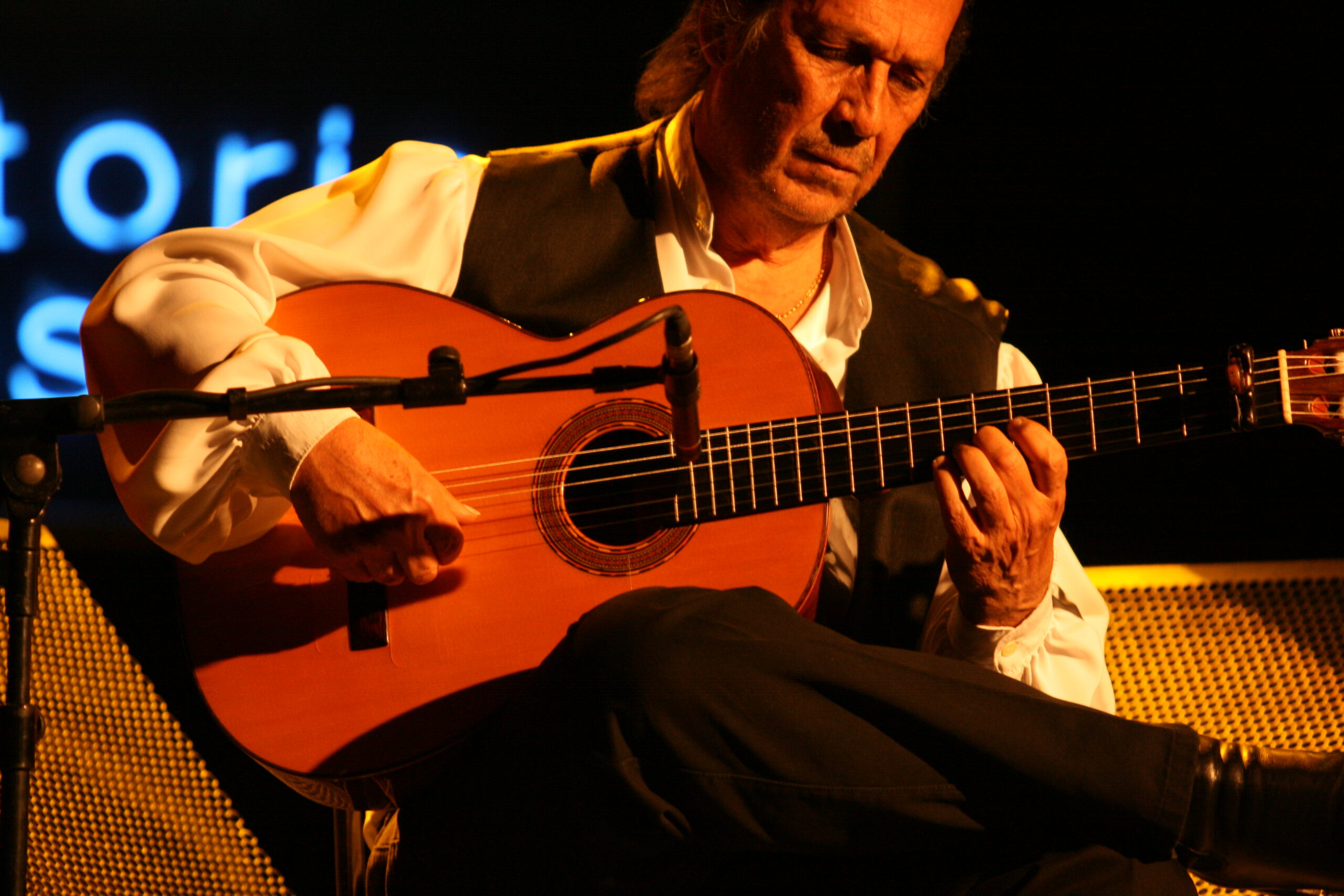
There is a moment in the live recording of “Friday Night in San Francisco” — the 1980 acoustic guitar album featuring Paco de Lucía alongside John McLaughlin and Al Di Meola — where Paco launches into a picado run of such velocity, clarity, and melodic intelligence that it sounds technically impossible. Three fingers — index, middle, ring — moving across the strings at a speed that challenges the limits of human neuromuscular control, each note not merely accurate but expressive, shaped with the individual weight and color that distinguishes a master from a technician. The room erupts. Al Di Meola and John McLaughlin — two guitarists who are themselves operating at the extreme edge of what the instrument can do — wait their turn with expressions that suggest they understand perfectly what they’re sharing the stage with.
Paco de Lucía was born Francisco Gustavo Sánchez Gómez on December 21, 1947, in Algeciras, a port city in southern Spain’s Cádiz province where the Mediterranean meets the Atlantic — a geographical position that made him, literally, a man between waters. The stage name came from his mother: “de Lucía” means “son of Lucía,” and the tribute to his mother, Lúcia Gomes Gonçalves, was a lifelong constant in a career otherwise characterized by relentless forward motion. He was the youngest of five children in a family of flamenco musicians, introduced to the guitar by his father Antonio at age five, and practicing up to twelve hours a day by age nine — not by choice but because the family’s economic circumstances required him to develop his talent as quickly as possible into a professional career. He left school to practice guitar. He was nine years old. The comparison his biographers make to the relationship between Leopold Mozart and his son is not hyperbole.
What he became — after those twelve-hour childhood days, after decades of performing with flamenco’s greatest singers, after the collaborations with McLaughlin and Di Meola that brought flamenco to international audiences who had never heard of the art form, after the ten albums with Camarón de la Isla that are considered among the greatest documents in flamenco history — is the figure that the jazz Times described in one clean sentence: “Most flamenco fans can trace the music’s history to either Before Paco or After Paco.” He divided an ancient art form into two epochs. He is the before and after. The gear that carried this revolution — handmade Spanish guitars, bare fingers, no amplification in most contexts — is the subject of this guide.
He died on February 25, 2014, in Playa del Carmen, Mexico, while on holiday with his family. He was sixty-six. The city of Algeciras declared two days of official mourning. The world of flamenco — and the wider world of serious guitar — experienced something that can only be described as grief, and it was genuine. He was irreplaceable in the way that the very best musicians are always irreplaceable: not because nobody else plays flamenco guitar, but because nobody else played it quite the way he did.
Background: From Algeciras to the World Stage
Algeciras in the late 1940s and 1950s was not a place of particular privilege. The Sánchez Gómez family lived in a Gitano (Roma) neighborhood, with flamenco as both cultural heritage and economic necessity. Paco’s father Antonio — known locally as “El Gitano Rubio,” the Blond Gypsy — was a guitarist who understood from early observation that his youngest son was extraordinary. The twelve-hour daily practice regimes he imposed on young Paco were not cruelty but urgency: the family needed a professional musician, and it was becoming clear that Paco had the gift to become one. Antonio took him out of school entirely to concentrate on guitar development. He was nine.
The guitar was the family’s connection to livelihood, culture, and identity simultaneously — not a hobby, not an art school project, but the instrument through which the Sánchez Gómez family expressed their deepest cultural identity and earned their daily bread. This context — economic necessity combined with cultural heritage combined with prodigious talent — is what produced the extraordinary foundation of Paco’s technique. You don’t develop that relationship with an instrument through casual practice. You develop it when the instrument is as essential as air.
He performed publicly for the first time at the end of 1959, at the Terraza cinema in Algeciras, in a duo with his brother Pepe called Los Chiquitos de Algeciras. He was eleven. The family moved to Madrid when Paco was fifteen, where the Spanish capital’s flamenco scene offered professional opportunities unavailable in Algeciras. He worked with the José Greco dance company, which brought him to America — his first international exposure, touring the United States as a teenager in a professional flamenco context that would have been formative for any musician.
The recordings began in 1967, when he was twenty, with La fabulosa guitarra de Paco de Lucía. The influence of the great flamenco guitarist Niño Ricardo is audible in these early recordings, but so is something already distinctly Paco’s own — a harmonic adventurousness, a rhythmic precision, a technical velocity that exceeded what the tradition had previously produced. By 1969’s Fantasía Flamenca, his style was clearly declared. By 1974, with the massive commercial success of “Entre dos aguas” — a rumba that sold over 300,000 copies as a single and introduced bongos and electric bass into flamenco for the first time — he had an international audience and a historic claim.
The collaboration with Camarón de la Isla — the flamenco singer who was to cantaores (singers) what Paco was to guitarists — produced ten albums from 1969 to 1977 that are universally regarded as the most important recordings in the history of nuevo flamenco. Their relationship was complex — competitive, deeply respectful, professionally troubled at times, and ultimately irreplaceable. They understood each other at a level that transcended professional partnership: Paco, who always wanted to be a cantaor, and Camarón, who always wanted to be a guitarist, found in each other the artistic complementarity they each lacked individually. The recordings they made together are the documentary record of this understanding.
The international breakthrough came in 1977 with the collaboration with guitarists John McLaughlin and Larry Coryell, later replaced by Al Di Meola, producing the Guitar Trio. The concept — three acoustic virtuosos from three different guitar traditions (jazz-fusion, flamenco, and classical/jazz hybrid) improvising together in a live concert setting — was novel enough to attract non-specialist audiences and musically substantial enough to satisfy specialists. The Friday Night in San Francisco recording from 1980 became one of the best-selling acoustic guitar albums in history, introducing Paco de Lucía to audiences in North America and Europe who had no previous exposure to flamenco.
The Paco de Lucía Sextet, formed in 1981 with his brothers and other collaborators, became his primary performing vehicle for the next three decades — a larger ensemble that allowed the orchestral ambitions of his compositional thinking to be realized live. The collaborations continued: Chick Corea on the 1990 album Zyryab. His 2004 Cositas Buenas won the Latin Grammy for Album of the Year. He reduced public performances after 2004, typically giving only a few concerts annually, mostly in Spain and Germany and at European festivals. He was still playing, still composing, still performing when the hemorrhage took him in Mexico in 2014.
The Rig: Paco de Lucía’s Guitars, Technique, and Equipment
Paco de Lucía’s gear discussion is, in certain fundamental ways, different from every other guitarist in this series. He was an acoustic guitarist playing an instrument without electric pickups in most performance and recording contexts. His “rig” is a handmade Spanish guitar, his bare fingers, and his body — the posture, the right-hand mechanics, the left-hand precision, the entire physical relationship between his body and the instrument. The amplification question, when it arose, was handled with microphones and PA systems rather than guitar amplifiers. The effects question doesn’t arise: there were none.
Guitars
The guitar most closely associated with Paco de Lucía’s mature career is the “flamenca negra” (black flamenco guitar) built by the brothers Faustino, Julio, and Mariano Conde of the Hermanos Conde workshop at Calle Gravina 7 in Madrid. The Hermanos Conde workshop had a history connecting it directly to the great luthier Domingo Esteso — the three Conde brothers began their work building guitars for Esteso’s widow in the early 1940s before establishing their own instruments under the label Sobrinos de Domingo Esteso and eventually Hermanos Conde. The guitars they developed were specifically designed for flamenco performance: extraordinarily loud, with strong basses and singing trebles, built around a 670mm scale length for maximum projection and tension clarity.
The “flamenca negra” designation refers to a specific type of flamenco guitar that departs from the traditional construction. Traditional flamenco guitars — the “flamenca blanca” — use cypress for the back and sides, which produces a bright, aggressive, percussive sound with a fast decay ideal for the rhythmic strumming (rasgueados) and rapid scale runs (picados) of traditional flamenco. The “flamenca negra” uses rosewood (palo santo or similar dense hardwood) for back and sides, like a classical guitar, which produces a darker, warmer, more sustained tone — closer to a classical guitar in character but built with the lighter internal bracing and lower action of a flamenco instrument. Paco’s adoption of the flamenca negra was itself a statement about where he was taking flamenco: the warmer, more complex harmonic character of the negra suited the jazz-influenced harmonies and the collaborative work with classical and jazz musicians that defined his later career, while its flamenco construction maintained the fast response and aggressiveness that pure flamenco demanded.
His primary Hermanos Conde instruments over the years included a Faustino Conde flamenca negra from 1968 (subsequently stolen); a 1975 Faustino Conde with German spruce top, rosewood-pau ferro back and sides, and 670mm scale (one of his most important instruments, played for many years); and various subsequent Conde instruments across the 1980s, 1990s, and 2000s. His collaboration with the Conde brothers on the FC28 concert model — a guitar designed specifically to project sufficiently for large concert halls without losing the flamenco character — resulted in an instrument using the best selected German spruce for the top, Madagascar rosewood for back and sides, ebony for the fretboard, and cedar for the neck. Paco described his relationship with his guitar simply: “My comfort with my guitar is everything to me as a flamenco artist; and this immense ‘everything’ is at the same time beauty, balance, harmony and strength.”
Before the Hermanos Conde relationship that defined his mature career, Paco played Ramírez guitars — the renowned Madrid luthier whose instruments were the standard choice for Spanish classical and flamenco guitarists through the mid-twentieth century. The Ramírez was his instrument when his career was establishing itself in the late 1960s. His transition to the Conde instruments, which came as his career was accelerating in the late 1960s and early 1970s, was driven by the specific tonal requirements his increasingly sophisticated playing was revealing. Faustino Conde’s guitars — with their powerful basses and brilliant trebles — gave him what the Ramírez couldn’t quite provide at the volumes and with the tonal complexity his music was requiring.
The distinction between flamenco and classical guitar construction is not subtle, and it matters enormously for understanding why a Hermanos Conde flamenca negra sounds like what it sounds like. Flamenco guitars are built lighter than classical guitars — thinner tops, lighter bracing — to maximize responsiveness and volume at the cost of some sustained warmth. They typically have lower action (strings closer to the fretboard) for the fast, percussive playing that flamenco requires. They use a “golpeador” — a thin plastic or wooden plate glued to the top beside the strings — to protect the top from the percussive finger taps (golpes) that are part of flamenco technique. They have a faster attack and quicker decay than classical guitars.
The Conde guitars specifically developed for Paco represented a refinement of all these principles: the action, the bracing pattern, the wood selection, and the finish were all evolved through years of collaboration between player and luthier to produce exactly the tonal profile that his playing required. A Conde guitar played by someone other than Paco de Lucía sounds like a magnificent flamenco guitar. A Conde guitar played by Paco de Lucía sounded like Paco de Lucía. The relationship between player and instrument, in this tradition, is not about the guitar imposing its character on the player but about the player drawing from the guitar a character that is only partially its own and partially theirs.
The Conde guitars Paco used most often operated at a 670mm scale length — longer than most electric guitars (typically 648mm or 628mm) and at the longer end of the acoustic guitar range. The longer scale produces higher string tension at standard pitch, which contributes to the clarity of individual notes even in rapid scale passages and the projection of the guitar’s acoustic sound. The string height (action) was set slightly higher than what is comfortable for a beginner but appropriate for the aggressive right-hand attack of flamenco technique — too low an action would cause the strings to buzz against the frets during the powerful strumming and scale runs that are central to the style.
Technique as Gear
In a guitar guide series primarily concerned with electric guitarists and their amps, pedals, and pickups, Paco de Lucía represents a category that requires a different kind of analysis. His “rig” is not a chain of electronic components. It is a body, trained over decades, performing specific physical actions with extraordinary precision and expressiveness. The technique is the gear.
Picado (Single-Note Scale Runs): Paco de Lucía’s picado technique — three-finger alternation (index, middle, ring finger) on the right hand, producing rapid single-note scale passages — was, by the assessment of every guitarist who has analyzed it, the most advanced in the history of flamenco guitar. The three-finger approach (most players use two-finger alternation) allowed velocities that two fingers cannot maintain over extended passages. Each note was not merely accurate but individually shaped — with its own weight, its own color, its own position in the rhythmic structure of the phrase. The picado runs that appear throughout his recordings are not exercises in speed. They are melodic statements of great sophistication delivered at a speed that makes their sophistication even more astonishing.
Rasgueado (Flamenco Strumming): The rasgueado — the percussive, rolling strumming technique that is the rhythmic backbone of flamenco — was in Paco’s hands a controlled violence. Individual fingers rolling across the strings in sequence (pinky, ring, middle, index, and back), or combined in various patterns depending on the rhythmic context, producing a dense, crackling, percussive sound that drives the compás (rhythmic cycle) forward with physical force. His rasgueados were executed with a clarity and rhythmic precision that distinguished them from the blurrier rasgueados of less trained players.
The Playing Posture: Paco was famous for his playing posture — sitting with his legs crossed in a position that he described as giving him “a better angle of attack and more stability for his demanding physical style.” This posture, which differs from both the classical guitar position (left leg elevated on a footstool) and the casual popular guitar position (right leg supporting the guitar), became iconically associated with him. It is not merely aesthetic: the crossed-leg position places the guitar at a specific angle relative to the right hand that optimizes the attack angle for flamenco’s particular right-hand requirements.
Harmony and Jazz Influence: One of Paco’s most consequential contributions to flamenco was the introduction of harmonic concepts drawn from jazz and bossa nova into what had been a harmonically fairly strict tradition. He described his fascination with jazz directly, naming Al Di Meola, John McLaughlin, Larry Coryell, and Chick Corea as musicians he admired “as highly as his flamenco mentors.” This cross-pollination — bringing jazz’s harmonic sophistication into flamenco’s rhythmic and emotional vocabulary — produced the nueva flamenco of his mature work, a synthesis that could not have been achieved by someone coming from only one tradition.
Amplification and Microphones
No Guitar Amplification (Primary Approach): Paco de Lucía was an acoustic guitarist in the fullest sense — his instrument produced its sound through the vibration of wood and string, and that acoustic sound, captured by microphones and projected through PA systems in live performance and by recording microphones in the studio, was his fundamental sonic output. He did not use guitar amplifiers in the conventional electric guitar sense. The question of “what amp did Paco use” does not have a meaningful answer for most of his career.
DPA Microphones (Live Performance, Later Career): For live performance in large venues with the Paco de Lucía Sextet, the acoustic guitar’s natural volume was insufficient to fill concert halls without amplification. The solution was microphone-based pickup rather than piezo or magnetic pickup systems — microphones mounted to or near the guitar capturing the acoustic sound and feeding it to the PA system. DPA microphones, known for their extremely accurate and natural reproduction of acoustic instruments, were used in his later career for this purpose. The goal was transparency: amplifying the acoustic guitar’s natural voice without changing its character. This is fundamentally different from electric guitar amplification, where the amp’s character is a primary component of the tone.
Fishman and Similar Systems (Specific Contexts): For specific recording and performance contexts where microphone-based amplification was impractical, acoustic pickup systems — piezo transducers mounted under the saddle or in the body — were used. Fishman pickups appeared in some configurations. The consistent priority was acoustic fidelity: the guitar’s natural sound, amplified as neutrally as possible, rather than the electric guitar’s signal-chain tone-shaping.
Strings and Setup
Nylon Classical/Flamenco Strings: Paco de Lucía played nylon strings — specifically the high-tension nylon strings appropriate for flamenco guitar. The flamenco tradition uses nylon strings (and previously gut strings) rather than steel, and the right-hand technique — bare fingers, no picks — is calibrated to the specific resistance and feel of nylon strings under the fingertips. The bass strings are wound metal over a nylon core; the treble strings are solid nylon monofilament. Paco’s preferred sets were high tension, which contributed to the clarity and projection of his tone at the expense of slightly higher left-hand effort for fretting.
The brand of strings he used varied over his career. D’Addario classical strings and similar high-quality manufacturers appear in documentation. The specific string choice in flamenco matters: different manufacturers produce strings with different tension profiles, different treble clarity, and different bass warmth. At the professional level, flamenco guitarists develop specific preferences and maintain them with the same attention that electric guitarists give to their pickup and amplifier choices.
Playing Style & Tone Philosophy
Paco de Lucía’s playing style synthesized two things that had not previously coexisted at the highest level in flamenco: absolute technical mastery of the tradition’s entire vocabulary, and the harmonic and melodic adventurousness of a musician equally conversant in jazz, bossa nova, and classical music. The first without the second produces a brilliant traditionalist. The second without the first produces an interesting experimenter. Together, they produced a revolution.
The technical mastery is the foundation. He could play every palo (form) of flamenco — soleares, siguiriyas, bulerías, tangos, farruca — with a depth of idiomatic understanding that came from having grown up immersed in the tradition from earliest childhood. This authenticity was not in question even when he was pushing the harmonic and rhythmic boundaries most aggressively. He knew what he was departing from because he had been inside it since he was five years old.
The harmonic adventurousness came from his engagement with jazz and Brazilian music. He was, in his biographer Pohren’s account, “fascinated with jazz” and deeply respectful of the technical demands of jazz improvisation. His own 2004 statement captures his philosophy precisely: “I have always found that the more technique you have the easier it is to express yourself. If you lack technique you lose the freedom to create.” This is not the romantic notion that feeling is more important than technique. It is the pragmatic recognition that technique is what gives feeling its full range of expression. More technique equals more freedom, not less.
His tone philosophy was acoustic purity: the guitar’s natural voice, drawn out by the right-hand technique’s precision and the left-hand’s absolute clarity of note production, without electronic enhancement or modification. The Conde guitars he used were chosen because they produced — in his hands — the specific combination of bass power, treble brilliance, and fast response that his music required. The golpeador protected the top from the physical demands of his technique. The strings and action were calibrated to the precise requirements of his right hand. Everything was in service of the direct, unmediated relationship between player and instrument.
How to Sound Like Paco de Lucía
Being honest about what “sounding like Paco de Lucía” requires is more important than providing achievable shortcuts, because the shortcuts don’t exist. His sound is inseparable from his technique, and his technique was developed over six decades of daily practice beginning in childhood. What follows is a guide to the equipment and approach that get you into the territory, alongside honest acknowledgment that the technique is the destination and the gear is just the vehicle.
Guitar: A Spanish-made flamenco guitar is the appropriate starting point. For “flamenca negra” tone — warmer, more complex, more jazz-compatible — rosewood or similar dense-wood back and sides with a spruce or cedar top. Hermanos Conde produces signature Paco de Lucía models that are the historically correct choice and among the finest flamenco guitars available. At more accessible price points: Alhambra, Raimundo, and Prudencio Sáez make credible entry-level to mid-range flamenco guitars. The golpeador (tap plate) should be in place on any guitar used for serious flamenco technique. Scale length of 650-670mm is standard for Spanish flamenco guitars.
Setup: Lower action than classical guitar but higher than electric guitar — flamenco-specific setup that allows the fast, percussive right-hand attack without excessive buzz, while maintaining sufficient string clearance for clean note production. High-tension nylon strings, changed regularly for maximum brightness and clarity (old nylon strings lose their treble definition significantly). The guitar should be set up by someone familiar with flamenco guitar requirements, which differ meaningfully from classical guitar setup.
Amplification settings (DI or microphone to PA):
| Parameter | Approach | Notes |
|---|---|---|
| Microphone Type | Small-diaphragm condenser | DPA 4021 or similar — maximum acoustic fidelity |
| Mic Position | 12th fret / soundhole edge | Captures full frequency range without proximity bass boost |
| EQ — Bass | Flat or slight cut at 200Hz | Remove mud without losing warmth |
| EQ — Mid | Flat to +2dB at 1-2kHz | Presence and clarity for picado runs |
| EQ — Treble | +2 to +3dB at 5-8kHz | Adds the brilliant, crystalline top-end of nylon strings |
| Reverb | Small room — very subtle | Just enough for ambient feel in large venues |
The technique — the honest assessment: Flamenco guitar technique at the level Paco de Lucía practiced it requires years of systematic study. The picado, the rasgueado, the alzapúa (thumb technique), the compás (rhythmic feel) — none of these are achievable from a YouTube tutorial. They require a teacher, ideally one trained in the Spanish flamenco tradition, and years of deliberate practice. If you want to play flamenco guitar seriously, find a teacher and commit to the long game. If you want to understand what Paco de Lucía was doing and why it matters, listen to the recordings.
Influence & Legacy
The Jazz Times statement — “Most flamenco fans can trace the music’s history to either Before Paco or After Paco” — is the most compact and accurate assessment of his historical position available. He divided flamenco’s history. Before him, the art form was vital, ancient, and geographically bounded: primarily a Spanish tradition, known internationally but not integrated into the global guitar conversation. After him, flamenco was an internationally recognized virtuosic tradition whose guitarist was capable of holding his own alongside the world’s finest jazz and classical musicians, and whose harmonic and rhythmic vocabulary had been permanently expanded.
His specific technical contributions — the three-finger picado system, the application of jazz harmonics to flamenco structure, the development of the flamenca negra as a concert instrument — are teachable and have been taught to subsequent generations of flamenco guitarists worldwide. Tomatito, Vicente Amigo, Gerardo Núñez, and other major flamenco guitarists of the generation that followed him show his influence at various degrees of directness. The “nuevo flamenco” genre — a broad category of flamenco-influenced music with jazz, pop, and world music elements — exists as a commercial and artistic space largely because Paco de Lucía demonstrated that flamenco’s identity could survive contact with other traditions without being diluted by them.
His influence on non-flamenco guitarists was also direct and acknowledged. Eric Clapton, who co-authored a major guitar history book, described him as “a titanic figure in the world of flamenco guitar” with “astounding technique and inventiveness.” John McLaughlin, who played alongside him in the Guitar Trio, has consistently described Paco as one of the greatest guitarists he encountered in a career of encounters with the world’s best. The mutual respect of the Friday Night in San Francisco recordings — three virtuosos finding common ground in the physical and musical language of acoustic strings — documents what happens when different traditions meet at the highest level.
The comparison with Django Reinhardt’s synthesis of Romani folk and jazz is the most instructive parallel: two guitarists who brought folk traditions from outside the American musical mainstream into dialogue with jazz, each creating something that neither tradition could have produced alone. Django’s was the founding gesture, Paco’s was the fullest development — different traditions, the same essential creative act of synthesis.
His connection to the broader world of guitar innovation runs through his collaboration with Al Di Meola’s approach to acoustic guitar — the Guitar Trio’s three-way conversation demonstrating how different technical traditions could illuminate each other when players of sufficient mastery came together. And for understanding how indigenous music traditions produce distinctively different guitar vocabularies, the contrast with Carlos Santana’s synthesis of Latin music and rock is revealing — two artists whose music is both deeply rooted in their specific cultural contexts and capable of crossing into universal communication precisely because of that rootedness.
The city of Algeciras mourned for two days when he died. The flamenco world has not stopped mourning since, in the specific way that a tradition mourns the irreplaceable: by continuing to play the music, by carrying the tradition forward in the direction he pointed, and by returning regularly to the recordings to remember what was possible when Francisco Gustavo Sánchez Gómez — Paco de Lucía, son of Lucía — put his hands on a Hermanos Conde guitar and played.
The Guitar Trio and the Meaning of Friday Night in San Francisco
No gear guide for Paco de Lucía would be complete without extended discussion of the Friday Night in San Francisco recording — not because it reveals new information about his equipment, but because it is the document that brought his playing to the international audience that had previously been inaccessible to it, and because it represents one of the most extraordinary acoustic guitar performances ever captured on record. Understanding what happened at the Old Waldorf in San Francisco on December 5, 1980, is essential to understanding who Paco de Lucía was and why his influence extends so far beyond the flamenco world.
The Guitar Trio concept — three acoustic guitarists from different traditions playing together in an improvised concert format — was John McLaughlin’s idea. McLaughlin had been following flamenco’s development and had encountered Paco through the European jazz-flamenco crossover scene that both inhabited in the mid-1970s. The original lineup included Larry Coryell alongside McLaughlin and Paco; Coryell was replaced by Al Di Meola before the San Francisco concert. Di Meola brought a different energy from Coryell — faster, more precision-obsessed, deeply influenced by flamenco’s own right-hand techniques — that turned out to complement rather than compete with Paco’s playing in ways that produced a genuinely collaborative rather than merely competitive concert.
The three guitars on stage that night were acoustic, unamplified or minimally amplified by the standards of the era. Three guitarists, playing at the absolute limits of their respective techniques, in conversation with each other in real time over the course of an evening that was being recorded. The resulting album sold several million copies — extraordinary for any acoustic guitar album, almost unprecedented for music with this level of technical demand. It introduced Paco de Lucía to audiences who had never heard flamenco and would not have sought it out. It demonstrated that acoustic guitar virtuosity, presented in the right context, could reach mainstream audiences without compromise.
From a gear perspective, Friday Night in San Francisco is interesting because it documents what Paco’s Hermanos Conde guitar sounded like when captured by professional studio recording techniques in a live concert environment — the full acoustic character of the instrument, with its strong basses and singing trebles, its fast attack and clear sustain, placed in contrast with Di Meola’s Gibson and McLaughlin’s Synclavier-adjacent jazz setup. The difference in tonal character between the three guitars — Paco’s flamenco negra versus the other two players’ instruments — is audible and significant. The flamenco guitar’s specific character sits in the mix with an authority that comes from its design: it was built to be heard in an ensemble, and it is heard.
The specific tracks that showcase Paco’s playing most clearly on the album include “Mediterranean Sundance / Río Ancho” — a piece that juxtaposed Di Meola’s “Mediterranean Sundance” with Paco’s “Río Ancho,” the two pieces interweaving in real time into something greater than either alone. The picado exchanges between Paco and Di Meola in this piece are the moments that made other guitarists put the record down and stare at the wall. The speed is the easy part to notice. The musical intelligence underneath the speed is what rewards repeated listening.
The album’s commercial success had an unexpected side effect: it created the “acoustic guitar trio” as a viable concert format. Numerous subsequent acoustic guitar duos and trios — in jazz, in world music, in pop-crossover acoustic music — drew directly from the model Friday Night in San Francisco established. This is not gear influence, but it is influence flowing directly from Paco’s participation in a specific musical event with specific musical equipment. The Hermanos Conde guitar on the stage at the Old Waldorf that night was doing something that changed the concert music landscape. The guitar itself was not unusual. The person playing it was.
Frequently Asked Questions: Paco de Lucía Guitars & Gear
What guitar did Paco de Lucía play?
Paco de Lucía’s primary instruments were “flamenca negra” guitars built by Hermanos Conde — specifically by Faustino Conde — at the workshop at Calle Gravina 7 in Madrid. He began playing Hermanos Conde guitars in the late 1960s and early 1970s, having previously played Ramírez guitars. The flamenca negra is a flamenco guitar with rosewood (rather than the traditional cypress) back and sides, producing a darker, warmer, more sustained tone than the traditional “flamenca blanca.” Key instruments include a 1968 Faustino Conde (subsequently stolen), a 1975 Faustino Conde with German spruce top and rosewood-pau ferro back and sides, and the FC28 concert model developed collaboratively with Hermanos Conde for large-venue performance. His guitars typically featured a 670mm scale length, high-tension nylon strings, and a golpeador (tap plate) for protection from percussive right-hand technique.
What is the “flamenca negra” and why did Paco de Lucía prefer it?
A “flamenca negra” (black flamenco guitar) is a flamenco guitar built with rosewood or similar dense hardwood for the back and sides, rather than the cypress used in the traditional “flamenca blanca.” The rosewood produces a darker, warmer, more sustained tone with greater harmonic complexity — closer to a classical guitar in tonal character, but with the lighter internal bracing and lower action of a flamenco instrument for speed and responsiveness. Paco de Lucía’s preference for the flamenca negra reflected his musical direction: the warmer, more complex harmonic character suited the jazz influences and collaborative work with classical and jazz musicians that defined his mature career, while the flamenco construction maintained the fast response and aggressive projection that pure flamenco required. His adoption of the negra style was itself an influence — many subsequent flamenco guitarists followed his lead.
Did Paco de Lucía use amplification?
Paco de Lucía was primarily an acoustic guitarist who relied on the natural acoustic projection of his Hermanos Conde guitars rather than guitar amplifiers. For live performance in large venues, his acoustic guitar was amplified through microphone systems (particularly DPA small-diaphragm condensers in his later career) or acoustic pickup systems (including Fishman in some configurations), feeding the signal to PA systems. The consistent goal was acoustic fidelity — amplifying the guitar’s natural voice as transparently as possible rather than shaping the tone through amplification. He did not use guitar amplifiers in the conventional electric guitar sense, and his tone was not shaped by an amp’s character the way an electric guitarist’s tone would be.
What technique made Paco de Lucía’s picado runs so extraordinary?
Paco de Lucía’s picado (single-note scale runs) were executed with a three-finger alternation technique using the index, middle, and ring fingers of the right hand — unusual in flamenco, where most players use two-finger alternation. The three-finger approach allowed velocities that two fingers cannot sustain over extended passages. What distinguished his picado beyond raw speed was the individual shaping of each note: each note in a rapid run had its own weight, color, and rhythmic position, creating melodic statements rather than merely technically impressive exercises. The technique was developed over decades of daily practice beginning in childhood and cannot be meaningfully shortcut. Flamenco guitar teachers consistently note that serious picado development requires years of systematic study.
How did Paco de Lucía change flamenco?
Paco de Lucía changed flamenco in two primary ways. First, technically: he expanded the speed, clarity, and complexity of flamenco guitar technique to levels previously unachieved, particularly in the picado system, and introduced the three-finger picado approach that has become standard for serious subsequent players. Second, harmonically and musically: he introduced harmonic concepts from jazz, bossa nova, and other traditions into flamenco’s previously fairly strict harmonic vocabulary, creating what is called “nuevo flamenco” — a synthesis of traditional flamenco forms with modern harmonic and rhythmic ideas. He was also instrumental in introducing instruments and sounds (including bongos and electric bass on “Entre dos aguas”) into recorded flamenco that had no precedent in the tradition. The Jazz Times summary — “Most flamenco fans can trace the music’s history to either Before Paco or After Paco” — captures the scale of his impact.
What was Paco de Lucía’s collaboration with John McLaughlin and Al Di Meola?
Paco de Lucía, John McLaughlin, and Al Di Meola (replacing Larry Coryell from the original collaboration) formed the Guitar Trio — three acoustic guitar virtuosos from different musical traditions (flamenco, jazz-fusion, and jazz/classical hybrid) performing together in a live concert format. Their recording Friday Night in San Francisco (1980), captured live at the Old Waldorf in San Francisco, became one of the best-selling acoustic guitar albums in history and introduced Paco de Lucía to international audiences with no prior exposure to flamenco. The collaboration demonstrated that the technical and expressive vocabularies of different guitar traditions could communicate and complement each other at the highest level. A second album, Passion, Grace and Fire (1983), continued the collaboration. The Guitar Trio’s influence on the concept of acoustic guitar as a vehicle for virtuosic cross-cultural conversation was significant and lasting.
When did Paco de Lucía die?
Paco de Lucía died on February 25, 2014, in Playa del Carmen, Mexico, of a heart attack while on holiday with his family. He was sixty-six years old. The city of Algeciras, his hometown in southern Spain, declared two days of official mourning. His death was met with expressions of grief from across the musical world — from flamenco communities in Spain and internationally, from jazz musicians who had collaborated with him, and from rock guitarists who had absorbed his influence. He was working actively until near the end of his life, despite having reduced his public performance schedule significantly after 2004. He is buried in Algeciras. His legacy continues through recordings, through the tradition of flamenco guitar that he transformed, and through the musicians who carry that tradition forward.
Related stories
Vernon Reid Guitars & Gear: The Complete Guide to Living Colour’s Guitar Genius’s Rig
Vernon Reid's guitars, amps, and effects — the complete guide. Parker MaxxFly, PRS Vela VR, Mesa Dual Rectifiers, Roland VG-99, Eventide H9, Living Colour gear guide.
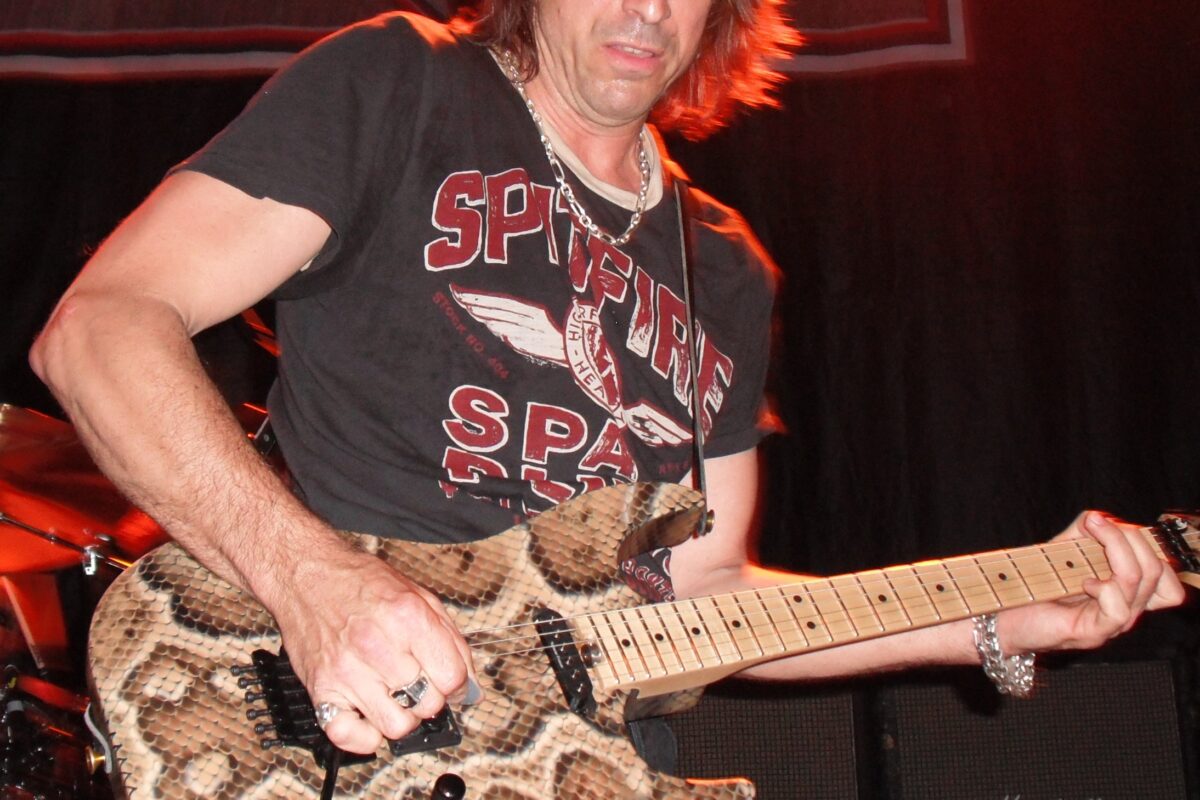
Warren DeMartini Guitars & Gear: The Complete Guide to Ratt’s Torch Guitarist’s Rig
Warren DeMartini guitars & gear: Ratt's Torch guitarist. Charvel Bomber, snakeskin, Jose-modded Plexi, Fender Super Champ, RTM pickup, slapback echo — the complete rig.
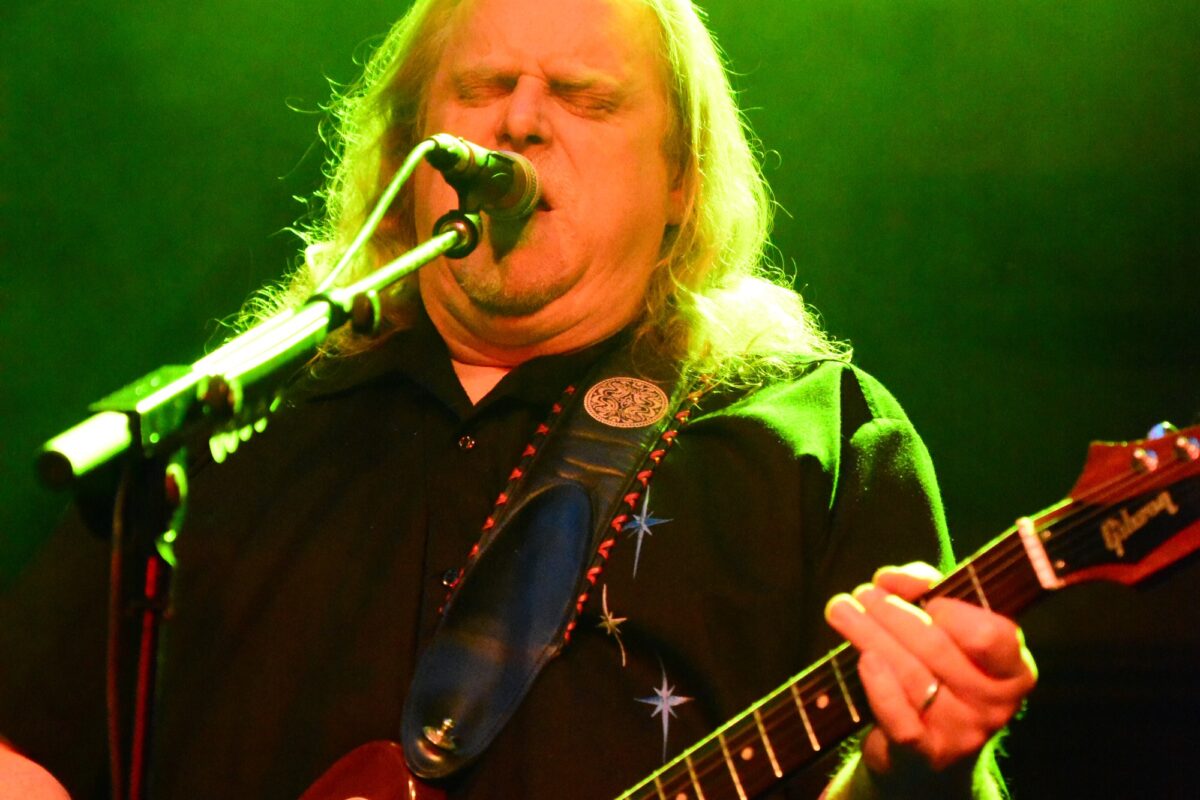
Warren Haynes Guitars & Gear: The Complete Guide to Gov’t Mule’s Guitar Master’s Rig
Warren Haynes' guitars, amps, and effects — the complete guide. Gibson Les Paul Chester, Soldano SLO-100 modified, Klon Centaur, Emma Discombobulator, and how to nail that Gov't Mule blues-rock tone.