

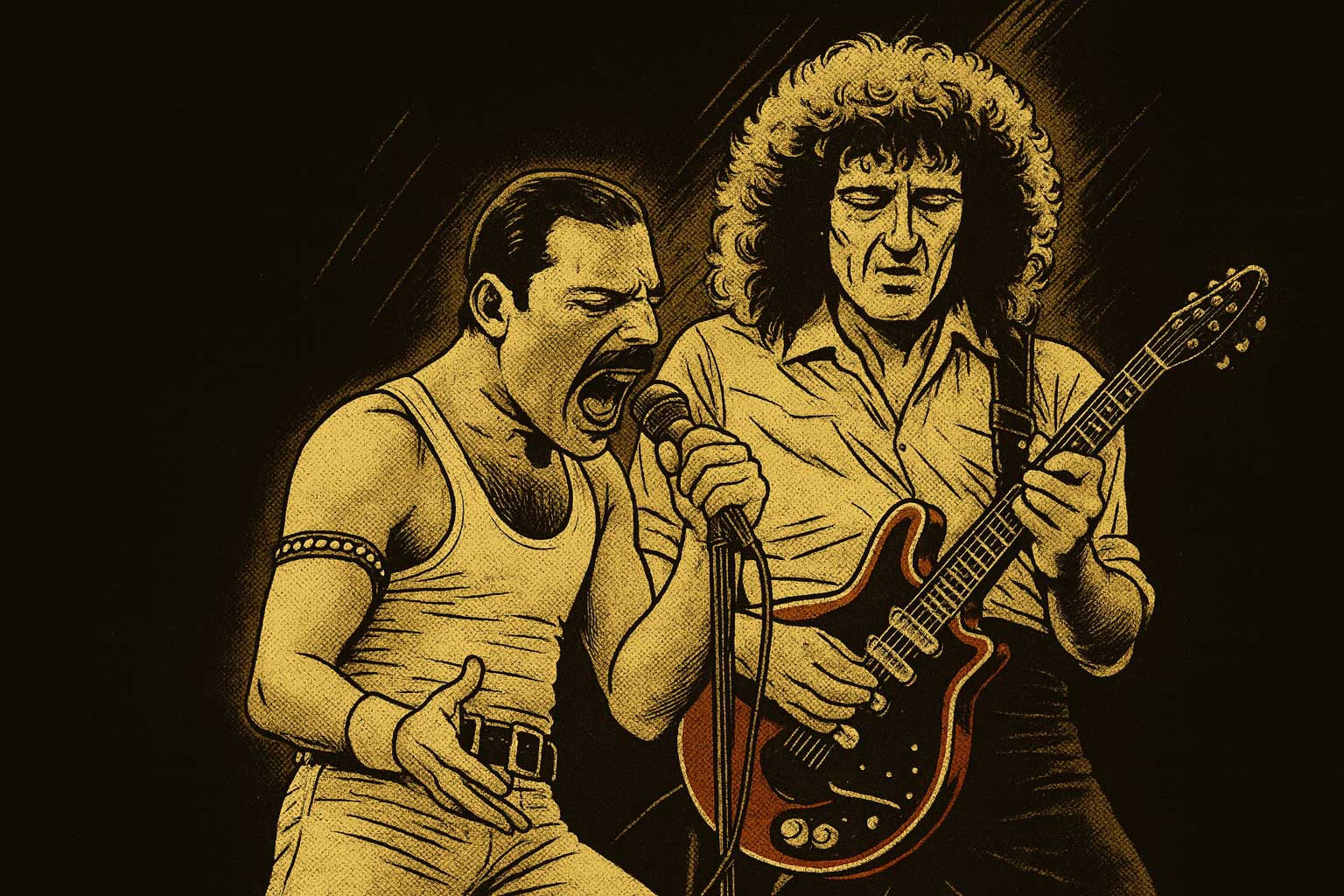
Picture this: a teenage kid in 1963, soldering wires in a dimly lit London attic, carving guitar parts from an old fireplace mantle and motorcycle springs, with his dad watching proudly from the corner. No factory. No brand name. Just Brian May, some leftover oak, and an idea — to build a guitar that could sing like a voice and scream like a violin. That guitar became The Red Special, and it didn’t just shape Queen’s sound — it rewrote rock history.
From the moment that homemade monster hit the stage, it was clear: this wasn’t just another British guitarist trying to sound like Clapton or Page. Brian’s tone had its own gravity — smooth yet explosive, precise yet emotional. Every solo, from “Bohemian Rhapsody” to “Brighton Rock,” was instantly recognizable. You could pick him out blindfolded in a lineup of a hundred guitarists.
May didn’t just play guitar — he engineered it. He treated sound like science and passion like circuitry. Using a sixpence coin instead of a pick, he discovered he could coax harmonics and warmth no plastic plectrum could touch. The result? That signature singing sustain and orchestral tone that made a single guitar sound like a symphony.
And of course, there was Queen — a band so grand it could only be held together by a mad scientist with perfect pitch and a guitar built from a fireplace. May wasn’t just the lead guitarist; he was the sonic architect, layering anthems that balanced chaos and beauty with surgical precision. His tone wasn’t about distortion — it was about drama.
In this article, we’ll tear down the walls of the Red Special itself, explore the legendary Vox AC30 trio, the mythical Deacy Amp, and the handmade treble boosters that turned his soft-spoken touch into an arena-sized roar. We’ll dive into how May’s mix of physics, passion, and pure stubbornness forged one of rock’s most unique guitar voices — a sound equal parts scientist and sorcerer.
From Homemade to Hall of Fame – The Story of the Red Special
Before Queen, before the stadiums, before the layered harmonies and light shows, there was a fifteen-year-old Brian May sitting in his parents’ living room, carving wood from an old fireplace mantle into what would become one of the most iconic instruments in rock history.
He couldn’t afford a Fender or Gibson. So he built one.
With his father, Harold — an electrical engineer — Brian began sketching, soldering, and scavenging for parts. They used mahogany from a 100-year-old fireplace, oak inserts, and a motorcycle valve spring for the tremolo system. The trem arm itself? A knitting needle. The fret markers were made from mother-of-pearl buttons, and the pickups were hand-wound by Brian himself with copper wire scavenged from old electronics.
The result was the Red Special — a guitar that didn’t just look unique, it behaved differently. Its semi-hollow body gave it a resonance that was somewhere between a Les Paul and a violin. Combined with May’s homemade pickups and his tendency to run them in series rather than parallel, the sound was thick, chimey, and harmonically rich.
“I wanted a guitar that could feed back controllably,” May explained. “Something that could sing — not scream.”
And sing it did.
By the time Queen formed in 1970, the Red Special had already become his voice. He’s played it on nearly every Queen album and tour since. It survived decades of sweat, pyrotechnics, and roaring crowds — and even after countless replicas and custom models from Guild, Burns, and his own Brian May Guitars, nothing quite matches the tone of the original.
It’s not just an instrument; it’s a family heirloom turned legend. A handmade anomaly that grew up alongside its creator — both equal parts brilliant, eccentric, and timeless.
Today, the original Red Special rests in a custom flight case between tours, still perfectly playable, still loaded with its 1960s electronics. And when Brian picks it up, it still sounds like the universe catching fire in tune.
(Also read Tony Iommi – The Godfather of Heavy Riffs for another master who turned limitation into legend.)
The Rig – Amps, Pedals, and Treble-Boosted Majesty
Brian May’s rig is one of the most studied in rock history — and yet, it’s beautifully simple. No walls of digital processors, no endless pedal chains. Just a homemade guitar, a handful of treble boosters, and a small army of Vox AC30s that, together, sound like a cathedral on fire.
The Vox AC30 – Heart of the Queen Sound
If the Red Special is the voice, the Vox AC30 is the throat that gives it power. May doesn’t just use one; he uses three — each with a specific job:
-
One runs dry, straight from the treble booster.
-
One runs slightly delayed (around 15–20 ms).
-
The third runs a longer delay (around 30 ms).
This creates the illusion of multiple guitars playing in perfect harmony — that massive, choir-like wall of sound that defined Queen’s arena anthems.
He keeps the amps dimed — volume, treble, and presence all cranked — letting the Red Special’s onboard volume control shape the gain. When he rolls the guitar volume back, it cleans up beautifully. Push it up again, and it roars.
“You don’t need 100 amps,” May once said. “Just one that breathes with you — and maybe two more for good measure.”
Treble Boosters – The Secret Sauce
The AC30 on its own breaks up smoothly, but it’s the treble booster that gives Brian’s tone its laser-beam focus. He started with the Dallas Rangemaster, later using Cornell, Fryer, and Pete Cornish versions tuned to his specs.
The booster pushes the mids and highs into overdrive, making the Red Special’s single-coil pickups scream without losing clarity. It’s why his leads on “Bohemian Rhapsody” or “Tie Your Mother Down” slice through the mix like a beam of light — saturated but never muddy.
His live chain is famously minimalist:
Red Special → Treble Booster → Delay(s) → Vox AC30s.
No overdrive pedals, no reverb — just raw tube compression and harmonic magic.
The Deacy Amp – A Mythical Creature
While the AC30s rule the stage, the studio had a different hero: the Deacy Amp, a tiny, homemade transistor amp built from scrap electronics by Queen bassist John Deacon.
This miniature marvel, powered by a 9-volt battery, produced rich, orchestral tones — perfect for Brian’s layered guitar harmonies.
It’s the sound you hear on “Good Company” and “Killer Queen” — those sweet, almost woodwind-like textures.
Today, modern replicas of the Deacy Amp still exist, but the original remains Brian’s secret weapon — a relic of the same DIY genius that gave birth to the Red Special.
Strings, Picks, and Touch
Brian’s technique completes the circuit. He uses Optima Gold .009–.042 strings, which deliver bright sustain without extra tension.
Instead of a pick, he famously uses a British sixpence coin — its serrated edges creating that crisp, metallic attack that no plastic plectrum can mimic.
His fingers do the rest — gentle vibrato, volume-knob swells, and precise dynamics that make even the loudest notes sound emotional.
“The sound is in the fingers,” he says. “Everything else just helps you tell the story.”
(Also read Jack White – Raw Tone and The White Stripes Sound to see how another tone alchemist builds beauty from chaos.)
The Playing Style – Orchestral Fire and Precision
Brian May doesn’t just play guitar — he composes with it. His phrasing, his tone, his harmonic layering — everything he does feels symphonic.
Where most players build riffs, May builds movements. His guitar work in Queen isn’t just a lead line over chords; it’s another voice in the choir, another instrument in the orchestra.
The Scientist and the Storyteller
May’s brain is wired like an engineer’s but guided by an artist’s heart.
He studied astrophysics, yet onstage he channels pure emotion. Every note he plays sounds both calculated and spontaneous — the rare combination of mathematical precision and emotional chaos.
He treats the fretboard like a laboratory. Every bend is measured, every harmony intentional.
Songs like “Bohemian Rhapsody” or “Somebody to Love” don’t just have solos — they have guitar dialogues, carefully arranged to complement Freddie Mercury’s melodies.
“We didn’t want the guitar to compete with Freddie’s voice,” May once said. “We wanted it to converse with it.”
That’s why even his solos feel like storytelling — they start soft, build tension, and explode into release.
Turning a Guitar into an Orchestra
Brian’s genius shines brightest in the studio.
Armed with his Red Special, treble boosters, and the Deacy Amp, he layered dozens of guitar tracks to create those choral harmonies that made Queen’s sound larger than life.
Listen to “Procession” or “Father to Son” — that’s not synth or strings.
That’s Brian stacking lines, note by note, until the mix becomes a universe of harmonics.
He called it his “guitar orchestra” technique — and it remains one of the most recognizable sonic signatures in rock.
Tone by Touch
Where most guitarists rely on pedals to shape dynamics, Brian does it with his hands.
He uses finger vibrato instead of tremolo tricks, controlling sustain with micro-adjustments of pressure and pick angle.
He’ll roll off his guitar volume mid-phrase to clean up an AC30’s breakup, creating the illusion of multiple amps fading in and out.
His coin pick technique adds bite and shimmer — the edges scrape the strings just enough to pull out extra harmonics.
It’s why his high notes sound like they’re glowing, not just ringing.
Improvisation and Stage Presence
Live, Brian is unpredictable in the best way.
He rarely plays a solo the same way twice — not because he forgets, but because he’s listening.
He reacts to Freddie’s phrasing, to Roger’s snare hits, to the audience’s energy.
Watch “Brighton Rock” live — that extended solo section is half composed, half pure instinct.
He’ll loop himself with delays, build harmonies on the fly, and turn a single riff into a cinematic journey.
It’s chaos dressed as control — just like the man himself.
(Also check Jimmy Page vs Tony Iommi – The Battle of Heavy Origins for another master of tone through controlled imperfection.)
The Legacy – The Genius Behind the Guitar and Beyond
Brian May’s legacy stretches far beyond his fretboard. He isn’t just one of rock’s greatest guitarists — he’s one of its purest visionaries. Every note he’s played, every amp he’s built, and every melody he’s crafted comes from the same place: a deep belief that music and emotion are physics made human.
He turned his limitations into a revolution.
Where most kids his age dreamed of owning a Gibson, Brian dreamed of building one.
Where most players chased volume, he chased clarity.
And where others built solos, he built cathedrals of sound.
The Genius of Collaboration
May was never just the “guitar guy” in Queen. He was an arranger, a songwriter, a multi-instrumentalist, and often the quiet architect behind the chaos.
He wrote classics like “We Will Rock You,” “Tie Your Mother Down,” and “Fat Bottomed Girls.”
Each riff, each chord progression, had intent. Even his simplest songs were designed to fill entire stadiums with communal rhythm — music that united everyone from punks to opera fans.
And he did it all without ego. His guitar didn’t demand the spotlight — it earned it.
Tone as Identity
Brian’s tone isn’t something you can buy; it’s something you build.
It’s the product of thousands of hours spent tinkering, experimenting, and refusing to settle.
That’s why even modern players with his exact gear — the Red Special replicas, the Vox AC30s, the treble boosters — still can’t quite sound like him.
Because what they’re missing is the mindset: the willingness to build your own universe from scratch.
That’s Brian May’s real gift to guitarists — not just his sound, but his curiosity.
He proved that tone is born from character, not equipment.
Beyond the Stage
After decades of global fame, May earned his PhD in Astrophysics and became an advocate for animal rights and space exploration.
He literally went from playing “We Will Rock You” to working with NASA on 3D imaging of asteroids.
It’s hard to imagine anyone else who could move so effortlessly between a stadium and a science lab — and make both feel like home.
His humanitarian work, his academic achievements, and his humility have only deepened his legend.
He’s not just a guitarist; he’s living proof that intellect and emotion, logic and passion, can coexist — and make noise together.
A Legacy Etched in Fire and Stardust
Brian May’s Red Special still hums with the same spirit it did in the 1960s.
He could replace it with a million-dollar custom build tomorrow, but he won’t. Because that guitar — with its fireplace wood, knitting needle tremolo, and homemade pickups — is more than an instrument. It’s his soul in physical form.
From “Bohemian Rhapsody” to “The Show Must Go On,” Brian May gave rock its most emotional vocabulary.
He taught the world that science and magic aren’t opposites — they’re partners.
And every time that sixpence hits the strings, the universe hums in agreement.
(Also check Slash – Les Paul Fire and the Guns N’ Roses Tone for another master who turned soul and sound into identity.)
FAQ – Brian May’s Tone, Guitar, and Red Special Secrets
What is Brian May’s Red Special made of?
The Red Special was built by Brian and his father in the early 1960s using wood from an old fireplace mantle, oak inserts, and even a motorcycle valve spring in the tremolo system. The fret markers came from mother-of-pearl buttons, and the tremolo arm was a knitting needle. Every part was homemade — and that’s exactly why it still sounds so alive today.
Why does Brian May use a coin instead of a guitar pick?
He uses a British sixpence coin because its serrated edges create a sharper attack and richer harmonics than plastic picks.
It lets him control dynamics like a violin bow — picking softly for warmth or digging in for metallic bite. That coin is one of the most important parts of his tone.
What amps does Brian May use?
He’s best known for his wall of Vox AC30s, typically running three at once: one dry, and two with different delay times to create that huge stereo spread.
In the studio, he also uses the legendary Deacy Amp, a tiny transistor amp built from junk parts by Queen bassist John Deacon. It’s responsible for the smooth, orchestral layers on tracks like “Killer Queen.”
What pedals are in Brian May’s setup?
May doesn’t use traditional overdrives or distortion pedals. His chain is simple:
Red Special → Treble Booster → Delay → Vox AC30s.
The treble booster — originally a Dallas Rangemaster — pushes the AC30s into natural tube overdrive, giving that bright, vocal sustain.
What strings and gauges does he use?
He uses Optima Gold .009–.042 strings, chosen for their clarity and smooth response.
The gold coating helps maintain brightness and prevents oxidation — essential for his singing sustain.
How does Brian May get that “orchestral” guitar sound?
He layers multiple guitar tracks using the Deacy Amp, blending harmonized lines like a symphony.
Each layer is recorded with precise phrasing and micro-delays, creating the illusion of a full orchestra — all from one guitar.
What tuning does Brian May use?
He mostly sticks to standard tuning (EADGBE), but he’s known to occasionally experiment with drop tunings or partial capo setups for specific arrangements.
Can I buy a Brian May Red Special replica?
Yes — several companies have built official models, including Brian May Guitars, Guild, and Burns.
The official BMG Red Special is the closest match to his original, using his personal specs and wiring setup.
What’s the secret to Brian May’s tone?
It’s not the gear — it’s the balance of everything: homemade guitar, treble booster, cranked tube amps, and delicate right-hand touch.
He builds emotion through precision and dynamics, not volume or gain.
(For similar tone icons, check Jack White – Raw Tone and The White Stripes Sound and James Hetfield – Downpicking King of Metallica.)