Jeff Beck — The Shape-Shifter of Electric Tone
GuitarGangsters Editorial 34 min read Updated 20 October 2026
There are guitar players who chase tone — and then there was Jeff Beck, who became it.
He wasn’t a bluesman, a rocker, or a jazz-fusion wizard. He was all of them — often in the same solo. Beck didn’t play to impress; he played to discover. Every night, his Strat spoke a different language, and somehow it always made perfect sense.
Born in the quiet suburbs of Wallington, England, in 1944, young Geoffrey Beck turned homemade cigar-box guitars into time machines. By the mid-’60s he was rewriting rock history with the Yardbirds, replacing Eric Clapton and prefiguring Jimmy Page — the missing link between tradition and rebellion. But where others saw blues, Beck saw colors. He bent sound like light through glass.
Through every decade, he reinvented himself: the Les Paul thunder of the Truth era, the cosmic funk of Blow by Blow, the synth-fusion firestorms with Jan Hammer, the minimalist storytelling of his later years. Each phase felt like a new artist emerging from the old one — but the fingerprints never changed.
He was the guitarist’s guitarist — a player’s player — the one even Clapton, Page, and Hendrix quietly feared. His genius wasn’t just in the notes but in the touch: that bare-finger attack, the gentle coaxing of the tremolo arm, the endless dance with the volume knob. He didn’t need distortion pedals to sound dangerous; his hands were the distortion.
Jeff Beck’s tone was a paradox — brutal and beautiful, mechanical and human, cosmic yet intimate. He could make a Strat weep like a cello or roar like a fighter jet, often within a single bar. His sound wasn’t just music; it was a living conversation between electricity and emotion.
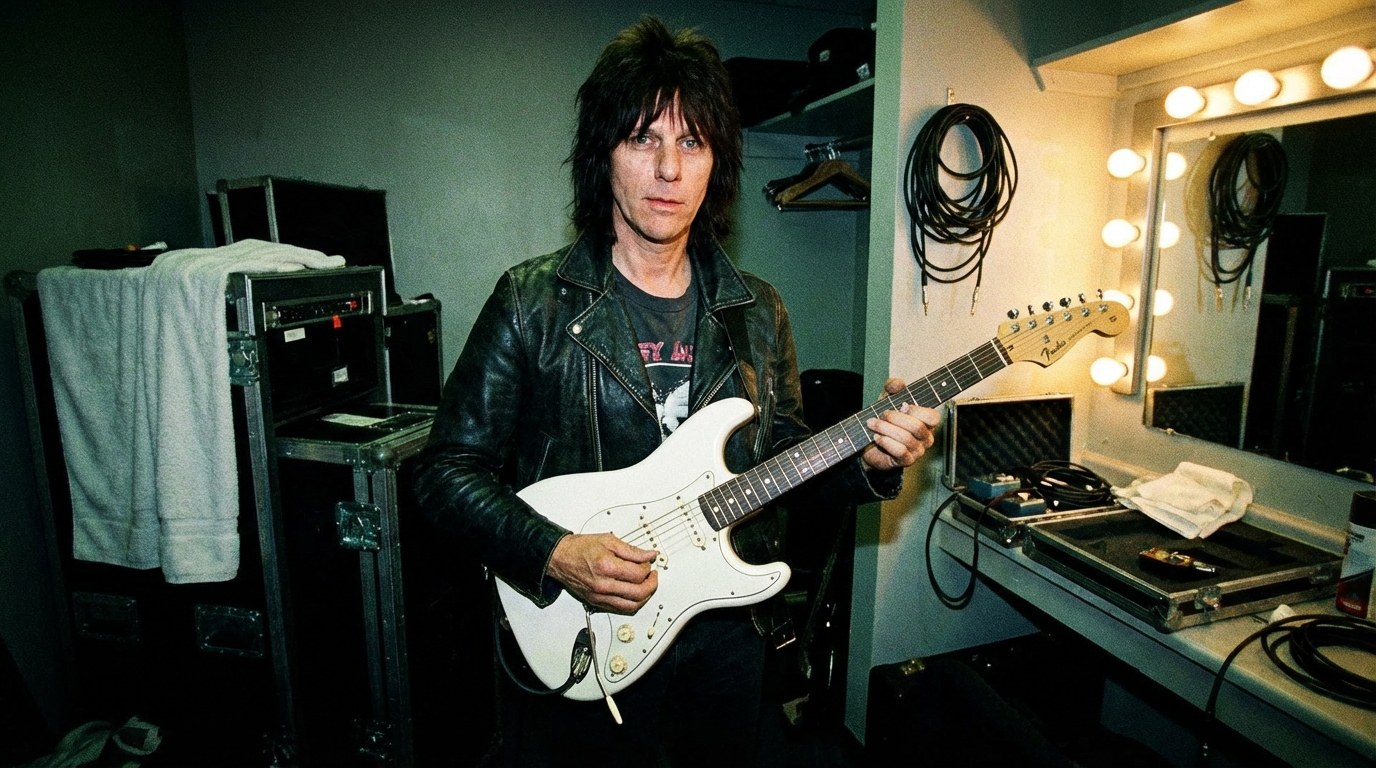
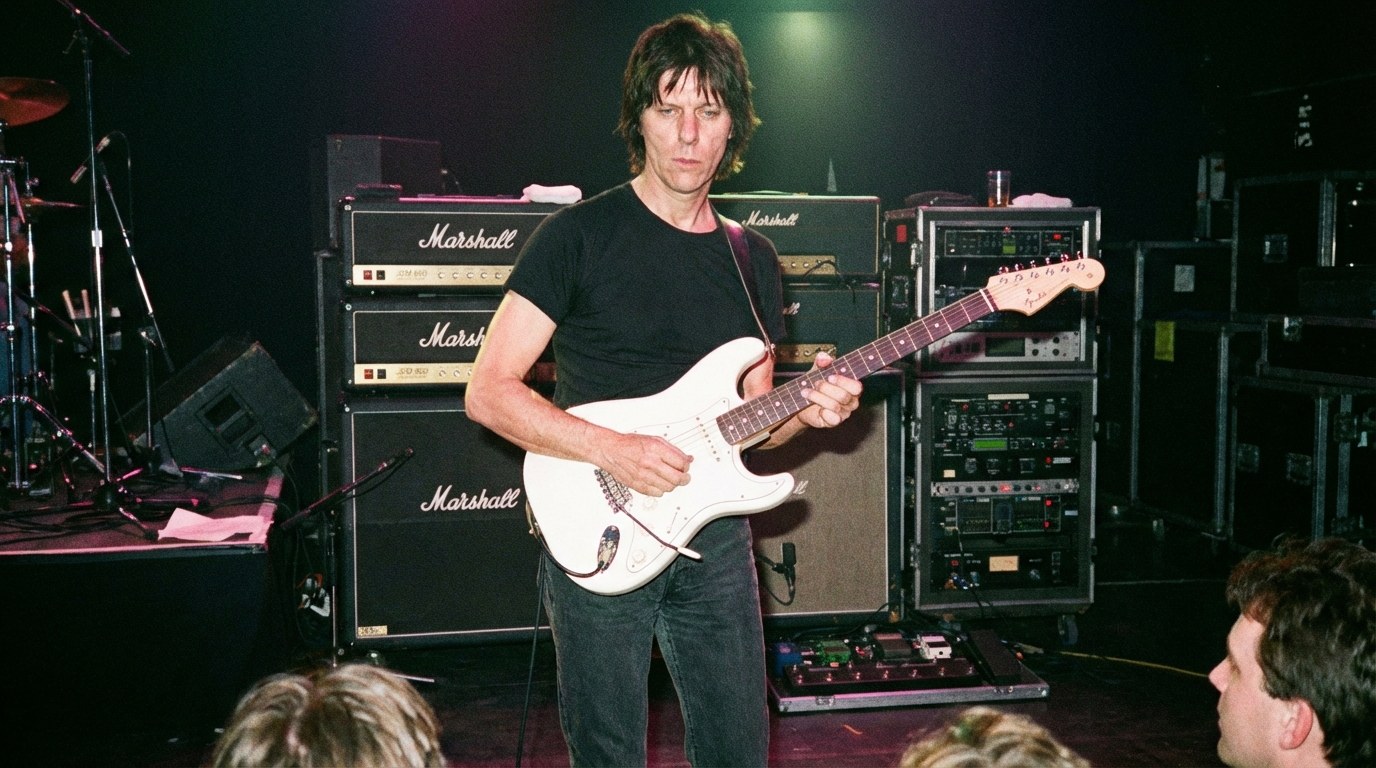
This is his story.
This is his rig.
This is how the quietest man in rock made his guitar speak louder than anyone else.
The Evolution of Jeff Beck’s Sound
Every era of Jeff Beck’s career sounded like a new invention — not just another chapter. He wasn’t chasing perfection; he was chasing possibility. From fuzz-drenched psychedelic chaos to the whisper of harmonics that could melt glass, Beck treated sound like clay — shaping, stretching, and breaking it until it revealed something no one had heard before.
Yardbirds (1965–1966)
The revolution began with a battered 1954 Fender Esquire, a Vox AC30, and a Tone Bender fuzz. In those brief, explosive months with the Yardbirds, Beck redefined what guitar could do. Feedback became melody, distortion became dialogue. “Heart Full of Soul” wasn’t just a hit — it was the first time a guitar sang like a sitar, and it made rock suddenly sound interstellar.
Jeff Beck Group (1968–1969)
Then came the thunder. Armed with a sunburst 1959 Les Paul and a Marshall Super Lead, Beck unleashed Truth and Beck-Ola — the missing link between British blues and heavy metal. It was volcanic: raw, dangerous, and blues reimagined as pure muscle. You can feel Led Zeppelin forming in its wake.
Fusion Awakening (1974–1976)
When most guitar heroes doubled down on volume, Beck went inward. On Blow by Blow and Wired, he traded screaming Les Pauls for Strats and turned to jazz harmonies, phrasing like a horn player and singing through his strings. Working with George Martin and Jan Hammer, he proved that tone could breathe — that virtuosity could whisper.
Late 1970s — The Experimenter
Ring modulators, para-flangers, and tape delays entered the palette. Beck was no longer playing solos; he was painting frequencies. It wasn’t about genre anymore — it was about emotion in motion.
The 1980s — Digital Shape-Shifter
The MTV decade didn’t tame him; it merely gave him new toys. Custom Jackson Soloists, locking trems, and the sleek tones of Flash brought him into modern pop culture, yet his phrasing stayed untouchably human. “People Get Ready” reminded the world that emotion still ruled the mix.
1990s–2000s — The Signature Era
The Fender Jeff Beck Signature Strat became his Excalibur — first with Lace Sensors, later with Hot Noiseless pickups. His tone turned smoother but more vocal, like the mature control of a martial artist who knows his power and no longer needs to prove it. Guitar Shop, Who Else!, and Live at Ronnie Scott’s became masterclasses in dynamics: no pick, no excess, just pure touch.
2010–2022 — The Final Shape
By his last decade, Beck’s sound had reached spiritual clarity. Through Vibro-Kings and Klon boosts, the tone was glassy yet feral, shifting from whisper to wail without ever losing breath. The 2022 tour — his last — felt like a farewell from an artist who had finally fused man and machine into one voice.
tone note: Beck’s career wasn’t a timeline — it was electricity learning how to feel.
Guitars & Gear — The Tools of the Tone Prophet
If you want to understand Jeff Beck, don’t start with his fingers — start with the instruments that tried to keep up with them. His guitars were never about endorsements or status. They were laboratories — each one a vessel for a new tone experiment. Beck didn’t collect guitars; he evolved them. Every nick, every stripped finish, every swapped pickup was a step toward the sound in his head that never stopped changing.
The Yardbirds Weapon — 1954 Fender Esquire
It started with “the ugliest guitar in the world,” a blonde 1954 Fender Esquire bought for £75. The body was reshaped to mimic a Strat, the wiring modified, the pickguard yellowed with time. Through that single bridge pickup and a Vox AC30, Beck helped invent the fuzz era. On Heart Full of Soul and Shapes of Things, he made the Esquire moan, snarl, and cry — often with a borrowed Roger Mayer fuzz prototype that predated the Tone Bender. That guitar didn’t just play songs. It started revolutions.
tone note: In his hands, one pickup was enough to make the world sound brand new.
The Les Paul Years — Truth in Mahogany
When Beck founded the Jeff Beck Group, the Esquire gave way to a 1959 Gibson Les Paul Standard and a 1954 “Oxblood” Les Paul — both modified within an inch of their lives. He stripped finishes, broke necks, swapped hardware, and found the sweet spot where blues met thunder. That Oxblood — later immortalized on the cover of Blow by Blow — became so legendary that Gibson reissued it decades later, and in 2025 Epiphone released a faithful Inspired by Gibson Custom version for the masses. With a Marshall Super Lead roaring behind him, Beck carved riffs that would help blueprint a heavier future.
tone note: The Oxblood wasn’t a guitar; it was a detonation device with six strings.
The Stratocaster Revelation — Voice of the Future
By 1974, the Les Pauls were too heavy for the sounds in his mind. Beck picked up a white Fender Stratocaster and, in doing so, redefined what tone could feel like. The Strat’s floating tremolo became an extension of his breathing — subtle micro-bends, glides, and swells that turned the instrument into a living voice. This was the sound of Blow by Blow and Wired — lyrical, elastic, and impossibly human. No pick, no fuss, just hand, string, and motion.
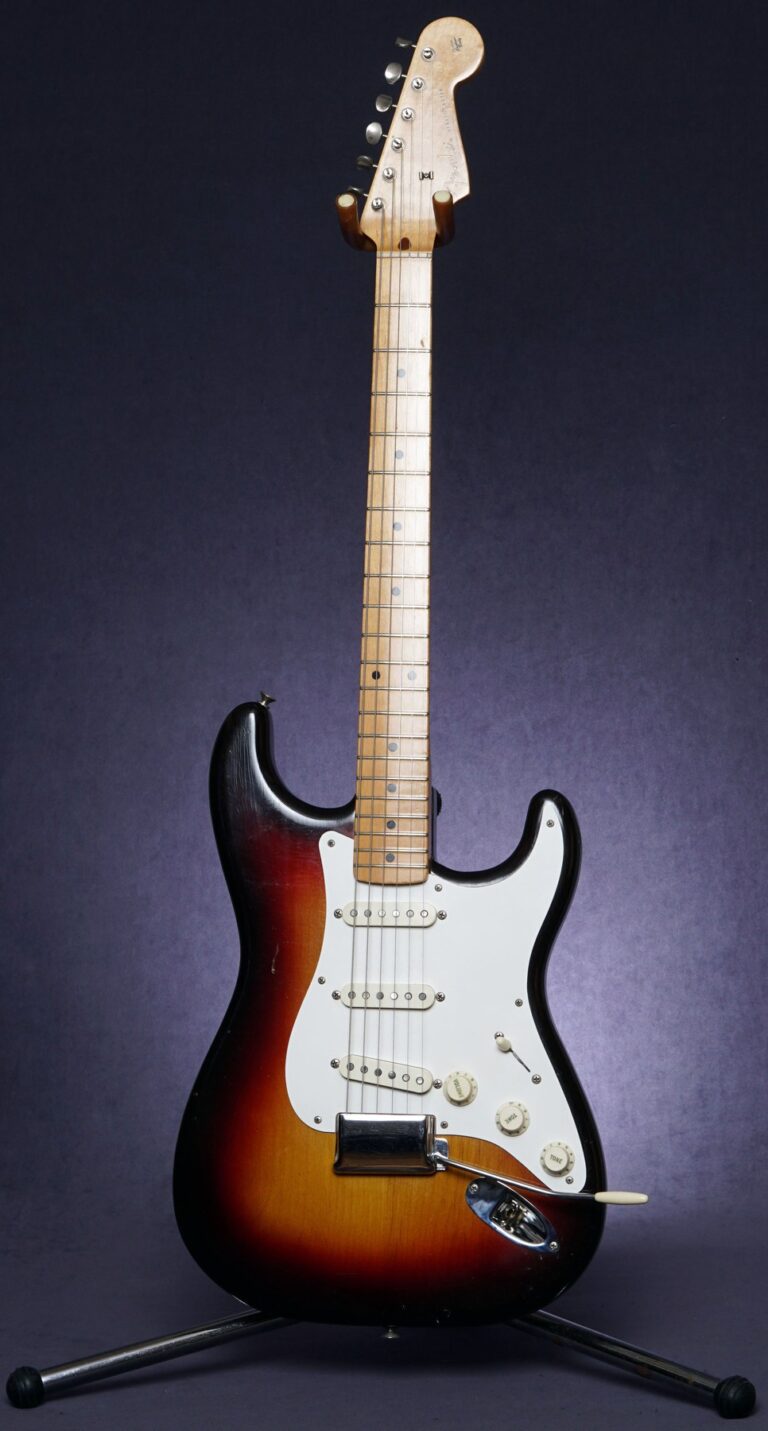
tone note: A Strat in Beck’s hands wasn’t a guitar — it was a larynx of light and steel.
The Experimental ’80s — Jacksons, Mods, and Neon
Beck flirted with the future: neon-bright Jackson Soloists with Kahler and Floyd Rose tremolos, true single-coil wiring, surgical precision. He played Flash like a man proving he could outplay pop radio with tone alone. Yet even surrounded by gated reverbs and digital gloss, his phrasing stayed analog.
tone note: Even when wrapped in neon, the soul stayed analog.
The Return to Fender — Signature Strat
In the 1990s, Beck came home to the Strat — this time with his name on the headstock. The Fender Jeff Beck Signature Strat became his constant companion: contoured heel, LSR roller nut, Hot Noiseless pickups, and wiring that let him shape all three pickups from a single tone control. Early models wore Lace Sensors; later versions refined the glassy, noise-free sheen heard on Who Else! and Emotion & Commotion. Every mod had a purpose: stability for whammy artistry, clarity for volume swells, comfort for endless phrasing.
tone note: Perfection didn’t come from technology — it came from removing everything that got in the way of feeling.
Modern Era Tools — Vibro-King, DSL, and the Board
By the 2010s, his setup was a masterclass in minimalism. The Jeff Beck Signature Strat into a Fender Vibro-King or a Marshall DSL100H, occasionally kissed by a Klon Centaur, delivered everything from angelic cleans to molten glass. He kept amps bright and unforgiving, with bass rolled low and mids forward — a tone philosophy born from both tinnitus and taste. His 2022 pedalboard, later auctioned for a small fortune, stretched nearly four feet: Maestro Ring Modulator, Klon Centaur, Strymon El Capistan, MXR Carbon Copy, Hughes & Kettner Rotosphere, and the trusty wah. The irony? Half the time, he barely touched them.
Amplifiers & Effects — The Gospel According to Tubes
If Jeff Beck’s guitars were his brushes, his amplifiers were the canvas — vast, reactive, and full of danger. He didn’t just plug in; he conversed with electricity. Every decade brought a new sermon, but the gospel never changed: the tubes must breathe.
The Early Years — Vox and the Birth of Feedback
In the Yardbirds, Beck’s tone was pure experimentation. His Vox AC30 wasn’t a clean machine; it was a weapon. Pushed past its limits, it screamed, compressed, and howled — the perfect partner for the prototype fuzzes that Roger Mayer slipped him. That brittle, explosive combination created a vocabulary of distortion no one had spoken before. He turned technical malfunction into musical language.
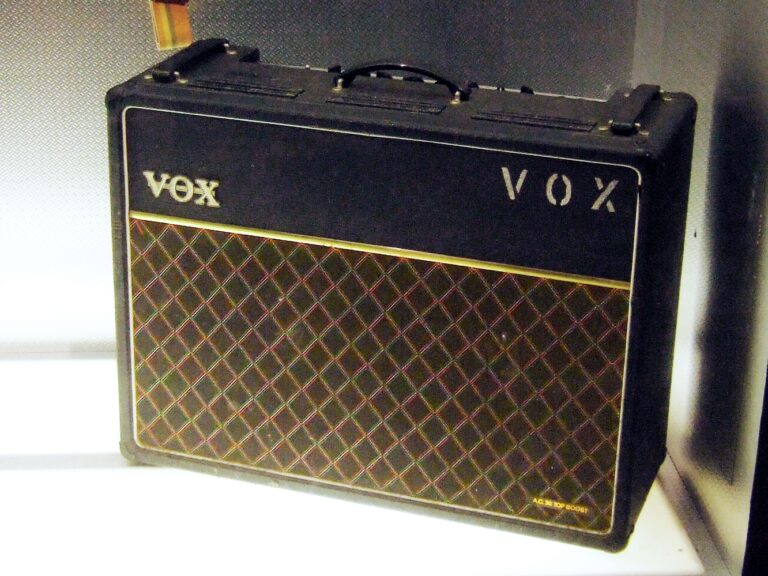
tone note: His first fuzz wasn’t about saturation — it was about chaos turned poetic.
The Jeff Beck Group — The Rise of Marshall Power
When Beck went solo, his amplifiers grew teeth. The Marshall Super Lead 100 and 4×12 cabs became his thunderstorm — all punch, no polish. On Truth and Beck-Ola, he stacked volume until it cracked the air itself. His tone wasn’t neatly overdriven; it was molten, shifting between fury and fragility with his volume knob as conductor’s baton.
While other players buried their sound in pedals, Beck’s distortion came from tubes pushed to the edge and a right hand that hit like lightning.
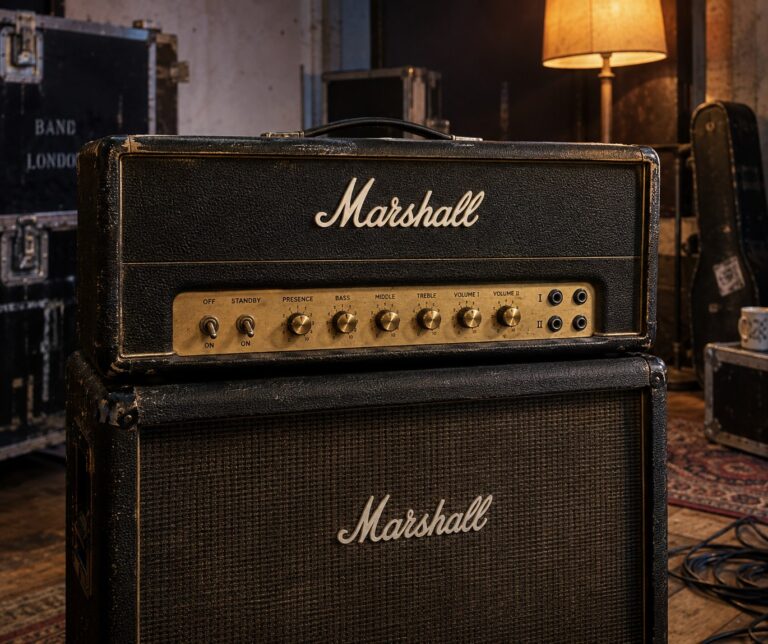
tone note: The volume knob was his gain pedal.
The Fusion Era — The JTM, the Studio, and George Martin’s Precision
By the mid-’70s, Beck had mastered the art of control. His amps — primarily Marshall JTM45s and Ampeg VT-40s — were tuned not for brute force, but for articulation. In the studio with George Martin, he rolled off bass entirely and let his Strat’s top end breathe. On Blow by Blow and Wired, that decision defined a new kind of guitar tone: vocal, articulate, and dynamic.
He paired those heads with Lexicon reverbs and Colorsound Overdrivers, shaping space rather than saturating it. He didn’t chase sustain; he chased voice.
tone note: Every note exhaled like it had lungs.
Late 1970s — The Sonic Alchemist
As the decade closed, Beck’s rig looked more like a science experiment than a rock setup. Para-flangers, Echoplex tape delays, and even ring modulators appeared on his board. The goal wasn’t effect for effect’s sake — it was color.
When others used pedals to hide, Beck used them to reveal what the guitar could be when electricity misbehaved beautifully.
tone note: When the signal broke, that’s when it started to sing.
The 1980s — Seymour Duncan and the Convertible Age
With the rise of studio perfectionism, Beck’s tone went surgical but never sterile. He toured with Seymour Duncan Convertible amps — modular tube heads that could mimic both Fender and Marshall DNA. They gave him range without sacrificing touch.
On stage, he often blended these with Marshalls for warmth and bite. His gain never came from the amp’s circuit — it came from dynamics. You can hear it on “People Get Ready”: clean enough to shimmer, powerful enough to move mountains.
tone note: Gain was a state of mind, not a knob.
The Signature Years — Marshall JCM2000 DSL100 and the Vibro-King
By the time Beck returned to Fender, he had perfected minimalism. The JCM2000 DSL100 — heavily modified and sharing little with retail models — became his modern warhorse, delivering clarity with authority.
Yet his true soulmate was the Fender Vibro-King. Three 10-inch speakers, handwired circuits, and an open midrange gave him a platform for transparency. Beck used it clean, loud, and dangerously dynamic — mids around 9, treble near 7, bass rolled low to 3. He sculpted distortion through his fingers and volume knob, not circuitry.
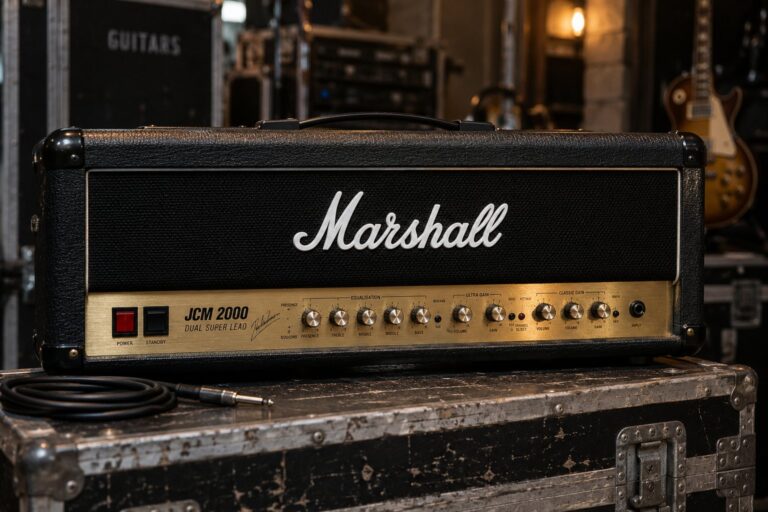
tone note: He set the amp to shout, then taught it how to whisper.
The Modern Board — Simplicity by Design
For all his reputation as an innovator, Beck’s pedalboard was shockingly restrained. In his final decade, it was about texture, not transformation.
His core chain looked like this:
Strat → Klon Centaur (boost) → Tape Echo (Strymon El Capistan) → Reverb (Lexicon-style) → Amp (Vibro-King or DSL).
For color, he’d occasionally engage a Maestro Ring Modulator, a Ventilator II rotary sim, or an MXR Carbon Copy for darker ambience.
The rest was touch, timing, and tone philosophy. No walls of sound, no pedal tap-dance — just fingers, volume, and air.
tone note: In the silence between effects, you could hear the electricity think.
The Live Equation — Controlled Chaos
On stage, Beck rarely played the same tone twice. His amps were always run hot, his guitars always slightly unstable, his fingers always steering the chaos. He would coax feedback like a violinist bending bow pressure — delicate, deliberate, and dangerous.
Techs describe his live tone as “one wrong breath away from disaster” — and that’s exactly how he wanted it.
Tone Philosophy — The Hands Behind the Legend
For Jeff Beck, tone wasn’t a product of gear — it was a living language. His amplifier didn’t shape the sound; his hands did. The knobs, pedals, and pickups were just translators for what he wanted to say. Every vibration, every swell of the volume knob, every tremolo shimmer was deliberate emotion turned into electricity.
The Touch — No Pick, No Rules
By the mid-’70s, Beck abandoned picks entirely. His thumb and index finger became paintbrushes. That decision changed everything. Without a pick’s rigid attack, he gained infinite control over volume, tone, and texture.
He could flick the strings for percussive snap, pluck for crystalline highs, or caress them until they whispered. His touch turned a Strat into a multi-instrument: part voice, part synth, part storm.
Listen to Live at Ronnie Scott’s — every note breathes, bends, and breaks like silk caught in wind.
tone note: He didn’t strike the strings — he negotiated with them.
The Whammy Bar — Voice, Vibrato, and Emotion
For most guitarists, the tremolo arm is an effect. For Beck, it was anatomy.
He kept his bridge floating just enough to lift or drop pitch microtonally — not to dive-bomb, but to speak. Combined with his fingers, it created the human inflection that defined his phrasing.
He’d push down for a sigh, pull up for a question, and flutter for vibrato that made strings sound alive. Every solo became a conversation, and the whammy bar was his punctuation.
tone note: The tremolo arm wasn’t a gimmick — it was his second vocal cord.
The Volume and Tone Knobs — Infinite Dynamics
While most guitarists set their knobs and forget them, Beck lived on them.
He kept his guitar volume just shy of maximum, using micro-adjustments to clean up or drive the amp. Roll back the knob, and it’s glassy; push it forward, and it’s fury. His tone control rarely left the middle — around 5 to 7 — where he could darken or brighten every syllable of his phrasing.
That constant motion made his guitar feel like a breathing organism, its dynamics shifting with his pulse.
tone note: His volume knob was a throttle, not a switch.
The Sound of Silence — Space as an Instrument
Few players used silence as beautifully as Jeff Beck.
He understood that every rest between notes carried tension — a breath before impact. He left room for echoes, for ghosts, for the audience to lean forward.
In songs like Cause We’ve Ended as Lovers, he made minimalism a virtue. Each phrase arrived like a confession, perfectly placed in the quiet. His restraint wasn’t caution; it was power.
tone note: His pauses said more than most solos.
The Microtonal Mindset — Beyond the Scale
Beck didn’t care about scales; he cared about color.
He bent between pitches, often landing between notes to find a vocal inflection. That microtonal control, born from endless whammy work and fingertip vibrato, gave his solos their human depth.
On tracks like Nadia and Brush With the Blues, those half-tones feel like emotion itself — neither happy nor sad, just real.
tone note: He didn’t play notes — he played intentions.
Feel Over Fire
Beck never chased speed. He could play faster than nearly anyone, but he preferred precision to flash. His greatest solos weren’t about fireworks; they were about phrasing.
Every bend had a purpose. Every harmonic felt like punctuation.
When others filled space, Beck carved silence. When others showed off, he told stories. His tone philosophy was brutally simple: emotion first, always.
Playing Style & Technique — Feel Over Fire
Watching Jeff Beck play was like watching electricity remember it had a soul.
He didn’t approach the guitar as a tool; it was an extension of his nervous system — precise, unpredictable, and alive. His style was a paradox: impossible control hidden beneath absolute freedom.
The Right Hand — The Source of Everything
Beck’s right hand was a world unto itself.
He used his thumb, index, and middle fingers interchangeably, often pinching the string for harmonic squeals or slapping it for percussive accents. The result was a tone that could bark, whisper, and sing all in the same phrase.
His thumb handled rhythm, his index created attack, and his palm muted and shaped notes like a compressor built from skin and bone. The secret wasn’t aggression — it was nuance.
tone note: His right hand was the engine, his left hand the steering wheel.
The Left Hand — Control, Strength, and Emotion
Jeff Beck’s left hand turned steel into emotion.
He used wide, expressive vibrato drawn from both wrist and arm, never from fingers alone. His bends weren’t mere pitch shifts — they were vocal inflections, micro-adjusted in real time to feel human.
He often slid into bends rather than striking from below, blurring the line between note and movement. Each vibrato was slightly different, a personal signature written in waveform.
tone note: His bends didn’t climb — they sighed.
Harmonics and Whispers
Few players understood harmonics like Beck.
He could coax artificial harmonics mid-phrase, using his thumb and index pinch while simultaneously adjusting the whammy bar. The result was impossible to imitate: a flute-like tone that seemed to hover above the guitar itself.
On tracks like Where Were You, he used these harmonics to make his Strat sound like a choir of ghosts. Every overtone shimmered, perfectly balanced on the edge of feedback.
tone note: He didn’t find harmonics — he summoned them.
The Dynamic Range — From Whispers to Hurricanes
Beck’s greatest trick wasn’t speed or complexity — it was dynamics.
He could go from a whisper to a roar within a single bar. His live performances were exercises in tension and release; no compressor, no limiter, no safety net. Just raw touch controlling the chaos.
He often let his amp hover at the edge of feedback, taming it with palm muting and positioning. That danger made his tone alive — always ready to break, but never losing control.
tone note: Every performance was a storm balanced on a wire.
Rhythm as Conversation
Unlike many soloists, Beck treated rhythm as sacred.
He didn’t just play over grooves — he danced with them.
In early Jeff Beck Group tracks like Let Me Love You, he syncopated riffs like a drummer trading fills with himself. Decades later, that sense of groove evolved into complex rhythmic phrasing, blurring bar lines while staying locked in feel.
He didn’t need a rhythm guitarist because he was one, weaving percussive attacks between melody lines with surgical timing.
tone note: He never counted beats — he felt them.
Improvisation and Precision
Every Jeff Beck solo was a new creation.
He never repeated himself, even on songs played for decades.
Improvisation wasn’t a risk for him — it was the reward. He listened to the air, to the drummer’s breath, to the resonance of the room, and reacted. Yet within that chaos, his phrasing remained surgical.
Each note had meaning. No filler. No waste. Just a perfect dialogue between instinct and discipline.
tone note: He didn’t improvise to escape structure — he improvised to find truth.
How to Sound Like Jeff Beck — Build the Shape-Shifter Setup
You can’t be Jeff Beck — but you can chase the ghost in his circuitry. His sound wasn’t born from complexity; it came from simplicity mastered to perfection. To get close, you need to think like him: touch before technology, expression before effects.
The Guitar Setup
Start with a Stratocaster. Any Strat can work if you know how to talk to it — but the closer to Jeff’s spec, the better.
- Model: Fender Jeff Beck Signature Stratocaster
- Pickups: Fender Hot Noiseless single coils (bridge + middle blend sweet spot)
- Neck: Medium-chunky with rosewood board for warmth
- Frets: Medium-jumbo for smooth bends
- Nut: LSR roller nut for stable trem use
- Strings: .009–.042 light gauge (Ernie Ball Super Slinky or similar)
- Tuning: Standard E
- Action: Medium-low; floating tremolo for subtle pitch play
Keep your tremolo balanced so the G string can rise a minor third, the B a whole tone, and the high E a half step. That floating range is the key to Beck’s vocal phrasing.
tone note: If your whammy bar doesn’t feel like a breath, you’ve set it wrong.
Amp Settings — Clean on the Edge
Jeff Beck’s tone lives right where clean meets chaos. Run your amp bright and unforgiving — let your hands shape the gain.
Fender Vibro-King starting point:
- Volume: 5
- Treble: 7
- Mid: 9
- Bass: 3
- Reverb: 4
Marshall DSL100 (lead channel):
- Gain: 4
- Treble: 6
- Middle: 7
- Bass: 5
- Presence: 6
- Reverb: 3
The trick is to roll your guitar volume back to about 8 for cleans, then push it forward for saturation. No channel switching, no distortion pedals — just dynamics.
tone note: The best overdrive is your courage to turn the amp too loud.
Pedals & Effects
Beck’s board looked deceptively simple — but every box mattered.
Core chain:
Guitar → Klon Centaur (boost) → Delay → Reverb → Amp
Key elements:
- Klon Centaur: Low gain, high output. Beck used it as a transparent push, not distortion.
- Strymon El Capistan: Tape echo around 350–400 ms, mix 20–25%, single repeat.
- MXR Carbon Copy: For darker delay during leads.
- Lexicon or Hall Reverb: Short decay, low mix (under 20%).
- Ventilator II / Rotosphere: Slow rotary for texture, engaged only during solos.
- Maestro Ring Modulator: For brief, otherworldly moments — never gimmick, always intent.
- Wah (Snarling Dogs or Vox): Used sparingly for color, not funk theatrics.
tone note: His pedalboard wasn’t an effects chain — it was punctuation.
Modeler & Digital Emulation
If you’re working in digital rigs, Beck’s tone translates beautifully when treated with restraint.
Helix:
- Amp: Brit 2204 (JCM800) or Fender Vibro-King model
- OD: Minotaur (Klon) at low gain
- Delay: Tape Echo ~ 380 ms
- Reverb: Hall, mix 18 %
- EQ: Bass 2–3 , Mid 8 , Treble 6 , Presence 5
Kemper:
- Profile: Modified Marshall DSL
- Pure Cabinet: On
- Stomps: Klon-style OD only
AmpliTube:
- British 8100 head + 4×12 cab
- TS808 or Klon clone in front
tone note: In digital worlds, less is more human.
Playing Mindset — Beyond the Settings
The most important part of Beck’s rig isn’t in the gear list — it’s in your hands.
Play softly, and let the amp bloom. Roll the volume back, then push it forward mid-phrase. Treat your tremolo arm as part of your hand, not an accessory.
Forget licks; chase emotion. When you can make one note speak louder than a scale, you’re getting close.
tone note: To sound like Jeff Beck, stop copying him and start listening to yourself.
Budget & Alternative Setups
You don’t need to spend vintage-Gibson money to chase Jeff Beck’s ghost. His tone was never about price tags — it was about precision, dynamics, and control. Here’s how to get dangerously close at any budget.
Entry-Level — The Apprentice Setup
For players chasing that vocal Strat tone without draining the wallet.
- Guitar: Squier Classic Vibe Stratocaster (preferably with alnico pickups)
- Amp: Boss Katana 50 MkII or Fender Champion 100
- Pedals: Joyo Tauren (Klon clone), NUX Tape Core Deluxe (delay), TC Electronic Hall of Fame Mini (reverb)
- Setup tips:
- Keep gain low, mids high.
- Let the amp breathe — volume above 5.
- Use tremolo arm gently for pitch color.
tone note: Cheap gear can still tell the truth if your hands mean it.
Mid-Range — The Working Musician’s Rig
Balanced, versatile, and capable of hitting Beck’s live tones without the museum prices.
- Guitar: Fender Player Series Stratocaster or Fender Vintera ’60s Strat
- Amp: Fender Hot Rod Deluxe IV or Marshall DSL40CR
- Pedals:
- Wampler Tumnus (Klon-style boost)
- Strymon El Capistan or MXR Carbon Copy
- TC Electronic Hall of Fame 2
- Neo Ventilator Micro for rotary texture
- Extras:
- Set the bridge to float slightly.
- Roll bass off to around 3, mids around 7–8, treble 6.
- Learn to ride the volume knob like an instrument.
tone note: This is the sweet spot where gear stops helping and your hands take over.
Pro-Level — The Full Beck Arsenal
For tone purists and stage veterans who want the real feel.
- Guitar: Fender Jeff Beck Signature Stratocaster (Hot Noiseless pickups)
- Amp: Fender Vibro-King or Marshall DSL100H (modified if possible)
- Pedals:
- Klon Centaur or Archer Ikon
- Strymon El Capistan (delay)
- MXR Carbon Copy (secondary delay)
- Hughes & Kettner Rotosphere or Neo Instruments Ventilator II
- Maestro Ring Modulator (vintage or plugin version)
- Lexicon or high-end hall reverb
- Studio tips:
- Mic a 4×12 cab with an SM57 on-axis and a room mic at 1.5 m.
- Record dry, add reverb post.
- Control your gain from the guitar, not the pedals.
The Shape-Shifter Tone — Mystery, Myth & Mechanics
Some tones can be measured in frequencies. Jeff Beck’s can’t. His tone wasn’t about EQ curves or signal chains — it was the sound of a man conversing with voltage.
Every era produced a new myth: the impossible sustain of “Cause We’ve Ended as Lovers,” the alien harmonics of “Where Were You,” the controlled fury of “Led Boots.” Each tone was its own species — born, perfected, and abandoned before anyone could catch up.
The Voice of “Cause We’ve Ended as Lovers”
Recorded during the Blow by Blow sessions in 1975, this track is Beck’s purest emotional statement — and arguably the greatest clean tone ever captured.
He played a white Stratocaster into a Marshall JTM45, bass rolled off, mids cranked, treble just below piercing. The drive came from volume alone.
What made it human wasn’t the gear — it was the phrasing. Each note swelled from silence, guided by volume knob and tremolo arm, breathing like a voice rather than a guitar.
That tone is almost impossible to fake digitally because it isn’t static — it’s alive, changing with every millimeter of touch.
tone note: The secret isn’t in sustain — it’s in restraint.
“Led Boots” — The Controlled Burn
On Wired (1976), Beck went the opposite direction: aggressive, rhythmic, explosive. “Led Boots” was funk-rock through a Marshall stack at war with itself.
The guitar — a Strat — pushed the JTM’s front end hard, aided by a Colorsound Overdriver set just before breakup. He muted strings with his palm while attacking with surgical precision, turning riffs into syncopated artillery.
That sound, all midrange growl and rhythmic violence, laid the groundwork for countless fusion players — and half of modern rock.
Contrary to myth, the name wasn’t a tribute to Led Zeppelin; it was an inside joke about heavy-footed drumming — though the irony fits perfectly.
tone note: Every riff was a conversation between muscle and melody.
“Where Were You” — The Impossible Song
There are guitarists who bend notes, and then there’s “Where Were You.”
Performed entirely without a pick, Beck plucked harmonics and bent them into vocal melodies using tremolo and volume swells.
The tone came from his Signature Strat straight into a clean Vibro-King with reverb and delay — nothing fancy, just air and fingers.
It sounds synthetic, but it’s 100% human — the product of fingertip harmonics so precise they seem digital. Every overtone bends slightly sharp or flat, creating the illusion of multiple instruments singing at once.
tone note: He didn’t imitate a voice — he became one.
“Nadia” — The Sonic Mirage
On You Had It Coming (2001), Beck took a dance remix of a Nitin Sawhney track and turned it into a transcendental guitar moment.
Using his Strat with Hot Noiseless pickups, a Klon Centaur boost, and stereo delays, he created a violin-like sustain that floated over electronic textures.
The key wasn’t gain; it was articulation. He struck each note with the lightest touch, then sculpted pitch and volume with the tremolo arm and knob simultaneously.
It’s a masterclass in tone purity — distortion-free, yet emotionally distorted in all the right ways.
tone note: No pedal can do what patience and touch can.
“Brush With the Blues” — Late-Era Fire and Grace
By the late 1990s, Beck’s tone had matured into a painter’s brushstroke.
On “Brush With the Blues,” he used his Signature Strat through a Marshall DSL100 with mids at 8 and gain under 5. The overdrive wasn’t crunch — it was growl.
He blended pick harmonics, open-string phrasing, and the barest tremolo shimmer. His attack could change the amp’s behavior mid-phrase — clean one second, volcanic the next.
This was Beck as a storyteller, letting the Strat narrate in whispers and screams.
tone note: By the time he found perfection, he didn’t need to chase it anymore.
Tone Myths Debunked
Myth #1: He used tons of effects.
False. His board was minimal — mostly delay and reverb. His hands did the heavy lifting.
Myth #2: His sustain came from compression.
Wrong. He used natural tube compression from high amp volume and touch control.
Myth #3: The whammy bar ruined tuning stability.
Not when used right. His roller nut and meticulous setup made the tremolo system part of his voice, not an obstacle.
Myth #4: You need vintage Marshalls to get his tone.
Not at all. Any bright, responsive amp pushed near the edge will do — the trick is how you hit it.
tone note: The biggest myth is that tone lives in equipment. Beck proved it lives in intent.
Song-by-Song Breakdown — The Soundtrack of a Lifetime
Jeff Beck didn’t make albums; he made eras. Every record redefined what guitar tone could be, and every song told a story that words couldn’t. His discography isn’t just a timeline — it’s a tone map, drawn in glass, sweat, and voltage.
“Heart Full of Soul” (1965) — The Birth of Electric Emotion
The Yardbirds had never sounded like this before — and neither had anyone else. Using his 1954 Esquire and a fuzz prototype built by Roger Mayer, Beck imitated a sitar long before anyone in London owned one.
The tone was sharp, vocal, slightly broken — like a radio transmission from another planet.
This was the first time feedback became expression, not accident. The moment rock guitar found its voice.
tone note: One pickup, one amp, one revolution.
“Shapes of Things” (1966) — The Blueprint for Psychedelia
Still with the Yardbirds, Beck pushed the fuzz further. The intro riff — thick, explosive, and just out of control — predicted everything from Hendrix to Smashing Pumpkins.
He sculpted distortion with volume control, creating a dynamic range inside chaos itself.
Even the solo sounded like it was discovering itself — exploratory, unstable, brilliant.
tone note: Chaos, if played with conviction, becomes art.
“Beck’s Bolero” (1966) — The Supergroup Spark
A secret session with Jimmy Page, John Paul Jones, Nicky Hopkins, and Keith Moon. Beck plugged his Les Paul into a wall of Marshalls and recorded a piece that sounded like the birth of hard rock.
He stacked guitars, overdubbed harmonics, and turned studio tape hiss into texture.
This was before Zeppelin, before fusion — just Beck, conducting mayhem.
tone note: One session, and the fuse for a decade of rock was lit.
“Let Me Love You” (1968) — The Voice of the Jeff Beck Group
Raw, fierce, and unapologetic. Beck’s 1959 Les Paul and a Marshall Super Lead created one of the earliest “big amp” tones — fat, vocal, yet somehow delicate.
The sustain wasn’t from pedals; it came from tube heat and touch.
Rod Stewart’s vocals might have fronted the track, but Beck’s guitar told the truth behind every line.
tone note: His Les Paul didn’t roar — it argued.
“I Ain’t Superstitious” (1968) — The Birth of Heavy
From Truth, this is where blues turned heavy metal. Beck’s tone is molten — that distinct midrange snarl that would define every guitarist chasing grit for the next 50 years.
He stacked multiple amps, riding feedback like a surfer rides waves, never letting it crash completely.
The riff was blues; the sound was apocalypse.
tone note: He didn’t play heavy music — he invented the atmosphere for it.
“Freeway Jam” (1975) — The Sound of Motion
Jazz fusion, rock attitude, zero compromise.
Beck’s white Strat, Ampeg VT-40, and Colorsound Overdriver created a tone like chrome bending in sunlight.
The phrasing mimics traffic flow — accelerating, braking, weaving — every bend a lane change.
This was Beck learning to make machines swing.
tone note: His Strat wasn’t a car; it was the freeway itself.
“Cause We’ve Ended as Lovers” (1975) — The Cry of the Strat
Already covered earlier, but it belongs here: the tone that made every guitarist question their soul.
Volume knob swells, tremolo breath, no pick — just emotion rendered in steel.
Stevie Wonder wrote it. Beck felt it.
A blueprint for every guitarist who ever wanted to sound human.
tone note: You can’t fake sincerity through a wire.
“Led Boots” (1976) — The Funk Hammer
Fusing Mahavishnu intensity with Beck’s swagger, “Led Boots” sounds like thunder funk on caffeine.
Beck’s Marshall stack is barely holding together, and that’s the point.
Each muted riff punches, each slide screams, and between them, silence dances.
It’s aggression, discipline, and freedom in the same breath.
tone note: A Strat can swing harder than a horn section — if you dare.
“Goodbye Pork Pie Hat” (1976) — The Ballad of Restraint
Beck’s take on the Mingus classic is haunting.
His tone is soft-edged, midrange-rich, and wrapped in Lexicon reverb.
He turns jazz phrasing into cinematic poetry — bending the melody until it breathes.
It’s control masquerading as vulnerability.
tone note: He didn’t play jazz; he whispered to it.
“People Get Ready” (1985) — The Spiritual Machine
Rod Stewart on vocals, Beck on grace.
The Jackson Soloist, Seymour Duncan amps, and subtle delay produce a glassy, choral tone that floats through the mix.
Every phrase feels like a prayer.
This was the era of synthesizers and big drums — and yet, Beck proved that a single sustained note could still move more hearts than any production trick.
tone note: Faith through feedback.
“Where Were You” (1989) — The Impossible Solo
A technical miracle disguised as meditation.
Beck’s fingertip harmonics and tremolo voicing make this track sound like an instrument that doesn’t exist.
No one — not even the digital age — has recreated it convincingly.
It’s the sound of total mastery disguised as fragility.
tone note: Angels don’t use pedals either.
“Brush With the Blues” (1999) — The Modern Prophet
Beck revisits the blues and reinvents it again.
Clean but hot Marshall DSL, subtle Klon push, and total dynamic control.
His touch turns every note into a living cell — bending, stretching, sighing.
It’s not nostalgia; it’s evolution.
tone note: The blues didn’t die — it adapted.
“Nadia” (2001) — Electric Spiritualism
Indian melody meets British electronics, translated through Fender and finesse.
Beck fuses global textures into something that feels post-human yet heartbreakingly organic.
This isn’t fusion — it’s transcendence.
tone note: The line between human and machine was erased here.
“Over the Rainbow” (2010) — The Farewell Whisper
From Emotion & Commotion, Beck reimagined a standard as a goodbye letter.
Every note is deliberate, tender, suspended in air.
His Vibro-King amp barely breaks a sweat — the emotion does all the work.
It’s a fitting final word from a man who made sound itself weep.
Myths, Truths & Tone Legends
Jeff Beck’s tone has lived longer than most trends — and with it, a tangle of myths, half-truths, and near-religious devotion.
Some stories are gospel. Others are smoke. The truth — as always with Beck — lives somewhere between signal and noise.
Myth #1 — “He Wasn’t Technical, Just Expressive”
Wrong. Beck was both, and then some.
He could out-shred anyone alive but chose not to.
His precision bordered on surgical — bending exact quarter-tones, executing harmonics in impossible positions, using tremolo to control pitch within cents.
He played like a jazz genius trapped in a rock body. His technical mastery was simply invisible because it served the story, not the ego.
tone note: True mastery hides behind understatement.
Myth #2 — “He Never Planned Anything”
False again.
Beck’s improvisation wasn’t random — it was reflexive. He built vocabulary from decades of sound exploration. He knew every register of his Strat, every resonance point of his amps.
What sounded spontaneous was guided by muscle memory and emotional logic. He wasn’t chasing mistakes — he was waiting for opportunities.
tone note: He didn’t improvise — he reacted.
Myth #3 — “He Was a Tone Snob”
Not even close.
Jeff Beck loved gear, but he wasn’t a collector — he was a scientist.
He’d rip pickups out, swap wiring, and sand down finishes until they felt right. His 1954 Esquire was ugly by design, his Strats constantly evolving.
When Fender delivered his first signature model, he told them to make it simpler.
Tone wasn’t in brands; it was in balance.
tone note: If it didn’t serve emotion, it wasn’t sacred.
Myth #4 — “He Never Used Effects”
He used just enough.
A touch of tape delay. A little reverb. Maybe a rotary sim for flavor.
But here’s the secret: he used them not to create space, but to frame it. Every pedal was an environment, not a gimmick.
He once said, “Effects are seasoning — not the meal.” That’s why his rig never looked like a spaceship, even when the music sounded interstellar.
tone note: Pedals were punctuation, not paragraphs.
Myth #5 — “He Hated the Spotlight”
Half true. Beck wasn’t shy — he was focused.
He never courted fame because fame couldn’t teach him anything new.
He’d rather spend a week adjusting spring tension on his tremolo than give interviews. When asked about celebrity, he shrugged: ‘I’m busy listening to my amps talk.’
That’s not ego — that’s devotion.
tone note: Some people chase applause. Beck chased tone.
Truth — The Tone Philosopher
Jeff Beck’s genius wasn’t only musical — it was philosophical.
He lived the belief that tone is an extension of honesty.
You can’t fake feel, and you can’t hide behind volume. Every note was a reflection of mood, touch, and intent. That’s why his sound could shift from violent to vulnerable in seconds.
He didn’t just play guitar — he translated himself through it.
Influence & Legacy — The Man Who Made Tone Human
When Jeff Beck passed in 2023, it wasn’t just the loss of a musician — it was the fading of a frequency the world may never hear again.
But his influence? It’s everywhere. Every Strat vibrato, every volume swell, every guitarist who dares to play with feel over fire — they all speak his language. Beck didn’t just inspire players; he rewired the DNA of modern guitar.
The Guitarists’ Guitarist
Ask any legend who the real master was, and the answer comes quick: Jeff Beck.
Eric Clapton called him “the best of us.” Jimmy Page said he was “untouchable.” David Gilmour, Brian May, Joe Satriani — all cited him as the north star of tone.
Beck was the standard no one could meet, and yet everyone tried.
Where others learned licks, Beck learned languages — blues, jazz, funk, electronica — and spoke them all fluently through six strings.
He made phrasing sacred again in a world obsessed with speed.
tone note: Even the fastest players still chase his slowest notes.
The Innovator’s Blueprint
Jeff Beck didn’t follow guitar technology — he led it.
He was among the first to use feedback musically, to manipulate the tremolo arm as a vocal tool, to blend jazz articulation with rock aggression.
Every decade, he evolved without ego: fuzz pioneer in the ’60s, fusion trailblazer in the ’70s, tone minimalist in the 2000s.
He never repeated himself because repetition bored him.
His career was proof that true innovation isn’t about reinvention — it’s about curiosity that never dies.
tone note: The future followed him, even when he stopped looking forward.
The Torchbearers — His Sonic Children
Beck’s fingerprints are all over modern guitar music.
John Mayer’s clean phrasing, Eric Johnson’s fluid dynamics, Joe Bonamassa’s sustain control, Guthrie Govan’s hybrid articulation — they all trace back to Beck’s vocabulary.
Players like Gary Clark Jr. and Philip Sayce carry his emotional grit; even electronic and ambient guitarists borrow his microtonal bends and tremolo subtleties.
You can hear him in jazz fusion, metal, R&B, pop, even cinematic scoring.
Every time a guitarist rolls the volume knob to whisper or sighs through a bend — Beck lives there.
tone note: His legacy isn’t heard — it’s felt.
The Studio Prophet
Behind the quiet demeanor, Jeff Beck was a studio visionary.
He understood mic placement, signal paths, and the physics of sound better than most producers.
During sessions for Blow by Blow, George Martin called him “a guitarist who paints with air.”
Decades later, Beck still produced his own records with minimal overdubs, preferring raw takes full of imperfection and magic.
He trusted tape hiss, finger noise, and the sound of electricity more than plugins or perfection.
tone note: He didn’t record songs — he captured ghosts.
The Cultural Impact
Beyond music, Beck’s aesthetic became cultural shorthand for integrity.
He never sold out, never chased trends, and never compromised.
His career proved that you could evolve endlessly without losing your soul.
He was inducted into the Rock & Roll Hall of Fame twice — once with the Yardbirds, once solo — but trophies never defined him.
What mattered was the next sound he hadn’t found yet.
tone note: Some legends chase immortality. Beck accidentally achieved it.
The Eternal Frequency
Even in silence, Jeff Beck’s tone hums through generations of amplifiers and fingers.
Every guitarist who bends a note searching for emotion — they’re part of his afterlife.
His playing proved that humanity and electricity can coexist, that technology doesn’t have to sterilize feeling.
He turned circuits into empathy and noise into truth.
And that’s why, even long after the last note of Over the Rainbow faded, his presence still vibrates in the background of every stage.
Outro — The Eternal Shape-Shifter
When Jeff Beck left the stage for the last time, the amps didn’t go silent — they just waited.
He wasn’t the loudest guitarist. He wasn’t the flashiest. But every note he played left a mark that time couldn’t erase.
He lived for tone the way poets live for language — chasing the perfect word, the perfect bend, the perfect breath between sound and silence.
He came from the same soil as Clapton and Page, but he chose a different road — one without speed limits, without rules, without applause as the destination.
Where others carved their names into history, Beck carved his into frequency.
He was the shape-shifter of electric tone — a man who could make a machine cry, make a wire sing, and make silence sound alive.
Even now, somewhere in the hum of an amplifier warming up, he’s there — that quiet, knowing presence between electricity and emotion.
You can’t recreate it, you can’t measure it, you can’t fake it. You can only feel it.
His guitars may rest behind glass, his Vibro-Kings may cool in storage, but the echo remains — in every tremolo flutter, in every tone knob roll, in every guitarist who dares to close their eyes and play what they feel.
Jeff Beck didn’t play music.
He became it.
Read our guide to the Fender Jeff Beck Stratocaster for a closer look at his signature guitar’s design.
Image credits
- Fender Stratocaster: Lightburst, Wikimedia Commons, CC BY-SA 4.0.
- Vox AC30 Top Boost: wetwebwork; existing crop and contrast/color adjustments: Clusternote, Wikimedia Commons, CC BY-SA 2.0.
- Marshall 1959 Super Lead Plexi: GuitarGangsters AI-generated reference illustration, not a photograph.
- Marshall JCM2000 DSL100: GuitarGangsters AI-generated reference illustration, not a photograph.
- Jeff Beck (illustration 1): GuitarGangsters AI-generated reference illustration, not a photograph.
- Jeff Beck (illustration 2): GuitarGangsters AI-generated reference illustration, not a photograph.
