Fender Jim Root Telecaster: The Guitar That Rewrote What a Telecaster Could Be
Jim Root's signature Tele — mahogany body, EMG 81/60 actives, 12-inch ebony board, all-black hardware — rewrote what a Fender could do for metal.
In 2007, Fender released a Telecaster unlike any it had ever built. There was no twang. There was no country. There was no paisley pickguard, no vintage maple fingerboard, no warm single-coil sweetness. There was a mahogany body — not alder, not ash, mahogany — finished in flat black or flat white. There were two EMG active humbuckers, the same pickups used by Metallica and Zakk Wylde and countless players who had never once looked at a Telecaster and thought it was for them. There was a single volume knob. No tone control. All-black hardware. And an ebony fingerboard with a 12-inch radius built for speed, not vintage authenticity.
It was, on paper, a provocation. The Telecaster is the most traditional electric guitar in existence, the instrument Leo Fender built in 1950 and whose essential character has barely changed in seventy-five years. And here it was, wearing the aesthetic of a thrash metal weapon and carrying the name of Slipknot’s guitarist Jim Root — a man whose professional life involved performing in front of fifty thousand people in a jester mask while playing some of the heaviest, most technically demanding music on mainstream radio.
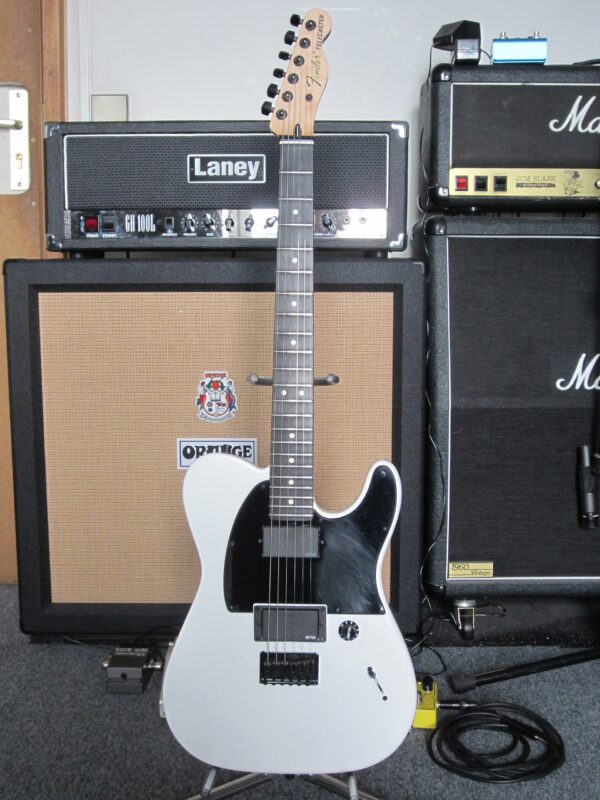
John Mayer, perhaps unexpectedly, called it “what every Telecaster should look like in this day and age.” Guitar World described it as game-changing. And it sold — both to Slipknot fans who had never owned a Fender and to Telecaster devotees who understood, quietly, that Root had done something genuinely interesting to a design that rarely gets pushed this far.
This is the story of that guitar.
Jim Root: The Man Behind the Mask
James Donald Root was born on October 2, 1971, in Las Vegas, Nevada, and grew up in Iowa. He taught himself to play guitar at age fourteen, working through metal records with the obsessive focus of someone who had no guitar teacher and limited resources. His early influences were the architects of 1980s and early 1990s metal: Randy Rhoads, Dimebag Darrell, Marty Friedman, the guitarists whose technique was defined by precision, speed, and extreme precision of riff construction. Root has described his musical approach as instinct-driven rather than theory-led — he suffers from OCD, and engaging too closely with formal theory disrupts the organic compositional process he has developed over three decades.
Root’s early career involved bands in the Des Moines area, including the thrash outfit Atomic Opera and the alternative metal group Stone Sour, which he joined in 1995 alongside vocalist Corey Taylor. When Slipknot — founded in Des Moines in 1995 as a nine-piece collective of masked heavy music provocateurs — needed a replacement guitarist in January 1999, Root was recruited on Taylor’s recommendation. He entered the band during the recording of their self-titled debut album, contributing guitar parts to “Purity” and “Me Inside,” and was designated as member #4.
In the early Slipknot years, Root played what he had available — a green Jackson DR-3 Dinky, a Jackson SL2, later a PRS Private Stock guitar, all run through Mesa/Boogie and Rivera amplifiers. The budget was sparse. “In the early days the guitars I was using live didn’t sound the greatest in the studio,” Root has said. “I had to use one of Mick’s BC Rich guitars for all of my tracking.” As Slipknot’s commercial ascent accelerated through albums like Iowa (2001), Vol. 3: The Subliminal Verses (2004), and All Hope Is Gone (2008), Root’s resources expanded and his gear choices became increasingly deliberate.
The pivot toward Fender came through an unlikely influence: John 5, the guitarist known for his work with Marilyn Manson and Rob Zombie, who is himself a dedicated and unconventional Telecaster player. Root credits John 5 with inspiring him to look at the Telecaster as a viable heavy music instrument. Root was under Custom Shop endorsement with Fender, and the company was initially steering him toward Charvel — a more expected choice for a metal guitarist. Root resisted. “If I walked on stage with a Jackson or B.C. Rich, that would be typical,” he has said. “I wanted to take something classic and iconic and make it functional for what I do.”
The Fender contact who helped make the signature happen was Alex Perez, who worked with Root on translating his requirements into a production specification. The starting point was the Fender Showmaster — Fender’s own short-lived attempt at a metal-oriented instrument — which served as a conceptual foundation. Root then shaped the specification around what he actually needed: a mahogany body for warmth and mass, EMG active humbuckers for the tight, compressed, high-output tone he required for detuned heavy playing, a fast neck with a flat fingerboard radius, and an absolute minimum of controls. In July 2007, the Jim Root Telecaster was released.
Full Specifications: Fender Jim Root Telecaster
The Mahogany Telecaster: Why the Wood Choice Changes Everything
Every other Telecaster Fender has produced at scale uses alder or ash as the primary body material. These two woods are lighter, brighter, and more acoustically transparent than mahogany — which is why Telecasters typically produce the bright, cutting, mid-forward tone so associated with country and rock guitar. Mahogany is the wood of Les Pauls, SGs, and acoustics built for warmth and resonance. It produces more low-end mass, warmer mids, and a thicker sustain character than either of the standard Tele tonewoods.
Root’s choice of mahogany was not accidental or merely aesthetic. The physics align directly with his playing context: detuned, high-gain metal guitar, often played down to B or A standard, requires body mass to prevent the low strings from becoming flabby and indistinct. A lightweight ash body under a detuned low B string loses definition quickly. The mahogany body provides the density that keeps those low frequencies focused and articulate even under heavy gain and radical detuning. Combined with the EMG 81’s tight, compressed high-output character, the mahogany Tele body becomes a genuinely logical choice for metal rather than a counterintuitive novelty.
The body also retains the standard Telecaster shape with modifications — a tummy cut for comfort on the player’s forearm side, and a shaved neck heel for improved upper-fret access. Notably absent is the standard Telecaster forearm contour, which means the front edge of the body is a full, unmodified slab. This is the same design choice as a vintage 1950s Telecaster — the hard edge that originally made Telecasters slightly uncomfortable for extended playing. For Root’s heavy, anchored right-arm playing style, the flat body edge is apparently not a concern.
The EMG 81 and EMG 60: The Sound of Modern Metal
The pickup configuration on the Jim Root Telecaster is as far from the instrument’s traditional single-coil architecture as it is possible to get while technically still using the Telecaster shell. EMG’s active humbuckers have been the defining pickups of modern metal guitar for four decades — they appear in the guitars of Metallica, Slayer, Zakk Wylde, Dave Mustaine, and virtually every other artist for whom “heavy” is a primary concern.
The EMG 81 in the bridge position is the most recognisable of the pair. It uses a ceramic magnet structure and an onboard preamp that delivers high output, tight low-end response, and a mid-forward frequency profile that cuts through even the most saturated amp gain. The tonal signature is compressed and controlled rather than organic and dynamic — where a passive pickup opens up and breathes under a player’s varying attack, the EMG 81 maintains a more consistent level and character. For playing contexts where precision and articulation under extreme gain are priorities — which is exactly what Slipknot’s music demands — this consistency is a feature rather than a limitation.
The EMG 60 in the neck position uses an alnico magnet structure rather than the 81’s ceramic, which produces a warmer, more articulate character suited to neck-position leads and clean tones. The combination of 81 at the bridge and 60 at the neck is one of the most widely used active pickup pairings in metal, and Root’s adoption of it on a Telecaster chassis is part of what makes the guitar genuinely interesting — the familiar active humbucker character now housed in an instrument whose geometry and resonance properties differ significantly from the mahogany-bodied metal guitars the EMGs normally inhabit.
Active EMG pickups require a 9-volt battery, housed in a small compartment in the rear of the body. This is standard practice for active pickups and requires the player to have a spare battery to hand — a detail worth knowing before a long rehearsal or recording session. Battery life is generally strong under normal playing conditions, though effects-heavy setups with multiple pedals can drain batteries faster.
The 12-Inch Radius and Ebony Fingerboard: Built for Speed
The fingerboard specifications on the Jim Root Telecaster are as deliberate as every other element of the design. A 12-inch radius is substantially flatter than the 7.25-inch radius of vintage Fender instruments or even the 9.5-inch radius of standard modern Fenders. On a flatter board, bending strings — particularly the aggressive, wide bends common in metal lead playing — is easier to execute without the note “choking out” or fretting out against the fingerboard curvature. Players transitioning from vintage-radius instruments to flatter boards consistently report that heavy bending becomes more comfortable and reliable on the flatter surface.
The ebony fingerboard on the Flat White model (the Flat Black version uses maple) adds another dimension. Ebony is one of the densest, hardest naturally occurring tonewoods used in guitar construction. It produces a fast, clean playing surface — slightly smoother than rosewood, slightly warmer in feel than maple. For fast single-note playing and precise articulation, ebony is a preferred fingerboard material among many technique-oriented players. It also has a visual drama — jet black against the flat white body — that complements the guitar’s stark aesthetic perfectly.
The 22 medium-jumbo frets represent a further refinement over vintage Telecaster specifications. Vintage Teles used thinner, narrower frets; the Jim Root signature’s medium-jumbo frets facilitate the picking attack and string contact preferred by most contemporary metal and rock guitarists. Combined with the flat radius and the locking tuners — which eliminate the string slippage common under heavy playing and facilitate fast string changes — the neck and fingerboard configuration is coherently designed for demanding technical use rather than assembled from stock components.
The Minimalist Control Layout: Philosophy in Hardware
There is a design philosophy embedded in the Jim Root Telecaster’s control layout that deserves attention. The guitar has a single volume knob. No tone control. The volume is positioned rear-mounted, away from the standard Telecaster’s front-face arrangement, placed where Root can reach it without the control interfering with his right-hand playing position. The three-way blade switch provides the standard Telecaster pickup selection. That is the entirety of the control system.
This minimalism is not laziness or cost-cutting. It reflects a specific philosophy about what controls on an electric guitar are actually for. Root’s tone is built at the amplifier — an Orange Rockerverb for live work, modified Bogner Uberschall and Mesa/Boogie Mark IIC variants in the studio. The guitar’s job is to send a consistent, high-quality signal to the amp without introducing variables. The single volume control handles all the volume management the player needs; the tone control, in an active humbucker / high-gain amp context, is often left at maximum by metal guitarists anyway and is therefore redundant. Removing it simplifies the signal path and eliminates a potential point of variance.
The rear-mounted control placement is a specific Root specification. On a standard Telecaster, the controls sit on the front face of the body where a right-handed player’s strumming arm can accidentally contact them. Moving the controls to the rear removes this risk while also giving the front of the guitar a cleaner, more architectural appearance. The result is an instrument with the clean visual language of a prototype rather than a finished consumer product — exactly the aesthetic Root and Fender were pursuing.
The Origin Story: How a Metal Guitarist Came to Redefine a Country Guitar
Root’s path to the Telecaster is worth examining because it illustrates something important about how signature guitars are made well and made poorly. The worst signature guitars are instruments where a famous name is attached to a specification that has no particular connection to what the artist actually plays. The best are instruments where the specifications are derived directly from what the artist needs in their specific musical context, and where the artist has enough credibility and conviction to push back against what the manufacturer wants them to make.
Root pushed back against Charvel, which would have been the obvious, commercially safe choice. He pushed toward the Telecaster, which was the unconventional choice, because he had played a Telecaster during the Vol. 3: The Subliminal Verses album cycle — specifically a Fender Flat Head Telecaster that he used during the Big Day Out sets — and had found that the Telecaster body and geometry suited his playing style in ways he had not expected. “Fender, at the time, needed something to bring them into more modern times,” Root has noted. “It made sense, and Fender was down.”
The partnership between Root and Fender engineer Alex Perez produced a specification that is genuinely internally consistent: every element — the mahogany body, the active EMGs, the flat radius board, the ebony fingerboard, the minimalist control layout, the all-black hardware, the satin matte finish — serves the same purpose. This is a guitar designed for heavy, detuned, high-gain playing, and everything on it supports that application without compromise or apology.
Since the original 2007 launch, the Jim Root Telecaster has been joined by the Jim Root Stratocaster (2010) and the Jim Root Jazzmaster (2014), all sharing a common aesthetic and similar specifications — active EMGs, flat radius boards, minimal controls, all-black hardware. Root has subsequently moved some of his work to a Charvel signature model (announced in 2021, released 2022), but the Telecaster remains the guitar most associated with his Slipknot work and most recognised by players in the heavy music community as his signature instrument.
Tone Recipes: Getting the Jim Root Sound
Recipe 1: Slipknot Live Rhythm Tone
- Pickup: Bridge (EMG 81)
- Amp: Orange Rockerverb 100 (or similar high-gain British amp)
- Gain: 7–8
- Treble: 6
- Mid: 5
- Bass: 6
- Master Volume: 5–6
- Guitar volume: Full (10)
- Tuning: Drop B (B-F#-B-E-G#-C#) or similar low tuning
- Notes: The EMG 81 requires less amp gain than many passive humbuckers to achieve the same saturation level — start at 6-7 on the gain and adjust up. The tight low-end of the 81 prevents the bass frequencies from blooming under high gain, so the bass control on the amp can be set higher than you might expect without losing clarity.
Recipe 2: Studio High-Gain (Bogner/Mesa style)
- Pickup: Bridge (EMG 81)
- Amp: Modified Bogner Uberschall or Mesa/Boogie Mark series
- Gain: 6–7 (EMG actives are already high-output)
- Treble: 5–6
- Mid: 4 (slight mid-scoop for studio crunch)
- Bass: 5
- Guitar volume: Full
- Notes: For studio work, Root uses a tighter, more controlled gain structure than the live Orange sound. The Mark IIC’s legendary scooped mid character is a common reference point. In a detuned context, reducing the mid slightly gives the rhythm guitar more physical weight without cluttering the mix.
Recipe 3: Clean / Articulate Lead (Neck Pickup)
- Pickup: Neck (EMG 60)
- Amp: Clean channel or low-gain setting on any quality amp
- Gain: 2–3
- Treble: 5
- Mid: 6
- Bass: 5
- Reverb: 2–3
- Guitar volume: 8
- Notes: The EMG 60’s alnico structure produces a warm, articulate clean tone that is often underestimated on a guitar associated primarily with heavy playing. Clean melodic lines, arpeggios, and atmospheric passages that appear in Stone Sour’s material demonstrate what the 60 is capable of in a less extreme context.
Recipe 4: Mid-Gain Crunch (Alternative / Hard Rock)
- Pickup: Bridge (EMG 81) or middle position (bridge + neck)
- Amp: Any quality EL34 or 6L6 amp (Marshall JCM800, Fender Twin pushed hard)
- Gain: 5–6
- Treble: 6
- Mid: 6
- Bass: 5
- Guitar volume: 8–9
- Notes: At mid-gain settings, the mahogany body’s warmth and the EMG 81’s controlled compression produce an interesting hard rock crunch tone. The Telecaster geometry — the single-cutaway body, the scale length — gives the guitar a slightly different voicing than a Les Paul or SG at the same gain level. This is the territory where the Jim Root Tele surprises players who expect only extremes.
Root’s live tone is built around high-gain amplification, tight low-end control, and the specific compressed, articulate character of the EMG 81 through a quality preamp. His primary live amp is the Orange Rockerverb, which delivers a distinctive British-voiced high gain with excellent note articulation and a tight, defined low end. In the studio, he has used modified Bogner Uberschall heads and Mesa/Boogie Mark IIC configurations, both of which offer different flavours of the high-gain metal tone he requires.
Competitors and Comparisons
ESP LTD EC-1000 vs. Jim Root Telecaster
The ESP LTD EC-1000 is one of the most widely used metal guitars in the same price bracket as the Jim Root Telecaster. It offers a set mahogany neck-through construction (versus the Tele’s bolt-on maple neck), EMG 81/60 pickups, and a Les Paul-inspired single-cutaway body. The EC-1000 is the more conventional choice for a metal guitarist — its tonewood configuration and construction are specifically optimised for heavy music in a way that the Telecaster chassis was not originally designed for. The Jim Root Tele offers something the EC-1000 cannot: the Telecaster’s specific geometry, bridge construction, and sustain character, which produce a slightly different tonal result even with identical pickups and similar body wood. Players who want to stand out visually and sonically from the standard metal guitar palette often find the Root Tele the more interesting choice.
Schecter Hellraiser C-1 vs. Jim Root Telecaster
The Schecter Hellraiser C-1 competes directly with the Jim Root Telecaster in the active humbucker / heavy music production guitar segment. The Hellraiser uses EMG 81/89 pickups, set-neck mahogany construction, and a double-cutaway body optimised for upper-fret access. Against the Jim Root Tele, the Hellraiser offers more upper-fret access (the Tele single-cutaway limits how far you can comfortably reach above the 15th fret) and a more ergonomic body shape for seated playing. The Jim Root Tele counters with the Fender brand credibility, the Telecaster’s distinctive resonance character, and a visual identity that is more unusual in heavy music contexts.
Jackson Soloist SL1 vs. Jim Root Telecaster
The Jackson Soloist SL1 represents the superstrat/metal specialist tradition that Root deliberately moved away from when he adopted the Telecaster. Where the Soloist is purpose-built for metal — neck-through construction, compound radius fingerboard, Floyd Rose system, all optimised for heavy playing — the Root Tele achieves many of the same sonic goals from a fundamentally different platform. The Soloist has no tonal overlap with any other guitar in a collection; the Root Tele has the unique quality of being a recognisable Telecaster that surprises listeners with what it actually sounds like in context.
Fender Brad Paisley Road Worn Telecaster vs. Jim Root Telecaster
Placing these two signature Telecasters side by side reveals the extraordinary range the Telecaster platform can accommodate. The Brad Paisley Road Worn Telecaster is light, clean-sounding, country-voiced, vintage-aesthetic, and built explicitly for articulate picking and hybrid technique. The Jim Root Telecaster is heavier in tone (if not in mass — mahogany can be surprisingly light), all-black, active, and built for detuned metal. They share a body shape, a scale length, and the Fender name. Almost nothing else is the same. The existence of both signature models in the same catalogue is a testament to the Telecaster platform’s genuine versatility.
Buying Guide: Who Should Play the Jim Root Telecaster?
Heavy music players who want something different
The Jim Root Telecaster’s primary appeal is to players in the heavy music world — metal, metalcore, heavy rock, nu-metal — who want the sonic tools of an active humbucker guitar in an instrument that looks and feels genuinely unusual on a heavy music stage. If everyone around you plays ESPs and Jacksons, a black matte Telecaster with EMG actives makes a visual and sonic statement that those instruments cannot.
Slipknot and Stone Sour fans
This is the most literal application — players who want the specific guitar Jim Root has played throughout his career and want the closest production approximation to his actual tone. The Jim Root Telecaster, run through a high-gain British-voiced amp, genuinely delivers the sonic character of Slipknot’s rhythm guitar work in a way that no other production guitar replicates as directly.
Telecaster players curious about active pickups
For players who already love the Telecaster platform but have never explored active humbuckers, the Jim Root model offers an unusually good opportunity. The combination of Telecaster geometry with EMG actives produces a tonal result distinct from both a standard passive-pickup Tele and a typical active humbucker guitar. Players often find it genuinely interesting rather than simply “heavier” — the Telecaster’s bridge and body resonance interact with the EMG’s compressed character in ways that offer a surprising palette.
Players looking for a high-performance flat-radius fingerboard
The Jim Root Telecaster’s 12-inch radius fingerboard represents an upgrade in playing comfort for any player who bends strings frequently. Even outside heavy music contexts, the flatter board facilitates easier bending and faster single-note playing than vintage-spec Fenders. Players who have always wanted the Telecaster’s tonal character with a more modern playing feel will find the Root model worth investigating.
Practical Ownership Considerations
Active EMG pickups require a 9-volt battery, typically located in a rear-routed compartment. Replacing the battery is straightforward, but players should establish a maintenance rhythm — particularly for those who leave their guitar plugged in between sessions, as active pickups draw power continuously when a cable is connected. A fresh battery at the start of any important session or performance is standard practice among active pickup users.
The guitar ships with Fender standard light-gauge strings (.009–.042), which are appropriate for standard tuning but will feel loose and potentially imprecise under the drop-B or lower tunings that characterise much of Root’s playing. Players who want to use the guitar for detuned playing should immediately restring with a heavier gauge — .011–.054 or heavier, depending on the target tuning — and have the guitar set up by a technician for the new gauge and tension. This is not a deficiency of the instrument but a standard consideration for any guitar played significantly below standard tuning.
The satin nitrocellulose finish is aesthetically dramatic and tactilely comfortable, but nitro finishes require the same care considerations as any nitro-finished instrument: avoid certain rubber and plastic contact, keep away from extended humidity extremes, and be aware that nitro will check (develop hairline cracks) over time when subjected to temperature changes. This checking is considered desirable by vintage guitar aesthetes and is part of the guitar’s character rather than a defect.
The ebony fingerboard, present on the Flat White version, is increasingly rare in production guitars due to regulated ebony sourcing. Some early examples have shown fingerboard cracking under certain conditions — a characteristic of ebony’s density and its sensitivity to extreme dryness. Standard fingerboard conditioning with appropriate products addresses this adequately under normal circumstances.
Frequently Asked Questions
Why does a Telecaster have active EMG pickups?
Because Jim Root designed his signature around the pickups he needed for his musical context rather than the pickups traditionally associated with the Telecaster platform. Active EMG humbuckers — particularly the 81 at the bridge — deliver the tight, compressed, high-output character that Root required for detuned heavy metal playing. The Telecaster body shape, mahogany construction, and bridge plate interact with the EMG’s character in ways that produce a distinct tonal result unavailable from either a standard Telecaster or a typical metal guitar with the same pickups.
Is the Jim Root Telecaster good for clean tones?
Yes, particularly through the neck pickup (EMG 60). The alnico-magnet EMG 60 has a warm, clear clean character that is often underestimated on an instrument associated with heavy playing. Stone Sour’s material — which includes melodic, atmospheric, and relatively clean passages — was played on Root’s Telecaster and demonstrates what the guitar can do outside of the heaviest settings. The bridge EMG 81 produces a clean tone that is characteristically compressed and controlled, which suits certain clean rhythm playing styles even if it lacks the bloom and openness of a vintage passive pickup.
What tuning does Jim Root use?
Root’s tunings vary by song and band context. For Slipknot material, he typically plays in drop-B (B-F#-B-E-G#-C#) or similar low tunings. For Stone Sour material, he used a range of tunings including drop-D and standard with drop-A sections. The mahogany body and active EMG pickups are well-suited to maintaining clarity and definition at these lower pitches, which is a primary reason Root selected these specifications.
What is the difference between the Flat Black and Flat White versions?
The primary difference is the fingerboard material: the Flat White model uses an ebony fingerboard, while the Flat Black model uses maple. The ebony fingerboard is denser and slightly faster-feeling than maple, and produces a marginally warmer tonal character. Visually, the contrast between the flat white body and the black ebony fingerboard is striking. The Flat Black version with maple fingerboard has a higher-contrast aesthetic in the other direction. Tonally, the difference between the two is subtle.
Is the Jim Root Telecaster still in production?
The Jim Root Telecaster has been part of Fender’s Artist Signature range since its 2007 launch, with varying availability across different periods. Root has subsequently developed signature instruments with other manufacturers (a Charvel signature was announced in 2021), which may have affected the ongoing production of the Fender model. Current availability should be checked with Fender dealers, and the used market offers a wide selection of earlier production examples.
Can the Jim Root Telecaster be used for styles beyond metal?
Unquestionably. The mahogany body and active humbuckers are equally at home in hard rock, alternative metal, heavy rock, and even aggressive indie contexts. The Telecaster geometry means the guitar has a different voicing than a double-cutaway humbucker guitar, and many players find it interesting for blues-influenced playing where the combination of warmth and compression produces a distinctive sound. One Thomann reviewer noted buying it for metal and punk but finding it handled “everything from brutal distortion to sparkling clean.” At its core, the guitar’s components are versatile; it is the aesthetic that signals its primary allegiance to heavy music.
What amp does Jim Root use live?
Root’s primary live amplifier has been the Orange Rockerverb 100, which delivers high gain with a distinctive British midrange character and excellent note definition under heavy playing. In the studio he has used modified Bogner Uberschall heads and Mesa/Boogie Mark IIC configurations. More recently, particularly for smaller shows, he has incorporated a Neural DSP Quad Cortex as a backup to his main amplifier setup.
The Anti-Tele That Is Still a Tele: Why the Jim Root Model Matters
The Fender Jim Root Telecaster matters for reasons that extend beyond the specific needs of its target audience. It matters because it demonstrated, in 2007 and definitively, that the Telecaster’s essential appeal — its geometry, its scale length, its bridge construction, its neck feel — is separable from the tonal tradition it carries. You can take a Telecaster and fill it with active humbuckers and mahogany and all-black hardware and produce something genuinely heavy and genuinely useful for metal without the result being a fake or a compromise. The guitar does what Root designed it to do.
It also demonstrated that Fender was capable of making instruments for audiences who had never previously identified as Fender customers. The Jim Root Telecaster introduced the brand to an entire generation of metal and heavy rock guitarists who had grown up associating Fender with country, blues, and classic rock. Many of those players subsequently discovered that Fender’s other instruments — Jazzmasters, Jaguars, even Stratocasters — had been sitting adjacent to their musical interests all along, waiting to be explored.
John Mayer’s remark that it was what “every Telecaster should look like in this day and age” was perhaps more prescient than it appeared at the time. Fender’s subsequent expansion into non-traditional signature territory — Deftones, Kurt Cobain Mustangs reissues, Jim Root Jazzmasters and Stratocasters — follows a path that the Jim Root Telecaster opened. The instrument that looks like a provocation turned out to be a door.
Image credits
- Fender Jim Root Telecaster: photo by Drmtrader, via Wikimedia Commons, CC BY-SA 3.0.
