
Roger Waters vs. James Hetfield: Does a Concert Ticket Buy an Escape From Politics?
The Waters–Hetfield dispute raises a bigger question about artists, audiences and freedom of expression.
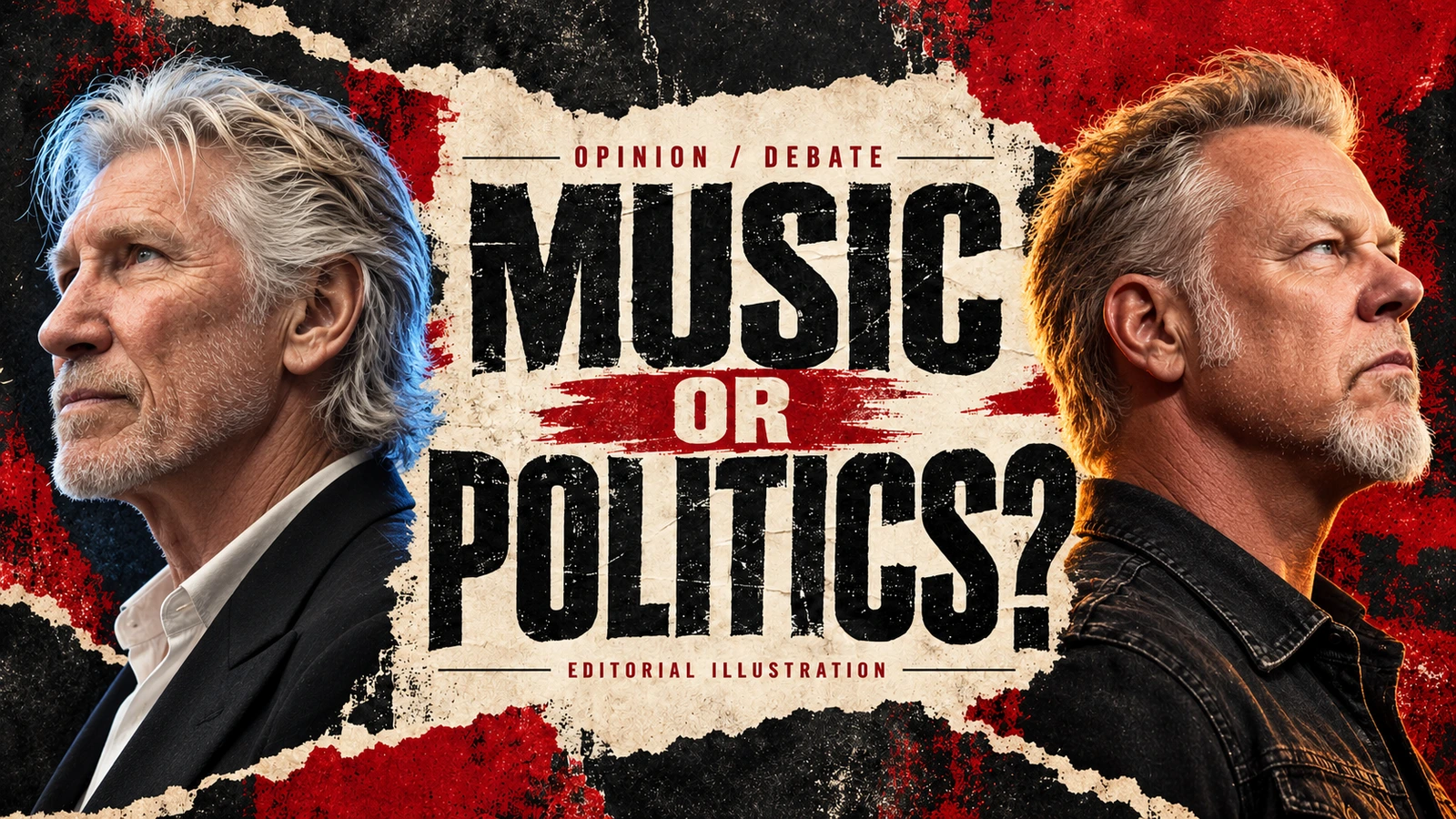
Opinion / Debate
Buying a concert ticket does not buy ownership of an artist’s conscience. But buying a ticket does not mean signing up for their worldview, either.
That is the useful argument inside the latest clash involving Roger Waters and James Hetfield. Not whose insult lands hardest. Not which fanbase can shout the other down. What, exactly, do musicians owe the people standing in front of them?
What happened, and what needs separating
Metallica’s official concert archive confirms the band played Sphere in Las Vegas on October 10, 2026. Reporting by Metal Hammer describes Hetfield thanking fans for making the trip, then presenting the show as a chance to leave outside pressures behind. He also took a swipe at unnamed entertainers who try to influence their audiences.
Waters subsequently criticized Hetfield during an appearance on The Katie Halper Show. Metal Hammer’s account says the discussion also revisited older Hetfield interviews and Metallica’s lyrical themes before Waters attacked his character and musicianship.
That context matters. Reducing the exchange to “Waters explodes because Hetfield wants to play music” strips out part of the discussion. Equally, turning Hetfield’s unnamed reference into a confirmed attack on a specific artist would go beyond what these remarks establish.
The following is an argument about that dispute, not an endorsement of either man’s personal attacks.
We previously explored the broader argument in our debate on politics at concerts. Waters’ personal intervention adds a different question: what happens when disagreement about the stage becomes an attack on the musician?
A stage is not a compulsory political platform
There is a strong case for Hetfield’s approach. A concert can be a rare space where people who disagree about almost everything share something uncomplicated: a riff, a chorus, the physical release of a loud band.
Wanting that experience is not evidence of ignorance. Someone can care deeply about the world and still want two hours without another argument about it. A musician can also believe that a speech would divide a room without helping the people it claims to support.
Artists should be free to make that choice. Political conviction does not become more sincere because it is delivered between songs, and a famous voice is not automatically an informed one.
But there is a difference between explaining your own approach and dismissing other performers for choosing differently. Once an artist makes the second argument, the audience is entitled to challenge it. You cannot enter a debate about what other musicians should say and then insist there is nothing to discuss.
A ticket is not a gag order, either
The opposite demand is just as weak: that paying customers should be able to keep an artist’s convictions offstage.
A performance is not a jukebox rental. Artists choose the songs, the presentation and the words between them. Sometimes their beliefs are inseparable from the work people came to hear.
Fans have choices, too. They can disagree, criticize, leave or decide that the next ticket is not worth their money. None of that requires pretending the artist has forfeited the right to speak.
The honest tension is between two kinds of freedom: the performer’s freedom to express a position and the listener’s freedom not to welcome it. Neither side gets a guaranteed standing ovation.
Attacking the musician does not settle the argument
Waters’ criticism of Hetfield’s playing is a distraction from the strongest version of this debate. Whether you admire a guitarist’s rhythm work has no bearing on whether their position on political speech makes sense.
For a guitar audience, that distinction should be obvious. We argue about feel, precision, songwriting and tone because those things matter to music. They are not tests of moral authority. Agreeing with a musician’s politics does not improve their timing; disagreeing does not erase their riffs.
The same applies to personal insults. They might generate more comments than a careful argument. They do not answer the question.
Our take: freedom goes both ways
Let Hetfield build a show around escape. Let Waters make his convictions part of his art. Challenge either approach without demanding that every musician follow one rule.
The line worth defending is not “politics everywhere” or “politics nowhere.” It is the freedom to speak, the freedom not to speak, and the freedom of an audience to push back.
When you buy a ticket, are you paying for the artist’s full expression, or should there be a boundary around what happens between songs?
Want to dig deeper into Hetfield’s playing and gear? Read our James Hetfield guide.
Image: Original AI-assisted GuitarGangsters editorial illustration, not a documentary photograph or a depiction of a shared event.