Chris Eldridge Guitars & Gear: The Martins, the Microphones and the Musical Decisions
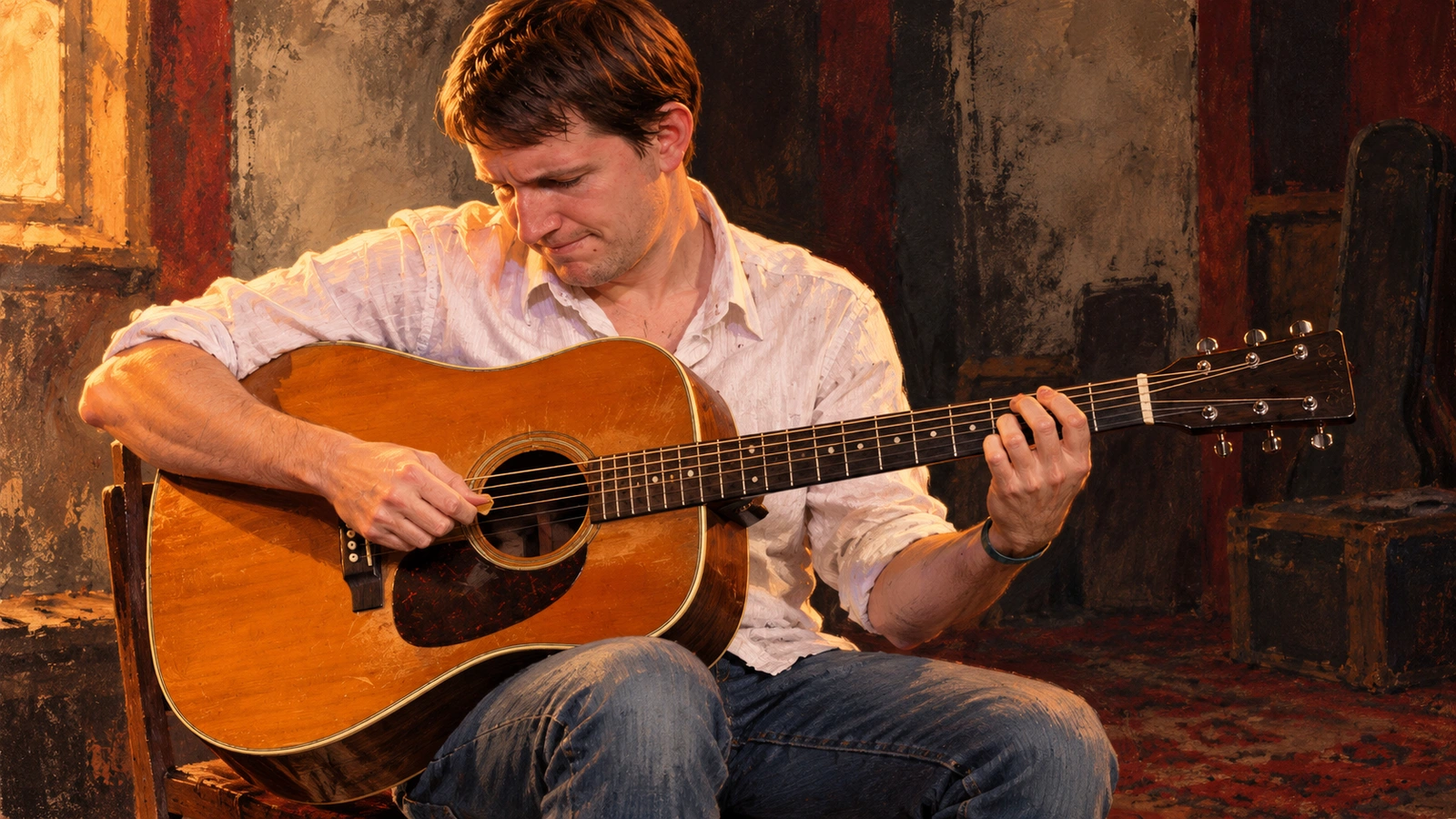
Chris Eldridge — original editorial illustration.
Chris Eldridge makes an unusually good case for looking beyond the pedalboard. His guitar world contains borrowed vintage instruments, carefully chosen picks, shared microphones and arrangements that demand more than a fast solo. The interesting question is not simply which Martin to buy. It is how one acoustic guitar can supply weight, motion and melodic detail without swallowing the musicians around it.
Background
Eldridge’s official biography records an Oberlin performance degree in 2004 and study with Tony Rice. It places the Infamous Stringdusters, Seldom Scene, Punch Brothers and his Julian Lage duo along his career path, and lists his Live From Here house-guitarist tenure as 2016–2020. These are different musical jobs, not interchangeable settings for a single lead-guitar sound.
An early electric-guitar hero was Eric Johnson. The September/October 2001 Flatpicking Guitar Magazine profile connects that enthusiasm with a young Eldridge learning restraint and ensemble responsibility through playing with the Seldom Scene.
In Molly Tuttle’s 2021 Acoustic Guitar interview, Eldridge remembered becoming absorbed in Rice’s Acoustics at about fourteen, then seeing the Tony Rice Unit at Graves Mountain Lodge. He recalled playing onstage with Rice as a teenager and strengthening their connection at MerleFest in 2001, while he was at Oberlin. These are Eldridge’s recollections, not a formal lesson timetable.
In 2013, Eldridge and Lage discussed Close to Picture with Fretboard Journal. Their guitars were both Martins from 1939: Eldridge’s D-28 and Lage’s 000-18. They described developing complementary parts, including writing At the Meeting House together.
DownBeat’s October 17, 2017 interview distinguishes two recording approaches. Lage described Avalon as a live-style session produced by Kenneth Pattengale, while Mount Royal, produced by Gabe Witcher, involved a more deliberate writing process. Eldridge said Mount Royal combined through-composed material with songs containing improvised solos.
That contrast gives listeners a better framework than “bluegrass guitarist meets jazz guitarist.” A written exchange and an improvised exchange put different demands on the same hands. In the first, the challenge may be making a carefully placed entrance feel inevitable. In the second, it may be leaving enough room for something neither player planned. The guitar needs clarity in both cases, but clarity comes partly from choosing which notes not to place on top of somebody else’s phrase.
Want to dig deeper into the musical lineage? Our Tony Rice guitars and gear guide is a useful companion to this profile. Here, the focus remains Eldridge’s own instruments and decisions rather than treating a mentor’s equipment as a substitute for his.
Mighty Poplar: The Session Behind the Name
Mighty Poplar’s official album credits identify Eldridge on guitar, vocals and mandolin; Andrew Marlin on vocals, mandolin and guitar; Noam Pikelny on banjo and vocals; Greg Garrison on bass and vocals; and Alex Hargreaves on fiddle. The band produced the record, Sean Sullivan recorded and mixed it at the Tractor Shed in Nashville, and Reuben Cohen mastered it. Its release date was March 31, 2023.
In Jay Moye’s Asheville Stages interview, Eldridge dates the group’s first recording gathering to October 2020. Marlin supplied much of the repertoire, with the other members also bringing songs. Moye describes four days of recording in close proximity around a pair of condenser microphones. Eldridge describes the project as an ongoing complement to their other bands, not a replacement.
The credits point to a broader musical responsibility than a lead-guitar slot. A musician credited with guitar, voice and mandolin can contribute in several ways across a record, but the album-level list does not identify which role belongs to each take. Nor does a later touring microphone arrangement automatically describe the recording session. A studio room, a pair of microphones and a group discovering arrangements together are one production problem; reinforcing that group in a venue is another.
The Rig: Chris Eldridge’s Guitars, Amps & Gear
The heart of this rig is an acoustic guitar in a particular musical setting. The following entries separate the different D-28s before looking at recording, reinforcement and the smaller pieces of equipment. The dates describe the evidence; they are not a promise that a historical setup remains unchanged today.
Guitars
1939 Martin D-28
By the time of the 2012 American Songwriter interview, Eldridge was using a 1939 Martin D-28 with Punch Brothers.
A working vintage acoustic is not necessarily an untouched museum object. A neck reset concerns the relationship between neck angle, bridge and playable action; a refret concerns the surface against which the strings are stopped. Those interventions can be central to making an old guitar work as a professional instrument. They do not tell us its precise action, relief or saddle height at a later session. Nor does an old top guarantee that every player will obtain the same response from it.
The 2013 Fretboard Journal interview adds a physical detail: Eldridge described his D-28 as retaining the wider 1¾-inch neck spacing, contrasting it with Lage’s narrower 1¹¹⁄₁₆-inch example. These are the player’s descriptions.
That difference is only one sixteenth of an inch at the quoted measurement, yet it changes the landing area available to the fretting hand. It is not a measurement of string spacing at the bridge. On an acoustic part that alternates stopped notes with ringing open strings, clearance around the fingertips is a distinct issue from the size of the body or the amount of bass the guitar produces.
American Songwriter names the 1939 D-28 for Who’s Feeling Young Now.
Premier Guitar identifies it among The Phosphorescent Blues instruments.
1937 Martin D-28: The Charles Sawtelle-Associated Loan
Fretboard Journal’s December 2010 page provides a second account of the loan and states that the guitar had been returned to Forster. Its associated Amanda Kowalski clip is titled Wildwood Flower. The page connects that performance with the Sawtelle instrument; it does not connect the guitar to the separate 1937 D-28 discussed in 2024.
The earlier Sawtelle-associated 1937 D-28 was a loan through Nick Forster, according to Fretboard Journal’s December 2010 account.
Eldridge confirmed the multi-year loan in 2012.
1937 Martin D-28: The 2024 Interview Instrument
In Acoustic Guitar’s April 3, 2024 interview, Eldridge discussed a 1937 D-28 and said it was the first D-28 made that year. That is his assertion about 1937 production—not a claim that Martin first made the D-28 in 1937. Its identity has not been established as the earlier Sawtelle-associated loan.
1954 Martin D-28: The Eric Johnson Connection
The 2001 Flatpicking Guitar Magazine profile supplies an ownership detail missing from later shorthand lists: Eldridge bought the 1954 D-28 from Eric Johnson after meeting him at performances in Austin. The article is an early-career snapshot, not evidence that this guitar appeared on a later Punch Brothers album.
1937 Martin D-18 and Borrowed Gibson Instruments
The 2015 Premier Guitar interview names his 1937 D-18 and 1939 D-28 for The Phosphorescent Blues, plus Nick Lucas guitars borrowed from T Bone Burnett and a 1930s Roy Smeck whose ownership is unspecified.
Suda Dreadnought: A Touring Solution
In the 2012 American Songwriter interview, Eldridge explained that his 1939 had no pickup and that the band was combining pickups and microphones. A Suda dreadnought handled road duties instead. This is a dated touring choice, not an album credit or a verified current pickup model.
The distinction is functional. An instrument can be excellent in front of a recording microphone yet awkward in a stage system designed around an additional electrical signal. The choice is not necessarily between a “better” and a “worse” guitar. It can be between a guitar that suits one capture method and one that integrates into the evening’s reinforcement system. That is why a working rig should be understood from the audience end of the chain as well as from the player’s chair.
Collings D2HA T S: Fair to Partly Cloudy
An April 29, 2020 Acoustic Guitar feature identifies another concrete instrument: the Collings D2HA T S demonstrated by Eldridge at Springdale Station in Austin. He played his original Fair to Partly Cloudy. The account describes his discussions with Collings about a dreadnought combining nuance with reserve power, and identifies the demonstrated guitar’s satin-finish option. This was a demonstration, not an ownership or album credit.
Other Documented Instruments
A separate May 2023 Fretboard Journal session brought Eldridge together with Bob Minner, Bryan Sutton and Kenny Smith to discuss and play the 1936 Martin D-18 associated with Norman Blake’s Whiskey Before Breakfast cover. The page names Brent Hawley as the owner. This is documented access to another musician’s historic guitar, not an additional Eldridge-owned D-18.
The Gibson on Who’s Feeling Young Now is unidentified by model.
The guitar on Julep also remains unknown: Eldridge himself was unsure in the 2015 interview.
Complete Guitar List (Key Instruments)
1954 Martin D-28: purchased from Eric Johnson.
1937 Sawtelle-associated D-28: loan; 1939 D-28: purchased.
Suda dreadnought: touring; unidentified Gibson: Who’s Feeling Young Now.
1937 D-18, 1939 D-28, borrowed Nick Lucas guitars and a Roy Smeck: 2015 session list.
Collings D2HA T S: Fair to Partly Cloudy demonstration, 2020.
1936 Martin D-18 associated with Norman Blake: 2023 group session; not owned.
1937 D-28: separately reported in 2024.
Amps
The Cabinet Configuration
No dedicated stage amplifier or speaker-cabinet configuration is established by the sources used here. The documented live story is acoustic reinforcement. That does not mean Eldridge has never played through an amplifier; it means there is no supported cabinet recipe to reproduce.
Shared Microphones and the Live Guitar
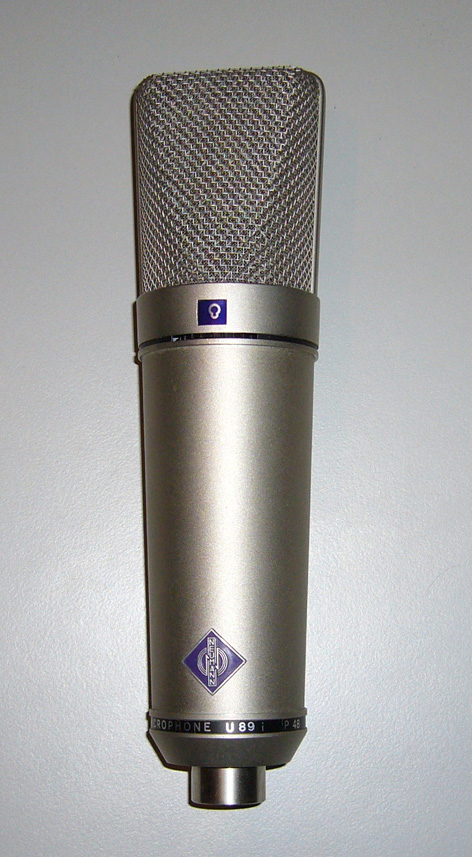
The 2024 account distinguishes bands: Punch Brothers had often used a U 89 and also MCM 114 clip-ons. Mighty Poplar’s fall 2023 arrangement put a U 89 and two MCM 114s on one stand; Mighty Poplar also used KM 84s on stands close to the U 89. These are context-specific ensemble arrangements, not a fixed four-microphone guitar rig.

A shared microphone changes what “turn the guitar up” means. The player may alter distance, attack or the number of strings struck rather than reach for a boost. These are not equivalent changes. Moving closer changes the relationship between guitar and room; playing harder changes the note’s attack; adding strings changes the arrangement. A good solution depends on whether the missing element is level, definition or harmonic weight.
Consider a low guitar note under a sustained vocal. Hitting it harder may make the beginning intrusive without keeping the note audible longer. A shorter, cleaner bass note followed by a lighter chord can create more separation. Conversely, a melody entrance may need a distinct attack rather than extra low-frequency weight. This is our explanation of the musical decisions a shared-microphone arrangement invites, not a claim about a specific Eldridge performance.
There is also a difference between a microphone that moves with an instrument and one that remains on a stand. With the former, ordinary body movement may preserve a more consistent instrument-to-capsule relationship. With the latter, movement becomes part of that relationship. Neither automatically wins: one may offer consistency while the other lets musicians reshape the ensemble balance physically. The important feature of Eldridge’s documented setups is that the musicians are sharing an acoustic space, not simply plugging isolated channels into a familiar rock backline.
Close to Picture: Recording the Duo
For Close to Picture, the 2013 interview describes Rob Griffin recording the duo in his living room. The players mention prototype microphones associated with Vovox, a stereo DPA pair between them and RADAR recording. The over-shoulder Mojave microphone was Lage’s description of his own position, not a dedicated Eldridge mic. Alex Venguer mixed the EP.
The stereo pair’s shared position is a different kind of information from a microphone assigned to one guitar. A pair can preserve relationships between sources in the room, while a closer individual microphone offers another balance option. Combining those perspectives requires a choice: how much should the listener hear the two players as a shared event, and how much as separately defined instruments? That is a recording distinction, not an endorsement of a particular prototype’s advertised sound.
Studio Amplifiers
No specific studio amplifier is established by this guide’s verified sources. Reamping changes the signal after its initial capture. A guitar microphone can feed another device and another room, adding a second sound to the production without changing the instrument that the guitarist held. Consequently, an amplifier audible in a record does not necessarily imply an electric guitar, an onboard pickup or a pedal under the player’s foot.
Pedals
Complete Pedalboard (Documented)
No artist-specific pedalboard is established in this evidence set. A capo, a pick and a microphone are important parts of the working setup, but they are not effects pedals. There is therefore no supported overdrive, delay or compressor purchase list for this guide.
Strings, Picks & Setup
Strings
The 2024 interview specifies medium .013–.056 D’Addario strings in nickel-bronze or phosphor-bronze.
The 2012 list names John Pearse.
Gauge is only one part of feel. On a given guitar, increasing string mass generally increases the tension needed to reach the same pitch, but string construction and setup also affect the experience under the pick. A player who strikes through the string may value resistance; another may obtain a cleaner note with less effort from a lighter set. The practical target is sufficient control over the note, not a competition to tolerate the highest tension.
For this style of playing, evaluate the plain treble strings as carefully as the basses. A full low chord can make a guitar seem impressive while the melody notes remain difficult to articulate evenly. Compare a short phrase across adjacent strings at a comfortable volume. If one string suddenly demands more force, that discontinuity will affect a melody more directly than a flattering strummed chord. This is a useful setup question whether the guitar is vintage or modern.
Picks
The 2024 account names a BlueChip TP48 and recent Apollo picks.
BlueChip also appears in the 2015 list.
A pick is the contact surface through which a movement becomes a vibrating string. Thickness, exposed tip and grip interact: a stiff pick held with too much exposed material can still catch; the same pick with a smaller working tip may travel through more cleanly. Those are variables worth isolating rather than changing brand, gauge, grip and attack at the same time. A familiar pick used consistently is often a better diagnostic tool than a handful of new alternatives.
Capo
Elliott appears in the 2024 account.
The 2015 list specifies McKinney-Elliott.
The musical value of a capo is not limited to easier chords. It moves the open-string layout into another key, changing where a phrase can use ringing open notes and where it must use fretted notes. For a guitar sharing space with another instrument, that can also move an accompaniment into a less crowded register. A capo position should therefore be judged by the resulting part, not merely by whether it reduces the number of difficult chord shapes.
Setup and the Limits of a Perfectly Clean Note
On Sonic Junction, Eldridge described accepting some buzz under hard playing in November 2015. In May 2021 he discussed advantages to floating for string leaps and light anchoring for timing and power.
In Molly Tuttle’s 2021 Rice remembrance, Eldridge described playing Rice’s guitar for an evening and finding it exceptionally responsive. He also recalled its very low action and how aggressively attacking it could produce an unappealing result. His account ties that setup to Rice’s touch and hand difficulties. It does not prescribe Rice’s measurements for Eldridge’s guitars, and no exact action figure is supplied.
That nuance matters. “No fret noise” is not a complete specification, because every guitar responds differently at different attack levels. A setup can be clean under a delicate melody and noisy under a very hard accent. Raising the action may increase clearance but also change fretting effort. The sensible comparison is between the sounds produced at the dynamic range you actually intend to use. There is no published Eldridge action measurement here, so an exact millimeter prescription would be invented.
Playing Style & Tone Philosophy
A Right Hand That Changed With the Music
In an October 29, 2018 Sonic Junction response, Eldridge described moving from extended fingers resting on the top toward a more closed hand after starting to play with Thile. Complex string crossings in The Blind Leaving the Blind helped drive the change. He reported gains in crosspicking but losses in aspects of his earlier bluegrass timing, and rejected the idea that another player’s preferred method must be best for everyone.
Our practical reading is that technique should be judged against the musical task. Can the hand leave the lower strings without striking them accidentally? Can it return in time for a chord accent? Does the melody maintain its pulse during that travel? Those questions are more specific than whether the fingers look open or closed. They also explain why copying an artist’s hand shape without copying the passage it serves can be misleading.
Alternating Motion, Crosspicking and the Shape of a Phrase
Eldridge’s public Soldier’s Joy lesson introduction recommends relaxed alternating pick strokes to maintain flow. Its lesson outline also includes singing the melody. In his 2021 response on the same page, he describes using both hands for occasional damping rather than committing to one permanent right-hand position.
Alternating motion and musical accents are separate layers. In a stream of eighth notes, down-up movement can provide a regular physical reference while the phrase emphasizes a note that happens to fall on an upstroke. If every downstroke becomes louder automatically, the hand starts imposing its own melody on the tune. The useful goal is a reliable motion with accents chosen by ear and phrase, not by whichever direction the pick happened to travel.
Crosspicking adds a spatial layer. Three strings can be sounded inside a four-beat phrase, so the beginning of a string pattern need not coincide with every beat. That mismatch creates interest but can also tempt a player to restart the accent each time the lowest string returns. Keeping the pulse independent from the string cycle lets an arpeggio remain connected to the larger phrase. This is a general technical explanation, not a transcription of Eldridge’s part in The Blind Leaving the Blind.
A Specific Composition: Fair to Partly Cloudy
Eldridge explained that Fair to Partly Cloudy grew from combining fretted notes high on the third string with open B and E strings. He singled out G-sharp at the third string’s thirteenth fret against those open strings, then explored crosspicking the combination.
In standard tuning, that G-sharp lies above the open B and E in pitch even though it is played on the string whose open pitch is lowest in the group. The resulting pitch classes are E, G-sharp and B: an E-major triad with its notes spread across different registers. That explains the harmony without reproducing the tune’s melody or its published tablature.
The distinction between a line and an arpeggio is equally useful. A line asks which note the listener should follow next; an arpeggio can expose several notes belonging to a harmony. When both are present, not every picked note needs equal weight. Bringing out one note while allowing the others to support it can make a single guitar suggest more than one voice without actually adding more notes.
Two Guitars Without Twice the Clutter
In 2017, Eldridge told DownBeat that the guitar-to-guitar conversation was a different experience from his usual string-band setting.
A useful way to understand that problem is to divide an arrangement into bass, harmony and melody, then refuse to assign all three permanently to either player. One guitar can supply a bass note while the other holds a chord; a moment later the chord can disappear and the bass player can answer a melody. The parts remain distinct because their functions change at different times. This is our analytical model, not a written rule claimed by the duo.
Register is only half the solution. Two parts can occupy different pitches and still obscure one another if every note starts at the same moment. Conversely, two lines in a similar register can remain clear when their attacks are staggered and their phrases breathe. A guitarist arranging a duo should therefore think about timing as a form of orchestration. Silence between gestures can be as important as the choice of chord voicing.
Sustain introduces another decision. A ringing note can connect a phrase beautifully, but it can also preserve a harmony after the other player has moved on. Muting is not merely cleaning up mistakes; it determines when a musical idea ends. In a two-guitar texture, ending a chord deliberately can open a space for the partner without requiring either player to become quieter overall. The result is separation created by phrasing rather than by an equalizer.
The Rhythm Guitar Is Part of the Lead Sound
The 2001 profile already places ensemble restraint in Eldridge’s development. That makes it useful to view rhythm and lead as adjacent responsibilities rather than separate identities.
An accompaniment can set up a solo’s first note. A heavy chord immediately before the entrance may leave too much sound in the air; a lighter or shorter chord can make the same lead note feel larger. Similarly, a bass run can point toward a chord change or distract from a singer’s arrival. The technical ability to play the run does not determine whether it belongs there.
For a player studying Eldridge, this suggests listening for transitions: the last accompaniment gesture before a melody, the first chord after a solo, and the places where a dense part becomes sparse. Those are concrete listening questions, not descriptions of an audition we performed for this article. They move attention away from isolated speed and toward how a guitarist keeps the whole piece intelligible.
How to Sound Like Chris Eldridge
The route below is an original practice and equipment framework built around the documented acoustic contexts. It is not a transcription of his lessons, a claim about his daily routine or a promise that identical equipment produces an identical sound.
The Guitar
Begin with a steel-string acoustic that responds clearly at both accompaniment and melody volume. A dreadnought puts you near the documented instrument family, but it does not excuse an uncomfortable setup. Play a short melody, a bass-and-chord accompaniment and a passage that crosses several strings. The guitar should let you move among those jobs without a dramatic change in effort.
The Amp
For the shared-microphone side of the story, the first useful experiment is a recording position, not an amplifier setting. Keep the recorder fixed and play the same short part at two comfortable distances. Listen for the balance between direct note and room, then repeat at the better position with lighter attack. Distance and attack can produce different results even when the apparent level is similar.
Use a modest listening volume for the comparison. A louder playback can seem more exciting without revealing a better guitar sound. Choose the version where the melody remains distinct and the bass does not overwhelm the chord. This is an experiment in capture and playing balance, not a recreation of the precise Neumann arrangements used by an ensemble on tour.
The Essential Pedals
There is no documented essential pedal to add. If you already use effects for other music, set them aside for the initial comparison so that you can hear the beginning and ending of each acoustic note. That does not make effects illegitimate; it keeps the first question focused on the part that is actually under your hands.
Budget vs Authentic
Martin’s modern D-28 Authentic 1937 is a recreation, not Eldridge’s original guitar. The manufacturer describes Guatemalan rosewood, Adirondack spruce with VTS, forward-shifted scalloped bracing, a 25.4-inch scale and a 1.75-inch nut. Those modern specifications must not be assigned backward to his vintage instruments.
The useful budget route is to improve the response of the acoustic you already have before pursuing a particular year or label. A suitable setup, a pick that releases cleanly and enough familiarity to control the instrument are productive first steps. A vintage purchase adds condition, repair history and provenance questions; it does not remove the need to learn the instrument’s dynamic range. Neither route supplies an automatic substitute for arrangement and timing.
Practice: An Original Two-Guitar Study
Here is a small arrangement problem designed for this guide. Use a familiar four-bar progression with a partner or a recorded second part. In the first pass, one guitar plays only a bass note at each chord change while the other carries a simple melody. Do not add fills. The point is to hear whether those few events already make the harmony and pulse clear.
In the second pass, the bass player adds one short upper-string chord after each bass note. Keep that chord shorter than the melody note above it. This creates a deliberate difference in duration. In the third pass, exchange roles without changing tempo. The successful handover is the one where the music continues to make sense, not the one with the most impressive fill between sections.
Finally, let each player answer one phrase with a brief melodic idea while the other leaves room. Do not both answer at once. This makes the arrangement depend on listening rather than a permanent lead/rhythm assignment. It is a practical way to explore the duo problem described earlier without pretending to reproduce an Eldridge-Lage composition or borrowing its actual notes.
Practice: Drop D Without Losing the Harmony
Flatpicking Guitar Magazine’s 2001 profile identifies Eldridge’s original Eileen’s Magic Shoes as a drop-D piece. That is a specific documented tuning example, not evidence that all his music uses drop D.
For an original experiment, lower only the sixth string from E to D. The open strings then read D-A-D-G-B-E from low to high. A D-major harmony can use the low D as a foundation while the upper strings retain their familiar tuning. But a familiar six-string G shape now needs attention: the sixth-string note at the third fret is F, not G. Moving that bass note to the fifth fret restores G.
This is why an alternate tuning changes more than one attractive bass note. Every shape that includes the altered string needs to be reconsidered. Try a simple D-to-G movement with a deliberately short bass note, then repeat with the bass allowed to ring. Compare the harmonic continuity rather than simply enjoying the extra low end. These are our invented examples, not the magazine’s transcription of Eileen’s Magic Shoes.
Practice: Make the Pick Direction Serve the Melody
Choose four different notes you can play comfortably. Give them equal durations and alternate down and up strokes. First accent the first note, then the second, then the third, then the fourth without changing the order or tempo. The exercise separates accent choice from pick direction. A musical upstroke should not disappear just because the hand finds the following downstroke more natural.
Next distribute the notes across two strings, then three. Keep the accents in the same places. The new string crossings should not secretly rewrite the rhythm. If they do, slow down until you can identify the exact crossing that changes the phrase. That is more informative than repeatedly running a long tune and hoping the difficult movement resolves itself.
Influence & Legacy
Eldridge’s official biography lists the 2019 Americana Music Association Instrumentalist award and teaching at Oberlin. The undated biography does not establish a freshly verified 2026 appointment.
His public Sonic Junction lessons provide a separate record of teaching and student responses.
The Rice Connection Becomes a Band Record
The distinction between respect and imitation also appears in Eldridge’s account of Rice as a mentor. He told Tuttle that Rice was interested in a musician communicating an individual identity, not treating technical command as the final goal. That testimony gives the later tribute a personal context without requiring us to invent what instrument Eldridge used on each track.
Nonesuch dates Hell on Church Street to January 14, 2022. Recorded at Nashville’s Blackbird Studio in November 2020, it reimagines Tony Rice’s Church Street Blues. Punch Brothers produced it; David Sinko and Sean Badum recorded it, David Boucher mixed it, and Gavin Lurssen mastered it. Eldridge is credited with guitar and vocals alongside Thile, Pikelny, Kowert and Witcher. The project was conceived before Rice’s death at Christmas 2020.
A 2026 Chapter, Not a Frozen Vintage Rig
Nonesuch’s current band account records the July 24, 2026 release of The Unsung Adventures of Punch Brothers: the group’s first entirely instrumental album and its first with fiddler Brittany Haas, who joined in 2023. It comprises eight original compositions and three arranged traditional pieces. The band produced it, Joseph Lorge engineered it, and sessions took place at Guilford Sound in Vermont during fall and winter 2025.
Those credits update the musical setting without identifying a new guitar. They do not establish the strings, pickup or microphone used on every track, and they do not justify carrying a 2012 road setup forward as a 2026 recording fact. They do establish that a guide to Eldridge should remain open to new repertoire and ensemble relationships rather than ending when the vintage-instrument list stops changing.
An instrumental album also offers a useful listening question: without a lyric to mark a verse or a change of perspective, what tells the listener that the music has entered a new section? It might be a different register, a new rhythmic role, a change in density or a transfer of melody between instruments. Those possibilities connect this chapter to the rest of the guide without pretending we performed a track-by-track listening test.
For an accessible route into the duo repertoire, the official Mount Royal release page dates the record to February 24, 2017 and lists twelve tracks. They include Bone Collector, Rygar, Old Grimes, Broadcast and Goldacre, alongside Things in Life, Sleeping by Myself and Living in the Mississippi Valley. These titles identify a listening starting point; the release page does not supply a guitar-per-track inventory.
For a broader flatpicking comparison, our Doc Watson guitars and gear guide provides another artist-focused route into the subject. The value of such comparisons is not to flatten different players into one school. It is to notice how an acoustic guitar can support melody, rhythm and song in different hands, then return to Eldridge’s documented choices with better questions.
FAQ
Which Martin guitars are central to Chris Eldridge’s rig?
The dated accounts include multiple D-28s, a D-18 and several studio alternatives. The instrument entries above separate model, year, ownership and use; they should not be collapsed into one unchanging rig.
Did he buy his 1954 D-28 from Eric Johnson?
Yes. The 2001 Flatpicking Guitar Magazine profile reports that purchase. It does not establish the guitar’s use on later albums.
What guitar did he play on Julep?
It remains unidentified. In the 2015 Premier Guitar interview, Eldridge could not specify which instrument he used.
What amplifier and pedals should I buy to copy his rig?
There is no verified artist-specific stage amp or pedalboard recipe in this guide’s sources. Start with the acoustic instrument, articulation and capture method. A studio production technique does not establish an artist’s live amplifier choice.
Does he always use a floating picking hand?
No. In a May 2021 Sonic Junction reply, Eldridge explicitly described benefits to both floating and light anchoring rather than requiring one permanent approach.
Is the practical section his own lesson plan?
No. The exercises here are original GuitarGangsters applications. His own public teaching pages are identified separately, and no exercise above is presented as a transcription of an Eldridge performance. The aim is to test musical principles on your instrument, not imitate a photograph or mistake a historical equipment list for a guaranteed sound.
Image credits
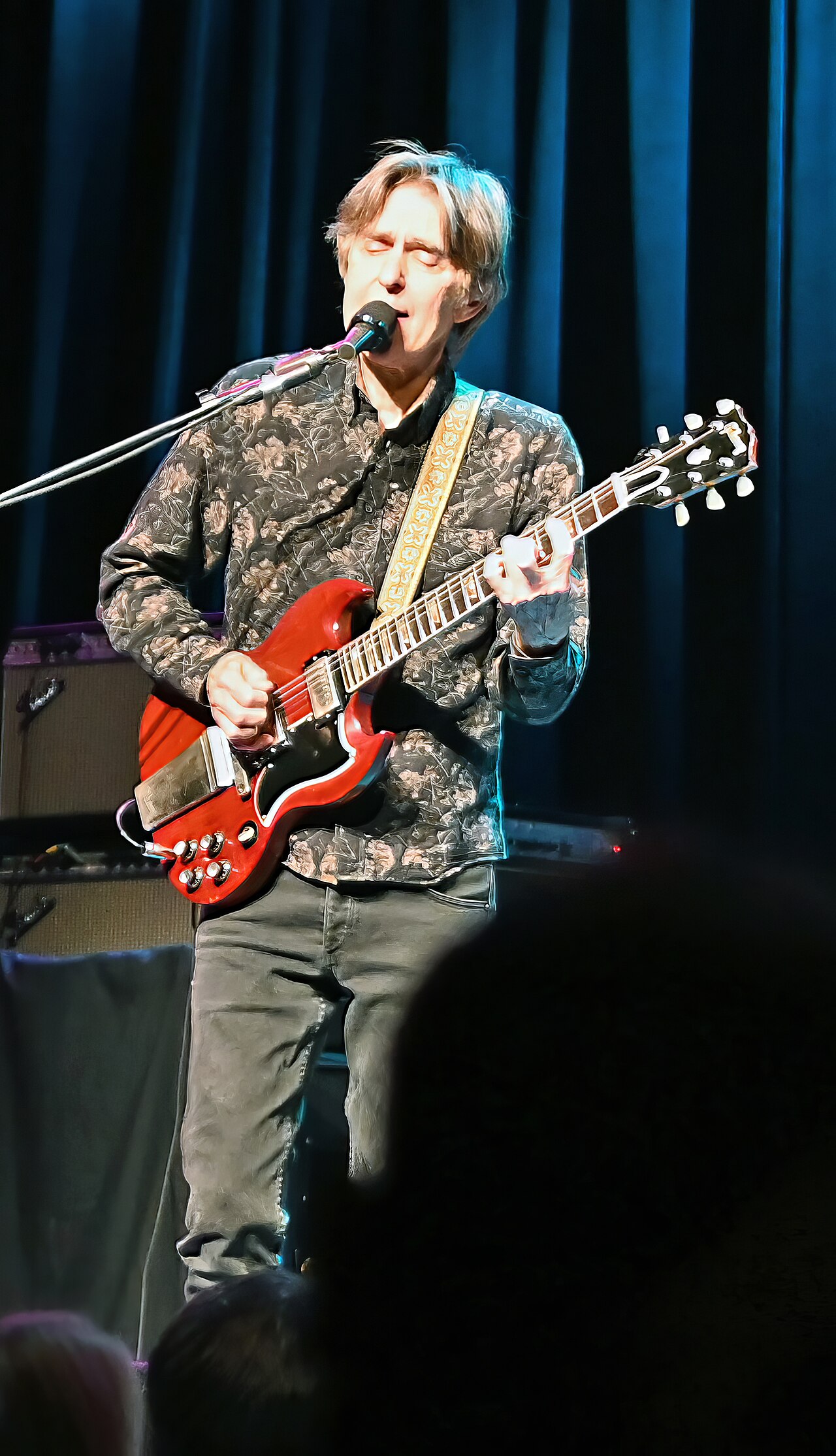
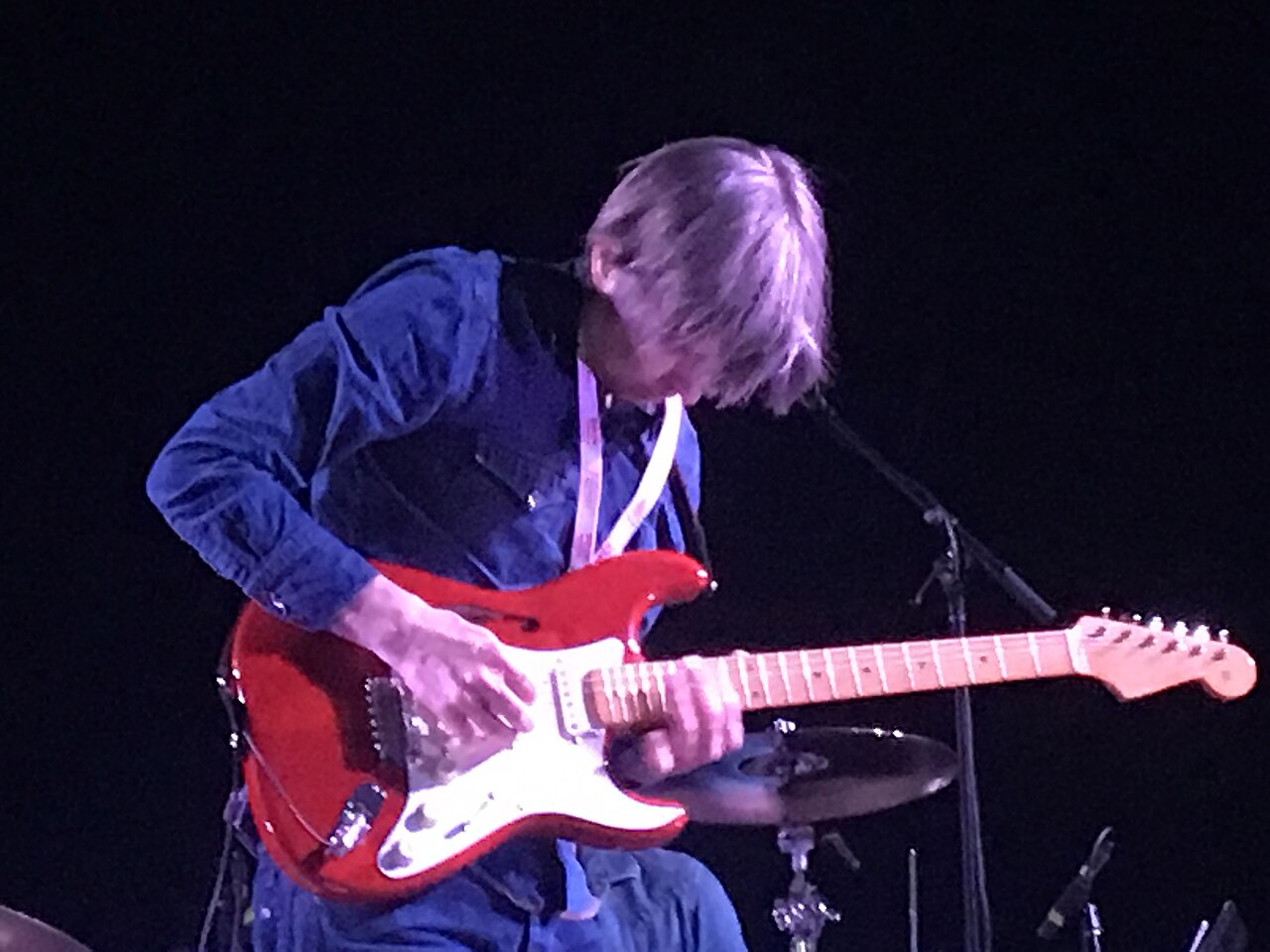
- Eric Johnson: Jud McCranie, Wikimedia Commons, CC BY-SA 4.0.
- Top image: Illustration: original AI-assisted editorial artwork based on Eric Frommer’s 2008 photograph of Chris Eldridge. Source and adaptation: CC BY-SA 2.0. New pose, composition, setting and lighting; proportional resize with a minimal 0.25-pixel crop at the top and bottom. No endorsement implied. The guitar’s exact model and year are not independently identified.
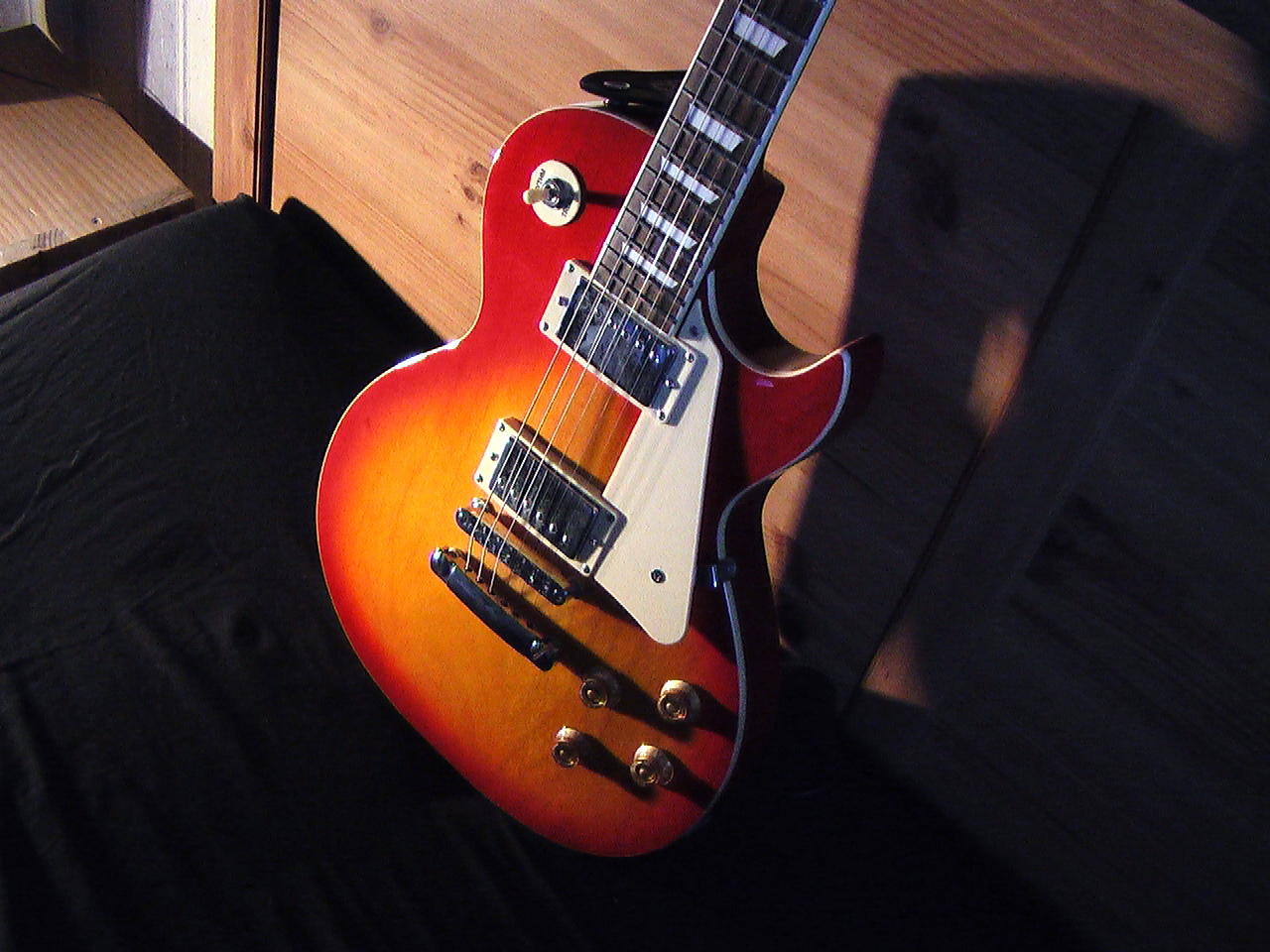
- A Gibson Les Paul with a sunburst finish: Delhovlyn, Wikimedia Commons, CC BY-SA 3.0.
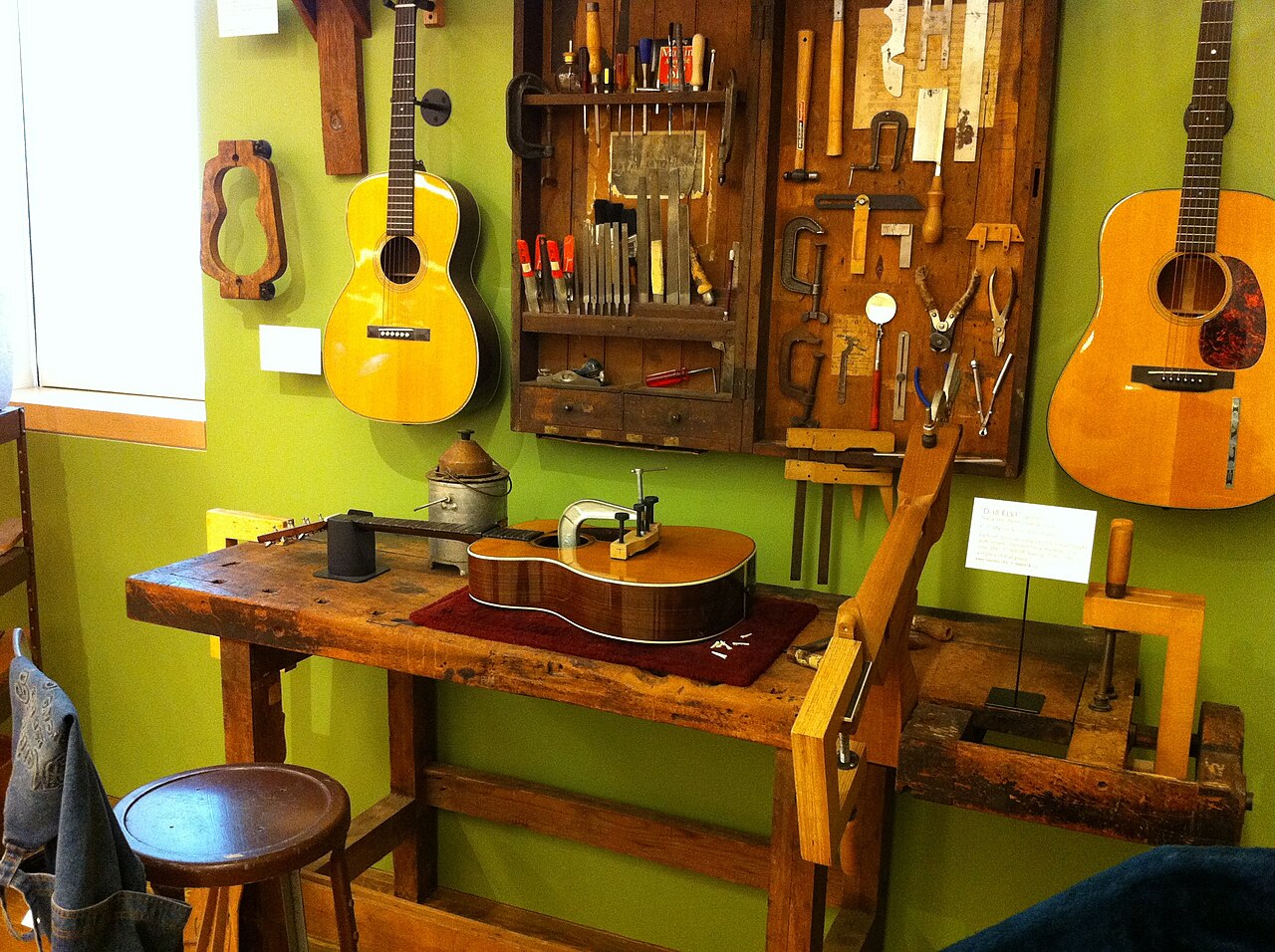
- A guitar workshop display with a workbench and hanging guitars: Dave Fey from St. Louis, USA, Wikimedia Commons, CC BY 2.0.
- Eric Johnson: Ejmerch, Wikimedia Commons, CC BY-SA 4.0.


