
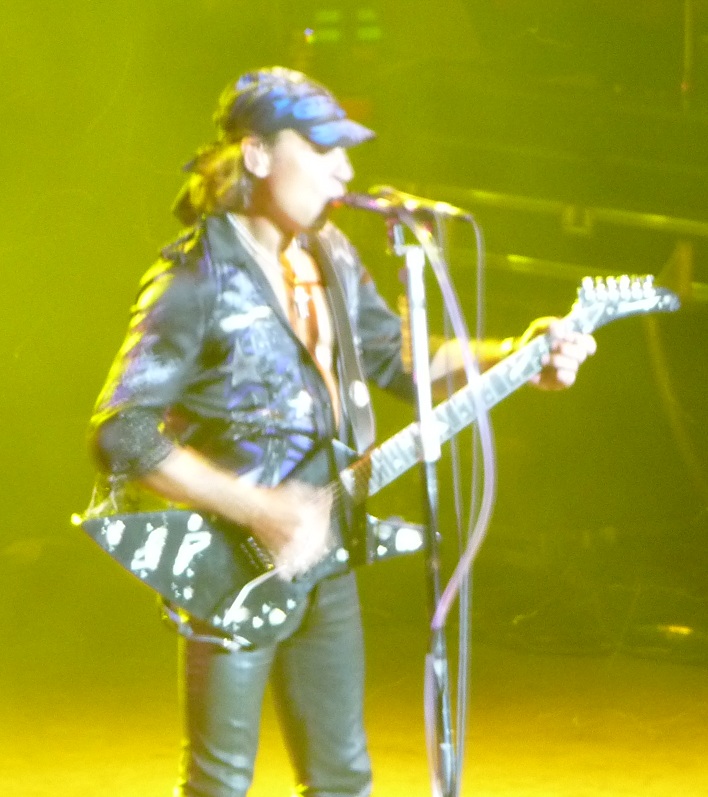
Gear Timeline
There is a detail about Matthias Jabs’s relationship with his amplifiers that tells you everything you need to know about the man: he replaced the Marshall amplification logo on his cabinet faceplates with his own name, in the same font style as the Marshall logo. This is not vandalism or disrespect — it is a statement of creative ownership, the declaration of a guitarist who has so thoroughly made a specific amplifier setup his own that the cabinet announces his identity rather than the manufacturer’s. Jabs did this because he could, because he understood the symbolism, and because after years of being the lead guitarist who made the Scorpions sound like the Scorpions, he had earned the right to rebrand the furniture. It is simultaneously the most rock and roll thing and the most German thing, combining artistic confidence with methodical attention to detail, and it captures exactly the qualities that made Matthias Jabs one of the most effective and underrated lead guitarists of the 1980s hard rock era.
Matthias Jabs was born on October 25, 1955, in Hannover, Germany — the same city that would become the Scorpions’ permanent base of operations. He came up through the German rock scene playing in bands called Lady and Fargo, developing his technical chops and his musical identity in the working-musician environment of local gigs and regional touring. When Uli Jon Roth departed the Scorpions in 1978 — leaving behind a Hendrix-influenced, psychedelically adventurous guitar legacy that had defined the band’s sound through five albums — the Scorpions held auditions that became legendary in their scale and seriousness. They auditioned approximately 140 guitarists. One hundred and forty people, from across Germany and apparently well beyond, lined up for the chance to fill the most demanding lead guitar chair in German hard rock. Matthias Jabs got the job. The subsequent history of the Scorpions — the commercial breakthrough of Lovedrive, the global dominance of Blackout and Love at First Sting, the half-billion-selling “Wind of Change” — is partly the history of what Jabs brought to that guitar chair.
His contribution to the Scorpions’ sound is defined by a specific creative and technical profile: melodically sophisticated lead guitar that serves the song’s emotional arc rather than showcasing the guitarist’s ability; a willingness to explore tonal variety (Explorer for the heavy, Stratocaster for the clean and bright, talk box for the vocal-filter magic of “The Zoo”) within a coherent overall approach; and an obsessive, methodical attention to equipment that produced one of the more unusual and interesting gear histories in German rock. Jabs has been not just a player but a creator of instruments — his development of the Jabocaster with Fender Japan, the Gibson Explorer 90 designed with the Gibson Custom Shop, and his ongoing signature series with German luthier Boris Dommenget represent an unusually active engagement with the instrument-design process for a working touring guitarist.
The specific tone Jabs created on the classic Scorpions recordings — the singing, sustaining lead work on “No One Like You,” the fluid melodic lines of “Still Loving You,” the blazing runs and emotive bends of “Rock You Like a Hurricane” — is built on two primary guitar identities that are as complementary as Rudolf Schenker’s Flying V and Jabs’s own instruments: the heavy, humbucker-equipped Explorer for the aggressive rock passages, and the modified Stratocaster with Floyd Rose and single humbucker for the passages requiring more tonal flexibility and the floating vibrato that the Floyd makes possible. Into Marshall Super Lead heads (50-watt preferred, for reasons he specified clearly and practically), then through the effect chain that includes one of rock guitar’s more theatrical and expressive tools: the talk box, used on “The Zoo” and several other Scorpions tracks to create a vocal-quality guitar effect that remains one of the most immediately recognizable sounds in the band’s catalog.
Beyond his guitar work, Jabs is also a businessman and guitar entrepreneur. He owns and operates MJ Guitars, a guitar store in Munich that serves both as a retail business and as a showcase for his signature instrument line. The Dommenget Mastercaster — his current primary touring guitar, designed with Boris Dommenget to produce the full range of Scorpions sounds from “wallcrashing heavy to ultraclean” from a single instrument’s controls — represents years of active development work rather than a passive endorsement arrangement. Matthias Jabs, in other words, is a guitar person in the fullest sense: someone whose relationship with the instrument extends beyond playing it to understanding, designing, and selling it. The Marshall logos on his cabinets say his name. The guitars in his store are his designs. The lead solos on the Scorpions’ catalog are his work. All of it reflects the same systematic, creative obsessiveness.
Background: The 141st Auditioner Who Changed Everything
The audition story — 140 guitarists tried and rejected before Jabs was selected — is more than just a good anecdote. It reflects the specific musical requirements that the post-Uli Jon Roth Scorpions needed to address. Roth’s playing had been extraordinary but highly individual: his Hendrix-influenced approach, with its use of extended psychedelic improvisations and modal harmonic explorations, had given the band a specific character that was musically adventurous but not ideally suited to the arena-rock direction that the Scorpions’ commercial ambitions required. The band needed a lead guitarist who could play with genuine technical facility and melodic sophistication while keeping the solos accessible, serviceable, and appropriate for songs rather than solo showcases. They needed someone who would complement Rudolf Schenker’s rhythm work and songwriting rather than compete with it. They needed Matthias Jabs.
Jabs’s first album with the Scorpions, Lovedrive (1979), was recorded in a somewhat unusual way: Uli Jon Roth had already laid down lead guitar tracks for some songs before his departure, and Jabs recorded lead tracks on some songs while Roth’s contributions remained on others. The resulting album is a transitional document — both guitarists present on the same album — and it is instructive to hear how different the two approaches are even on the same album. Roth’s tracks retain the Hendrix-influenced psychedelic quality of his Scorpions career; Jabs’s tracks are tighter, more focused, with the melodic directness and emotional accessibility that would define his subsequent work.
The commercial breakthrough came with Blackout (1982) — an album recorded under the specific difficulty of Klaus Meine’s voice crisis (the vocalist had lost his voice completely and required surgery, pushing the recording process through a period of genuine uncertainty about whether the band had a future). Jabs’s guitar work on Blackout is decisive and committed — the album’s hard-driving, aggressive character reflects both the band’s tension during the troubled recording period and Jabs’s growing confidence in the chair. Love at First Sting (1984) was the commercial apex: “Rock You Like a Hurricane,” “No One Like You” (already released in 1982 on Blackout), “Still Loving You” — these are the songs that established the Scorpions as a global arena band, and Jabs’s lead guitar is inseparable from all of them. He was making history with his solos, and the equipment he was using to do so is worth examining in detail.
The Rock Believer sessions, documented in Guitar World, show how seriously Jabs approaches the instrument even decades into his career: for the 2022 album, he bounced between a Bigsby-mounted ’59 Les Paul, a ’58 Les Paul, a ’55 Les Paul Junior, an old Strat, a few Explorers, and the Telecaster he’d played on “Wind of Change” — a deliberately vintage-leaning approach to match the vintage Marshall stacks that the band was using to find their original Eighties sound. This is not the behavior of a guitarist who treats gear as a commodity to be replaced and upgraded; this is the behavior of a collector and connoisseur who understands that different instruments and different amplifiers create different creative possibilities, and who curates his equipment with the same care he brings to the guitar solos that appear on the recordings.
The Rig: Matthias Jabs’s Guitars, Amps, and Effects
Guitars
Matthias Jabs’s most famous guitar is a 1976 Gibson Explorer — an instrument whose visual identity is as distinctive as anything in the hard rock guitar world, and whose origin story involves an admirable degree of DIY creative initiative. When Jabs acquired this Explorer in 1976, it was a standard production-finish instrument. In 1979, having clearly decided that the factory finish wasn’t going to work for him, he painted it white himself. He then applied the black stripes using 2-inch wide gaffer tape — the industrial adhesive tape that live musicians and production crews use for everything from securing cables to patching equipment — creating the graphic pattern that would become one of rock guitar’s most recognizable visual statements. He subsequently sent the guitar to Gibson, where the paint job was applied professionally with the durability and precision that a touring instrument requires. The hardware (gold throughout) and the pickups are stock Gibson production components, with the exception of Grover tuning machines. This is significant: Jabs did not upgrade the pickups, did not modify the electronics, did not chase aftermarket components to improve the instrument’s performance. The stock Gibson pickups through a 50-watt Marshall Super Lead were sufficient to produce everything he needed from this guitar. The DIY white stripes, transformed into a professional paint job, completed a visual and sonic identity that Jabs maintained across the most commercially successful years of the Scorpions’ career. The 1976 Explorer’s mahogany construction and stock humbucker pickups produce the warm, aggressive, naturally sustaining tone that defines the classic Scorpions lead sound — “No One Like You,” “Still Loving You,” “Big City Nights” are all this guitar and these pickups into those 50-watt Marshalls.
Running parallel to the Explorer as a primary instrument during the 1980s was a 1963–64 black Fender Stratocaster that Jabs called his “trouble guitar” — a nickname that suggests affectionate frustration with an instrument that delivered enormous creative rewards but demanded constant maintenance attention. The guitar was significantly modified from its original configuration: it received a Floyd Rose floating tremolo system (replacing the original Stratocaster synchronized tremolo) and a Bill Lawrence L90 pickup — a single humbucker replacing the original Stratocaster triple-single-coil setup. The L90 Bill Lawrence is a distinctive pickup design known for its articulate, high-output character with good single-note definition — somewhere between a single-coil’s clarity and a humbucker’s output, with a specific midrange character. The Floyd Rose gave Jabs the dive-bombing and vibrato capabilities that the Stratocaster’s original tremolo couldn’t reliably provide — particularly important for the “Blackout” track itself, which featured tremolo-intensive parts that demanded the tuning stability the Floyd provides. The combination of the vintage Stratocaster body (with its alder construction and single-coil-optimized resonance) with the humbucker pickup and Floyd Rose gave Jabs a tonal option very different from the mahogany Explorer — brighter, more articulate, with different sustain characteristics and the dramatic vibrato capability that the Floyd enables.
In the late 1980s, Jabs worked with the Gibson Custom Shop to design the Explorer 90 — a modified Explorer with a body size 10% smaller than the standard Gibson production model. The “90” designation refers to this dimensional reduction: 90% of the standard Explorer’s body scale. The motivation was practical and articulates a specific touring musician’s priority: Jabs wanted a sleeker, more maneuverable stage guitar that retained the fundamental tonal character of the Explorer while being physically smaller and easier to handle in the context of the elaborate stage productions that characterized major Scorpions tours of the era. The Explorer 90 was equipped with a Floyd Rose tremolo system — consistent with the floating vibrato approach he had developed with the modified Stratocaster — and featured the same mahogany construction and humbucker pickup configuration as the standard Explorer. This model subsequently became a short-run Gibson production instrument, available to the general public rather than exclusively as a custom build for Jabs’s personal use. The Explorer 90’s reduced body size addresses a genuine ergonomic issue with the standard Explorer’s wide, angular wings while preserving the fundamental acoustic resonance of the mahogany body construction.
The “Jabocaster” — Jabs’s signature Fender Stratocaster, dubbed with a portmanteau name that Fender themselves coined — was produced by Fender Japan as a Limited Edition model in the late 1990s. The Jabocaster differs significantly from Jabs’s original 1963–64 Strat modifications: rather than being a replica of his working stage guitar, it was designed to Jabs’s specific requirements for a touring-practical instrument. The body is reduced by 10% from standard Strat dimensions — consistent with the size-reduction approach he had taken with the Explorer 90 — and the overall instrument was built to Jabs’s specifications rather than being a standard Fender production model with minor variations. The Jabocaster is considered quite rare, having been produced only in Japan for a limited period and never having achieved broad international distribution. Collectors seeking Jabocasters face a genuine scarcity challenge, which is unfortunate given the guitar’s historical interest as both a Scorpions artifact and an example of Jabs’s active instrument design work.
Jabs’s signature relationship with German luthier Boris Dommenget produced the EX90 Stars — an Explorer-style guitar featuring the white-with-black-stripes aesthetic derived from his original DIY paint job, built to the 90%-size specification that had characterized his Gibson Custom Shop collaboration. The EX90 Stars features a korina body (echoing the original 1958 Gibson Flying V and Explorer construction material, and consistent with the tonal preferences established elsewhere in the Scorpions camp), with a 24-fret ebony fingerboard inlaid with Mother of Pearl and abalone Matthias Jabs signature inlays, Dunlop 6150 frets, and Dommenget’s proprietary Musclebucker pickups. Each pickup has its own volume control with a coil-split push/pull function, sharing a master tone control and using a three-way toggle plus a dedicated lead switch — a wiring configuration that allows Jabs to access the full range of tones from humbucking warmth to single-coil clarity without changing guitars between songs. Gotoh hardware, Kluson tuners, and a Vintage bone nut complete the specification. The Musclebucker pickups — Dommenget’s proprietary high-output humbuckers — provide the output and character required for hard rock and heavy metal lead work while the coil-split function enables cleaner, more articulate tones for passages where the full humbucker output would be excessive.
The Dommenget Mastercaster represents the culmination of Jabs’s instrument design evolution — described in its development brief as “a better follow-up of the Jabocaster” that “should be able to produce all the different sounds of the Scorpions, from wallcrashing heavy to ultraclean, with all sounds available from the guitar controls,” and featuring 24 frets. The development process took “a couple of years” of iterative refinement. The resulting instrument is designed to be a comprehensive tonal solution for live Scorpions performance — one guitar capable of covering the full range of sonic territory that the band’s catalog requires, from the aggressive high-gain lead passages of “Rock You Like a Hurricane” to the cleaner, more delicate tones of “Wind of Change.” The Mastercaster was Jabs’s primary stage guitar for the Humanity Hour 1 album period and its associated touring, and represents the most fully realized expression of his instrument design vision. It is built by Boris Dommenget’s workshop using Dommenget’s characteristic approach to construction quality and pickup design.
Jabs’s relationship with Dommenget extends to acoustic instruments as well — a Dommenget EX Acoustic (an acoustic version of the Explorer body shape) is documented in his collection and used for acoustic performance contexts. The FireAxe is another Dommenget-built signature instrument in the Jabs arsenal, featuring korina construction with a maple top (6mm), a medium-C korina neck profile, and ebony fingerboard with Matthias Jabs signature inlays. Both the EX Acoustic and the FireAxe reflect the breadth of Jabs’s instrument collection and the depth of his Dommenget collaboration — this is not a simple endorsement arrangement but a genuine ongoing creative partnership between a guitarist and a luthier who both take the instrument seriously as a design object.
Jabs’s studio work reveals a significantly more varied instrument palette than his live touring rig might suggest. For the Rock Believer sessions (2022), he used a Bigsby-equipped ’59 Les Paul, a ’58 Les Paul Standard, a ’55 Les Paul Junior, vintage Stratocasters, various Explorer configurations, and the Candy Apple Red Telecaster that he had notably used on the “Wind of Change” recording. In a Vintage Guitar interview, Jabs identified the specific instruments on individual album tracks: “the opening chord on ‘Mysterious’ — believe it or not, that’s the old Candy Apple Red Telecaster.” The vintage collection provides specific tonal options that modern instruments, regardless of quality, cannot precisely replicate — the aging of wood and pickups, the specific resonant character of particular production years, the indefinable quality that makes certain vintage instruments respond differently under the fingers. Jabs understands and exploits these differences deliberately, choosing specific vintage instruments for specific tonal requirements rather than relying on a single consistent instrument across all studio contexts.
Throughout the period before the Dommenget custom pickups became his standard, Jabs used Seymour Duncan SH-4 JB Model humbuckers in his Explorers and modified guitars — the same high-output aftermarket humbucker that his bandmate Rudolf Schenker also used during the MSG period. The SH-4 JB’s hot-wound character, bright top end, and aggressive midrange presence made it a natural fit for hard rock and heavy metal lead work: maximum output and definition for solos that needed to cut through the full Scorpions band mix. Seymour Duncan is documented in his gear lists as a consistent choice during the 1980s and into the 1990s.
Amps
Jabs has used both 100-watt and 50-watt Marshall Super Lead heads, and his stated preference for the 50-watt version is both specific and instructive. He found the 50-watt heads’ tone “easier to control” — a practical observation about how the 50-watt Marshall’s power section behaves differently from the 100-watt variant. The 50-watt amp reaches natural power-amp saturation at lower absolute volumes, which means the EL34 output stage is working harder (and therefore producing more of its characteristic harmonic enrichment and natural compression) at manageable stage levels. The 100-watt amp, by contrast, requires higher absolute volume to reach equivalent power-amp saturation — and at those higher volumes, the amp’s character may be harder to manage in terms of stage level, monitor balance, and the overall production of the live sound. Both Rudolf and Matthias ended up preferring 50-watt heads for essentially the same reason — a shared understanding within the Scorpions guitar section of how their specific amplifier configurations perform at different output levels. Jabs replaced the Marshall logos on his cabinets with his own name, in the identical font — one of rock guitar’s more entertaining acts of logo appropriation.
For the World Wide Live era and the commercial peak of the Scorpions’ recording and touring career, Jabs’s primary amplification was the Marshall JCM800 2210 — a 100-watt, two-channel master-volume head that appears in the World Wide Live DVD footage. The JCM800 series represented Marshall’s move into higher-gain territory while preserving the fundamental EL34 character of the earlier Super Lead designs. The 2210 variant’s two channels — clean and lead — gave Jabs the ability to switch between clean tones and high-gain lead sounds without additional channel-switching equipment, a practical advantage in the live context of a major arena tour.
The JMP MkII Super Lead head is documented at 0:05 in specific performance footage, identifiable by its characteristic large toggle switches and four-input configuration. This is the early-period Scorpions amplification — the pre-master-volume Marshall that Jabs was using in the transitional period between the Lovedrive and Blackout eras, the raw, non-master-volume amplification that produces the most direct relationship between guitar output and power-amp response.
The Soldano SLO-100 Super Lead Overdrive is one of the most celebrated high-gain amplifiers in rock guitar history — Mike Soldano’s design was an immediate success from its late-1980s introduction and has remained a benchmark for high-gain tube amplification for four decades. Jabs uses Soldano heads both in studio recordings and in his live rig alongside other amplifiers. The Vintage Guitar interview confirmed the Soldano in specific recording contexts: “I think I used an old ’60s Hiwatt amp in connection with a Soldano amp” for specific track recordings. The Soldano’s character differs from the Marshall in ways that suit different sonic requirements: more focused high-end, more aggressive preamp gain structure, with the SLO-100’s three-channel configuration (Clean, Crunch, Overdrive) giving Jabs a greater range of tonal flexibility than the vintage Marshall designs.
ENGL appears in Jabs’s documented modern amp setup — consistent with the ENGL adoption seen in both Rudolf Schenker and Michael Schenker’s modern rigs. The German-made ENGL amplifiers provide a quality-constructed, tour-reliable alternative to vintage Marshall heads for the live context, with the EL34 power section that preserves the fundamental British amplification character while offering more gain control and tonal flexibility than the vintage designs. For a band that has been touring at arena level for four decades, the reliability and consistency of a modern amplifier is a genuine practical advantage.
Hiwatt amplifiers appear in Jabs’s documented arsenal for specific studio applications — as confirmed by his Vintage Guitar interview description of using “an old ’60s Hiwatt amp in connection with a Soldano amp” for specific recording passages. The Hiwatt’s exceptional clean headroom provides a character quite different from the Marshall’s natural saturation, and the combination of Hiwatt clean response with Soldano overdrive character creates a tonal blending that neither amplifier produces alone. Jabs’s use of multiple amplifiers simultaneously (or alternately for different tracks) in the studio reflects his systematic approach to tone: identify the specific tonal requirement of each passage, then select the equipment that best serves it.
The Fender Prosonic — a relatively rare, short-lived Fender tube amplifier head that appeared in the mid-to-late 1990s, designed to provide American-voiced tube amplification with more gain capability than typical Fender clean amps — also features in Jabs’s documented amp list. The Prosonic’s character is quite different from his Marshall and Soldano primary amps: American rather than British voiced, with Fender’s characteristic bright, open quality filtered through a higher-gain circuit than the standard Fender clean amp approach. For the clean and semi-clean passages that appear in the Scorpions’ repertoire, the Prosonic provides a tonal color distinct from the Marshall-based sounds.
Kitty Hawk was a German preamp manufacturer whose units appeared in Jabs’s rack-based amplification setup at various points. Rack preamps allow the guitarist to separate the preamp (tone-shaping) and power-amp (volume and power-tube saturation) functions of conventional amplification, using the rack preamp to generate the tonal character and then routing that signal to a separate power amplifier. This approach gives the guitarist more tonal flexibility and the ability to combine different preamp voicings with different power amp characters — a level of systematic signal chain architecture consistent with Jabs’s methodical approach to tone.
Effects
Matthias Jabs’s most immediately recognizable and distinctive effect is the talk box — a device that routes the guitar signal through a plastic tube into the player’s mouth, where the oral cavity acts as a resonating chamber that shapes the sound. By moving the mouth and lips while the guitar signal is playing through this tube, the guitarist produces a vocalized, speech-like quality in the guitar tone — the characteristic “wah-wah-wah” vocal-guitar hybrid that is one of rock guitar’s most theatrical and expressive effects. Jabs used the talk box in conjunction with a wah pedal on “The Zoo” from Animal Magnetism (1980) — the combination of the wah’s sweep with the talk box’s vocal filter creating a layered, complex effect that gives the track its distinctive, immediately recognizable guitar voice. Additional Scorpions tracks featuring the talk box include “To Be No. 1” (Eye II Eye), “Money and Fame” (Crazy World), “Can You Feel It” (Unbreakable), “Media Overkill” (Savage Amusement), and “Raised on Rock” (Sting in the Tail). The talk box is not an effect that most rock guitarists encounter or use — it requires significant performance technique and is associated primarily with specific players (Peter Frampton’s “Do You Feel Like We Do?” and Joe Walsh’s “Rocky Mountain Way” are the most famous examples). Jabs’s use of it across multiple tracks and decades reflects a genuine enthusiasm for its expressive possibilities rather than a one-time novelty application.
Standard wah pedal use appears in Jabs’s documented effects chain — both the Dunlop Crybaby and the Vox Wah (the original British-made design that preceded the Dunlop’s American production) feature in his gear history. The wah is used both conventionally (rocking back and forth for dynamic, vocal guitar expression during solos) and in the specific combination with the talk box documented on “The Zoo.” The Vox Wah’s slightly different frequency sweep compared to the Crybaby produces a subtly different tonal character — the Vox tends to be slightly more midrange-focused, the Crybaby slightly broader — and having both available gives Jabs tonal flexibility in how he uses the filter effect.
An Echoplex tape echo unit appears in Jabs’s effects documentation — the same Maestro Echoplex that Tommy Bolin used as a primary compositional tool, and that appears in the gear histories of multiple players from the 1970s through the 1980s who valued tape-based delay for its specific organic, degrading-repeat character. Jabs used the Echoplex for depth and dimension on lead passages, adding the warm, natural quality of tape delay to his sustained lead lines.
Seymour Duncan JB Model pickups are specifically listed in Jabs’s documented equipment — the high-output, bright-top-end humbucker that appeared in multiple guitars across the classic Scorpions era. The JB’s aggressive character is well-suited to hard rock lead work through Marshall and Soldano amplification, providing the output and upper-midrange presence needed for solos to cut through the full Scorpions band sound at arena volumes.
Matthias Jabs has been a D’Addario endorsed artist since 1999, using their string sets across multiple guitar configurations. D’Addario strings are among the most widely used in professional guitar circles, known for their consistent quality, precise winding, and reliable intonation. His specific gauge preferences reflect both his guitar configurations (the Floyd Rose-equipped guitars typically require specific gauge/tension considerations to maintain proper tremolo balance) and his playing technique (the bends, the vibrato, the aggressive attack of his hard rock lead approach all affect optimal string gauge selection).
D’Andrea picks are listed as Jabs’s pick choice — a standard pick manufacturer providing the specific thickness, material, and bevel that his technique requires. Pick choice affects the initial attack quality and the warmth or brightness of the note attack in ways that are subtle but audible across a full-length album recording.
Playing Style & Tone Philosophy
Matthias Jabs plays hard rock lead guitar with a melodic intelligence that separates him from the purely technical players who dominated the 1980s guitar landscape. His solos are not demonstrations of speed or technical vocabulary for their own sake — they are musical statements that follow the emotional arc of the song they’re in, building and releasing tension with the same compositional awareness that good songwriting requires. The lead work on “Still Loving You” is perhaps the clearest demonstration: a ballad that requires guitar lines of genuine emotional weight rather than technical display, and Jabs delivers exactly that — sustained, singing notes, expressive vibrato, dynamic control that lets the guitar breathe and swell in ways that complement rather than compete with the song’s atmospheric character.
His approach to the Explorer/Strat dual-identity — heavy humbucker mahogany for the aggressive passages, modified single-humbucker Stratocaster for the brighter, more articulate passages — reflects a sophisticated understanding of how guitar construction affects tonal character and how that character should serve specific musical functions. The mahogany Explorer’s natural warmth and sustain are perfect for the slow, singing lead lines of “Still Loving You”; the Stratocaster-bodied instrument’s brighter, more articulate character is better suited to passages requiring note-by-note definition over a fast chord progression. This is not random gear collecting — it is systematic tonal architecture in service of musical goals.
The talk box use deserves specific attention as a playing style element. Operating a talk box effectively requires the guitarist to simultaneously think like a guitarist (executing the appropriate physical technique on the instrument) and like a vocalist (shaping the oral cavity appropriately for the desired vowel or consonant sound while the guitar signal is feeding through it). This dual-mode performance consciousness — playing and speaking simultaneously through the same instrument — is one of the more technically demanding performance techniques in rock guitar, and Jabs’s consistent, effective use of it across multiple tracks across multiple decades demonstrates both technical facility and genuine enthusiasm for the expressive possibilities it opens up.
His approach to tone is characteristically systematic and purposeful: use the right instrument for the specific musical requirement, choose amplifiers that enhance the guitar’s natural voice without overwhelming it, and deploy effects purposefully rather than decoratively. The Marshall logo replacement story captures this philosophy perfectly — he didn’t change the amplifier, but he claimed it as his own. The equipment serves the artist; the artist doesn’t serve the equipment.
How to Sound Like Matthias Jabs
The Jabs tone has two primary modes: the Explorer/Marshall heavy mode that defines the classic Scorpions lead sound, and the modified Stratocaster/Marshall mode that provides the brighter, more articulate tonal option for specific passages. For the “Rock You Like a Hurricane” and “No One Like You” lead character, the Explorer-plus-50-watt-Marshall combination is the starting point. For the “Wind of Change” acoustic-electric character (Telecaster into vintage Hiwatt/Soldano combination), the instrument choice shifts dramatically.
The key tonal characteristic across both modes is melodic clarity and sustain without muddiness — Jabs’s lead lines need to be individually audible and emotionally expressive even over Rudolf Schenker’s substantial rhythm guitar foundation. This requires specific gain structure: enough preamp gain for sustain and harmonic richness, but not so much that individual notes blur together in the distortion. The 50-watt Marshall hits this balance naturally when pushed appropriately by the Explorer’s humbucker output.
| Control | Setting (0–10) | Notes |
|---|---|---|
| Gain (50W Marshall Super Lead) | 8 | High preamp gain — the Explorer’s humbucker output pushing the Marshall’s input stage into substantial saturation. The 50-watt output stage then adds its own natural compression and harmonic enrichment on top of this. The result is singing, sustained lead tone with enough definition for melodic clarity. |
| Bass | 6 | Moderate bass — enough for warmth in the mahogany Explorer’s low register, but controlled to preserve the note definition needed for lead work over Rudolf’s rhythm guitar. Too much bass blurs notes together in the guitar’s lower register. |
| Mid | 7 | Present midrange — the seat of the Explorer’s tonal authority and the frequency range where Jabs’s melodic lines project most powerfully. A mid-forward setting helps the lead guitar cut through the full Scorpions band mix with clarity and authority. |
| Treble | 7 | Moderate-high treble for note definition and pick attack articulation. The Explorer’s humbucker top end combined with the Marshall treble at 7 produces the cutting, precise quality of Jabs’s faster lead passages without introducing harshness on sustained notes. |
| Presence | 6 | Moderate presence for definition in large-venue contexts. The Seymour Duncan JB and the Explorer’s natural character already provide substantial high-frequency presence; the presence control brings additional clarity without introducing shrillness. |
| Master Volume (JCM800) | 7–9 | Push the master high for full EL34 output-stage engagement. The 50-watt Marshall’s power section is central to the tone — the natural compression and harmonic richness of the EL34 tubes working hard is not replicable at low master volume settings. |
| Seymour Duncan JB (or Dommenget Musclebucker) | Guitar volume: 8–9 | Hot output pickups driving the Marshall’s input stage. Back the guitar volume off slightly from maximum to maintain note clarity at the high gain settings — the JB’s output at full guitar volume can push the preamp into excessive saturation that blurs individual note definition. |
| Wah (if used) | Dynamic — sweep for solo expression | Standard dynamic wah use for vocal expression on lead solos. In combination with the talk box (for the “The Zoo” effect): engage wah first, then add talk box — the layered filter effect requires careful balancing of both elements for the characteristic sound. |
| Delay (Echoplex / equivalent) | Mix: 25%; Time: 200ms; Feedback: 2 repeats | Subtle tape-style delay for dimension and sustain on lead passages. Two repeats with natural tape-style decay. Keep the mix moderate — Jabs’s lead lines have enough intrinsic sustain from the amp; the delay should add depth without muddying the melodic clarity. |
| Talk Box (specialty) | Route signal through tube to mouth; shape oral cavity | For the “The Zoo” effect: use in combination with wah pedal (wah first in chain, then talk box). Shape vowel sounds in the mouth while picking — “Wah” “Ooh” “Ah” sequences for the characteristic talking-guitar quality. Practice the coordination of hand technique and mouth shaping simultaneously. Not for the faint-hearted. |
Influence & Legacy
Matthias Jabs’s influence on hard rock guitar is, like his bandmate Rudolf Schenker’s, often overlooked in favor of more overtly flashy contemporaries — which is both an injustice and, in its own way, a tribute to how effectively his guitar playing serves the songs it appears in. When lead guitar becomes background information that you stop consciously registering because it fits so perfectly, that’s not invisibility — that’s mastery. The solos on “Still Loving You” and “No One Like You” have been heard by hundreds of millions of people worldwide. They work. They’ve always worked. They will continue to work long after the names of more technically impressive but less musically coherent players are forgotten.
His specific contributions to the guitar instrument design vocabulary are also significant. The Explorer 90 — a modified Explorer for players who find the standard model’s dimensions unwieldy — anticipated the kind of player-focused, ergonomically thoughtful guitar development that has become more common in subsequent decades. The Jabocaster’s specific design parameters, derived from Jabs’s touring requirements, represent genuine innovation in the Fender Stratocaster’s design evolution. And the Dommenget Mastercaster’s design brief — a single guitar capable of covering the full tonal range from “wallcrashing heavy to ultraclean” — is a meaningful product specification that reflects years of systematic thinking about what a professional touring guitarist actually needs from his instrument. For more on the Scorpions’ twin-guitar architecture within which Jabs operates, see Rudolf Schenker’s rhythm guitar history. The broader German hard rock tradition that the Scorpions helped define is explored through Michael Schenker’s UFO-era gear. The talk-box tradition that Jabs continued from its origins in 1970s rock is a lineage worth exploring through Peter Frampton’s pioneering use of the effect in his classic period work, referenced in Peter Frampton’s gear history.
The Marshall logo replacement remains the best single image for Matthias Jabs’s relationship with his equipment: he understood the amplifiers so completely, had made them so thoroughly his own through decades of use, modification, and systematic understanding, that it made perfect sense to put his name on them. Not because he had invented them. Not because he was sponsored by a company of his own. But because the tone that came out of those cabinets was his — his hands, his guitars, his knowledge of how to get what he needed from that specific combination of wood and wire and hot glass valves. That’s what the logo replacement means. That’s the Matthias Jabs philosophy. The equipment says his name because the music does.
Frequently Asked Questions: Matthias Jabs Guitars & Gear
What is Matthias Jabs’s most famous guitar?
Jabs’s most iconic instrument is a 1976 Gibson Explorer that he personally painted white in 1979, then applied black stripes using 2-inch gaffer tape, creating the distinctive visual identity that became his trademark. He subsequently sent the guitar to Gibson to have the paint job applied professionally with proper durability for touring. The hardware and pickups are stock Gibson components — gold hardware with Grover tuning machines replacing the factory tuners — which means the famous visual makeover was purely aesthetic rather than a tonal overhaul. This guitar is inseparable from the classic Scorpions lead sound of the early-to-mid 1980s: “No One Like You,” “Still Loving You,” “Big City Nights” — all of these solos came from the white-and-black Explorer into 50-watt Marshall heads.
What is the “Jabocaster” and how did it come about?
The Jabocaster is a signature Fender Stratocaster model designed by Matthias Jabs and produced by Fender Japan as a Limited Edition instrument in the late 1990s. The name — a portmanteau of “Jabs” and “Stratocaster” — was coined by Fender rather than by Jabs himself. Unlike many signature guitars that are simply standard production models with cosmetic variations, the Jabocaster was designed to Jabs’s specific specifications, featuring a body reduced to 90% of standard Stratocaster dimensions (consistent with his Explorer 90 design philosophy) rather than a conventional-sized body. The guitar was produced in limited quantities in Japan and has never achieved wide international distribution, making original Jabocasters relatively rare. The Dommenget Mastercaster subsequently evolved as “a better follow-up of the Jabocaster,” incorporating lessons learned from both the Jabocaster and Jabs’s extensive touring experience into a more comprehensive instrument design.
What amps does Matthias Jabs use?
Jabs has used a wide range of amplifiers across his career, with Marshall Super Lead heads (both 50-watt and 100-watt) as the primary foundation — with a stated preference for the 50-watt variant, whose tone he found “easier to control” compared to the 100-watt. He famously replaced the Marshall logos on his cabinets with his own name in the identical font style, one of rock’s more memorable acts of brand appropriation. Additional documented amplifiers include Marshall JCM800 2210 heads for the World Wide Live era, Soldano SLO-100 for high-gain applications (confirmed in specific studio recordings), vintage Hiwatt amplifiers for specific tonal applications (used in combination with the Soldano on certain tracks), ENGL amplifiers for modern live work, a Fender Prosonic for American-voiced tonal color, and Kitty Hawk preamp units in his rack system. He often combines amplifiers simultaneously or uses different amps for different instrument and track contexts rather than maintaining a single consistent amplification configuration.
What is the talk box and which Scorpions songs feature it?
A talk box is an effects device that routes guitar signal through a plastic tube into the player’s mouth, where the oral cavity acts as a resonating chamber. By moving the mouth and forming vowel shapes while the guitar plays through the tube, the guitarist produces a vocalized, speech-like quality — the iconic “talking guitar” effect. Jabs uses the talk box in combination with a wah pedal for maximum expressiveness. Scorpions tracks featuring his talk box include “The Zoo” (Animal Magnetism, 1980, the most famous example), “Money and Fame” (Crazy World), “Media Overkill” (Savage Amusement), “To Be No. 1” (Eye II Eye), “Can You Feel It” (Unbreakable), and “Raised on Rock” (Sting in the Tail). The technique requires simultaneous guitar performance and deliberate mouth shaping, making it one of the more demanding effects to execute convincingly in a live context.
What is the Dommenget Mastercaster?
The Dommenget Mastercaster is Matthias Jabs’s current primary signature guitar, built by German luthier Boris Dommenget to Jabs’s comprehensive specification. The design brief was ambitious: produce a single instrument capable of covering all the tonal range the Scorpions require — from “wallcrashing heavy to ultraclean” — with all sounds accessible from the guitar’s own controls. The development took “a couple of years” of iterative refinement. The resulting guitar features Dommenget’s construction approach, proprietary Musclebucker pickups with coil-split capability per pickup, 24 frets, and a design philosophy oriented toward maximum tonal flexibility from a single instrument rather than requiring multiple guitar changes during performance. The Mastercaster was Jabs’s primary touring instrument for the Humanity Hour 1 album period and its associated world tour.
How did Matthias Jabs get the Scorpions job?
When Uli Jon Roth departed the Scorpions in 1978, the band held auditions to find his replacement — a process that reportedly involved approximately 140 guitarists from across Germany and beyond. Jabs, who had previously played in German bands Lady and Fargo, was selected from this extraordinarily competitive field. His first album with the Scorpions, Lovedrive (1979), was recorded in unusual circumstances: Roth had already laid down guitar tracks for some songs before his departure, resulting in an album where both guitarists appear. Jabs’s contributions to Lovedrive already show the melodically focused, technically accomplished approach that would define the subsequent Scorpions commercial peak — Blackout (1982), Love at First Sting (1984), and the global dominance that followed.
What is the Gibson Explorer 90 and why did Jabs design it?
The Explorer 90 was a modified Gibson Explorer designed by Matthias Jabs in collaboration with the Gibson Custom Shop in the late 1980s. The “90” designation indicates that the body is 90% of the standard Gibson Explorer’s dimensions — a deliberate size reduction motivated by Jabs’s need for a more maneuverable stage guitar that retained the Explorer’s fundamental tonal character while being physically smaller and easier to handle on the elaborate stage productions of major Scorpions tours. The Explorer 90 was equipped with a Floyd Rose floating tremolo (reflecting Jabs’s use of the Floyd on his modified Stratocaster) and maintained mahogany construction for tonal consistency with his standard Explorer. The model was produced by Gibson as a short-run production instrument available to the general public as well as custom-built for Jabs’s personal use — one of several points in his career where his instrument development work produced commercially available products rather than purely personal custom instruments.
Related stories
Sylvain Sylvain Guitars & Gear: The Complete Guide to the New York Dolls’ Gretsch, Les Paul Junior & Automatic Guitar Proto-Punk Rig
Sylvain Sylvain guitars & gear: New York Dolls guitarist. Les Paul Junior 'automatics', Gretsch Golden Anniversary, white Les Paul Custom stolen by Steve Jones — proto-punk tone.
Ted Nugent Guitars & Gear: The Complete Guide to the Motor City Madman’s Byrdland Rig
Ted Nugent guitars & gear: the Motor City Madman's Byrdland rig. 12 vintage Gibson Byrdlands, Fender Twin Reverbs, Peavey 6505, zero effects, and the Stranglehold tone.
Ted Turner Guitars & Gear: The Complete Guide to Wishbone Ash’s Twin Guitar Pioneer’s Rig
Ted Turner guitars & gear: Wishbone Ash's twin-lead pioneer. Stratocasters, Firebird, Orange amps, and the Argus-era tone fully explained.