Phil Campbell Guitars & Gear: The Complete Guide to Motörhead’s 31-Year Guitar Legend’s Rig
Phil Campbell guitars & gear: Motörhead's 31-year guitarist. Gibson Firebird, Les Paul Custom, Marshall, Bogner, Seymour Duncan Custom Custom — a tribute to a legend.
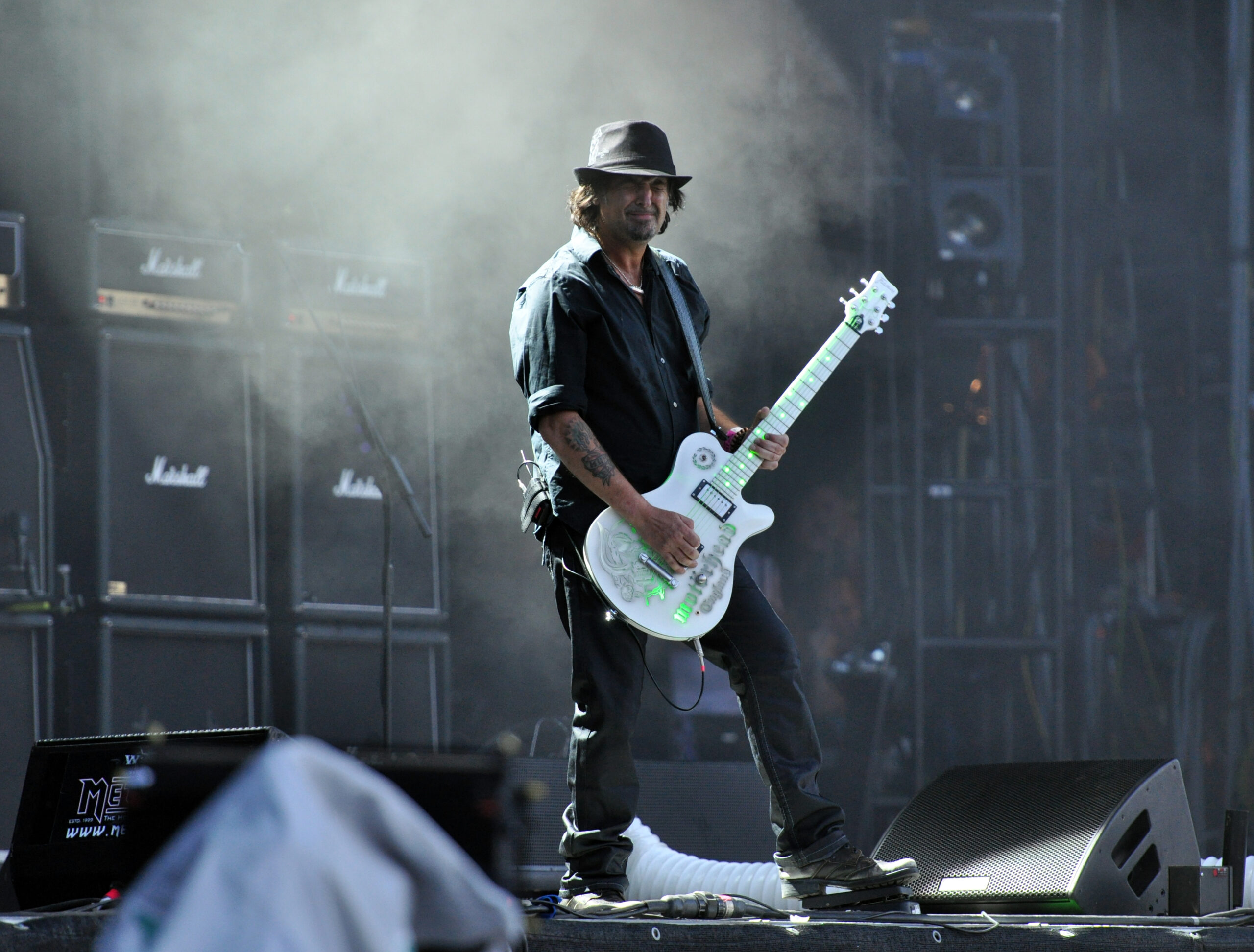
Photo by Jonas Rogowski, licensed under CC BY-SA 3.0 (https://commons.wikimedia.org/wiki/File:Phil_Campbell_of_Mot%C3%B6rhead_at_Wacken_Open_Air_2013_02.jpg)
When Phil Campbell was twelve years old, he attended a Hawkwind concert and asked Lemmy Kilmister for his autograph. Twelve years later, in 1984, he auditioned to become Lemmy’s guitarist in Motörhead, was hired alongside Michael “Würzel” Burston, and remained in the band for the next thirty-one years — until Lemmy’s death in December 2015 ended Motörhead. It is one of rock’s more elegantly circular biographical arcs: the twelve-year-old who collected the autograph became the guitarist who stood beside the autograph-giver for three decades, helping create the records that a new generation of twelve-year-olds would grow up with. Phil Campbell was born in Pontypridd, South Wales, on May 7, 1961. He died in Pontypridd on March 13, 2026, at the age of sixty-four, following a long battle in intensive care after a major operation. Lemmy didn’t outlive him by much. But in the eleven years between Lemmy’s death and Campbell’s own, he formed Phil Campbell and the Bastard Sons with his three actual sons, released a solo album featuring Alice Cooper, Rob Halford, and Dee Snider, and never stopped playing. The slowest right hand in heavy metal never stopped moving.
The Journey
Phil Campbell was, by his own description, not a technical guitarist. “I’ve never thought of myself as a technical player — I’ve probably got the slowest right hand in the business,” he told Total Guitar. “My comfort zone is big volume and lots of blues.” This is an unusual self-assessment for the guitarist of one of the fastest and most aggressive rock bands in history — the band whose proto-thrash speed, “Ace of Spades” tempo, and wall-of-volume approach to live performance influenced Metallica and an entire generation of metal. But it is also, characteristically, true. Campbell’s playing was not about speed for its own sake; it was about feel, about volume, about the specific blues-rock foundation that he brought to Motörhead’s music from the beginning. His influences — Jimi Hendrix, Tony Iommi, Jimmy Page — are the same influences that informed the blues-rock tradition from which heavy metal emerged, and Campbell never lost sight of that foundation even in the most extreme contexts of Motörhead’s catalog.
He joined Motörhead after the departure of Brian Robertson — the same guitarist who had been part of the Thin Lizzy twin-guitar approach that shaped a generation of British rock players. The specific circumstances of his hiring became one of rock’s better anecdotes: Lemmy couldn’t decide between Campbell and fellow auditionee Würzel, so he hired them both. The two-guitarist lineup produced Orgasmatron (1986), Rock ‘n’ Roll (1987), and several other albums before Würzel’s departure in 1995 left Campbell as the sole guitarist — a position he held for twenty years and sixteen albums. The transition from two guitarists to one required Campbell to cover both rhythm and lead simultaneously, which in Motörhead’s context meant playing extremely loud, extremely committed, and trusting the blues-rock foundation that had always been his real instrument.
His guitar career began at ten years old, and by thirteen he was performing regularly with pub and cabaret bands around South Wales — the working-class British music tradition of playing in rooms where the audience was not particularly interested in you and you had to earn their attention. He formed the heavy metal originals band Persian Risk in 1979, five years before the Motörhead audition. Persian Risk was, in the specific musical culture of late-1970s Wales, both the education and the preparation: a band serious enough about its music to function as a professional development platform while remaining small enough that the lessons were learned without the cushion of major-label support or tour management infrastructure. By the time Lemmy called in 1984, Campbell was ready — not because he was the fastest or most technically polished guitarist available, but because he had the foundation, the feel, and the specific quality of genuine musical commitment that Lemmy recognized and valued.
Phil Campbell and the Bastard Sons — formed in 2016 after Motörhead’s dissolution, featuring Campbell’s three sons Todd, Dane, and Tyla on guitar, bass, and drums respectively — was his answer to the question of what a musician does when the band that defined his career ends. “For about four months I didn’t know what to do. I was so exhausted I considered retiring completely,” he told Classic Rock in 2023. He didn’t retire. He called his sons, and they played. Four albums between 2018 and 2023. Shows opening for Guns N’ Roses and Hawkwind. A musical legacy continued through the family that had always been his primary non-musical commitment. He was Bampi — the grandfather — to his family. He was Wizzö — the guitarist — to the world. Those two identities were, in his own account, always in harmony rather than tension.
Background: The Pontypridd Kid Who Played Cabaret at Thirteen and Motörhead at Twenty-Three
The Welsh music scene that produced Phil Campbell has a specific character worth understanding: a working-class culture with deep roots in community music-making, shaped by the chapel tradition, the pub circuit, and the specific combination of Celtic expressiveness and industrial pragmatism that produces musicians who play because playing is what you do, not because it leads to fame and fortune. Campbell’s path from teenage cabaret musician to Motörhead is the working-class British rock trajectory at its most direct — no art school, no formal training, no commercial calculation; just a kid who loved the guitar, played everywhere he could, got better, got noticed, and eventually found himself standing beside Lemmy Kilmister for thirty-one years.
His early influences — Jimi Hendrix, Tony Iommi, Jimmy Page — represent the fundamental blues-rock guitar trinity that underpins British heavy metal in its entirety. Hendrix for the emotional directness, the sound as physical experience, the guitar as an extension of the body rather than a tool controlled by it. Iommi for the power, the riff intelligence, the understanding that heavy music is as much about what you don’t play as what you do. Page for the blues-rock architecture, the feel-based approach to lead playing, the specific quality of improvised guitar that sounds composed precisely because it isn’t. These three influences, synthesized through a decade of pub and cabaret experience and the specific crucible of Persian Risk’s NWOBHM context, produced the musician who walked into the Motörhead audition in 1984 with the exact qualities Lemmy needed.
The relationship with Lemmy — which was both a musical partnership and a genuine human friendship across thirty-one years — is the most significant fact of Campbell’s musical biography. Motörhead was Lemmy’s band in a fundamental and total way: the music was built from Lemmy’s bass riffs, his vocal approach, his lyrical vision, his specific combination of punk attitude and heavy metal power. Campbell’s role was to add the guitar dimension to this foundation — not to compete with it, not to redirect it, but to serve it with the blues-rock fire that Lemmy valued. “My comfort zone is big volume and lots of blues” is precisely the description of the quality that made Campbell the right guitarist for Motörhead: not speed, not technical virtuosity, but the specific combination of volume and feel that Lemmy’s music required.
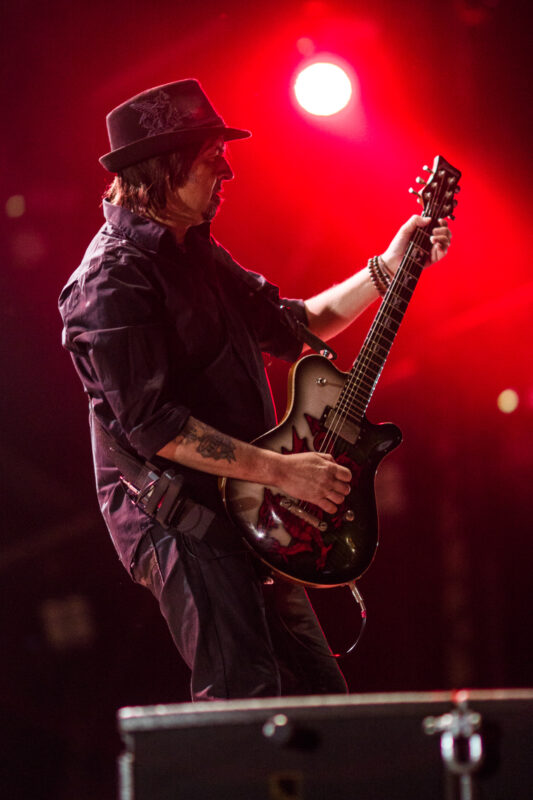
The Würzel partnership from 1984 to 1995 was one of the more distinctive two-guitarist arrangements in rock — not the harmonized twin-lead approach of Thin Lizzy or Iron Maiden, but a more blunt, brute-force dual-guitar attack in which the primary goal was maximum volume and maximum aggression. When Würzel departed, Campbell’s transition to sole guitarist required the same pragmatic adaptation that the pub circuit had always demanded: cover the space, trust your ears, play with conviction. The twenty years of sole-guitarist Motörhead produced some of the band’s most critically respected late-career work, and Campbell’s guitar playing across those albums demonstrates the full depth of the blues-rock foundation that he had been building since he was ten years old.
The Rig: Phil Campbell’s Guitars, Amps, and Effects
Guitars
The Gibson Firebird is the guitar most closely associated with Phil Campbell’s visual identity in the Motörhead period — the through-neck, reverse-headstock Gibson design with mini-humbucker pickups and the specific resonant character that the through-neck construction produces. The Firebird’s character is distinctive within the Gibson family: the through-neck construction provides different sustain characteristics from the set-neck Les Paul or the bolt-on Melody Maker, and the mini-humbucker pickups (designed by Seth Lover for Gibson, the same engineer who created the original PAF humbucker at Gibson in the 1950s) have a specific bright, articulate tone that differs from the fuller, warmer PAF character. In the context of Motörhead’s music — where the guitar needs to cut through Lemmy’s enormously powerful bass and Phil “Philthy Animal” Taylor’s drums (later Mikkey Dee’s drums) at maximum volume — the Firebird’s brightness and articulation serve the mix more effectively than a warmer, more compressed guitar might. Campbell’s Firebird on stage was the visual representation of the music: angular, aggressive, distinctively shaped, and unmistakably from the era of classic rock.
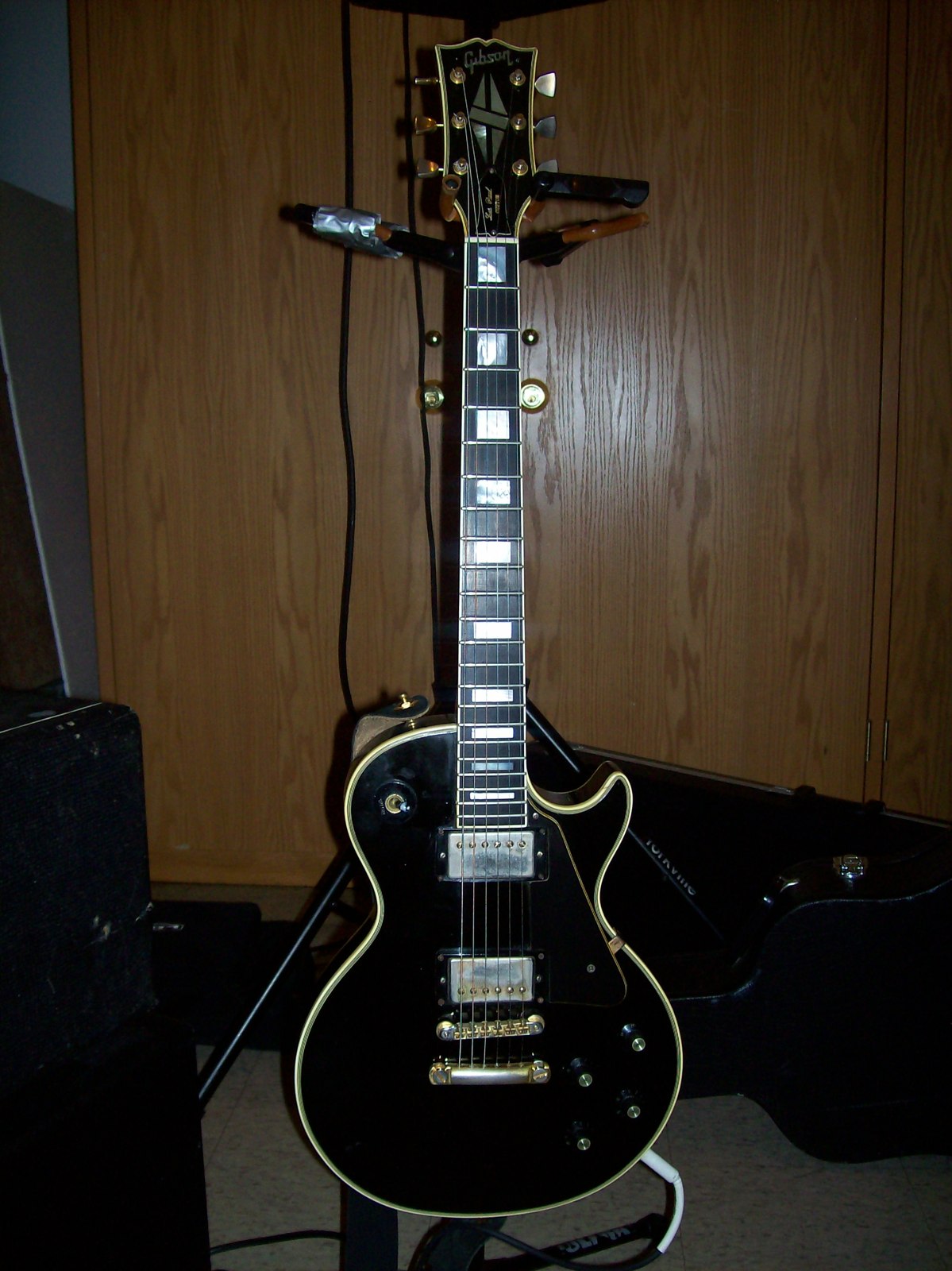
Gibson Les Paul Custom models also feature prominently in Campbell’s documented arsenal, both in studio recordings and as live alternatives. The Les Paul Custom — with its ebony fingerboard, multiple binding, and full-size humbuckers — produces the warmer, more sustaining character of the Standard Les Paul family in a more elaborately finished package. Campbell’s confirmed Les Paul Customs include a 1956 Custom (which he mentioned keeping in his collection “along with a ’57 black with the Bigsby”) and a ’57 black with Bigsby, nicknamed “The Fretless Wonder” — the original “Fretless Wonder” nickname was applied by Gibson to the earliest Les Paul Customs because of their extremely flat, almost imperceptible fret height. His confirmation that he “didn’t use anything too vintagey, there were only about six guitars in the rack in the control room” reflects the practical, music-first approach to studio work that characterizes his career.
Campbell was endorsed by Framus Guitars — the German guitar manufacturer with a history dating back to the late 1940s — in the later period of his career. Framus’s guitars are known for their European construction quality and their specific tonal character, somewhat different from the American Gibson instruments that define his primary guitar identity. The Framus endorsement provided Campbell with high-quality touring instruments alongside his primary Gibson collection.
A signature model from Lag Guitars — the French manufacturer — exists in Campbell’s documented endorsement history. Lag’s guitars are well-regarded for their construction quality and accessibility, and a Phil Campbell signature from Lag would have provided fans and players with an affordable instrument bearing his name and specification.
Minarik Guitars — an American manufacturer known for unusual body shapes and metal-influenced designs — also produced a Phil Campbell signature model. Minarik’s instruments occupy the mid-to-upper price range and feature quality construction appropriate for professional use.
A Caparison Angelus M3B appears in Campbell’s documented modern gear — Caparison being a Japanese boutique manufacturer known for high-quality metal-oriented guitars with exceptional playability and construction. The Angelus M3B is a set-neck design with mahogany construction and Caparison’s specific neck profile, providing a different tonal character from the through-neck Firebird but maintaining the humbucker-equipped, high-output guitar identity consistent across Campbell’s playing history.
Campbell’s documented pickup configuration uses the Seymour Duncan Custom Custom (SH-11) in the bridge position and the Seymour Duncan ’59 (SH-1) in the neck position — confirmed on the Seymour Duncan website. The Custom Custom is a medium-output humbucker with a specific bright, clear character at high gain settings — designed to maintain articulation under high distortion where some higher-output pickups lose note definition. The ’59 in the neck provides the warm, vintage-voiced PAF-inspired character for cleaner, more expressive lead tones. This combination — Custom Custom bridge for the aggressive, clear distortion tones of Motörhead’s hard rock, ’59 neck for the warmer, more bluesy tones of the melodic passages — is consistent with Campbell’s stated “big volume and lots of blues” tonal philosophy.
Campbell’s string brand of choice was Gibson Brite Wires — the nickel-wound electric guitar strings in Gibson’s product line. His endorsement statement on the subject is characteristically direct and complete: “I love my Brite Wires. They don’t break. They don’t rust. They never get out of tune. They have the perfect tone. Why change it if it’s working? I trust ’em that much.” This is the entire case for the strings made in a single paragraph, and it cannot be improved upon. They work, they don’t break, they don’t rust, they stay in tune. That is what strings need to do.
Amps
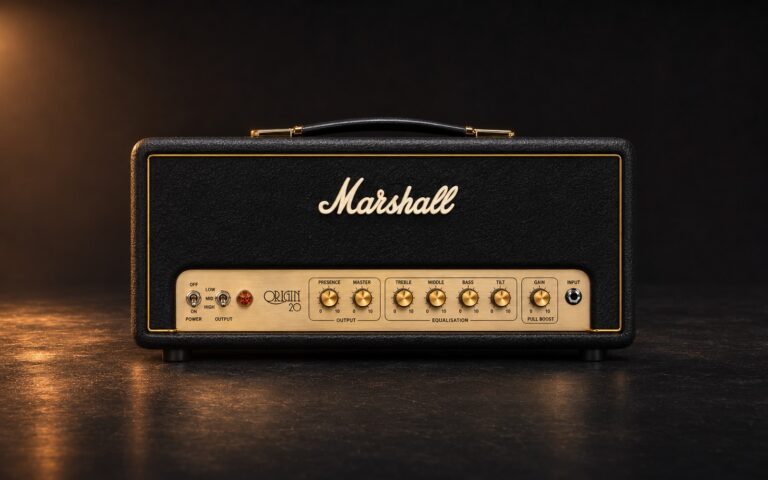
Marshall amplifiers are Phil Campbell’s primary live amplification throughout his career — the same British valve amplification tradition that defined his influences (Page, Iommi) and the broader heavy metal and blues-rock idioms in which he operated. His Vintage Guitar interview confirms: “I’ve been using Marshall amps.” Specifically, his guitar tech Roger DeSouza confirmed that the Marshall 1959RR (the Slash Signature, based on the classic Super Lead design) was acquired after hearing it played at NAMM: “I went and got Phil 2 of those right after that.” The 1959RR’s EL34 power section, high-gain preamp, and the fundamental Marshall British character — the warmth, the harmonic complexity, the natural power-amp saturation at working volumes — provided the tonal foundation for Motörhead’s guitar sound across Campbell’s tenure. Motörhead’s music is, fundamentally, very loud blues-rock played at high voltage, and the Marshall’s natural affinity for exactly this application made it the obvious and correct choice.
The Marshall 1959RR — the Slash Signature Super Lead reissue — was specifically acquired for Phil Campbell by his tech Roger DeSouza after a NAMM demonstration, with DeSouza purchasing two of them. The 1959RR is based on the 1959 Super Lead design — the non-master-volume 100-watt Plexi architecture that defines the British rock amplifier sound of the late 1960s and 1970s — with specific revisions for the Slash collaboration. The EL34 power section, the non-master-volume architecture (requiring the amp to be run at significant volume for natural saturation), and the fundamental Plexi character suit both the historical tradition Campbell’s playing comes from and the specific requirements of Motörhead’s live sound.
Campbell’s Vintage Guitar interview confirms the use of “a Bogner as well in the studio” — the American boutique manufacturer known for high-gain, high-quality valve amplification with a specifically warm, complex distortion character. Bogner amplifiers are favored by many professional guitarists for recording applications where the natural tone of a quality valve amplifier, captured at appropriate volume levels, provides the foundation of the guitar sound. The specific Bogner model is not identified in available sources, but Bogner’s general character — sophisticated, warm, with excellent dynamic response — suits studio work particularly well.
Laboga amplifiers — a Polish boutique manufacturer — also appear in Campbell’s documented live equipment. Laboga’s high-gain heads are less widely known than British or American alternatives but are well-regarded for their build quality and tonal reliability. Their inclusion alongside Marshall and Bogner reflects the same practical, quality-driven approach to equipment selection that characterizes all of Campbell’s gear decisions.
Gurus amplifiers from Italy also appear in Campbell’s documented rig. The Italian boutique amplifier scene has produced several high-quality manufacturers whose instruments have found professional audiences particularly in Europe, and Gurus’s valve amplifiers reflect that tradition of high-quality, tonally sophisticated valve amplification designed for professional use.
Effects
Campbell’s Vintage Guitar interview — “Effects-wise, I use delays and wahs” — establishes his minimal, functional approach to effects. Delay is the primary time-based effect, used for adding spatial dimension to lead guitar lines and for the specific atmospheric quality appropriate for certain Motörhead passages. The specific delay unit is not comprehensively documented in available sources, but the TC Electronic collaboration mentioned in the Premier Guitar documentation suggests TC Electronic delay products were part of his later-career toolkit.
The wah pedal is the second effect confirmed in Campbell’s “delays and wahs” effects summary. The wah adds vocal, sweeping expressiveness to lead lines — a particularly appropriate tool for a guitarist whose primary influences include Hendrix (perhaps the most celebrated wah guitarist in rock history) and Page (who used wah extensively on Zeppelin recordings). Campbell’s wah use is consistent with his blues-rock foundation: expressive, feel-based, serving the music rather than demonstrating effects ownership.
TC Electronic’s collaboration with Campbell is documented in the Premier Guitar records, suggesting the use of TC Electronic effects products in his rig during the collaborative period. TC Electronic’s stompbox products are widely used by professional guitarists for their quality and reliability. TC Electronic’s history in professional guitar effects spans decades, and their work with Campbell reflects the company’s practice of partnering with established professional guitarists to develop and validate their product lines.
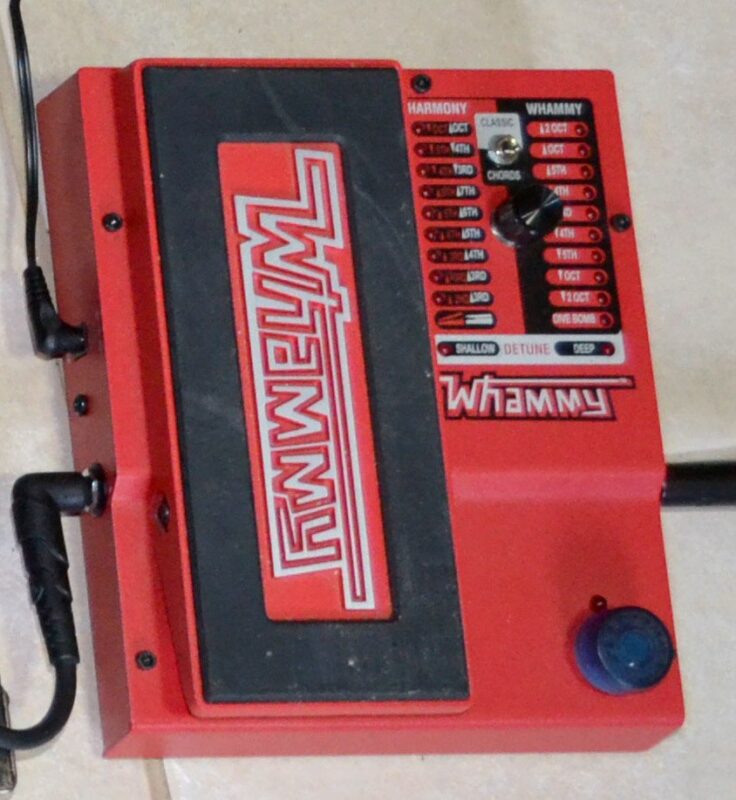
A DigiTech Whammy pedal appears in the context of Campbell discussing guitar heroes and their techniques — his reference to a guitarist he admired using the Whammy “for the solo, where it goes up an octave” and having “just got it right” reflects Campbell’s awareness of and interest in pitch-shifting effects as expressive tools. Whether the Whammy was a regular part of his own signal chain is less definitively documented than the delay and wah he confirmed in his Vintage Guitar interview, but its appearance in his gear conversations indicates an awareness of the effect’s expressive potential.
The Würzel Years: Two Guitars in Motörhead
The decade-long partnership between Phil Campbell and Michael “Würzel” Burston (born Michael Burston, 1949–2011) — the two guitarists who joined Motörhead simultaneously in 1984 after Lemmy simply couldn’t decide which one he wanted — is an underexamined chapter of rock guitar history. Motörhead’s music had not previously featured a dual-guitar attack in any consistent way: the band’s classic lineup had been the legendary three-piece of Lemmy, Fast Eddie Clarke, and Phil Taylor, with Clarke covering the entire guitar dimension alone. The addition of two guitarists simultaneously was not part of a plan; it was the consequence of Lemmy’s inability to choose between them, combined with his instinctive understanding that the music would benefit from both voices.
The Campbell-Würzel partnership is documented across the albums Orgasmatron (1986), Rock ‘n’ Roll (1987), No Sleep at All (1988, live), and briefly on 1916 (1991) before Würzel’s health and personal circumstances led to his departure. What they created was not the harmonized twin-lead sophistication of Thin Lizzy or Iron Maiden but something rawer and more blunt: two guitarists playing with maximum volume and maximum aggression, sometimes in unison, sometimes in complementary parts, producing the specific quality of wall-of-guitars that suited Motörhead’s massive live sound. Neither man was trying to be the more sophisticated player; both were trying to be louder, more committed, and more thoroughly Motörhead.
Würzel died in 2011, aged sixty-one. Campbell outlived him by fifteen years and carried the guitar role in Motörhead for two decades alone. The twenty years of sole-guitarist Motörhead from 1995 to 2015 represent the most sustained and fully realized period of Campbell’s contribution to the band — the albums that demonstrate what happens when a blues-rock guitarist with maximum volume in his comfort zone is given the entire guitar dimension of one of heavy metal’s most demanding bands to fill. He filled it. Every night, for twenty years, with the slowest right hand in the business and the biggest volume anyone needed.
His tech Roger DeSouza — whose confirmation of the Marshall 1959RR acquisition after NAMM is among the most specific pieces of gear documentation in Campbell’s career record — worked with him through the demanding touring schedules that defined Motörhead’s operation in their later years. Motörhead were a genuinely hard-working touring band: they played hundreds of shows per year, across every continent, for decades. The equipment that survived this schedule needed to be reliable above all other qualities. The Marshall amps, the Gibson instruments, the Gibson Brite Wires strings — all of these are products that Campbell chose specifically because they worked, consistently, night after night, tour after tour, without drama. “Why change it if it’s working?” applied to strings also applied to amplifiers and guitars.
“My comfort zone is big volume and lots of blues” is one of the most accurate and complete self-descriptions of a guitarist’s approach available in rock interview documentation. Big volume and lots of blues: these are exactly the two primary elements of Phil Campbell’s guitar playing, and everything else — the Motörhead context, the Firebird and Les Paul choices, the Marshall and Bogner amplification, the minimal effects approach — serves these two fundamental values.
The blues foundation is audible in his lead playing even in the most extreme Motörhead contexts. The bends are blues bends — wide, expressive, reaching for the note from below. The vibrato is blues vibrato — committed, emotional, present. The choice of notes in improvised passages reflects the same pentatonic and blues-scale vocabulary that Hendrix, Page, and Iommi all drew from. When Motörhead’s production strips away everything except the fundamental elements — bass, drums, guitar, vocals — what remains in Campbell’s guitar work is the same thing that remains in the work of his influences: genuine feeling, communicated through the simplest possible tonal means.
His “slowest right hand in the business” self-description is also true in a specific way: Campbell was never a speed player in the technical sense of the word. His lead work is melodic and feel-based rather than technically virtuosic. But the right hand that was “slow” by shred standards was also the right hand that could play the rhythm guitar in Motörhead — one of the loudest, fastest, most physically demanding live bands in rock history — with the consistency and commitment required to do it for thirty-one years. There is a different kind of speed in the right hand that keeps up with Motörhead at full volume across a ninety-minute set; it is not the shredder’s speed but the machine’s speed, and Phil Campbell had it completely.
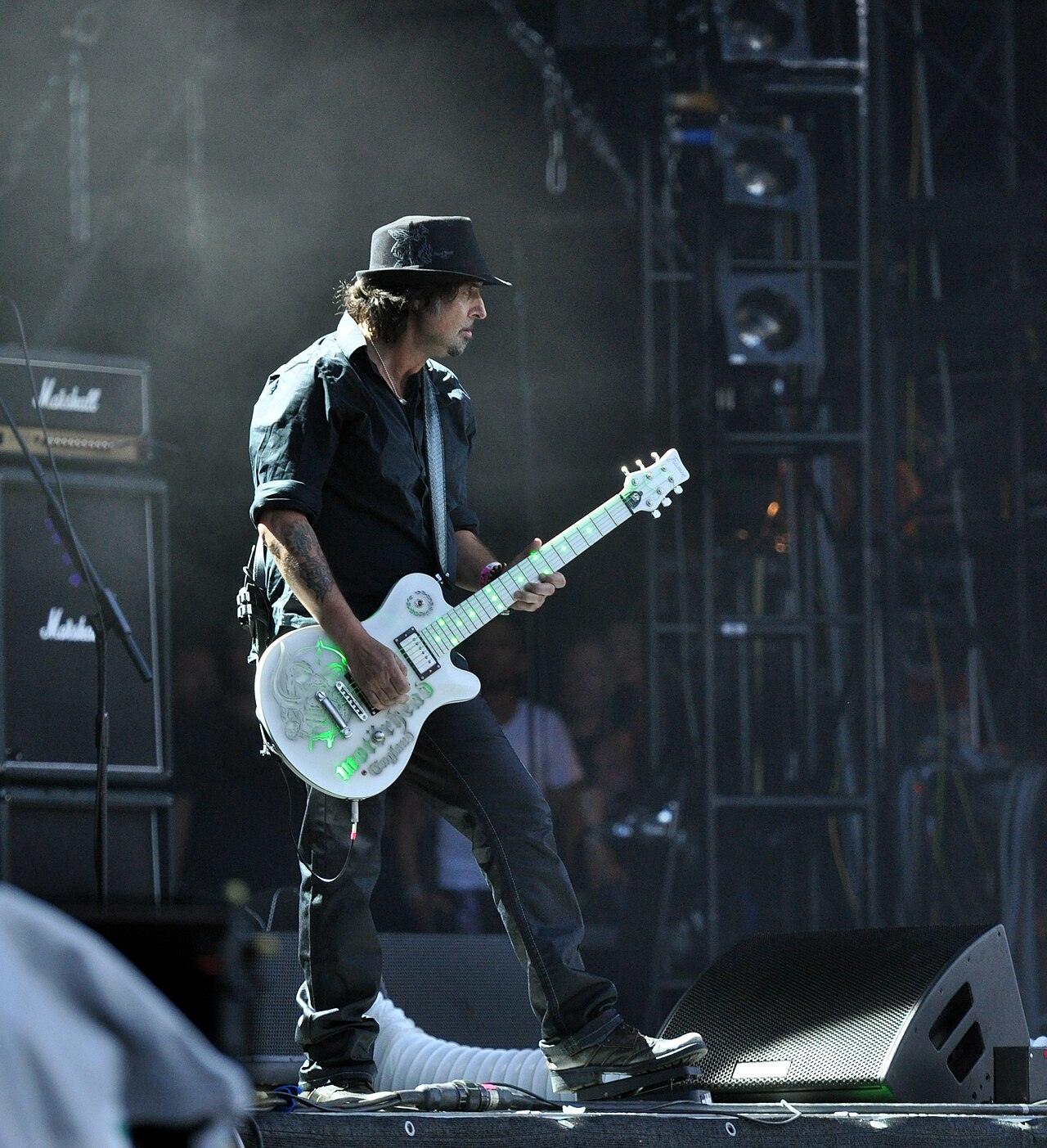
The specific quality of Campbell’s rhythm playing deserves its own examination, because it is the aspect of his contribution most often overlooked in favor of the lead work. Motörhead’s rhythm guitar — the chugging, palm-muted, maximally loud downstroked attack that drives “Ace of Spades,” “Orgasmatron,” “Iron Fist,” and the rest of the catalog — is physically demanding in a very specific way. It requires not speed exactly, but stamina and consistency: the ability to maintain a specific rhythmic lockstep with Lemmy’s bass and the drummer’s kick drum at very high volumes for ninety minutes or more, night after night. Campbell did this for thirty-one years. The “slowest right hand in the business” was, in the rhythm context, the most reliable right hand in the business — the hand that kept Motörhead moving forward with the relentless momentum that made their live performances feel like a physical assault rather than merely a musical event.
The Firebird’s role in this rhythm approach is specifically relevant. The through-neck construction produces a different sustain character from the set-neck Gibson designs: notes decay slightly differently, with the through-neck’s specific coupling of string vibration through the entire neck and into the body producing a sustain characteristic that some players describe as “more even” across the fretboard than set-neck alternatives. In the context of Motörhead’s rhythm playing — where palm-muted, aggressively picked notes need to attack cleanly and decay consistently — the Firebird’s construction provides a specific advantage. The mini-humbuckers’ brightness also helps: in a dense mix with Lemmy’s thunderous bass and the drums’ physical presence, a guitar that cuts with the Firebird’s midrange and treble character remains audible where a warmer, more compressed instrument might disappear into the low-end wall.
How to Sound Like Phil Campbell
The Phil Campbell tone requires: a Gibson Firebird or Les Paul Custom with Seymour Duncan Custom Custom bridge and ’59 neck; a Marshall (1959RR or equivalent non-master-volume Super Lead) pushed to natural saturation; minimal effects (delay for dimension, wah for expression). The most critical element is commitment: big volume and lots of blues, applied with the thirty-one-year conviction that comes from genuinely loving the music and genuinely loving the guitar. Equipment provides the architecture. The tone is the building.
| Control | Setting (0–10) | Notes |
|---|---|---|
| Marshall Volume / Gain | 8–9 | Non-master-volume Plexi/Super Lead territory: push the volume for natural EL34 power-amp saturation. The 1959RR requires volume to sound its best. Motörhead’s guitar tone is not achieved at bedroom levels. As loud as the situation permits. |
| Bass | 6 | Moderate bass — in the Motörhead context, Lemmy’s bass occupies the extreme low-frequency territory. The guitar’s bass setting should be present without competing with the bass. Controlled low-end preserves the guitar’s articulation in the dense Motörhead mix. |
| Mid | 7 | Present midrange — the heart of the blues-rock guitar character. Campbell’s tone is mid-forward rather than scooped, consistent with the blues tradition that underpins his playing. The midrange carries the note information in fast Motörhead passages. |
| Treble | 7 | Present treble for cut and definition — particularly important for the Firebird’s mini-humbucker configuration, where the natural treble character of the mini-bucker needs amp support to project clearly at Motörhead volumes. Bright enough to cut through; warm enough to feel like it’s coming from a valve amplifier. |
| Presence | 6–7 | Moderate-to-high presence for definition at live volumes. Motörhead plays loud. The guitar needs to project with definition and authority across very loud live environments. Presence at 6–7 provides this without the harsh sibilance of extreme presence settings. |
| Delay (Selective Lead Use) | Time: 300–400ms; Mix: 20%; Repeats: 2 | Used selectively for lead guitar dimension — not an always-on effect. The delay adds spatial depth to extended lead passages without cluttering the fundamental Motörhead aggression of the rhythm work. Moderate settings; the blues-rock foundation doesn’t need heavy delay treatment. |
| Playing Conviction | 10 | “My comfort zone is big volume and lots of blues.” This is non-negotiable. Play at full commitment. The Phil Campbell tone is as much a physical state as a technical configuration. Big volume requires the body to commit to the sound, not just the fingers to execute the notes. |
Influence & Legacy
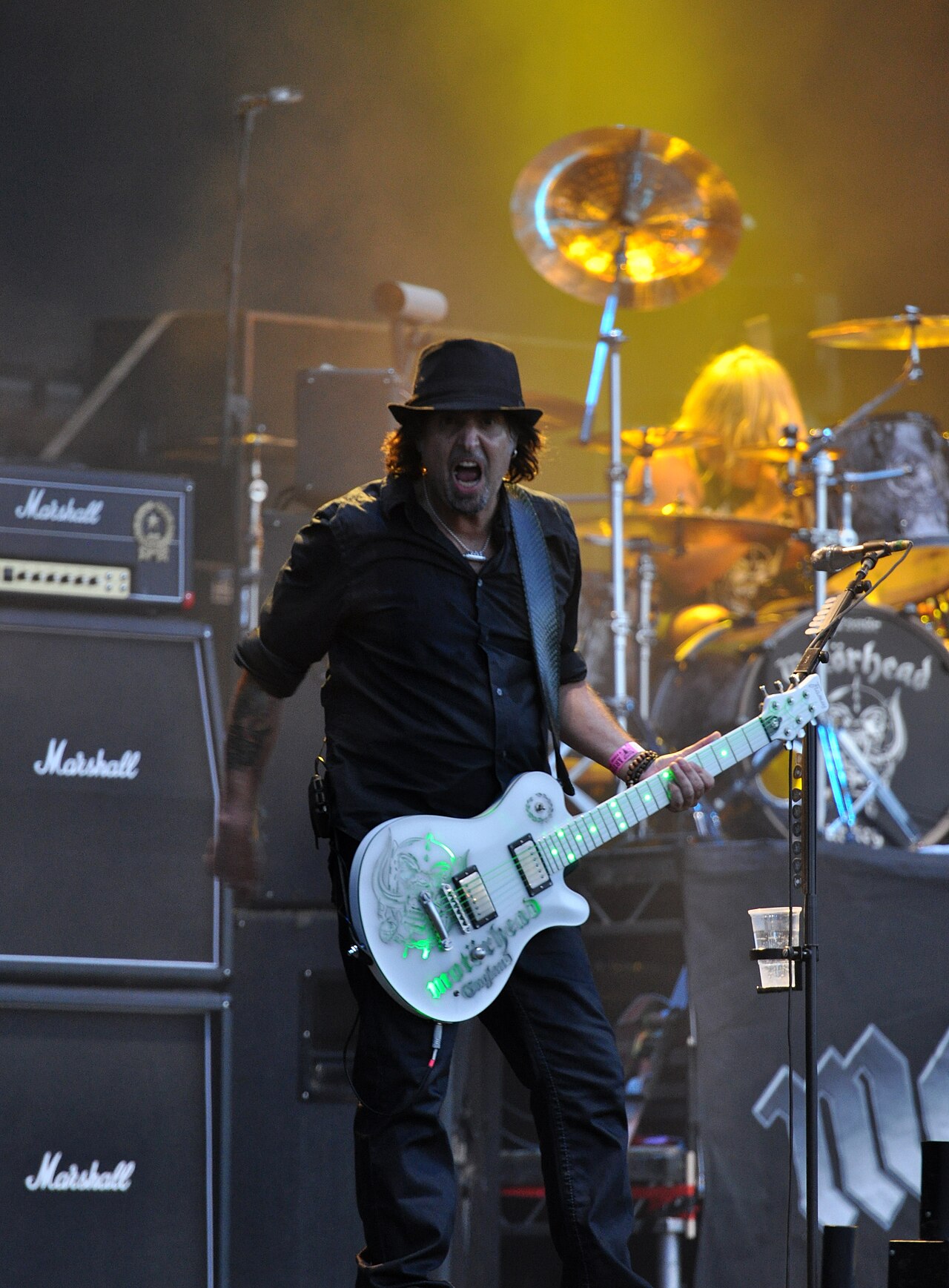
Phil Campbell’s legacy in heavy metal is inseparable from Motörhead’s legacy, because for thirty-one years — and particularly for the final twenty years as the sole guitarist — he was the guitarist of Motörhead. The albums Orgasmatron (1986), Rock ‘n’ Roll (1987), 1916 (1991), Bastards (1993), Inferno (2004), and Bad Magic (2015) represent the most substantial portion of the band’s catalog and the period during which Campbell’s guitar work was most fully realized. The “Ace of Spades” guitar part — the most famous single guitar riff associated with the band, though recorded before Campbell joined — he later performed for thirty-one years, making it as much his as its original author’s through sheer repetition and commitment.
His decision to continue making music after Lemmy’s death — forming Phil Campbell and the Bastard Sons, releasing Old Lions Still Roar with its remarkable guest list of Cooper, Halford, and Snider, continuing to tour and record until his health made it impossible — reflects the specific character of someone for whom music was not a professional identity to be maintained but a fundamental daily reality that continued as long as there was breath for it. “Big volume and lots of blues” until the end. The Motörhead tradition he represented — British working-class rock and roll at maximum volume, with genuine feeling and minimum pretension — runs through the entire history of the band he served so faithfully, and through the guitarists who came before him: Brian Robertson, his immediate predecessor in Motörhead, whose Thin Lizzy legacy connected the band to the broader twin-guitar tradition. The blues-rock foundation that Campbell never abandoned connects to Paul Kossoff’s emotional guitar approach, and the Iommi influence he explicitly acknowledged runs through the entire Black Sabbath tradition that underpins British heavy metal. Leslie West’s “big volume and blues” philosophy is, in a different accent and a different decade, essentially the same statement Campbell made about his own approach.
Philip Anthony Campbell. Born Pontypridd, 7 May 1961. Died Pontypridd, 13 March 2026. Guitarist, Motörhead, 1984–2015. “I’ve probably got the slowest right hand in the business. My comfort zone is big volume and lots of blues.” He was, in that comfort zone, magnificent.
Frequently Asked Questions: Phil Campbell Motörhead Guitars & Gear
What guitars did Phil Campbell play in Motörhead?
Campbell’s primary stage guitar in Motörhead was the Gibson Firebird — the through-neck, reverse-headstock Gibson design with mini-humbucker pickups, whose bright, articulate character suited the Motörhead live mix. He also used Gibson Les Paul Custom models extensively, including a 1956 Custom and a 1957 black “Fretless Wonder” with Bigsby tremolo. Additional instruments included Framus guitars (endorsement), a Caparison Angelus M3B, and signature models from Lag and Minarik. His pickup configuration across these instruments was Seymour Duncan Custom Custom (SH-11) in the bridge and Seymour Duncan ’59 (SH-1) in the neck — confirmed on the Seymour Duncan website. He strung all his guitars with Gibson Brite Wires, about which he said: “They don’t break. They don’t rust. They never get out of tune. They have the perfect tone. Why change it if it’s working?”
What amplifiers did Phil Campbell use?
Campbell confirmed in his Vintage Guitar interview: “I’ve been using Marshall amps, a Bogner as well in the studio, and Laboga amps. I also use Gurus amps, which are made in Italy.” His guitar tech Roger DeSouza confirmed the use of two Marshall 1959RR Super Lead heads — the Slash Signature based on the vintage Plexi Super Lead design — acquired after DeSouza heard the amp demonstrated at NAMM. Marshall valve amplification was his primary live sound throughout his Motörhead career; the Bogner provided additional tonal options for studio recording; Laboga and Gurus augmented the live rig. His effects were deliberately minimal: “Effects-wise, I use delays and wahs.”
How did Phil Campbell join Motörhead?
Campbell auditioned for Motörhead in 1984 following the departure of Brian Robertson. Fellow auditionee Michael “Würzel” Burston also tried out. Lemmy, unable to decide between the two, hired both. Campbell had been playing professionally since thirteen, performing in pub and cabaret bands around South Wales; he had formed the NWOBHM band Persian Risk in 1979. The hiring was the culmination of a specific biographical arc: at age twelve, he had attended a Hawkwind concert and asked Lemmy for his autograph. The twelve-year-old who wanted Lemmy’s signature became the guitarist who stood beside Lemmy for thirty-one years.
What was Phil Campbell’s relationship to Motörhead after Lemmy’s death?
After Lemmy Kilmister died in December 2015, Motörhead officially disbanded. Campbell spent several months in a state of uncertainty before forming Phil Campbell and the Bastard Sons with his three actual sons — Todd (guitar), Dane (bass), and Tyla (drums). “For about four months I didn’t know what to do. I was so exhausted I considered retiring completely,” he told Classic Rock in 2023. The Bastard Sons released four albums between 2018 and 2023, including The Age of Absurdity (2018), We’re the Bastard Sons (2019), Renegade Dictator (2021), and Kings of the Abyss (2023). He also released a solo album, Old Lions Still Roar (2019), featuring guest vocalists Alice Cooper, Rob Halford, Dee Snider, and others. He continued touring and recording until his health deteriorated in early 2026, dying on March 13, 2026, aged sixty-four.
What was Phil Campbell’s playing style?
Campbell was fundamentally a blues-rock guitarist transplanted into a heavy metal context. “I’ve never thought of myself as a technical player — I’ve probably got the slowest right hand in the business. My comfort zone is big volume and lots of blues,” he told Total Guitar. His primary influences were Jimi Hendrix, Tony Iommi, and Jimmy Page — the blues-rock guitar tradition that underpins British heavy metal. His lead playing was melodic and feel-based rather than technically virtuosic: wide, expressive bends; committed vibrato; pentatonic and blues-scale vocabulary. In Motörhead’s context, his role was to add the guitar dimension to Lemmy’s bass-and-vocal foundation with maximum volume and genuine blues-rock feeling — which, for thirty-one years, he did exactly right.
What is the Seymour Duncan Custom Custom and why did Campbell use it?
The Seymour Duncan Custom Custom (SH-11) is a medium-output humbucker designed to maintain articulation and note definition at high gain settings — where some higher-output pickups lose clarity and compress into an indistinct mass. In Motörhead’s high-volume, high-gain context, articulation at extreme settings was essential: each guitar note needed to project with definition through Lemmy’s powerful bass and the drums’ physical presence. The Custom Custom’s specific voicing — bright and clear enough to retain note information under high distortion — suited this application directly. The complementary ’59 (SH-1) in the neck provided the warm, vintage PAF character for cleaner passages and the more melodic blues-rock moments in Motörhead’s catalog.
Did Phil Campbell have signature guitar models?
Campbell had signature models from several manufacturers across his career. Lag Guitars (French manufacturer) produced a Phil Campbell signature. Minarik Guitars (American, known for metal-influenced designs) also produced a signature model. A TC Electronic collaboration is documented. Framus Guitars (German) had an endorsement relationship with Campbell. None of these signature models achieved the cultural prominence of his primary performing instruments (Gibson Firebird and Les Paul Custom), but they represent the professional endorsement relationships that reflect Campbell’s status as one of heavy metal’s most respected and long-serving guitarists. His most consistent tool endorsement was Gibson Brite Wires strings, which he championed with the wholehearted enthusiasm of someone who had found what worked and saw no reason to change it.
Image credits
- Phil Campbell: Jonas Rogowski, Wikimedia Commons, CC BY-SA 3.0.
- Phil Campbell: Jonas Rogowski, Wikimedia Commons, CC BY-SA 3.0.
- Gibson Les Paul Custom: Ibanez Guy, Wikimedia Commons, CC BY-SA 3.0.
- Top image: by Jonas Rogowski, Wikimedia Commons, CC BY-SA 3.0.
- Phil Campbell: photo by Adam Kliczek, via Wikimedia Commons, CC BY-SA 3.0.
- DigiTech Whammy: marcelodonati, Wikimedia Commons, CC BY 2.0.