PRS CE 24: The Bolt-On Nobody on the Spreadsheet Actually Played
The real players behind the PRS CE 24: Alex Lifeson's 1990s Rush rig, the guitar on Linkin Park's Hybrid Theory, and a modern prog-metal signature.
The PRS CE 24 has a bolt-on-neck origin story tied to one of prog rock’s most recognizable guitarists, a nu-metal album that sold over 30 million copies, and a modern signature model built specifically for dive-bomb-heavy prog metal .
What “CE” Actually Means
PRS introduced the original CE — short for “Classic Electric” — in 1988, four years after the company’s founding, as a deliberate departure from the set-neck construction that had defined every PRS guitar up to that point. According to PRS’s own retrospective interview with longtime employees Jack Higginbotham and Rob Carhart, the goal was straightforward: build a faster, cheaper-to-produce alternative to the Custom 24 by bolting the neck on rather than gluing it in. It didn’t entirely work out that way — maple necks turned out to be far less forgiving to shape than mahogany, and the CE ended up saving PRS only around 45 minutes of production time per guitar despite being priced as if it saved far more. Buyers got a genuine bargain as a result.
The original CE used an all-alder body; a maple-top version followed, and the body wood transitioned fully to mahogany with a maple cap around 1994–95 as PRS’s supply of clean alder became harder to source — the same wood-availability pressure that later pushed the company toward experiments like the Swamp Ash Special. The CE was discontinued in 2009 as PRS consolidated its lineup, then revived in 2016 after PRS’s product team identified a gap between the S2 line and the Core Standard and decided, in Higginbotham’s words, to bring back “the CE.”
PRS CE 24 — Full Specifications
Bolt-On vs. Set-Neck: Why the CE Sounds Different from a Custom 24
The CE 24 shares nearly identical woods, pickups, and body dimensions with the PRS Custom 24 — the difference that actually matters is entirely in how the neck attaches to the body. A bolt-on joint transfers string vibration differently than a glued set-neck: less sustain in absolute terms, but more immediate attack, brighter top-end “snap,” and a more percussive response that many players describe as closer to a vintage Fender than to a typical PRS. PRS leans into this directly in its own marketing, framing the CE 24 around “the snap and response that comes from a bolt-on neck guitar” as a deliberate tonal choice rather than a budget compromise.
The 85/15 humbuckers — the same pickups found across much of PRS’s Core lineup, loosely descended from Paul Reed Smith’s own mid-1980s pickup designs — are voiced for extended frequency range at both ends, and the push/pull coil-tap control gives the CE 24 access to genuinely usable single-coil tones alongside its full humbucker output, doubling its practical range without adding a third pickup.
This is also why the CE 24 has such a specific reputation among working guitarists rather than collectors: it’s frequently described as the more honest recording and touring instrument of PRS’s two 24-fret flagships, since the brighter, more percussive attack of a bolt-on neck tends to sit cleanly in a dense studio mix without the extra midrange bloom a set-neck guitar can add. That’s part of why it shows up so often as the guitar used to track an album before a heavier, warmer set-neck model takes over for live shows — a pattern that plays out almost exactly in Brad Delson’s own history with the model, discussed below.
Famous Players
This is the first PRS entry in the thread where none of the five recurring names holds up under scrutiny for the specific model. Santana has his own dedicated shape; Tremonti’s real PRS origin was a set-neck McCarty; Mayer’s PRS work centers on the Silver Sky and the earlier Super Eagle hollowbodies; Orianthi’s signature is built from a Custom 24; Grissom’s signature DGT is McCarty-platform, not CE. What the sheet missed entirely were three genuinely strong, well-documented CE 24 relationships.
Alex Lifeson: The Guitar He Called PRS to Ask For
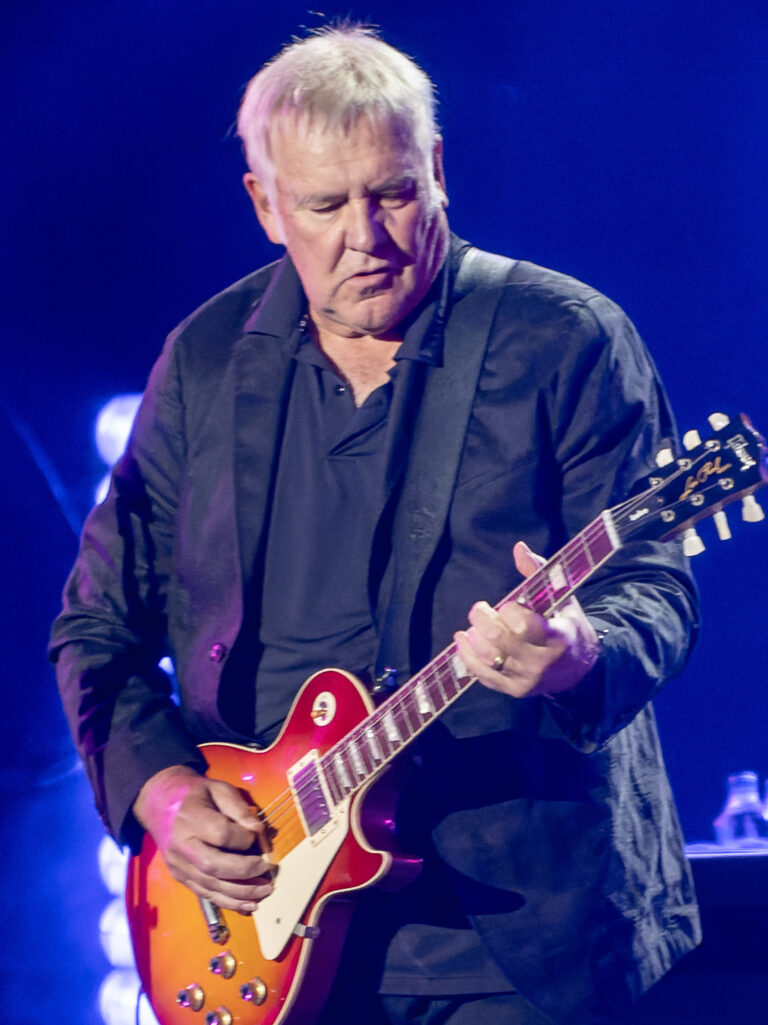
Alex Lifeson of Rush has one of the best-documented origin stories of any artist gear relationship in the PRS catalog — and it starts with a phone call. According to PRS’s own account, someone from Lifeson’s camp contacted the company after he’d seen a CE model and wanted to try one; PRS sent him a guitar, and, in the words of PRS employee Jack Higginbotham, “to this day he still has it.” Lifeson’s black 1991 CE 24 became a defining part of Rush’s live sound through the 1990s, used specifically for songs requiring the guitar’s full 24-fret range — Lifeson has described it as “nothing particularly special… but it has 24 frets, and I needed it for this song,” referring to “Leave That Thing Alone.” He toured with a small rotation of CE 24s — black, tobacco sunburst, red, and Whale Blue finishes — across the Roll the Bones, Counterparts, Test for Echo, and Vapor Trails-era tours, with some modified to include piezo pickups for acoustic-electric hybrid tones live. Lifeson later moved primarily to Gibson and his own signature Les Paul models, but the CE 24 remains the guitar most closely tied to his 1990s PRS era.
Brad Delson: The Guitar Behind Hybrid Theory
Brad Delson of Linkin Park’s connection to this specific model is unusually well documented: he used a PRS CE 24 to track most of Linkin Park’s 2000 debut album Hybrid Theory — one of the best-selling rock albums of all time — before switching to a Custom 24 as his primary live and studio guitar for the rest of the band’s career. Delson’s current live rig centers on Custom 24s (including his iconic red “Hybrid Theory Soldier” graphic guitar), but the bolt-on CE 24 is specifically the guitar on the record that built Linkin Park’s initial sound, a detail that tends to get flattened into “he plays PRS” in most gear roundups.

Dustie Waring: A Modern Signature Built on the Bolt-On Platform
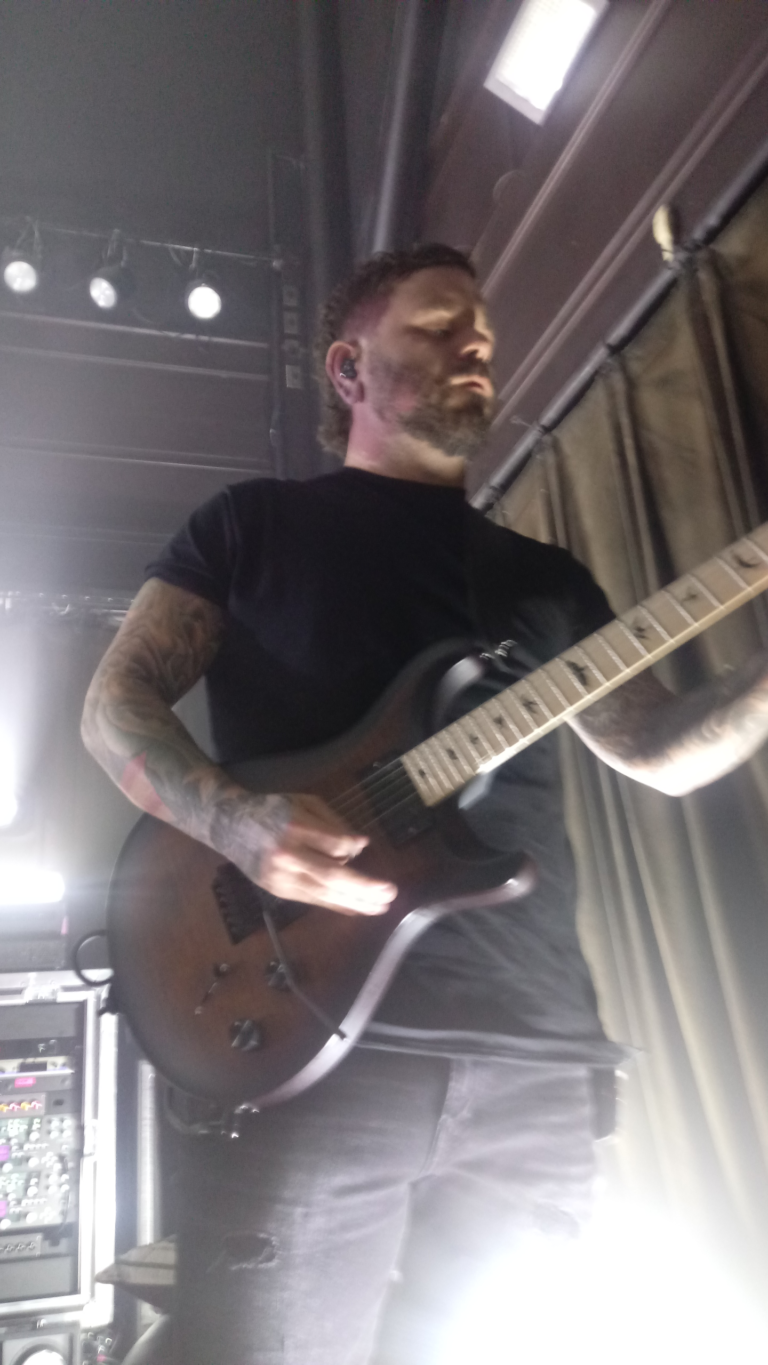
Dustie Waring of the progressive metal band Between the Buried and Me has held an official PRS signature model since 2018: the DW CE 24 “Floyd,” built specifically on the CE bolt-on platform rather than a set-neck Custom shape. The model swaps in a Floyd Rose 1000 tremolo with locking nut, Waring’s own Mojotone “DW Tomahawk” humbuckers voiced for high-gain clarity, and a slightly modified, thinner Pattern Thin neck carve. “I’ve always thought CEs were really great guitars,” Waring said of the collaboration, “it’s just cool to see a CE with a maple board and a Floyd.” It’s a reminder that the bolt-on platform’s snap and immediacy translate as readily to modern prog-metal dive-bombing as it did to Lifeson’s 1990s arena rock.
Tone Recipes
Prog-rock 24-fret lead (Lifeson-inspired): Bridge humbucker, moderate gain, into a Marshall-style or Hiwatt-style tube amp — lean on the CE’s natural snap rather than piling on distortion, and use the extended upper register the 24-fret neck provides.
Nu-metal rhythm (Delson/Hybrid Theory-inspired): Both pickups or bridge alone, heavily saturated gain, tight low end — CE 24s of this era were commonly run through Mesa Boogie Dual/Triple Rectifiers for the thick, palm-muted low tunings that defined the sound.
Prog-metal dive-bomb rhythm (Waring-inspired): Bridge humbucker, high gain, Floyd Rose-equipped variant if available — the coil-tap on the standard CE 24 can substitute a cleaner single-coil voice for contrast on the same guitar.
Vintage-clean single-coil (using the coil-tap): Neck pickup, tone knob pulled for coil-tap, clean amp — a genuinely usable Strat-adjacent tone that most players overlook on a guitar known primarily for humbucker output.
How It Compares
Against the PRS Custom 24, the CE 24 is essentially the same guitar with a different neck joint — bolt-on snap and brightness versus set-neck sustain and warmth, at a lower price point since bolt-on construction is faster and cheaper to produce even with PRS’s exacting tolerances.
Against the McCarty 594, the difference is broader: the CE 24 uses hotter, wider-range 85/15 humbuckers and a 24-fret neck built for reach and range, while the 594 uses lower-output, vintage-voiced pickups and a shorter 22-fret neck built for feel and warmth. Players choosing between them are choosing between modern versatility and vintage character.
Against a Gibson Les Paul Standard, the contrast is a direct illustration of bolt-on versus set-neck philosophy on two otherwise similar mahogany-and-maple guitars — the CE 24 trades some of the Les Paul’s thick sustain for brighter attack and lighter overall weight.
Buying Guide
The standard Core CE 24 is the best entry point for players who want PRS’s flagship tone with a brighter, more Fender-adjacent edge than the Custom 24 offers. The CE 24 Special, a 1,500-piece 2025 limited run, adds a middle single-coil in a hum/single/hum configuration with a 5-way switch for genuinely different tonal territory — scooped, three-pickup tones the standard two-humbucker CE 24 can’t reach even with coil-tapping. The CE 24 Semi-Hollow trades some of the platform’s snap for added air and resonance, aimed at players who want acoustic-adjacent warmth without leaving the bolt-on format. The DW CE 24 “Floyd” is worth a dedicated look for anyone doing serious tremolo work, since it’s the only CE variant built around a true locking Floyd Rose system rather than PRS’s own patented tremolo. Budget-conscious buyers should look at the SE CE 24, which brings the same body combination and neck feel down to well under a third of the Core price. Within the SE line, the Standard Satin version strips things back further still — a satin-finished mahogany body without the maple cap, aimed squarely at players who want the CE platform’s snap at the lowest possible price rather than the figured-top aesthetics.
Anyone shopping used should pay attention to the mid-1990s wood transition described above: pre-1994 CE models were built on alder bodies rather than the mahogany-and-maple combination used on every CE 24 since, which changes the tonal profile meaningfully even though the specs sheets often list both eras under the same model name. A CE from Alex Lifeson’s own era falls squarely in that alder-body window, which is part of why his early-’90s guitars are frequently described by owners and collectors as sounding notably different from a current-production CE 24.
Practical Ownership Notes
The open-back Phase III tuners are a deliberate departure from PRS’s locking designs elsewhere in the catalog — they promote resonance and tone transfer at the cost of slightly slower string changes, a tradeoff worth knowing if you’re used to locking tuners on other guitars. At 7.8 lbs, the CE 24 sits on the heavier side of PRS’s lineup despite its bolt-on construction, since the mahogany-and-maple body combination is unchanged from the set-neck Custom 24. The satin nitro neck finish feels notably different from PRS’s glossier Core necks — faster and less sticky under the hand, but it will show finish wear over time in a way a gloss neck won’t.
FAQ
What does “CE” stand for on a PRS guitar?
“CE” originally stood for “Classic Electric,” introduced in 1988 as PRS’s first bolt-on-neck model, distinct from the set-neck construction used on the rest of the company’s catalog at the time.
What’s the actual difference between a CE 24 and a Custom 24?
The body woods, pickups, and general dimensions are nearly identical; the difference is the neck joint — bolt-on maple on the CE 24 versus a glued set-neck on the Custom 24 — which changes the guitar’s attack, sustain, and overall tonal character.
Did Alex Lifeson really play a PRS CE 24?
Yes, extensively — his black 1991 CE 24 and several other CE 24s in different finishes were a defining part of Rush’s live rig through much of the 1990s, documented directly by PRS itself.
Was the CE 24 used to record Linkin Park’s Hybrid Theory?
Yes — Brad Delson used a CE 24 to track most of that 2000 album before switching to a Custom 24 as his primary guitar for the rest of Linkin Park’s career.
Is there a version of the CE 24 with a Floyd Rose?
Yes — the DW CE 24 “Floyd,” a signature model built with Dustie Waring of Between the Buried and Me, is the only CE variant built around a true locking Floyd Rose tremolo system.
Image credits
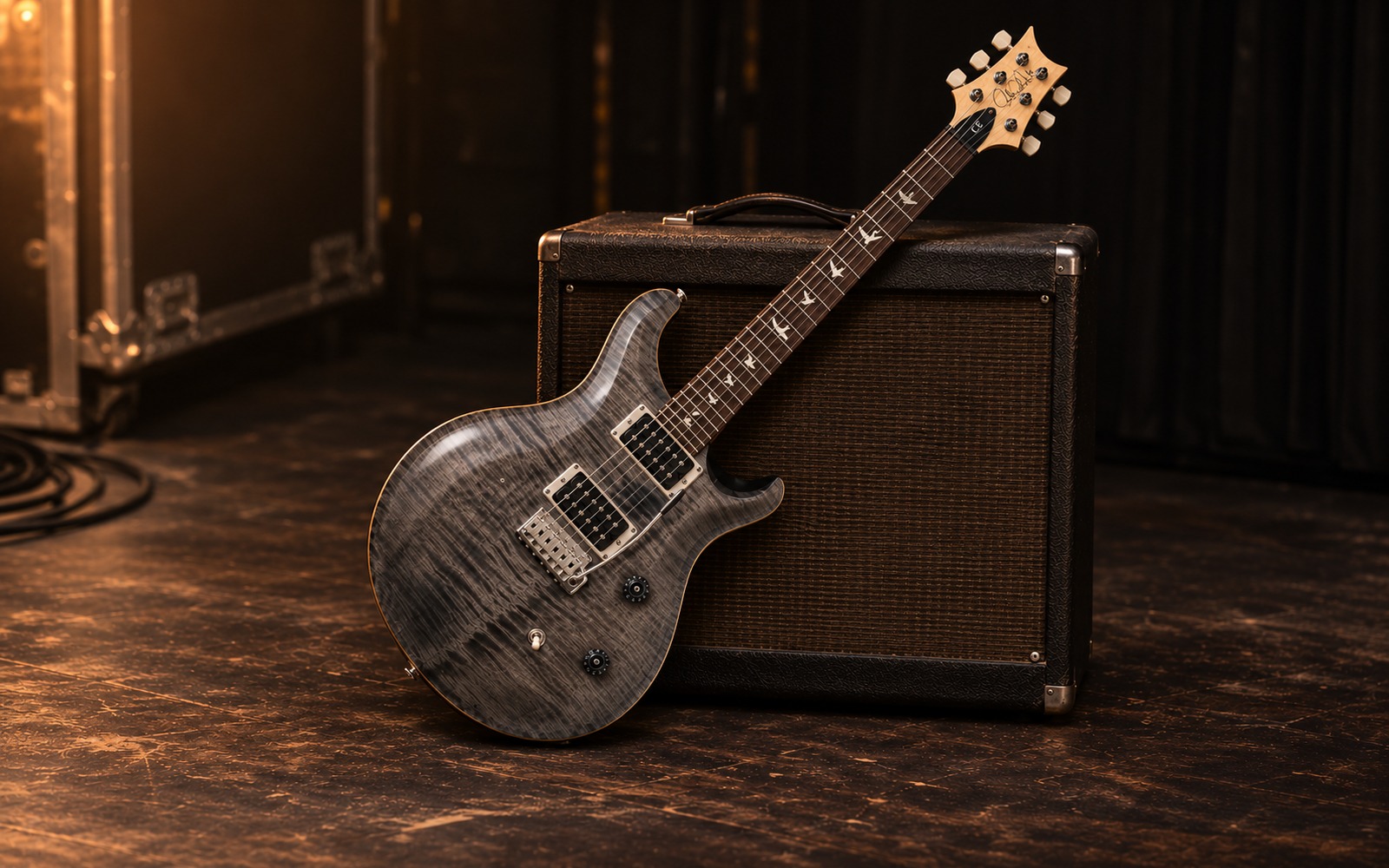
- Top image: GuitarGangsters AI-generated reference illustration, not a photograph.
- Alex Lifeson: by Raph_PH, Wikimedia Commons, CC BY 2.0.
- Brad Delson: Stefan Brending ( 2eight ), Wikimedia Commons, CC BY-SA 3.0.
- Dustie Waring: FantaLimeDrinker, Wikimedia Commons, CC0.
Latest News
Related
On This Day
Monday 9 November
From this week: