Gretsch G6118T Anniversary: The Guitar Built to Undercut Its Own Family’s Icon
The Gretsch Anniversary was built to match the 6120's spec at a lower price. Here's the real history behind this underrated hollowbody.
Search for almost any Gretsch hollowbody and you’ll find the same five names attached — Chet Atkins, Brian Setzer, George Harrison, Malcolm Young, Eddie Cochran. It’s the brand’s generic “Professional Collection” player list, and for the G6118T Anniversary it doesn’t hold up. None of these five built their signature sound on an Anniversary. Atkins and Setzer are 6120 players through and through, Harrison’s Gretsches were a Duo Jet, Tennessean, and Country Gentleman, Young’s defining instrument was a solidbody Jet Firebird, and Cochran’s orange 6120 is one of the most photographed guitars in rock history. The Anniversary’s real story isn’t about any of them — it’s about the guitar Gretsch built specifically so that everyone who couldn’t afford Chet Atkins’s name on their pickguard could still get almost everything else.
A 6120 for $165 Less
Gretsch introduced the Anniversary model in 1958 to mark the company’s 75th year in business, and the pricing decision behind it remains one of the more quietly bold moves in the brand’s history. Rather than building a stripped-down curiosity, Gretsch’s engineers specced the Anniversary almost identically to the pricier 6120 Chet Atkins Hollowbody — same body dimensions, same trestle bracing, same Filter’Tron pickups that gave the 6120 its signature twang. The differences were cosmetic and functional rather than tonal: no binding on the neck, headstock, or f-holes, no factory Bigsby, and critically, no Chet Atkins signature on the pickguard.
That last omission mattered more than it sounds. In 1958, a 6120 cost $475. The Double Anniversary — the two-pickup version most players wanted — cost $310, a genuinely enormous gap for what was, underneath the trim, essentially the same instrument. It’s not hard to understand why so many players of the era snapped up the Anniversary instead of paying the Atkins premium, and that value proposition is exactly why vintage Anniversaries remain more affordable than comparable 6120s on today’s collector market — the guitars are functionally similar, but one carries a famous name and the other doesn’t.
There was also a cheaper Single Anniversary option, priced at just $225 and equipped with only a neck pickup, aimed at buyers who wanted the Anniversary body and construction at an even steeper discount. That decision has aged unevenly: without a bridge pickup, the Single lacks the meaty, twangy voicing that many players consider the essence of “That Great Gretsch Sound,” and today it trades for roughly half what a Double commands on the vintage market. For players hunting a genuine bargain, though, that gap has created an unusual opportunity — buy an affordable vintage Single, add a bridge Filter’Tron and the extra controls to match, and the result is a period-correct 6120-alike assembled for meaningfully less than either the vintage Double or a real 6120 would cost.
The 1960 “Downgrade” That Still Divides Players
The Anniversary’s story took an unexpected turn just two years after launch. In 1960, Gretsch pulled the trestle bracing and Filter’Tron humbuckers out of both Anniversary models and replaced them with newly developed single-coil Hilo’Tron pickups — Gretsch’s own in-house design, marketed at the time with enthusiastic brochure copy promising “Full Hi-Fidelity,” “Brilliant Highs,” and “Extra Lively Response.” Most collectors and players today read this as a genuine step down rather than a refinement: Filter’Trons are widely considered the definitive Gretsch pickup, and the trestle-braced originals are the versions most sought after on the vintage market.
That said, the Hilo’Tron-equipped Anniversaries have their own committed fanbase, and the sound — brighter, airier, more hi-fi in character — genuinely suits certain styles better than a humbucker would. It’s a real fork in the Anniversary’s DNA, and it’s one Gretsch still honors today: alongside the humbucker-loaded Players Edition covered in this article, Gretsch also currently offers a G6118T-60 Vintage Select model built specifically to replicate that 1960 single-coil spec, right down to period-correct TV Jones Hilo’Tron pickups and a three-way tone switch instead of a simple tone knob.
Who Actually Reaches for One Today
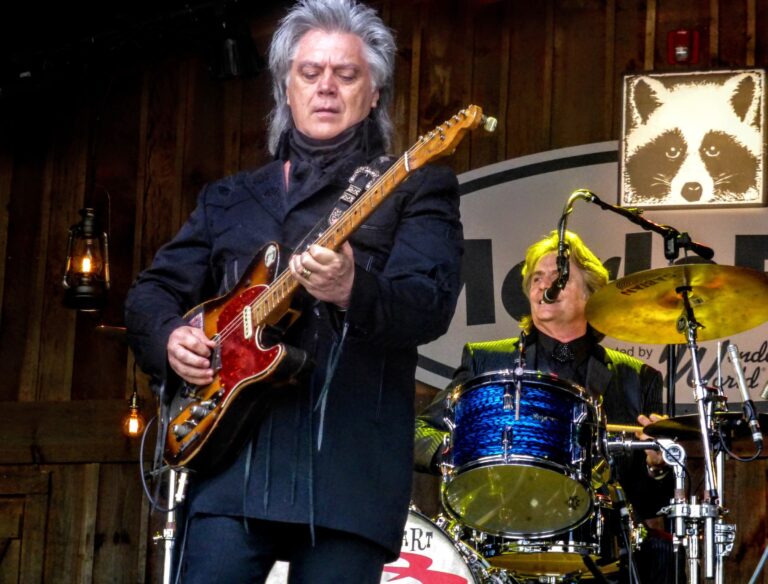
Unlike the Falcon or the 6120, the Anniversary was never built to be any single artist’s signature instrument, so there’s no equivalent to a Stephen Stills or Billy Duffy attached to it. But it’s very much still a working guitar in real musicians’ hands rather than a museum piece. Bright Eyes frontman Conor Oberst has been documented playing a 1959 Anniversary live, including a filmed 2016 Monsters of Folk performance, and singer-songwriter George Ezra bought one from a vintage shop on London’s Denmark Street and reportedly played an entire gig on it the very next day after purchase. Neither is chasing rockabilly authenticity or a Chet Atkins connection — they’re simply guitarists who found an Anniversary, liked how it played and sounded, and used it. That’s arguably closer to what the model was actually designed for in 1958: a genuinely good hollowbody for players who didn’t need — or want to pay for — a famous name on the headstock.
That lack of a single defining artist is also part of why the Anniversary has quietly stayed in continuous production, in one form or another, for well over sixty years — an unusually long run for what began as a one-time celebratory model. Without a signature player’s career trajectory to tie its relevance to, Gretsch has been free to keep reinterpreting the Anniversary purely on its own merits: reissuing the 1958-59 trestle-braced spec for purists, the 1960 single-coil spec for players chasing that airier tone, and now the Players Edition for working musicians who want vintage character with contemporary reliability. Few guitars in the Gretsch catalog have been allowed to evolve this freely, precisely because none of them were ever locked to one person’s name.
Players Edition: The Bargain Concept, Modernized
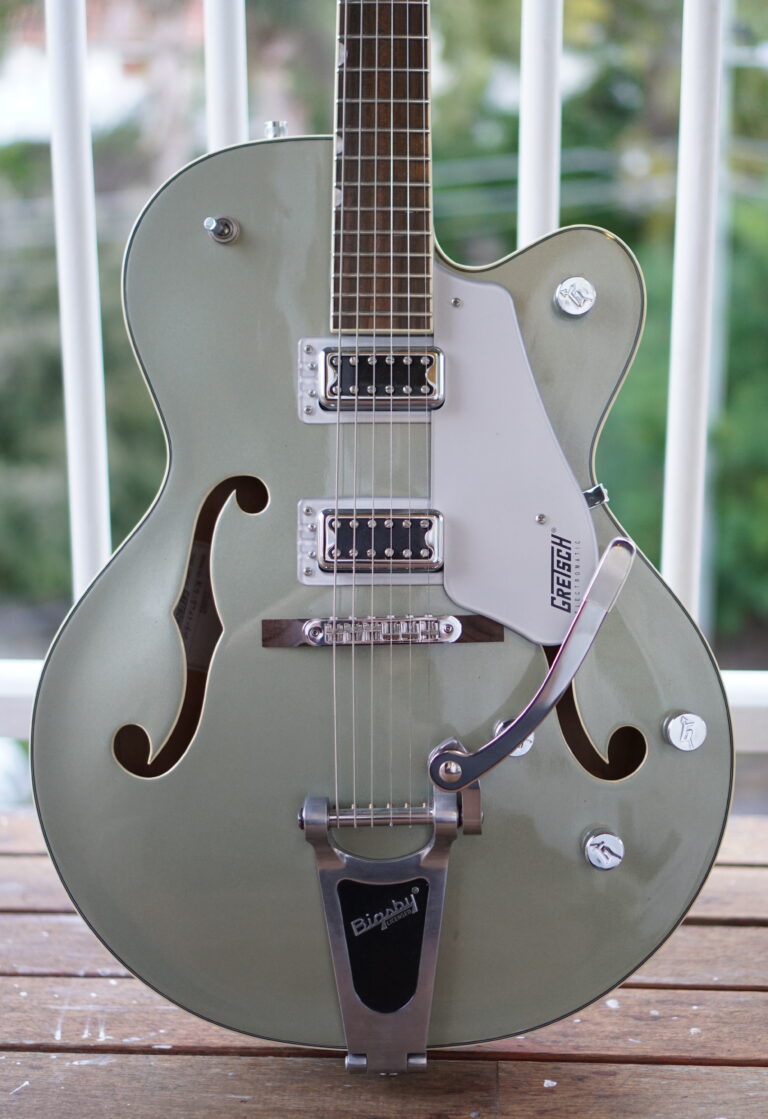
The current G6118T Players Edition Anniversary applies the same modernization playbook Gretsch has used across its Professional Collection: “ML” bracing (a lighter, more resonant evolution of the vintage trestle design), a pinned Rocking Bar bridge, a string-thru Bigsby that finally makes restringing painless, locking tuners, a Tusq XL nut, Squeezebox paper-in-oil tone capacitors, a treble-bleed circuit, a no-load tone pot, and a thinner 2.25-inch body compared to older reissues. One detailed review summed up the appeal bluntly: it’s a “workingman’s Gretsch” with genuinely useful upgrades, priced well below the equivalent 6120 or Falcon while delivering comparably serious tone and build quality.
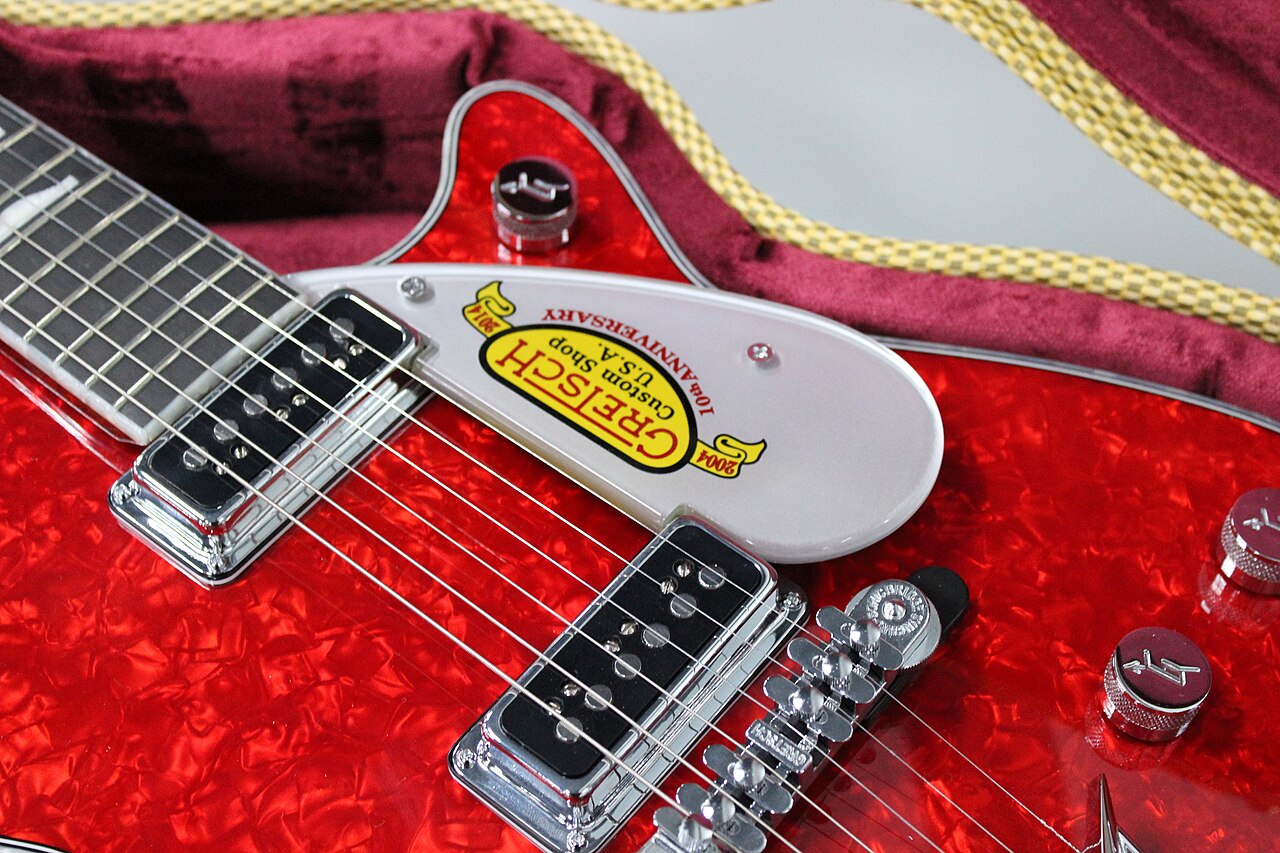
The pickups deserve particular mention. Depending on production year, the Players Edition Anniversary ships with either High Sensitive Filter’Trons or the newer FT-67 Filter’Tron design — both humbuckers, honoring the original 1958-59 spec rather than the 1960 single-coil detour. One reviewer who compared the modern Players Edition directly against a vintage 6120 conversion noted the new pickups produce a lower resonance and more natural compression than the vintage set, with a smoother overall character that suits fingerpicking particularly well — a genuinely different, not simply lesser, voicing compared to a decades-old original.
Cosmetically, the Players Edition Anniversary leans hard into the model’s original mid-century identity: nickel “G-Arrow” control knobs, aged white binding with black purfling, and a diamond-shaped anniversary head plate plaque that nods directly to the guitar’s 1958 origins. The signature Two-Tone Smoke Green finish — light minty green on top, darker olive green on the back and sides — is the color most associated with the vintage originals, though contemporary Players Edition production has also included finishes like Copper Metallic/Sahara Metallic and Lotus Ivory/Charcoal Metallic two-tone combinations, giving buyers a period-correct look without locking them into a single vintage color scheme. Limited-run anniversary editions have pushed further still, including a 140th “Double Platinum” version finished in an opulent two-tone platinum scheme with a solid Adirondack red spruce top, released to mark Gretsch’s 140th year as a company — a nice bit of symmetry, given that the entire Anniversary concept began as a birthday celebration for the brand in the first place.
Full Specifications
Tone Recipes
Classic rockabilly twang: Bridge pickup, amp on the edge of breakup, light slapback delay. The Filter’Tron voicing here leans slightly smoother and more compressed than a vintage-spec 6120, making sustained notes easier to control.
Warm fingerstyle: Neck pickup or both together, clean amp headroom, tone rolled back slightly. Reviewers specifically single out the Players Edition’s natural compression as a strength for fingerpicked material.
Singer-songwriter strum (the Oberst/Ezra approach): Both pickups, amp clean, minimal effects. A big, resonant hollowbody chord tone that doesn’t require heavy processing to sound complete on its own.
Hi-fi jangle (Vintage Select ’60 spec): Bridge Hilo’Tron single-coil, three-way tone switch set bright, clean-to-mild-breakup amp. A genuinely different character from the humbucker-loaded Players Edition — airier and more percussive.
How It Compares
Against the G6136T Players Edition Falcon, the Anniversary trades size, spectacle, and price for a more manageable, gig-friendly package that still delivers genuine Professional Collection tone and build quality. Against a 6120T-59, the historical relationship is the whole point — the Anniversary was engineered from day one to deliver nearly identical trestle-braced, Filter’Tron tone at a meaningfully lower price, a value gap that persists between the two model lines today. And against Gretsch’s own Vintage Select ’60 Anniversary, the choice comes down to pickup philosophy entirely: humbucker-driven modern Players Edition twang, or period-correct single-coil Hilo’Tron chime.
Buying Guide
- Know which era you’re buying into. Trestle-braced, Filter’Tron-equipped 1958-59 originals (and their modern Players Edition equivalents) are a fundamentally different guitar from 1960-and-later single-coil Hilo’Tron examples — decide which tonal character you actually want before shopping vintage or reissue.
- Single vs. Double Anniversary (vintage shopping): The vintage Single Anniversary lacks a bridge pickup entirely, which most players find limits its versatility significantly compared to the two-pickup Double — factor that into any vintage purchase.
- String-Thru Bigsby is a genuine quality-of-life upgrade. If you’ve restrung a vintage Gretsch Bigsby before, the modern Players Edition’s threaded string-thru bar is a meaningful improvement worth paying for.
- Compare against a 6120 before committing. If your budget stretches to both, play them side by side — the tonal gap is smaller than the price gap, but it’s not zero.
Ownership Notes
Owners consistently praise the Players Edition’s playability improvements — locking tuners, a slicker Tusq nut, and the string-thru Bigsby all reduce the maintenance friction that put some players off vintage-spec Gretsch hollowbodies in the past. The most common critique across reviews is a need for a treble boost or EQ nudge to get the fullest “true twang” character some players expect from the Gretsch name, a byproduct of the smoother, more compressed voicing of the modern Filter’Tron sets compared to a well-worn vintage original.
Frequently Asked Questions
Was the Anniversary really just a cheaper 6120?
Functionally, yes, for its first two years. The 1958-59 Anniversary shared the 6120’s body, trestle bracing, and Filter’Tron pickups, lacking only binding, a stock Bigsby, and Chet Atkins’s name.
What changed in 1960?
Gretsch replaced the trestle bracing and Filter’Tron humbuckers with newly developed Hilo’Tron single-coil pickups — a change most collectors consider a downgrade, though the resulting tone has its own dedicated following.
Where is the modern G6118T made?
Japan, as part of Gretsch’s Professional Collection.
Does any well-known musician actually play one?
The Anniversary was never built around a single signature artist. Modern documented players include Bright Eyes’ Conor Oberst and singer-songwriter George Ezra, both photographed and filmed using vintage examples.
Is it a good alternative to a 6120?
That was its original design purpose in 1958, and the modern Players Edition carries the same value proposition forward — comparable Professional Collection tone and build quality at a meaningfully lower price.
Image credits
- A Gretsch Custom Shop 10th Anniversary Duo Jet in its case: Peter VanLane, Wikimedia Commons, CC BY 2.0.
Latest News
Related
On This Day
Tuesday 10 November
From this week: