Gretsch G5230T Electromatic Jet: The Honest Budget Jet Nobody Famous Plays
No famous player, no myth — just the Gretsch Jet look and Filter'Tron chime at a budget price. Full specs, tone recipes, and buying guide for the G5230T.
Chet Atkins, Brian Setzer, George Harrison, Malcolm Young, and Eddie Cochran did not play a Gretsch G5230T Electromatic Jet. They couldn’t have. This guitar didn’t exist until 2021, decades after every one of those five had already built their entire reputations on other Gretsch models costing four to five times as much. That’s not a knock on the G5230T — it’s actually the most interesting thing about it. This is a guitar that inherits the Jet shape, the Filter’Tron sound, and the Bigsby swagger without inheriting a single one of the artist stories that usually come attached to that recipe. No famous name, no myth. Just the “great Gretsch sound” at a fraction of the price, sold entirely on its own merits.
A Budget Jet With No Borrowed History
Gretsch’s Jet family has been in continuous production since 1953, and by the time the G5230T arrived on the scene, that lineage already had its icons locked in: George Harrison’s 1957 Duo Jet, Malcolm Young’s stripped-down orange Jet Firebird, the entire Setzer/Cochran/Atkins constellation orbiting the 6120. All of those guitars live in Gretsch’s Japanese-built Professional Collection, priced well north of $2,000. The G5230T Electromatic Jet occupies an entirely different part of the catalog — the Electromatic tier, Gretsch’s mid-priced import line, sitting above the entry-level Streamliner series but well below the Professional Collection.
Added to the Electromatic lineup in 2021, the G5230T takes the Jet’s single-cutaway silhouette and chambered-body construction and rebuilds it at a street price around $650–$750. It shares its general shape and DNA with the George Harrison-associated Duo Jet lineage and the Malcolm Young-adjacent Jet Firebird, but it isn’t a reissue of either. It’s a new, ground-up design built to hit a price point those historic guitars were never meant to touch. Chet Atkins and Brian Setzer‘s names belong to the 6120 side of the Gretsch story, not this one; Eddie Cochran’s orange 6120 and Harrison’s black Duo Jet are museum pieces compared to this guitar’s very modern, very practical mission.
The guitar also ships in multiple sub-variants that get confused with each other online: the standard G5230T Electromatic Jet with Black Top Filter’Tron pickups, the G5230T Electromatic Jet FT (a near-identical spec sold under a slightly different naming convention depending on market and year), and the flashier G5230T Electromatic Sparkle Jet FT with silver or gold sparkle finishes and FT-5E Filter’Tron pickups. All three share the same core chambered-mahogany architecture; the differences are cosmetic and pickup-specific rather than structural.
This is part of a deliberate strategy on Gretsch’s part rather than an accident of production. As one reviewer put it, a major strength of the modern Gretsch lineup is having a guitar at every budget: entry-level Streamliner models built in Indonesia, mid-tier Electromatic guitars like the G5230T built primarily in China, and the Professional Collection built in Japan for players who want the closest thing to a vintage-spec instrument. The G5230T’s job within that structure isn’t to compete with the Duo Jet on prestige. It’s to get the Jet shape, the chambered resonance, and a genuinely credible version of the Filter’Tron sound into the hands of players who would otherwise never own a Gretsch at all.
Full Specifications
| Spec | Details |
|---|---|
| Body | Chambered mahogany with maple top, single-cutaway |
| Neck | Set mahogany neck, “Thin U” profile |
| Scale length | 24.6″ |
| Fingerboard | Laurel, 12″ radius, 22 medium jumbo frets |
| Inlays | Neo-Classic thumbnail |
| Nut width | 1.6875″ |
| Pickups | 2x Black Top Filter’Tron humbuckers (Sparkle Jet variant uses FT-5E Filter’Trons) |
| Controls | Individual pickup volumes, master volume with treble bleed circuit, master tone, 3-way toggle |
| Bridge/Tailpiece | Bigsby B50 vibrato with anchored Adjusto-Matic bridge |
| Hardware finish | Chrome |
| Weight | Approx. 8.0–8.5 lbs |
| Country of origin | China (Electromatic tier) |
| Street price | Approx. $649–$749 |
Construction and Tone: Filter’Tron on a Budget
The G5230T’s chambered mahogany body with a maple top is a direct, honest inheritance from the Duo Jet blueprint — routed internal cavities under a glued arched top, delivering resonance and reduced weight compared to a true slab solidbody. Reviewers consistently note that the guitar feels lighter than expected for its size, and one long-term owner directly compared it favorably to a Fender Stratocaster in overall heft.
The Black Top Filter’Tron pickups are the real story here. They’re not the vintage-spec Filter’Trons found on Professional Collection guitars, and they’re not the TV Jones units found on Vintage Select reissues — but reviewers who’ve spent real time with both describe the Electromatic pickups as landing somewhere around 70–80% of the way to that “real deal” TV Jones sound, at a fraction of the cost. One detailed review called the result “a deep twangy clean sound” with genuine crossover potential into punk and shoegaze territory, well beyond the rockabilly and classic rock context Gretsch built its reputation on. The individual pickup volume controls plus a treble-bleed master volume circuit give unusually granular tone-shaping for a guitar at this price, particularly useful in the middle pickup-selector position where you can blend bridge and neck output independently.
The Sparkle Jet FT variant swaps in FT-5E Filter’Trons, which MusicRadar’s reviewer found delivered a comparable but slightly different flavor of that classic Gretsch chime, wrapped in a considerably more eye-catching silver or gold sparkle finish.
Famous Players: An Honest “No”
For the G5230T, there simply isn’t a verified artist to name. No widely recognized touring or recording artist has a documented, verifiable connection to this specific model. That’s not a failure of research — it’s a structural fact about where this guitar sits in Gretsch’s lineup. The five names on the standard list all built their Gretsch identities on instruments this guitar was never designed to replace:
- George Harrison is inseparable from his 1957 Duo Jet, a Japanese Professional Collection instrument in a completely different price bracket.
- Brian Setzer built his sound around a 1959 6120 bought for $100 in the classifieds, decades before the Electromatic tier existed in its current form.
- Chet Atkins‘s entire Gretsch relationship runs through the 6120 and Country Gentleman he helped design starting in 1954.
- Malcolm Young‘s stripped-down 1963 Jet Firebird, a gift from his brother George, is a completely different model with its own signature descendants.
- Eddie Cochran played exclusively orange 6120s throughout his short, hugely influential career.
None of them has been photographed, filmed, or credibly reported playing a G5230T, and there’s a simple reason why: it wasn’t invented yet. Rather than force a connection that doesn’t exist, the honest framing is this: the G5230T is a workhorse gateway guitar, bought by gigging musicians and bedroom players who want the Jet silhouette and Filter’Tron chime without the Professional Collection price tag. That’s a legitimate story on its own — just not one built around a famous name.
Tone Recipes
Classic rockabilly slap-back: both pickups blended via the 3-way switch, amp volume pushed to the edge of breakup, slap-back delay around 100ms, palm-muted low strings for percussive attack.
Clean British Invasion jangle: neck pickup solo, tone rolled back slightly, into a clean Fender Deluxe Reverb-style amp with light spring reverb.
Punk and garage crunch: bridge pickup, amp gain pushed hard or paired with an Ibanez TS9 Tube Screamer for extra midrange bite — the Black Top Filter’Trons hold their clarity even under heavy drive.
Shoegaze/atmospheric wash: both pickups combined, tone rolled to around 4, into a reverb-heavy clean platform with a chorus or modulation pedal layered on top.
How the G5230T Compares
Against the Gretsch G6128T Duo Jet, the historical guitar this model visually echoes, the G5230T offers roughly a quarter of the price in exchange for Chinese assembly, Black Top rather than High Sensitive Filter’Tron pickups, and a nut width slightly narrower at 1.6875″ versus the Duo Jet’s 1.688″ — nearly identical on paper, but the fit, finish, and pickup voicing separate the two tiers noticeably in person. Against the Gretsch G5420T Electromatic Classic Hollow Body, the comparison is more about body type than price: the G5420T is a true hollow body built in Korea, while the G5230T is a chambered solidbody built in China, giving the G5230T a tighter, more controlled low end and better resistance to feedback at higher gain. Against a budget solidbody rival like the Gibson Les Paul Standard‘s entry-level Studio-tier cousins, the G5230T wins on personality and Bigsby-equipped vibrato flexibility, while a Les Paul-style guitar wins on raw sustain and mainstream rock familiarity.
Buying Guide
- Standard vs. Sparkle Jet: choose the standard Black Top Filter’Tron model for a more classic, understated look and slightly punchier low end; choose the Sparkle Jet FT for a more eye-catching stage presence and FT-5E pickups.
- Filter’Tron vs. Broad’Tron sibling: if you find yourself comparing the G5230T against the Broad’Tron-equipped G5220 Electromatic Jet BT, know that you’re choosing between two different pickup philosophies, not just two colorways — Broad’Trons run hotter and push harder into overdrive, while the G5230T’s Filter’Trons stay closer to the classic, cleaner Gretsch chime with a Bigsby’s added vibrato flexibility.
- Check the country of manufacture: Electromatic-tier Gretsch guitars have been built across China, Korea, and Indonesia depending on the specific model and production era — don’t assume every Electromatic shares the same factory, and check the label on any used example before buying.
- Bigsby setup matters: as with all Bigsby-equipped Gretsches, most tuning complaints trace back to nut friction and string break angle rather than the vibrato unit itself. Budget for a proper setup if buying new.
- Used market: because this is a budget-tier guitar without collector demand, used prices drop significantly below retail — a well-cared-for used example can be a genuine bargain.
The Electromatic Jet Family: More Than One Guitar Wears This Name
The G5230T is one branch of a wider Electromatic Jet family that’s easy to confuse from the outside. The G5220 Electromatic Jet BT swaps the Filter’Tron pickups for a pair of Black Top Broad’Tron humbuckers — hotter output, more aggressive overdrive character, and a simpler V-Stoptail bridge instead of a Bigsby, which trades vibrato flexibility for tuning stability. Guitar World’s review of the G5220 praised its Broad’Tron pickups for balancing PAF-like output with real definition, while noting the Electromatic tier as a whole undercuts even Gretsch’s own value proposition against rivals like Epiphone and Fender’s Player Plus line. Step down further and you’ll find the G5222 Electromatic Double Jet and G5232T Electromatic Double Jet FT, which move to a double-cutaway body shape with Neo-Classic inlays (versus the single-cut’s Big Block inlays) while keeping the same chambered mahogany construction. All of these guitars, including the G5230T, share a common Thin U neck profile and laurel fingerboard across the range — genuinely consistent playability even as the pickups and bridge hardware shift model to model.
Why This List Keeps Getting Recycled
It’s worth asking why a generic Atkins/Setzer/Harrison/Young/Cochran list keeps attaching itself to Gretsch solidbodies regardless of tier or price. The answer is straightforward: those five names are so definitional to the Gretsch brand as a whole — Atkins effectively co-designed the company’s modern electric guitar identity in 1954, and the other four built entire careers on Jet and 6120-family instruments — that generic content templates default to them any time “Gretsch” and “solidbody” appear in the same product row. It’s a reasonable shortcut for a $3,000 Professional Collection reissue built to replicate their exact specifications. It’s simply the wrong shortcut for a $650 guitar built fourteen years after the youngest of those five artists released a note of new music. The lesson for any buyer comparing marketing copy across the Gretsch catalog: brand-level heritage claims and model-specific player claims are not the same thing, and it pays to know which one you’re reading.
Practical Ownership Notes
The chambered mahogany body is more humidity-sensitive than a true solidbody, so treat it with the same storage care you’d give a semi-hollow guitar. The master volume’s treble-bleed circuit means you can roll back volume without losing high-end sparkle, which is worth exploring rather than leaving the volume knob permanently maxed out. Owners report the pot response on some units rolls off faster than expected near the bottom of its range — worth checking during setup, and easily addressed with a pot swap if it bothers you. If you’re chasing a more vintage-accurate Filter’Tron voice down the line, the Black Top pickups are a common and relatively affordable upgrade target for players who outgrow the stock tone.
FAQ
Did any famous guitarist actually play the Gretsch G5230T?
No widely recognized artist has a documented connection to this specific model. It was introduced in 2021, long after the guitarists commonly associated with Gretsch Jets had already built their reputations on other, pricier models.
Is the G5230T the same as a Duo Jet?
No. It shares the Jet family’s single-cutaway shape and chambered construction, but it’s a separate, budget-tier Electromatic design with different pickups, hardware, and country of manufacture than the Japanese-built Professional Collection Duo Jet.
What’s the difference between the G5230T and the Sparkle Jet FT version?
Primarily cosmetic and pickup-specific: the Sparkle Jet FT uses FT-5E Filter’Tron pickups and comes in silver or gold sparkle finishes, while the standard G5230T uses Black Top Filter’Trons in more conventional finishes.
Is the G5230T good for beginners?
Yes. Reviewers consistently note its comfortable neck profile, manageable weight, and well-executed fit and finish make it approachable for newer players while still offering enough tonal depth for more experienced guitarists.
Where is the G5230T made?
China, as part of Gretsch’s Electromatic tier, which sits between the entry-level Indonesian-built Streamliner series and the premium Japanese-built Professional Collection.
Image credits
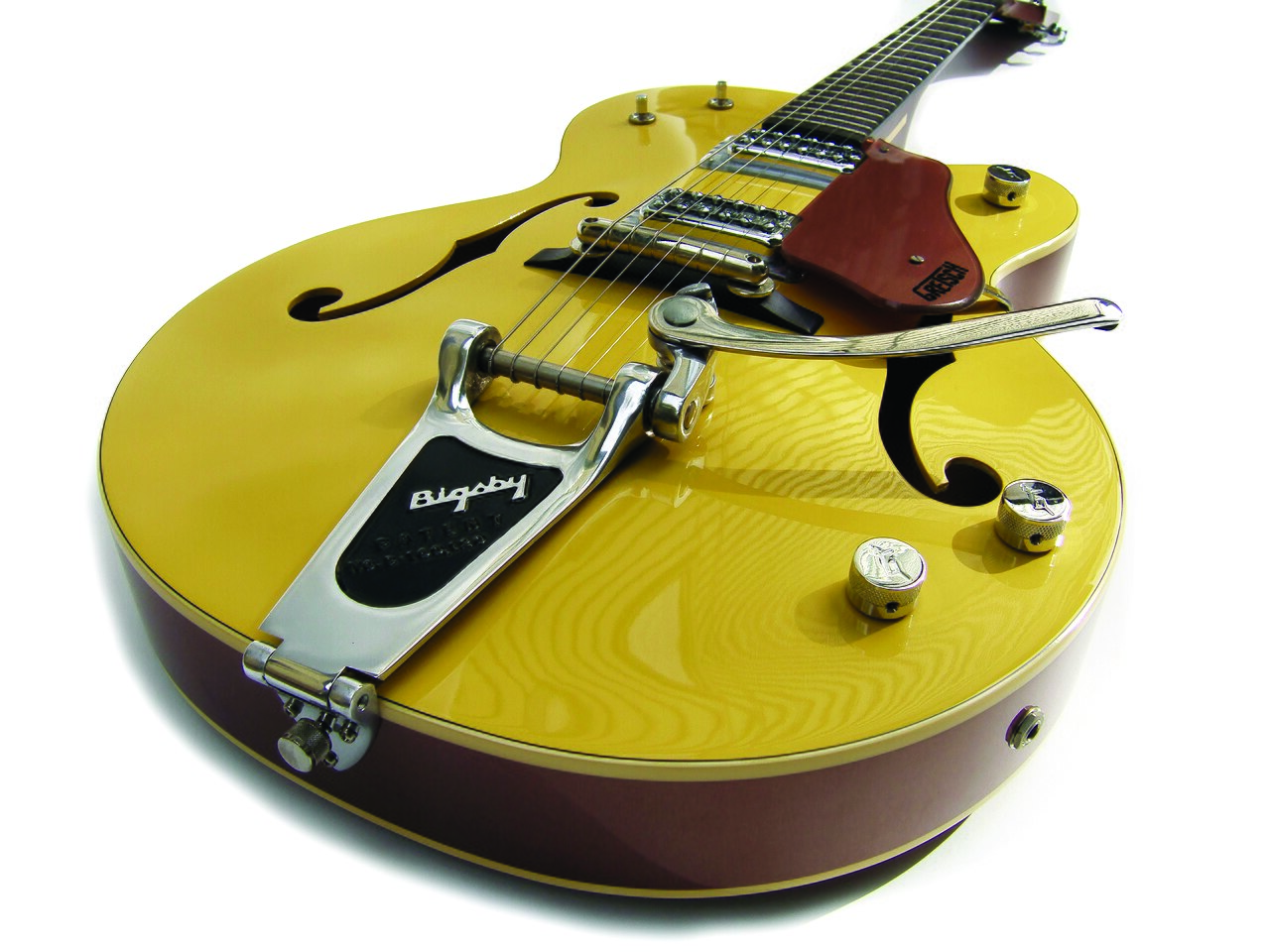
- A Gretsch hollow body guitar with a Bigsby tailpiece: irish10567 from Little Falls, NJ, USA, Wikimedia Commons, CC BY 2.0.
Latest News
Related

On This Day
Tuesday 10 November
From this week: