Jackson Pro Series Rhoads RR24: The Guitar Its Namesake Never Got to Approve
Randy Rhoads died before Jackson finished the guitar bearing his name. Here's the real history behind the Pro Series RR24 and its signature descendants.
Randy Rhoads never played this guitar, never approved its final design, and died before Jackson could even show him the finished production version. Everything sold under his name since 1983 has been an educated reconstruction of what he was working toward, not a guitar he ever held.
That distinction matters more here than almost anywhere else. Most signature guitars are, by definition, built to an artist’s own specifications and then approved by that artist before going to market. The Rhoads V broke that chain halfway through, which makes it one of the only genuinely famous “signature” shapes in the entire guitar industry that its own namesake never got to sign off on.
The Napkin Sketch That Started It All
Before Jackson: The Sandoval V
Rhoads’ first custom V-shaped guitar wasn’t a Jackson at all. Luthier Karl Sandoval, working out of the same Charvel-adjacent Southern California scene that also produced Eddie Van Halen’s Frankenstrat parts, built Rhoads a polka-dot Flying V hybrid in 1979, completed right around the time Rhoads left Quiet Riot to join Ozzy Osbourne’s new solo band. That guitar toured Europe with Ozzy through 1980, photographed extensively by the European press, before Sandoval left the Charvel orbit to run his own shop — which is what sent Rhoads looking elsewhere for his next custom build. Before either of these instruments, Rhoads had built his early reputation almost entirely on a cream-colored Gibson Les Paul Custom, which remained his primary studio guitar even after the V-shaped instruments entered the picture; the Jackson prototypes were built to supplement his live rig, not to replace the Gibson outright.
December 23, 1980
Flying home from that UK tour for Christmas, Rhoads had time to sketch out an idea: an asymmetrical, sharper-edged variation on the Flying V shape, inspired by nothing more specific than a general sense that he wanted something more radical. On December 23, 1980, he brought those rough drawings to Grover Jackson, who had recently taken over the Charvel workshop in San Dimas, California, after Karl Sandoval’s departure. Working with builders Tim Wilson and Mike Shannon, Jackson and Rhoads spent the day refining the concept into a real design. Rhoads named the resulting guitar the Concorde, after the supersonic jet he’d flown home on — the white, pinstriped prototype that would become the template for every Jackson Rhoads guitar sold since.
Why It Says “Jackson,” Not “Charvel”
Grover Jackson had genuine reservations about the design. Charvel’s reputation at the time was built on bolt-on-neck superstrats in the Van Halen mold — conventional, if hot-rodded, Fender-style guitars. An asymmetrical, batwing-shaped neck-through instrument was a significant departure, and Jackson worried it might alienate Charvel’s existing customer base if it flopped. His solution was to put a different name on the headstock entirely, so that if the radical design didn’t land, it wouldn’t reflect on Charvel’s bread-and-butter business. That decision — made purely as a hedge against commercial risk — is the reason the Jackson brand exists at all.
Getting It Right Took Two More Guitars
The first Concorde prototype shipped to Rhoads in Europe in early 1981, built from a maple body and neck that Rhoads found both too heavy and too large — he reported difficulty reaching the upper register, and worse, fans kept asking if he’d simply cut up a Gibson Flying V, which wasn’t the reaction he wanted. Rhoads and Jackson met again in October 1981 to sharpen the design further: a narrower, more angular V, with the top horn extended even further to distinguish it unmistakably from Gibson’s shape, plus the shark fin fretboard inlays that would become a permanent signature feature. Rhoads took delivery of this second prototype, in black with gold hardware, on December 27, 1981. Three months later, on March 19, 1982, Rhoads died in a plane crash during a tour stop in Florida. He was 25. Jackson had already cut the parts for a third, further-refined prototype, waiting for Rhoads to come off tour and give final feedback — feedback that never came. Those unfinished pieces sat in storage for over a year before eventually surfacing as what collectors now call the RR3 prototype, a genuine missing link between Rhoads’ input and the guitar that would go into mass production without him.
A Signature Model Its Namesake Never Signed Off On
This is the detail that separates the Rhoads line from almost every other signature guitar in Jackson’s catalog, or in this entire project: it isn’t really a signature model in the traditional sense, because Rhoads was never alive to approve the guitar that eventually carried his name into production. Jackson began building Rhoads models commercially in 1983, a year after his death, working from the design direction established across those three prototypes. The first professional guitarist to receive one of these early production Rhoads guitars was, unexpectedly, Vinnie Vincent — formerly of KISS — who played a Jackson Rhoads throughout the Creatures of the Night and Lick It Up tours between 1982 and 1984, well before the shape had become synonymous with the metal genre it would eventually come to define. Vincent later modified the concept further himself, adding a second, slightly rotated V shadowing the first.
The Signature Descendants: Real Artists, Real Guitars
Where the Rhoads shape gets genuinely interesting is what happened after it became an established platform rather than a single artist’s custom instrument. Unlike the Soloist or Dinky shapes — where famous names kept surfacing on the wrong guitar — the Rhoads V has spawned an unusually direct family of its own signature spinoffs, each one a real, verifiable connection to a real player.
Alexi Laiho and Roope Latvala of the Finnish bands Children of Bodom and Sinergy received a joint custom Rhoads model in 2001 — an alder-bodied, neck-through, 24-fret guitar with ebony fretboard and gold hardware, officially designated the Rhoads L/L. Laiho’s version, finished black with yellow bevels, became one of the most recognizable Rhoads variants of the 2000s outside of the original Ozzy-era guitars themselves, and Jackson later released a limited run of the standard RR24 in that same black-with-yellow-highlights scheme as a tribute. Their design work directly shaped later production Rhoads models.
More recently, and more directly tied to the exact model this article covers, Gojira’s Christian Andreu received his own Jackson Pro Plus Series signature guitar built explicitly on the RR24 platform — the Rhoads RR24 EVTN6, which takes the standard RR24’s body and neck-through construction and adds an Evertune constant-tension bridge, a single Fishman humbucker voiced for modern metal, and stainless steel frets. It’s about as direct a connection as any in the Jackson catalog: an artist’s actual signature model literally carries the RR24 name inside its own model designation.
Beyond those two, the broader Rhoads family tree includes several other confirmed long-term players: Phil Campbell, Motörhead’s guitarist for over three decades, has played Jackson Rhoads models throughout his career (his fuller gear history lives on his own guide). Phil Demmel of Machine Head — who also has his own Jackson signature V, the Demmelition — cut his teeth on Rhoads-shaped instruments before that signature deal (see his gear guide for the full story). Corey Beaulieu of Trivium is a longtime Jackson Rhoads player as well, documented on his own page. Matthew Tuck of Bullet For My Valentine has likewise played Rhoads-shaped Jacksons alongside his own signature model, though no dedicated page exists for him in this database yet. And Vinnie Vincent’s foundational role — the first guitarist to actually gig on a production Rhoads, years before Randy’s shape became metal shorthand — is covered on his gear guide.
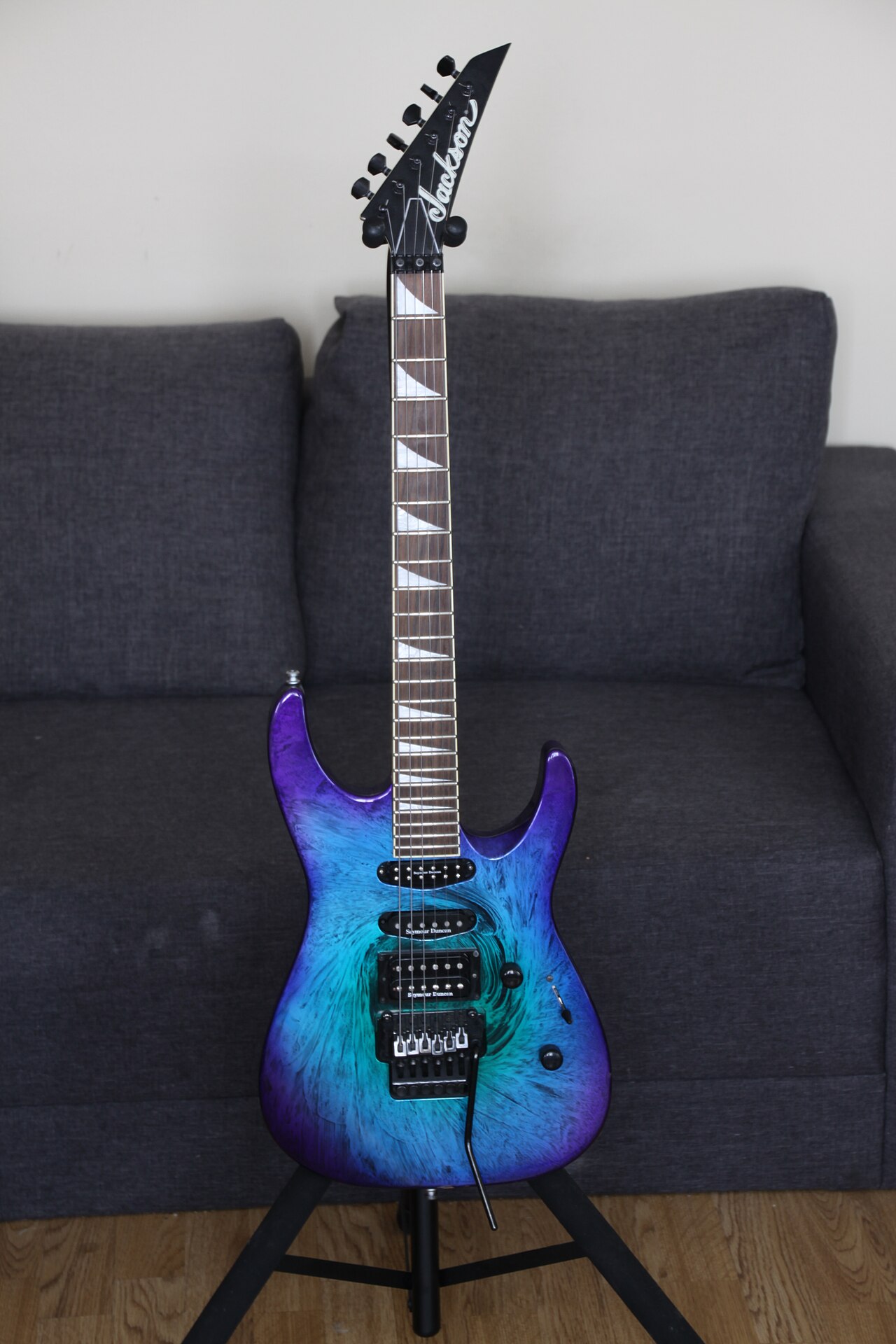
What ties this whole roster together is genre range rather than a single sound: Motörhead’s rock-and-roll boogie, Machine Head and Trivium’s groove-and-thrash-inflected metal, Gojira’s technical, environmentally-themed extreme metal, and Bullet For My Valentine’s metalcore all found a home in the same silhouette. That’s a wider stylistic spread than most single guitar shapes manage to attract, and it’s a reasonably strong argument that the Rhoads V’s appeal has long since outgrown any single genre or era — it became a blank canvas for aggressive rock guitar broadly, rather than staying tied to the neoclassical, Ozzy-era sound Rhoads himself actually played.
Construction: What the Pro Series RR24 Actually Is
The current Pro Series RR24 sits in the middle of Jackson’s now-sprawling Rhoads catalog — above the entry-level JS30RR and below the USA Select RR1 — and it inherits the neck-through construction that Rhoads himself insisted on for his second prototype. Jackson’s own spec sheets describe a one-piece maple neck running the full length of the body, reinforced with graphite rods and finished in a hand-rubbed oil that avoids the tackiness of gloss lacquer, joined to a body built from mahogany with an ash top on certain finishes (older Pro Series runs from the 2000s used solid alder instead — a spec change worth knowing if you’re comparing guitars from different years). The neck also carries a wrap-around comfort heel, a detail borrowed from Jackson’s Soloist line, aimed at making the upper frets genuinely reachable despite the guitar’s dramatic body silhouette. The fretboard is ebony, with a 12″-to-16″ compound radius, 24 jumbo frets, and the now-iconic Alumiloid shark fin position markers alongside Luminlay side dots for stage visibility.
Hardware includes a recessed Floyd Rose FRT-O2000 double-locking tremolo, a Floyd Rose R3 locking nut at 42.8mm, and Jackson sealed die-cast tuners. Electronics have shifted over the years: some editions ship with a single EMG 81 humbucker in a nod to the stripped-down simplicity of Rhoads’ actual touring rig, while the current standard configuration pairs a Seymour Duncan TB-6 Distortion (bridge) with an SH-6N Distortion (neck), run through a three-way blade switch with master volume and tone. Finish options run from Natural Mahogany with gold hardware to Charcoal Gray with black hardware and white body, neck, and headstock binding throughout. New units typically run $1,300–1,400, positioning the RR24 as roughly four times the price of the entry-level JS30RR and a fraction of the cost of the USA Select RR1.
Family Tree: A Catalog of Its Own
Few shapes have generated as many production tiers as the Rhoads V. At the top sits the USA Select RR1, hand-built with premium appointments and finishes like Graveyard, Snakeskin, and Pile O’ Skulls. The Pro Series covers the RR24 (this article’s model), the RR24Q (quilted maple top variant), and older Japan-built RR24M editions before production shifted to Indonesia. Below that, the RR3 uses a bolt-on maple neck with a rosewood fretboard and 22 frets rather than 24, paired with a licensed Floyd Rose rather than an Original — a genuinely different, more affordable build than its neck-through siblings. The RR5 splits the difference: neck-through construction like the RR24, but with a fixed bridge and rosewood board rather than ebony. Jackson’s newer Concept Series has produced premium variants like the RR24 HS (humbucker/single-coil hybrid pickup layout) and even a 7-string RR24-7, while the Pro Plus Series has introduced striking cosmetic runs like the RR24 Mirror, with a mirrored top and stainless steel frets. At the very entry level sit the JS30RR and the child-sized Minion RR, proving the shape scales all the way from a beginner’s first guitar to a Custom Shop museum piece. Jackson has stated the current catalog includes roughly a dozen distinct Rhoads models running simultaneously — an unusually large family for a single guitar shape.
Rhoads V vs. King V: Two Different Metal Silhouettes
It’s worth distinguishing the Rhoads shape from Jackson’s other V-bodied instrument, the King V. The Rhoads is deliberately asymmetrical — its whole design point was to look nothing like a traditional, symmetrical Flying V, per Rhoads’ own frustration with fans assuming he’d modified a Gibson. The King V, by contrast, keeps a more balanced, symmetrical V profile closer to Gibson’s original shape, just executed with Jackson’s own construction standards and hardware. Both trace back to the same late-1970s/early-1980s California custom shop scene, but they solve the “V-shaped metal guitar” problem in visibly different ways, and the artists who’ve gravitated to each shape tend to reflect that difference in stage presence and playing style.
Tone Recipes
Classic Ozzy-Era Voicing: Bridge humbucker (EMG 81 on equipped models, TB-6 on standard editions), moderate-to-high gain through a Marshall-style plexi tone, minimal effects — Rhoads’ own recorded tone leaned on amp saturation and a clean signal chain rather than pedal stacking.
Modern High-Gain Rhythm: Bridge pickup, high-gain amp or boosted front end, tight noise gate, mids pushed for palm-muted definition — the setting that suits the Gojira/Andreu end of this guitar’s family tree.
Neoclassical Lead: Neck pickup (SH-6N), moderate gain backed off from full saturation, and a focus on picking dynamics over sustain — Rhoads’ classically-trained phrasing came through most clearly on cleaner, more articulate settings, a detail often lost under the guitar’s aggressive visual reputation.
Buying Guide & Known Issues
The V shape itself comes with a practical trade-off that every review of every Rhoads model mentions: it’s genuinely difficult to play sitting down, since the body has no lower bout to rest against a thigh. This isn’t a manufacturing defect, just an inherent property of the design that’s worth knowing before buying if most of your playing happens seated. Reviewers consistently praise the neck-through models’ upper-fret access and sustain, along with excellent factory setup and fretwork across recent Pro Series and Pro Plus runs. Body wood and pickup configuration have both shifted meaningfully across production years and price points — Pro Series RR24s from the 2000s used alder bodies and sometimes a single EMG 81, while current editions typically use mahogany-with-ash-top construction and dual Seymour Duncans — so it’s worth confirming exactly which era and configuration you’re looking at before buying used, particularly if you’re chasing a specific tone. Owners on long-running forums and retailer review pages consistently rate the compound-radius ebony fretboard and shark fin inlays as standout details even among players who otherwise prefer more conventional guitar shapes. One long-tenured owner review put it bluntly: the single-pickup EMG-equipped versions get dismissed by shoppers who assume one humbucker means limited output, when in practice the EMG 81’s hot signal covers rhythm and lead duties without needing a second pickup at all — a detail worth knowing if you come across an older single-humbucker RR24 and assume it’s underspecced next to the current dual-pickup standard.
Frequently Asked Questions
Did Randy Rhoads actually play the RR24?
No. Rhoads died in 1982, a year before Jackson began commercial production of guitars bearing his name. The RR24 and every other production Rhoads model are built from the design direction established across his prototypes, not a guitar he personally played or approved in final form.
What’s the difference between the RR24 and the RR3?
The RR3 uses a bolt-on neck, a rosewood fretboard, 22 frets, and a licensed Floyd Rose tremolo — a more affordable build. The RR24 (and RR5) use neck-through construction, an ebony fretboard, and 24 frets, positioning them higher in Jackson’s lineup.
Who is the guitar’s most direct modern signature connection?
Gojira’s Christian Andreu, whose Pro Plus Series signature model is explicitly built on the RR24 platform and carries the RR24 designation in its own model name.
Why is it called the “Concorde” in some historical accounts?
Concorde was Rhoads’ own working name for the design, chosen after he flew home from a UK tour aboard the supersonic aircraft of the same name. The guitar became known as the Randy Rhoads model only after his death, once it entered commercial production.
Image credits
- A Jackson PC-1 guitar in Chlorine Blue: ArtBrom, Wikimedia Commons, CC BY-SA 2.0.
- A Jackson Dinky guitar on a stand: Styroks, Wikimedia Commons, CC BY-SA 4.0.
Latest News
Related
On This Day
Thursday 12 November
From this week: