Jackson Pro Series Dinky DK2QM: The Body Shape Three Icons Share
The Jackson Dinky DK2QM shares its bolt-on shape with Phil Collen's PC1, Adrian Smith's San Dimas Dinky, and Misha Mansoor's Juggernaut. Here's the history.
Def Leppard’s Phil Collen, Iron Maiden’s Adrian Smith, and Periphery’s Misha Mansoor have almost nothing in common on paper. One built his career on glammed-up ’80s arena rock, one has spent four decades in one of the most enduring NWOBHM bands on Earth, and one basically invented djent from a bedroom studio in Maryland. But strip away the eras and the genres, and all three have built a version of their own signature guitar on the exact same bolt-on body shape: the Jackson Dinky. The Pro Series Dinky DK2QM is the mass-production, Indonesia-built descendant of that shape — and understanding why three such different players gravitated toward it tells you more about this guitar than any spec sheet could.
Before There Was a “Q” or an “M”: The Dinky’s Real Origin Story
Jackson’s Superstrat lineage runs through two parallel tracks that started life almost identically and then split on a single construction detail. The Soloist arrived first, debuting in prototype form in the early 1980s and reaching production by 1984, built with a maple neck-through-body design that gave it long sustain and a premium price tag. Two years later, in 1986, Jackson answered with something simpler: a bolt-on-neck superstrat built to a slightly smaller “7/8” body size relative to a standard Stratocaster, which is exactly where the name came from. Players nicknamed it the Dinky, and the name stuck as an official model.
The distinction matters more than it sounds. A neck-through guitar like the Soloist (covered in depth in our look at the USA Soloist SL1) is more expensive to build and harder to repair, but many players feel it delivers more sustain and a smoother, more even response across the neck. The Dinky’s bolted joint is cheaper to manufacture, easier to service, and — according to plenty of players over the decades — gives a snappier, more percussive attack that suits aggressive rhythm playing. Both approaches trace back to the same design language pioneered by Grover Jackson’s shop in the early ’80s, and both remain in production today, which is exactly why Jackson’s own catalog treats them as sibling platforms rather than one replacing the other.
Grover Jackson himself had left the company he founded by 1990, selling first to International Music Company before departing entirely, yet the Dinky outlived that transition by decades and has now been in continuous, if evolving, production for close to forty years. It survived Jackson’s 2002 acquisition by Fender, the shift of most production to Indonesia and Mexico for anything below the USA Select tier, and multiple complete redesigns of its pickup and hardware packages. Few Jackson shapes have proven as durable — the Rhoads V and the Soloist are arguably more iconic on magazine covers, but neither has spawned as wide a range of price points, stretching from entry-level JS-series models under $300 to USA Select instruments well north of $2,000.
Three Real Players, One Shared Shape
Three genuine players are connected to this guitar, though the connections run through each artist’s own signature instrument rather than a stock DK2QM itself.
Phil Collen: The Original Dinky Signature
Collen has been a Jackson endorser since the mid-1980s, introduced to the brand through producer Robert “Mutt” Lange while recording Def Leppard’s Pyromania — before that, Collen had played Ibanez Destroyers almost exclusively. According to Premier Guitar’s history of the model, Grover Jackson first built Collen a neck-through Soloist to his own specifications, and the two then developed one of Jackson’s very first artist signature instruments, the PC1, based on the body of the 7/8-scale Dinky. That makes Collen’s signature one of the oldest continuously produced Dinky-platform guitars in Jackson’s history, predating the DK2QM by decades. The PC1’s headstock has changed at least once along the way — early production carried Jackson’s pointed six-in-line design, while post-2002 (Fender-era) models switched to a more traditional Strat-style headstock, a small but telling sign of how much the brand’s identity shifted after the acquisition. Jackson’s current product listing notes that the USA Signature PC1 still carries Collen’s staple exotic woods and a built-in Sustainer/Driver system, refreshed in 2017 to match his latest specifications. Collen isn’t alone from Def Leppard’s camp, either — bassist Rick Savage has also been counted among Jackson’s longtime players.

Adrian Smith: The Dinky as a Working Tour Weapon
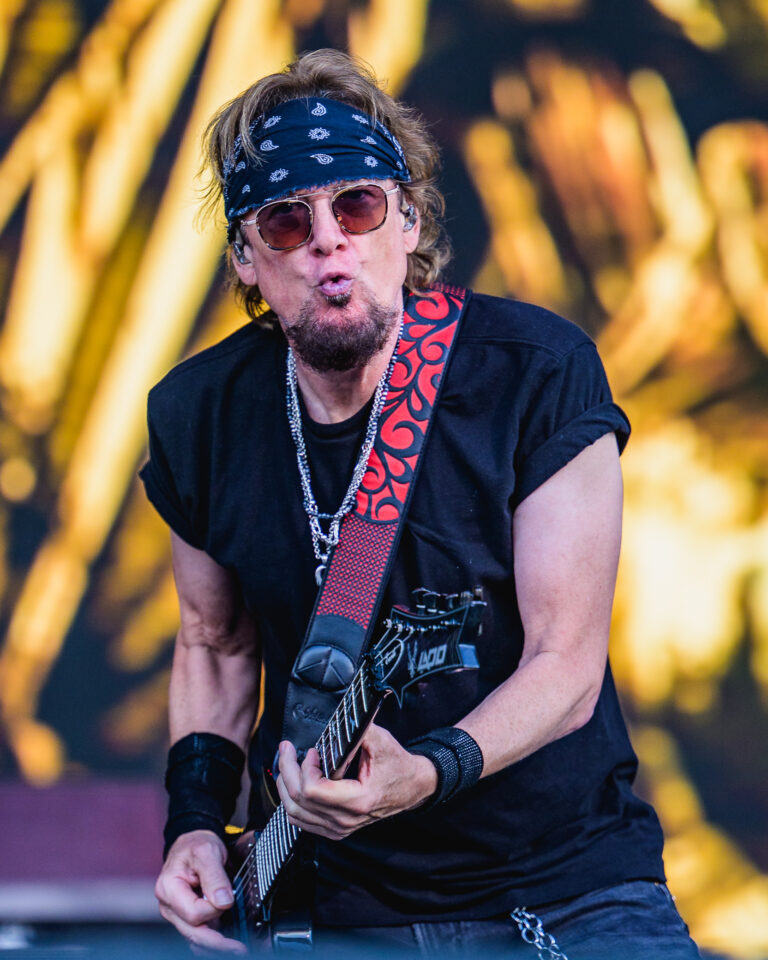
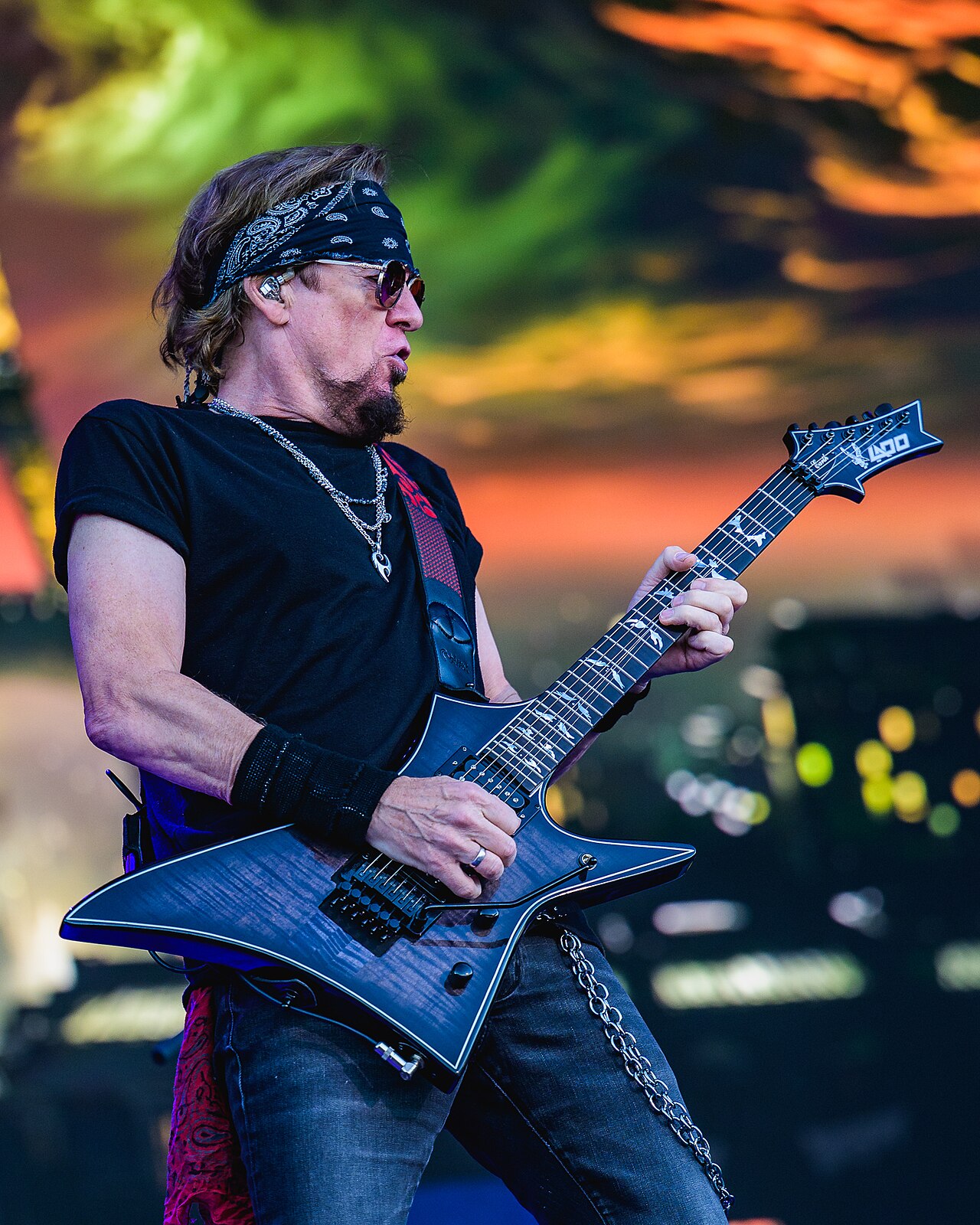
Iron Maiden didn’t hand out individual signature models for decades, despite the band’s deep Jackson-adjacent history — MusicRadar’s review of the guitar points out that it took until 2009, released on official Iron Maiden Day, for any single member of the band’s guitar trio to receive one. That guitar was the Adrian Smith San Dimas Dinky, unveiled at Winter NAMM 2009 with an alder body, bolt-on quartersawn maple neck, and an unusual-for-Jackson HSS layout pairing a DiMarzio Super Distortion bridge humbucker with two Fender Samarium Cobalt Noiseless single-coils. Smith wasn’t shy about how quickly the guitar became essential gear: after Jackson sent him a prototype, he said it became his number one choice onstage for Maiden’s 2008–2009 Somewhere Back in Time world tour — a genuine road-tested endorsement rather than a name licensed for marketing. The model has since spun off into several variants, including the quilt-topped SDQM and the budget-friendly X Series SDXM and SDX. Notably, the original prototype Smith worked from carried an HSS layout that later shifted for the wider 2009 production run, and Smith has said he likes experimenting tonally with different guitars and synth setups — the Fender-derived Samarium Cobalt single-coils were specifically chosen to give him a classic Strat neck-pickup sound that stood apart from bandmates Dave Murray and Janick Gers on stage. The Somewhere Back in Time tour itself was a victory-lap trek revisiting Iron Maiden’s 1980s catalog, which makes the timing notable: Smith’s first true signature model arrived not during a new album cycle but while the band was actively re-performing the songs that made his reputation in the first place. Smith’s full rig history is covered on his dedicated gear guide.
Misha Mansoor: The Djent Descendant
Jump forward roughly a decade and a genre away, and the Dinky shape resurfaces in Periphery mainman Misha Mansoor’s Juggernaut line. Jackson’s own product copy is explicit about the lineage, describing the Juggernaut as sculpted with a body shape directly inspired by the Dinky, complete with sleekly scalloped horns and a comfortably contoured neck heel. Where the Juggernaut departs from the DK2QM is in its electronics philosophy — most versions ship with a fixed Hipshot or Jackson hardtail bridge rather than a Floyd Rose, and Mansoor co-designed his own pickup sets rather than reaching for stock Seymour Duncans. Of the Bare Knuckle-built Juggernaut humbucker developed for the USA model, Mansoor has said he can proudly call it his own signature pickup set. The Juggernaut now spans USA, Pro Series, and Pro Plus tiers with wildly different scale lengths and tonewoods depending on configuration — a far more extensive signature family than either Collen’s or Smith’s. The Juggernaut family has grown considerably since its debut, spanning six- and seven-string configurations, scale lengths from 25.5″ up to 26.5″ for extended-range models, and body woods ranging from alder and poplar to caramelized mahogany with figured tops. It’s a far more sprawling signature lineup than either Collen’s or Smith’s single-shape approach — fitting, given that Periphery and the broader djent scene Mansoor helped launch through his early Bulb home-recording project were built on constant tonal experimentation rather than a single defining sound. Mansoor’s complete gear history lives on his own guide.

Randy Rhoads and Marty Friedman
Two other Jackson players have no business here at all, and the reasons are almost mathematically clean. Randy Rhoads died in a 1982 plane crash — four years before the Dinky existed as a Jackson model in 1986. His entire relationship with the brand runs through the V-shaped Concorde design that gave Jackson its name in the first place, documented in full on his gear guide. Marty Friedman’s Jackson story, meanwhile, is a Kelly story from beginning to end: his 1985 Jackson Kelly San Dimas carried him through Cacophony, Megadeth’s Rust in Peace and Countdown to Extinction, before he auctioned it off in 2011 for tsunami relief charity. His current MF-1 signature isn’t a Dinky either — it’s built on a single-cutaway body closer to a traditional set-neck design. The one wrinkle worth knowing is a famous December 1991 Guitar World cover showing Friedman with a one-off Firebird-inspired Jackson prototype, which he later admitted he barely played and never turned into a real signature model. More on that detour is on his own page.
The Honest Caveat: Nobody Famous Plays This Exact Guitar
Here’s the nuance worth being upfront about: none of the three genuine connections above are to the actual Pro Series DK2QM. Collen, Smith, and Mansoor are each connected to the Dinky shape through their own dedicated signature lines — instruments built to their individual specs, priced well above this Indonesian-made Pro Series tier, and loaded with pickups, necks, and hardware none of them chose for a mass-market guitar. No widely documented touring artist has been photographed treating a stock Pro Series DK2QM as a main instrument. What you’re actually buying with the DK2QM is the silhouette and playing feel that three separate legends independently chose to build their careers around — at a fraction of the cost of any of their namesake models.
Construction: What Roughly $900 Actually Buys
The DK2QM’s defining feature, as the “Q” and “M” suffixes suggest, is a AAAA-grade quilt maple top over an alder body — a specific combination that separates it from siblings using rosewood or ebony boards. It pairs a flat-sawn, graphite-reinforced bolt-on maple neck with a wrap-around heel and a recessed Floyd Rose FRT-O2000 double-locking tremolo system. The rest of the build: a 12″-to-16″ compound-radius maple fingerboard with 24 jumbo frets and offset black dot inlays, a 1.6875″ (42.8mm) nut, black neck and headstock binding, and a convenient heel-mounted thumbwheel truss rod adjuster. Electronics are a direct-mount Seymour Duncan JB (TB-4) in the bridge and a Seymour Duncan ’59 (SH-1n) in the neck, wired to a five-way blade switch with master volume and tone. Hardware is black throughout, and the guitar ships without a case, made in Indonesia. New units generally run $900–1,000; used Pro Series examples regularly turn up for $500–650, which Equipboard’s forum-tracking flags as a genuinely good value point for the platform.
Family Tree: Decoding the Dinky Alphabet Soup
Jackson’s Dinky naming convention looks cryptic until you know the pattern. The base DK2 pairs an alder body with a rosewood board and no figured top. Add an “M” and you get a maple fingerboard instead of rosewood; add a “Q” and a quilt maple top appears over the body. The DK2QM reviewed here combines both upgrades — quilt top plus maple board — while the DK2Q keeps the quilt top but pairs it with a rosewood or ebony board instead. Further out on the family tree: the DK2S swaps in a Sustainiac driver pickup, the DK3 moves to an HSH pickup layout, and the Pro Plus DKAQ uses an arched okoume top body — a lighter tonewood more commonly associated with boat-building than guitars, chosen for its maple-like tonal properties at a fraction of the weight. Most models, including this one, are also available in an “HT” hardtail configuration with a fixed Jackson bridge in place of the Floyd Rose, for players who’d rather skip trem maintenance entirely. Beyond the Pro Series sits the X Series (budget, Indonesia-built, simplified electronics) below it, and the USA Select Dinky line above it, which trades the Pro Series’ Seymour Duncans for active EMG 81/85 pickups and a quartersawn hard rock maple neck built stateside. For the Soloist side of Jackson’s family tree, see the Pro Series Soloist SL2.
Dinky vs. Soloist: Why the Bolt-On Still Has Fans
It’s worth returning to the construction question, because it explains why Jackson has never retired either platform. The Soloist’s neck-through design centers the neck wood through the entire body, which tends to produce longer sustain and a more unified resonance between neck and body positions — the reason players chasing violin-like lead tones often reach for it. The Dinky’s bolt-on joint trades a little of that sustain for a tighter, more percussive low end and — practically speaking — a guitar that’s cheaper to build, lighter to carry, and far easier to have serviced or re-necked by a local tech. Collen, Smith, and Mansoor didn’t choose the Dinky platform by accident: all three play in contexts (arena hard rock, driving NWOBHM rhythm work, and tightly palm-muted djent riffing, respectively) where that punchier low-mid attack does real work.
Tone Recipes
Classic Rock Crunch: Bridge JB into a mid-gain plexi-style head, gain around 5, treble and presence up, mids scooped only slightly — this is the setting that makes the JB/’59 combo feel like it was built for Reagan-era arena rock, because it largely was. Roll the guitar’s tone knob back just slightly to tame the JB’s naturally bright upper end.
Full-On Metal Rhythm: Bridge JB, high-gain amp or pedal stacked in front of a clean channel, noise gate engaged, mids pushed rather than scooped for palm-muted riff definition. Works especially well through the Floyd Rose’s tight low end when tuned down a step or more, and the alder body keeps things from getting too dark or woolly even at extreme gain.
Vintage-Voiced Lead: Switch to the neck ’59, back gain off to a warm, singing overdrive rather than saturated distortion, and lean on the compound-radius neck’s low action for legato runs and wide vibrato. This is the setting closest to what a player chasing Smith’s or Collen’s cleaner catalog moments would reach for.
Position 3 Split Tone: The five-way switch’s inner-coil positions (2 and 4) split each humbucker down to single-coil output, useful for lower-gain rhythm parts or chiming clean arpeggios without swapping guitars entirely — a genuinely versatile feature on a guitar most players buy purely for its metal credentials.
Buying Guide & Known Issues
Owners consistently single out the hand-rubbed oiled neck finish as a highlight, especially compared to older Dinky generations that shipped with glossier, stickier neck finishes some players found rough under fast hands. On the downside, a recurring cosmetic complaint on Sweetwater’s review pages involves small divots or tool marks in the body and neck binding — not uncommon at this price point on a mass-produced import, but worth inspecting closely before buying used. The lacquer-free maple fingerboard looks striking out of the box but picks up visible finger grime faster than a sealed rosewood or ebony board; it doesn’t affect playability, but it’s a maintenance quirk worth knowing about. More than one reviewer has also wished aloud that Jackson had used its signature shark-fin inlays here instead of plain offset dots — a purely aesthetic gripe, but a common one.
Body dimensions are consistently praised for playability: the Dinky’s slim, compact profile and flattened inner horn edges make the upper frets — the 23rd and 24th in particular — genuinely reachable rather than theoretical, a detail that matters more on this shape than on bulkier Superstrats. Several long-term reviews also note the guitar arrives with a factory setup tight enough that most buyers won’t need to do more than a basic intonation check before gigging it. On the value side, used MIM (Indonesia-built, sometimes loosely labeled) DK2QMs turning up in the $500–650 range represent one of the more efficient ways to get a Seymour Duncan-loaded, Floyd Rose-equipped superstrat with real design pedigree behind its shape. Buyers comparing trem versus hardtail should note that USA-built Dinkys in this shape can run as high as $2,000–4,000 secondhand — the Pro Series tier exists specifically to put the same silhouette within reach of players who’ll never need a hand-built neck.
Frequently Asked Questions
Is the Jackson Pro Series Dinky DK2QM made in the USA?
No. Pro Series instruments, including the DK2QM, are built in Indonesia. Jackson’s USA-made Dinkys exist under the USA Select series at a significantly higher price point.
What’s the actual difference between the DK2QM and the DK2Q?
Both share the quilt maple top, but the DK2QM pairs it with a maple fingerboard while the DK2Q uses rosewood or ebony. It’s purely a wood and cosmetic distinction — the core construction is otherwise identical.
Can I get this guitar without a Floyd Rose?
Yes. Jackson also sells an “HT” version of the DK2QM with a fixed Jackson hardtail bridge instead of the recessed Floyd Rose, for players who’d rather avoid trem setup and maintenance.
Did any of the three artists mentioned actually play a stock DK2QM?
No — Collen, Smith, and Mansoor are each connected to the Dinky body shape through their own individually specced signature guitars, not this specific mass-production model.
Image credits
- Adrian Smith: Birgit Fostervold, Wikimedia Commons, CC BY-SA 4.0.
- Phil Collen: Raph_PH, Wikimedia Commons, CC BY 2.0.
- Adrian Smith: by Birgit Fostervold, Wikimedia Commons, CC BY-SA 4.0.
- Misha Mansoor: Markus Felix, Wikimedia Commons, CC BY-SA 3.0.
Latest News
Related

On This Day
Monday 9 November
From this week: