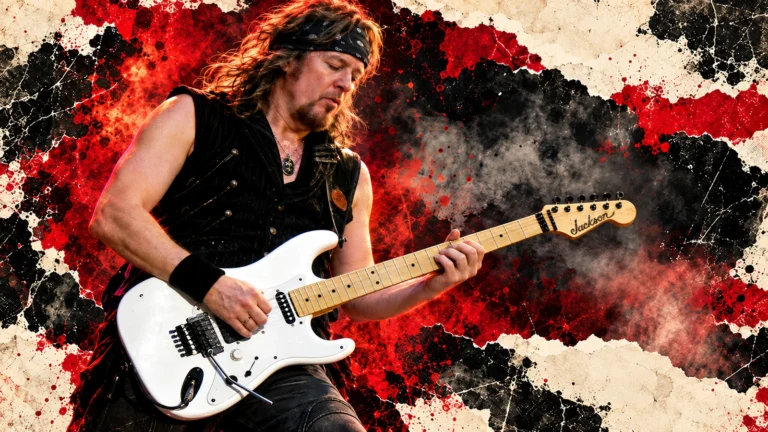
Jackson X Series Kelly KEX: The Shape Marty Friedman Made Legendary
Marty Friedman's Jackson Kelly sold for $125,000. Here's the affordable X Series KEX version of the same shape, plus the real history behind its design.
The X Series Kelly KEX is the shape that actually made Marty Friedman’s name inseparable from Jackson, even if the guitar he built his legend on cost roughly two hundred times what this one does.
That gap between legend and affordable reality is worth sitting with for a moment, because it’s a genuinely different situation from most of the “wrong guitar, right brand” stories elsewhere in this project. Here, the shape itself is the correct connection — it’s just that the specific guitar Friedman actually played was a hand-built, decades-old American original rather than anything coming off a modern Indonesian production line. Understanding that distinction is most of what makes this article worth reading.
An Australian Guitarist’s Napkin Sketch, Twice Over
The Jackson Kelly’s origin story runs almost parallel to the Rhoads V’s, right down to the collaborative sketch session with Grover Jackson — except this time the guitarist behind the design never became a household name himself. Bradford Kelly played guitar in Heaven, an Australian heavy metal band that toured with Iron Maiden and had ties to AC/DC in the early 1980s. Kelly worked with Grover Jackson to design a heavily reworked take on the Gibson Explorer shape: sharper angles, a more extreme silhouette, and Jackson’s now-signature neck-through construction and pointed headstock. The design debuted in 1982 and has remained essentially unchanged since — a rare case of a guitar shape arriving fully formed and never needing a significant redesign. Kelly himself stopped making music some years later and has since passed away, leaving the guitar that carries his name as his most visible and lasting contribution to metal.
It’s worth putting the Kelly’s timing in context alongside the rest of Jackson’s early catalog: it arrived the same year Randy Rhoads died and a full two years before the Soloist launched in 1984, making it one of the very earliest shapes Jackson put into production under its own name rather than Charvel’s. Alongside the Ibanez Destroyer, the Kelly represented one of the sharpest, most aggressive takes on the classic Explorer silhouette to emerge from the early-’80s Southern California custom shop scene — a visibly more extreme reworking than ESP’s later, more faithful Explorer-shaped guitars that would go on to define James Hetfield’s look with Metallica.
Marty Friedman: The Guitarist Who Actually Made This Shape Famous
Unlike Randy Rhoads and the Rhoads V, Marty Friedman was very much alive and very much playing when his connection to the Kelly shape solidified — and unlike almost every other artist connection uncovered elsewhere in this Jackson chapter, this one holds up completely, because Friedman’s entire career-defining guitar work happened on this exact shape.
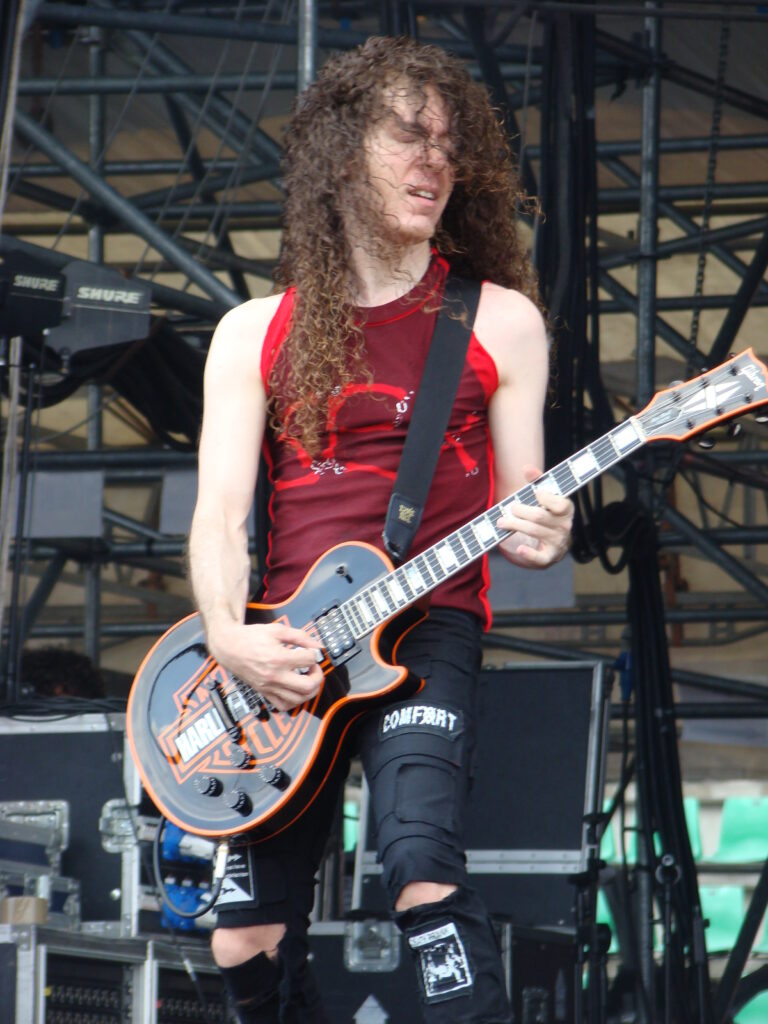
Friedman bought his most famous Jackson Kelly, a 1985 San Dimas-built model nicknamed “#2,” in Hawaii while playing in the band of the same name — one of the first 500 guitars Jackson ever produced. It originally carried a black-and-white tiger-stripe finish with two humbuckers and two tone controls; when Friedman joined Megadeth, he had it repainted black and simplified to a single humbucker with one volume control. That guitar became his main touring and recording instrument through Megadeth’s two most celebrated albums, Rust in Peace (1990) and Countdown to Extinction (1992), as well as his work with Jason Becker in Cacophony and his own early solo records. The solo on “Symphony of Destruction” — one of Friedman’s most recognizable pieces of playing — was cut on this exact guitar. It was retired from active duty when Friedman left Megadeth in 2000 and has since sold at auction for sums well into six figures, with one specific example listed as high as $125,000.
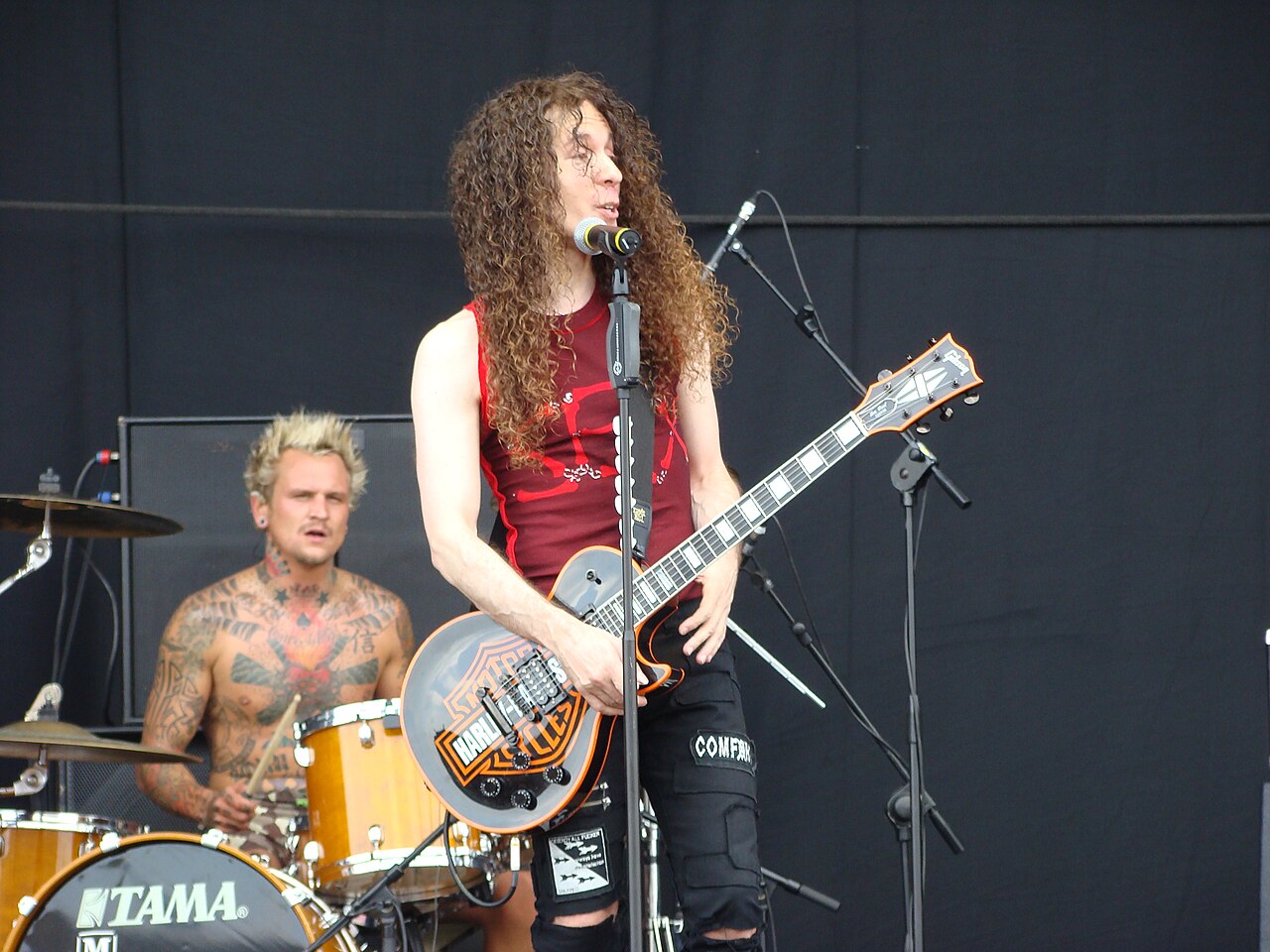
Jackson eventually built Friedman his own signature model, the KE-1 (later KE-1T), which stayed in the Jackson catalog through the 1990s and helped push the Kelly shape into the mainstream of thrash and shred guitar during the genre’s commercial peak. Friedman’s playing style — built on angular, non-Western scale choices and an unconventional circular picking technique rather than standard alternate picking — became inseparable from the Kelly’s thin, fast neck and long sustain. Friedman himself has talked about how his ear for Middle Eastern and East Asian melodic content, rather than the pentatonic vocabulary most of his peers relied on, set his phrasing apart even on a guitar shape that dozens of other thrash and shred players were also using at the time.
Friedman’s Megadeth years weren’t his only chapter with the Kelly shape — before joining Megadeth in 1990, he’d already built a formidable reputation alongside the late Jason Becker in the neoclassical shred duo Cacophony, recording Speed Metal Symphony (1987) and Go Off! (1988) on Kelly-shaped Jacksons, along with his early solo records Dragon’s Kiss (1988) and Scenes (1992). That’s a decade-plus of career-defining recorded work, spanning multiple bands and projects, all captured on variations of the same shape — a genuinely unusual level of instrument consistency. He later moved away from Jackson for a period before returning to the brand in 2017 with an entirely different signature model, the single-cutaway MF-1, which deliberately does not use the Kelly shape at all — a detail that matters for anyone trying to track his gear history accurately, since his current signature and his most famous instrument are two structurally unrelated guitars.
A Secondary Connection: Adrian Smith’s Mid-’80s Kelly Years
Adrian Smith’s Jackson history actually has an earlier chapter that predates all of that: during the mid-to-late 1980s, Smith played a Jackson Kelly on stage with Iron Maiden, delivering one of his more memorable solos on “Aces High” with it. It’s a genuine period-specific connection rather than a misattribution, though it points to the shape rather than to this specific budget-tier SKU. Smith has since moved through Fender Stratocasters and his own San Dimas Dinky signature, making the Kelly era a relatively brief but real part of his overall Jackson story.
The Rest of the List, Quickly Ruled Out
Randy Rhoads has no documented connection to the Kelly at all — his entire Jackson legacy runs through the V-shaped Concorde/Rhoads line he helped design before his death in 1982, the same year the Kelly launched. Misha Mansoor’s Jackson signature, the Juggernaut, is explicitly built on the Dinky platform according to Jackson’s own product copy, with no Kelly connection whatsoever. Phil Collen’s signature history runs through the Dinky-based PC1 line; while some general Jackson marketing copy lists his name alongside Kelly players, no specific documented instance of Collen using a Kelly has turned up in this research, and it’s treated here as unconfirmed rather than repeated as fact.
Construction: What the X Series KEX Actually Is
The KEX carries the Kelly’s neck-through construction down to its most affordable Indonesia-built tier — a genuine point of pride for Jackson, since neck-through builds are considerably more expensive to manufacture than a bolt-on alternative, and the company has kept it even at this price point rather than cutting the corner. The one-piece maple neck runs the full length of the guitar, reinforced with graphite rods and finished with a scarf joint at the headstock, paired with body wings built from poplar or basswood depending on the specific finish and production run. The fingerboard varies by SKU as well: some KEX variants ship with laurel, others with rosewood, both cut to a 12″-to-16″ compound radius with 24 jumbo frets and the Kelly’s signature pearloid shark fin inlays.
Electronics are a pair of Jackson’s own high-output humbuckers, wired to a three-way toggle switch with single volume and tone controls, feeding into a recessed Floyd Rose Special double-locking tremolo — a licensed, more affordable Floyd Rose design rather than an Original. The nut is a Floyd Rose Special locking unit at 1.6875″ (42.86mm), matched with Jackson sealed die-cast tuners and a dual-action truss rod adjustable at the headstock. White binding runs along the body, neck, and pointed six-in-line headstock on most finishes, and hardware color (gold or black) varies by colorway — a Satin Black finish typically pairs with gold hardware, while more aggressive colorways like Ferrari Red lean toward black hardware and a black headstock for a more monochrome look. Weight sits in a comfortable middle ground for a neck-through instrument, and new units typically run $700–800, occasionally dipping lower during retailer sales.
Family Tree: More KEX Variants Than You’d Expect
The base KEX comes in several distinct cosmetic and spec variants worth telling apart before buying. The KEXQ adds a quilted maple top for a more premium look at a modest price increase. The KEXM swaps in a maple fingerboard and typically ships in bolder, brighter finishes like Neon Yellow. The KEXS is a separate, China-built tier positioned as a more budget-friendly alternative to the Indonesia-built KEX line, generally regarded as a step down in fit and finish. Most distinctively, the KEXMG is the only model in the entire X Series Kelly range to feature active EMG pickups — an EMG 81 in the bridge and EMG 85 in the neck — rather than Jackson’s own passive high-output humbuckers, giving it a noticeably different, more compressed and higher-output voice than the rest of the family. Above the X Series sits the Pro Series, which includes genuine artist signature models from Jeff Loomis and Brandon Ellis, both built on the same core Kelly shape with premium hardware and pickup packages. Higher still sits the USA Select and Custom Shop Kelly, where Friedman’s own historic instruments technically belong, and at the very entry level, the JS32 Kelly trades the neck-through build for a bolt-on neck to hit an even lower price point while keeping the core shape and a licensed Floyd Rose intact.
Kelly vs. Rhoads vs. King V: Sorting Out Jackson’s Angular Guitars
It’s easy to lump Jackson’s pointy guitars together at a glance, so it’s worth drawing a clear line between the three most prominent angular shapes in the catalog. The Rhoads V, covered elsewhere in this project, is a deliberately asymmetrical V with one horn noticeably longer than the other — a shape Randy Rhoads specifically wanted to look nothing like a traditional Flying V. The King V keeps things more symmetrical, closer to Gibson’s original V silhouette. The Kelly is different from both: rather than a V shape at all, it’s a modified Explorer, with a single lower body point and a more angular, sharper-edged take on that classic hockey-stick silhouette. Where the Rhoads V and King V split the difference between two points, the Kelly commits to Explorer-style asymmetry with a single long lower horn — which is part of why, despite Jackson’s reputation for aggressive-looking guitars, players consistently report the Kelly as one of the more comfortable shapes to actually sit down and play.
Tone Recipes
Classic Thrash Rhythm: Bridge humbucker, high gain, mids kept present rather than scooped for palm-muted riff definition — the setting that carries Friedman-era Megadeth’s tightly picked rhythm work.
Exotic-Scale Lead: Neck humbucker, moderate-to-high gain, and a focus on phrasing over sustain — Friedman’s use of non-Western scales relies more on note choice and vibrato than on any specific amp voicing, so this setting rewards clean articulation over raw gain.
Full-Bore Solo Tone: Bridge humbucker with the amp pushed toward its most saturated setting and a boost pedal in front for extra push — a fair approximation of the searing, cutting lead tone on “Symphony of Destruction” and “Hangar 18.”
Modern Active-Pickup Voicing: If working from the EMG-equipped KEXMG rather than the standard passive KEX, expect a noticeably more compressed, higher-output signal straight into the amp — dial back gain slightly compared to a passive-pickup setup to avoid over-saturating, since active pickups typically need less amp-stage gain to reach a comparable intensity.
Buying Guide & Known Issues
Owners consistently flag the stock Floyd Rose Special as the KEX’s weakest link, particularly for players using string gauges heavier than the stock .009–.042 set — several forum threads recommend swapping the high E saddle for a Schaller replacement, or upgrading to a Schaller Lockmeister entirely, for more reliable tuning stability under heavier strings or aggressive dive-bomb use. The licensed Floyd Rose Special uses noticeably softer metal than Jackson’s own higher-tier Floyd Rose 1000 series, which shows up over time as quicker wear at contact points rather than any immediate reliability problem. On the upside, the neck-through construction earns consistent praise for sustain and, somewhat counterintuitively given the guitar’s aggressive silhouette, for comfortable seated playability — several long-term owners note the Kelly’s balanced weight distribution makes it easier to play sitting down than its sharp-angled looks would suggest, a detail that surprises first-time buyers expecting an awkward, V-shaped-guitar experience.
The stock pickups are generally well-regarded for their intended aggressive, high-output voicing, though some owners find them a touch dark and have swapped in EMG 81/60 combinations for extra clarity and output, particularly players coming from the passive-pickup KEX toward something closer to the active-EMG KEXMG’s voice. Upper-fret access above the 22nd fret draws mixed reviews compared to Jackson’s own Soloist and King V shapes, a minor trade-off of the Kelly’s more compact body relative to those other silhouettes. Buyers should also double-check which specific KEX variant they’re looking at before purchasing used — the laurel-fingerboard and rosewood-fingerboard versions, along with the poplar-versus-basswood body wood question, aren’t always clearly labeled in casual resale listings, and the tonal and cosmetic differences between them are real even if subtle.
Read our guide to Marty Friedman’s guitars and gear for the wider story behind his Jackson years and later rigs.
Frequently Asked Questions
Did Marty Friedman actually play a Jackson X Series Kelly KEX?
No. Friedman’s famous Kelly guitars were USA-built Custom Shop and San Dimas instruments worth well into six figures today. The KEX is the modern, Indonesia-built budget interpretation of the same shape he made famous, not a guitar he personally played.
What’s the difference between the KEX, KEXQ, and KEXM?
The KEXQ adds a quilted maple top, while the KEXM uses a maple fingerboard and typically ships in brighter colorways. All three share the same core neck-through construction and passive high-output humbuckers.
Is there an active-pickup version of the Kelly?
Yes — the KEXMG is the only X Series Kelly model with active EMG 81/85 pickups, giving it a higher-output, more compressed tone than the rest of the passive-pickup KEX family.
Who designed the Jackson Kelly shape?
Bradford Kelly, guitarist for the Australian metal band Heaven, collaborated with Grover Jackson on the design in 1982. The shape has remained essentially unchanged ever since.
Image credits
- Marty Friedman: Shadowgate, Wikimedia Commons, CC BY 2.0.
- Marty Friedman: by Shadowgate, Wikimedia Commons, CC BY 2.0.
Latest News
Related
On This Day
Thursday 12 November
From this week: