Hangman fx’s The Dancing Plague turns delay timing into a performance control
The Dancing Plague combines stereo delay, tremolo and chorus/vibrato, with signal-responsive modulation and recordable clock-control movement.
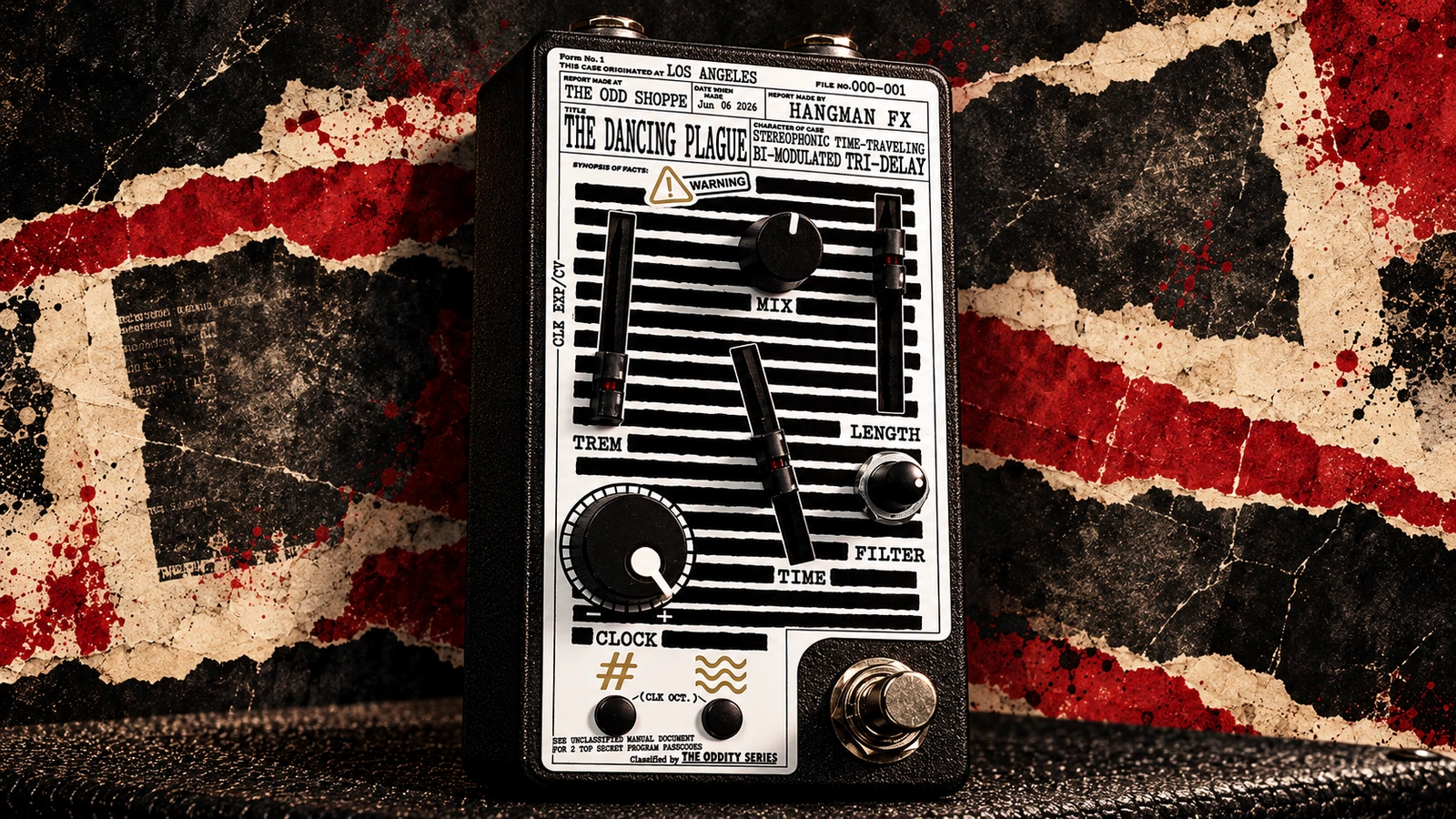
Hangman fx’s The Dancing Plague is a stereo delay that treats changing time as part of the performance. The first pedal in the maker’s Oddity Series combines multiple delay taps with tremolo and chorus/vibrato, then adds ways to make those elements move rather than remain fixed.
More than a repeating echo
According to Hangman fx, the pedal offers six programs plus two additional “Top Secret” programs. In four of those eight, its Divergent Delay Time system makes the three delay taps respond differently as the Time slider moves.
Touch Swirl modulation responds to the incoming signal. The Clock control affects delay timing as well as tremolo and modulation; Clock Octave operation adds octave-based changes to that clock behaviour.
The unusual performance feature is the ability to record up to ten seconds of Clock-knob movement and replay it. Rather than simply dialling in one sound, a player can preserve a changing control gesture as part of the effect.
What to check before choosing it
That specification suggests a different buying question from “How many standard delay sounds does it have?” If your goal is motion, rhythmic instability or repeatable changes during a passage, the control system deserves attention. If your priority is a familiar echo with minimal setup, the extra interaction is something to investigate rather than assume you need.
Those are considerations drawn from the design, not conclusions from a hands-on test. Recent specialist coverage appeared on October 31; the exact manufacturer launch date has not been established. Hangman fx listed the pedal at US$230 when checked on November 2, with local taxes, shipping and current availability requiring a separate check.
Want to explore another approach to programmable delay? Read our Boss DD-500 guide for broader context—not a claim that the two pedals share the same architecture.
Original AI-generated editorial illustration by GuitarGangsters; not a documentary product photograph or hands-on test.