Hagerman’s Vulture Skull puts a triode and pentode to work in one overdrive
Hagerman’s Vulture Skull uses a 6U8A-family tube, triode gain and pentode clipping, with a boost mode and a specified 9V, 380mA supply requirement.
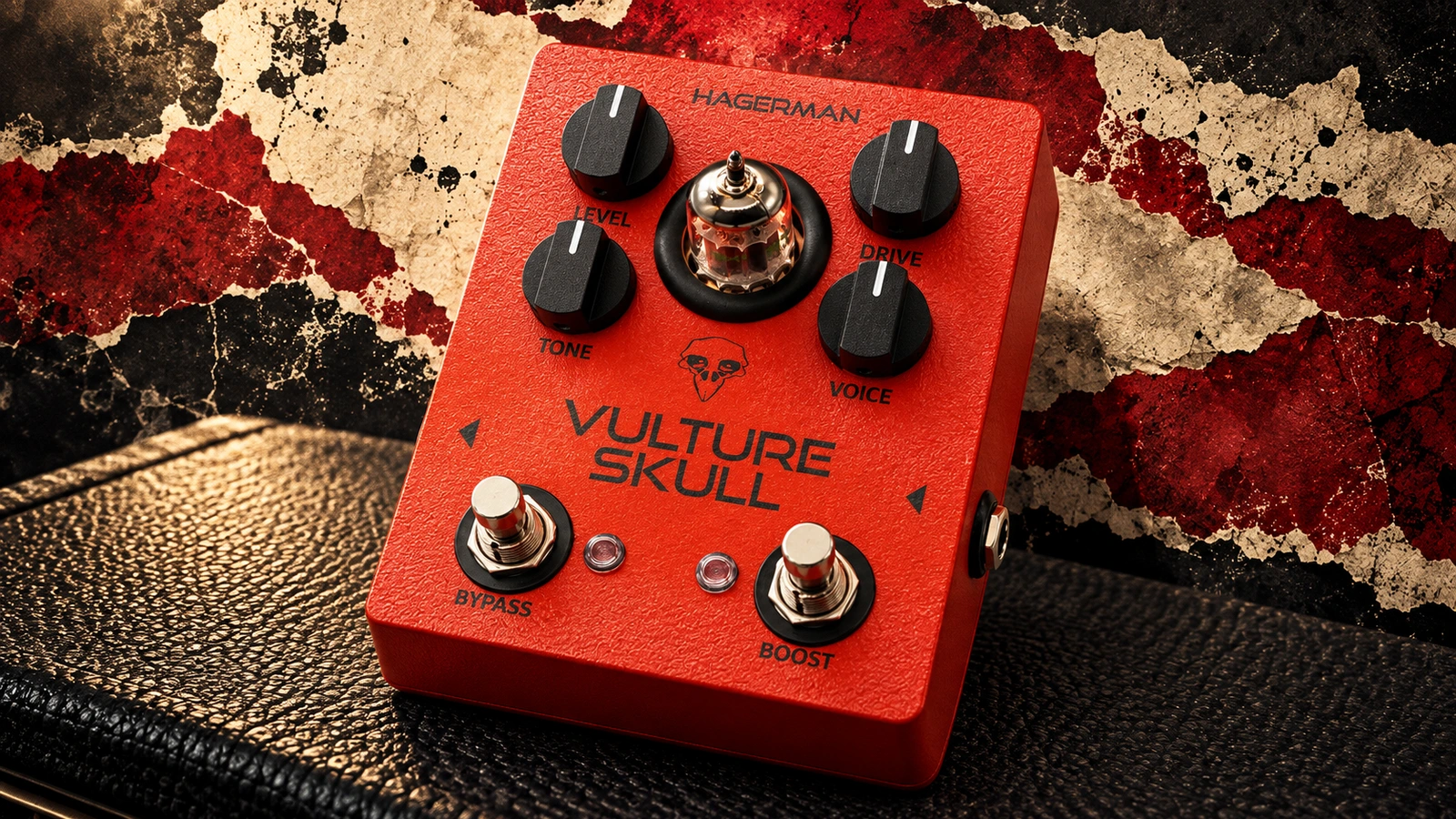
Hagerman’s Vulture Skull is a new tube overdrive built around two different functions inside one vintage television tube. A triode supplies gain, while a pentode provides the following clipping stage. The standard tube is a 6U8A, according to the maker.
That is a more useful starting point than treating the exposed tube as decoration. The published circuit description places it directly in the overdrive’s gain and clipping path.
Four controls, plus a different route into boost
Voice and Drive sit between the two tube stages, with Tone and Level after them. The separate Boost function ground-lifts the Voice and Drive controls, changing how the pentode is driven rather than merely promising an unspecified louder output.
The layout gives players separate questions to explore: how the signal is shaped before clipping, how hard that clipping stage is driven, and what happens to the resulting tone and output level afterward. Whether that works for a particular guitar and amplifier still needs an actual audition.
Power matters here
The manufacturer’s manual specifies a centre-negative 9V DC supply capable of delivering 380mA. Internally, the tube supply is 66V; that is not an instruction to connect a higher-voltage external adapter. The manual also calls for approximately 30 seconds of warm-up. The product listing specifies true bypass.
Hagerman displayed a US$289 price when checked on November 2. Recent specialist coverage appeared on October 31, while the manufacturer’s product-listing metadata dates to October 30. Neither establishes a worldwide shipping date, and regional availability and landed cost should be checked separately.
We have not tested its response or compared its sound against other drives. The concrete distinction is the published triode-to-pentode circuit and the way its controls interact with those stages.
Want a broader starting point for choosing a drive? Read our comparison of the Tube Screamer, Klon, Blues Driver and OCD. It covers other approaches, not equivalent Vulture Skull circuitry.
Original AI-generated editorial illustration by GuitarGangsters; not a documentary product photograph or hands-on test.