The Cat That Bites: Bad Cat Hot Cat and the 25-Year Search for Class A High Gain
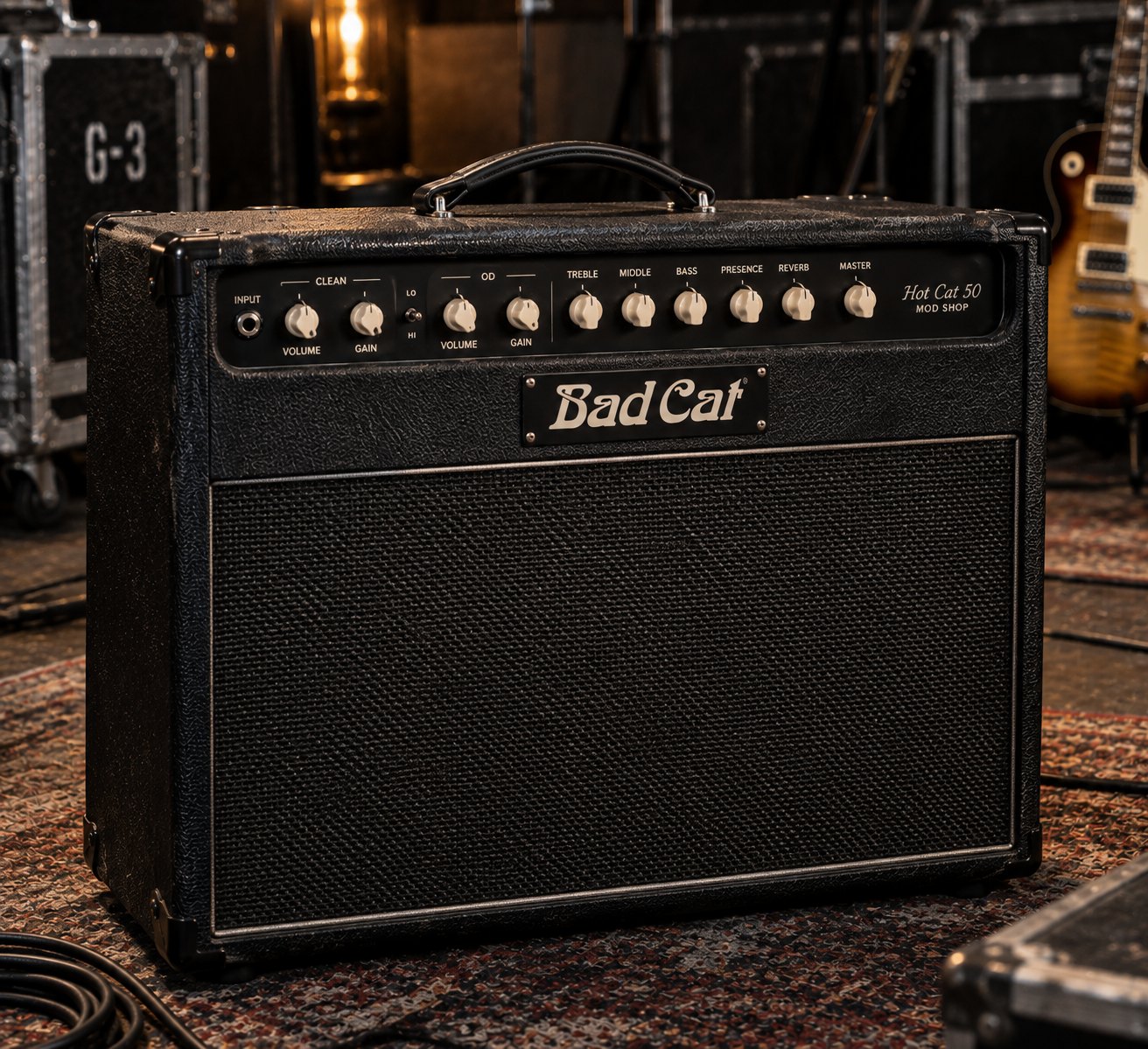
Bad Cat Hot Cat. AI-generated reference illustration, not a photograph.
Three generations, one name. The Bad Cat Hot Cat: 30W Class A hand-wired to 50W Class A/B in 25 years. Circuit guide, tone recipes, verified players.
In 2001, the idea of a boutique amp that could do genuine high gain — not blues breakup, not vintage crunch, but full-bore rock and metal saturation — out of a Class A circuit was novel enough to turn heads at every major amp forum and guitar shop in America. Bad Cat’s Hot Cat was that amp. It showed up in its red sparkle vinyl wrap with a glowing logo and immediately forced players to reconsider what “Class A” actually meant for high-gain playing. Two decades and three fundamental redesigns later, the Hot Cat name is still on the product page at badcatamps.com — but the amp behind that name has changed more than most players realise.
This article covers every generation of the Hot Cat, what actually changed between them, who plays one, and how to get the most out of whichever version lands on your bench.
Bad Cat: From Matchless DNA to Modern Amplification
The Bad Cat story begins in 1999 in Costa Mesa, California, where founder James Heidrich decided to build high-quality, Class A tube amplifiers in the tradition of the British boutique amp movement. The key hire came quickly: Mark Sampson, co-founder of Matchless Amplifiers, became Bad Cat’s chief designer from summer 2000 through December 2003. That lineage is not incidental. The original Bad Cat models were, in many respects, Matchless circuits in different clothing — the Black Cat mapped closely to the DC-30, the Cub to the Lightning. What Sampson brought to Bad Cat was his characteristic approach to Class A voicing: warm, dynamically responsive, compressed in a way that rewards playing touch over raw picking aggression.
The Hot Cat was Sampson’s departure from that formula. Where the Black Cat and Cub stayed firmly in Vox-inspired Class A clean-to-crunch territory, the Hot Cat was explicitly designed to push into high-gain rock. Bad Cat’s own marketing at the time called it the world’s first Class A high-gain amplifier — and given the circuit measurements, it was an accurate claim.
Heidrich sold Bad Cat in 2011. The amp continued under subsequent ownership through various iterations. Heidrich died on February 11, 2023, from a pulmonary embolism at age 64. In roughly the same period, Peter Arends — formerly of Boutique Amps Distribution — came on as CEO and head of engineering with a clear mandate to modernise the product line. The result was the 2023 Hot Cat redesign, which we’ll address separately below because it is, in most measurable circuit terms, a different amplifier from the original.
The Original Hot Cat: Class A in Honest Detail
The original Hot Cat (manufactured through approximately 2011 under Sampson’s circuit design) is a 30-watt, all-tube, point-to-point hand-wired combo or head. Power tubes are two EL34s operating in Class A cathode bias — each tube with its own separate 270Ω cathode resistor and no negative feedback from the output transformer secondary. The preamp runs four 12AX7s. Rectification comes from a 5AR4 tube rectifier that can be switched to solid-state, giving players a choice between the soft-knee compression of tube rectification and the harder edge of silicon.
The Class A claim is worth unpacking. When a pair of EL34s run Class AB, the expected output is 40 watts or more. The original Hot Cat produces 30 watts — Bad Cat deliberately sacrifices those 10 watts to maintain true Class A operation, meaning both output tubes drive plate current throughout every cycle with neither tube reaching cutoff at full power. At idle, each EL34 runs at approximately 75mA with 352V plate-to-cathode voltage — essentially at the rated 25W plate dissipation limit for the tube, running hot. The physics confirm the marketing: at full power, the tubes never reach cutoff. This is genuinely Class A, not the looser “Class A-ish” language that gets applied to most cathode-biased amps.
Why does this matter sonically? Class A operation at near-100% plate dissipation produces a characteristic compression that is different from Class AB even at the same power level. Both output tubes are always conducting, which means the crossover region (where Class AB amps transition between tubes and where thin, buzzy crossover distortion originates) simply does not exist. The saturation character is smooth and even, and the dynamic response to pick attack and guitar volume is more continuous — the amp “gives” in a way that feels less binary than a high-headroom AB design.
The controls on the original Hot Cat are deceptively minimal: Clean Volume, Gain, Edge, Level (for the dirty input), active Treble, active Bass, a Brilliance switch, and Master Volume. The single-channel design runs two inputs — Clean and Hi-Gain — with the Hi-Gain input delivering overdrive loading via the 12AX7 preamp section and the Edge control shaping the bite character of that overdrive. A guitarist using an A/B switch could effectively run both channels simultaneously from the same amp. The result was described in Guitar Player’s August 2002 review by Darrin Fox as having clean tone that was “absolutely gorgeous… upper-mid and high-end tones are rich and detailed, and no matter how loud I cranked up the amp, the overall sound was smooth and musical.”
USA Player Series: Class A on PCB
After the Heidrich-era hand-wired circuit, Bad Cat moved the Hot Cat into what became known as the USA Player Series. The core circuit philosophy remained intact — two EL34s cathode biased for Class A operation, 30 watts — but the construction shifted from point-to-point wiring to military-grade PCB. The output transformers remained hand-wound. A two-channel layout with digital reverb replaced the original single-channel + dual-input arrangement, and rectification moved to solid-state full-time.
Forum debate about the sonic difference between PTP original and Player Series PCB runs predictably in both directions, but players who owned both generally reported that the tonal gap was smaller than the construction difference would suggest. The thick PCBs involved significant hand work in assembly, and the core Class A bias point was maintained. This is the generation that most Equipboard-documented players actually use — including the most prominent name associated with the Hot Cat.
The 2023 Redesign: New Cat, Same Name
The Peter Arends-era redesign of the Hot Cat, reviewed by Richard Purvis in Guitar.com in April 2023, is a fundamentally different amplifier from the Sampson original. The headline change: it is Class A/B, fixed-bias. This is not a minor adjustment — it changes the operating point, the compression character, and the output power. The 2023 Hot Cat produces 45 watts. The additional 15 watts over the original exist precisely because it is no longer in Class A; Class A/B does not sacrifice power for the same idle-bias goal.
Construction is PCB throughout, with solid-state rectification (no tube rectifier option) and digital reverb. The circuit has two independent channels, each accessible via footswitch: Channel 1 is the clean side with presence-responsive headroom; Channel 2 is the high-gain driver with distinctly British character. Both share the same three-way tone circuit (Bass, Mid, Treble). A Hi/Lo gain boost is available on each channel via footswitch.
Purvis’s Guitar.com review was broadly positive about the result while clear-eyed about what changed: “a product of shrewd compromise,” he wrote, with Channel 2 at medium gain producing “a good dollop of British overdrive, with an edginess in the treble that’s more Marshall JCM than Vox Top Boost.” At full gain with the boost engaged it “tumbles over a cliff in 80s metal territory.” The digital reverb is usable without being spectacular. The line out works well into a DAW with impulse responses. The Celestion Vintage 30 is spec’d to Bad Cat’s custom parameters. Cabinet dimensions: 600 × 500 × 262mm, weight 21.3kg.
Hot Cat 50: January 2026
In January 2026, Bad Cat announced the Hot Cat 50 — the current production model as of this writing. Power rating is 50 watts from a redesigned power section. The two channels are now fully independent (rather than sharing an EQ circuit), each with Lo and Hi gain modes. Channel 1 delivers American-style clarity in Lo mode and added bite for country and roots-rock lead in Hi. Channel 2 draws on JCM-circuit inspiration, with Lo mode for 1980s rock punch and Hi mode for tighter, modern high-gain territory. Onboard reverb, fully buffered effects loop, direct line out, and a two-button footswitch are standard. Street pricing at launch: $2,499.99 head, $2,699.99 combo.
Bad Cat’s Jon Bingham described the design goal bluntly: “Our goal was to make the cleans bigger and bouncier, like the older Hot Cats, while at the same time making the dirty channel bigger and more visceral than any Hot Cat before.”
Specs at a Glance
| Generation | Era | Watts | Class | Construction | Rectifier | Channels | Reverb |
|---|---|---|---|---|---|---|---|
| Original (Sampson) | 2001–~2011 | 30W | Class A, cathode bias | PTP hand-wired | 5AR4 tube (switchable SS) | 1 ch, 2 inputs | No |
| USA Player Series | ~2012–2022 | 30W | Class A, cathode bias | PCB (military grade) | Solid-state | 2 channels | Digital |
| Arends redesign | 2023–2025 | 45W | Class A/B, fixed bias | PCB | Solid-state | 2 channels (shared EQ) | Digital |
| Hot Cat 50 | 2026–present | 50W | Class A/B | PCB | Solid-state | 2 fully independent | Onboard |
Power tubes across all generations: 2× EL34. Preamp tubes: 4× 12AX7. Speaker: Celestion (Vintage 30 in current generation). Made in the USA throughout.
Famous Players
The Bad Cat brand maintains an artists page but does not specify which models named players use. Identifying specific Hot Cat users requires cross-referencing primary sources independently.
Josh Homme (Queens of the Stone Age) is confirmed as a Hot Cat 30R user via Equipboard, sourced from a YouTube video (timestamped at 2:32) and a photograph. Homme’s publicly documented primary rig — as covered in Guitar World, Mixdown Magazine, and various gear rundowns over the years — centres on Vox AC30s, a custom GreedTone amplifier, and the Peavey Decade solid-state practice amp that he has called his “secret weapon” for overdrive tone. The Hot Cat 30R is a legitimate, documented addition to that rig rather than its centrepiece. He is the most high-profile confirmed Hot Cat player, and the connection is real — just not the whole story. His guitarist page is at s5-042-josh-homme-gear-guide.html.
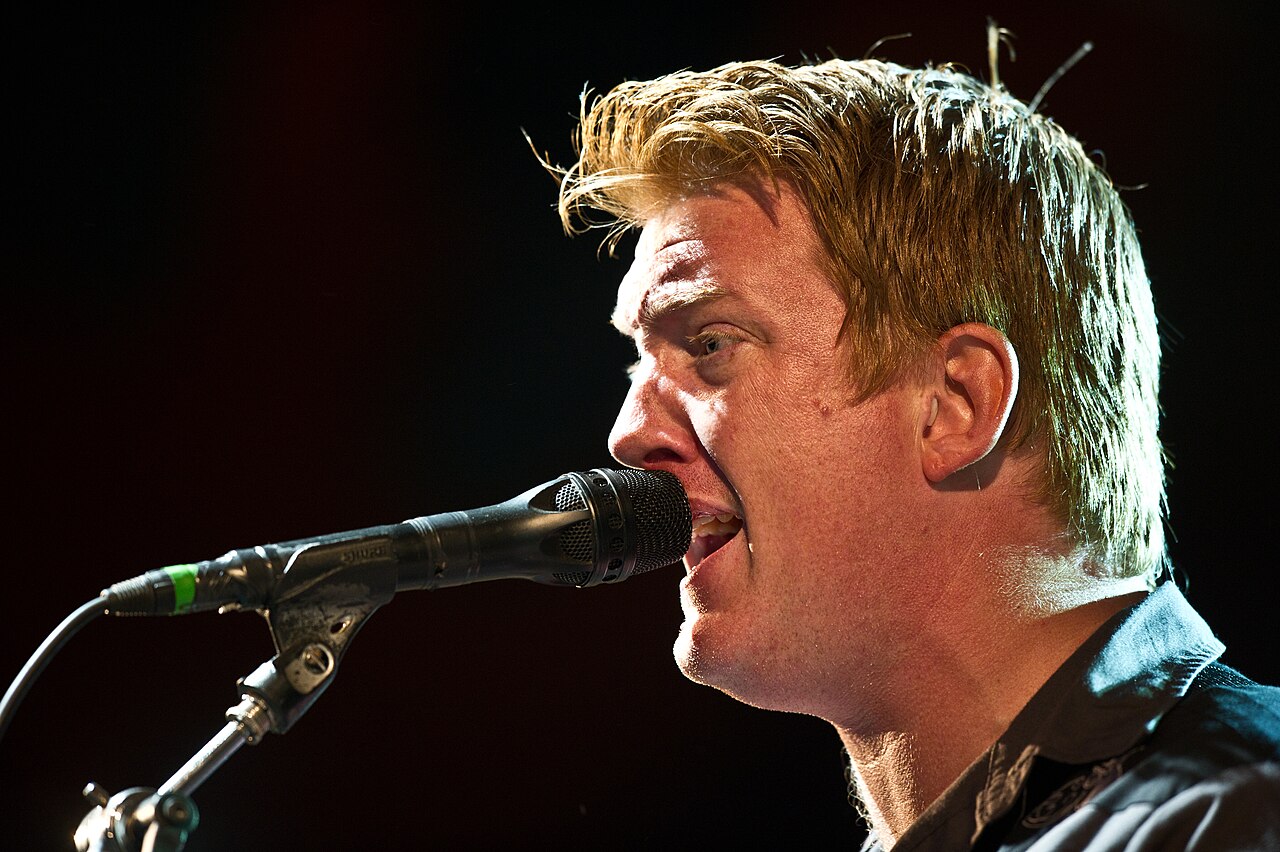
Jamie Cook (Arctic Monkeys) is documented on the Hot Cat 30R across multiple gear databases including Equipboard and UberProAudio. Cook’s use of the amp fits the band’s recorded tone history — the Arctic Monkeys have always gravitated toward British EL34 crunch rather than American clean-to-mean designs, and the Hot Cat 30R’s cathode-biased Class A circuit in the Player Series era delivers exactly that texture: midrange-forward, articulate under single-note lines, compressed without being woolly. His connection to this amp is well-established in the guitar press.
Josh Farro (Paramore, formerly) is also listed on Equipboard as a Hot Cat 30R user. Farro was Paramore’s lead guitarist through their most influential records (All We Know Is Falling, Riot!, Brand New Eyes) before departing in 2010. His use of the amp aligns with the high-gain EL34 character the band’s earlier records showcased.
The broader Bad Cat brand roster includes Keith Urban, Billie Joe Armstrong (Armstrong primarily associated with Bad Cat’s Siamese Drive pedal rather than a specific amp model), and Bonnie Raitt (documented on the Black Cat 30 Combo, not the Hot Cat). None of these connections should be read as Hot Cat endorsements without specific confirmation.
Tone Recipes
Recipe 1 — Clean Edge with Sparkle (Player Series, Channel 1)
Set Channel 1 Gain at 9 o’clock, Volume at noon, Master at noon. Treble at noon, Mid at 10 o’clock (slight scoop reduces the piano-lid brittleness of the Vintage 30), Bass at 11 o’clock. Presence at 2 o’clock. Use a Fender Stratocaster in positions 2 or 4. The result is a wide-bandwidth clean with defined attack and a slight air in the upper register — like a polished black-panel Fender with more midrange body. Works at bedroom to medium rehearsal volumes without losing clarity.
Recipe 2 — Class A Crunch (Original or Player Series, Hi-Gain Input)
Original Hot Cat: Clean Volume at noon, Gain at 1 o’clock, Edge at noon, Level at 11 o’clock, Treble at noon, Bass at noon, Brilliance on. Master at 9 o’clock. Gibson Les Paul with humbuckers, bridge pickup. This is the amp’s signature tone: warm, round overdrive with articulate note separation even in the lower register. What you do NOT get here is the scooped midrange of an American amp; the Hot Cat is a mid-forward machine and this crunch sits right in the 1–3 kHz band. Cut mids 2 dB at 800 Hz if it thickens up in the mix.
Recipe 3 — Josh Homme Desert Rock (Player Series, Channel 2)
Channel 2, Gain at 10 o’clock (lower than you think), Volume 2 at noon, Master at 1 o’clock. Treble at noon, Mid at 2 o’clock (push the mids up — the desert rock sound is NOT scooped), Bass at 10 o’clock. Presence at noon. Guitar volume on the instrument at 7–8, not full. Add an Ibanez TS9 Tube Screamer in front with Drive at 9 o’clock and Level at noon, into the dirty channel. The combination of the Class A cathode-biased EL34 stage and the TS9’s mid hump produces the focused, slightly nasal drive that the early QOTSA records built their character around.
Recipe 4 — British High Gain (2023 Redesign, Channel 2 Hi Mode)
Channel 2 selected, Hi mode engaged. Gain 2 at 2 o’clock. Volume 2 at noon, Master at 11 o’clock. Bass at noon, Mid at 2 o’clock (restore the mid scoop that’s naturally cut by the fixed-bias AB stage), Treble at noon, Presence at 11 o’clock. Boost on. This is the 2023 version doing what the 2023 version does well: JCM-era British gain with a wider low-end than the original Marshall designs, and the EL34 bite that gives it treble authority without fizz. Works across humbuckers and P-90s. Not a clean/crunch sound — this is a purpose-built high-gain setup.
Recipe 5 — Natural Compression Solo Tone (Player Series, Channel 1 pushed)
Channel 1, Gain at 2 o’clock (pushing the clean channel toward saturation), Volume 1 at 1 o’clock, Master at 9 o’clock. Treble at noon, Mid at noon, Bass at noon, Presence at 1 o’clock. Guitar volume at full, tone at 7–8. Stratocaster bridge pickup. The Class A cathode bias begins compressing naturally around this Gain setting — you get a singing, self-limiting solo tone that tracks fast licks without muddying chord passages, because the single-coil keeps the upper harmonics defined. This is the “Hot Cat clean channel doesn’t need a pedal” moment.
How It Compares
The most natural comparison is with the Matchless DC-30 — the direct ancestor of Sampson’s design. The DC-30 is also EL84/EL34-based Class A, but it aims for the Vox Top Boost chimney sound rather than high gain. The Hot Cat borrows that chassis philosophy but pushes the preamp gain architecture much further. If you want the Matchless clean headroom but need to drive a high-gain channel without a pedal, the Hot Cat is the answer; if you play primarily clean-to-crunch and want the AC30 sparkle, the DC-30 is the move.
The Matchless Lightning sits closer to the Bad Cat Cub than the Hot Cat — the Lightning’s 15-watt EL84 platform is designed for bedroom-to-small-club volumes with organic breakup, not the Hot Cat’s high-gain credentials.
Against the Marshall JCM800 2203, the Hot Cat original trades the JCM’s fixed-bias AB aggression for Class A compression and warmth. Both are EL34 amps, both do high gain, but the JCM800 has harder attack transients, more scooped mids in its natural state, and no compression at idle. The Hot Cat’s midrange push and cathode-bias compression are audibly distinct — less authoritative in the bottom end, more musical under sustained notes. The 2023 Hot Cat redesign actually moves closer to JCM territory with its fixed-bias AB circuit.
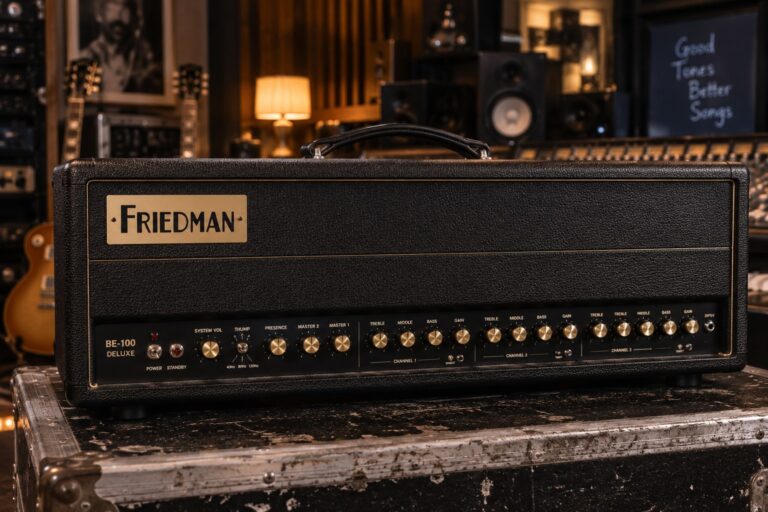
The Friedman BE-100 Deluxe is the modern boutique high-gain benchmark for JCM-derived circuit topologies. The BE-100 is built around fixed-bias AB operation with an extremely refined preamp gain stage. It has more gain available than any Hot Cat generation, tighter low-end response, and a 100-watt headroom that the Hot Cat cannot match. But the Friedman lacks the original Hot Cat’s Class A compression character entirely — it is a different tonal philosophy.
The Fender Deluxe Reverb makes the axis clearest: the Deluxe Reverb is 22 watts of cathode-biased 6V6 American clean. Put them side by side and you understand immediately what the Hot Cat adds to the Class A formula — the EL34 bite, the British midrange push, and the gain architecture that takes you from the Deluxe’s clean territory all the way to JCM-adjacent saturation without a pedal.
Buying Guide
If you want the original Sampson Class A circuit: Buy used. The original hand-wired Hot Cat (pre-2011) shows up on Reverb and in vintage amp dealers; prices for working examples typically land in the $1,200–$2,000 range depending on condition and configuration. Check the tube complement, verify the output transformer has not been substituted, and confirm the rectifier switching still functions. A tech inspection before buying is worth the cost.
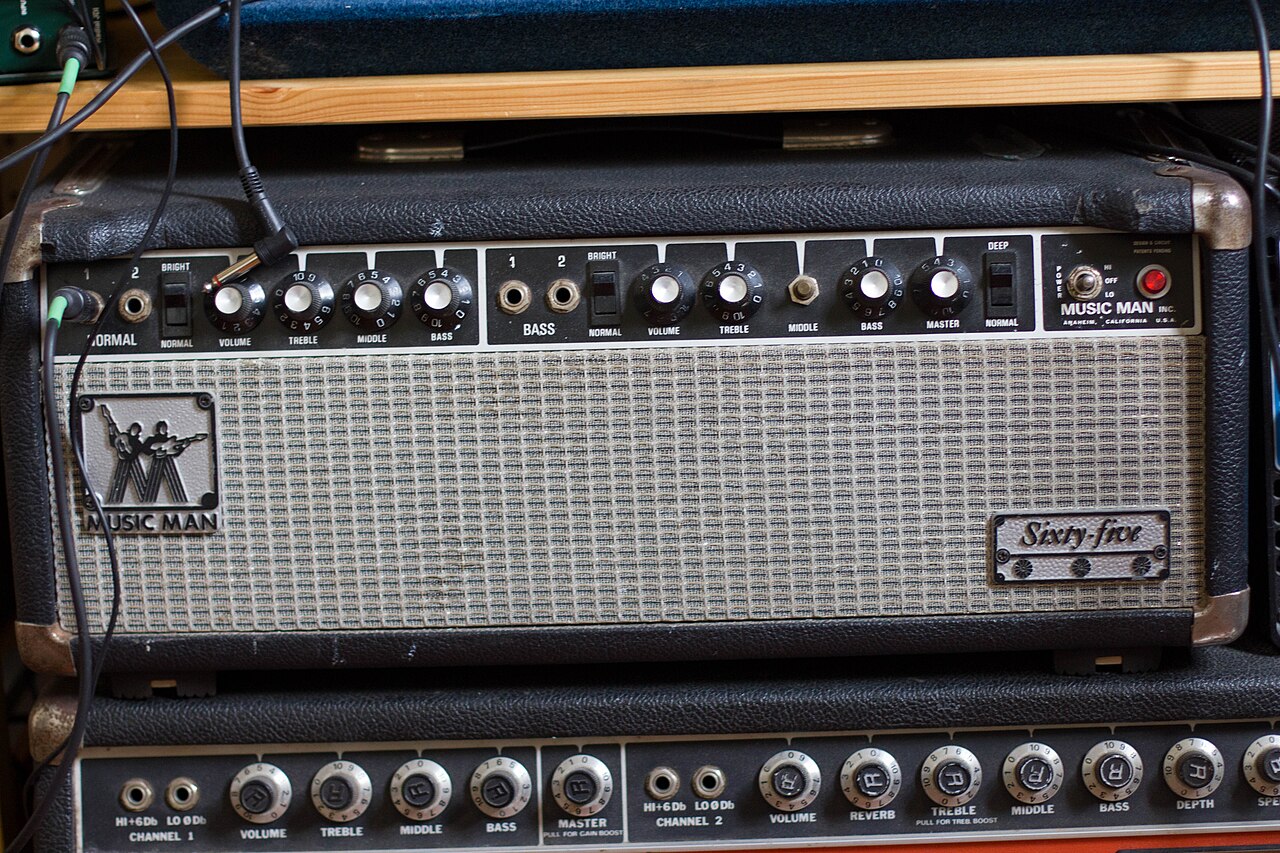
If the Player Series is your budget target: Used examples of the PCB-based Hot Cat 30R (from the ~2012–2022 era) typically sell in the $800–$1,400 range. These are the amps Josh Homme and Jamie Cook used. The Class A circuit is intact, the output transformers are hand-wound, and the tonal difference from the original PTP version is smaller than the construction difference suggests. Verify that the reverb circuit functions (digital reverb units in this era can develop issues), check the FX loop send/return, and confirm the channel-switching footswitch is included.
If you want a new amp: The Hot Cat 50 at $2,499.99 head is the current production model. Be clear with yourself that this is a 50-watt Class A/B PCB amplifier — excellent by its own standards, but a different circuit philosophy from the Sampson original. If that trade-off is acceptable (and for many players doing modern rock or metal it is a better amp), the Hot Cat 50’s independent two-channel architecture and clean headroom are genuine improvements over the single-EQ shared-channel design of the 2023 generation.
Head vs. combo: The Hot Cat has always been available as both. If you own a good 1×12 or 4×12 cabinet, the head is the more flexible choice and typically $150–$300 cheaper. The combo speaker in current production is the Celestion Vintage 30, which works well with the amp’s midrange character but is bright-leaning; if you’re using a head into a Greenback-loaded cab you’ll get a warmer result that some players prefer for the original Cat’s character.
Ownership Notes
Cathode bias (original and Player Series) means self-biasing: Unlike fixed-bias amps, original and Player Series Hot Cats do not require a tech visit every time you change output tubes. Swap matched pairs of EL34s and the circuit adjusts automatically. This is a genuine practical advantage. The 2023 and Hot Cat 50 generations use fixed bias and will need professional re-biasing when you change power tubes.
Tube rectifier (original only): The 5AR4 in the original Sampson-era Hot Cat is a meaningful sonic variable. Switching from tube to solid-state rectification on the same amp produces a harder, more immediate attack and slightly higher B+ voltage. For leads, the SS position can sharpen note definition. For chord work where compression and sag feel important, the tube position is usually the choice. If you own an original, this switch is worth spending time with.
Speaker break-in: Celestion Vintage 30s in new combos can sound bright and slightly harsh before 20–30 hours of playing time. The Hot Cat’s midrange character interacts noticeably with the speaker break-in curve — give it time before making EQ decisions.
Effects loop: The buffered FX loop in the Player Series and later generations is functional but not tube-buffered. Time-based effects (delay, reverb) work well there. Compression and distortion pedals are generally better placed in front of the amp rather than in the loop on this circuit.
Noise floor: The original Class A hot-biased circuit runs the EL34s at near-maximum plate dissipation, which means the amp runs hot and can develop a noise floor at high gain settings in the Hi-Gain input path. This is not a defect — it is physics. A quality noise gate placed in the effects loop (or in front of the amp) addresses it at high gain settings.
FAQ
Is the current Bad Cat Hot Cat still Class A?
No. The 2023 redesign moved the Hot Cat from Class A cathode bias (the Sampson original, 30 watts) to Class A/B fixed bias (45 watts, then 50 watts in the Hot Cat 50). The Class A operation was the defining technical claim of the original circuit. Used Player Series models (pre-2023) retain the Class A cathode-biased circuit.
What’s the difference between the original Hot Cat and the Player Series?
Both generations use the same Class A cathode-biased EL34 circuit for 30 watts. The original is point-to-point hand-wired with a 5AR4 tube rectifier (switchable to solid-state) and a single-channel design with Clean and Hi-Gain inputs. The Player Series moved to military-grade PCB with solid-state rectification full-time, added a two-channel layout with digital reverb, and maintained hand-wound output transformers. Forum consensus is that the tonal gap between the two is narrower than the construction difference implies.
Does Josh Homme play a Bad Cat Hot Cat?
He is documented as a Hot Cat 30R user via Equipboard (YouTube and photo sources). His primary documented rig for QOTSA centres on Vox AC30s, a custom GreedTone amplifier, and a Peavey Decade solid-state practice amp for overdrive. The Hot Cat is a confirmed part of his gear history, not the centrepiece of his published rig descriptions.
How do EL34s in Class A compare to EL84s in Class A?
EL84s (as in the Matchless DC-30 and original Vox AC30) are smaller-format pentodes that saturate earlier, break up at lower volumes, and have a characteristic chime in the upper register. EL34s at the same operating point (as in the Hot Cat) have more headroom before saturation, more low-end authority, a harder midrange punch, and a different harmonic signature under breakup — heavier, more British. The EL34’s higher power handling is what allows the Hot Cat to do high gain from a Class A circuit without running out of headroom too early.
What pedals work best with the Hot Cat?
Into the clean channel of the original/Player Series: an Ibanez TS9 or similar mid-boosting overdrive is the classic match — the TS9’s mid hump aligns with the amp’s natural midrange character and pushes the EL34s into saturation without fighting the Class A compression. Transparent overdrives (Klon-style) also work well. Into the 2023/Hot Cat 50 Channel 2: a noise gate in the effects loop addresses the gain floor, and a boost pedal in front (not added gain) tightens the attack on the fixed-bias AB stage.
Can the Hot Cat do metal?
The original Class A circuit is a high-gain amp, but its smooth compression character and warm midrange push are not typical metal-amp traits — most metal amp designs are fixed-bias AB for tighter low-end response and harder attack transients. The Hot Cat 30R can do convincing hard rock and alt-metal with modern technique. The 2023 redesign (45W Class A/B) is considerably more competitive for high-gain metal territory. For downtuned, tight-rhythm metal, a Friedman BE-100 or similar fixed-bias AB design will be more purpose-built.
What’s the used-market price for a Hot Cat 30R?
Original hand-wired Sampson-era: $1,200–$2,000 depending on condition (rare, sought after). Player Series PCB: $800–$1,400. 2023 redesign (45W): minimal used-market data at time of writing, new prices were £1,699 head / £1,899 combo. Hot Cat 50 (current, 2026): $2,499.99 head / $2,699.99 combo new.
Is Bad Cat still made in the USA?
Yes. Every Hot Cat generation — from the original Sampson-era hand-wired models in Corona, CA through the current Hot Cat 50 — has been manufactured in the United States. The Cub V and Hot Cat 50 are both produced at Bad Cat’s current Irvine, California facility.
Image credits
- A band on a lit stage in front of a crowd: Dhagely, Wikimedia Commons, CC BY-SA 4.0.
- A tube amp head: David Hilowitz from San Antonio, USA, Wikimedia Commons, CC BY 2.0.
- Josh Homme: Bill Ebbesen, Wikimedia Commons, CC BY 3.0.
- Top image: GuitarGangsters AI-generated reference illustration, not a photograph.
Latest News
Related
On This Day
Monday 9 November
From this week: