One Knob Turns, One Hundred Doors Open: The Line 6 M5 Stompbox Modeler
The Line 6 M5 packs 100+ effects into a compact single-effect pedal with MIDI and stereo I/O. Here's why it earned a place on The Edge's touring rig.
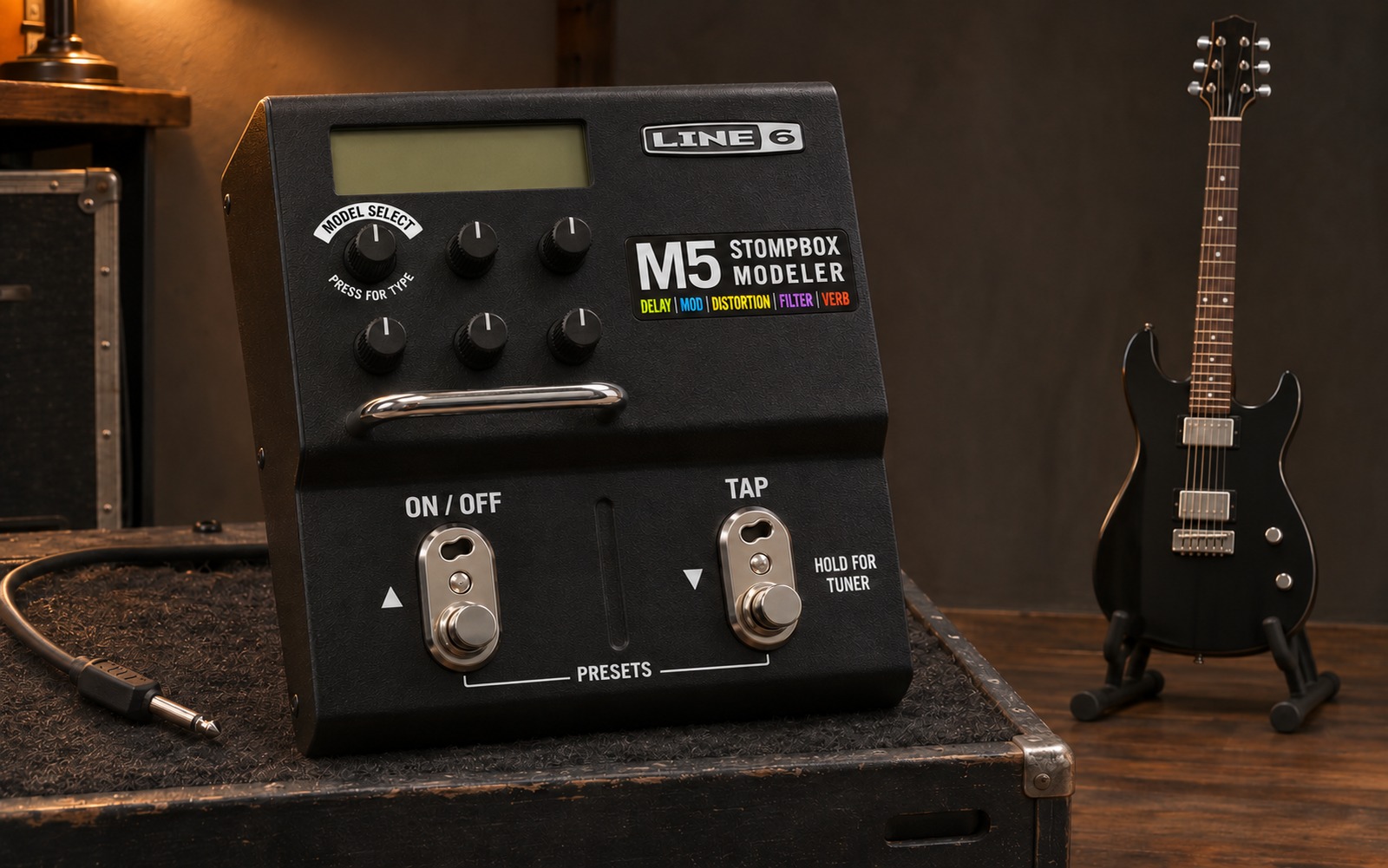
At some point on every serious gigging guitarist’s pedalboard journey, the math stops working. The delays. The modulations. The occasional filter or pitch-shift gag you need for that one part of that one song. Before long you’re dragging a board the size of a carry-on suitcase, each pedal burning a footprint you don’t really have. Line 6 already had an answer in 2008 when they shipped the M13 — a fifteen-footswitch monster with four simultaneous effects and enough knobs to keep a flight engineer happy. Then came the M9 in 2009. Smaller, three effects at once, still substantial. The M5 in 2011 was the logical end of the line: the size of a standard stompbox, one effect at a time, and every single one of the 100-plus models from the entire M-series library sitting behind a single rotary knob. It does one thing at a time. It does that one thing extremely well. And for a significant slice of the professional guitar world — from The Edge’s 2018 arena touring rig to Nashville session specialist Tim Pierce’s workhorse board — that turns out to be exactly enough.

Line 6 and the Stompbox Modeler Lineage
Line 6 was founded in Calabasas, California in 1996 by Susan Wolf, Marcus Ryle, and Michel Doidic. The company’s founding concept — using digital signal processing to model the behavior of classic analog amplifiers and effects rather than simply approximating them — was genuinely new at the time. The 1996 AxSys 212 was the first modeling guitar amp to use software-based models of tube circuits. The POD in 1999 brought that same modeling engine into a kidney bean-shaped desktop unit that became ubiquitous in recording studios almost immediately.
Also in 1999, Line 6 launched the first generation of its Stompbox Modeler series: the DL4 Delay Modeler, the DM4 Distortion Modeler, the MM4 Modulation Modeler, and the FM4 Filter Modeler. These four footswitch pedals each did one category of effects brilliantly, with three simultaneous models, four presets, and an expression pedal input. The DL4 in particular became canonical — its green chassis and four-footswitch layout are still reference points for delay pedals today, and its loop sampler rewired how guitarists thought about live looping.
The M-series was the natural evolution: consolidate all four stompbox modelers into one unit. The M13 (2008) put the whole library on a pedalboard chassis with four simultaneous effects engines, 28-second looper, and MIDI. The M9 (2009) shrank it to three engines and six scenes. The M5 (2011) stripped it back to a single engine — one effect at a time — and packed the result into a chassis barely bigger than the original DL4 siblings. The design question was whether anyone actually needed to run a chorus and a phaser simultaneously badly enough to justify the extra real estate. For most players, it turned out, the answer was no.
Specifications
| Parameter | Specification |
|---|---|
| Effects library | 100+ models across 6 categories |
| Categories | Distortion, Modulation, Delay, Filter, Compressor/EQ, Reverb |
| Simultaneous effects | One |
| Presets | 24 (footswitch-scrollable) |
| Looper | 24-second mono |
| Inputs | Stereo 1/4″ L/R |
| Outputs | Stereo 1/4″ L/R |
| Expression pedal input | Yes, 1/4″ TRS |
| MIDI | 5-pin DIN In + Out |
| Display | Backlit LCD (shows effect name, category, parameter labels) |
| Controls | 6 multifunction rotary knobs, model select knob, On/Off footswitch, Tap footswitch |
| Tuner | Built-in (hold Tap) |
| Power | DC 9V power supply (included) |
| Construction | All-metal chassis |
| Weight | 2.5 lbs |
| Original street price | $195–$279 (2011–discontinued) |
| Current availability | Discontinued; used market $100–$160 |
The Effect Library: What’s Actually in There
The M5’s 100-plus effects are not a grab bag. They are the complete model set from the M13 and M9 — the same algorithms, the same parameter ranges — reorganized for single-effect access. Six categories are represented.
The Distortion section inherits models from the DM4 and the POD era: the Screamer (Ibanez TS808), Classic Distortion (MXR Distortion+), Heavy Distortion, Buzz Saw, Jet Fuzz (Roland Jet Phaser with a fuzz layer — a distinctly peculiar beast that became a cult favorite among M-series users), Line 6 Drive, and more. The drive section is the least-celebrated part of the M5, and for good reason: digital approximations of analog clipping circuits remain the hardest thing to get right, and the M5’s gain models sound convincing at lower settings but lack the dynamic feel of dedicated analog overdrives. Most M5 owners who discuss the unit online use it for everything except drive.
The Modulation category is where the M5 builds its reputation. Phaser, Chorus, Flanger, Tremolo, Vibrato, Rotary Drum (Leslie-style), Pitch Vibrato, and more are all present. The models trace back to the MM4’s targets: the Small Clone, the Electric Mistress, MXR Phase 90, and several Phase variants including a Barberpole that just keeps rotating in one direction indefinitely. The Spin Cycle (vintage optical tremolo) is genuinely lush. This is the section Tim Pierce explicitly flagged when describing why he keeps the M5 on his Nashville studio board: “If somebody asks for a phaser or flanger it’s there for you.”
The Delay section includes digital, analog, tape, multi-head, and pitch-modulated delays — including the Tube Echo (an Echoplex EP-1 style tape delay that is one of the M5’s finest effects), Sweep Echo, Ping Pong, Reverse Delay, and the Dynamic Delay. These are the same algorithms that made the DL4 famous, running in the same engine, and they remain competitive with dedicated delay pedals at this price point. The Analog w/Mod is the closest thing to a Memory Man the digital world has produced outside of something like the Chase Bliss Thermae.
The Filter section includes envelope filters (Tron Up, Tron Down), wah models (Obi Wah, Fassel), a Seeker Wah for use with an expression pedal, Voice Box (talk box emulation), and several synth-style filters. The envelope filters are polarizing — the attack characteristics differ from a real Mu-Tron enough to be noticeable, and players who have bonded with a real Funk Machine will hear the gap. For live use where the audience isn’t analyzing waveforms, they work.
The Compressor/EQ category gives you compression options drawn from the Tube Comp (Universal Audio 1176-style), Red Comp (Ross), and a Boost Comp, alongside an EQ and a Screamer model in this section. The compressor models are gentle and musical — suitable as always-on board compressors for players who don’t want to dedicate a full pedal slot to a squash box.
The Reverb section is the equal of the modulation bank. It draws from the Verbzilla — Line 6’s dedicated reverb module — and includes Spring, Plate, Hall, Room, Cave, Echo (a gated reverb), Particle (Line 6’s original granular-reverb algorithm that predates the ambient-reverb pedal genre by several years), and Tile (a lo-fi boxy ambience). The Particle Reverb in particular sounds better in the M5 than in many dedicated reverb pedals at the same price, which is one reason the M5 appears on pedalboards where several more expensive individual pedals sit alongside it.
Famous Players
The M5 does not have a signature artist — no single player “owns” it the way Eddie Van Halen owned the MXR Phase 90 or David Gilmour owned the Electric Mistress. Instead, it turns up repeatedly as the wild card on professional pedalboards: the one flexible tool in a rig built from dedicated boxes, kept specifically for the moments when nothing else covers the ground.
The Edge (U2) is the most prominently documented M5 user. In a 2018 Premier Guitar Rig Rundown, guitar tech Dallas Schoo walked through The Edge’s arena touring rig and pointed out the M5 pedal. Given that The Edge’s live guitar setup is among the most discussed and documented in rock history, its presence on that rig is not a casual endorsement. The Edge has used Line 6 products throughout his career — including the DL4, which shaped a significant portion of U2’s post-2000 guitar tone — so the M5’s presence in his 2018 rig is consistent with a long-standing relationship with the platform.
Trey Anastasio (Phish) is documented using not one but two Line 6 M5 Stompbox Modelers in his pedalboard, and can be seen explaining them in a video of his guitar rig at approximately 22 minutes and 47 seconds. This is consistent with Anastasio’s approach to his rig, which is famously comprehensive and idiosyncratic — the kind of setup where running two M5s makes sense because it allows him to have two different modulations loaded and ready without scrolling during a set.
Reeves Gabrels, best known for his work with David Bowie’s Tin Machine and his later role as lead guitarist in The Cure, is documented using the M5 via a photo on his Facebook page showing it on his pedalboard. Gabrels has a history of experimental effect use — his tones with Bowie in particular were defined by unorthodox processing — and the M5 fits the profile of a player who wants maximum flexibility from minimum hardware.
Tim Pierce is one of the most recorded session guitarists in Los Angeles history, appearing on records from Don Henley and Bruce Springsteen to Michael Jackson and Rick Springfield. He documents the M5 on his pedalboard in a video where he says plainly: “I see these M5s on a lot of Nashville studio guitarist pedalboards. It’s really a really good workhorse. Nice reverb… if somebody asks for a phaser or flanger it’s there for you.” Pierce’s endorsement is significant precisely because session guitarists are ruthlessly practical — they keep what works and pull what doesn’t before the next call time, and the M5 has stayed.
Teppei Teranishi, lead guitarist of Thrice, is documented using the M5 in a MusicRadar rig rundown. His quote is worth quoting directly because it captures the M5’s specific use case with unusual precision: “That’s my, ‘I need this one random thing for this one part in this one song’ pedal. There’s a couple of things that need that for whatever reason, like the parked wah: there’s a riff in The Artist In The Ambulance that just doesn’t work without that effect. And the Whammy-like pitch-shifter pedal thing for the end of For Miles.” That single quote is probably the best single-sentence description of why the M5 earned its place on hundreds of touring rigs: not as a primary tone tool, but as the one pedal that handles the effects you can’t justify a full dedicated box for.
Russell Lissack (Bloc Party) is documented using the M5 in a rig rundown, visible on his pedalboard at 18 minutes and 2 seconds in the footage. Bloc Party’s guitar tone on the records — heavily processed and post-punk in character — is consistent with the kind of modulation and filter use the M5 excels at.
Tone Recipes
The Nashville Utility Mod
Load the MXR Phase 90-style model from the modulation bank. Rate at approximately 9 o’clock (slow), Depth at noon (moderate), Feedback at minimum. Into a clean amp with a little compression before it. This is Tim Pierce’s territory: the kind of phasing that sits in a track without announcing itself, thickening a clean guitar part without competing with the vocal. If the session asks for chorus, rotate the model select to Tri Chorus and drop rate to 8 o’clock. The M5 is ready in three seconds flat.
The Edge Dotted-Eighth Architecture
Select Digital Delay with subdivision set to dotted eighth. Tempo synced to song BPM via the Tap footswitch. Mix at noon, Feedback at 9–10 o’clock (two or three repeats, no self-oscillation). Into a clean or lightly driven amp with the room reverb from the next channel loaded as a second M5 preset for the ambient moments. This is the architecture The Edge used to build the rhythmic pulse of songs like “Where The Streets Have No Name” and “Bullet The Blue Sky.” The M5 does not do the U2 thing by itself — it requires specific amp settings, a very clean picking hand, and careful tempo work — but it gives you the right starting material.
The Thrice Parked Wah
Load the Seeker Wah from the Filter bank. Connect an expression pedal to the M5’s expression input. Set the expression pedal heel-down and leave it there — this parks the wah in the partially open position, a frequency-focused tone that adds midrange bark without moving. Teppei Teranishi used exactly this trick for the main riff of “The Artist In The Ambulance.” Without the M5 handling this specific detail, the riff loses its characteristic snarl. This is the “I need this one random thing for this one part” use case, operating exactly as described.
The Session Reverb Room
Select Room from the Reverb bank. Decay around 10–11 o’clock (short — 0.8–1.2 seconds), Pre-delay at minimum, Mix at 9 o’clock (subtle). This is not a swell-and-shimmer ambient reverb — it is the kind of functional room you add when tracking acoustic-style parts that feel naked without a little air. The M5’s reverbs consistently over-deliver for the price, and the Room model in particular is useful enough to sit on a session board beside dedicated reverb units that cost three times as much.
The Pitch Glide Expression
Load the Pitch Glide (available in the Modulation section). Connect an expression pedal. Set the range to +12 semitones. Heel down gives you unison; toe down lifts the pitch an octave. This is the Whammy substitute that several users (including the Thrice quote above — “the Whammy-like pitch-shifter pedal thing for the end of For Miles”) describe using rather than adding a separate Digitech Whammy to the board. The tracking is not quite a Whammy 5 but it is close enough for live use, and it saves a significant footprint.
How It Compares
The M5’s siblings, the M9 and M13, are the obvious comparisons and the obvious upgrades. The M9 adds three simultaneous effects engines, six scenes, and a 28-second looper for players who need to layer modulation and delay at the same time. If you regularly run a chorus into a delay into a reverb simultaneously, the M9 is the right tool. If you are honest about the fact that you mostly use one effect at a time and swap between them, the M5 does the same job for less money and half the pedalboard space.
The Empress Effects Zoia occupies a completely different tier of complexity. Where the M5 has a model select knob and six parameter dials, the Zoia has a 40-button grid and 80-plus modular building blocks. The Zoia can do things the M5 cannot conceive of — cascading modular signal chains, custom routing, community-programmed patches from an SD card library. The M5 can be dialed in during a soundcheck by someone who has never touched it before. These are not competing tools; they are tools for different guitarists at different points in their effect journey.
The Hologram Electronics Chroma Console is the modern boutique answer to the same question the M5 answered in 2011: how do you put a deep effects library in a single pedal? The Chroma Console has four effect modules running simultaneously (Character, Movement, Diffusion, Texture), gestures and drift features, MIDI, and a granular sonic palette the M5 cannot touch. It also costs $399 new versus $100–150 for a used M5. For pure ambient and experimental territory, the Chroma Console wins. For the working gigging player who needs a reliable Swiss Army knife with no learning curve and a 20-year track record of surviving touring rigs, the M5 argument is still coherent.
The Eventide H90 Harmonizer occupies the premium end of the multi-effects conversation. Dual stereo effect chains, 62 algorithms, a deep preset system, and effects quality that frankly outclasses the M5 in every category where both overlap. The H90 costs over $600 new. If budget is no object and you want the best pitch shifting, harmonizing, and time-based effects available in a pedal, the H90 is the answer. If you want 100 good-enough effects for $120 used, you are looking at the M5.
The Line 6 Helix Floor is what the M-series grew up to become. DSP power that makes the M5 look like a wristwatch, amp modelling, full signal chain simulation, 32 effects blocks simultaneously, and a price point to match. A player who started with an M5 and grew into the Helix is tracing an almost inevitable Line 6 trajectory. The M5 still earns a place on Helix-owning pedalboards as the backup one-trick backup tool for a player who does not want to boot up a Helix for a rehearsal.
The Strymon Iridium is a useful comparison because it illustrates the M5’s focus. The Iridium is a single-purpose premium pedal — amp simulation and cab IR loading, nothing else — priced at $399. It does its one job at a level the M5 cannot match. The M5 does 100 jobs at a level the Iridium cannot match. The choice between them tells you something about the player: the Iridium buyer values depth of excellence in one thing; the M5 buyer values breadth of competence across many things. Both are right.
Buying Guide
The M5 is discontinued. Line 6 has not announced a replacement, and the M9 and M13 are also no longer in production. The entire M-series line was a product of a specific era in Line 6’s history — before the Helix platform absorbed the company’s development focus — and the used market is where these units live now.
Prices on Reverb as of 2026 run from approximately $100 to $160 for clean units in working order. The all-metal chassis ages well; the most common failure points are the LCD (look for dead pixels in the display, which cannot be repaired economically) and the power input jack, which can loosen with heavy use. Ask the seller to photograph the display with a powered-on unit before buying.
The expression pedal input is a significant feature — it unlocks pitch-based effects, wah sweeps, volume control, and effect parameter sweeps. If you plan to use the expression jack, confirm it is functional before purchase: plug in an expression pedal and verify the selected effect responds smoothly across the full sweep.
MIDI In and Out means the M5 can be integrated into a full MIDI rig — preset changes via MIDI program change, real-time parameter control via CC. For players building a switching system, the M5 is a legitimate rack-era tool that slots into any preset-based rig cleanly. This is a capability that few pedals at this price point offer, and it partly explains why the M5 kept showing up on professional rigs for a decade after launch.
Firmware: Line 6 issued firmware updates for the M5 that improved MIDI stability and added effects models over the unit’s production life. Check that any used unit is running the latest firmware (v2.0 or higher, depending on version history). Line 6’s support pages for the M5 remain live as of this writing, and firmware update instructions are available there.
Ownership Notes
The M5 powers up in exactly the state it was left in — the same effect, same settings, same preset position. There is no boot sequence, no menu navigation on startup. Plug it in and stomp. For a player who keeps the same effects dialed across multiple rehearsals, this is genuinely useful behavior.
The 24 preset slots are footswitch-scrollable by holding both the On/Off and Tap switches simultaneously, then scrolling up with On/Off or down with Tap. It is not graceful live, but it works. Most M5 users in live rigs either use MIDI program change to jump presets, or they simply use the model select knob between songs and do not bother with the preset system at all.
Noise: the M5 has a documented noise floor that becomes audible with drive effects, particularly when combined with high-gain amplifiers or other gain stages earlier in the chain. The drive models are the weakest part of the M5’s library, and this is part of why. The modulation, delay, and reverb sections run clean. If noise is a concern, put the M5 after your drives rather than before.
The 24-second looper is a bonus feature rather than a core selling point. It is a mono loop with no overdub layer count, no undo, and no sync. It is adequate for basic practice looping or for a simple backing loop in a one-guitarist-and-singer duo context. It is not a substitute for a dedicated looper pedal in any live application that depends on looping as a feature of the performance.
Power supply is included in new units; used units rarely include it. The M5 takes a standard Line 6 9V DC supply drawing 500mA. Standard Boss-style 100mA supplies will not power it. A current-limited isolated output from a quality power board (Voodoo Lab, Strymon Zuma, similar) will handle it cleanly.
FAQ
Is the Line 6 M5 still in production?
No. The M5 has been discontinued, along with the M9 and M13. The entire M-series line was effectively superseded by the Line 6 HX Effects and Helix platform, which offers far greater DSP power and effect quality at a higher price point. The M5 is available only on the used market, where it is well-supplied and inexpensive.
Can the M5 run more than one effect at a time?
No. The M5 is explicitly designed to run one effect at a time. This is the core design choice that separates it from the M9 (three simultaneous) and M13 (four simultaneous). If you need to run chorus plus delay plus reverb at the same time, the M5 is not the right tool. If you can live with one effect at a time, the M5 gives you access to the same library at a fraction of the footprint and cost.
Does the M5 work as well on bass as on guitar?
Yes, with caveats. The modulation, delay, and reverb effects work well on bass — the Analog Chorus, Tube Echo, and reverb algorithms in particular are bass-friendly. The drive and distortion models are less useful on bass because they lack the low-end compensation that dedicated bass drive pedals include. The filter section, particularly the envelope filters, works excellently on bass and is one of the more common bass use cases for the M5.
What expression pedal works with the M5?
Line 6 designed the M5 for use with the EX-1 expression pedal, which is specifically calibrated for Line 6 products. Many standard expression pedals with TRS outputs will also work — the Mission Engineering EP-1 is widely reported to be compatible. Not all expression pedals are TRS-wired in the way the M5 expects; a pedal that does not respond or responds erratically is likely wired differently. Check the manual or Line 6’s support pages for compatible pedal specifications.
Is the M5 true bypass?
No. The M5 uses a buffered bypass circuit. This is consistent with Line 6’s design philosophy across the M-series. The buffer is generally regarded as clean and transparent, and the buffered output can benefit signal chains with long cable runs. Tone purists who require true bypass at every stage of their signal chain will want to be aware of this, though in practice the M5’s buffer does not significantly color the bypassed signal.
How do the M5’s effects compare to the original DL4, MM4, and FM4 pedals?
They use the same DSP algorithms from the same Line 6 platform — the models in the M5’s delay section are the same models that appeared in the DL4. In practice, most players with side-by-side experience report that the M5’s effects sound essentially identical to the originals. The DL4’s loop sampler is longer (14 seconds stereo vs. 24 seconds mono on the M5) and the DL4 has three dedicated footswitches for loop control, which makes it significantly more useful as a looper. But for straightforward effect use, the M5 covers the same ground.
What do most professional M5 users use it for specifically?
The most consistent answers in rig rundowns and interviews are modulation (a phaser or flanger that doesn’t justify a dedicated pedal slot), the occasional specialized filter effect (parked wah, envelope effects), and reverb as a backup or supplement to the amp’s own reverb. Very few professional users rely on the M5’s drive section. It earns its board space as a flexible modulation and time-based tool in rigs built primarily around dedicated analog overdrives and drives.
Why does the M5 still appear on professional pedalboards fifteen years after launch?
Several reasons converge. The core algorithms are still genuinely good — no one built a cheap digital modulation pedal that clearly outclassed the M5’s chorus or phaser library at anything close to its used price. The format is ideal: the footprint of a normal stompbox, the library of a multi-effects unit, and an interface simple enough to program mid-soundcheck. The all-metal build has proven durable across many touring seasons. And the used price has dropped to the point where it is among the most cost-efficient effects units on the market. When Tim Pierce says he sees M5s on a lot of Nashville studio boards, he is describing a tool that has found its permanent equilibrium: cheap enough that it is always worth keeping, capable enough that it never gets pulled.
Image credits
- Top image: GuitarGangsters AI-generated reference illustration, not a photograph.
- A mint green distortion pedal: Danelectro French Toast octave distortion rehouse on metal case (2011-10-03 by Andrés Galeotti).jpg: Andrés Galeotti fro, Wikimedia Commons, CC BY 3.0.
- A pedalboard with a mix of pedals: marcelodonati, Wikimedia Commons, CC BY 2.0.
- The Edge: iinchicore, Wikimedia Commons, CC BY-SA 4.0.
Latest News
Related
On This Day
Monday 9 November
From this week: