Boss GT-1000CORE: The Full GT-1000 Engine in a Stompbox That Actually Fits Your Board
A BOSS GT-1000CORE.
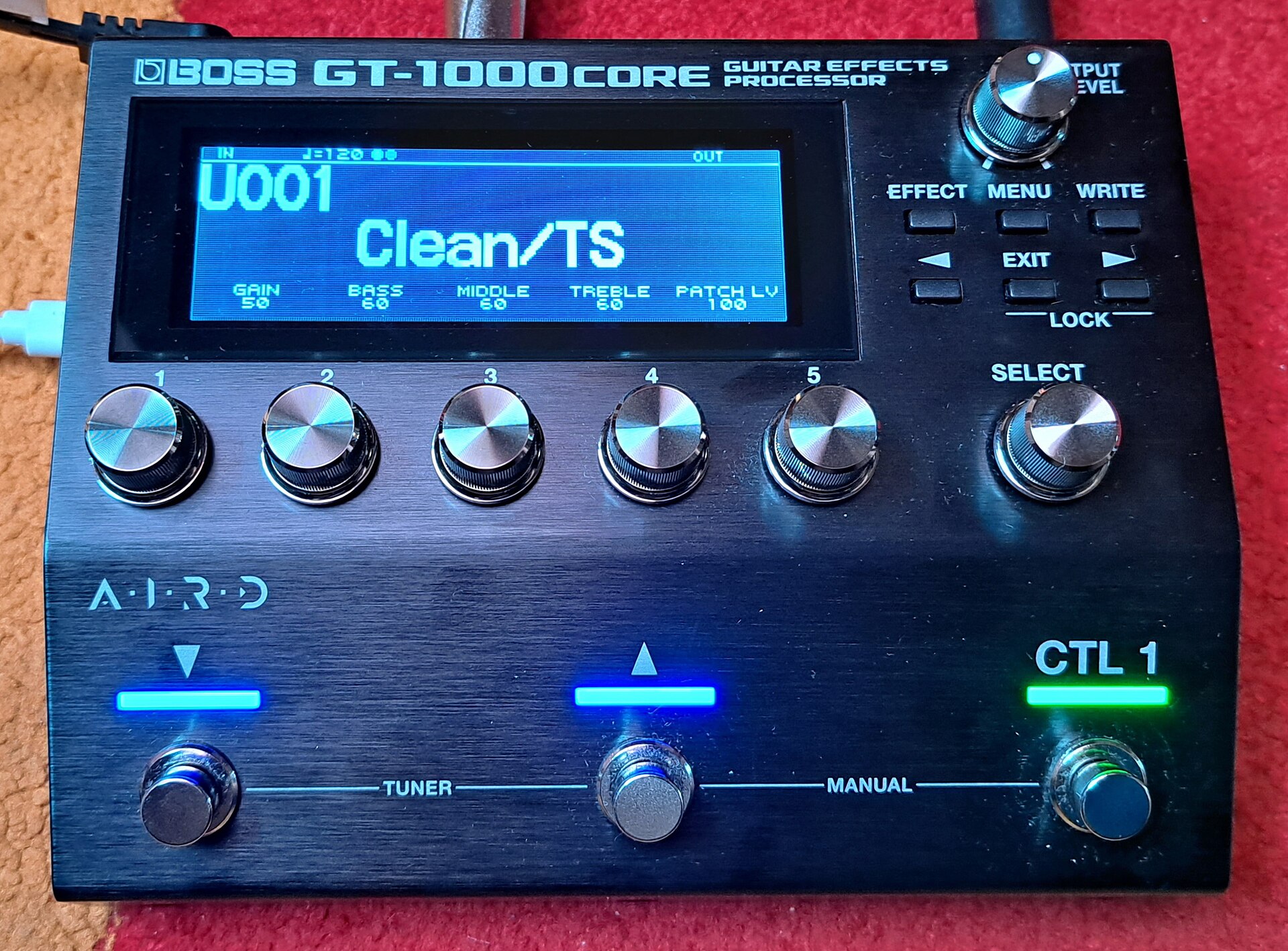
The Boss GT-1000CORE packs the GT-1000's full AIRD engine into a 2-lb stompbox. Four-cable method powerhouse, 140+ effects, 24 blocks — here's what to know.
The pedalboard purist’s dilemma has never really gone away. You love your tube amp. You love the feel of analog pedals hitting the front end. But you also want 24 simultaneous effects blocks, MIDI recall, a 38-second looper, and USB re-amping on the same gig night. The Boss GT-1000 solved that problem brilliantly — then made it bigger, heavier, and harder to shoehorn next to your delay and wah. The GT-1000CORE answers the obvious follow-up question: what if you kept the brain and lost the body?
Released in 2020, the GT-1000CORE drops the GT-1000’s built-in expression pedal, Bluetooth wireless, and DIN MIDI ports, swaps eight footswitches for three, and compresses the whole thing into a form factor not much larger than two compact Boss pedals side by side. The DSP engine — same 32-bit/96kHz AIRD processor, same 140-plus effect types, same 20 AIRD preamp models, same 24 simultaneous blocks — stays exactly where it was. What you lose is the self-contained floor unit. What you gain is a device that actually belongs on a working pedalboard alongside your other gear.
This is not a review. GuitarGangsters covers gear as gear — the history, the architecture, the context, the honest player list, and the practical workflow questions that don’t show up in spec sheets. The GT-1000CORE rewards that approach because it is genuinely different from the GT-1000 in ways that matter beyond dimensions.
Boss GT Series: From Floor Unit to Stompbox Brain
Boss’s GT series has a lineage stretching back to the mid-1990s. The GT-3 (1996) was a reasonably compact floor processor at a time when multi-effects rigs were rack affairs. The GT-5 and GT-6 followed through the early 2000s, building a reputation for effects quality that outpaced their amp simulations. Johnny Marr was running a GT-5 during his time with The Healers in that period — a player best known for pristine Smiths-era chorus and delay who found that Boss’s algorithms tracked what his ears expected. He later moved to a GT-100, maintaining the same logic: real amp in the room, Boss handling time-based and modulation duties behind it.
The GT-1000, announced at NAMM 2018, was a significant architectural shift. Boss introduced AIRD — Augmented Impulse Response Dynamics — a modeling approach derived from the Tube Logic technology inside their Katana amplifiers. Rather than static convolution of a captured amp state, AIRD models the dynamic response behavior of the amplifier: how it compresses under a hard pick attack, how the sag behaves when you dig in, how the breakup character shifts between single-coil and humbucker input levels. The distinction matters less in a demo booth and more at 11 p.m. on a loud stage when your playing needs to breathe. The GT-1000 won critics over; the GT-1000CORE brought the same technology to anyone who already had a pedalboard they didn’t want to rebuild around a floor unit.
The announcement of the GT-1000CORE came alongside the RC-5 and RC-500 loopers in 2020, positioned explicitly as a pedalboard integration device rather than a standalone processor. Boss was clear about the use case: players who want GT-1000-grade processing but want to keep working with their existing amps and rigs, not replace them.
Specifications
The weight comparison alone tells a story: the GT-1000CORE is 2 lbs; the GT-1000 is 7.93 lbs. A pedalboard that already carries a tuner, two overdrives, a wah, and a reverb doesn’t have another 8 lbs of headroom without a larger board and a second power supply. The CORE at 2 lbs sits next to those compact pedals without requiring a structural rethink.
AIRD Technology: Same Engine, Different Housing
Boss’s AIRD modeling is worth understanding on its own terms, particularly because it gets conflated with IR-based profiling or neural capture in ways that aren’t accurate. Traditional convolution amp models capture a static snapshot of an amplifier’s frequency response at a given input level and reproduce it faithfully — the result sounds accurate but often feels static under heavy playing dynamics. Neural capture (as in the Quad Cortex or Neural DSP Nano Cortex) creates a dynamic model using machine learning, trained on the actual amp’s behavior across an input range. AIRD occupies a different position: it is a component-level simulation of the amplifier circuit’s dynamic behavior, evolved from the Tube Logic platform that made the Katana amplifiers feel significantly more responsive than typical digital modeling amps of their generation.
In practice, the distinction shows up in pick attack response and bloom. AIRD models don’t just simulate what an amp sounds like — they simulate how it moves when you dig in. The criticism that PG reviewer Dave Hunter noted in his 2021 GT-1000CORE review is worth repeating honestly: running the CORE into a traditional tube amp with the AIRD bypassed — using the unit purely as an effects processor — delivered the most satisfying “in the room” playing feel. That’s not a condemnation; it’s a use case clarification. For direct-to-FOH or FRFR monitor work, the AIRD handles the amp character. For players with tube amps they already love, the CORE is better treated as an extremely powerful effects engine than as a replacement front-to-back signal chain.
The GT-1000CORE earned a Premier Guitar Gear Award for 2021 — recognition that at its launch price of $699 (now more commonly found sub-$600 new), the value proposition for professional-grade multi-effects processing was difficult to match at the time.
Famous Players
The GT-1000CORE has no single defining artist association the way a signature model would. That’s accurate. But it doesn’t mean no verified users exist — it means the device’s appeal cuts across enough different contexts that no single name defines it the way Nita Strauss defined the GT-1000 for solo-band direct-to-FOH work.
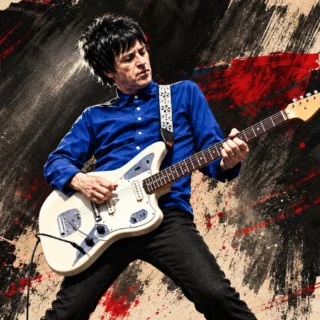
Johnny Marr
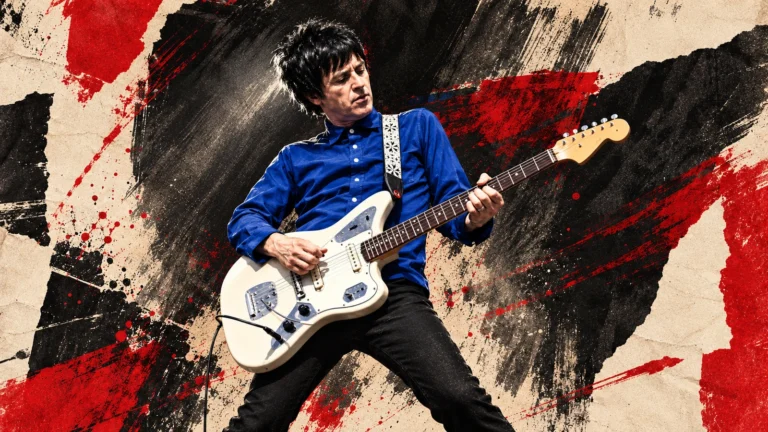
The most clearly documented GT-1000CORE user in professional touring is Johnny Marr. In October 2023, during an interview on That Pedal Show on YouTube, Marr showed his current pedalboard and explained that the GT-1000CORE serves as his chorus and delay engine — allowing him to consolidate time-based and modulation duties that previously required multiple separate stompboxes. He noted that his sound remains the same; the form factor changed, not the result.
The context matters. Marr’s career is defined by layered chorus and long-throw delay — the shimmering, twelve-string-adjacent Rickenbacker textures of the Smiths era relied on a Boss CE-1 and CE-2 in combination with sophisticated routing. His later live work consolidated into GT-series units precisely because Boss’s chorus algorithms are among the oldest and most trusted in the GT processing chain. He ran a GT-5 with The Healers in the early 2000s, moved to a GT-100, and arrived at the GT-1000CORE as the logical conclusion: the best Boss multi-effects processing in the smallest possible package. This is a primary-source, on-camera confirmation of the specific model in active touring use — not an Equipboard entry without photo evidence, not a brand endorsement page claim, but Marr himself explaining why he uses it and what it does in his rig.
Equipboard Artists (Treat as Context, Not Confirmation)
Equipboard lists seven artists against the GT-1000CORE, including Rabea Massaad and Steven Drozd. A note of honesty here: Rabea Massaad is documented across multiple Equipboard entries for different modelers including the Neural DSP Quad Cortex (confirmed live at the 2024 ArcTanGent Festival with QC plus expression pedal) and is a Neural DSP Archetype plugin collaborator. His presence on the GT-1000CORE Equipboard page has not been confirmed against a primary source showing the specific hardware in use, and given his documented QC live use in 2024, the Equipboard GT-1000CORE entry may reflect studio or demo work, past ownership, or a listing error. Article treats Rabea’s connection as unverified at the GT-1000CORE level. Steven Drozd (Flaming Lips, multi-instrumentalist) appears on Equipboard’s listing without a primary-source interview or Rig Rundown confirming the specific unit in a guitar context. Both are mentioned here as Equipboard data points, not as verified touring users of this specific hardware.
The honest summary: the GT-1000CORE’s strongest verified primary-source user at the touring level is Johnny Marr, documented October 2023 on That Pedal Show with own words explaining the specific device and its role in his live rig. The device is genuinely a professional tool in serious use — the Equipboard total of seven artists at this niche category is a meaningful signal — but its appeal is distributed across a wide range of use cases rather than concentrated in one iconic live rig photo.
Tone Recipes and Settings
1. Smiths-Era Chorus Stack (Johnny Marr Reference)
The GT-1000CORE’s CE-1 and CE-2 algorithm replicas are the reason Marr uses this unit. Route: Guitar → GT-1000CORE (Chorus block → Delay block) → Fender Twin Reverb or Roland JC-120. Select the CE-2W Chorus type. Set Rate 35%, Depth 55%, Effect Level 80%. Layer a second Dual Chorus block underneath at Rate 20%, Depth 30%, Effect Level 40%. Add a stereo delay (950ms, feedback 25%, high-cut 4kHz, Effect Level 35%). Run stereo outs to two amps panned slightly apart. The result is the layered shimmer characteristic of Smiths recordings — not a single chorus voice but a composite of two CE-family movements at slightly offset rates. The JC-120 stereo path is particularly effective because the Jazz Chorus’s own built-in chorus interacts with the CORE’s output in a way that adds spatial complexity without muddiness.
2. Four-Cable Method Clean Platform (Tube Amp Front/Back Integration)
Send 1 → Amp Input. Return 1 ← Amp FX Send. Set pre-loop blocks: Wah → Compressor → Overdrive. Set post-loop blocks: Chorus → Delay → Reverb. Master output → Amp FX Return. Now the amp’s own preamp and power section handle gain and compression; the CORE handles everything else. Set AIRD preamps to bypass. OD-1X Overdrive simulation in the pre-block at Gain 30%, Drive 40%, Level 50% — used for mild boost, not main gain. This is the definitive workflow for players who already have a tube amp they love: the CORE becomes a professional effects loop manager with 24 blocks of routing flexibility and MIDI preset recall.
3. Direct-to-FOH Modern Metal
AIRD preamp: Mesa Recto-style (Crunch setting). Gain 70%, Bass 55%, Mid 35%, Treble 65%, Presence 60%. Pre-block: Noise Gate (Threshold -40dB, Attack 2ms, Release 150ms) → Overdrive (Gain 30%, Level 50% — used as a pre-gain tightener). Post-block: Stereo Delay (ping-pong, 320ms, feedback 20%, Effect Level 25%) → Hall Reverb (short decay 800ms, Pre-delay 30ms, Effect Level 15%). Load a modern 4×12 IR into the cab sim block. Main out to FOH XLR direct via mixer or PA DI. No amp, no cab, no mic — the entire signal chain lives in a 2-lb stompbox. This is the fly-rig application: international touring where backline is guaranteed but quality backline is not.
4. Ambient Textures / Post-Rock Swells
Volume swell into delay: assign an expression pedal to the first block (volume) via EXP/CTL jack. Compression → Volume Swell → Pitch (Shimmer, +1 octave, Blend 35%) → Reverb (hall, long decay 4.5s, Pre-delay 80ms, Level 70%) → Delay (dotted-eighth, 550ms, feedback 65%, high-cut 3.5kHz, Effect Level 50%). The swell block creates the bowed attack; the shimmer pitch adds harmonic content; the reverb and delay build the wash. Assign a footswitch to an alternate delay feedback setting (85%) for wall-of-sound moments. This patch works going direct to FRFR monitors or into the front of a clean amp.
5. Country Chicken-Pick Clean
AIRD preamp: Fender-style (Twin reference). Gain 20%, Bass 55%, Mid 45%, Treble 60%. Pre-block: Compressor (Sustain 55%, Attack 20ms, Release 180ms, Level 50%). Post-block: Parametric EQ (boost 2kHz by +3dB for string attack definition) → Chorus (CE-2W, Rate 20%, Depth 30%, subtle — not Smiths-shimmer level) → Delay (quarter-note, 400ms, feedback 20%, Effect Level 25%). Low gain, high compression, short delay with subtle chorus gives the clean sparkle that sits under a fiddle and pedal steel without competing. Assign a footswitch to engage a clean boost block (+6dB, no EQ change) for solo fills.
Comparisons
Boss GT-1000CORE vs. Boss GT-1000
Same DSP engine, same effects library, same AIRD preamp types, same 250/250 patch structure, same looper length. The GT-1000 adds: 5 more footswitches (8 total), built-in expression pedal, Bluetooth for wireless Tone Studio editing, DIN MIDI instead of TRS MIDI. It weighs 7.93 lbs versus the CORE’s 2 lbs. The GT-1000 is a complete self-contained floor unit; the CORE is a processing brain designed to live alongside other gear. Choose the GT-1000 if you want a standalone unit with no external controllers needed and wireless editing via Bluetooth. Choose the CORE if you have a pedalboard already built around compact pedals, want to 4-cable-method into your real amp, or need a sub-3-lb fly rig. Current pricing runs $799–$899 for the GT-1000 vs. $469–$660 for the CORE new — the CORE is meaningfully cheaper even though the sound quality is identical.
Boss GT-1000CORE vs. Line 6 Helix Floor
The Helix Floor ($1,499 MSRP) offers more amp models (over 300 amps/cabs/effects), 12 footswitches, a built-in expression pedal, a larger color touchscreen, and a more established professional touring ecosystem. The CORE costs roughly half as much, weighs a third as much, and fits on pedalboards where a Helix Floor simply doesn’t. The Helix’s HX algorithms are excellent and its IR slot count (128) exceeds the CORE’s. For players who want a complete floor replacement unit with a professional reputation and deep amp modeling library, the Helix Floor wins on features. For pedalboard integration with an existing tube amp rig, the CORE’s 4CM dual loops and compact form compete credibly at the price differential.
Boss GT-1000CORE vs. Neural DSP Quad Cortex
The Quad Cortex ($1,699 MSRP) runs Neural Capture machine-learning profiles, carries a 7-inch touchscreen, offers 8 footswitches and a built-in expression pedal, and supports PCOM (running Neural DSP Archetype plugins directly on hardware). Its capture resolution is extraordinary. The CORE’s AIRD approach and the QC’s neural capture are different modeling philosophies — AIRD is component-level simulation, Neural Capture is machine-learning from actual amp response. The QC is a flagship modeler that costs $1,200 more. The CORE is a professional multi-effects processor in a compact stompbox at a price accessible to working musicians. If the budget is open and a complete amp replacement is the goal, the QC is a legitimate choice. If the budget is real and tube amp integration is the priority, the CORE’s value is difficult to argue against.
Boss GT-1000CORE vs. Kemper Profiler Head
The Kemper Profiler ($1,699 for the Head) is a profiling unit that captures real amplifiers at high fidelity — the gold standard for amp reproduction. It doesn’t model from component simulation; it profiles the actual amp’s behavior across the input range and plays it back. The CORE doesn’t profile amps; it simulates them. For pure amp accuracy, the Kemper wins, particularly for established studio sessions where amp character needs to be locked in. For pedalboard-integrated live use where real amps are already present and the modeler is being used for effects rather than amp replacement, the comparison flips: the Kemper at 7.7 lbs with separate footswitch requirements compares less favourably to the CORE at 2 lbs with 4CM capability at a third of the price.
Boss GT-1000CORE vs. Neural DSP Nano Cortex
The Nano Cortex ($549) is the most direct competitor in the compact multi-effects stompbox category: similar physical format, similar weight (620g vs. 900g), similar price bracket. The Nano Cortex’s 256 Neural Capture slots and 256 IR slots represent a deep amp-replacement capability in a tiny form. Its limitation: no screen for live parameter adjustment, no built-in MIDI DIN (TRS only), and editing requires the Cortex Cloud iOS/Android app (no laptop-based editor for the Nano). The CORE has a 1.75″ × 4.35″ LCD and Tone Studio laptop editing via USB — more accessible for players who adjust settings at gigs. The CORE also has 140+ effect types with 24 simultaneous blocks versus the Nano’s 50+ effects post-NanOS 2.0. The Nano wins on capture-based amp authenticity; the CORE wins on effects depth, editing accessibility, and the direct lineage of Boss’s long-trusted effects algorithms.
Buying Guide
The GT-1000CORE launched at $699 in 2020. By 2026, new units are available between $469.99 and $659.99 depending on retailer and promotional pricing; Sweetwater, Guitar Center, and B&H have all run the unit below $550 during seasonal promotions. The average current price on Equipboard’s price tracker (August 2026) sits at $617 new.
Used GT-1000COREs trade in the $350–$500 range on Reverb. The unit is built to Boss’s standard of professional durability — the chassis is metal, the jacks are solid, the footswitches are rated for extended use. Condition differences in the used market are more about cosmetic wear and original packaging than functional degradation. Check that all three footswitches actuate cleanly, that the LCD has no dead zones, and that all rear-panel jacks seat without crackle.
What to confirm before buying: does your use case need Bluetooth? If you plan to edit patches wirelessly from a tablet during rehearsal without plugging in USB, the GT-1000CORE doesn’t have it — the GT-1000 does. Does your MIDI chain use DIN 5-pin connectors? The CORE uses TRS MIDI and you’ll need a TRS-to-DIN adapter (Boss MA-1 or equivalent) to connect legacy MIDI devices. Do you need more than three footswitches? The CORE’s three switches are manageable with well-organized patch recall, but adding a Boss ES-8 or FC-6 footswitch controller gives you the surface area of the full GT-1000 at additional cost and pedalboard real estate.
The power supply (9V, 500mA centre-negative) is included new. Used units frequently arrive without it — confirm before committing. Any quality isolated pedalboard power supply with a 9V 500mA output works; the unit doesn’t require a proprietary supply.
Ownership Notes
Boss Tone Studio is the GT-1000CORE’s primary editing environment and the reason USB is the first cable you should plug in after power. The hardware controls allow deep editing on the unit itself, but Tone Studio’s visual drag-and-drop signal chain editor is significantly faster for building and managing complex patches. Signal chain visualization on a laptop makes the difference between a 20-minute patch build and a 2-minute one. Tone Studio runs on Mac and PC and connects via USB-B — the same connector as the GT-1000. Boss Tone Central (the same library used for the GT-1000) provides free downloadable artist patch collections including Steve Lukather, Marty Friedman, Jack Thammarat, and genre collections (Rock Anthology, Jazz Essentials, Metal Masters). These are entry points for learning how experienced players structure chains, not finished answers — they consistently need gain reduction and output level adjustment to match a real amp’s input sensitivity.
The four-cable method setup on the GT-1000CORE is its most underutilized capability and arguably its strongest argument for the price. Most players plug in, select a patch, and use the CORE as a standalone processor. Players who run 4CM — particularly into tube amps with a loop they trust — find that pre-loop and post-loop block separation lets them preserve the amp’s natural character while having modeler-level routing flexibility in the effects chain. The CORE’s dual send/return jacks make this straightforward: Send 1 to amp input, Return 1 from amp FX send, pre-loop blocks cover gain and drive, post-loop blocks cover modulation and time. Alternatively, Send 2 can feed a separate PA or recording interface while Return 2 handles a different monitoring path — a fly-rig setup that covers stage monitor and FOH from one unit.
Memory mode versus Manual mode is the GT-1000CORE’s personality switch. In Memory mode, each footswitch recalls a stored patch — useful for song-by-song setlists. In Manual mode, the footswitches toggle individual effects blocks on and off, behaving like individual stompboxes without preset recall. Many players switch between modes during a set using a CTL assignment. Understanding this distinction is the difference between using the CORE as a floor processor and using it as an intelligent pedalboard with deep programming available when you need it.
TRS MIDI is compact and functional, but if your pedalboard runs a MIDI clock from a DIN-equipped device, buy the Boss MA-1 adapter before your first gig. It’s a $15 solution to a connectivity problem that shows up in live situations, not at home.
Frequently Asked Questions
What does the GT-1000CORE lack compared to the GT-1000?
Three things: a built-in expression pedal, Bluetooth for wireless Tone Studio editing, and DIN MIDI ports (the CORE uses TRS MIDI). It also has three footswitches instead of eight. The DSP engine, effect library, AIRD preamp models, patch count, and looper are identical. Everything that makes the GT-1000 sound good is present; what’s missing is the standalone floor unit functionality designed for players who need no external controllers or wireless editing.
Can the GT-1000CORE run four-cable method?
Yes, and it does so cleanly. The dual send/return jacks provide two independent loops. Loop 1 is used for 4CM amp integration (Send 1 to amp input, Return 1 from amp FX send). Loop 2 can feed a separate output path — to a PA DI, a recording interface, or a second amp — simultaneously. The 4CM configuration lets you use the CORE’s pre-loop blocks for drive and gain processing while preserving the amp’s own character, with post-loop blocks handling modulation and time effects after the amp’s power section.
How many patches can the GT-1000CORE store?
500 total: 250 factory presets and 250 user-programmable memory slots. Factory presets can be overwritten. All 500 slots are organized into banks accessible via the three footswitches and selector knob on the unit, or more easily managed via Boss Tone Studio on a connected computer.
Does the GT-1000CORE work as a USB audio interface?
Yes. The USB-B connection gives you a 6-in/6-out audio interface at 24-bit resolution. You can record guitar direct into a DAW with the CORE’s processing active (amp sims, effects, the full chain), or record a dry guitar signal and re-amp it through the CORE later. The USB connection simultaneously runs Boss Tone Studio for patch editing — same cable, two functions.
Is Bluetooth available for wireless Tone Studio editing?
No. Bluetooth is a GT-1000-only feature. The GT-1000CORE requires USB-B for Tone Studio connectivity. This is a practical consideration for players who edit patches at rehearsal without a laptop: on the GT-1000 you can edit wirelessly from a phone or tablet; on the CORE you need a laptop or computer with USB available. On-unit editing is fully functional — all parameter changes are accessible from the hardware — but the visual Tone Studio interface is significantly faster for complex signal chain management.
What expression pedal works with the GT-1000CORE?
Any Boss expression pedal connects via the EXP/CTL jacks: Boss EV-30 Dual Expression, Boss FV-500H/L Volume/Expression, or Roland EV-5. Third-party expression pedals with a TRS jack and linear pot taper typically work; Boss recommends their own units for guaranteed compatibility. The CORE has two CTL/EXP jacks, allowing both an expression pedal for continuous control and a separate footswitch for switching assignments simultaneously.
How does the GT-1000CORE differ from the Neural DSP Nano Cortex?
Both are compact multi-effects stompboxes at roughly similar price points and physical size. The Nano Cortex uses machine-learning Neural Capture for amp modeling (256 capture slots, 256 IR slots) and is stronger as a standalone amp replacement for direct-to-FOH use. It has no screen and requires the Cortex Cloud app for deep editing. The GT-1000CORE uses AIRD component-level amp simulation (20 preamp types), has a 1.75″ × 4.35″ LCD, uses Boss Tone Studio for laptop-based editing, and offers 140+ effect types with 24 simultaneous blocks — a deeper effects library with more accessible on-unit editing. The Nano Cortex leans toward amp replacement; the CORE leans toward effects processing depth with amp simulation available as a bonus.
Who is the GT-1000CORE designed for?
Players who want the processing power of the GT-1000 in a compact form factor that integrates with an existing pedalboard rather than replacing it. This means tube amp enthusiasts who want professional-grade MIDI-recalled effects without abandoning their amp; touring musicians building fly rigs around compact, lightweight gear; players who use 4CM amp integration for pre/post signal separation; and anyone who finds the GT-1000’s size and weight impractical for their board but doesn’t want to step down to a less capable processor. It is not the right device for players who want a self-contained floor unit with built-in expression control and wireless editing — that’s the GT-1000’s job.
Image credits
- A pedalboard with overdrive, wah and fuzz pedals: Michael Morel from Barcelona, Spain, Wikimedia Commons, CC BY 2.0.
- A Boss DD-7 Digital Delay pedal: Kuriosatempel, Wikimedia Commons, CC BY-SA 4.0.
- A Boss ODB-3 bass overdrive pedal seen from the rear: Roadside guitars, Wikimedia Commons, CC BY-SA 2.0.
- Top image: photo by Pallerti, via Wikimedia Commons, CC BY-SA 4.0.
Latest News
Related
On This Day
Monday 9 November
From this week: