Thirty Knobs, Eight Switches, Zero Excuses: Why the Boss ME-90 Is the Gigging Player’s Secret Weapon
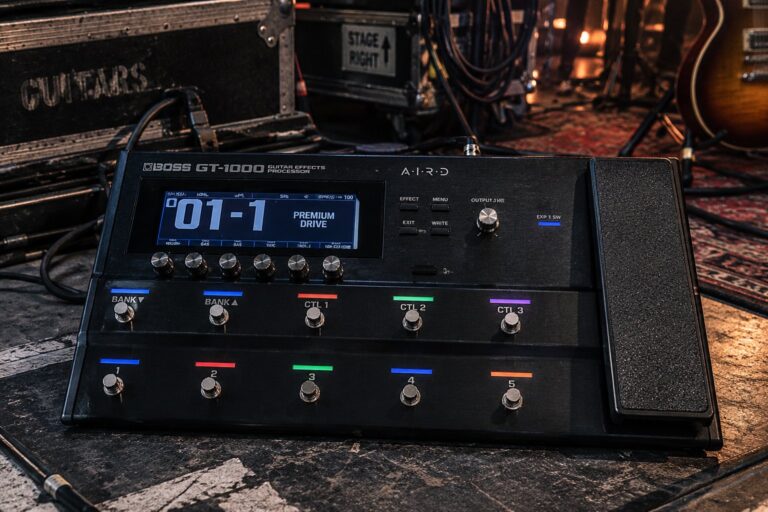
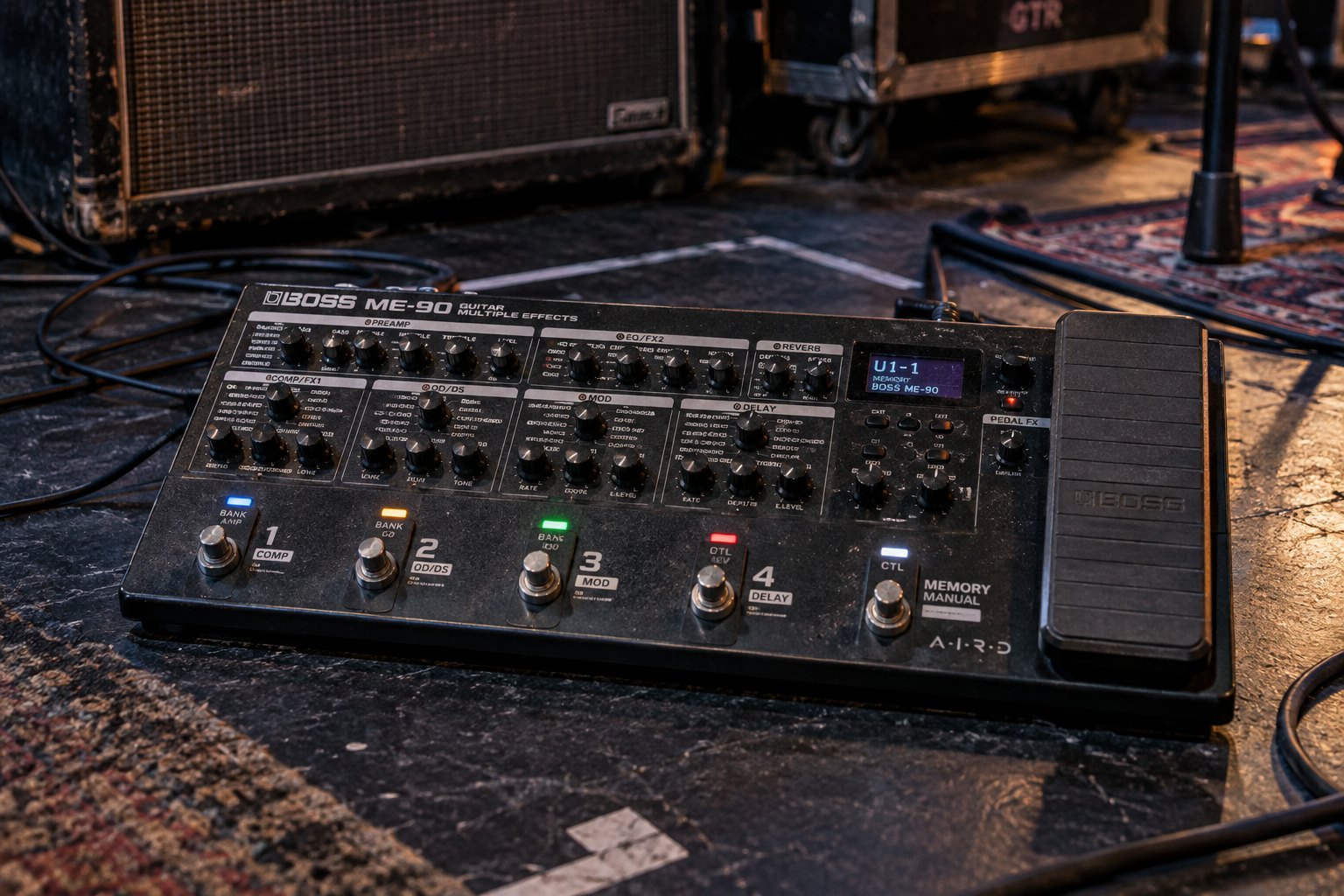
BOSS ME-90 Guitar Multi-Effects Processor. AI-generated reference illustration, not a photograph.
The Boss ME-90 packs 11 AIRD amp models, 60 effects, and GT-1000 DNA into a $350 floor unit. Here's why it belongs in serious gigging rigs.
There’s a certain kind of guitarist who gets quietly smug at soundcheck. They walk onstage, plug one cable into the PA, tap two footswitches to call up a patch, and spend the remaining forty minutes of load-in drinking a beer while the pedal-board guys argue about power supplies and buzz loops. That guitarist owns a Boss ME-90.
Announced on July 6, 2023, the ME-90 is the latest and most capable entry in the Boss ME series — a lineage that stretches back to 1988 and has quietly equipped more working guitarists than any boutique rig you’ve read about in a magazine. It is not a profiler, not a neural-capture device, not a touchscreen laptop in a floor unit. It is 30 physical knobs, 8 footswitches, 11 AIRD amp models lifted directly from the flagship GT-1000, and a build quality that will outlast the venues you play it in. Street price: $349.99.
That price, more than anything, defines the ME-90’s mission. At this number you are not buying a Helix or a Quad Cortex. You are buying the distilled intelligence of decades of Boss multi-effects engineering delivered in a format that a working function-band guitarist can set up in four minutes and not think about again until the load-out. This is not a limitation. For most people in most situations, it is exactly the right tool.
Thirty-Five Years of Getting It Right: The ME Series Story
Boss launched the ME-5 in 1988, just one year after Roland introduced the world’s first multi-effects processor, the GP-8. Where the GP-8 was aimed at studio professionals, the ME-5 was explicitly for live guitarists: five stompbox-style footswitches, a handful of essential effects, and a layout that anyone who’d ever used a pedal board could understand inside of ten minutes. It had no knobs — parameters were accessed via a small button matrix — but the philosophy was already there. Consolidate what players actually need, make it fast to operate, build it to last.
The ME-6, ME-8, ME-20, ME-25, ME-30, and ME-50 followed in roughly chronological succession, each generation adding effects types, improving audio quality, and gradually shifting from analog circuitry to Boss’s own COSM (Composite Object Sound Modeling) digital processing. The ME-25 brought COSM amp modeling to the price point for the first time. The ME-50 added an expression pedal. By this point the format was essentially fixed: rows of category-labeled knobs, a cluster of footswitches, and a compact slab body built to take a boot heel to the face without flinching.
In 2014 the ME-80 arrived with a genuinely clever footswitch redesign that mounted two switches on a shared cradle within a single footswitch’s footprint — effectively doubling the number of footswitches without expanding the unit’s floor real estate. It also introduced BOSS Tone Studio, the free desktop editor that opened up deep patch editing and direct access to BOSS Tone Central’s library of artist-preset downloads. The ME-80 sold in enormous numbers and became the reference point for the category.
The ME-90 launched nine years later, keeping everything that made the ME-80 beloved — the knob-per-function layout, the dual-cradle footswitches, the battery option — while swapping COSM for AIRD and upgrading the amp models from the ME-80’s own library to preamps ported directly from the GT-1000. That last point matters more than the price difference suggests. The GT-1000 is Boss’s professional-grade flagship floor processor, a unit that sells for more than twice the ME-90’s price. Its AIRD preamps don’t get watered down on the way over.
Full Specifications
| Announced | July 6, 2023 (Los Angeles) |
|---|---|
| US Street Price | $349.99 |
| Processing | 32-bit floating-point |
| AD/DA Conversion | 24-bit |
| AIRD Amp Models | 11 onboard + more via Tone Studio |
| Amp Model Names | Natural, Twin Combo, Tweed Combo, Diamond, Brit Stack, Recti Stack, X-Crunch, X-Hi Gain, X-Modded, Maximum, Juggernaut |
| Effect Types | 60 onboard + 20+ via Tone Studio |
| Effect Categories | Comp/FX1, OD/DS, Mod, Delay, Reverb, EQ/FX2 (plus Preamp) |
| Simultaneous Effects | All categories active simultaneously (one type per category) |
| Presets | 36 preset + 36 user patches |
| Footswitches | 8 (dual-cradle design) |
| Expression Pedal | Built-in with integrated toe switch |
| Front-Panel Knobs | 30 |
| Effects Loop | Send/Return (placeable pre or post amp model) |
| User IRs | 3 (loaded via Tone Studio software) |
| USB | USB-C (audio interface + Tone Studio communication) |
| Bluetooth | Optional (via Boss WL-D20 or BT-DUAL adapter) |
| Output Switch | Rear-panel Amp / Line toggle |
| Power | 4 × AA batteries or optional AC adapter (9V DC) |
| Control Modes | Memory mode (patch recall) + Manual mode (stompbox-style) |
| Tone Studio | macOS / Windows (patch editing, alternate amp/effect types, IR loading) |
| Ecosystem | BOSS Tone Central (artist patches), Tone Exchange (user community patches) |
| Bass version | ME-90B (released alongside) |
AIRD: What It Actually Means at This Price
AIRD stands for Augmented Impulse Response Dynamics. The name is deliberately technical-sounding, but the claim underneath it is straightforward: the amp models respond to pick attack, volume knob position, and playing dynamics in a manner that approximates how real tube amplifiers respond to those inputs, rather than simply applying a static frequency-response curve to the signal. Boss does not claim that AIRD models specific named amplifiers the way Kemper’s profiling captures an individual unit on a specific day. Instead AIRD models dynamic response characteristics — the way a clean Fender compresses under a hard pick, or the way a cranked Marshall opens up as you roll back the guitar’s volume.
In practice, on the ME-90, this means the eleven amp types genuinely react differently to how hard you hit them. Natural and Twin Combo stay clear with volume up, clean with presence and sparkle, but reward digging in with a subtle, controlled breakup. Tweed Combo has that mid-forward bark at the top of the clean range, exactly where a real tweed-era push becomes interesting. Brit Stack and Recti Stack are designed for rock and high-gain territory respectively and both maintain articulation on palm-muted low strings better than COSM-era Boss preamps at equivalent settings. Juggernaut and Maximum are for players who want their amp section to function as a distortion device in its own right, with gain on tap beyond what any tube preamp in a normal rehearsal room could legally produce.
Each amp model ships with a dedicated cabinet simulation, so the ME-90 produces a usable DI-ready signal straight from the XLR — or in this case, straight from the 1/4″ output set to Line mode. The rear-panel toggle between Amp and Line is one of the most practically important controls on the unit. In Amp mode the output is voiced for front-of-house PA use when a real amplifier is in the chain at speaker-input level; in Line mode the cabinet simulation is active and the output is flat, ready for a PA, interface, or FRFR speaker. Most players running without a backline should always be in Line mode. Running into the front of a real amp with Line mode engaged produces the muddiness that causes people to complain about multi-effects processors — it’s a settings issue, not a product flaw.
Famous Players: An Honest Assessment
The Boss ME-90 does not have a famous player story in the traditional sense, and understanding why is important context for evaluating the product. The ME series has always existed at a price point where endorsement deals are structurally awkward: the artists who can negotiate them typically play flagship equipment, and the equipment at this price point sells on its merits to working musicians who are not endorsees of anything.
The one artist documented on Equipboard’s ME-90 page is Vincen García, a Spanish-Catalan singer-songwriter and Latin indie artist. This is Equipboard data, not a primary-source interview or verified rig rundown. The connection is noted for completeness rather than presented as a primary verification.
No Premier Guitar Rig Rundown, no primary-source interview, and no manufacturer artist page has been found placing a touring guitar headliner on an ME-90 during our research for this article. This is not a meaningful criticism of the product. It reflects the demographic reality of who buys ME-90s. The guitarist filling three different function bands on six nights a week out of a hatchback has less incentive to publish their rig than the guitarist playing arenas, and considerably more incentive to own something that costs $350, takes up no more floor space than a pizza box, and runs on batteries when the venue’s power is dodgy.
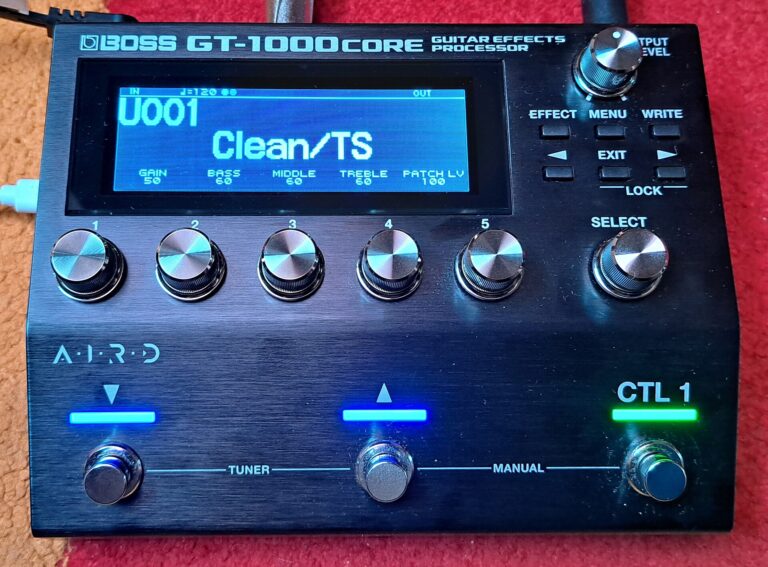
For reference, Johnny Marr — who we independently verified as a GT-1000CORE user (That Pedal Show, October 2023, own words) — represents the tier above the ME-90 in the Boss multi-effects lineup. Misha Mansoor and Mark Holcomb of Periphery operate at the Fractal and Neural DSP tier for studio work and have been used here as genre context in adjacent articles. The ME-90 is not the tool any of them reach for when they need a touring rig. It is very possibly the tool one of them has in the back of their car for when a session comes up and they can’t be bothered to bring a pedalboard.
Five Tone Recipes
1. Pub Rock and Classic Rock — Front-of-House Direct
Set the Preamp to X-Crunch with Gain at 9 o’clock, Bass at noon, Mid at 1 o’clock, Treble at noon, and Presence just above noon. Set the EQ/FX2 section to a slight high-mid boost around 2 kHz (+3dB) to cut through a loud pub mix. Add a light spring reverb (Spring, Time 2.0s, Effect Level around 30%). Use Manual mode so your volume pedal lives on the expression pedal at all times. Assign CTL to toggle the Mod section (Chorus at Rate 40, Depth 40) for chorus-heavy parts. Rear switch to Line. This covers everything from Faces to Thin Lizzy to Tom Petty without touching a knob between songs.
2. Nashville Country Clean with Compression
Set Preamp to Twin Combo, Gain at minimum, Bass at 10 o’clock, Mid at 11 o’clock, Treble at 2 o’clock. Engage Comp/FX1 and select the Boss CS-type compressor (Sustain 50, Level 55, Attack slow). Delay section: a single-slap Digital Delay at 130ms, Feedback 1 repeat, Level 25. Reverb: Room, Time 1.5s, Level 20. This clean platform with compression handles chicken-pick country, arpeggiated chords, and ambient ballads. Works spectacularly when your guitar’s volume knob is used actively.
3. Modern High-Gain Metal — Tight and Direct
Preamp to Recti Stack (or Maximum for tighter bass response). Gain at 2–3 o’clock, Mid deliberately scooped to 9 o’clock, Bass at 11 o’clock, Treble at 1 o’clock. Gate: Threshold at 50, Attack fast. Add a tube-screamer style OD/DS in front of the Preamp section (T-Screamer type, Drive at minimum, Level at maximum, Tone at noon) to tighten the low end. Delay: Analog delay, 400ms, 1 repeat, Level 20. No reverb. This is the classic high-gain FOH signal: tight, punchy, and noise-gated so the audience hears palm mutes, not HVAC interference.
4. Indie / Shoegaze Texture — Swells and Ambience
Preamp to Natural at moderate gain (10–11 o’clock) or Diamond for slightly warmer character. Assign the expression pedal’s Freeze mode to swell sustained notes. Mod section: Shimmer (if available via Tone Studio) or standard Chorus at slow Rate 25, Depth 60. Delay: Dual delay with long time values (600ms primary, 800ms secondary), Feedback at 45, Level 35. Reverb: Hall at Time 4.0s+, Level 45. Volume pedal (assign to expression pedal toe) for manual swells. This is the ambient indie recipe that works equally well for shoegaze, dream pop, and the quieter passages in progressive rock sets.
5. Blues Clean-to-Gritty — Volume Knob Sensitive
Preamp to Tweed Combo. Gain at 1 o’clock — this is intentionally right at the edge of breakup. Lower your guitar’s volume knob to 6–7 and you’re in Stevie-clean territory. Roll it to 10 and the Tweed Combo opens up into a warm, mid-forward crunch. Engage no OD pedal in the OD/DS section — the amp does the work. Mod section off. Light tape-echo delay (Tape Echo type, 320ms, Feedback 30, Level 25). Spring reverb (Level 20). This recipe rewards actually playing dynamically rather than relying on patch switching, which is exactly the point of the exercise.
Memory Mode, Manual Mode, and the 4CM Option
The ME-90 operates in two fundamentally different control modes and the choice between them defines your entire workflow on stage.
Memory mode is the traditional multi-effects paradigm: the front four footswitches recall complete patches (amp model + all effects on/off states saved together), and the two rear switches bank up and down through patch groups. This is the right mode for cover bands with specific setlists, theatrical shows with cue-based sound changes, and any situation where you need to go from a clean verse tone to a lead tone with seven effects engaged at one stomp. The ME-90 ships with 36 factory presets and holds 36 user patches.

Manual mode turns the ME-90 into a pedalboard of category-based stompboxes. Each footswitch controls one effect category (Comp, OD/DS, Mod, Delay, Reverb, and so on), exactly as if they were individual pedals. There are no patch changes — you’re directly toggling categories on and off. This is the mode for players who grew up on pedalboards and find patch-switching unnatural, and for situations where you want to make real-time decisions rather than rehearsed ones.
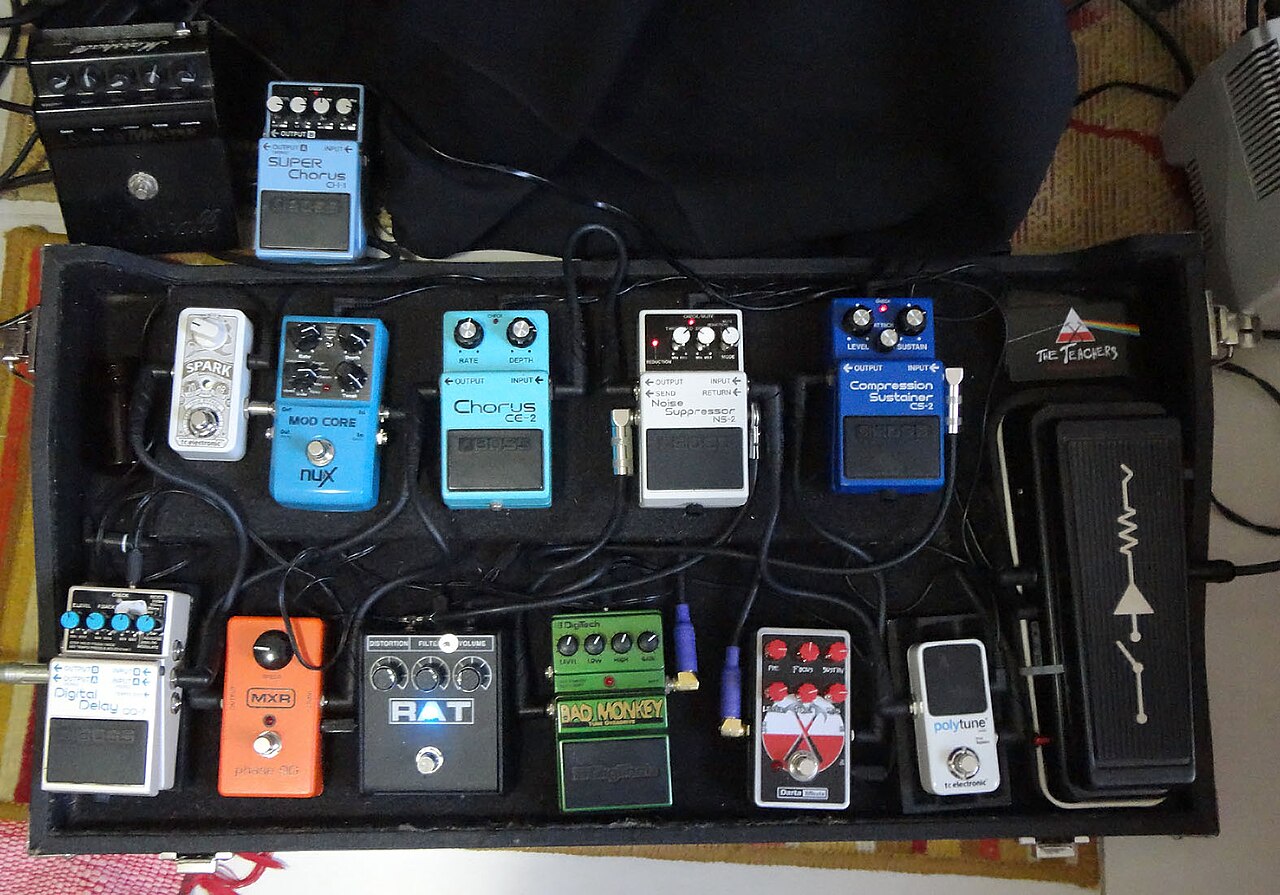
The effects loop deserves specific mention. It accepts external pedals, and critically, it can be placed either before or after the amp model in the signal chain — a flexibility that most ME-series predecessors lacked. If you have one pedal you love that the ME-90 can’t replicate (a specific boutique fuzz, a vintage phaser, an expression-based tremolo), you can loop it in and Boss will switch it on and off along with your patches. In Memory mode, the loop’s on/off state is saved per patch. This is a significant practical feature for players who want the ME-90’s convenience without fully abandoning their analogue favourites.
The Four-Cable Method (4CM) is also possible with the ME-90, though its implementation is simpler than on units like the GT-1000CORE, which has two independent loops. With the ME-90’s single loop, you can place pre-amp effects before your real amp’s input and time-based effects in the amp’s effects loop — the standard 4CM configuration. It is somewhat manual to configure compared to dedicated 4CM-capable processors, but it works.
Tone Studio, Tone Central, and the Ecosystem Play
The ME-90’s $350 price does not fully represent the depth of what you’re buying, because Boss Tone Studio is free and it materially expands the unit. Through Tone Studio you can swap some of the 11 onboard amp types for additional AIRD models (not all types are available simultaneously — it’s a selection, not unlimited), access additional effect types beyond the 60 onboard, and load up to three user IR files for alternative cabinet simulation. The IR loader is a genuine differentiator at this price — most competitors at $350 don’t include it.
BOSS Tone Central hosts free artist patch downloads created by professional players. These are not marketing content; they are functional patches tuned for specific sounds. Downloading a handful and using them as starting points for your own modifications is one of the fastest ways to understand what the ME-90’s amp models are capable of beyond the factory presets.
BOSS Tone Exchange takes this further with a community-upload platform where other ME-90 owners share patches. The library is extensive and searchable by genre, making it a practical resource for function band players who need to cover a specific era’s guitar tone quickly.
Bluetooth control, via the optional Boss BT-Dual or WL-D20 adapter, adds wireless patch editing via the Boss Tone Studio iOS/Android app. This is not standard; it requires the adapter purchase. But for players who want to adjust tones from the front of the stage without walking back to the unit, it’s a legitimate option.
Comparisons: Where the ME-90 Fits in the Ecosystem
The immediate family comparison is within Boss’s own lineup. The Boss GX-100 sits above the ME-90 at approximately $619 street and adds a 4.25″ touchscreen, drag-and-drop chain building, 23 AIRD preamps (vs. 11), 150+ effects (vs. 60), and 300 presets (vs. 72). The GX-100 cannot run on batteries, requires AC power, and demands more setup time. The ME-90 is the version you choose when tactile-first operation and the ability to run unplugged matter more than depth of editability.
The Boss GT-1000 is the professional-tier unit at roughly $800–900 new, with 20 AIRD preamps, 116+ effect types, 250 presets, Bluetooth built-in, XLR sub-outputs, and dual effects loops. The GT-1000 is the right answer for touring players who need the full toolkit. The ME-90 is the right answer when you need 90% of the capability at 40% of the cost and half the floor real estate.
Against the Line 6 POD Go, the most directly competitive unit at a similar price, the comparison is genuinely close. The POD Go offers Helix-quality DSP (the same HX processing as the flagship Helix Floor), four simultaneous processing blocks with more routing flexibility, and a colour LCD display. Its amp modeling is arguably more cinema-quality for studio recording. The ME-90 counters with more physical knobs (faster live operation), the battery option, a more robust tactile control layout, and the BOSS ecosystem for community patches. The POD Go is the stronger studio tool; the ME-90 is the stronger live tool for players who hate screens.
Against the Neural DSP Quad Cortex at $1,350+, the comparison is really about use case. The Quad Cortex is a professional neural-capture modeler with a touchscreen interface and the ability to capture your own physical amplifiers. It belongs in a different conversation. The point of noting it is that the ME-90 costs one-quarter the price and for most working guitarists on most gigs, produces results that the audience cannot distinguish in a live PA mix.
The Neural DSP Nano Cortex is a more relevant comparison at its sub-$400 price, with neural capture processing in a compact unit but without the extensive onboard controls and effects ecosystem of the ME-90. Players who prioritize capture accuracy over breadth of effects will prefer the Nano Cortex; players who need a one-box solution for everything — amp, effects, looping, audio interface — will prefer the ME-90.
Buying Guide: New, Used, and What to Watch For
New ME-90s have been widely available since late 2023 at the $349.99 US street price, with some authorized dealers periodically offering modest discounts. The unit is current production with no successor announced at the time of writing, and Boss’s ME series has historically enjoyed long production runs — the ME-80 ran from 2014 to 2023, nearly nine years — so there is no urgency premium on new purchases.
Used ME-90s are beginning to appear at $250–$300 in good condition as early adopters cycle through gear. Because the unit is relatively new and built to Boss’s characteristic durability standards, used examples are generally reliable. Inspect the expression pedal’s range of motion (check for smooth, consistent travel with no dead spots) and confirm the toe switch activates cleanly. The knobs use rotary detent controls on some parameters and continuous sweep on others — check all 30 for smooth action. USB-C connectivity is functional and not subject to the mechanical stress issues that affected older USB-B ports on previous Boss units.
The battery option (4 AA) provides approximately eight hours of runtime at moderate volume — useful for rehearsal, less practical as a touring power solution. For gigging use, budget $15–20 for an appropriate 9V DC center-negative adapter at 500mA or above. Boss’s own PSA-series adapters are the safest choice; third-party adapters with correct polarity and current rating work equally well.
If you need the extended effects library available via Tone Studio, budget time rather than money — the software is free and the patch download ecosystem is extensive. Plan a setup session before your first gig to dial in three to five core patches rather than relying on factory presets.
Ownership Notes: Making It Work Live
The rear-panel Amp/Line switch is the first thing to set correctly. If you’re going direct to a PA or FRFR speaker, it must be on Line. If you’re feeding the front of a real guitar amplifier, use Amp mode. Running Line mode into a real amp produces doubled cab simulation that results in an unusably muddy signal — this causes more negative user reviews of the ME-90 than any actual product defect.
Manual mode is best approached category by category during soundcheck. Start with the amp section (the Preamp category), set your base tone, then add effects one section at a time. Because you cannot stack two effects within the same category (two different modulation types running simultaneously, for example), your signal chain planning needs to happen within the hardware constraints. If you find yourself consistently needing a flanger and a chorus simultaneously, you either need an external pedal in the loop or a move up to the GX-100 or GT-1000.
The expression pedal’s toe switch and the assignment options are more powerful than they appear from the front panel. Beyond the standard wah and volume assignments, Freeze mode (which holds a sustained note pitch-accurately beneath live playing) is available and is particularly effective for ambient and post-rock applications. Assigning the toe to engage a delay trail or a gain boost is a setup that many ME-90 owners arrive at within their first month of use.
The effects loop, if you have pedals to run through it, rewards experimentation with position. Boss’s implementation allows the loop to be set pre-amp (so your external pedal is treated as a gain stage feeding the amp model) or post-amp (so the amp model’s output feeds into your external pedal). For vintage fuzzes that need to see a high-impedance input before amp modeling, pre-amp loop placement is essential. For reverb pedals with longer trails you want to preserve post-switching, post-amp placement is correct.
Frequently Asked Questions
What is the main difference between the ME-90 and the ME-80?
The ME-80 used Boss’s COSM (Composite Object Sound Modeling) amp modeling technology. The ME-90 replaces COSM with AIRD (Augmented Impulse Response Dynamics), the same amp modeling architecture used in the GT-1000 flagship. AIRD is specifically engineered to model dynamic response rather than static frequency response, resulting in more realistic pick-attack sensitivity and volume-knob interaction. The ME-90 also adds USB-C connectivity, a redesigned expression pedal with improved parameter resolution, and a slightly lighter chassis than the ME-80 while maintaining the same fundamental control layout.
Can the ME-90 be used without a guitar amplifier?
Yes. Set the rear-panel switch to Line mode, which activates the cabinet simulation built into each amp model. The 1/4″ output can feed a PA’s direct input, an audio interface, or a full-range flat-response (FRFR) speaker. This is described as the unit’s primary intended use case for live performance. Running the ME-90 through a real amplifier in Line mode produces doubled cabinet simulation and audible muddiness — use Amp mode when feeding a real guitar amplifier’s input.
How many effects can run simultaneously?
The ME-90 has six effect categories (Comp/FX1, OD/DS, Mod, Delay, Reverb, and EQ/FX2) plus the amp model. All six categories can be active simultaneously, providing a complete signal chain. The limitation is that you can only use one effect type within each category at a time — you cannot run two modulation effects simultaneously without using an external pedal in the effects loop. The GT-1000 removes this limitation with its more flexible routing engine.
Does the ME-90 work as an audio interface?
Yes, via the USB-C connection. The ME-90 appears as a two-in/two-out USB audio interface in your DAW. This is useful for direct recording and re-amping. The interface runs at 24-bit resolution, which is appropriate for all practical recording purposes. Boss Tone Studio communicates over the same USB-C connection and can be open simultaneously.
What does “Tone Studio” add that’s not available on the hardware?
Boss Tone Studio for macOS and Windows provides access to additional amp model types and effect types not loaded on the hardware by default (swapping and replacing, rather than adding on top of the 60 onboard), allows loading of up to three user impulse response files for alternative cabinet simulation, and offers a graphical patch editing environment that is considerably faster than editing via the hardware’s small LCD. Tone Studio also connects directly to Boss Tone Central for one-click download of artist patches and to Boss Tone Exchange for community-uploaded presets.
Is Bluetooth built into the ME-90?
No. Bluetooth is optional and requires purchasing Boss’s optional BT-Dual or WL-D20 Bluetooth adapter. Once connected, it enables the Boss Tone Studio mobile app for iOS and Android, which allows wireless patch editing and streaming audio to the ME-90 for playing along with tracks without a cable. The adapter is an additional cost of approximately $30–60 depending on the model chosen.
How does the ME-90 compare to the Line 6 POD Go at a similar price?
The POD Go uses Line 6’s HX processing engine — the same DSP platform as the flagship Helix — which produces studio-quality amp modeling well-suited to recording. It offers a colour LCD display and more flexible routing (four simultaneous blocks with multiple routing paths). The ME-90 counters with 30 physical knobs for faster on-the-fly adjustments, battery operation, a more intuitive live-performance control layout without menus or screen navigation, and the Boss Tone Central ecosystem. The POD Go is the stronger studio-recording choice; the ME-90 is the stronger choice for live performance where speed of adjustment matters more than routing depth.
What’s the warranty on the Boss ME-90?
Boss (a Roland Corporation division) offers a five-year limited warranty on the ME-90 through its standard BOSS 5 Year Warranty program for products registered within the warranty period. Registration is handled through the Boss Backstage portal. The five-year term is longer than most competitors in this category, which typically offer one or two years, and reflects Boss’s confidence in the platform’s build durability.
Image credits
- A pedalboard with a mix of pedals: marcelodonati, Wikimedia Commons, CC BY 2.0.
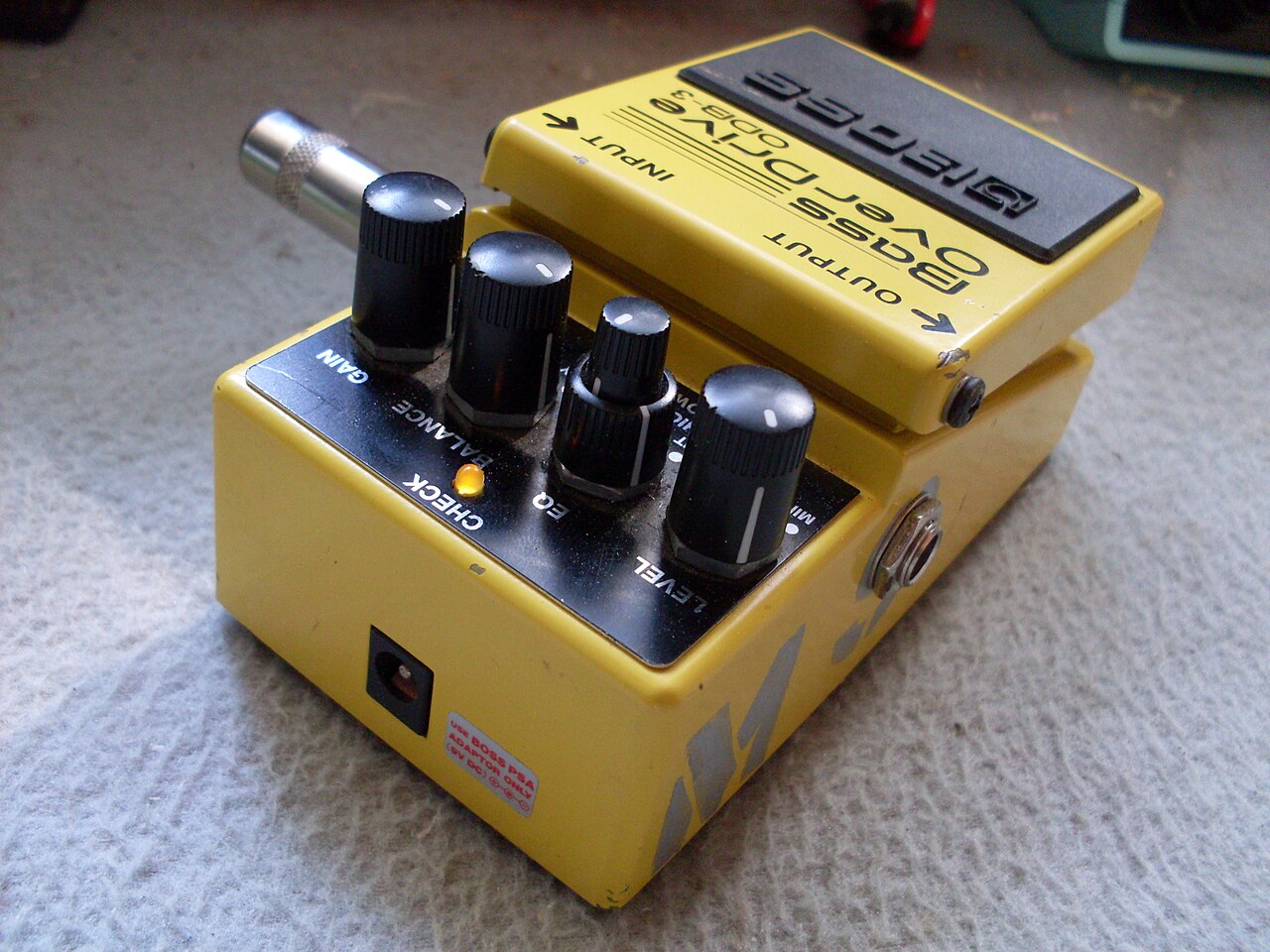
- A Boss ODB-3 bass overdrive pedal seen from the rear: Roadside guitars, Wikimedia Commons, CC BY-SA 2.0.
- Boss OD-2 Turbo Overdrive and OD-2R pedals side by side: Kuriosatempel, Wikimedia Commons, CC BY-SA 4.0.
- Top image: GuitarGangsters AI-generated reference illustration, not a photograph.
Latest News
Related
On This Day
Monday 9 November
From this week: