The Whole Rig in Your Pocket: Why the Friedman IR-X Dual Tube Preamp Is a Pedalboard Game-Changer
The Friedman IR-X: two high-voltage 12AX7 tubes, dual channels, 12 IRs, 128 MIDI presets in a 1.5-pound pedal. Full specs and tone recipes inside.
Two real 12AX7 tubes, Dave Friedman’s signature voicings, and pro IR technology — crammed into a box smaller than most lunch pails
For decades, the name Friedman meant one thing to serious rock guitarists: a handwired, high-voltage, USA-built amplifier that cost about as much as a used car and sounded better than almost anything else on the planet. Dave Friedman spent years in a North Hollywood workshop quietly rewiring Marshalls for the kind of artists whose names you see in Guitar World’s Greatest Guitarists lists — Jerry Cantrell, Eddie Van Halen, Steve Stevens — and when he finally launched his own production amps in 2011, the world quickly discovered that those bespoke tones were worth every penny of the premium price tag.
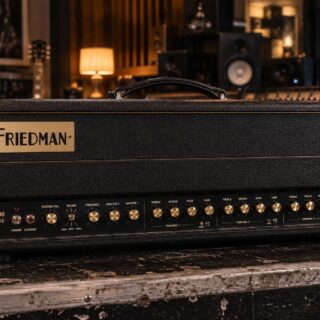
The problem, as always with boutique amplification, was accessibility. Not everyone can drop $5,000 on a BE-100 head, source a matching 4×12 loaded with the right speakers, and then figure out how to get that rig into a fly date or a recording studio without a freight bill. The Friedman IR-X Dual Tube Preamp — launched in 2023 — is the company’s most direct answer yet to that question. It is not a simulation of a Friedman preamp. It is a Friedman preamp, complete with two high-voltage 12AX7s doing the actual work, married to a sophisticated DSP IR cabinet system and 128 MIDI presets. The whole package weighs 1.5 pounds. Your pedalboard just got considerably more serious.
Dave Friedman: From Marshall Mods to Global Boutique Brand
Dave Friedman’s origin story is one of the great self-taught apprenticeships in guitar gear history. Working out of Los Angeles in the 1980s and 1990s, he developed a reputation for Marshall modifications that went far beyond the standard preamp tube swap or cap job. He understood the interaction between power supply sag, preamp gain staging, and output transformer voicing at a level that very few technicians matched, and the results were amplifiers that retained the snarl and dynamics of a vintage Plexi while adding the articulation and controlled aggression that modern rock demanded.
His client roster during those years reads like a who’s who of arena-level guitar playing. Jerry Cantrell had Friedman dialing in the heavily downtuned, sludgy-yet-articulate wall of sound that defined Alice in Chains. Steve Stevens, who required a level of technical sophistication in his rig that matched his playing, became such a close collaborator that the first Friedman production amplifier — the SS-100, released in 2011 — bore his initials. Eddie Van Halen, whose brown sound had launched a thousand imitation mods, also spent time in Friedman’s workshop chasing tone refinements.

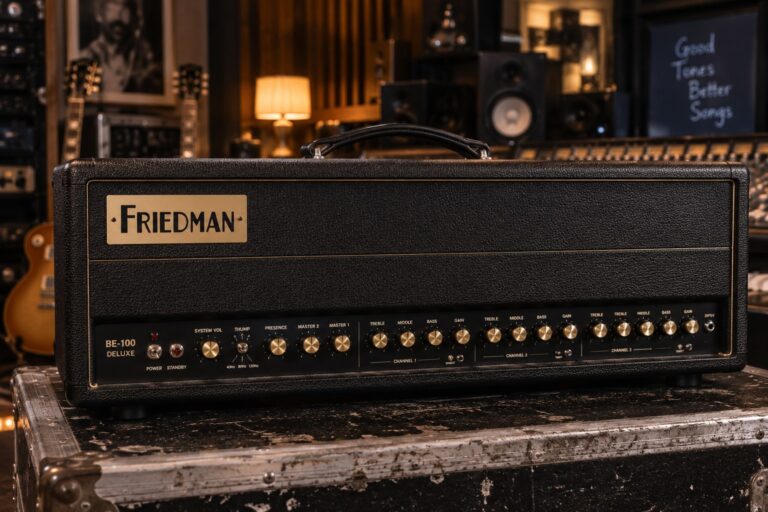
When Friedman Amplification began producing amplifiers for the broader market, the flagship BE-100 (the “BE” standing for Brown Eye, a nod to the EVH tradition) became the reference point for a particular flavor of high-gain tone: more controlled and articulate than a raw Plexi, warmer and more organic than a Mesa Rectifier, with a midrange clarity that makes complex chord voicings sound like music rather than mud. Over the following decade, that basic voicing philosophy informed the entire Friedman line — from the tiny Pink Taco 20-watt combo to the JEL-20 Jake E. Lee signature head.
The IR-X represents the logical extension of that philosophy into the preamp pedal format that has dominated the modern guitarist’s pedalboard. The question was never whether Friedman could build a great preamp in a pedal — it was whether they’d do it with real tubes or take the solid-state shortcut that competitors sometimes hide behind marketing language. They went with real tubes, at real operating voltages. The difference, as any player who has tried both approaches knows, is not subtle.
What Actually Makes the IR-X Different
The defining fact about the IR-X is that phrase “high-voltage.” Many preamp pedals on the market advertise tube circuitry as a selling point while actually running their 12AX7s at voltages far below what the tubes are designed to operate at — typically somewhere between 9V and 30V, compared to the 200V-plus that a tube preamp stage in a real amplifier uses. At low voltages, a 12AX7 behaves more like a soft-clipping diode than a tube. It adds warmth in a generic, decorative sense, but it doesn’t exhibit the compression, bloom, and harmonic complexity that makes tube amplification special.
The IR-X runs its two 12AX7s at proper high voltage. The result is a preamp that responds to your picking dynamics the way a real amp does: dig in and it compresses and blooms; back off and it opens up and cleans. Roll back the guitar’s volume knob and Channel 1 goes almost entirely clean. This is not behavior you get from a 9V tube circuit.
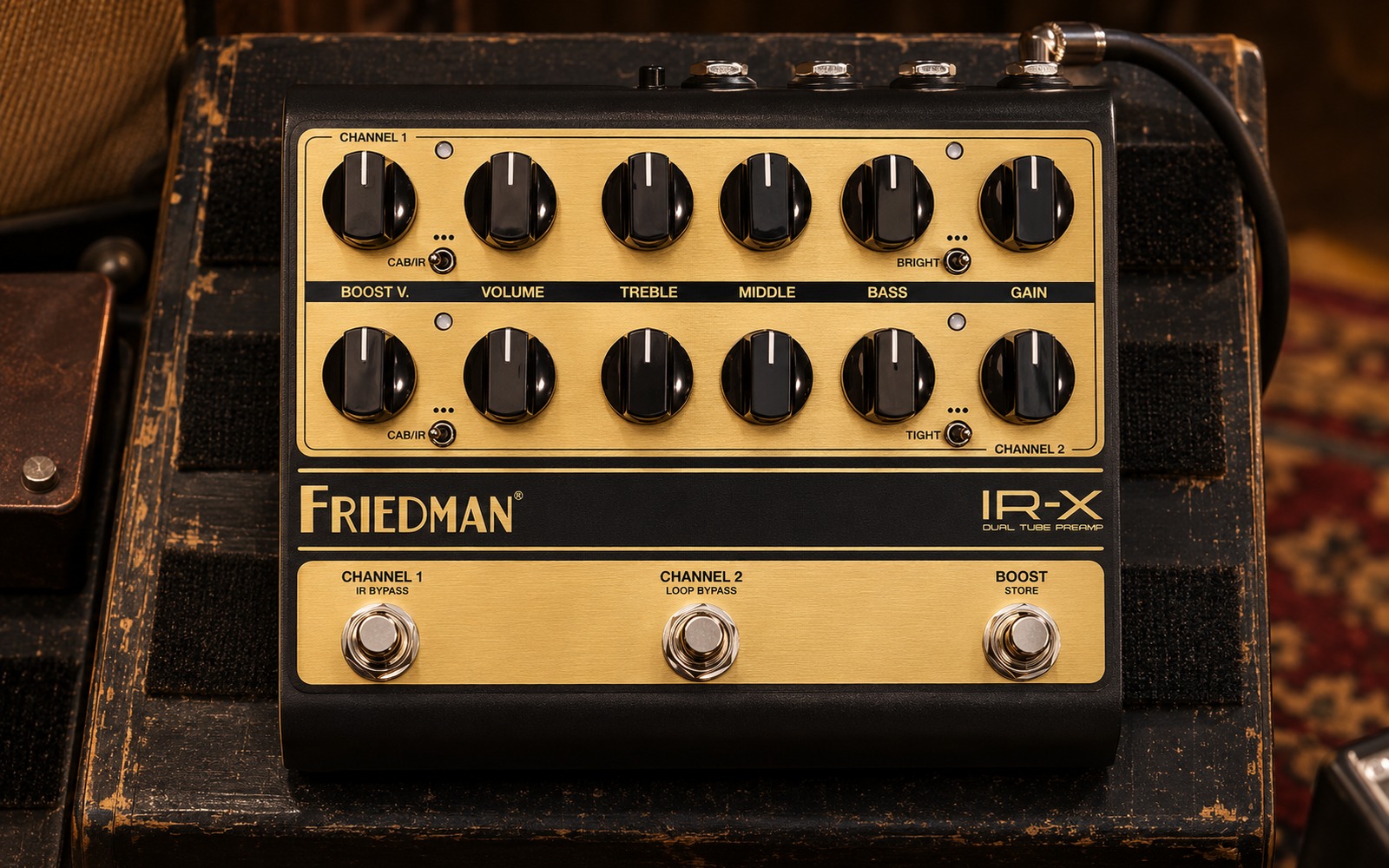
Channel 1 is voiced for the British end of the tonal spectrum — a clean-to-crunch voice that starts from a warm, touch-sensitive clean and works up through Plexi-style breakup as the gain increases. A 3-way Bright switch adjusts the high-frequency response, letting you dial out ice-pick harshness or add sparkle depending on your guitar and cabinet choice. It is a fundamentally versatile channel: a Telecaster through Channel 1 with a light touch produces chimey, glassy tones; the same channel with a humbucker guitar and the gain pushed gives you the kind of British rock rhythm sound that powered a thousand classic albums.
Channel 2 is where the Friedman signature high-gain voice lives. This is the channel that sounds like a BE-100 — the tightly focused, percussively punchy, harmonically dense overdrive that players like Cantrell built their careers around. A 2-way Tight switch controls the bass response in the preamp stage, giving you a standard voicing or a tighter, more focused bottom end that’s better suited to drop tunings and fast picking. Both channels feature independent Boost circuits with their own Gain and Volume controls, effectively giving you four distinct sounds accessible via footswitch from a box roughly the size of a standard two-channel stompbox.
Specifications
The Three Factory IRs and What They Tell You
The IR-X ships with 12 Friedman cabinet impulse responses, but understanding the three that are factory-loaded per channel tells you a lot about the voicing philosophy behind the entire unit.
The 6402 57/121 is Dave Friedman’s personal workshop cabinet — a 4×12 housing four Celestion 6402 Greenback speakers that has been in his North Hollywood shop since the very beginning. It’s the cab he uses to voice every amplifier that leaves his bench. Captured with a combination of an SM57 (for cut and presence) and a Royer R-121 ribbon mic (for warmth and body), this IR has become the de facto reference for the “Friedman sound.” When players describe what a BE-100 sounds like in recordings, they’re usually hearing this cabinet — or something very close to it.

The V30 is a more conventional option: a standard Friedman closed-back 4×12 loaded with Celestion Vintage 30s, captured with a single SM57 through an API preamp. It’s the punchy, high-presence British rock sound that has dominated hard rock and metal production for thirty years — think classic 1990s high-gain tones. And the 1980B V30 GB is a rarer flavor: an actual 1980s UK-market 4×12 loaded with Greenbacks in the top two positions and Vintage 30s in the bottom two, a combination that produces a significantly larger, more complex soundstage with deep low end and cutting top end simultaneously.
Beyond the factory three, the editor software lets you load any third-party IR in WAV format, which means the entire aftermarket IR ecosystem — from OwnHammer and Celestion’s official IRs to the free packs scattered across ToneHunt — is immediately available. You can also bypass the onboard IR system entirely and use the IR-X as a pure tube preamp feeding an external IR loader or a traditional guitar cabinet.
Famous Players in the Friedman Orbit
To be transparent about something important: the Friedman IR-X is a 2023 product, and at the time of writing, documented famous-player usage specific to this particular unit is limited. The official Premier Guitar gear spotlight demo was conducted with Sammy Boller — a technically accomplished Candyrat Records artist who is a Friedman endorser — alongside Dave Friedman himself. Boller’s demonstrations showed the unit’s range convincingly, from clean jazz voicings to full-on high-gain metal, and he is one of the few players who can be definitively confirmed as a public IR-X demonstrator.
What the IR-X does inherit is the enormous credibility of the Friedman artist family, who use the brand’s full amplifier range. Jerry Cantrell of Alice in Chains is the most historically significant Friedman user — his relationship with Dave Friedman predates the company itself, and the high-gain voicing of the BE-100’s Channel 2 exists in direct lineage from the modified Marshalls that defined Cantrell’s tone on records like Dirt and Jar of Flies. That Channel 2 on the IR-X is the same voicing philosophy in miniaturized form.
Steve Stevens (Billy Idol, Michael Jackson’s “Beat It”) was so influential in shaping Friedman’s production amp philosophy that his initials are on the first model. He has been a consistent presence in Friedman’s orbit and his clean-to-lead approach maps well onto the IR-X’s two-channel architecture. George Lynch (Dokken, Lynch Mob) is also on Friedman’s official roster, bringing a different flavor of high-gain 1980s vocabulary that works particularly well with the Channel 1 Plexi voicing pushed hard.
Phil X, the Bon Jovi guitarist known as much for his YouTube gear content as his arena performances, is another confirmed Friedman artist. His use of the brand’s amps across live and studio contexts has given Friedman considerable visibility in both the pro touring and enthusiast YouTube communities. Chris Shiflett of Foo Fighters, Jim Root of Slipknot, Bill Kelliher of Mastodon, Neil Schon of Journey, and Ray Toro of My Chemical Romance round out a roster that spans three decades of hard rock and metal in a way that underlines how versatile the Friedman voicing actually is across different subgenres.
The honest summary: if you want a unit specifically because your favorite artist publicly plays the IR-X unit itself, the documentation is currently thin. If you want a unit because it embodies the preamp architecture and voicing that has made Friedman’s name in the touring and studio world, the lineage is direct and well-documented.
Tone Recipes and Settings
Recipe 1: Jerry Cantrell Crunch Rhythm
Channel: 2 (high gain) | Tight switch: Tight (2) | Gain: 6–7 | Bass: 6 | Middle: 4 | Treble: 6 | Volume: 6 | Boost: Off | IR: 6402 57/121
Start here for the quintessential Friedman high-gain rhythm tone. The Tight setting controls loose bass frequencies in the preamp stage, giving downtuned chords definition rather than mud. Pull the mids slightly scooped. Use with a humbucker guitar. The 6402 Greenback IR adds warmth without killing clarity.
Recipe 2: Classic British Plexi Rock Lead
Channel: 1 | Bright switch: Center (medium) | Gain: 7 | Bass: 5 | Middle: 7 | Treble: 5 | Volume: 6 | Boost: On, Boost Gain at 5 | IR: V30
Channel 1 pushed with the boost engaged gives you a Plexi-voiced lead sound with considerable midrange presence. The V30 IR adds the classic “singing” top end associated with British rock lead tones. Engage the boost footswitch for solos; channel surfing alone handles rhythm-to-lead transitions.
Recipe 3: Warm Clean Platform
Channel: 1 | Bright switch: Position 1 (most off) | Gain: 2–3 | Bass: 5 | Middle: 6 | Treble: 4 | Volume: 6 | Boost: Off | IR: 1980B V30 GB
The 1980B hybrid cabinet IR with a low gain setting gives you the kind of complex, warm clean that works as a pedal platform. Run your favorite overdrive or fuzz into the IR-X input on this setting and the high-voltage tube stage adds the organic compression and harmonic richness that makes pushed pedals feel like a real amp stack.
Recipe 4: Modern Metal / Drop Tuning
Channel: 2 | Tight switch: Tight (2) | Gain: 8 | Bass: 5.5 | Middle: 3.5 | Treble: 6.5 | Volume: 5.5 | Boost: On, Boost Gain 4 | IR: V30; additionally use editor to set Presence high, Thump low
For drop-D and lower tunings, the editor’s Presence and Thump software controls make a significant difference. High presence sharpens pick attack; low thump keeps low-string riffing tight. This combination is the closest the IR-X gets to the scooped, high-output, articulate modern metal aesthetic.

Pedal Pairings That Work
The IR-X’s input handles pedals the same way a good tube amp input does — it rewards quality signal sources and benefits from transparent drive pedals that interact with the tube stage’s natural compression rather than fighting it.
For Channel 1 in clean mode, a Klon-style overdrive or a mid-forward Tube Screamer variant in front of the input pushes the preamp into natural breakup in a way that sounds convincingly amp-like. The high-voltage tubes respond to the additional signal by compressing and blooming rather than clipping digitally, which is precisely why the high-voltage design matters in practice.
For Channel 2 already in high-gain territory, adding gain pedals in front is usually counterproductive — the channel itself has sufficient gain for any reasonable application. What works well is a clean boost (an EP Booster or similar) to add volume for leads without changing the basic character of the sound. The IR-X’s own onboard boost handles this function, but an external clean boost lets you maintain the preset’s boost setting for other uses while still having solo volume on tap.
In the FX loop, modulation and time-based effects belong here rather than before the input. Reverb, delay, chorus, and flanger sound dramatically better in an effects loop behind a preamp stage than they do in front of a high-gain input — the loop placement prevents gain stages from amplifying the artifacts in those effects. The IR-X’s loop is specifically described by Friedman as “ultra-transparent,” which in practice means minimal tone sucking even with multiple pedals inserted.
How the IR-X Fits Into Different Rig Architectures
The IR-X is a deliberately flexible unit with three distinct use modes that Friedman explicitly documents.
In all-in-one mode, the IR-X is your entire rig. Guitar into the input, dirt and filter pedals in the input chain, time-based effects in the loop, balanced XLR out to the console. This is the fly-gig dream: a consistent, stage-ready tone that doesn’t depend on backline quality, doesn’t require mic placement negotiation with a sound engineer, and fits in a carry-on bag alongside your laptop and cables. The onboard headphone output means you can also use it as a completely silent practice rig.
In standalone preamp mode, the IR-X feeds a power amplifier and a real cabinet onstage while still sending the IR-processed signal to the console via the balanced output. This gives you the physical stage sound and visual presence of a real cabinet while delivering a consistent mic’d tone to front-of-house regardless of stage volume. Many professional touring guitarists use a variation of this hybrid approach specifically because it decouples their monitor sound from the front-of-house mix.
As a pure IR loader, you can feed any preamp or pedal into the IR-X’s effects loop return, bypassing the tube preamp entirely. In this mode it functions as a cab simulator for whatever preamp or amp circuit you prefer, with access to all 12+ Friedman IRs plus any custom IRs you’ve loaded via the editor software.
The Editor Software: Unlocking the IR-X’s Full Potential
The Friedman 4.3 Editor software (Mac 10.15+, Windows 7 64-bit+, powered by SYNERGY) is a genuine companion rather than a beginner afterthought. It connects via USB and reveals several controls that are unavailable on the hardware itself.
Per-channel Presence and Thump controls simulate the power amp section’s interactive controls — Presence adjusts the negative feedback loop’s high-frequency content (in simpler terms: more Presence = more cutting top end and string definition), while Thump adjusts the low-frequency weight of the power section simulation. These two controls alone can dramatically shift the character of a preset, from tight and articulate to loose and large.
Boost Lock is a particularly useful live feature: it allows you to lock the Boost in the on position so that the boost footswitch doesn’t accidentally disengage it mid-song. Effects loop on/off per preset means you can configure presets where certain patches have the loop active (for delay and reverb) and others bypass it (for a raw preamp sound). All 128 MIDI presets can be saved, renamed, and organized via the editor, and IR management — loading, auditioning, and assigning custom IRs to specific channel positions — is also handled here.
Comparisons and Alternatives
The IR-X sits in an increasingly crowded segment: preamp-pedal-plus-IR units aimed at players who want pro tube tone without a full amp rig. Its most direct competitors at similar price points include the Neural DSP Quad Cortex (substantially more expensive, all-digital, vastly more sounds), the Strymon Iridium (digital, limited to three amp voices, no MIDI presets, approximately $400), and various UAFX pedals in the dual-tube-with-IR format.
The key differentiator for the IR-X is the tube architecture. Every competitor at or near this price point uses digital amp modeling — some very good modeling, certainly, but modeling nonetheless. The IR-X uses real tubes for the preamp stage and DSP only for the cabinet simulation. That distinction matters for a specific subset of players who value tube dynamics and response over breadth of available tones. If you need sixty amp simulations, a Helix or Quad Cortex is the more rational purchase. If you need one great Friedman-voiced preamp that responds like a real tube amp, the IR-X is essentially without competition at its price.
Within the Friedman lineup, the IR-X compares to the BE Mini (a full tube amp in mini head format) in that both provide the core Friedman high-gain voice, but the IR-X adds the IR system and balanced output in exchange for not having a speaker output or power amp section. Players who need to drive a real cabinet at volume on a regular basis should look at the BE Mini or the JEL-20; players who primarily work direct or into studio monitors should strongly prefer the IR-X.
Ownership Notes: What to Know Before You Buy
The IR-X ships with the 12V power supply included — no hunting for a correct voltage adapter. Tube life in a unit of this type, operated at high voltage, is similar to a conventional amplifier: plan to replace the 12AX7s every few years under regular use. Because the tubes run at proper voltage and temperature, they age the way amplifier tubes age rather than the way decorative low-voltage tubes do, which means the wear characteristics are predictable and the replacement process is familiar to any amp technician.
The three-position CAB/IR toggle switches on the hardware are the fast live-access method for IR selection, limited to three IRs per channel. The full power of the IR system — all 12+ included IRs plus any custom loads — requires the editor software and saving to MIDI presets. This means that for a gigging player, the practical workflow is: set up your favorite IR assignments in the software at home, save them to MIDI presets, then access them via MIDI controller live. Players without a MIDI controller will use the toggle switches and be limited to three IR options per channel in hardware-only operation.
The balanced TRS output is worth paying attention to. Some DI boxes and audio interfaces use XLR connections only; the TRS format requires an appropriate cable or adapter to connect to XLR inputs on a mixing desk or audio interface. This is a minor logistical point but worth having the right cable in your gig bag before your first show.
The IR-X’s weight — 1.5 pounds — makes it genuinely pedalboard-friendly in a way that many dual-tube units are not. It fits on standard pedalboards without requiring dedicated oversized platform solutions, and its 5.5″ x 6.5″ footprint is comparable to a large Strymon pedal rather than a rack unit.
Frequently Asked Questions
Does the Friedman IR-X actually use real tubes, or is “tube” just marketing?
The IR-X uses two genuine 12AX7 preamp tubes operating at proper high voltage — the same operating voltage you’d find in a conventional guitar amplifier. This is explicitly different from many competitor pedals that run tubes at 9V–30V as “tube warming” circuits. The high-voltage operation means the IR-X exhibits real tube compression, bloom, and dynamic response.
Can I use the IR-X with a real guitar cabinet instead of running direct?
Yes, via the standalone preamp mode. Connect the FX loop Send to your effects chain, then to a power amplifier, and on to your cabinet. The balanced output simultaneously sends an IR-processed signal to the console or interface. You can also bypass the IR entirely if you’re running into a real power amp and speaker that you prefer to mic traditionally.
How many IRs can I load into the IR-X?
The hardware has a 3-position toggle switch per channel for quick hardware IR access. Via the editor software and MIDI presets, each of the 128 presets can be assigned any IR you’ve loaded, meaning you effectively have a large IR library available — just not all simultaneously accessible without a MIDI controller and preset management.
Is the Friedman 4.3 Editor software required to use the IR-X?
No — the IR-X is fully functional as a hardware unit without the editor. The software adds Presence and Thump controls per channel, IR loading, Boost Lock, and MIDI preset management. Players who don’t use MIDI controllers and are happy with the three factory IRs per channel accessible via the toggle switches can use the IR-X indefinitely without ever connecting to a computer.
Which channel sounds most like a Friedman BE-100?
Channel 2 is the high-gain voice that most closely approximates the BE-100’s signature sound — the tight, articulate, harmonically dense overdrive that defined Friedman’s production amp reputation. Channel 1 is a cleaner, more British-voiced sound that extends from clean to Plexi-style crunch, complementing Channel 2 rather than duplicating it.
What power supply does the IR-X require?
A universal 12V power supply is included in the box. The IR-X cannot be powered by standard 9V pedal power supplies. If you use a pedalboard power solution like the Cioks or Voodoo Lab units, you’ll need to verify that a 12V output is available and correctly configured for the IR-X’s current draw.
Is the IR-X suitable for styles beyond rock and metal?
Channel 1 at lower gain settings produces warm, responsive clean tones that suit blues, country, and soul applications. The touch sensitivity provided by the high-voltage tube circuit means the channel cleans up extremely well when you roll your guitar’s volume back, giving one-guitar players access to a range of sounds without footswitch changes. It is not optimized for jazz or ultra-clean American tones, but it is considerably more versatile than its high-gain heritage might suggest.
How does the IR-X compare to the Friedman BE Mini amp head?
The BE Mini is a complete amplifier with a power section and speaker output — you can drive a real cabinet with it. The IR-X is a preamp with IR cabinet simulation and a balanced output for direct recording or live FOH. The IR-X is better suited to direct/studio applications and fly gigs; the BE Mini is better suited to players who need a physical amp and real speaker on stage regularly. Both use real tube preamp circuitry voiced in the Friedman tradition.
Image credits
- Top image: GuitarGangsters AI-generated reference illustration, not a photograph.
- Eddie Van Halen: Anirudh Koul, Wikimedia Commons, CC BY 2.0.
- Steve Stevens: Stefan Brending (2eight), Wikimedia Commons, CC BY-SA 4.0.
- Jerry Cantrell: Morten Jensen, Wikimedia Commons, CC BY 2.0.
Latest News
Related
On This Day
Tuesday 10 November
From this week: