The Last Reverb Pedal You’ll Ever Need to Buy: Inside the Boss RV-500
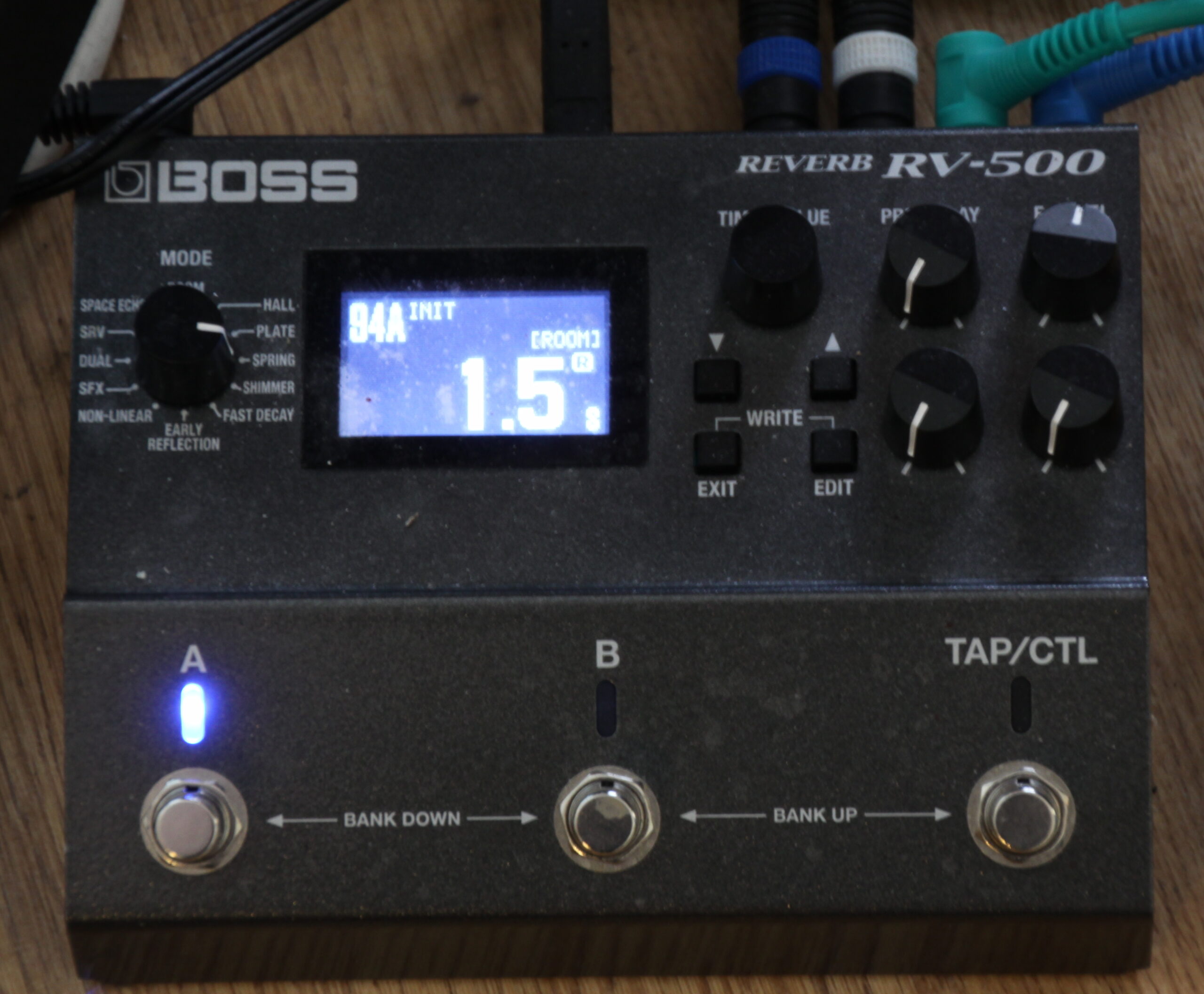
Boss RV-500, photographed 15 May 2019. Photo: Styroks; existing Commons crop by Skimel (23 April 2022). CC BY-SA 4.0 (https://creativecommons.org/licenses/by-sa/4.0/). Existing crop retained; resized for web without further cropping or retouching. Web version licensed under CC BY-SA 4.0. Source: https://commons.wikimedia.org/wiki/File:BOSS-RV-500-reverb.jpg
The Boss RV-500 packs 12 modes and 21 reverb algorithms into one pedal. Here's everything players need to know before buying.
Most reverb pedals try to do one thing well. A spring tank on a vintage Fender does spring reverb. A plate emulation unit does plates. The old Roland SRV-2000 rack — prized by studio engineers in the 1980s and now trading for serious money on the vintage market — does that one gorgeous digital wash that defined an era. The premise of the Boss RV-500, announced June 23, 2017, was simple and slightly audacious: what if one pedal could credibly do all of it?
The answer is a 12-mode, 21-algorithm reverb processor that sits at the top of the Boss reverb hierarchy — above the classic Boss RV-6, above everything in the compact Boss lineup — and earns its flagship status by offering things that simply weren’t possible in a stompbox before it. Two reverbs running simultaneously. A built-in delay engine on every patch. MIDI program change at your feet. A direct emulation of the Roland SRV-2000 and RE-201 Space Echo. And 297 patch memories to hold it all.
This isn’t a pedal for players who need a single splash of room. This is a pedal for players who need studio-quality reverb that can be precisely recalled at the stomp of a switch in the middle of a live show. Steve Stevens carries one on his Billy Idol tour rig. The ambient guitar community adopted it immediately. And it has been in continuous production ever since.
Where the RV-500 Came From: The Boss Reverb Lineage
Boss has been making reverb pedals since the RV-2 Digital Reverb in 1987 — the first Boss reverb processor to offer multiple algorithms in a stompbox. The RV-3, RV-5, and eventually the RV-6 followed in sequence, each expanding the algorithm count and refining the sound. The RV-6, released in 2015, brought 8 modes including the distinctive Dynamic and Shimmer algorithms in the standard Boss compact form factor.
But the RV-6 was still a compact pedal — no patch memory, no MIDI, no deep editing, no dual-engine operation. There was a ceiling to what the format could do. The RV-500, arriving two years after the RV-6, was the answer to that ceiling. Boss took the same platform they’d used for the DD-500 Digital Delay — launched at the same 2015 Summer NAMM event as the RV-6 — and applied the same architectural logic to reverb. Larger format. Graphic LCD. Deep editing. Patch memory. Full MIDI. Dual-engine processing.
The result is a pedal that occupies a different conceptual category from the RV-6 entirely. The RV-6 is a gigging compact that sounds great without thinking. The RV-500 is a professional reverb instrument that rewards programming and repays the time you spend learning it.
Boss RV-500 Specifications
The 12 Modes and 21 Algorithms
The RV-500 organizes its reverb capabilities into 12 top-level modes, each containing one or more specific algorithms. Understanding what each mode offers is essential to getting the most from the pedal:
Room
Small to medium enclosed acoustic spaces. Essential for adding lifelike dimension to a dry signal without making the reverb obviously identifiable as a pedal. Multiple room character options within the mode let you dial from a dead practice room to a larger venue acoustic.
Hall
Concert hall acoustics with longer pre-delay and more complex early reflections. The go-to for clean guitar melodies, country pickers, and anyone who wants a reverb that breathes without drowning the notes.
Plate
The classic studio plate emulation — a thin metal sheet driven by transducers and picked up by microphones. Plate reverb has a particular brightness and density that recording engineers have used since the 1950s. The RV-500’s plate emulation captures that metal-frequency character with high accuracy.
Spring
Tank spring reverb, as found in vintage Fender amplifiers and many other tube amp designs. The distinctive drip and splash of a spring tank is one of the most recognizable sounds in electric guitar history. The RV-500 offers multiple spring character options from tight and focused to loose and splashy.
Shimmer
Octave-shifted pitch added to the reverb tail — one of the defining sounds of ambient and post-rock guitar. The Shimmer algorithm takes an incoming note, generates a pitch-shifted copy (typically one or two octaves up), and blends it into the reverb wash. The result is an eerie, orchestral swell that has become a cliché precisely because it sounds so enormous.
Fast Decay
Reverb with an unusually rapid tail cutoff — useful for situations where you want the spatial sense of reverb without a long trail that muddies subsequent notes. Particularly effective for rhythmic playing styles where note definition matters as much as texture.
Early Reflection
Focuses on the early reflection pattern of acoustic spaces rather than the diffuse reverb tail. Early reflections — the first discrete echoes that arrive at your ears after direct sound — create the sense of room size without the wash. This algorithm is effective for realistic acoustic environment simulation and can be layered with other reverb sources in dual-engine mode.
Non-Linear
The gated and reverse reverb algorithms that defined 1980s rock and pop production. Gated reverb — the big, abruptly cut-off drum sound associated with Phil Collins and countless others — is the most recognizable application, but the RV-500’s Non-Linear mode also covers reverse reverb and other pre-tail-first processing that creates the dreamy, backward-recorded sound without requiring tape.
SFX
Special effects reverb algorithms that go beyond traditional acoustic space emulation into sound design territory. Useful for experimental music, ambient texture generation, and creating signature sounds that don’t correspond to any real-world acoustic space.
Dual
The Dual mode is one of the RV-500’s most powerful features: run two complete reverb patches simultaneously, with routing options that include serial processing (reverb A feeds into reverb B), parallel processing (both A and B receive the dry signal independently), or frequency-split processing (low frequencies go through reverb A, high frequencies through reverb B, with an adjustable crossover point). The frequency-split option in particular opens up sophisticated sound design that was previously achievable only in professional studio software.
SRV — Roland SRV-2000 Emulation
The Roland SRV-2000 was a professional digital reverb processor released in 1982 — one of the first high-quality digital reverb units available at a price point that working studios could reach. It appeared on countless recordings throughout the 1980s and defined the “big digital reverb” sound of that era. Original SRV-2000 units now trade for $500 to $1,500+ depending on condition. The RV-500’s SRV algorithm captures the specific character of that unit: a bright, slightly metallic digital wash with a distinctive pre-delay and decay envelope that is instantly recognizable to anyone who has heard 1980s recordings.
Space Echo — Roland RE-201 Emulation
The Roland RE-201 Space Echo is one of the most beloved and most-emulated effects units in guitar history. Originally a tape delay and spring reverb combination unit from 1974, the RE-201 defined the sound of reggae, dub, and a significant portion of classic rock. Its combination of warm tape delay and lush spring reverb created a texture that digital emulations have been chasing for decades. The RV-500 includes an RE-201 algorithm that addresses both the tape delay characteristics and the spring reverb engine of the original unit within a single patch — including the warmth-to-degradation range of tape saturation.
Famous Players Who Use the Boss RV-500
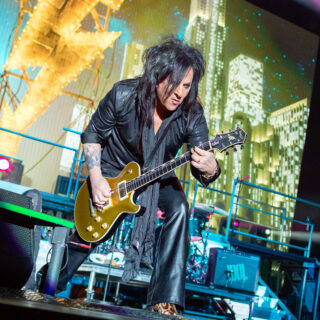
Steve Stevens — Billy Idol
The most high-profile confirmed RV-500 user is Steve Stevens, the Grammy Award-winning guitarist best known for his two decades of work with Billy Idol and the iconic “Top Gun Anthem.” Stevens carries the RV-500 on his live touring rig, confirmed by a Premier Guitar Rig Rundown published May 28, 2025, covering Billy Idol’s “It’s A Nice Day To… Tour Again!” spring 2025 dates at Nashville’s Bridgestone Arena. PG’s John Bohlinger, working with Stevens’ tech and guitar builder Frank Falbo, documented the RV-500 on Stevens’ secondary effects board alongside a Boss GM-800 guitar synthesizer, a Fender Smolder Acoustic OD, a Grace Design ALiX preamp, an Empress Bass Compressor, a Fishman Aura, and a Peterson tuner — a deliberately sophisticated board that suggests he uses the RV-500 for precisely managed reverb tones across multiple guitar and signal types.
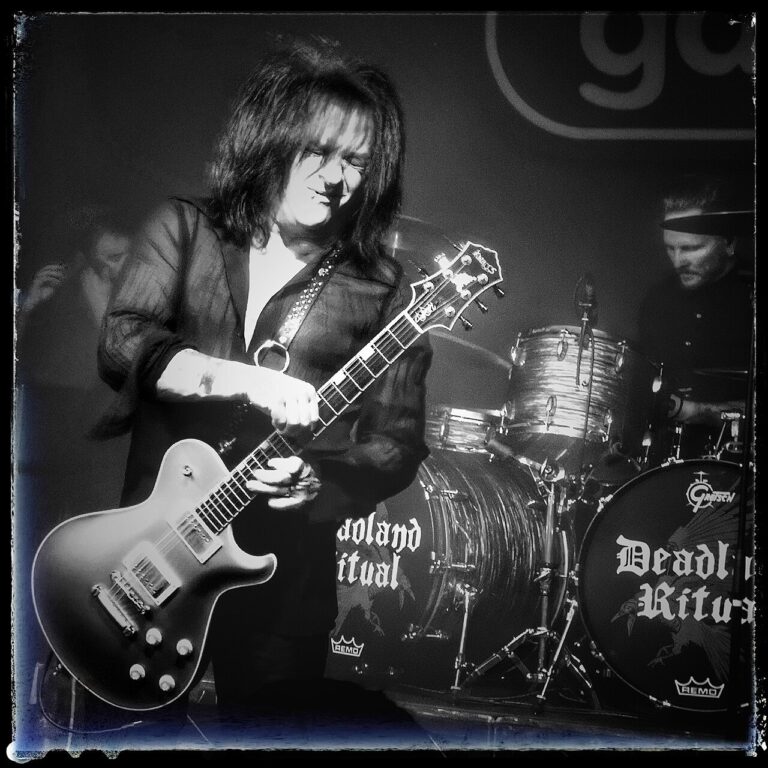
Stevens’ rig is complex: he runs multiple Knaggs signature guitars through Friedman B100 and SS100 heads panned hard left and right, with his signal processed through a Neve 8803 rack EQ and into RedSeven Amplification Amp Central Evo loadboxes before front of house. The RV-500 sits in a context where every sound needs to be recallable, programmable, and reliable night after night. That’s exactly the kind of professional touring context the RV-500 was designed for.
beabadoobee
British-Filipino singer-guitarist beabadoobee — known for dreamy shoegaze-inflected indie pop and the viral hit “Coffee” — uses the Boss RV-500 as part of her live pedalboard, documented via a KEXP pedalboard photograph from her November 21, 2022 live show. beabadoobee’s guitar style leans heavily on reverb and ambient texture, and the RV-500’s shimmer and hall algorithms fit naturally into the kind of wide, washy guitar sounds that characterize her music. Her documented use of the RV-500 represents exactly the indie and shoegaze audience that has embraced the pedal alongside its heavier-hitting professional users.
Misha Mansoor — Periphery
Misha Mansoor of djent progenitors Periphery has been documented as a Boss RV-500 user via Equipboard community documentation. Mansoor is known for his obsessively detailed approach to tone and effects programming — exactly the kind of player who would appreciate the RV-500’s deep patch editing and precise parameter control. This connection is community-documented rather than primary-source confirmed via a Rig Rundown or manufacturer interview, but Mansoor’s general affinity for powerful, programmable effects processing aligns well with what the RV-500 offers.

A Note on the Commonly Listed Artists
The Boss RV-500’s manufacturer documentation and online databases commonly associate it with artists like The Edge, John Mayer, Mark Lettieri, and Mateus Asato. These associations deserve an honest look. The Edge’s reverb sounds — especially his legendary U2 tones — come from rack systems including the Korg SDD-3000, Eventide harmonizers, and Fractal Axe-Fx units; no primary-source Rig Rundown or interview documents him using the RV-500. John Mayer’s reverb processing varies by era and context but has not been specifically linked to the RV-500. Mark Lettieri uses a Neural DSP Quad Cortex for reverb and effects in documented rig coverage. Mateus Asato has been documented using a Strymon Flint for reverb. All four are artists who represent the kind of music the RV-500 suits, but their names attached to this specific pedal reflect genre-level marketing association rather than confirmed pedal-specific use. They’re excluded here in favor of the players who have been documented actually using it.
Tone Recipes and Settings
Studio Hall — Classic Clean
Mode: Hall. Pre-Delay: 15–25ms. Decay: 2.5–3.5 seconds. High Damp: around 4 kHz rolloff. E.Level: 30–40%. This setting adds the spatial sense of a professional live recording environment without imposing itself on the instrument. Works equally well behind a clean Fender Stratocaster chord and a single-note melody line. Keep the delay engine off for maximum clarity in the reverb tail.
Plate for Leads and Recording
Mode: Plate. Pre-Delay: 30–40ms. Decay: 1.5–2 seconds. High Damp: minimal (plates are naturally bright). E.Level: 35–50%. The longer pre-delay creates a gap between the direct signal and the reverb onset, letting attack transients cut through clearly before the reverb fills in behind them. Classic studio technique for making a lead guitar sit forward in a mix while still sounding lush.
SRV-2000 — 1980s Arena Rock Wash
Mode: SRV. Reverb Time: medium-long (3–5 seconds). Pre-Delay: 20ms. E.Level: 40–55%. High Damp: moderate. This is the big, slightly metallic digital reverb sound that defined arena rock production from about 1982 through 1989. Not subtle. Not meant to be. Dial it in behind a Marshall-tone Les Paul playing power chords and it sounds exactly like a $600 vintage studio processor in a stompbox.
Space Echo — Dub and Warm Tape Reverb
Mode: Space Echo. Set the tape delay time to 400–450ms. Mix the spring reverb component at around 30%. Keep E.Level moderate. This setting captures the warm, slightly saturated character of a Roland RE-201 on a slow, medium-gain setting — the sound of classic reggae and dub production. Works equally well behind a clean Fender Telecaster for an atmospheric alternative-country or Americana vibe.
Shimmer — Post-Rock Ambient Wash
Mode: Shimmer. Pitch shift: +1 octave. Decay: 6–8 seconds. E.Level: 50–65%. Use an expression pedal on the CTL/EXP jack to control E.Level — heel down is dry signal, toe down is full shimmer. This is the defining ambient guitar texture: notes dissolve into an orchestral octave wash. Slow picking with high guitar sustain (rolled-back tone control, middle pickup) produces the most recognizable results.
Dual Mode — Room + Hall Layered
Engine A: Early Reflection (small room), short decay, moderate level. Engine B: Hall, long decay (4+ seconds), low level. Routing: parallel. The early reflections from Engine A create the immediate acoustic space around the note, while Engine B’s long hall tail provides the sustained depth behind it. This dual-layer approach approximates how reverb actually works in a real acoustic space — the room responds immediately, the tail develops slowly.
Non-Linear — Gated Reverb for Rock and Pop
Mode: Non-Linear (gated). Gate threshold: medium. Decay: 0.8–1.2 seconds. E.Level: 40–55%. The gate closes the reverb tail abruptly at a set point — creating the characteristic punchy, oversized reverb sound that needs no introduction to anyone familiar with 1980s production. Surprisingly effective on guitar as well as drums: try it behind a distorted rhythm guitar for a massive, arena-sized rhythm tone that cuts through without a washy tail.
How the Boss RV-500 Compares
vs. Boss RV-6
The RV-6 and RV-500 are siblings, not competitors. The RV-6 offers 8 modes in the standard Boss compact chassis at $149–189 new, with no patch memory, no MIDI, no dual-engine operation, and no editing beyond the four front-panel knobs. It does what it does beautifully and immediately. The RV-500 offers 12 modes and 21 algorithms, 297 patch memories, full MIDI, dual-engine operation, a built-in delay on every patch, and USB connectivity for the free editor/librarian software. The RV-500 costs roughly twice the price and takes up significantly more board space. The right choice depends entirely on how much depth you need and whether you’ll actually use the programming capabilities. For players who want set-and-forget reverb that sounds excellent, the RV-6 is the right tool. For players who need precisely recalled, deeply programmable professional reverb, the RV-500 is the one.
vs. Strymon BigSky
The Strymon BigSky has been the reference-point premium reverb pedal since its release in 2013. It offers 12 different reverb modes with extremely deep per-preset editing, USB connectivity, full MIDI, and expression pedal support at a similar price point to the RV-500. The BigSky’s cloud algorithm and its Bloom and Swell modes are widely considered among the finest ambient reverb sounds available in any pedal, and its vintage Plate and Spring emulations have a particular warmth that many players prefer. The RV-500 counters with the built-in delay engine (per patch, not requiring a separate delay pedal), the Roland SRV-2000 and RE-201 emulations (which are not available in the BigSky), and the dual-engine frequency-split mode. Neither pedal is definitively superior — the BigSky tends to win on pure ambient tone depth, the RV-500 on versatility and integration of effects processing. If you know you’re primarily an ambient guitarist, the BigSky deserves a side-by-side audition. If you need the broadest possible reverb vocabulary plus a delay engine in one unit, the RV-500 is the stronger choice.
vs. Eventide Space
The Eventide Space is another professional-grade reverb processor that competes in the RV-500’s price range, with 12 algorithms including some of the most sophisticated pitch-shifted reverb designs available in a pedal. The Space’s HotSaw algorithm, Shimmer, and MangledVerb modes offer unique character that no other reverb pedal precisely replicates, and Eventide’s deep modulation integration sets it apart from both Boss and Strymon. The Space is, however, a harder pedal to program quickly — its interface requires more investment to master. The RV-500’s interface, while complex by compact-pedal standards, is comparatively straightforward, and the Boss editor software makes programming on a computer screen considerably more accessible. The Space is for players who want specifically Eventide’s algorithmic approach; the RV-500 is for players who want the broadest algorithmic vocabulary within a more ergonomic editing workflow.
vs. Boss DD-500
The DD-500 shares the RV-500’s platform and many of its structural features — same form factor, same 297-patch architecture, same MIDI and USB connectivity, same general editing workflow. Players who already own a DD-500 will find the RV-500’s interface immediately familiar. The two pedals are natural complements: the DD-500 handles delay with depth, the RV-500 handles reverb with equal sophistication. On the RV-500, the built-in delay engine provides solid delay-within-reverb functionality, but it doesn’t replace the DD-500’s 12 dedicated delay modes and 10-second maximum delay time for players who need the full delay toolkit as well.
Buying Guide
New vs. Used
The RV-500 has been in continuous production since 2017 and is available new from authorized dealers at approximately $329–440 USD (prices vary by region and retailer). Used examples in excellent condition typically run $200–290 USD. The pedal has no manufacturing variants that affect sound — all RV-500 units are electronically identical regardless of production date — so a used unit represents the same sonic capability as a new one at a significant price reduction.
Power Supply — This Is Non-Negotiable
The RV-500 draws 225mA at 9V DC. This is a significant current demand — more than enough to cause noise, instability, or failure with most daisy-chain power supplies. An isolated, regulated 9V power supply with at least a 250mA output rating is mandatory for reliable operation. Budget for this at purchase if you don’t already have a suitable supply. The same applies to the Boss DD-500 and DD-200, which share this current draw — if you run those pedals cleanly, your existing isolated supply may already cover the RV-500.
What You Also Need
The free RV-500 Editor/Librarian software (Windows/Mac) is not optional for serious use — it lets you edit patches on a computer screen, see all parameters simultaneously, and back up all 297 patches as a single file. Download and install it before gigging with the pedal. Losing 297 carefully programmed patches because of a factory reset or technical issue is an avoidable disaster. A USB Type B cable (the same square-plug type used by most USB MIDI interfaces) is required to connect the pedal to a computer — these are inexpensive and widely available but worth having in your bag.
The Patch Memory Learning Curve
New RV-500 users should expect a programming investment. The pedal ships with factory presets that demonstrate its capabilities but don’t represent any specific player’s actual tonal needs. Plan an afternoon of exploration — ideally with the editor software open on a laptop beside the pedal — before committing the RV-500 to a live situation. The payoff is a reverb instrument that behaves exactly as programmed, night after night, for years.
Ownership Notes
The Delay Engine Changes How You Think About Reverb
Having a full delay engine available within every reverb patch fundamentally changes the workflow. Instead of thinking “I need reverb, then separately I need delay,” the RV-500 allows you to think “I need this specific combination of reverb and delay, recalled from patch 47, every night.” Pre-delay — the gap between the dry signal and the reverb onset — can be set precisely in milliseconds. The delay engine goes further, allowing proper rhythmic delay tails that feed into the reverb wash. This integration is one of the strongest arguments for the RV-500 over competitors that require a separate delay pedal to achieve the same combined effect.
Buffered Bypass and Signal Path
Like most Boss multi-feature units, the RV-500 uses buffered bypass. The buffer quality in Boss processing pedals is high — their buffers are widely regarded as transparent — but players with germanium fuzz pedals or other buffer-sensitive devices earlier in the signal chain should note that the RV-500’s buffer will always be active in the chain. This is generally a non-issue in modern pedal contexts, but worth knowing.
The Simul Mode Depth
Dual-engine Simul mode is the RV-500’s most underused capability. The frequency-split option in particular — where the crossover frequency is adjustable — allows genuinely sophisticated sound design. Low frequencies in a dry, tight spring reverb while high frequencies swim in a long hall tail produce a sound that doesn’t correspond to any single reverb type but has its own distinctive character. Exploring Simul mode is worth at least a dedicated session before settling on a bank of presets.
The Roland Heritage Algorithms
The SRV-2000 and RE-201 Space Echo emulations are more than historical nostalgia. The SRV-2000 algorithm captures a specific type of digital reverb character — bright, immediate, slightly crystalline — that differs from modern smooth hall emulations in ways that are musically useful, especially for players working in 1980s-influenced styles. The RE-201 algorithm captures the unique warmth of tape saturation combined with spring reverb in a way that no purely digital reverb emulation achieves, because it’s modeling both the delay characteristics and the spring tank of the original unit. These are not box-ticking exercises. They sound like the real things.
Frequently Asked Questions
What’s the difference between the Boss RV-500 and RV-6?
The RV-6 is Boss’s compact flagship reverb with 8 modes, no patch memory, no MIDI, and simple four-knob control in the standard Boss compact chassis. The RV-500 is the professional-grade flagship with 12 modes, 21 algorithms, 297 patch memories, full MIDI I/O, a built-in delay engine, dual-engine operation, USB connectivity, and an LCD display. The RV-6 is plug-and-play; the RV-500 is programmable and recallable. Both are current production.
Can the RV-500 run two reverbs at the same time?
Yes — this is the Simul (simultaneous) mode, also called Dual mode. Engine A and Engine B can run in parallel (both receiving the dry signal independently), series (A feeds into B), or frequency-split (low frequencies go through A, high through B, with an adjustable crossover point). This is one of the features that makes the RV-500 genuinely distinct from simpler reverb pedals.
Does the Boss RV-500 need an isolated power supply?
Yes. The RV-500 draws 225mA at 9V DC, which is too much for most daisy-chain power supplies to deliver cleanly. An isolated power supply with at least 250mA of output capacity at 9V is mandatory for noise-free operation. Daisy-chaining will typically cause hum, noise, or instability.
What is the Roland SRV-2000 emulation in the RV-500?
The Roland SRV-2000 was a professional digital reverb processor released in 1982, one of the earliest high-quality digital reverb units available at near-professional price points. It defined a specific “80s digital reverb” sound — bright, slightly metallic, with a distinctive pre-delay and decay envelope — that appears on a huge number of recordings from that decade. Original units trade for $500–$1,500+. The RV-500’s SRV algorithm emulates this character digitally, making it accessible within a pedalboard context.
What is the Space Echo algorithm in the RV-500?
The Space Echo mode emulates the Roland RE-201, a beloved tape delay and spring reverb combination unit from 1974 that defined the sound of reggae, dub, classic rock, and beyond. The emulation addresses both the tape delay characteristics (warm, slightly saturated echoes) and the spring reverb component of the original unit within a single RV-500 patch. It’s one of the most sophisticated single-algorithm reverbs in the pedal.
Can I back up my RV-500 patches?
Yes — via the free RV-500 Editor/Librarian software (Windows/Mac) and a USB Type B cable. All 297 patches can be exported as a single file and restored completely. This is essential for anyone who has invested time programming patches before a tour or important recording.
Is the Boss RV-500 good for ambient guitar?
Yes — it’s one of the best pedals available for this purpose. The Shimmer algorithm, the long-decay Hall and Room modes, the non-linear and SFX algorithms, and above all the dual-engine Simul mode with frequency splitting give ambient players an enormous palette of sustained, evolving reverb textures. The expression pedal input for real-time parameter control adds live performance dimension. Beabadoobee’s documented use of the RV-500 in her shoegaze-adjacent live rig is one example of how the pedal integrates into guitar music built around reverb texture.
How does the Boss RV-500 compare to the Strymon BigSky?
Both are professional-grade reverb processors at similar price points. The Strymon BigSky is widely regarded as having particularly lush ambient reverb sounds, especially in its Cloud, Bloom, and Swell algorithms. The RV-500 counters with a built-in delay engine on every patch, the Roland SRV-2000 and RE-201 emulations, and the dual-engine frequency-split mode. Neither pedal is the objective winner — audition both if you can before deciding, as the tonal character differs meaningfully.
Image credits
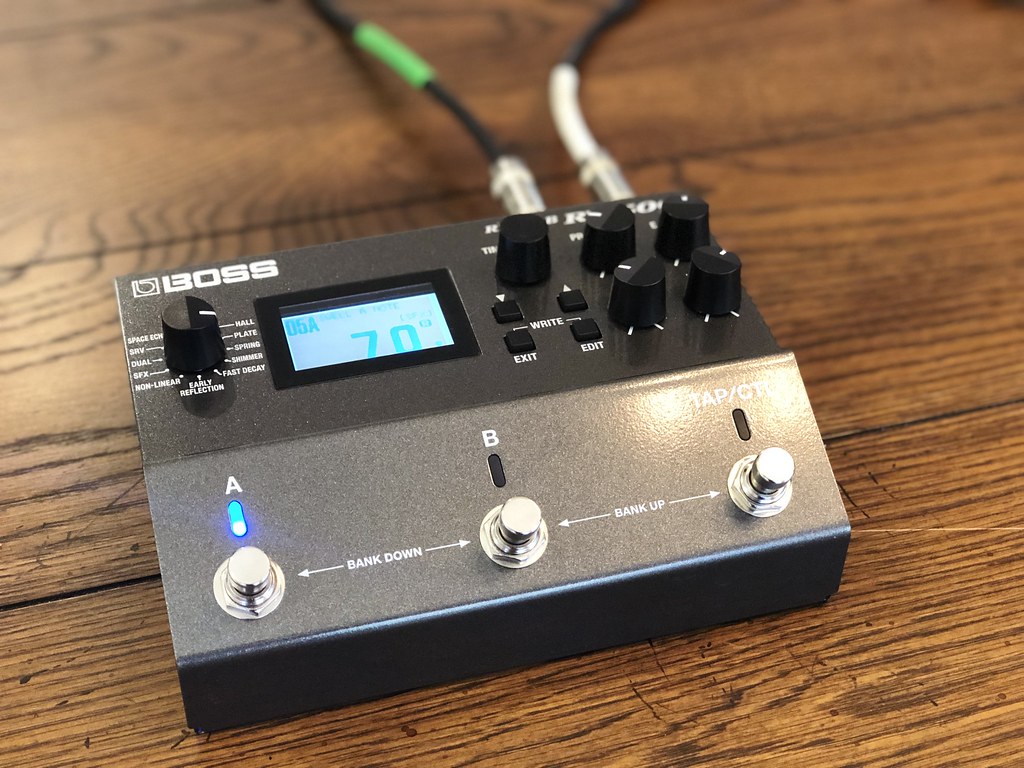
- Top image: Boss RV-500, photographed 15 May 2019. Photo: Styroks; existing Commons crop by Skimel (23 April 2022). Source photograph · CC BY-SA 4.0. Existing crop retained; resized for web without further cropping or retouching. Web version licensed under CC BY-SA 4.0.
- Boss RV-500: photo by Guitar Chalk (www.guitarchalk.com), via Flickr, CC BY 2.0.
- Steve Stevens: Ross Cowan, Wikimedia Commons, CC BY 2.0.
- Misha Mansoor: Markus Felix, Wikimedia Commons, CC BY-SA 3.0.
Latest News
Related
On This Day
Monday 9 November
From this week: