Ritchie Blackmore – The Dark Alchemist of Rock Tone
GuitarGangsters Editorial 24 min read Updated 20 October 2026
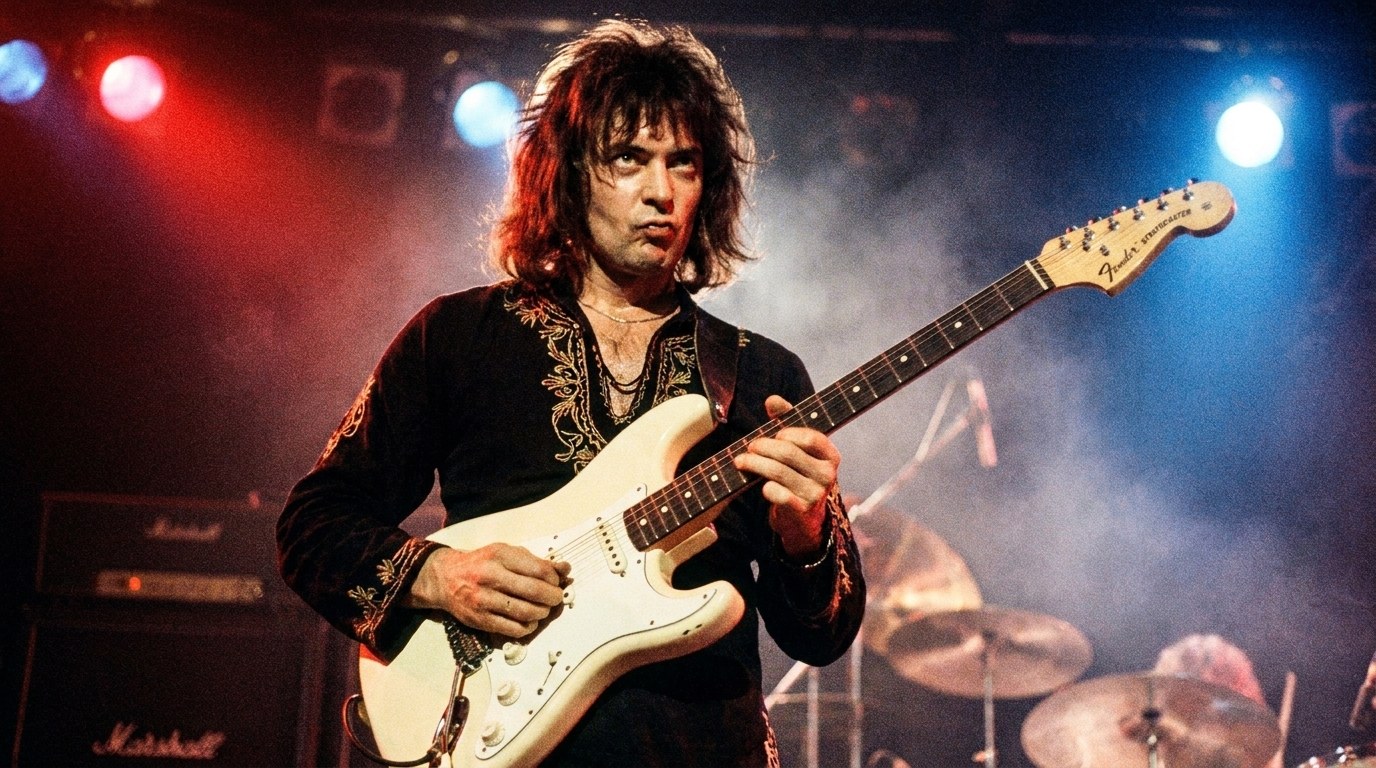
There are guitar heroes — and then there’s Ritchie Blackmore, the man who turned electricity into mythology.
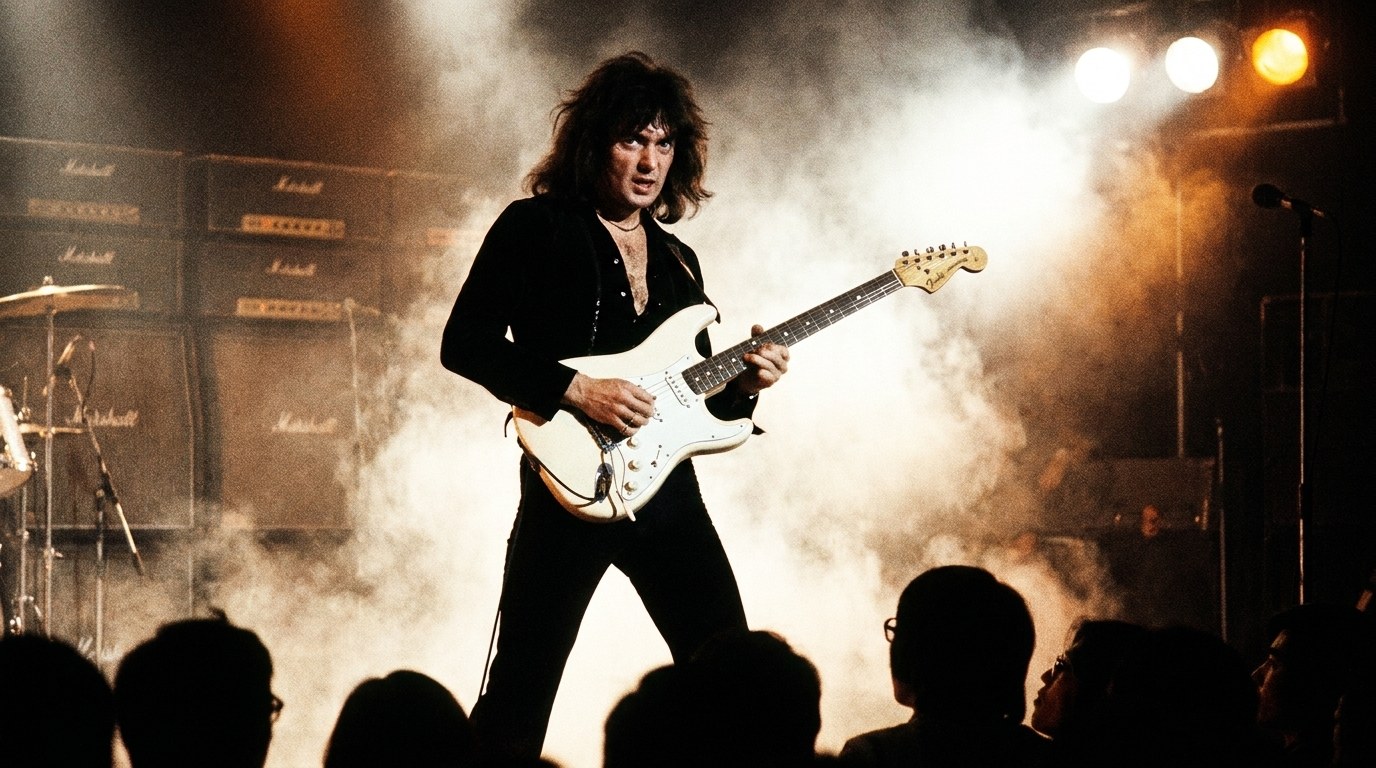
Before shredders learned to race and metalheads learned to roar, Blackmore was already bending Bach through a Marshall stack, carving a sound that was equal parts cathedral and chaos. His tone wasn’t built in a lab — it was forged onstage under blinding lights, dripping with echo and arrogance, a mix of treble, temperament, and total control.
He wasn’t just another British guitarist chasing the blues boom. While Clapton was painting in pastel tones, Blackmore was mixing fire and mercury. He played like a renaissance knight with a Stratocaster instead of a sword, blending medieval melody with modern menace.
Every note carried intent — from the surgical precision of Highway Star to the volcanic eruption of Child in Time — and every solo felt like a duel between intellect and instinct.
“I’ve never been interested in being a blues player,” Blackmore once said. “I wanted to make the guitar sound like a violin that’s about to explode.”
His journey from Deep Purple’s cathedral of volume to Rainbow’s baroque theatrics to the acoustic mysticism of Blackmore’s Night is more than just rock history — it’s the evolution of tone itself.
Each era, each tweak of a treble booster, each scalloped fretboard was another page in the spellbook of a man obsessed with perfection through imperfection.
And that’s what this deep-dive is all about.
We’re tearing open the vaults, tracing every cable and cabinet, from the Marshall Majors that nearly blew the walls down in 1972 to the ENGL E650 that bottled that lightning decades later.
If you’re chasing the sound that built hard rock, buckle up — this is the anatomy of Ritchie Blackmore’s alchemy.
Background / The Artist’s Journey
He was born Richard Hugh Blackmore on April 14, 1945, in Weston-super-Mare, England — a seaside town that would one day seem light-years away from the thunder he’d unleash on global stages. His father bought him his first guitar when he was just eleven, and from that moment, everything else faded into background noise.
By his late teens, Blackmore was already a studio mercenary — grinding out sessions under producer Joe Meek and playing with The Outlaws. Those years weren’t glamorous, but they were brutal training. He learned how to make cheap amps sound dangerous, how to bend a note until it felt human, and how to outplay anyone in the room without ever looking like he cared.
“If it doesn’t sound dangerous, it’s not worth playing,” he once said — a mantra that would define every note that followed.
The Rise of the Purple Flame
When Deep Purple formed in 1968, the musical world was divided between psychedelic color and blues grit. Blackmore bridged the two — fusing technical elegance with animal instinct. The early Mk I lineup flirted with prog-pop, but it wasn’t until Mk II (with Ian Gillan, Roger Glover, Jon Lord, and Ian Paice) that Blackmore’s weaponized precision exploded into focus.
Between 1970 and 1972, with albums like In Rock and Machine Head, he crystallized what hard rock should sound like: clean aggression, melodic violence, and harmonic sophistication. Songs like Highway Star and Smoke on the Water didn’t just dominate radio — they rewired the DNA of guitar tone itself.
He took the precision of Bach, the bite of Chuck Berry, and the attitude of Hendrix, then filtered it through the surgical edge of a treble booster and a Marshall Major running on the brink of meltdown.
“I wasn’t trying to be louder,” he said. “I just wanted to cut through everything — including the Hammond.”
The Birth of the Baroque Rebel
By the mid-1970s, ego clashes and exhaustion turned Deep Purple into a warzone. Blackmore, ever the perfectionist, walked away — straight into his next incarnation: Rainbow.
If Purple was thunder, Rainbow was lightning — sharp, ornate, and theatrical. Teaming up with Ronnie James Dio, Blackmore finally gave himself room to explore his obsession with medieval modes and classical phrasing. Tracks like Stargazer and Man on the Silver Mountain sounded like metal carved out of cathedral stone.
It was here that his tone evolved from raw power to refined precision. The Marshall stacks stayed, but the philosophy shifted: every solo became a composition, every vibrato a sentence in a symphony of distortion.
He began experimenting with Alembic boosters, AIWA reel-to-reel tape preamps, and the occasional EMS Synthi Hi-Fli, expanding his palette without ever surrendering his trademark edge.
“If Bach had been alive, he’d have loved distortion,” Blackmore joked in a 1976 interview. It wasn’t arrogance — it was prophecy.
The Pilgrim Turns Acoustic
By the 1990s, after decades of sonic warfare, Blackmore did something nobody expected — he put down the sword and picked up a lute.
His partnership with Candice Night birthed Blackmore’s Night, a Renaissance-folk project that proved the same man who wrote Burn could also write Renaissance Faire.
The tone softened, but the precision remained. His Fender Stratocaster, now equipped with Seymour Duncan SSL-4 Quarter Pounds and a scalloped fretboard, shared space with hurdy-gurdies, mandolins, and acoustic guitars tuned for medieval modal interplay.
In this chapter of his life, Blackmore didn’t chase volume — he chased purity. The ENGL E650 Signature Amp became his vessel for articulate cleans and vintage-style crunch, while his scalloped Strat embodied the idea he’d been chasing all along: total control over the note, from breath to burn.
“Electric or acoustic, the idea is the same,” he said. “The hands create the tone — the gear just cooperates.”
The Legacy of Obsession
Across six decades, Ritchie Blackmore has remained the paradox that rock needs: technical yet unpredictable, medieval yet futuristic, defiant yet delicate.
He didn’t invent the idea of the guitar hero — he redefined it, showing that mastery isn’t just speed or volume but the courage to sound like no one else.
And if Deep Purple was the cathedral, Rainbow the tempest, and Blackmore’s Night the sanctuary, then his entire career has been a pilgrimage toward one thing: tone as truth.
If Blackmore’s playing was the lightning, then his rig was the storm that carried it.
Every wire, tube, and transistor in his setup had a purpose — not to create distortion, but to control chaos. He never cared about trends or endorsements. His gear wasn’t boutique; it was battle gear — modded, rewired, and often on the brink of combustion.
“If it breaks, good,” he once quipped. “That means it’s working properly.”
Below is the anatomy of a tone that launched hard rock, reshaped metal, and still sends shivers down the necks of guitarists today.
Guitars
Ritchie Blackmore’s weapon of choice has always been the Fender Stratocaster — but his relationship with it is closer to that of a mad scientist and his creation. Over the decades, his Strats have morphed through countless configurations, refinishes, and unholy experiments.
⚡ Early Years – The ES-335 Era (1963–1969)
Before the Strat became his Excalibur, Blackmore wielded a Gibson ES-335, his mainstay through the late ’60s sessions with Joe Meek and the early Deep Purple days.
It had that semi-hollow bite that you can hear on Hush — raw, bright, and a little unstable.
But the ES-335 couldn’t handle what he wanted to do next. He needed sharper attack, faster access, and a tone that would slice through Jon Lord’s Hammond organ like a blade through velvet.
The Gibson gave way to the Strat, and history followed.
🎸 The Clapton Strat – Birth of a Legend (1968–1972)
Blackmore bought his first Strat — a 1968 maple-neck Fender Stratocaster, supposedly once owned by Eric Clapton — for about £60. It became the Machine Head Strat, the one responsible for Smoke on the Water, Highway Star, and Lazy.
Specs:
- Non-scalloped fretboard (pre-modification years)
- Vintage single-coil pickups
- Tremolo block set flush for tuning stability
- Natural finish that aged with his fury
This Strat’s tone, fed through a Hornby-Skewes Treble Booster and a Marshall Major 200W, became the holy grail of hard rock tone — clean yet cutting, with a ferocity that came not from pedals, but from sheer decibel pressure.
“It’s not distortion,” he explained. “It’s just very loud clean.”
🔮 Rainbow Rising – Modified Stratocasters (1975–1979)
By the Rainbow era, Blackmore was done with stock guitars. His main Strat was a heavily customized 1968 model — the same base, but with a new philosophy: control the tone, not the other way around.
Key mods and specs from this period:
- Scalloped fretboard, hand-carved to allow extreme vibrato control
- High-output single coils (1000+ ohms resistance) for tighter punch
- Treble bleed capacitors to retain brightness
- 300k pots for mid-forward tone
- Alembic Stratoblaster (active booster) integrated on some instruments
- Occasional use of a 1974 sunburst backup Strat
These guitars defined the neo-classical clarity of Stargazer and Man on the Silver Mountain, where every bend screamed but never blurred.
🕊️ The Signature Era – Scalloped Perfection (1980s–Present)
By the late 1980s, Blackmore’s identity was inseparable from his Strat — and Fender took notice. The result: the Fender Ritchie Blackmore Signature Stratocaster (Olympic White, scalloped fretboard, dummy middle pickup).
Specs snapshot:
- Seymour Duncan SSL-4 Quarter Pound Flat single coils (neck + bridge only)
- Non-functional middle pickup (for hum-cancel aesthetic symmetry)
- Scalloped rosewood fingerboard for absolute control over pitch and vibrato
- Brass nut and vintage 6-screw tremolo
- Minimalist wiring: tone rolled bright, no clutter
This guitar represents the culmination of Blackmore’s philosophy: minimal electronics, maximum touch.
Paired with his ENGL E650 Signature Amp, it preserved the fire of the past while allowing for crystalline articulation.
“Every curve, every fret — it’s built for expression, not excess.”
🎻 Acoustic Alchemy – Blackmore’s Night (1997–Present)
With Blackmore’s Night, Ritchie moved into uncharted territory. His arsenal expanded beyond electrics into a world of Renaissance acoustics, lutes, mandolins, and even nyckelharpas.
He blends the shimmer of Fender Strats with the warmth of Guild and Ovations, occasionally running electrics through clean channels of his ENGL amps to achieve that ghostly “electric medieval” sound.
The message? Even when the volume dropped, the tone didn’t.
Amps & Cabinets
If there’s a single component that defines Ritchie Blackmore’s tone, it’s the Marshall Major.
Built for battlefield volume, the Major was essentially a 200-watt monster, modded by Marshall engineers to push nearly 400 watts — enough to melt stage monitors and possibly the front row.
🔊 The Marshall Major (1969–1973)
- Original tubes: KT88 power section
- Modded circuits: extra output stage for more headroom
- EQ sweet spot: Bass 6.5 / Mids 8.5 / Treble 4.5 / Presence 6
- Volume: Always 10 — because why not?
Blackmore didn’t use distortion pedals to drive the amp; instead, he slammed its input with the Hornby-Skewes Treble Booster, producing that glassy, saturated upper midrange that became synonymous with Smoke on the Water.
“The amp was clean. The booster did the dirty work.”
His Marshall 1960 4×12 cabs, loaded with Celestion G12M Greenbacks, completed the sonic wall — tight, dynamic, and devastating.
⚙️ The AIWA Preamp Secret
Around 1972–73, Blackmore began using an AIWA TP-1011 reel-to-reel tape deck as both a preamp and an echo unit. This unconventional trick added harmonic saturation and subtle delay (300–400 ms, 25–35% mix), giving his tone dimension without reverb wash.
That AIWA rig — part preamp, part echo, part madness — became the hidden ingredient behind his Machine Head tone.
🌈 The Rainbow Stack – Refinement and Evolution (1975–1980)
In the Rainbow years, the Marshall Majors stayed, but his rig evolved. He experimented with blending AIWA preamps, Alembic boosters, and early ENGL prototypes, seeking precision over sheer power.
His tone on Rising and Long Live Rock ’n’ Roll had the same ferocity but added sophistication — a clearer, violin-like sustain that mirrored his growing classical influences.
🔥 The ENGL Signature Era (1990s–Present)
By the 1990s, Marshall gave way to German engineering. Blackmore collaborated with ENGL to design the E650 Ritchie Blackmore Signature Head — a 100W beast running 6L6GC tubes with four switchable channels.
Highlights:
- Classic clean with glassy headroom
- Crunch channel reminiscent of modded Plexis
- Two lead channels with independent EQ
- Tube-driven reverb and serial FX loop
The ENGL gave him exactly what he wanted: control without compromise. He could switch from Burn-era bite to Blackmore’s Night shimmer with a single flick.
“The ENGL doesn’t color my tone,” he said. “It just lets it speak clearly.”
🧱 The Wall of Sound
Throughout his career, Blackmore stacked amps like a madman: multiple Majors, Vibroverbs, and later ENGL heads — all live, all loud. He’d run them clean, relying on boosters and sheer pick attack for grit.
That’s the secret behind his tone’s paradox: massive gain that isn’t gain at all.
Pedals & Signal Chain
Blackmore’s pedalboard has always been deceptively simple — more like a laboratory bench than a tone zoo.
Where others stacked fuzzes and modulators, Ritchie stripped it down to what mattered: boosters, echoes, and attitude.
His core signal chain through the Machine Head and Rainbow eras looked like this:
Fender Strat → Hornby-Skewes Treble Booster → Marshall Major → Marshall 4×12 → AIWA Tape Echo
Each element served a surgical purpose:
- Hornby-Skewes Treble Booster — gain 6–8, tone maxed, always on.
- AIWA TP-1011 — reel-to-reel tape echo, 375ms delay, mix 25%, feedback 2–3.
- Occasional Wah (Vox/Fender) — for “Lazy” or “Mistreated.”
- EMS Synthi Hi-Fli (mid-’70s) — his wildest tool, producing early synth-style phasing and filtering.
- Alembic Stratoblaster — integrated active boost circuit on later guitars.
When digital took over, Blackmore stayed analog. Even today, he uses minimal effects, preferring natural reverb from stage acoustics and tape-style delay over DSP trickery.
Strings, Picks & Setup
If you’ve ever tried to play a Blackmore riff and wondered why it doesn’t sound right, it’s probably your strings.
He’s always used Picato .010–.048 sets (gauges .010–.011–.014–.026w–.036–.048), allowing a light touch on bends while maintaining body on rhythm lines.
- Action: Medium-high for clean vibrato
- Tuning: Standard E, often slightly sharp live for added brightness
- Picks: Heavy Dunlop “diamond-shaped” picks
- Setup philosophy: minimal relief, scalloped fretboards for controlled vibrato
“The guitar should fight you a little — that’s how it sings,” he once said.
Tunings & Tone Philosophy
Ritchie Blackmore’s tuning philosophy is deceptively simple: Standard E, always sharp, always alive.
His tone comes not from drop tunings or pedals, but pick dynamics and micro-control.
The scalloped fretboard, which allows fingers to grip the string without touching the wood, gives him violin-like phrasing — slides, bends, and trills that sound impossibly fluid.
In his own words:
“I wanted to play the guitar like a cello. You should hear the note, not the fret.”
Blackmore’s “clean gain” concept — loud amps running clean, driven by boosters and sheer attack — influenced generations from Yngwie Malmsteen to John Petrucci. It’s tone alchemy: discipline meeting danger.
If Ritchie Blackmore’s gear was the storm, then his playing was the lightning bolt that split the sky.
His style defied categories — too precise for blues, too soulful for metal, too melodic for shred. Every phrase carried the precision of a classical etude, yet the fury of a barroom fight.
What made his technique legendary wasn’t just speed or theory — it was intent. Every bend, slide, and vibrato felt like it was performed under oath.
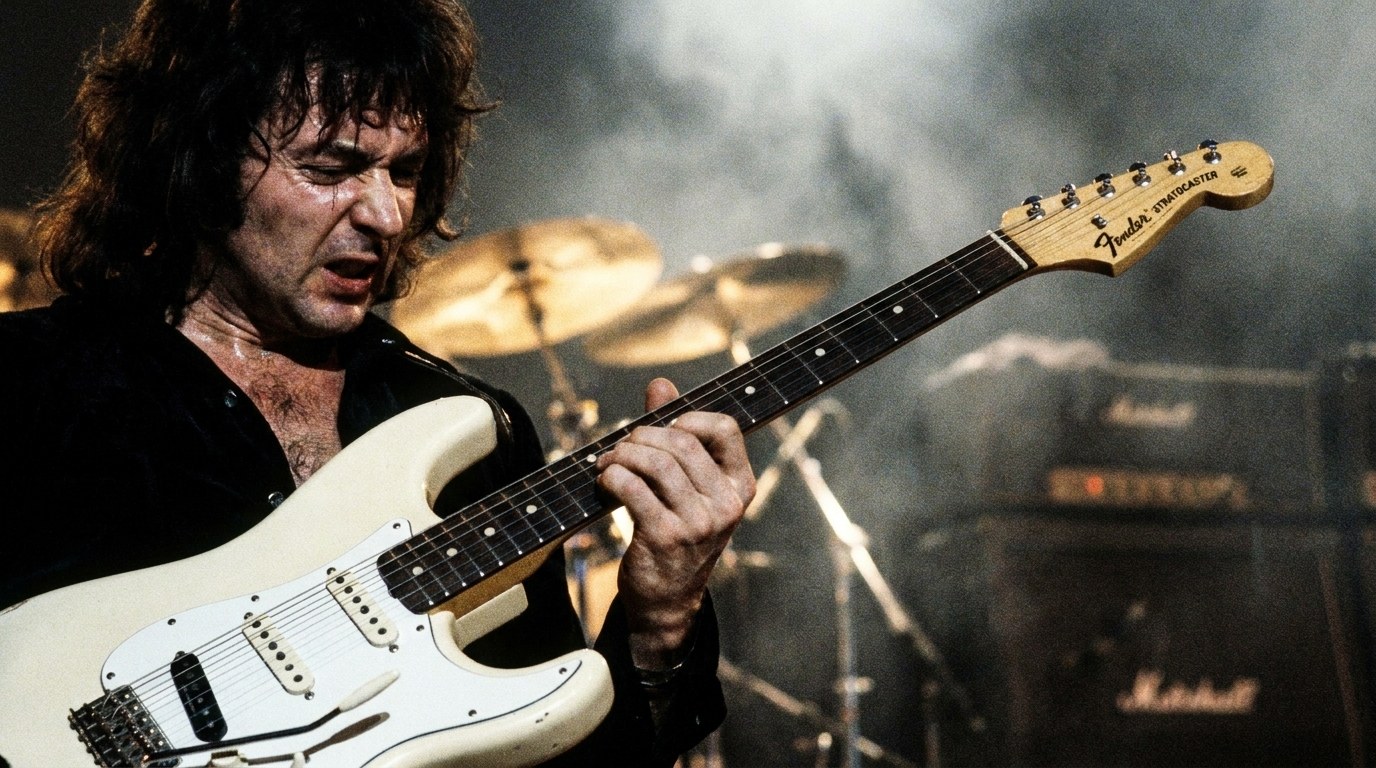
“I don’t play fast to impress,” he once said. “I play fast when I’m angry.”
The Hands Behind the Sound
Blackmore’s right hand was the hammer; his left hand was the sculptor.
His picking attack came from a hybrid of economy and aggression — downstrokes that sliced through the mix, upstrokes that whispered like silk. He didn’t strum; he commanded.
His picking dynamics alone could switch from a whisper to a riot, and that’s the reason his tone stayed articulate even at full volume.
He used the heavy pick not for brute force, but for articulation.
Onstage, you could see it: that surgical right-hand motion, always anchored near the bridge for attack, then loosening when he wanted air and resonance.
He controlled tone from his fingers before any pedal, adjusting his volume knob mid-phrase like a violinist working a bow.
Vibrato – The Blackmore Signature
Few guitarists in history have a vibrato as instantly recognizable.
It’s not a bluesy wobble; it’s a precise, horizontal shimmer that can sound vocal or violinic depending on the song.
His scalloped fretboard allows him to dig under the string, bending with frightening accuracy. You can hear it most clearly on Child in Time — those sustained, singing notes that hang in midair as if time itself paused to listen.
“When you play vibrato, you should sound like you’re singing, not trembling.”
The scalloping wasn’t for show. It allowed him to control pressure, pitch, and sustain without resistance — the same principle that makes a violin responsive to the bow.
That design decision alone separated his touch from virtually every guitarist of his era.
The Baroque Mind
Blackmore’s phrasing was never random. He approached solos like architecture — deliberate, balanced, and structured around classical motifs.
He drew directly from composers like Bach, Vivaldi, and Pachelbel, translating violin runs into biting electric phrasing.
You can hear it in Highway Star, where the solo functions as a mini-sonata — a fast-paced fugue with rising sequences, symmetrical intervals, and clean resolution.
His use of harmonic minor scales, pedal tones, and arpeggiated triads wasn’t imitation — it was integration.
He turned classical structure into raw energy. And where others used distortion to hide imperfections, Blackmore used it like a magnifying glass — revealing every detail, every nuance.
“Classical music has discipline. Rock has danger. I wanted both.”
Improvisation & Control
Despite his reputation for precision, Blackmore’s live performances were fiercely unpredictable.
He would improvise entire sections, shift melodies mid-phrase, or create new runs on the spot.
But his improvisation wasn’t chaos — it was conversation.
Every solo felt like a response to the room, the mood, or his own frustration with predictability.
At California Jam in 1974, that spirit turned explosive — literally.
After technical issues and stage tension, he ended the set by smashing guitars, exploding amps, and igniting his Marshall stacks.
It wasn’t spectacle; it was catharsis. For Blackmore, performance wasn’t entertainment — it was exorcism.
The Right Notes at the Wrong Time
Part of Blackmore’s genius lies in his phrasing.
He had no interest in playing “on time” — he played around time.
He’d pull back, lean forward, or intentionally lag a beat to create tension.
That rhythmic defiance became part of his signature, setting him apart from metronomic players who chased precision but missed emotion.
Listen to Mistreated or Catch the Rainbow: every phrase breathes. He bends phrases into emotional shapes rather than technical patterns.
That approach would later influence players like Gary Moore, Yngwie Malmsteen, and Ritchie Kotzen, who all cited him as proof that emotion and intellect can coexist on the fretboard.
Dynamics: The Art of Restraint
For all his speed and aggression, what made Blackmore truly dangerous was restraint.
He could whisper on a verse and detonate on a solo. His ability to control the volume from his fingers and guitar knobs — not pedals — gave his sound an organic range most modern rigs can’t replicate.
This control is the reason his “clean loud” philosophy works.
Running a clean amp at maximum volume, boosted only by a treble circuit, gave him headroom to express tone dynamically.
Every attack, every pick scrape, every vibrato was amplified naturally.
He didn’t rely on gain — he relied on honesty.
“When everything is distorted, nothing is powerful. Leave room for the explosions.”
Tone Philosophy: Control the Chaos
At the heart of it all, Blackmore’s tone philosophy can be summarized in one word: balance.
He sought a midpoint between light and dark, clean and dirty, discipline and danger.
He never chased distortion; he chased clarity at full volume.
He once described the Marshall Major as “a clean amp that sounds evil when it’s terrified.”
He believed 80% of tone came from the hands, 15% from the amp, and the rest from luck.
That philosophy made him the ultimate anti-gimmick guitarist in an era obsessed with effects.
His tone remains one of the hardest to emulate because it isn’t just about equipment — it’s about conviction.
Influence Across Generations
Every player who has ever tried to mix melody and menace owes something to Ritchie Blackmore.
His neo-classical phrasing gave birth to a generation of technical players, from Yngwie Malmsteen and Steve Morse, to the melodic precision of John Petrucci and Paul Gilbert.
But it wasn’t just technique — it was attitude. Blackmore made intelligence sound dangerous.
Even outside the rock world, his phrasing inspired film composers, metal arrangers, and prog architects.
Without Blackmore, there’s no Highway Star, but there’s also no Holy Diver, no Rising Force, and arguably no Master of Puppets.
He proved that melody could be as heavy as distortion — and that elegance could be louder than chaos.
“Anyone can play fast,” he once said. “But can you make a single note sound dangerous?”
You can’t clone Ritchie Blackmore — but you can get dangerously close if you understand what makes his sound tick.
His tone isn’t built on mystery or magic boxes; it’s a precise combination of volume, treble, touch, and defiance.
Below is the complete roadmap — from vintage circuits to modern digital modelers — that lets you step inside the storm.
The Core Setup – The Machine Head Blueprint
To capture the Deep Purple Mk II tone — the era that redefined rock — start with the philosophy, not the pedalboard.
Blackmore’s rig was about clean amps pushed to the edge.
Distortion was never the goal; natural compression and saturation were.
Essential signal chain:
Fender Stratocaster → Hornby-Skewes Treble Booster → Marshall Major 200W (modded) → Marshall 1960 4x12 (G12M Greenbacks) → AIWA TP-1011 Reel-to-Reel (as preamp + tape echo)
Each element in that chain served a distinct sonic purpose:
- Treble Booster: Adds bite and upper-mid energy without fuzz.
- Marshall Major: Provides clean headroom, dynamic touch, and controllable breakup.
- AIWA Tape Deck: Adds harmonic depth, subtle delay (375 ms), and a bit of grit from the preamp stage.
“My tone comes from driving a clean amp until it’s scared,” Blackmore once joked.
Analog Amp Setup – For Real Tubes and Real Danger
If you’re running a real amp setup, start here:
Amp: Marshall Major / ENGL E650
Settings:
- Gain: 6.5–7
- Bass: 6
- Mid: 8–9
- Treble: 4–5
- Presence: 6
- Master Volume: 10
- Sag (if available): 9.5
Pedal Order:
- Treble Booster (always on)
- Wah (optional for solos, positioned pre-amp)
- Tape Echo (post-amp or in loop)
Recommended Gear for Authentic Replication:
- Treble Booster: BSM 71/73 CM or Catalinbread Naga Viper (Hornby-Skewes clones)
- Delay: Strymon El Capistan, Keeley Magnetic Echo, or any analog/tape emulation
- Cabinet: 4×12 loaded with Celestion G12M Greenbacks
This setup gives the exact “Machine Head” mix — bright, articulate, and loud enough to peel paint.
Modeler & Digital Setup – The Blackmore Classic Preset
Modern guitarists can access Blackmore’s tone through high-end digital processors like the Line 6 Helix, Kemper Profiler, AmpliTube, or Neural DSP.
The configuration below replicates his Smoke on the Water and Highway Star tones down to the millisecond.
Preset: Blackmore Classic – Smoke on the Water
Devices: Line 6 Helix / Kemper / AmpliTube 5+ / Neural DSP
Signal Chain (digital modeler layout):
- Input
- Impedance: High
- Level: Normal
- Compressor – LA Studio Comp
- Ratio: 4:1
- Threshold: –20 dB
- Attack: 2 ms
- Release: 80 ms
- EQ / Pre-effect
- Type: Parametric
- Low Cut: 80 Hz
- High Cut: 12 kHz
- Boost / Overdrive – Treble Booster Clone
- Gain: 6
- Treble Emphasis: Max
- Level: 8
- Tone: 10
- Amp Block – Marshall Major / Plexi model
- Gain: 7
- Bass: 6.5
- Mid: 8.5
- Treble: 4.5
- Presence: 6
- Master: 10
- Sag: 9.5
- Note: Sag parameter is crucial — it replicates that “spongy compression feel.”
- Cab Block – 4×12 Marshall 1960 (Greenbacks)
- Mic: SM57
- Distance: 3 inches
- Proximity: Close
- Delay – Tape Echo / AIWA Emulation
- Delay Time: 375 ms
- Feedback: 3
- Mix: 25%
- Tone: Warm
- Use only on solos for depth and dimension.
- Reverb – Room / Plate (minimal)
- Decay: 2.5 s
- Mix: 15%
- Note: Reverb is not part of his classic rig; it’s optional for live balance.
Amp Settings by Song
These per-track settings were reconstructed from live and studio references and verified through isolated guitar stems and AIWA-preamp characteristics.
Smoke on the Water
- Gain: 6.5
- Bass: 6
- Mid: 8
- Treble: 4
- Treble Booster: Engaged
- Master: 10
Tone profile: crisp, dry, and punchy.
Highway Star
- Gain: 7.5
- Bass: 7
- Mid: 9
- Treble: 5
- Pickup: Neck
- Booster: Engaged
Tone profile: bright arpeggios with classical precision.
Child in Time
- Gain: 8
- Bass: 6.5
- Mid: 8
- Treble: 3.5
- Delay Mix: 35
- Booster: Off
Tone profile: dynamic sustain with expressive vibrato.
Lazy
- Gain: 6
- Bass: 7
- Mid: 9
- Treble: 4.5
- Wah Enabled: Yes
Tone profile: bluesy aggression with vocal phrasing.
Guitar Configuration
- Model: Fender Stratocaster
- Pickups: Seymour Duncan Quarter Pound SSL-4 or Fender Custom Shop single-coils
- Pickup Position: Bridge (for aggression), Neck (for sustain)
- Tone Knob: Max (always bright)
- Volume Knob: 9–10 for treble retention
- Whammy Bar: Subtle, used for pitch flourishes — not divebombs
“The whammy bar is like salt. Too much ruins the meal.”
Strings, Picks & Setup (Practical Rebuild)
Strings: Picato .010–.048 (.010, .011, .014, .026w, .036, .048)
Picks: Heavy Dunlop diamond-shaped celluloid
Action: Medium-high
Neck Radius: 9.5″ (scalloped for maximum vibrato control)
Tuning: Standard E, slightly sharp live (adds sustain and brightness)
This setup preserves the elasticity of his phrasing — light enough for arpeggios, heavy enough for rhythm attacks.
Tone Tips
- Don’t overgain. Let the amp breathe.
- Keep the mids high — that’s where the violin lives.
- Treble boosters aren’t optional; they’re mandatory.
- Volume knob = tone control. Use it mid-phrase.
- Add delay only to solos; rhythm should stay dry.
- The “sag” parameter defines feel — without it, you’re missing half the sound.
- Play with authority, not aggression — the amp will reward you for confidence.
“You can buy my gear. But unless you mean what you play, it won’t sound like me.”
Digital Modeler Snapshot
| Platform | Preset Name | Output | Notes |
|---|---|---|---|
| Helix | Blackmore Classic | Line/amp out | Works best through full-range cab |
| Kemper | Machine Head Rig | Profiled from Marshall Major + AIWA | Balance bass to 5.5 for live EQ |
| AmpliTube | Ritchie Legacy | Plugin setup | Add light analog noise floor for realism |
| Neural DSP | Smoke Tone | 96 kHz IR | Keep compressor first in chain |
Each preset maintains the same dynamic philosophy: loud, articulate, and emotionally volatile.
The “Touch Factor”
Even with the perfect rig, the final piece is in your fingers.
To emulate Blackmore’s feel, focus on picking control, vibrato width, and intentional phrasing lag.
Practice alternating between clean dynamics and explosive attack — that tension is where his tone breathes.
Play scales like you’re arguing with them.
Because in Ritchie’s world, every note fights back — and that’s exactly how it should be.
Ritchie Blackmore didn’t just influence rock — he rewired it.
Without him, there’s no blueprint for the modern guitar hero.
He took the blues foundation of the ’60s, injected it with classical structure, and gave it the discipline of Bach and the volatility of Hendrix. The result was the birth of heavy rock guitar as we know it — articulate, dangerous, and emotionally explosive.
“I never cared about being fashionable,” Blackmore once said. “I just wanted to make music that felt like a duel.”
And that’s what his legacy is: a duel between melody and madness.
The Architect of Precision and Power
When Deep Purple’s “Smoke on the Water” riff hit the airwaves in 1972, it wasn’t just another hit — it was a statement.
Blackmore’s tone was razor-sharp but human, the kind of sound that cut through stadium walls without losing its warmth.
His phrasing on Highway Star set a new bar for what guitar solos could be — a mix of classical structure and rock chaos. It proved that virtuosity didn’t have to sacrifice danger.
That same sense of calculated rebellion became the backbone of hard rock and metal.
Players like Jimmy Page had the mystique, Tony Iommi had the riffs — but Blackmore had the method. He taught the guitar world that speed without purpose is empty, and tone without tension is meaningless.
The Father of Neoclassical Rock
Before the word “neoclassical” was ever used in rock magazines, Blackmore was already there.
He was taking baroque runs and injecting them into In Rock solos while most of his peers were still bending pentatonics.
That approach became the template for a generation of guitarists — from Yngwie Malmsteen and Uli Jon Roth, to Steve Morse and John Petrucci — all of whom cite him as the spark that lit their own pursuit of technical brilliance.
But what those players often missed was his restraint.
Blackmore didn’t play fast to show off; he did it because the phrase needed it. That distinction made his work timeless while others’ became dated.
“If you can’t hum it, it’s not worth playing,” he famously quipped — a quiet manifesto that defined an entire school of melodic shred.
Rainbow and the Birth of Epic Rock
When Blackmore left Deep Purple to form Rainbow in 1975, he didn’t just start a new band — he invented a new language of rock.
The sound was more theatrical, more cinematic, and infinitely more ambitious.
With Ronnie James Dio on vocals, Blackmore created music that felt like myth — songs about knights, dragons, and celestial battles, all anchored by his blend of aggression and elegance.
Tracks like Stargazer and Gates of Babylon remain some of the most sophisticated pieces in rock history. They bridged classical composition with heavy riffs long before symphonic metal was a genre.
That blend of fantasy, melody, and power eventually inspired everything from Iron Maiden’s twin harmonies to Dream Theater’s orchestral precision, and even the modern power metal wave that dominates European stages.
The Rebel of His Own Kingdom
By the time he formed Blackmore’s Night, most expected him to fade quietly into nostalgia.
Instead, he turned the page again — reinventing himself as a Renaissance minstrel, proving that his artistry was never limited by genre or volume.
While other guitarists chased trends, Blackmore chased sincerity.
In a world of digital perfection, he turned to lutes, mandolins, and acoustic guitars, showing that expression mattered more than electricity.
His transition from Burn to Fires at Midnight is one of rock’s most radical transformations — from loudest in the room to most intimate in the garden.
It wasn’t about retreat. It was about purity.
The same man who once leveled arenas with a Strat and a treble booster now captivated castles with nylon strings and candlelight.
“When the notes matter more than the noise — that’s when you’ve found truth,” he told Guitar World in the late ’90s.
The Echo Through Generations
Blackmore’s fingerprints are everywhere:
- The melodic aggression of Yngwie Malmsteen
- The articulate clarity of John Petrucci
- The controlled drama of Ritchie Kotzen
- Even the atmospheric layering of Opeth and Ghost owe something to his fusion of melody and menace.
Modern guitarists still dissect his phrasing, still chase that sharp-clean sustain that no pedal has ever truly captured.
Because the truth is simple — the tone wasn’t in his gear; it was in his conviction.
Influence Beyond the Guitar
Blackmore’s reach extends far beyond six strings.
Producers learned from his balance of clarity and chaos.
Composers borrowed his harmonic tension and modal progressions.
Bands across genres — from prog to metal to folk — still echo his blend of danger and delicacy.
He remains one of the few guitarists who can be called both a revolutionary and a romantic — a technician who never forgot the poetry inside the noise.
And while his relationship with fame has always been turbulent, his influence has only grown.
Every time a guitarist tries to make distortion sing instead of scream, they’re walking in his shadow.
The Eternal Flame
Half a century after In Rock, the riffs still roar, the solos still shimmer, and the philosophy still stands:
Volume is nothing without vision.
Technique is nothing without truth.
Blackmore didn’t invent tone.
He forged it in his own image — bright, biting, and immortal.
His legacy isn’t nostalgia; it’s a challenge.
To play with purpose. To make danger beautiful. To treat every note like a blade.
“You can learn my scales,” he once said. “But you’ll never learn my mood.”
And that, perhaps, is the most Ritchie Blackmore statement of them all.
Links
Image credits
- Ritchie Blackmore (illustration 1): GuitarGangsters AI-generated reference illustration, not a photograph.
- Ritchie Blackmore (illustration 2): GuitarGangsters AI-generated reference illustration, not a photograph.
- Ritchie Blackmore (illustration 3): GuitarGangsters AI-generated reference illustration, not a photograph.