
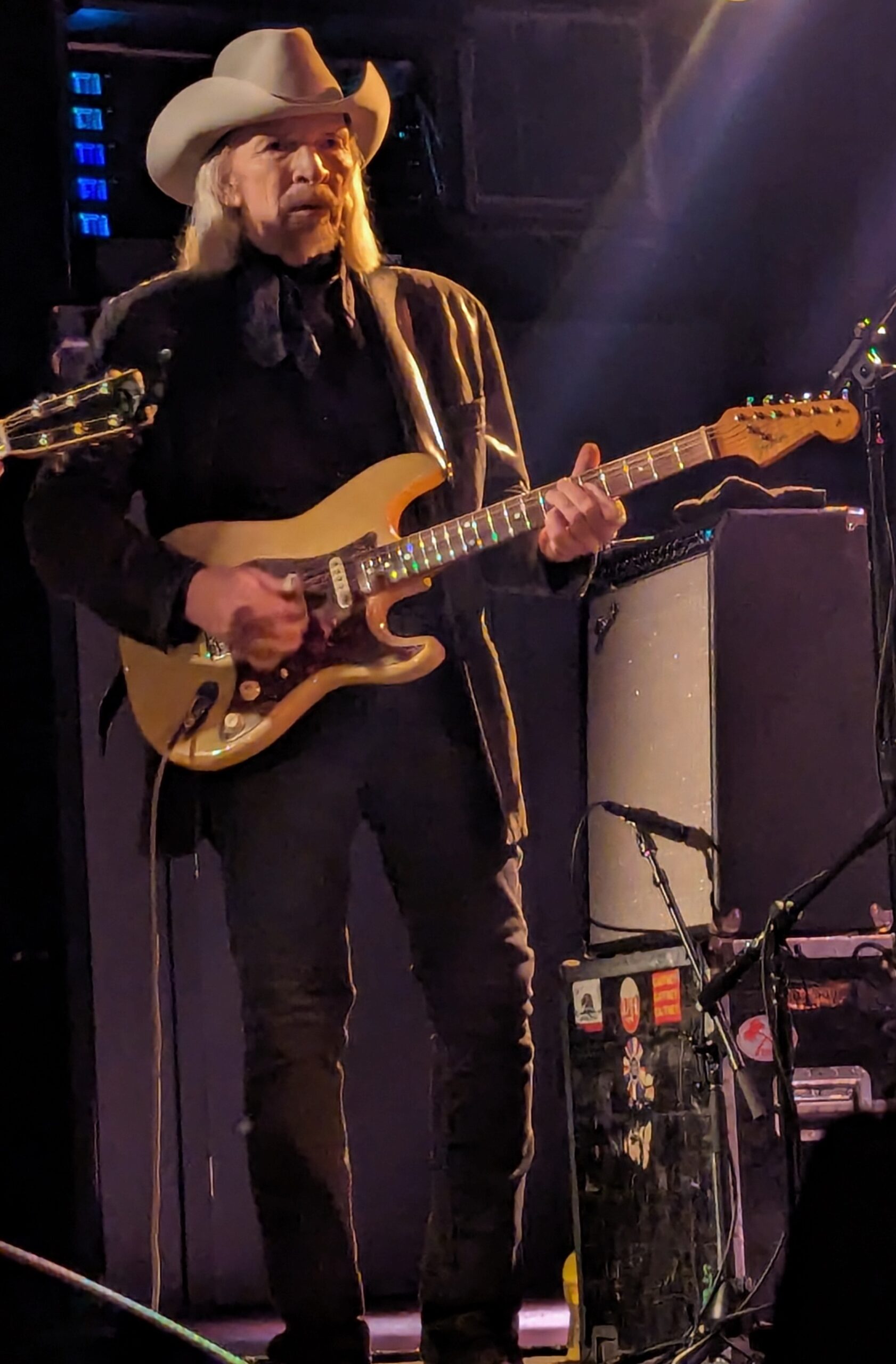
Dave Alvin guitars gear is the story of a guitarist who absorbed everything — blues, rockabilly, punk, country, folk, jazz, Mexican music, Southern gospel — and synthesised it all into a guitar approach so deeply American it sounds like geography as much as music. Alvin is the Blasters’ guitarist and primary songwriter, the man who wrote “Marie Marie,” “Border Radio,” and dozens of other songs that stand as genuine additions to the American vernacular songbook. He grew up in Downey, California listening to Howlin’ Wolf and Muddy Waters alongside Buck Owens and Merle Haggard, played in the same Los Angeles punk scene that produced X and the Blasters, and emerged from all of it with a guitar vocabulary that was simultaneously more historically grounded and more emotionally direct than almost any of his contemporaries.
The Journey
His relationship with the electric guitar is fundamentally different from the technical-display or sonic-texture approaches documented in many earlier articles. For Alvin, the guitar is a storytelling vehicle — a means of communicating specific emotional and narrative truths — and every element of his setup exists to serve that communicative function as directly and as honestly as possible. The result is a setup of deliberate simplicity that sounds, in his hands, like it contains multitudes. This is the complete breakdown of Dave Alvin guitars gear, technique, and tonal philosophy.
Background
David Alvin was born on November 11, 1955, in Downey, California — a working-class suburb of Los Angeles in the San Gabriel Valley, the specific cultural geography of which shaped his musical and literary imagination profoundly. Downey sat between the Mexican-American communities of East Los Angeles and the country-music culture of the Bakersfield scene to the north, and the combination gave Alvin early access to a musical range that most American guitarists didn’t encounter until they actively sought it out. He and his brother Phil absorbed Howlin’ Wolf, Muddy Waters, and the Chicago blues tradition alongside the rockabilly and honky-tonk of the Bakersfield sound, and the two formed the Blasters in 1979 — a band whose explicit project was to honour and revitalise the American roots music tradition that the punk and new wave movements had largely rejected.
The Blasters were not a revival act in the conventional sense — they were not attempting to recreate 1950s music for a nostalgia audience but to make living music that carried the energy and emotional truth of those traditions forward. The distinction mattered: a revivalist copies the surface; Alvin absorbed the substance. His guitar playing reflected this distinction — not technically imitative of specific players but emotionally continuous with the tradition he loved, making the blues and rockabilly vocabulary his own rather than performing it as historical demonstration.
His departure from the Blasters in 1986 — after disputes with his brother Phil — opened a solo career that allowed the full range of his musical and literary imagination to develop without the constraints of a band format. Albums including Romeo’s Escape (1987), Blue Blvd (1991), King of California (1994), Ashgrove (2004), and From an Old Guitar: Rare and Unreleased Recordings (2020) demonstrated a songwriter and guitarist of genuine depth, one whose work had the emotional weight of the tradition he absorbed alongside a specifically contemporary voice. He won the Grammy Award for Best Contemporary Folk Album for Ashgrove in 2001, recognition that his synthesis of roots traditions and personal expression had produced genuinely significant work.
Dave Alvin Guitars Gear: The Complete Rig
Guitars
Dave Alvin’s primary guitar throughout his career with the Blasters and his subsequent solo work has been the Fender Telecaster — specifically vintage examples from the 1950s and early 1960s that represent the instrument at its most direct, most uncompromising, and most deeply connected to the American country, blues, and rock and roll tradition it helped define. His primary Telecaster — a late-1950s example with the original two-single-coil pickup configuration, the vintage brass saddle bridge with the characteristic “ashtray” bridge cover, and the maple neck and rosewood fretboard combination of the period — was not chosen for its vintage value but for its specific tonal qualities that served his musical vision better than any alternative.
The Telecaster’s specific tonal qualities were central to Alvin’s approach. The bridge pickup’s aggressive, percussive attack and the characteristic “twang” quality of the bridge single-coil through the Telecaster’s distinctive metal bridge plate gave his rhythm playing a specific cutting authority — immediate, forward, acoustically present in ways that other guitar types could not replicate in quite the same way. The neck pickup’s warm, hollow, almost vocal quality gave his melodic lead work a specific character that connected it directly to the country and blues tradition — the Telecaster’s neck pickup was the sound of the California country tradition (Buck Owens, Merle Haggard) and the Chicago blues (Muddy Waters’s own varied electric guitar explorations) simultaneously. The tension between these two sounds — the bridge’s aggressive twang and the neck’s warm hollowness — gave the Telecaster its specific utility as a storytelling guitar: different emotional registers available from a single instrument without needing to change guitars.
Alvin collected vintage Telecasters across different production years, each with specific characteristics that made it appropriate for particular applications. Early 1950s examples with maple necks and brass saddles; late 1950s examples with rosewood boards; early 1960s examples with the changed bridge saddle configuration — each generation gave slightly different tonal characteristics that he understood and deployed appropriately. His deep knowledge of the Telecaster across production years reflected the same historical literacy that gave his music its depth.
The Gibson ES-335 — the semi-hollow mahogany-and-maple construction with PAF-spec humbuckers that gave it the warm, singing quality appropriate to jazz and blues lead work — appeared in Alvin’s documented setup for specific applications where the Telecaster’s bright, percussive character was less appropriate than the ES-335’s warmth and sustain. His blues lead work — particularly the slow, emotionally direct single-note lines of the Chicago blues tradition — found a natural home in the ES-335’s more vocal, sustained character.
Gibson Les Paul guitars appeared in Alvin’s setup for specific recording applications where the Les Paul’s humbucker warmth and mahogany sustain gave a tonally appropriate alternative to the Telecaster’s more percussive character. His Les Paul use was selective — reaching for it when the specific application required its warmth and body.
Alvin’s engagement with the American roots guitar tradition gave him knowledge of and access to a range of vintage instruments beyond the Telecaster — vintage Gretsch archtops, Danelectro guitars, and various other period-correct instruments that appeared in specific recording and live applications. His willingness to use the right instrument for each specific application, regardless of the practical complications of maintaining multiple instruments, reflected the same commitment to musical truth that characterised his entire artistic approach.
Both Martin dreadnoughts (D-28, D-18) and Gibson acoustic guitars appeared prominently in Alvin’s setup — the acoustic instruments of the country, folk, and blues traditions that informed his complete musical vocabulary. His acoustic playing demonstrated genuine technique and historical knowledge: not a rocker playing acoustic as an occasional change-up but a guitarist who had absorbed the acoustic tradition’s specific vocabulary and applied it with the same commitment as his electric work.
Alvin’s vintage Telecaster single-coils — the specific bridge and neck pickups from the periods of his primary instruments — were stock rather than replaced. His commitment to keeping original pickups in his vintage instruments reflected the same respect for the original design intent that characterised his approach to the music itself: not improving or modernising but understanding and engaging with what was originally there and why it worked.
Alvin used various string gauges depending on instrument and application — typically .010–.046 or .011–.052 on electric Telecasters and .012–.056 on acoustic guitars. His string choices reflected the same pragmatic approach as everything else in his setup: the gauge that gave the best tonal result and physical feel for each specific instrument and application.
Amps
The Fender Bassman — specifically the 5F6-A circuit version of the late 1950s, using four 6L6GC output tubes producing approximately 50 watts, four 10-inch Jensen P10R or P10Q speakers, and the cathode-follower tone stack that Jim Marshall and Ken Bran copied almost exactly when building the original Marshall amplifier — was Dave Alvin’s primary amplification. The Bassman’s historical significance was enormous: designed by Leo Fender in 1958 for bass guitar use, it was immediately adopted by guitarists for its warm, present, naturally overdriving character that suited the blues and rockabilly of the period perfectly. The Bassman drove into natural saturation at playing volumes manageable in a club or small theatre, giving the kind of warm, harmonically complex overdrive that later players would pursue through more elaborate means. For Alvin’s blues and roots rock application — material that valued natural overdrive and the specific warmth of tube saturation over processed, gain-staged distortion — the Bassman gave the most appropriate available tone.
The 5F6-A Bassman’s circuit gave a specific combination of clean headroom and natural overdrive threshold: at moderate volumes, the clean sound was full, warm, and transparent; pushed harder, the natural breakup gave a smooth, musically natural overdrive with a specific harmonic complexity that came from the tubes’ gradual saturation rather than hard silicon clipping. This “amp-driven” overdrive — the guitar’s signal causing the amplifier’s output stage to saturate naturally — gave a tonal character fundamentally different from any pedal-driven distortion, and it was specifically this character that the blues and rockabilly tradition had built its vocabulary around. The Bassman’s four Jensen P10R speakers gave the same tonal benefits as the Fender Super Reverb’s four-10-inch configuration documented in the Billy Zoom article — warmth, presence, and the specific spatial complexity of four separate point sources — appropriate to Alvin’s roots-based application.
The Fender Deluxe Reverb appeared in Alvin’s setup for specific applications — particularly in club settings where the 22-watt Deluxe’s smaller scale made it more practical than the full Bassman. The Deluxe’s 6V6 output tubes gave natural saturation at lower volumes than the Bassman’s 6L6GC, useful for intimate club performances where controlling stage volume was important. Its built-in spring reverb gave the atmospheric spatial dimension that country and blues guitar playing traditionally incorporated.
The Fender Twin Reverb appeared for larger venue applications where the Bassman’s volume ceiling was insufficient. The Twin’s higher headroom gave clean, transparent amplification at the volume levels required for theatres and outdoor stages, while the built-in spring reverb maintained the spatial dimension central to Alvin’s tonal approach.
Various vintage Fender amplifiers — from the earliest Champ and Princeton small-watt single-ended designs through the full Deluxe and Bassman — appeared in Alvin’s studio documentation for specific applications where each amplifier’s particular character (the Champ’s raw, single-ended saturation; the Princeton’s intimate, warm character) suited specific recording contexts.
Effects
The Fender tube tremolo — built into specific Fender amplifiers including the early Deluxe and other models, using a tube-based oscillator circuit to modulate the amplifier’s bias and create a smooth, warm volume tremolo — appeared in Alvin’s setup for specific atmospheric applications in the country and blues tradition. Tube tremolo gives a different character from optical or FET tremolo: smoother, warmer, with a specific wave shape determined by the tube circuit’s characteristics that distinguishes it from the harder, more rectangular wave of later solid-state tremolo designs.
Spring reverb — both the built-in tanks of Alvin’s Fender amplifiers and the standalone Fender reverb unit for amplifiers without built-in reverb — was a central element of his signal chain. The spring reverb’s warm, organic spatial quality gave the guitar a sense of acoustic environment appropriate to the country, rockabilly, and blues traditions he worked within.
Wah pedals appeared in Alvin’s setup for specific blues lead applications — the wah’s bandpass filter giving lead lines a vocal, expressive quality in the tradition of the slow blues players he admired. His wah use was selective and musically motivated — deployed for specific passages where the wah’s vocal quality enhanced the emotional content of the music rather than as a constant performance element.
Light overdrive pedals — the MXR Distortion+ or the Boss DS-1 at moderate settings — appeared selectively in Alvin’s setup for specific passages requiring additional gain beyond the natural Bassman overdrive. His overdrive pedal use was highly selective — reaching for it only when the natural Bassman character was insufficient for the specific musical application. The result was an approach where the vast majority of the gain came from the amplifier’s natural overdrive rather than from pedal-driven clipping.
The Boss TU-2 chromatic tuner gave accurate on-stage tuning — the standard professional tuner pedal for its reliability. His use of standard production tuning equipment rather than more exotic alternatives reflected the same anti-pretension practicality that characterised his entire gear approach.
The Maestro Echoplex appeared in Alvin’s setup for slapback echo applications in rockabilly-influenced passages — the same historical device used in the Sun Records tradition that directly influenced his musical vocabulary. His use of the Echoplex connected him directly to the recording tradition he was working within.
Playing Style & Tone Philosophy
Dave Alvin is the most literary guitarist in American roots rock — a player whose guitar work functions not merely as musical accompaniment but as a narrative voice in its own right, saying specific things about specific emotional states and specific places. His guitar lines have the quality of short sentences: economical, precise, loaded with implied meaning from the tradition they draw from. When he plays a slow blues lick on the neck pickup of his Telecaster, the sound is simultaneously a guitar line and a reference to a century of American experience — not because it’s complicated but because it’s done with total conviction and total knowledge of what it means.
His technique was built from the ground up on the specific traditions he absorbed. The Texas shuffle rhythm guitar — the specific combination of bass note, chord, and shuffle rhythm that gives Texas blues and Chicago blues rhythm playing its characteristic propulsion — was central to his approach, giving the Blasters’ recordings their rhythmic authority. The Bakersfield country picking — the precise, bright Telecaster technique of players like Don Rich (Buck Owens’s guitarist) — gave his lead work its specific country-tinged clarity. The Chicago blues single-note phrasing — the carefully placed, emotionally weighted notes of Muddy Waters, Little Walter, and Jimmy Rogers — gave his slow blues work its emotional depth. None of these traditions was a pose; he had absorbed them all as living vocabulary and used them with the naturalness of a native speaker.
His vibrato technique was wide and emotionally committed — the blues player’s full wrist rotation — applied with the specific timing of a musician who understood that the vibrato’s timing relative to the note’s attack was as important as its width and rate. Wide vibrato beginning immediately on a note produces a different emotional effect from wide vibrato that begins after the note’s attack has settled, and Alvin understood this distinction and applied it appropriately for each specific musical moment.
His chord vocabulary reflected the complete American roots tradition: not just power chords and bar chords but the specific partial chord voicings of Texas blues rhythm guitar (the movable double-stop patterns that gave Chicago and Texas blues rhythm its specific rolling quality), the open string chord voicings of country guitar, and the jazz-influenced chromatic passing chords that appeared in the more harmonically sophisticated moments of his compositions. This harmonic range — from the most basic blues chord to the most sophisticated chromatic passing chord — gave the Blasters’ arrangements a harmonic completeness unusual for a roots rock band.
Tonally, Dave Alvin guitars gear philosophy was built on the foundational simplicity of the American roots music tradition’s canonical combination: Telecaster through a Fender Bassman. This was not a limitation but a specific artistic choice — the decision to pursue tonal truth within the most historically appropriate and musically complete pairing available, rather than adding additional complexity in pursuit of additional tonal variety. The natural overdrive of the Bassman pushed by the Telecaster’s bridge pickup gave the blues rock passages their authoritative character; the Bassman’s clean headroom gave the country and jazz passages their transparent warmth; and the spring reverb gave everything the spatial dimension that separated records from performances.
The Fender Bassman 5F6-A’s cathode-follower tone stack — the specific design element that distinguished the Bassman from the earlier Fender amplifier tone stacks and that Jim Marshall and Ken Bran borrowed when creating the original Marshall — deserves technical examination because it explains why both the Bassman and the Marshall produce the specific tonal characters that made them the dominant amplifiers in blues rock and hard rock respectively. A cathode-follower is a tube circuit stage in which the tube’s cathode (rather than its plate, as in conventional tube voltage amplifiers) provides the output signal. This configuration gives a low-output impedance — typically 1k ohm or less — that provides a “stiff” drive to the subsequent passive tone stack. The passive tone stack (the bass, middle, and treble controls connected in a specific network of resistors and capacitors) operates differently when driven from a low-impedance source than from the high-impedance plate output of a conventional gain stage. From a low-impedance source, the tone stack’s EQ adjustments are more independent of each other — turning the bass control doesn’t interact with the treble response as much as in passive tone stacks driven from high-impedance sources. The result: the Bassman’s tone controls give more independent, more usable frequency-response adjustments than competing amplifiers whose passive tone stacks interacted more extensively. For Dave Alvin guitars gear’s application — the Telecaster’s wide tonal range (bridge twang to neck warmth) requiring specific tonal compensation at different pickup positions — the Bassman’s controllable, independent tone stack gave more precise tonal shaping capability than simpler alternatives.
The Texas shuffle rhythm guitar pattern — central to Dave Alvin guitars gear’s rhythmic vocabulary — is one of the most musically specific and most culturally significant rhythm guitar figures in American music. The Texas shuffle uses a combination of bass notes, double-stops (two-note chord fragments), and a specific swing rhythm pattern (subdividing the beat into a dotted-eighth/sixteenth rather than even eighth notes) to create a rhythmically propulsive, harmonically suggestive guitar part that simultaneously provides bass motion, harmonic context, and rhythmic drive. The specific chord shapes in the Texas shuffle — movable double-stop patterns using the third and seventh of the underlying chord, or the root and fifth in various rhythmic configurations — give the pattern its harmonic richness despite its apparent simplicity. When Alvin plays a Texas shuffle in E, he is simultaneously outlining the chord, providing a bass-note counterpoint, and creating the specific swing feel that the blues tradition requires for the music to “feel right.” This pattern — and the dozens of variations and embellishments he has developed from it — was absorbed from primary sources (T-Bone Walker, Lowell Fulson, the Bassman-era Texas blues tradition) rather than from instructional materials, giving his execution of it the natural authority of a tradition transmitted person-to-person rather than notated and analysed.
Downey, California — and its specific cultural position in the Los Angeles metropolitan area — shaped Alvin’s musical imagination in ways that deserve examination as part of the complete Dave Alvin guitars gear context. Downey sits at the intersection of multiple Southern California cultural streams: the Mexican-American community of the eastern San Gabriel Valley, which gave Alvin access to Mexican music and the specific cultural experience of immigrant communities in Los Angeles; the Bakersfield country music tradition that Buck Owens and Merle Haggard had developed from the Southern migrants who had come to California during and after the Depression and World War II; and the suburban Southern California landscape whose specific combination of beauty and desolation gave his lyrics their specific visual and emotional quality. The Bakersfield sound — honky-tonk country made in California by migrants from Oklahoma, Texas, and Arkansas who brought their musical traditions with them — was a direct influence on Alvin’s Telecaster approach: the Telecaster was the Bakersfield sound’s primary guitar, Buck Owens and Don Rich playing specific techniques on specific Telecasters that gave the music its bright, cutting character. The Mexican music of East Los Angeles was a direct influence on the rhythmic and harmonic vocabulary of the Blasters’ most distinctive compositions. The landscape of the San Gabriel Valley — the dry hills, the industrial infrastructure, the specific quality of California light — was a direct influence on the emotional quality of his lyrics. Dave Alvin guitars gear cannot be fully understood without the specific geography that produced the musician who chose and used it.
The Telecaster bridge pickup’s specific physical design — and why it gives the characteristic “twang” that makes it such an appropriate guitar for the American roots music tradition — has a specific mechanical explanation worth examining in this context. The Telecaster bridge pickup sits in a metal bridge plate (the “ashtray” bridge) that is bolted directly to the guitar body. This metal bridge plate acts as a large pickup cover but also as a magnetic shielding component for the pickup — the bridge pickup’s magnetic field interacts with the metal plate, which changes the effective magnetic aperture of the pickup and gives a specific frequency response boost in the upper midrange and treble frequencies. The metal plate’s interaction also gives the pickup a specific “snarl” quality — a slightly aggressive, forward quality in the 2–4kHz region — that contributes to the Telecaster bridge’s characteristic sound. The saddles (originally steel barrel saddles, later replaced with brass or steel compensated saddles in different production periods) also contribute to the bridge’s tonal character: the direct metallic coupling between string contact point and bridge plate gives a specific hard, percussive attack that gives the Telecaster its characteristic “twang” attack transient. For Dave Alvin guitars gear in the blues, country, and rockabilly contexts, this specific attack quality — bright, immediate, percussive — was precisely the tonal characteristic that the tradition required: the guitar’s sound announcing itself immediately and forcefully before the sustained body of the note developed.
How to Sound Like Dave Alvin
Guitar Approach
A vintage Fender Telecaster (1952–1964 original, or Fender American Vintage II 1951 Telecaster / American Vintage II 1963 Telecaster as accurate production alternatives) with original or vintage-spec single-coil pickups and the standard Telecaster bridge is the foundation of Dave Alvin guitars gear tone. The bridge pickup’s brass saddle ashtray bridge gives the characteristic “twang” that distinguishes vintage Telecasters from modern versions with updated saddle hardware. Use .010–.046 or .011–.052 round-wound nickel strings for the brightness and flexibility appropriate to the tradition. Study the Texas shuffle rhythm pattern, the movable double-stop figures of Chicago blues rhythm guitar, and the Don Rich–style country Telecaster picking before applying any of them in a performance context — understanding the tradition’s specific techniques is as important as the instrument and amplifier.
Amp Approach
A Fender Bassman 5F6-A (vintage original, or the Fender Bassman LTD as the most accurate current reissue) with four 10-inch Jensen P10R speakers is the correct foundation. Set for natural overdrive — not clean, not heavily saturated, but the specific warm breakup that occurs when the 6L6GC output tubes are pushed at moderate playing volumes. The natural Bassman overdrive is the primary distortion source; pedals are supplements, not substitutes.
| Control | Setting (0–10) | Notes |
|---|---|---|
| Bassman Volume | 5–7 | Moderate — push toward natural overdrive threshold; the amp should breathe, not scream |
| Bass | 6 | Warm — Telecaster bridge pickup is bright; support with Bassman bass for balance |
| Mid (Bassman presence tone control) | 5–6 | Neutral to slightly forward — present but not aggressive |
| Treble | 6 | Present — Telecaster needs treble support for country and blues definition |
| Guitar Volume (lead) | 10 | Full — push the Bassman into maximum natural overdrive for blues passages |
| Guitar Volume (country/clean) | 6–7 | Rolled back — use the Telecaster’s clean-up characteristic for country and clean passages |
| Tremolo Speed (if applicable) | 3–4 | Moderate speed — country tremolo is a rhythmic element, not just atmospheric |
| Reverb (spring) | 3–4 | Moderate — appropriate spatial dimension for club and studio blues and country |
| Echoplex Slapback (rockabilly) | 80–120ms, 1 repeat | Short slapback for specific rockabilly passages — not constant |
Fender Bassman natural overdrive as the primary gain source. Spring reverb as the essential spatial element. Fender tube tremolo for specific country and rockabilly passages. Maestro Echoplex slapback for rockabilly-specific passages. Cry Baby wah for specific blues lead expressiveness. MXR Distortion+ at minimal settings as a selective additional gain supplement when the Bassman’s natural overdrive is insufficient. Keep the chain minimal — Dave Alvin guitars gear is about the Telecaster and the Bassman’s natural interaction, with effects serving specific tradition-appropriate functions.
Influence & Legacy
Dave Alvin’s influence on American roots rock and Americana guitar is profound and specifically musical rather than commercially defined. His synthesis of blues, country, rockabilly, punk, and folk influences within a compositionally serious, lyrically literate framework gave subsequent musicians a model for how to engage seriously with the American roots tradition without becoming a revivalist — a model for treating the tradition’s vocabulary as living rather than historical. The Blasters’ recordings, and subsequently his solo albums, demonstrated that this synthesis could produce genuinely contemporary music rather than nostalgia product.
His influence is felt most directly in the Americana movement that developed in the 1990s — bands like Son Volt, Whiskeytown, and Lucinda Williams’ various projects, and the broader category of musicians who made serious work at the intersection of country, blues, folk, and rock. His specific guitar approach — the Telecaster honesty, the Bassman natural overdrive, the blues vocabulary applied with genuine knowledge and emotional commitment — has been absorbed by countless guitarists who may not consciously identify him as an influence but whose work carries his values forward.
The comparison with Billy Zoom — his direct Los Angeles punk scene contemporary whose Gretsch-and-Fender roots-rock approach paralleled Alvin’s Telecaster-and-Bassman approach in the same cultural moment — illuminates the specific tradition of Los Angeles roots-conscious rock guitar that distinguished the West Coast punk scene from its New York and London counterparts. The parallel with James Burton — the quintessential Telecaster player whose country and rockabilly guitar vocabulary was the direct historical source for the sounds Alvin absorbed and deployed — shows the lineage from the 1950s American guitar tradition through the 1970s–80s roots rock revival to the contemporary Americana movement. And the connection to Rory Gallagher — the Irish guitarist whose similarly absolute commitment to the blues tradition, vintage instruments, and emotional honesty in guitar playing paralleled Alvin’s American equivalent of the same values — places Dave Alvin guitars gear in the international tradition of guitarists who treated the blues not as a genre but as a living ethical commitment to emotional truth.
Frequently Asked Questions: Dave Alvin Guitars & Gear
What guitar does Dave Alvin play?
Dave Alvin’s primary guitar throughout his career with the Blasters and his solo work has been the Fender Telecaster — specifically vintage 1950s and early 1960s examples with original single-coil pickups, the characteristic brass saddle bridge, and the specific tonal qualities of the period that suit the blues, country, and rockabilly traditions he works within. The bridge pickup’s aggressive twang and the neck pickup’s warm, vocal quality give the Telecaster its specific utility as a storytelling guitar — different emotional registers available within a single instrument. He also uses Gibson ES-335 for blues applications and vintage acoustic guitars (Martin, Gibson) prominently in his solo work.
What amplifier does Dave Alvin use?
Alvin’s primary amplification is the Fender Bassman in its 5F6-A circuit configuration — the late-1950s version with four 6L6GC output tubes, four Jensen P10R 10-inch speakers, and the cathode-follower tone stack. The Bassman’s natural overdrive — the warm, harmonically complex saturation that occurs when the 6L6GC output tubes are pushed at moderate playing volumes — was the primary gain source for his blues and roots rock work. Fender Deluxe Reverb and Twin Reverb served specific applications, and various other vintage Fender amplifiers appeared in studio contexts.
What was The Blasters and why were they important?
The Blasters were a Los Angeles-based American roots rock band formed by Dave Alvin (guitar), Phil Alvin (vocals), John Bazz (bass), and Bill Bateman (drums) in 1979. Their explicit project was to honour and revitalise the American roots music tradition — blues, rockabilly, honky-tonk, R&B — that the punk and new wave movements had largely rejected. Their recordings (American Music, 1980; The Blasters, 1981; Non Fiction, 1983; Hard Line, 1985) combined the energy of the punk scene they emerged from with the musical substance of the traditions they respected, giving them a specific quality of vitality and authenticity unusual in either the roots revival or the punk world they occupied simultaneously.
How does Dave Alvin’s guitar approach connect to the American blues tradition?
Alvin absorbed the American blues tradition from primary sources — Howlin’ Wolf, Muddy Waters, Jimmy Rogers, Little Walter — as a child and teenager growing up in Downey, California, where his older brother introduced him to Chicago blues records alongside country and rockabilly. His guitar approach reflects this absorption: the Texas shuffle rhythm pattern, the movable double-stop figures of Chicago blues rhythm guitar, the slow blues single-note phrasing, and the emotional directness of the tradition are all present in his playing as genuine vocabulary rather than academic reference. His Telecaster-through-Bassman setup gives the most direct available connection to the electric blues tradition’s specific tonal character.
What is the Fender Bassman 5F6-A and why is it historically significant?
The Fender Bassman 5F6-A is the late-1950s version of Fender’s original bass amplifier, using four 6L6GC output tubes producing approximately 50 watts, four 10-inch Jensen speakers, and the cathode-follower tone stack designed by Leo Fender. It was the most influential amplifier circuit in rock and roll history: Jim Marshall and Ken Bran copied its circuit almost exactly when building the original Marshall amplifier in 1962, and every Marshall amplifier since has been based on the Bassman’s fundamental design. For guitarists, the Bassman’s natural overdrive at playing volume, its warm bass response, and the specific character of the four Jensen P10R speakers gave blues and roots rock players the most appropriate available tone — warm, present, naturally saturated, with the specific tonal qualities that the tradition was built around.
What is Americana music and how does Dave Alvin relate to it?
Americana is a genre category (and a Grammy Award category since 2010) that encompasses music rooted in American vernacular traditions — country, blues, folk, gospel, bluegrass, rockabilly — but made with contemporary artistic intent rather than as historical recreation. Alvin was a pioneering figure in what became the Americana genre before the label existed — his synthesis of multiple American roots traditions within compositionally and lyrically serious music created a template for the movement that followed. His Grammy Award for Ashgrove (Best Contemporary Folk Album, 2001) was one of the early official recognitions of this work. The Blasters’ recordings are now recognised as foundational documents of the American roots rock revival that preceded and anticipated the Americana movement.
Does Dave Alvin play acoustic guitar?
Yes — acoustic guitar is a significant part of Alvin’s musical identity, particularly in his solo work. His acoustic playing draws from the same traditions as his electric work — country folk guitar, blues fingerpicking, and the singer-songwriter folk tradition that emerged in the 1960s and that he absorbed alongside his blues and rockabilly influences. His acoustic performances demonstrate genuine technique in multiple acoustic guitar traditions: not a rocker using acoustic as an occasional change-up but a guitarist who has developed genuine acoustic vocabulary in the country, blues, and folk traditions. Martin dreadnought acoustics (D-28, D-18) give the full, projecting sound appropriate to his acoustic performance work.
Alvin’s Grammy Award for Ashgrove in 2001 — Best Contemporary Folk Album — was a specific kind of recognition that illuminated both the quality of his work and the awkwardness of the genre categories available to music like his. “Contemporary folk” is a serviceable description of certain qualities of the album — acoustic instruments, roots-based songwriting, personal and narrative lyrics — but it doesn’t capture the blues depth, the country breadth, the punk energy, or the literary ambition that made Ashgrove distinctive. The Grammy recognition was important not because genre labels matter but because it represented official acknowledgment that his synthesis had produced genuinely significant work — that the combination of multiple American roots traditions within a compositionally serious framework was not a category error but a genuine artistic achievement. His guitar approach on Ashgrove and the surrounding solo work demonstrated Dave Alvin guitars gear at its most fully developed: the Telecaster’s range from acoustic-near-electric delicacy to electric authority, the Bassman’s range from clean transparency to natural saturation, and the specific application of multiple traditions’ vocabularies in service of compositions that used music as a narrative vehicle with the same seriousness that literature brought to the task. The award was recognition that this project — using the guitar and the song to tell the truth about American life — was worth doing and had been done exceptionally well.
One final dimension of Dave Alvin guitars gear worth addressing: his approach to the guitar as a specifically physical instrument, not just a tone-generating device. Like John Norum’s Les Paul, Rory Gallagher’s battered Stratocaster, and the other vintage-instrument players throughout this series, Alvin’s relationship to his specific guitars involved the physical objects themselves — the weight and balance of specific instruments under his hands, the specific feel of worn fretboards and played-in necks, the acoustic resonance of bodies that had absorbed decades of vibration. His vintage Telecasters were not valuable because they were old but because they were played — because the wood and metal had settled into their specific resonant equilibrium through years of use in a way that new instruments haven’t had time to achieve. The acoustic qualities of well-played vintage instruments — the subtle changes in wood density and composition that extended vibration causes — were understood by Alvin not as mysticism but as practical acoustic reality: the guitar that had been played well for forty years sounded different from an equivalent guitar played for four months, and the difference mattered. This understanding — that the instrument was a living object that developed through use rather than a static manufactured commodity — was itself part of the philosophy that gave Dave Alvin guitars gear its specific character.
The Telecaster’s clean-up characteristic — the guitar’s volume control reducing the pickup’s loading on the amplifier’s input and producing a cleaner, warmer tone at reduced settings — was as important to Dave Alvin guitars gear as to John Norum’s Les Paul PAF-through-Plexi setup documented earlier in this series. When Alvin rolled back the Telecaster’s volume from 10 to 6–7 for a country or clean passage, the combined effect of reduced signal level and changed pickup impedance loading gave the Bassman’s input a cleaner, warmer signal — the amplifier’s own overdrive threshold was not reached, giving the clean, transparent Bassman character appropriate to the country and folk passages. When he pushed the volume to 10 for a blues lead, the full Telecaster output drove the Bassman into its natural saturation, giving the warm, harmonically complex overdrive appropriate to the blues passages. This single-control tonal management — using the guitar’s volume pot as a primary tonal control rather than merely as a level attenuator — was specific to the passive guitar/natural-overdrive amplifier combination that Dave Alvin guitars gear represented. It required intimate knowledge of the specific relationship between each guitar’s output at each volume setting and the specific Bassman’s input sensitivity — knowledge accumulated through years of playing the same instruments through the same amplifier. This specificity, this deep familiarity with particular instruments and their particular interactions, was itself the product of the commitment to the tradition that gave Alvin’s music its authority.
Related stories
Wes Montgomery Guitars & Gear: The Complete Guide to the Jazz Master’s Rig
Wes Montgomery's guitars, amps, and effects — the complete guide. Gibson L-5 CES, Standel amps, thumb picking technique, flatwound strings, and how to nail that warm jazz tone.

Yngwie Malmsteen Guitars & Gear: The Complete Guide to the Shred Master’s Rig
Yngwie Malmsteen's guitars, amps, and effects — the complete guide. The Duck Stratocaster, scalloped fretboard, Marshall wall, DiMarzio HS3, and how to nail that neoclassical metal tone.
Sylvain Sylvain Guitars & Gear: The Complete Guide to the New York Dolls’ Gretsch, Les Paul Junior & Automatic Guitar Proto-Punk Rig
Sylvain Sylvain guitars & gear: New York Dolls guitarist. Les Paul Junior 'automatics', Gretsch Golden Anniversary, white Les Paul Custom stolen by Steve Jones — proto-punk tone.