Sonny Landreth Guitars & Gear: The Complete Guide to the King of Slydeco’s Technique, Modified Strats & Pushed Amps
Sonny Landreth guitars & gear: the King of Slydeco. Modified Stratocasters, open E tuning, behind-the-slide fretting, pushed Fender tube amps — Eric Clapton's most advanced guitarist.
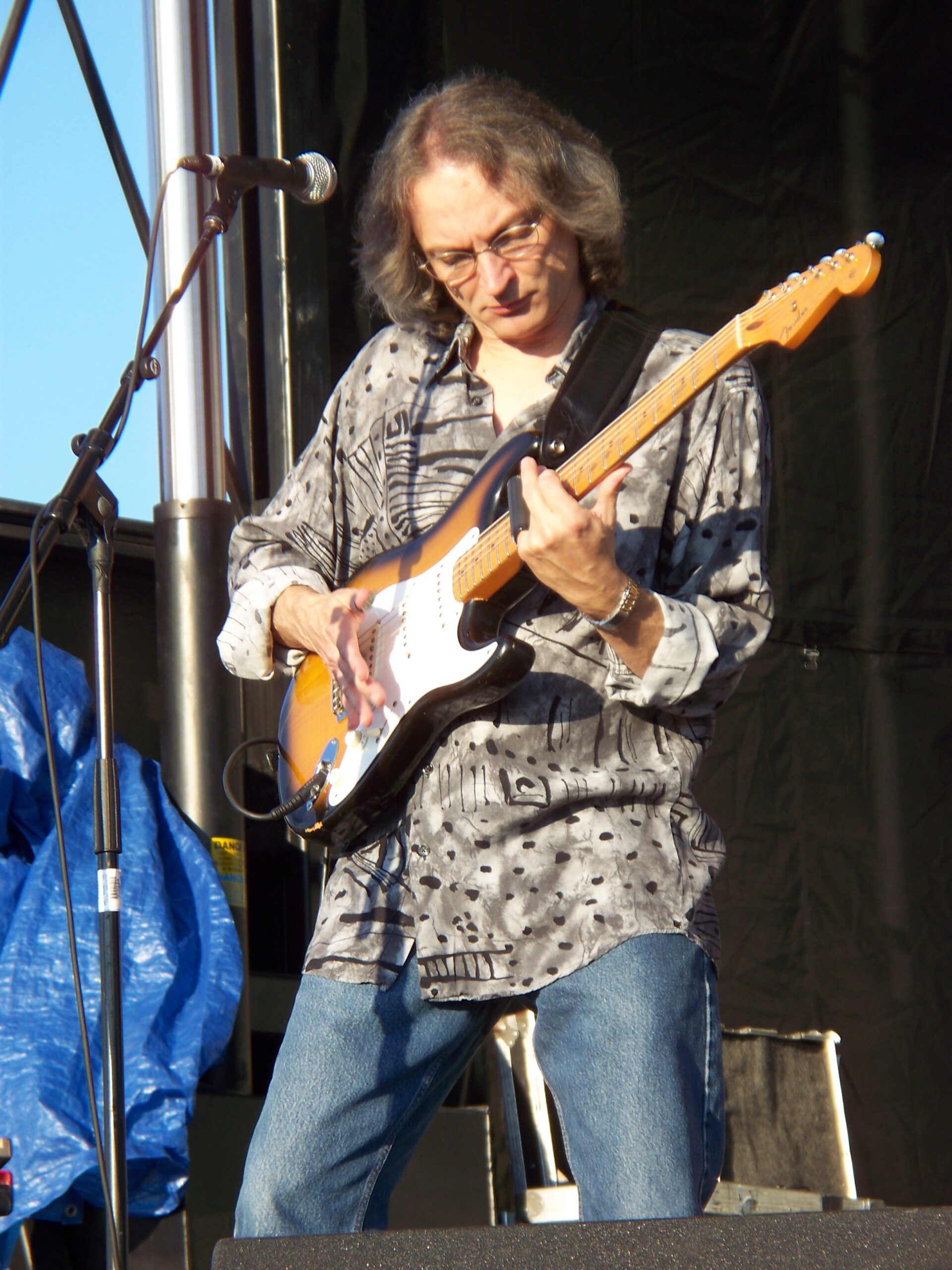
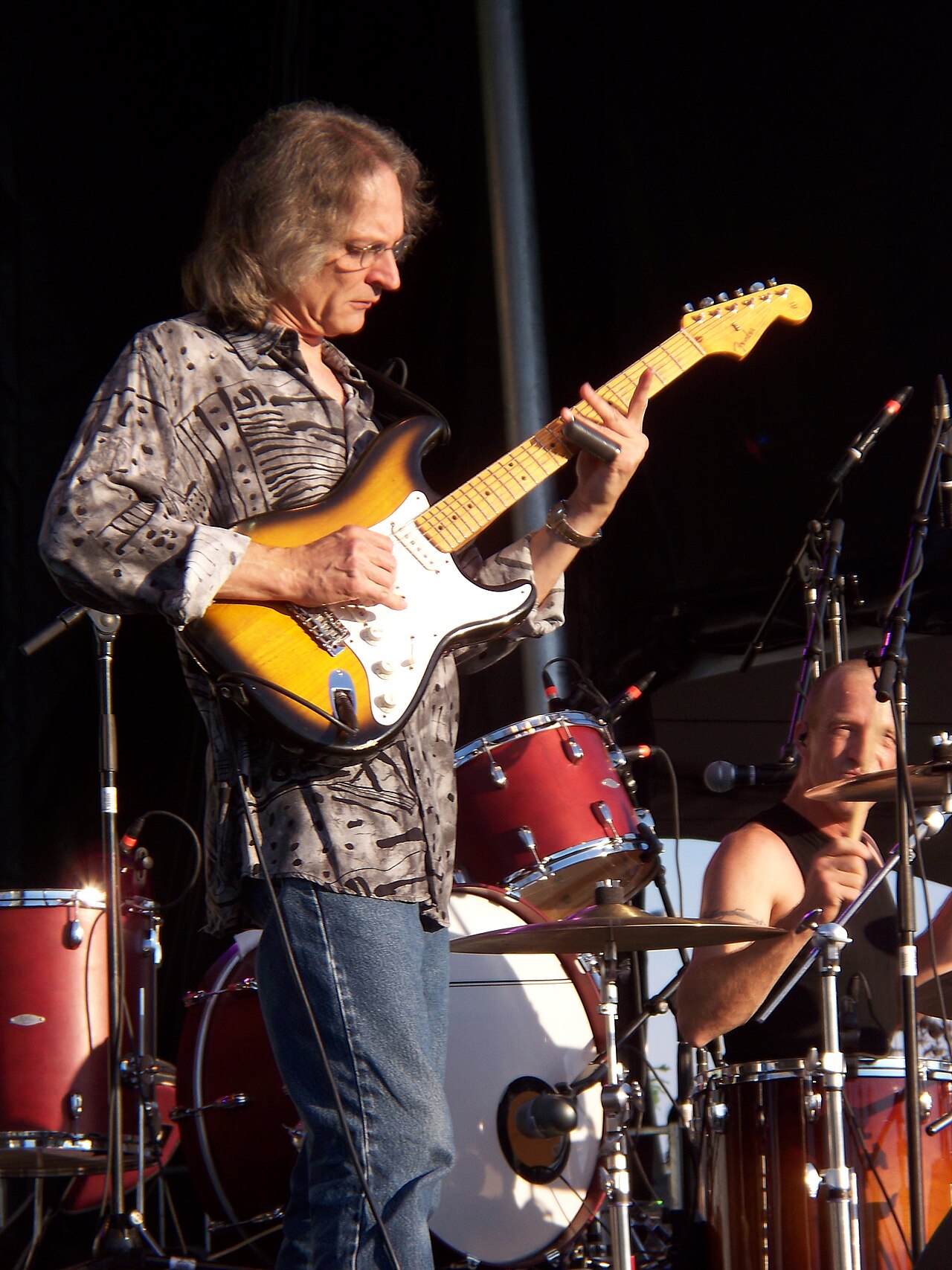
Photo by ceedub13, licensed under CC BY 2.0 (https://commons.wikimedia.org/wiki/File:Sonny_Landreth_%40_Ottawa_Bluesfest_(3286176906).jpg)
Eric Clapton has said that Sonny Landreth is “probably the most underestimated musician on the planet, and also probably one of the most advanced.” This is Eric Clapton saying this — the guitarist whose own technique and tone are among the most celebrated and most analyzed in rock history, who has invited Landreth to perform at every single Crossroads Guitar Festival since the event’s inception, and who recorded alongside Landreth on From the Reach (2008). Clapton did not say Landreth was advanced for a slide guitarist, or advanced for a blues musician, or advanced within any genre category. He said probably one of the most advanced guitarists on the planet. Full stop. The specific quality that earns this assessment from a peer of Clapton’s calibre is Landreth’s behind-the-slide technique: the ability to fret notes and chords with the fingers that are not holding the slide — the index, middle, and ring fingers of the left hand, positioned behind the slide on the pinky — while the slide itself plays a separate melodic or harmonic line simultaneously. Two musical voices, one guitarist, one hand, one guitar. The slide plays above the fret; the fingers play behind the glass. The result is what Landreth calls “the music behind the glass” — a polyphonic guitar approach that no standard technique produces and that he has developed over fifty years into one of the most genuinely original guitar voices in American music. No equipment makes you Eric Clapton’s most-advanced-guitarist nominee. That is technique, and technique alone.
Clide Vernon “Sonny” Landreth was born on February 1, 1951, in Canton, Mississippi, and settled in southwest Louisiana — eventually in Breaux Bridge, Louisiana, where he still lives — absorbing the specific musical culture of that region: the zydeco of Clifton Chenier, the Cajun music of the bayou country, the Delta blues of the Mississippi tradition he came from, and the rock and roll influences of Scotty Moore, Eric Clapton, and Jimi Hendrix that reached him through the broader American popular music environment of the 1960s and 70s. He was the first white member of Clifton Chenier’s Red Hot Louisiana Band — an acknowledgment of musical quality from a bandleader who was one of the founding figures of the zydeco tradition. Playing with Chenier gave Landreth the specific zydeco rhythmic vocabulary and the deep cultural embedding in the Louisiana music tradition that distinguishes his music from guitar players who have absorbed the same influences academically rather than practically.
His guitar career began, perhaps surprisingly, on the trumpet — he first learned to play trumpet before switching to guitar, developing the horn player’s specific approach to melodic phrasing, note bending, and the relationship between sustained tone and melodic direction that shapes the specific quality of his slide playing. “He eventually started using a slide to capture the instrumental sounds he’d heard on classic blues recordings, which he felt functioned more like a soundtrack for the vocal than mere accompaniment.” This is the definition of the blues slide tradition: the guitar serving as a second voice in dialogue with the vocal, producing the pitch bends and glissandos that a human voice produces and that fretted guitar playing cannot. Landreth heard this, wanted to produce it, and developed the specific technique that produces it at the highest possible level.
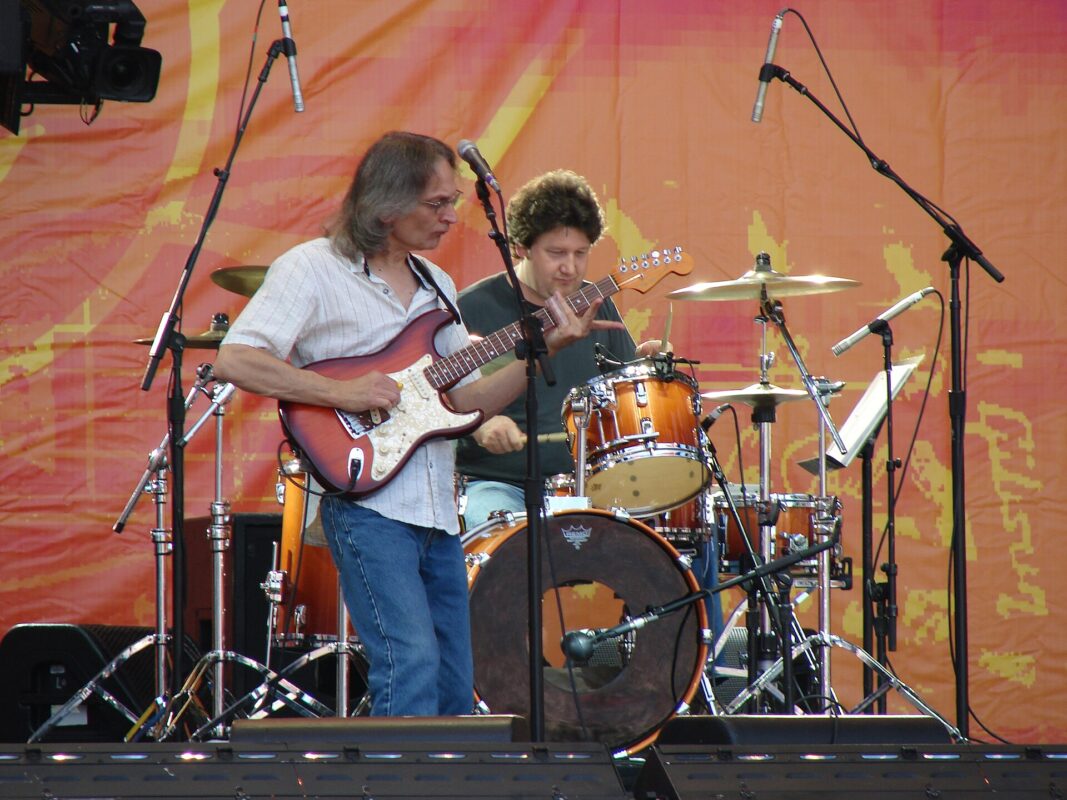
The “King of Slydeco” title — a portmanteau of “slide” and “zydeco” that accurately captures his dual musical identity — is the most compressed available description of what makes Landreth’s music specifically Landreth’s: the slide guitar technique applied to zydeco and Cajun musical vocabulary, producing a sound that no other musician occupies because no other musician has the same combination of technical mastery, cultural embedding, and specific geographic identity. He is not a blues guitarist who plays slide. He is not a zydeco musician who happens to use a Stratocaster. He is Sonny Landreth, specifically, and the music behind the glass is specifically his.
His house, as NPR’s John Burnett described it, is “crowded with amplifiers and guitars and overseen by a mutt named Simco” — the stage manager, couch manager, and security chief. The amplifiers that sound “as if they’re being pushed near the breaking point,” the modified Stratocasters that he plucks, bangs, and picks with all the fingers of his right hand, the tubular glass slide on his left pinky — this is the specific environment from which the music behind the glass emerges. The gear serves the technique. The technique serves the music. The music is Sonny Landreth.
Background: Clifton Chenier, John Hiatt, and Fifty Years of Behind-the-Glass Innovation
The Clifton Chenier chapter of Landreth’s career established the specific cultural authenticity of his Louisiana musical identity and the practical zydeco vocabulary that distinguishes his playing from the country blues and rock blues traditions that most slide guitarists primarily occupy. Chenier — whose accordion-led Red Hot Louisiana Band was one of the primary commercial and creative forces in zydeco’s development as a genre — ran a demanding, musically rigorous band that required genuine competence and genuine feeling from every member. Landreth’s position as the guitarist gave him a specific education in how the zydeco rhythm works, how the call-and-response between the accordion and the guitar functions, and how the syncopated, polyrhythmic groove of Louisiana music relates to the blues tradition from which it develops. This education is audible in every Blackberry Smoke album that draws on Southern rock traditions, because Landreth has been one of the primary sources from which those traditions flow into contemporary music.
The John Hiatt session work of the 1980s — Hiatt hired Landreth to play guitar after his playing caught Hiatt’s ear — placed him in the specific context of American roots rock that would eventually bring his playing to broader attention. Hiatt’s specific combination of country, blues, and rock influences, and the specific guitar role in his arrangements, suited Landreth’s multi-technique approach well: the ability to play slide, fingerstyle, chordal, and single-note melodic material from the same guitar in the same song gave him the versatility that a demanding session context required. His resume extended to include Jimmy Buffett, John Mayall, Zachary Richard, Junior Wells, Beausoleil, Allen Toussaint, Mark Knopfler, and Steve Riley — a roster that confirms both the breadth of his stylistic flexibility and the depth of his reputation among musicians who hire for genuine musical capability rather than commercial profile.
South of I-10 (1995) and Levee Town (2000) are the albums that established Landreth’s solo reputation among guitarists worldwide — the documents of the behind-the-glass technique at its most fully developed, applied to original songs rooted in the specific Louisiana musical culture he had spent two decades absorbing. “Both South of I-10 and Levee Town contain some of the most incredible slide guitar work ever recorded,” as the Premier Guitar assessment puts it. The Road We’re On (2003) and Grant Street (2005) charted on the Billboard Blues Album Chart. From the Reach (2008) featured Clapton, Mark Knopfler, Dr. John, Vince Gill, Eric Johnson, and Jimmy Buffett — a roster of guitar luminaries performing songs that Landreth wrote specifically for each collaborator’s style, a compositional approach that simultaneously demonstrated his generosity toward his peers and his deep knowledge of each player’s musical identity.
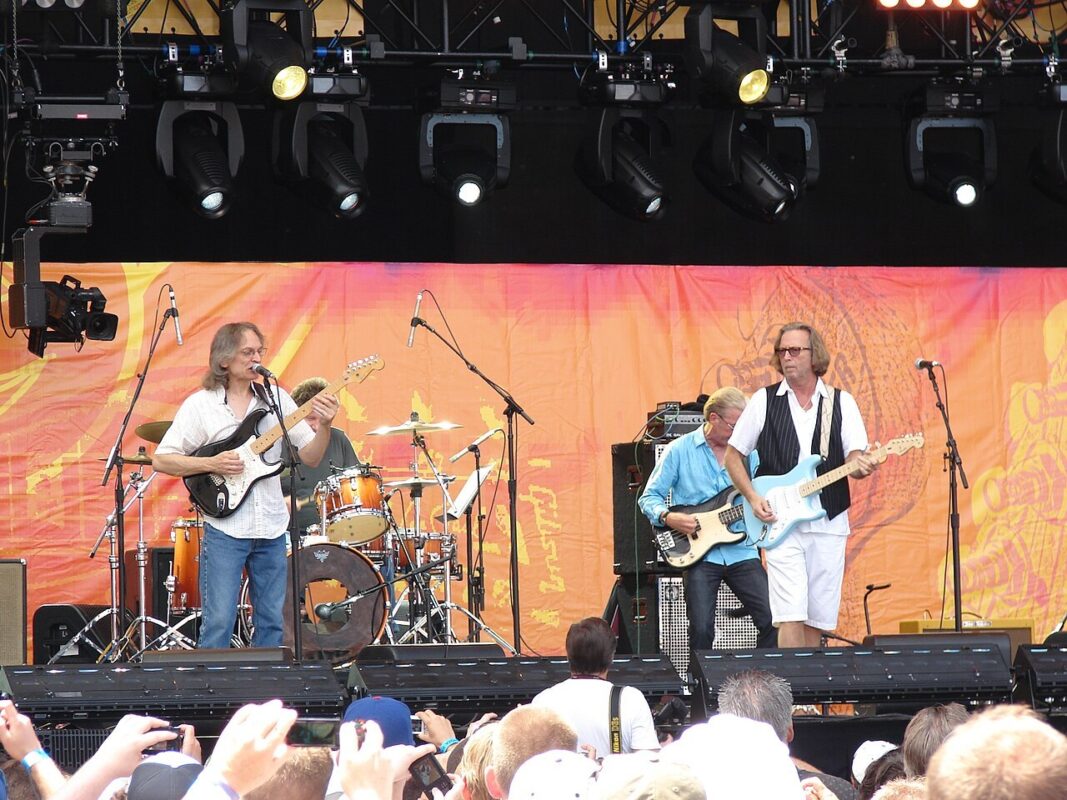
The Crossroads Guitar Festival — Eric Clapton’s biennial event featuring the world’s most accomplished blues and rock guitarists — has included Sonny Landreth at every edition since its inception. This consistent invitation, from the guitarist who described him as probably the planet’s most advanced, is the clearest possible institutional confirmation of a reputation built on playing rather than marketing, on genuine technical achievement rather than commercial profile. Landreth is, as NPR put it, “a guitarist’s guitarist” — primarily known within the guitar-playing community rather than to the broader public, but known within that community with the specific, deep respect that genuine peer recognition produces.
The Rig: Sonny Landreth’s Guitars, Amps, and Effects
Guitars
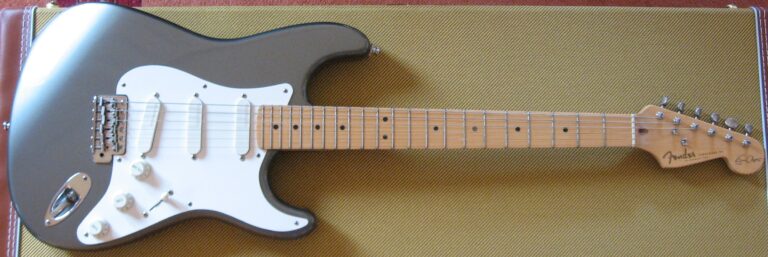
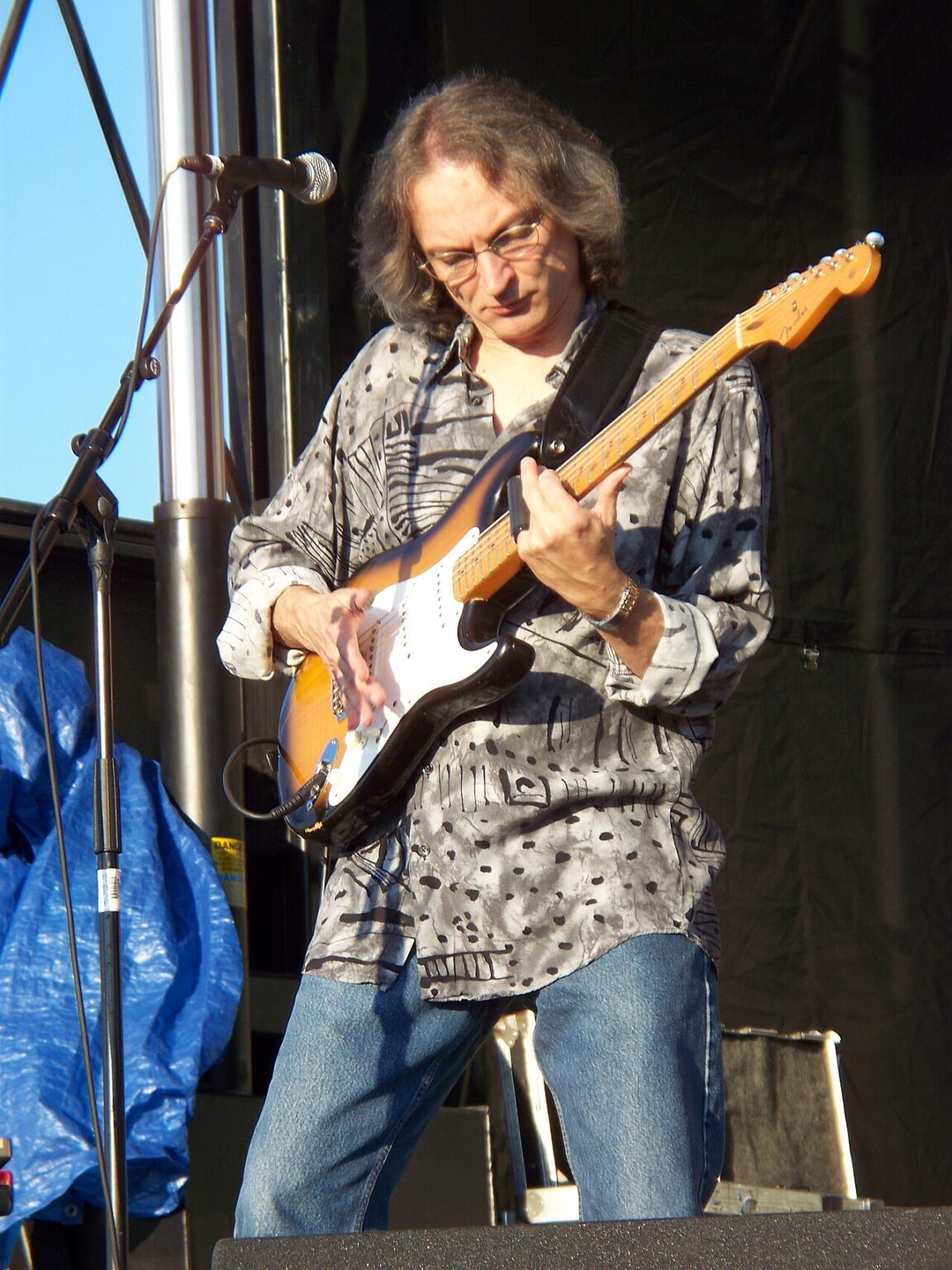
Sonny Landreth’s primary instrument is a modified Fender Stratocaster — modified for his specific playing requirements rather than played stock. The Stratocaster is the specific choice for multiple reasons: its three single-coil pickups provide the full range of tonal options from the neck’s warmth through the in-between positions’ quack to the bridge’s bright, cutting character that slide guitar requires for maximum projection; its contoured body design suits the physical demands of extended playing; and the specific three-pickup configuration with five-way switching gives Landreth the full tonal palette that his multi-technique approach requires across different passages and different musical contexts. The modifications to his personal Stratocasters are specific to his playing requirements — the specific setup that accommodates both standard fretting behind the slide and the slide itself, with the action and nut configuration appropriate for the open tunings he primarily uses. The Stratocaster’s specific combination of single-coil clarity and the three-pickup variety represents the most complete instrument platform for the specific multi-voice playing approach that Landreth has developed.
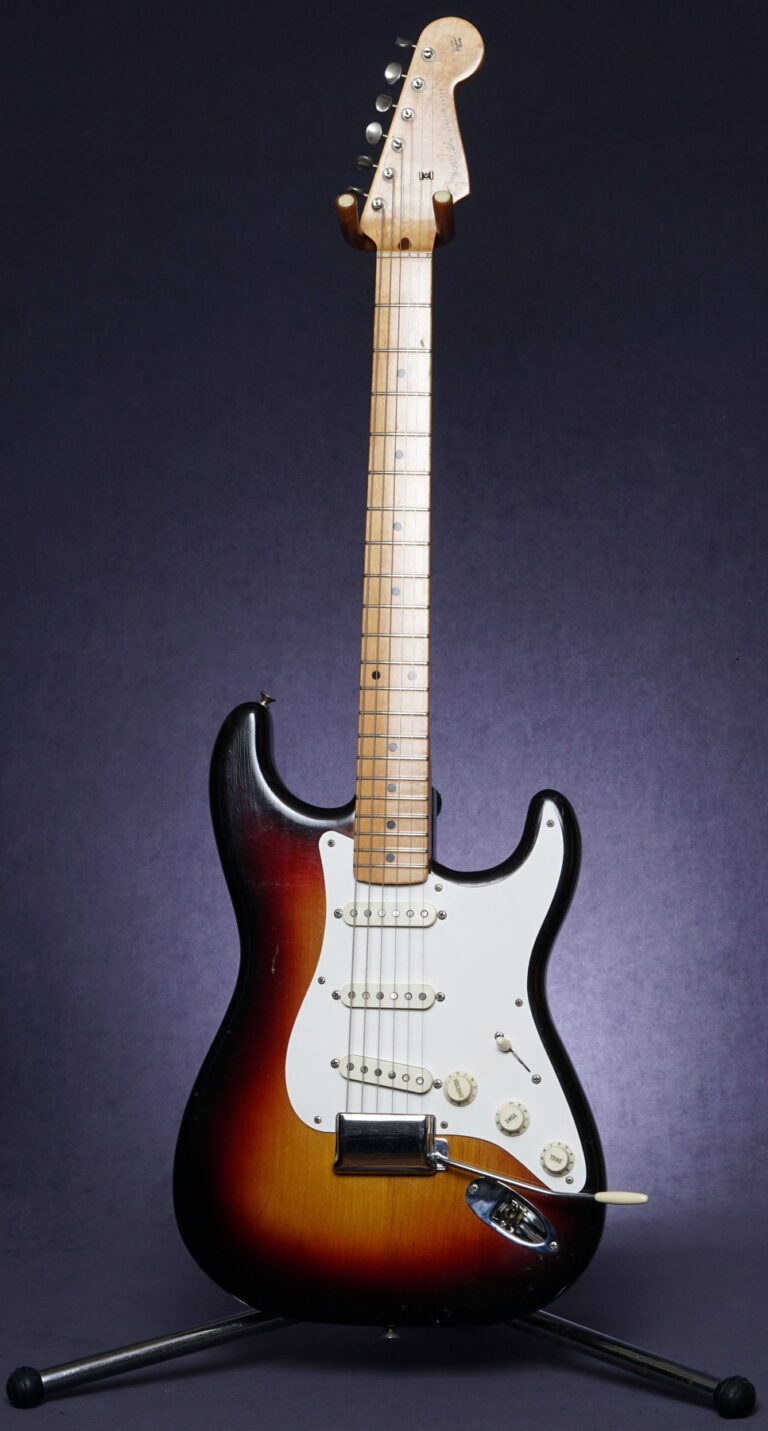
Landreth’s primary tuning is open E — low to high: E-B-E-G#-B-E — one of the most widely used open tunings for electric slide guitar, shared with players including Duane Allman and Derek Trucks. Open E (also known as “Vestapol” tuning) produces a full E major chord when all strings are strummed open, with the third string tuned up a semitone from G to G# and the fourth and fifth strings tuned up a whole step from D and A to E and B respectively. The practical benefit for slide playing: any straight bar across all strings at any fret position produces a major chord, enabling the specific sliding chord technique that characterizes classic bottleneck blues. The increased string tension relative to standard tuning (several strings are tuned up) produces a slightly stiffer feel and a brighter, more resonant tone from the Stratocaster’s single-coil pickups — contributing to the specific projection and clarity that Landreth’s pushed-amp approach requires.
Landreth also uses a metal-body resonator guitar for acoustic contexts — specifically demonstrated in his NPR appearances where he “picks up a shiny, metal-body resonator guitar and slips a tubular glass slide onto his left pinky finger” to demonstrate the behind-the-glass technique. The metal-body resonator is the acoustic slide guitar instrument of the pre-electric blues tradition: a guitar with a metal resonator cone that projects the string vibration into a metal body for natural acoustic amplification in the era before electric amplification was available. Landreth uses it for specific acoustic performances and for the demonstration of the fundamental slide technique in contexts where electric amplification would be inappropriate or unnecessary. The resonator’s specific bright, metallic, sustaining tone is different from the electric Stratocaster’s character but serves the same acoustic function: projecting the slide’s pitch and the behind-the-glass fretting’s chord voicings with maximum clarity.
The tubular glass slide on Landreth’s left pinky finger is the primary slide instrument — the hardware that glides above the fretboard and along the strings while the other four fingers fret chords and notes behind the glass. The choice of the pinky finger for the slide is fundamental to the behind-the-glass technique: placing the slide on the smallest finger leaves the index, middle, and ring fingers free to fret behind it, which is what makes the simultaneous two-voice playing possible. A guitarist who wore the slide on the ring finger would have only two fingers available behind it, severely limiting the chord voicings that can be fretted simultaneously. Glass slides produce a specific warmer, smoother tone than metal slides — less aggressive in attack, with a rounder quality of sustain — that suits Landreth’s warm, vocal approach to the slide voice.
Landreth wears a special thumb pick / flat pick hybrid on his thumb so he can bear down on a pick while simultaneously using his fingerstyle technique for the slide. This specific right-hand tool enables the combination of picking attack (for drive and definition) and fingerstyle technique (for individual string control and the tapping, slapping, and plucking elements of his right-hand approach) that his multi-technique playing requires. Standard picks and standard fingerstyle techniques are each optimized for their respective applications; Landreth’s hybrid thumb pick/flat pick creates a right-hand tool optimized for both simultaneously. This is the right-hand equivalent of the left-hand slide-plus-fretting approach: both hands doing two things at once, the whole player functioning as a multi-voice musical instrument.
Amps
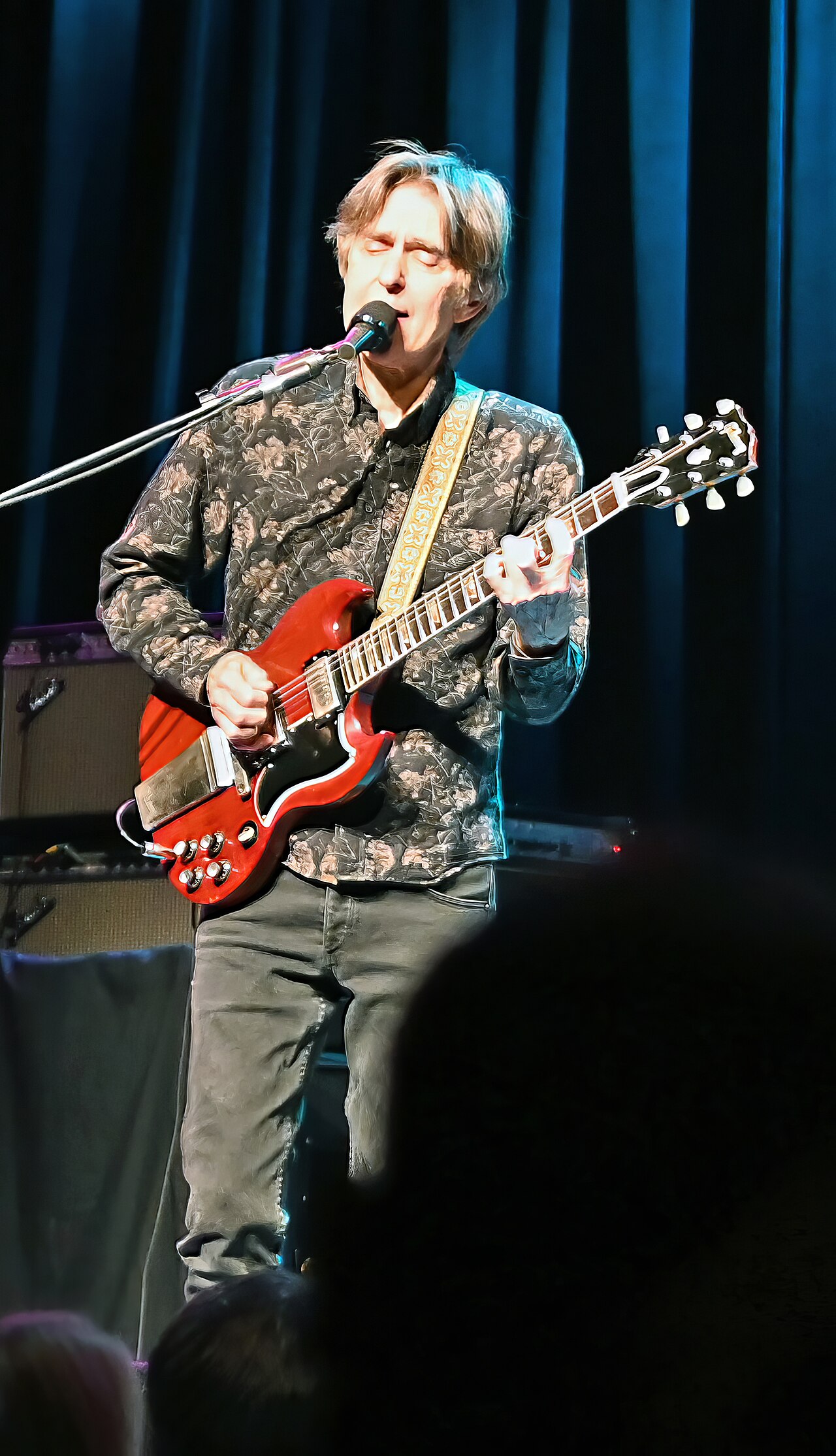
The defining characteristic of Landreth’s amplification approach is documented precisely in the NPR Mountain Stage description: he uses “a unique combination of tools and techniques — amplifiers that sound as if they’re being pushed near the breaking point.” This “near the breaking point” approach is the slide guitarist’s fundamental amplifier philosophy: the natural saturation of a valve amplifier driven to its output stage’s working point produces the specific quality of compression, harmonic complexity, and sustain that electric slide guitar requires for maximum expressiveness. A clean, headroom-heavy amplifier does not sustain the slide’s pitch and harmonic content with the same richness as an amplifier that is working at its operational limits. Landreth’s specific amplifier choices are selected for their ability to produce this near-the-breaking-point character at appropriate performance volumes — warm, complex, sustaining, with the specific quality of harmonic content that distinguishes a pushed valve amplifier from a clean one.
Fender amplifiers are the primary amplification family in Landreth’s rig — consistent with the Stratocaster as his primary guitar and with the specific warm, American-voiced character that Fender amplification provides for blues and roots music applications. The combination of Fender Stratocaster single-coil pickups with Fender amplification produces a specific tonal character — bright, warm, with the specific quality of American 6L6-powered amplification — that differs from the British EL34 character of Marshall amplification and that suits the Louisiana blues and zydeco vocabulary of Landreth’s music. Various Fender models appear in his documented equipment across different recording and performing contexts; the specific “pushed near the breaking point” approach to Fender amplification is well-suited to models like the Twin Reverb, Deluxe Reverb, and Super Reverb that can be driven into natural saturation at volumes appropriate for live performance.
Landreth’s “house crowded with amplifiers” description reflects the typical touring guitarist’s accumulation of amplification options for different contexts: different rooms, different venue sizes, different acoustic environments require different amplifiers. His specific boutique amplifier choices — consistent with the warm, pushed-near-the-breaking-point philosophy — include amplifiers from small, quality-focused American manufacturers who build instruments specifically for the kind of warm, natural valve saturation that his slide guitar approach requires. The “modified guitars” that he “plucks, bangs and picks” are paired with amplifiers that respond to these physical playing techniques with the harmonic richness that the behind-the-glass technique’s simultaneous voices require for projection.
Effects
The most significant “effect” in Sonny Landreth’s musical arsenal is not a pedal, a rack unit, or any piece of external signal processing equipment. It is the behind-the-slide fretting technique — the ability to fret notes and chords with the index, middle, and ring fingers of the left hand while the glass slide on the pinky plays a separate melodic line simultaneously. This technique produces the specific polyphonic quality of Landreth’s playing that Clapton recognized as making him probably the most advanced guitarist on the planet: two musical voices from one player, one guitar, operating simultaneously in a way that requires complete independence of the slide-bearing pinky from the fretting fingers behind it and the complete integration of the two voices into a single musical statement. “He often frets a note or two behind the slide to give unusual voicings” — but this description undersells the technique’s sophistication; at its most developed, Landreth plays full chord voicings behind the slide while the slide carries an independent melodic line above, producing a musical result that resembles a duet rather than a single instrument performance.
Alongside the left-hand behind-the-slide fretting, Landreth uses his right hand for tapping, slapping, and picking strings using all of the fingers on his right hand — combined with the thumb pick/flat pick hybrid that enables simultaneous picking attack and fingerstyle technique. The right-hand multi-technique adds additional voices and rhythmic elements to the already complex polyphonic output of the behind-the-glass left-hand approach: percussive slaps on the body, tapped harmonics, plucked individual strings with different fingers for different tonal characters. The complete Landreth technique — both hands simultaneously performing multiple distinct functions — produces the musical complexity that justifies Clapton’s assessment without requiring any amplifier or effects unit beyond the pushed valve amp and the modified Stratocaster.
Like the Southern rock players Rossington and Starr, Landreth uses the guitar’s volume and tone controls as active playing tools rather than set-and-forget controls. The specific slide guitar application of the volume control: rolled back for the note-behind-the-glass passages where the fretting fingers need to project clearly over the slide’s voice, pushed forward for the full-volume slide passages where the pushed amp’s near-the-breaking-point character is required. This dynamic management is the specific technique of a guitarist who understands that the tonal variation between different passages of a single song is managed by the player’s hands and the guitar’s controls, not by switching between preset signal chain configurations.
Landreth’s effects approach is minimal in the same sense as the other blues-tradition players : the instrument and the amplifier provide the fundamental tonal character, and external effects are used selectively for specific musical purposes rather than as constant components of the signal chain. The pushed-amplifier philosophy is itself an alternative to external effects — using the amplifier’s natural harmonic saturation rather than distortion pedals, using the guitar’s resonant character rather than reverb and delay processors, using the physical technique of both hands rather than electronic processing to produce the musical complexity. His “music behind the glass” emerges from the physical reality of two musical voices from one set of hands on one instrument through one pushed amplifier. The effect is not in the pedals.
The Road We’re On (2003) charted number one on the Billboard Blues Album Chart. Grant Street (2005) charted at number two. Blacktop Run (2020) — his most recent studio album — demonstrates continued creative vitality at age sixty-nine, with the same commitment to the behind-the-glass technique and the Louisiana musical tradition that has defined his work from the first note he played in Clifton Chenier’s band. He has been a two-time Grammy nominee. He has appeared at every Crossroads Guitar Festival. He has collaborated with virtually every major guitar player who matters in the roots music tradition. And he remains, as NPR put it, primarily known within music circles rather than to the broader public — which is the specific condition that Eric Clapton’s “underestimated” assessment describes. The most advanced guitarist is not always the most famous one. The physics of music recognition does not work that way. The music behind the glass does not care about chart positions. It sounds the way it sounds, and it sounds the way it sounds because fifty years of deliberate practice made it possible.
His specific Louisiana identity — the geographic and cultural rootedness that distinguishes the King of Slydeco from slide guitarists who have absorbed the same influences from a distance — is the element of his music that sustains its emotional authenticity across decades of performance. The Clifton Chenier apprenticeship was not academic; he played with the man, in the band, in the rooms where the music was made, with the people who made it. The zydeco rhythms, the Cajun harmonic inflections, the specific Louisiana sense of time and groove — these are part of his musical body in the way that formally studied influences are not. He heard them, felt them, played them, and made them his. The music behind the glass is also the music inside Sonny Landreth, and those are the same thing.
Playing Style & Tone Philosophy
Sonny Landreth plays guitar with the physical completeness of a musician who has spent fifty years developing every available dimension of the instrument’s technical possibilities. The behind-the-slide fretting with the left hand, the multi-technique right hand, the thumb pick/flat pick hybrid, the specific open E tuning, the pushed amplifiers — each element of his approach is the product of decades of deliberate development in service of a specific musical goal: producing, from one guitar and one player, the full polyphonic richness that the Louisiana musical tradition he inhabits requires.
The specific quality of his slide technique — warmer, more vocal, more harmonically complex than most slide guitarists — comes from the combination of the glass slide’s smooth, rounded tone and the pushed amplifier’s natural saturation. Glass slides are warmer than metal; the pushed amplifier is warmer than a clean one. The combination of these two warmth sources produces the specific voice of the Landreth slide: a sustained, harmonically rich, almost human-voice quality that carries the Louisiana music’s emotional directness without sacrificing the technical precision that the behind-the-glass fretting requires.
The trumpet background — the instrument he first learned before switching to guitar — shapes his melodic thinking in specific ways that are audible in the slide playing. Trumpet players think in single melodic lines that bend pitch with continuous control; they understand the relationship between sustained tone and melodic direction in ways that fretted instrument players sometimes don’t develop as naturally. Landreth’s slide lines have the specific quality of horn phrasing: they breathe, they sustain, they bend pitch with intention rather than as an incidental by-product of the slide’s motion. The guitar is his instrument; the trumpet is still in his musical thinking.
How to Sound Like Sonny Landreth
Approximating the Sonny Landreth sound requires: a Fender Stratocaster (or equivalent three-single-coil guitar) in open E tuning; a tubular glass slide on the left pinky; a pushed Fender or equivalent American valve amplifier at the near-the-breaking-point operating level; and the behind-the-slide fretting technique applied with the other three left-hand fingers. The technique cannot be approximated by equipment alone — it requires the specific physical development of independent left-hand finger function. But the tonal foundation of the rig — open E Stratocaster, pushed Fender amp — is achievable and recognizable.
| Control | Setting (0–10) | Notes |
|---|---|---|
| Amp Volume (Pushed — Near Breaking Point) | 7–9 | Push the amp toward its output stage’s working point. The specific harmonic richness and sustain of the slide tone comes from the amplifier working at near-maximum output rather than at clean headroom levels. For a vintage Fender, this means the amp is audibly at the edge of natural saturation — not clean, not heavily distorted, but the specific warm crunch of a pushed 6L6 output stage. |
| Bass | 6 | Moderate bass — the open E Stratocaster’s single-coil pickups provide the specific bright, clear character of the Fender single-coil. Amp bass at 6 supports without over-emphasizing the low end at the expense of the upper harmonic content that the behind-the-glass fretting voices need to project. |
| Mid | 6–7 | Present midrange — the slide voice needs midrange presence to project over the rhythm guitar. Pushed Fender amps naturally produce midrange warmth in their natural saturation character; the midrange control at 6–7 supports this without the scooped, thin character of a high-treble/high-bass setting. |
| Treble | 6–7 | Present treble for the Stratocaster single-coil’s characteristic clarity and cut. The slide’s pitch precision requires the listener to clearly hear the specific pitch above the fret; the treble supports this audibility. |
| Open E Tuning (E-B-E-G#-B-E) | Mandatory | Tune from standard (low to high) by raising strings 1, 4, and 5 only — string 1 stays E, strings 2 and 6 stay E and B. String 3 goes from G up to G#; string 4 goes from D up to E; string 5 goes from A up to B. The result is an open E major chord: E-B-E-G#-B-E. Increased string tension; brighter tone; straight-bar major chords at every fret position. |
| Slide Position (On Left Pinky) | Directly above the fret wire | The glass slide must be positioned directly above the fret wire for correct intonation — not behind it (flat) or ahead of it (sharp). Light contact pressure; the weight of the slide against the strings rather than pressing them down toward the fretboard. The fretting fingers behind the slide can lightly touch the strings to mute unwanted resonance. |
| Behind-the-Glass Fretting | Practice; independence; patience | The most important technical element. Three fingers (index, middle, ring) of the left hand, positioned behind the slide, fretting notes and chord voicings simultaneously with the slide’s melodic line. Begin with single notes behind the slide; progress to two-note intervals; eventually to full chord voicings. Requires the complete independence of the pinky (holding the slide) from the other three fingers (fretting). This takes extended practice. There is no shortcut. |
Influence & Legacy
Sonny Landreth’s influence on guitar technique is primarily the influence of a technical innovator who has expanded the vocabulary of what one human being can do with one guitar — specifically the vocabulary of slide guitar, which he has extended beyond its conventional limits through the behind-the-glass fretting technique into a polyphonic approach that the tradition before him could not produce. Every slide guitarist who places the slide on the pinky and frets behind it is working in the space that Landreth developed; many are explicitly aware of his influence, and many more are simply doing what they discovered was possible without knowing that he was the primary developer of the possibility.
His cultural contribution — the specific embedding of the Louisiana zydeco and Cajun traditions in an electric guitar vocabulary that reaches audiences worldwide — is as significant as the technical contribution. The “King of Slydeco” title is not just a clever portmanteau; it describes a genuinely unique musical territory that no other musician occupies. The zydeco-inflected guitar of South of I-10 and Levee Town, the Cajun harmonic vocabulary of his Louisiana-rooted songwriting, the specific rhythmic approach that the Chenier apprenticeship installed — these are the cultural contributions that give his technical innovations their musical meaning. Technique without culture is acrobatics. Landreth’s technique is in the service of a deeply embedded, authentically felt musical tradition that gives it meaning and emotional weight.
Eric Clapton’s Crossroads Guitar Festival invitation — every year since inception — is the most sustained institutional acknowledgment of his status among his peers. The From the Reach collaborations with Clapton, Knopfler, and others represent the specific peer recognition that the guitar community’s most celebrated players extend to someone they recognize as one of their own at the highest level. For the Southern rock and Americana guitar tradition that Landreth’s blues roots inform and that the previous entries in this series occupy, see Charlie Starr’s Blackberry Smoke approach — a guitarist who inhabits a different portion of the Southern music spectrum but who shares the commitment to the Louisiana and Southern musical tradition. The broader American roots guitar tradition connects to Gary Rossington’s foundational Lynyrd Skynyrd approach, and the specific slide guitar tradition that Landreth extends most directly is explored in the earlier Allen Collins entry — where the Firebird and the Hopf tremolo serve a very different slide function within the same broader Southern guitar family.
The music behind the glass. Pushed amps. A tubular glass slide on the left pinky, three fingers fretting behind it. A Stratocaster in open E, a trumpet player’s melodic thinking applied to a guitarist’s physical technique. Eric Clapton called him probably the most advanced. The music proves it. The gear enables it. The fifty years of deliberate development made it possible.
Frequently Asked Questions: Sonny Landreth Guitars & Gear
What is Sonny Landreth’s behind-the-slide technique?
Sonny Landreth’s behind-the-slide technique involves fretting notes and chords with the index, middle, and ring fingers of the left hand while a glass slide on the pinky finger plays a separate melodic line above the fretboard. Most slide guitarists use the slide alone, fretting nothing with the other fingers. Landreth frets behind the glass — chord voicings, individual notes, and chord fragments — while the slide simultaneously plays a melodic line above the frets. The result is what he calls “the music behind the glass”: two distinct musical voices from one player, one hand, one guitar. This polyphonic approach is the specific quality that led Eric Clapton to describe Landreth as “probably the most underestimated musician on the planet, and also probably one of the most advanced.”
What guitar and tuning does Sonny Landreth use?
Landreth’s primary instrument is a modified Fender Stratocaster, modified to his specific playing requirements for both standard fretting behind the slide and the slide itself. His primary tuning is open E — low to high: E-B-E-G#-B-E — produced from standard tuning by raising strings 3, 4, and 5 (G to G#, D to E, A to B while strings 1, 2, and 6 remain at their standard pitches). Open E tuning produces a full E major chord when all strings are strummed open, enables straight-bar major chords at every fret position, and provides increased string tension that produces a brighter, more resonant tone from the Stratocaster’s single-coil pickups. He also uses a metal-body resonator guitar for acoustic contexts.
What amplifiers does Sonny Landreth use?
Landreth’s amplification philosophy is documented in the NPR Mountain Stage description as “a unique combination of tools and techniques — amplifiers that sound as if they’re being pushed near the breaking point.” This pushed-amplifier approach is fundamental to the specific tonal character of his slide playing: the natural harmonic saturation of a valve amplifier working at near-maximum output produces the sustain, compression, and harmonic richness that slide guitar requires for maximum expressiveness. His house is “crowded with amplifiers” — various models for different contexts. The primary amplification family is Fender, consistent with his Stratocaster primary guitar and the warm, American-voiced character that Fender 6L6-powered amplification provides for Louisiana blues and zydeco applications.
Why does Sonny Landreth wear the slide on his pinky finger?
Landreth places the slide on his pinky (little finger) specifically because it leaves the maximum number of fingers — index, middle, and ring — available to fret behind the slide. The behind-the-glass fretting technique that defines his playing requires three fingers available for simultaneous fretting while the slide is in use. A guitarist who placed the slide on the ring finger would have only two fingers available behind it, severely limiting the chord voicings that can be played simultaneously. The pinky slide placement is the physical prerequisite for the behind-the-glass technique’s full harmonic possibilities. Most traditional bottleneck blues players use the ring finger for the slide; Landreth’s use of the pinky is a deliberate technical choice that enables the polyphonic approach.
What is “Slydeco” and why is Sonny Landreth called the King of it?
“Slydeco” is a portmanteau of “slide” and “zydeco” — the two primary musical identities that define Landreth’s approach. He is a slide guitar virtuoso (the “slide” part) who plays with deep roots in the zydeco and Cajun musical traditions of southwest Louisiana (the “zydeco” part). His early career playing with Clifton Chenier’s Red Hot Louisiana Band — Landreth was the first white member of Chenier’s band — gave him a genuine, practical embedding in the zydeco tradition rather than an academic familiarity with it. The “King of Slydeco” designation recognizes both the technical mastery of the slide guitar and the cultural authenticity of the zydeco musical identity that distinguishes his approach from slide guitarists who have absorbed Louisiana influences without the same depth of cultural immersion.
Who are Sonny Landreth’s main influences and collaborators?
Landreth’s documented musical influences include Scotty Moore, Eric Clapton, Jimi Hendrix, and Chet Atkins — the last of whom is a specific reference to the fingerstyle technique and thumb-pick approach that informed his right-hand multi-technique. He was first inspired to take up the guitar seriously after seeing B.B. King, Jimi Hendrix, and Clifton Chenier in his late teens. His collaborators include Eric Clapton (who has invited him to every Crossroads Guitar Festival since its inception and who recorded on From the Reach), Mark Knopfler, Dr. John, Vince Gill, Eric Johnson, Jimmy Buffett, John Mayall, Zachary Richard, Beausoleil, and Allen Toussaint. His session work for John Hiatt across several albums in the 1980s brought him to broader attention.
What is special about From the Reach (2008)?
From the Reach is Sonny Landreth’s collaborative album featuring guest guitarists performing songs that Landreth wrote specifically for each musician’s style. The album includes Eric Clapton, Mark Knopfler, Dr. John, Vince Gill, Eric Johnson, and Jimmy Buffett — each performing a song written for their specific musical personality. The compositional approach — writing for collaborators’ individual voices rather than asking them to play in a single house style — demonstrates both Landreth’s compositional intelligence and his deep knowledge of each collaborator’s musical identity. Clapton’s presence on the album (on “Storm of Worry”) confirms the specific peer relationship between two guitarists who Clapton has publicly acknowledged as one of the most advanced on the planet.
Image credits
- Eric Johnson: Jud McCranie, Wikimedia Commons, CC BY-SA 4.0.
- Sonny Landreth: ceedub13, Wikimedia Commons, CC BY 2.0.
- Top image: by ceedub13, Wikimedia Commons, CC BY 2.0.
- Sonny Landreth: photo by Alex G from Puteaux, France, via Wikimedia Commons, CC BY 2.0.
- Fender Stratocaster: Lightburst, Wikimedia Commons, CC BY-SA 4.0.
- Sonny Landreth live: Alex G, Wikimedia Commons, CC BY 2.0.
- Sonny Landreth live: ceedub13, Wikimedia Commons, CC BY 2.0.