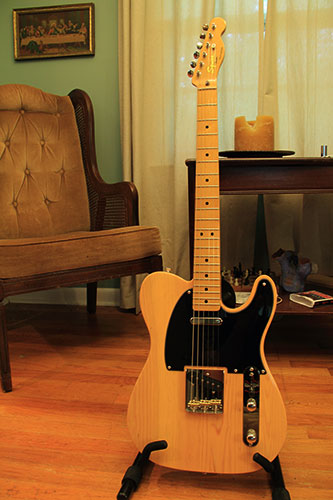
Squier Classic Vibe ’50s Telecaster: Blackguard Reborn
The Squier Classic Vibe '50s Telecaster chases the blackguard tone behind Keith Richards' Micawber and James Burton's '53 Tele, for a fraction of the price.
Before there was a Stratocaster, before there were humbuckers, before “tone” was even a word guitarists argued about online, there was a slab of ash with two pickups and a black pickguard. The Telecaster didn’t just start Fender’s empire — it invented the solid-body electric guitar as a mass-market product. The Squier Classic Vibe ’50s Telecaster exists to put that original blackguard recipe within reach of anyone with a few hundred dollars, and it’s good enough that players who could easily afford the real vintage thing keep buying these instead.
The Guitar That Started Everything
Fender launched the Telecaster in the early 1950s — first as the single-pickup Esquire, then the dual-pickup Broadcaster, then, after a naming dispute with Gretsch over “Broadkaster,” the Telecaster name stuck for good in 1951. The earliest versions are now known to collectors and players alike as “blackguard” Teles, named for the black single-ply pickguard Fender used before switching to white in 1954. These guitars defined the template every Telecaster since has followed: a slab ash or alder body, a bolt-on maple neck, two single-coil pickups, and a bridge plate doing double duty as pickup housing and string anchor.
The Squier Classic Vibe ’50s Telecaster is built specifically as tribute to that earliest blackguard era — Fender’s own marketing describes it as putting the sound and look of the highly prized early-50s blackguard guitars into reach of mere mortals. It’s part of the broader Classic Vibe series, the line that’s spent close to two decades proving Squier doesn’t have to mean compromise, and the ’50s Telecaster is widely considered one of the standout models in that lineup — frequently cited by reviewers as not just the best Telecaster in the Classic Vibe range, but one of the strongest value propositions across the entire guitar market regardless of brand or price tier.
It’s worth appreciating just how radical the original design was for its time. Before the Telecaster, electric guitars were largely hollow-bodied instruments adapted from acoustic designs, prone to feedback at stage volume and expensive to manufacture. Leo Fender’s approach — a solid slab body, a bolt-on neck that could be replaced or repaired without specialized luthier tools, and pickups mounted directly to the body rather than suspended over a soundboard — was as much an industrial design breakthrough as a musical one. It made the electric guitar a genuinely mass-producible, affordable, durable instrument for the first time, and that engineering philosophy is still legible in every Telecaster built since, including this one.
Full Specifications
The pine body is the detail that draws the most discussion, and it’s worth explaining why Squier chose it. Leo Fender’s original Telecasters used pine and ash bodies before settling on ash, and pine remains a genuinely respected tonewood — Fender’s own Custom Shop has released pine-bodied Telecasters at premium prices specifically because of how well-regarded the wood is. For Squier, pine also keeps manufacturing costs down without compromising the resonance and sustain that define a good Telecaster, and reviewers consistently single out the body’s lively, punchy character as a highlight rather than a limitation. One detail worth noting for buyers: the two pickup voicings differ by finish — the Vintage Blonde models run vintage-voiced Alnico III pickups, while Butterscotch Blonde versions use punchier Alnico V units, giving buyers a genuine tonal choice baked into the color selection.
Modern Comfort, Vintage Voice
One detail any blackguard-era purist should know going in: this is not a literal recreation of a 1952 Telecaster’s playing feel. Leo Fender’s original guitars had genuinely massive necks with a 7.25-inch fingerboard radius — comfortable by 1950s standards, but a serious adjustment for most modern players. The Classic Vibe instead uses a slimmer, flatter 9.5-inch radius neck with medium jumbo frets, trading some of the original’s vintage chunkiness for the kind of comfortable, modern playability most players actually want. The result, by most accounts, captures the blackguard look and tonal character convincingly while updating the parts of the experience that don’t need to stay frozen in 1952.
Recent production runs have also quietly improved key details. A 2020-era refresh increased fret height from roughly .034″ to .043″, giving the guitar noticeably better bend support and more true-sounding notes, and switched the nut material from synthetic to genuine bone — both meaningful upgrades that push the instrument further into genuine value-for-money territory rather than simple budget-guitar status.
Famous Players: Three Genuinely Accurate Blackguard Connections
Unlike some budget Strat and Tele variants where the “famous players” list is really just a roll call of guitar legends loosely associated with the broader model family, the blackguard Telecaster has something rarer: a short list of artists whose actual, specific, well-documented main guitars are genuine early-50s blackguard Telecasters. This is the rare case where the connection holds up to scrutiny rather than needing a DNA-and-lineage disclaimer.
Keith Richards‘ famous “Micawber” — arguably rock’s most recognizable Telecaster — is a 1953 blackguard Telecaster, a gift from Eric Clapton around Richards’ 27th birthday in late 1970, that became central to the Rolling Stones’ sound on Exile on Main St. and every album since. Richards modified the guitar over the decades (a Gibson PAF humbucker added to the neck position, a custom brass bridge, the famous five-string open-G setup with the low E removed entirely), but the foundation — an early-50s ash-bodied blackguard Tele — is exactly what this Squier model recreates. It’s a connection accurate enough that builders documenting their own Micawber-inspired projects have specifically chosen the Squier Classic Vibe ’50s Telecaster as their starting platform, treating it as a credible foundation for a serious DIY tribute rather than a toy to be set aside in favor of something more expensive.
James Burton‘s primary guitar through his legendary early career — the dark-red 1953 Telecaster he played on Dale Hawkins’ “Susie Q” in 1957 and Ricky Nelson’s “Hello Mary Lou,” before later moving on to his famous pink paisley Tele with Elvis Presley — was also a genuine blackguard-era instrument, refinished but structurally the same guitar this Squier model is built to recreate. Burton’s signature chicken-pickin’ style, built on a guitar from precisely this era, is as direct a connection as budget gear coverage gets. He stayed loyal to that original ’53 well into his Elvis years, reportedly still playing it right up until the Las Vegas shows began in 1969 — meaning the bulk of his most influential early studio and session work, spanning a remarkable run of hits with Ricky Nelson and countless other artists, came from exactly the kind of guitar this Squier model is designed to put within reach of any working player.
It’s also worth mentioning Bruce Springsteen‘s famous “Mutt” guitar — the Telecaster/Esquire hybrid on the cover of Born to Run — which combines a 1950s Telecaster body with a 1950s Esquire neck, making it another genuinely period-accurate blackguard-era instrument at the heart of one of rock’s most famous guitar relationships.
Brad Paisley, covered in detail elsewhere on this site, represents the modern continuation of this lineage — a contemporary Telecaster ambassador whose own gear draws heavily on the same blackguard-inspired tonal DNA, even though his signature instruments are modern builds rather than vintage-correct recreations.
Tone Recipes
1. Micawber-Style Open-Tuning Rhythm
Bridge pickup, into a Fender Deluxe Reverb on the edge of breakup. Try open G tuning (remove the low string mentally, or simply favor the upper five strings) for a taste of the Richards approach — the bridge pickup’s bite cuts through dense rhythm parts exactly the way blackguard Teles are famous for.
2. Chicken-Pickin’ Lead
Bridge pickup, light compression, into a Boss BD-2 Blues Driver for a touch of grit. The snappy attack and string-through-body sustain are exactly the foundation James Burton’s hybrid pick-and-fingers technique was built around.
3. Neck Pickup Warmth
Neck pickup, tone rolled to 6, amp clean with light reverb. Rounder and warmer than the bridge position, well-suited to chord-melody playing and ballads — the classic “other half” of the Telecaster’s vocabulary.
4. Position 2 Quack
Both pickups together (position 2), amp clean to lightly breaking up. The Telecaster’s middle setting offers a different character from a Strat’s — less hollow, more focused — useful for funk and R&B-leaning rhythm work.
5. British Blues-Rock Crunch
Bridge pickup into a Vox AC30 Top Boost, gain pushed moderately. This pairing chases the bright, chiming-yet-aggressive tone associated with British blues-rock guitarists who built their sound around Telecasters and Vox amplification.
How It Compares
Against the Fender Stratocaster, the comparison is fundamentally about playing philosophy: the Tele’s two-pickup simplicity and hardtail bridge chase focus and twang, while the Strat’s three pickups and tremolo chase versatility and expressive vibrato. Players drawn to the Classic Vibe ’50s Telecaster tend to be chasing directness — fewer knobs, fewer switches, more straightforward tone shaping through hands and amp.
Compared to a Gibson ES-335, the difference is night and day: the 335’s semi-hollow construction and humbuckers deliver a warmer, rounder, more sustain-forward voice suited to jazz and blues-rock, while the Telecaster’s solid pine body and single coils stay bright, percussive, and cutting. Players choosing between these two are choosing fundamentally different tonal philosophies, not just different price points.
Buying Guide
Vintage Blonde vs. Butterscotch Blonde
The two standard finish options carry a genuine tonal difference, not just a cosmetic one. Vintage Blonde models use vintage-voiced Alnico III pickups for a softer, more period-accurate early-50s tone, while Butterscotch Blonde versions pack punchier Alnico V pickups for more output and a slightly more modern edge. Neither is objectively better — the choice should come down to whether a player wants maximum vintage authenticity or a bit more contemporary bite. It’s worth noting that Butterscotch Blonde is also the more historically resonant color choice in its own right; it’s the finish most associated with the original blackguard era in collector and player culture, which may matter to buyers chasing maximum visual authenticity alongside the tonal character.
Production Era Considerations
Buyers shopping secondhand should be aware that build details have evolved over the model’s run — most notably the 2020-era switch to taller frets and a bone nut. Current production represents the most refined version of the formula, though earlier examples remain solid instruments and are sometimes available at a discount. Pre-2020 units aren’t a downgrade so much as an earlier iteration of a guitar that’s been incrementally improved rather than redesigned from scratch, which is a meaningfully different proposition than buying an older example of a guitar that’s since had a major spec overhaul.
What to Watch For
Because the Classic Vibe series has built a strong reputation as a platform for modification — much like its Stratocaster siblings — secondhand units occasionally turn up with replaced pickups, bridges, or tuners. A well-modded example can represent excellent value, but as with any used Squier Classic Vibe purchase, confirm what’s actually stock before paying a premium for “original” condition.
Practical Ownership Considerations
At well under 8.5 lbs, this is a comfortable guitar for extended playing sessions, and the pine body’s resonance translates to genuinely loud, lively unplugged volume — useful for practicing or simply enjoying the instrument acoustically. The simple three-saddle bridge is period-correct but does mean intonation across all six strings is achieved in pairs rather than individually; some players upgrade to a six-saddle bridge for more precise intonation, while purists tend to prefer the vintage three-saddle design specifically for its authentic feel and tone, even with the intonation trade-off.
Pine as a body wood does come with one practical caveat worth knowing: it’s a softer wood than the ash or alder typically found on higher-tier Telecasters, which means it’s somewhat more prone to dings and dents from careless handling. For a guitar that’s clearly built to be played hard rather than displayed carefully, this is rarely a dealbreaker — if anything, the character that accumulates with honest wear suits a guitar built in tribute to instruments that were themselves played to the point of bare wood showing through, as documented on guitars like Richards’ Micawber and Springsteen’s Mutt. But it’s worth factoring into gig bag and case choices, since pine bodies benefit more than most from basic protection during transport.
Frequently Asked Questions
Did Keith Richards play a Squier Classic Vibe ’50s Telecaster?
No — Richards’ famous “Micawber” is a genuine 1953 Fender Telecaster. But it’s the same blackguard-era guitar this Squier model is built to recreate, making the design lineage directly accurate rather than a marketing stretch.
What’s the difference between the Vintage Blonde and Butterscotch Blonde models?
Vintage Blonde uses vintage-voiced Alnico III pickups for a softer, more period-correct tone, while Butterscotch Blonde uses punchier Alnico V pickups for more output and edge.
Why does the Classic Vibe ’50s Telecaster use a pine body?
Pine was used on some of Fender’s earliest Telecasters before the company settled on ash, and it remains a well-regarded tonewood — Fender’s own Custom Shop has released premium pine-bodied Telecasters specifically because of the wood’s resonant character.
Is the neck the same size as a real 1950s Telecaster?
No. Original blackguard Telecasters had very chunky necks with a 7.25-inch fingerboard radius; the Classic Vibe uses a slimmer, flatter 9.5-inch radius for more modern, comfortable playability.
Who else played a genuine ’50s blackguard Telecaster?
James Burton’s primary early-career guitar, used on Dale Hawkins’ “Susie Q” and Ricky Nelson’s “Hello Mary Lou,” was a 1953 blackguard Telecaster, and Bruce Springsteen’s famous “Mutt” guitar from the Born to Run album cover combines a 1950s Telecaster body with a 1950s Esquire neck.
Has the Classic Vibe ’50s Telecaster changed over the years?
Yes — notably around 2020, production switched to taller frets (improving bend feel and sustain) and a genuine bone nut in place of the earlier synthetic material.
Is this guitar good for beginners?
Yes — its comfortable modern neck profile, manageable weight, and straightforward two-pickup layout make it accessible for new players, while the build quality and tone hold up well for experienced players too.
Squier Classic Vibe ’50s Telecaster in Butterscotch Blonde, photographed 16 June 2011. Earlier-generation example; specifications vary by production era. Photo: John Tuggle. tele1, CC BY 2.0. Full original frame retained, displayed at no more than its natural width. No crop or retouch.
Image credits
- Top image: John Tuggle, CC BY 2.0.