
You can almost hear it before you see it.
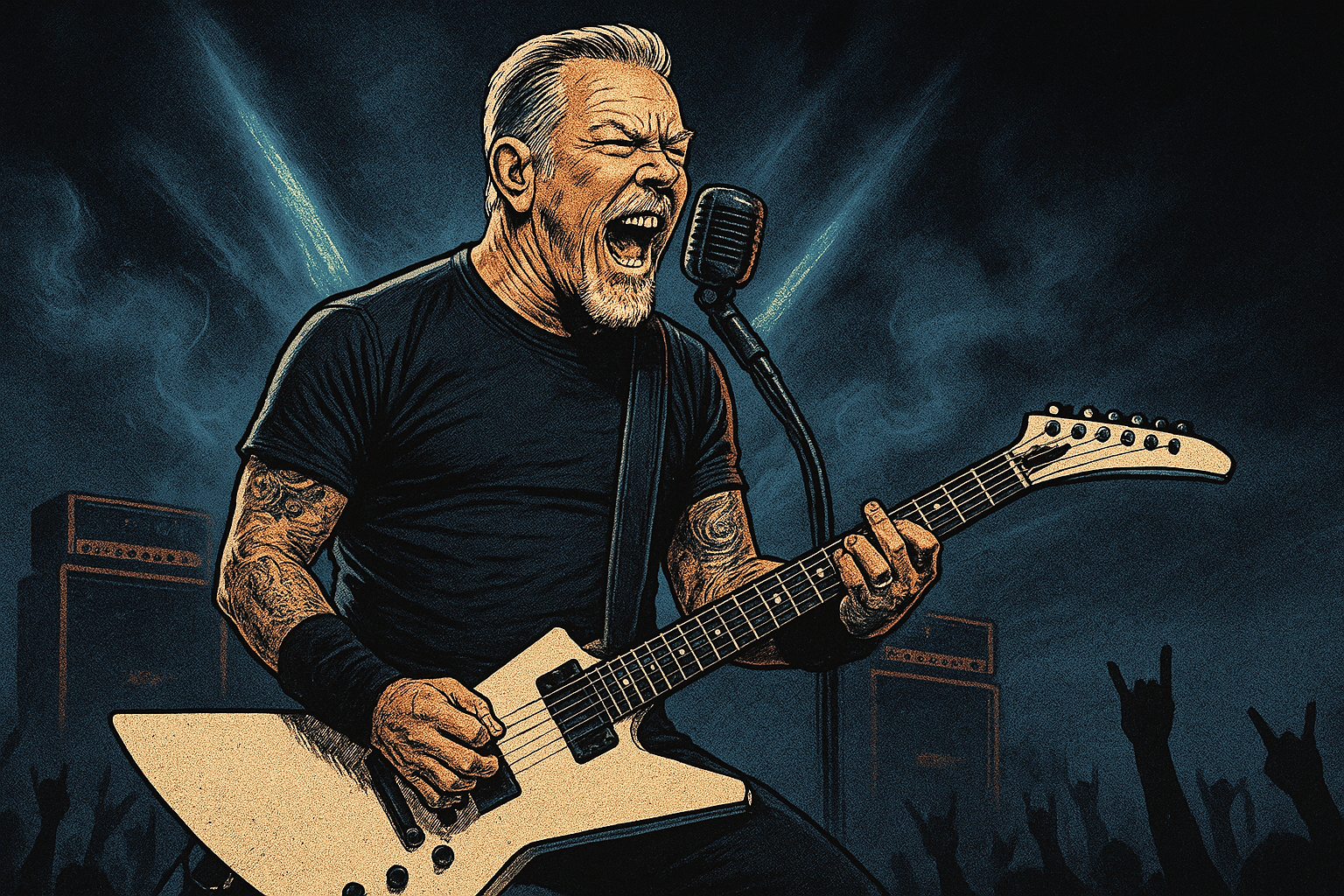
That machine-gun chug, that surgical right hand — it’s James Hetfield, the Downpicking King of Metallica.
While other guitarists chase solos, Hetfield built a career on rhythm — pure, relentless precision that turned downstrokes into a weapon of mass groove.
If you’ve ever tried to play “Master of Puppets” all downstrokes for more than 30 seconds, you already know: this isn’t about speed, it’s about stamina, discipline, and straight-up attitude.
The Birth of Downpicking – How Hetfield Forged the Sound of Thrash
It didn’t start in a studio. It started in garages — sweaty, loud, and full of bad amps.
James Hetfield wasn’t chasing technical perfection; he was chasing impact.
When Metallica first started hammering out early riffs like Hit the Lights and Whiplash, Hetfield’s instinct told him one thing: upstrokes killed the energy. So he ditched them. Every hit had to go down — hard, tight, and on the beat.
The result? That percussive, almost mechanical rhythm that made Metallica’s sound heavier than anything before it.
By the time Master of Puppets dropped, Hetfield’s right hand was basically a metronome made of muscle.
Even pros have tried — and failed — to keep up with his stamina. As Hetfield himself once said, “Downpicking always sounded better than alternate picking.”
It’s not just technique. It’s identity. It’s attitude.
It’s the heartbeat of thrash.
The Technique – Why Downpicking Hits Harder
Most guitarists learn alternate picking because it’s efficient. Hetfield went the other way — he made inefficiency sound godlike.
Downpicking forces every note to hit with the same direction, same weight, same attack. There’s no “up” to soften the blow. It’s all impact, all control. That’s why riffs like Creeping Death and Blackened feel like getting hit in the chest — the consistency of those downstrokes turns rhythm into percussion.
But there’s more science than most people realize.
Every downstroke pulls the string in one direction, keeping tension steady and tone tighter. Combine that with Hetfield’s ridiculously precise palm muting, and you get that dry, punchy thump that sits perfectly with Lars’ snare hits.
He’s not just playing rhythm — he’s locking into the drums like a second drummer with six strings.
Try it yourself: play Master of Puppets at full tempo, all downstrokes. If your forearm doesn’t feel like it’s about to fall off, you’re not doing it right.
As Cory Wong put it in Guitar World, “Hetfield is basically rhythm itself.”
No metronome, no click — just raw, human machine timing.
The Gear – Hetfield’s Tools of Destruction
You can’t talk about Hetfield without talking about the machines he wields.
From the white ESP Explorers that became his trademark in the 80s to the weathered Iron Cross Les Paul Custom, every guitar he’s touched has been built for one purpose — brutal precision.
Let’s start with that right-hand battlefield:
Hetfield’s go-to for decades has been his ESP Eet Fuk Explorer, loaded with EMG 81/60 pickups — the same setup that defined modern metal tone.
The 81 in the bridge delivers that sharp, surgical crunch, while the 60 in the neck adds a surprising clarity for clean intros like Nothing Else Matters.
He doesn’t chase boutique tone. He chases clarity under chaos.
Then there’s the amp wall — an army of Mesa/Boogie Mark IIC+ heads, later joined by his Diezel VH4s and Custom Friedman rigs for tour setups. Each one dialed to sound like a tank engine idling through hell.
No fancy pedals, no overproduced effects — just raw power and tight EQ. His sound is the sonic equivalent of concrete cracking.
Even his picks tell the story: extra-thick custom Dunlop Black Fang (.73–1.0 mm) picks designed to survive his punishment.
Downpicking at that speed and force? You don’t use a pick — you wield a weapon.
The Discipline – What It Takes to Play Like Hetfield
Anyone who’s ever tried to keep up with Hetfield’s right hand knows this: it’s not about talent — it’s about discipline.
That downpicking endurance didn’t just appear overnight. It was built in rehearsal rooms that smelled like beer, sweat, and burnt tubes. Hour after hour. Riff after riff. No shortcuts.
Hetfield’s approach to rhythm is almost athletic.
He once said that when he picks up the guitar, he wants to “be the drummer.”
That mindset defines everything about his playing — it’s about groove, not ego.
While lead players chase licks, Hetfield trains like a rhythm athlete, focusing on control, tightness, and consistency under pressure.
There’s also that mental armor.
You don’t keep the same aggression for 40 years without some kind of inner engine.
He’s battled stage fright, addiction, and burnout — but every time he walks on stage, that right hand hits like a piston.
Downstrokes don’t just sound tight. They feel defiant.
So if you want to play like Hetfield, forget speed for now.
Start with a single riff.
Lock in with a metronome, lower your wrist, and hit that string like you mean it.
Then do it again — for an hour.
When your arm starts screaming, that’s when the real training begins.
The Legacy – How Hetfield Changed Metal Rhythm Forever
Before Hetfield, rhythm guitar was background noise. After Hetfield, it became the main event.
His right hand didn’t just play riffs — it defined what heavy meant. The entire thrash metal revolution — Megadeth, Slayer, Anthrax, even modern bands like Trivium — borrowed from that same relentless downstroke engine.
Metallica’s early albums reprogrammed the DNA of metal rhythm. Kill ’Em All was punk energy with metal precision. Ride the Lightning added sophistication. Master of Puppets? That was the moment rhythm guitar became a weapon of mass destruction.
Hetfield proved that you don’t need a flashy solo to make people’s jaws drop — just one tight, palm-muted riff that feels like it’s punching through walls.
Today, every rhythm-driven player owes a debt to that sound — the tight chugs, the syncopated accents, the impossible endurance.
Even the most technical djent players trace their lineage back to one guy in a white Explorer who decided upstrokes were overrated.
Downpicking isn’t just a technique anymore — it’s a philosophy.
Precision, aggression, control.
It’s Hetfield’s legacy, burned into every amp, every palm mute, every kid learning “Enter Sandman” on a beaten Strat in their bedroom.
Pro Tips – Getting That Hetfield Sound
You can’t fake the Hetfield vibe — but you can get close if you’re willing to suffer a little.
Here’s how to build that right hand from mortal to metal god level:
1. Train like it’s leg day
Set a timer for 15 minutes. Pick one riff — Creeping Death, Battery, whatever makes you sweat — and play it with only downstrokes.
Rest, then do it again. You’re not just building skill; you’re building endurance.
If your wrist isn’t on fire by the end, go longer.
2. Stay low, stay tight
Hetfield’s tone lives in his wrist, not his arm. Keep your hand low, your elbow locked, and mute just enough to let the string breathe.
It’s not about slamming — it’s about control under tension.
3. Keep your signal chain clean
No overkill pedals. Just a solid high-gain amp, EMG 81s, and tight mids.
Too much gain and you lose the bite.
Remember: Hetfield’s sound isn’t messy. It’s surgical violence.
4. Hit like you mean it
Hetfield once said that every downstroke should feel like hitting a snare drum.
Don’t play the riff — attack it.
Every note should have intent. The rest is muscle memory.
5. Respect the rhythm
Downpicking isn’t about showing off — it’s about being the anchor.
If your drummer falls apart, you’re still the wall. That’s Hetfield’s real secret weapon: rhythm discipline.
James Hetfield Rig
If tone could punch, Hetfield’s would knock you out cold. His rig has evolved over four decades — from raw garage energy to a precision-engineered war machine built for surgical rhythm. But the core idea never changed: clarity, tightness, and power.
Guitars – The White Explorers and the Iron Cross
Hetfield’s guitars are as iconic as his riffs.
His first love was the 1984 Gibson Explorer nicknamed So What, later replaced by a fleet of ESP Explorers custom-built to handle his brutal right hand.
The standouts include:
-
ESP MX220 “Eet Fuk” – the definitive Hetfield guitar, white finish, mahogany body, and EMG 81/60 pickups.
-
ESP MX250 “Fuk Em Up” – similar build, but tuned for live punishment.
-
ESP Snakebyte – his modern signature model, available in Snow White, Camo, and Satin Black.
-
Iron Cross Les Paul Custom (1973) – an early ‘80s workhorse with the famous Iron Cross sticker, used on St. Anger, Death Magnetic, and Hardwired tours.
Every guitar shares one thing: rock-solid mahogany for sustain and mid-punch, with fast ebony fretboards for precision riffing.
Pickups – The EMG Era
Since the late ‘80s, Hetfield has sworn by active EMG pickups — the 81 in the bridge for that sharp, razor-like crunch, and the 60 in the neck for clarity and warmth.
In recent years, he switched to his own signature set: the EMG JH “Het Set”, which adds a bit more dynamic response and organic feel compared to the older 81/60 combo.
These pickups are voiced for tight low-end, glassy highs, and that signature Hetfield punch.
Strings and Picks
-
Strings: Ernie Ball Power Slinky (.11–.48) or custom gauges tuned for Drop D and beyond. The heavier tension gives stability for his brutal picking style.
-
Picks: Dunlop Black Fang (.94 mm) and (.73 mm) — made from Ultex for durability and bite. The sharp tip helps him dig in without flubbing fast runs.
Amps – Mesa, Diezel & Beyond
Hetfield’s tone is forged in tube fire. His amp arsenal is legendary:
-
Mesa/Boogie Mark IIC+ – the foundation of Ride the Lightning and Master of Puppets. Tight mids, aggressive highs, and brutal headroom.
-
Mesa/Boogie Triple Rectifier – introduced in the ‘90s for Load and Reload, adding a more modern bite.
-
Diezel VH4 – became a staple in the 2000s for a cleaner, more controlled distortion.
-
Friedman BE100 & Meathead – modern live setup blended with his Mesa tone for a perfect mix of vintage and modern aggression.
His current touring rig is often a wet/dry/wet system, blending three heads for stereo spread and absolute clarity on stage.
Cabinets & Speakers
-
Mesa 4×12 cabinets loaded with Celestion Vintage 30s.
-
Occasionally paired with Celestion G12-65s for added mid warmth.
Each cab is mic’d with a Shure SM57 and a Sennheiser MD421, blended in the mix for that signature punch.
Pedals & Effects
Hetfield’s pedalboard is surprisingly minimal — he’s all about letting the amp and pickups do the talking.
Still, his rig often includes:
-
Klon Centaur clone or Mesa Grid Slammer for a slight front-end boost.
-
TC Electronic Chorus/Flanger for clean passages.
-
Dunlop Cry Baby Wah (used sparingly).
-
Line 6 HX Effects for modern live switching and consistency.
-
ISP Decimator II for noise reduction.
No gimmicks, no overkill — just the essentials for precision tone.
Recording & Live Setup
In the studio, Hetfield’s tone is meticulously double-tracked — sometimes quadruple — with each take perfectly in sync.
His rhythm parts are often split between two different amp heads to create a wide, crushing stereo image.
Live, his techs maintain an intricate switching system that allows him to change guitars, tunings, and amp channels seamlessly mid-show.
That’s the Hetfield blueprint — brutal, disciplined, and built for war.
No pedals to hide behind. No fluff. Just tone so tight it could cut steel.
FAQ – Downpicking, Tone & Hetfield’s Secrets
Why is James Hetfield called the “Downpicking King”?
Because nobody — and I mean nobody — hits as consistently hard as he does. Hetfield built Metallica’s sound around pure downstrokes, creating a rhythmic machine that changed metal forever.
How can I improve my downpicking speed and endurance?
Start slow, stay tight, and play long. Use a metronome and work on muscle control, not just speed. Consistency matters more than tempo — that’s the real Hetfield secret.
What pickups does James Hetfield use?
He’s been an EMG guy since the ’80s. His current setup uses the EMG JH “Het Set”, which delivers that classic Metallica crunch with a touch more organic warmth.
What gauge strings does Hetfield play?
Usually Ernie Ball Power Slinky (.11–.48) — heavy enough to stay in tune under his brutal right hand, light enough for those fast gallops.
What amps define his tone?
The Mesa/Boogie Mark IIC+ is the crown jewel, blended live with Diezel VH4s and Friedman heads for that tight, modern metal tone that’s become the benchmark for rhythm players.
Is Hetfield’s tone mostly in his gear or his technique?
Technique, no contest. The gear helps — but the tone lives in that right wrist. His control, timing, and downstroke accuracy are what separate him from everyone else.
The Right Hand of Metal
James Hetfield didn’t just invent a sound — he invented a standard.
Every rhythm guitarist who’s ever stood in front of an amp and thought, “I want that punch”, is chasing Hetfield. His tone is muscle, his timing is precision, and his legacy is pure fire.
So plug in, crank the mids, and don’t you dare alternate pick.
Downstroke your way to glory — and when your arm’s burning, just remember:
That’s how legends are made.