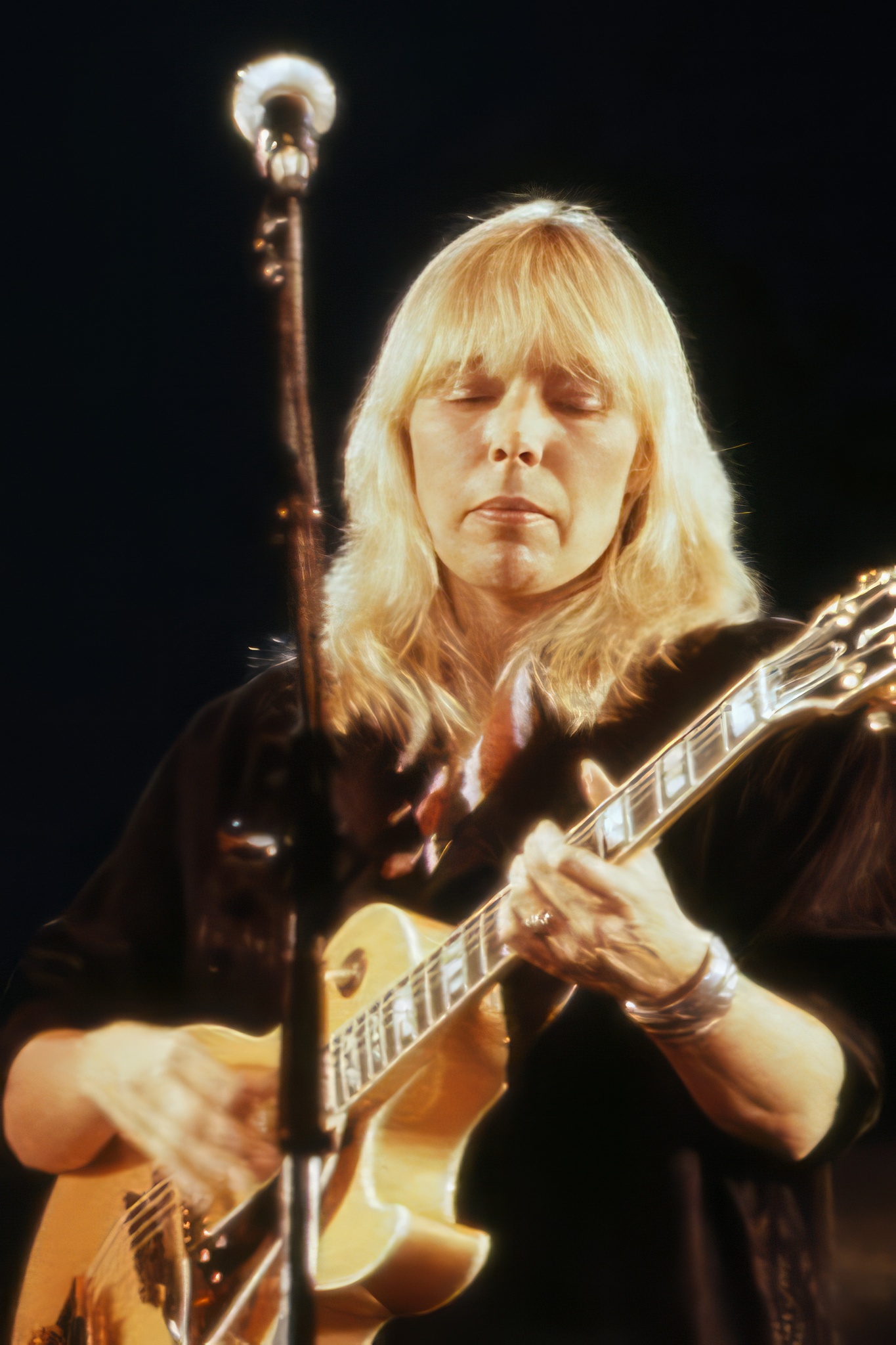
Joni Mitchell Guitars & Gear: The Complete Guide to the Folk-Rock Genius’s Rig
Joni Mitchell's guitars, amps, and effects — the complete guide. Martin D-28, 51 open tunings, Ibanez George Benson, Roland JC-120, dulcimer, and her revolutionary compositional approach to guitar.
Photo by Capannelle, licensed under CC BY 2.0
When Joni Mitchell was nine years old, she contracted polio. She spent weeks in a hospital in Saskatchewan, and she spent those weeks singing — for the other patients, for her own comfort, because the music was there and the music was what she had. She recovered, but the polio left her left hand weaker than it would otherwise have been. When she later began playing guitar, the conventional barre chords that standard guitar technique requires were harder for her to manage. So she didn’t manage them in the conventional way. Instead, she discovered that open tunings — alternate configurations of the strings that produce a chord without fretting anything — could give her the chord she needed with less left-hand pressure, using simpler fingerings. What she couldn’t do the standard way, she did a different way. The different way was better. She has used over fifty different open tunings across her career, each one a specific compositional choice that gave a specific song its specific harmonic character. The limitation became the technique. The technique became the art. This is how Joni Mitchell became the most influential guitarist in the history of folk and singer-songwriter guitar.
Roberta Joan Anderson was born on November 7, 1943, in Fort Macleod, Alberta, Canada. She is known professionally as Joni Mitchell. Her career spans sixty years of recording, from the acoustic folk debut of 1968 through the jazz orchestrations of the Mingus album in 1979 to the recent Carnage revival. She has won nine Grammy Awards. She was awarded the Gershwin Prize for Popular Song in 2023 — the first Canadian and only the second woman to receive it. Rolling Stone ranked her the 9th greatest guitarist of all time in 2011 and the 17th in 2023. She was inducted into the Rock and Roll Hall of Fame in 1997, into the Canadian Music Hall of Fame in 1981, into the Songwriters Hall of Fame in 1997. She is, in the collective assessment of the music world, one of the primary musicians of the twentieth century — and her specific contribution to guitar playing, through the development of alternate tunings as a compositional system, is a contribution that has influenced every acoustic guitarist who came after her.

This is the complete guide to the guitars, amplification, and specific tuning approaches through which she made that contribution — from the Martin acoustic of the early folk years through the Ibanez George Benson electric jazz boxes of the Hejira era through the Roland synthesizer guitar that allowed her to play fifty tunings from one instrument. The gear is interesting. The tunings are the story.
Background: From Saskatchewan to Laurel Canyon to the World Stage
Joni Mitchell’s musical biography begins not with a guitar but with a hospital room and a group of patients who needed something to distract them from their illness. Mitchell sang for them. The performance impulse — the willingness to use music as communication and comfort — was present before the instrument. The instrument was always in service of that impulse.
She began playing guitar in her early teens, using Pete Seeger’s The Folksinger’s Guitar Guide as her instructional text. “When I was learning to play guitar, I got Pete Seeger’s The Folksinger’s Guitar Guide,” she recalled. She was so proficient that she skipped ahead of the book’s lessons and learned to fingerpick the way Elizabeth Cotton picked on her famous song “Freight Train” — Cotton’s specific approach to thumb-and-finger alternating bass-and-melody that produces a self-sufficient accompaniment from a single acoustic guitar. This Cotton-influenced fingerpicking, absorbed from a Pete Seeger tutorial, became the physical foundation of Mitchell’s guitar technique.
The open tuning discovery came gradually, through the specific combination of her weakened left hand and her harmonic curiosity. Conventional open tunings — open G (D G D G B D), open D (D A D F# A D), open E (E B E G# B E) — gave her simpler fingerings for complex harmonies. But as she worked with these tunings, she discovered something more interesting: that the harmonic vocabulary available from a specific tuning was not just a simplified version of standard-tuning harmony but something genuinely different, with specific intervals and resonances available from the open strings that standard tuning couldn’t provide. Her “tuning archivist,” photographer Joel Bernstein, documented the process: “while tuning her guitar from one open tuning to another she came upon unlooked-for intermediate chords whose tone-color immediately resonated with her. She thus began to compose in tunings that had never even been explored before.”
The early career unfolded in the specific geography of the mid-1960s North American folk scene: Toronto, Detroit, New York’s Greenwich Village, and eventually Los Angeles and the Laurel Canyon community that became one of the centers of the late-1960s singer-songwriter tradition. Her first album (Song to a Seagull, 1968) established her compositional identity; Clouds (1969) and Ladies of the Canyon (1970) built her audience; Blue (1971) is generally considered her masterwork and one of the most intimate and emotionally direct albums in popular music history. The move toward jazz and electric guitar came in the mid-1970s: The Hissing of Summer Lawns (1975), Hejira (1976), Don Juan’s Reckless Daughter (1977), and the collaborative Mingus (1979). These albums brought in electric guitars (particularly the Ibanez George Benson models) and jazz musicians — Jaco Pastorius’s fretless bass on Hejira is among the most celebrated instrumental contributions to any singer-songwriter album in history. The jazz period eventually gave way to the more rock-influenced work of the 1980s (Dog Eat Dog, Chalk Mark in a Rain Storm), and Mitchell has continued recording and performing into the 2020s with the same compositional intelligence applied to an evolving sonic palette.
The jazz collaboration with Charles Mingus — whose 1979 album Mingus was literally the last project the great jazz bassist and composer was able to plan before his death from ALS — remains one of the most unusual and most significant cross-genre collaborations in twentieth-century music. Mingus heard “Paprika Plains” from Don Juan’s Reckless Daughter and recognized in Mitchell a musician of jazz-level harmonic intelligence. He asked her to set words to six of his compositions, most written specifically for the project. The resulting album is not jazz and not pop but something that exists in the overlap — Mitchell’s voice and guitar and lyrical sensibility applied to Mingus’s harmonic world. It demonstrates the full scope of what her guitar education — the Tuck Andress family connection, the open tuning harmonic vocabulary, the Elizabeth Cotton fingerpicking — had produced: a musician who could meet one of jazz’s most demanding composers as a peer.
Her stroke in 2015 and subsequent recovery — she had a brain aneurysm that temporarily affected her ability to speak and walk — was one of the most serious health crises to affect a major musician. Her return to performance, most dramatically at the Newport Folk Festival in 2022, was a demonstration of extraordinary resilience and an outpouring of collective love from an audience that had feared they might never see her play again. She played guitar at Newport. The left hand, weakened by polio seventy years earlier, worked. The tunings were there. The music was there.
The Rig: Joni Mitchell’s Guitars, Amps, and Tuning System
Guitars
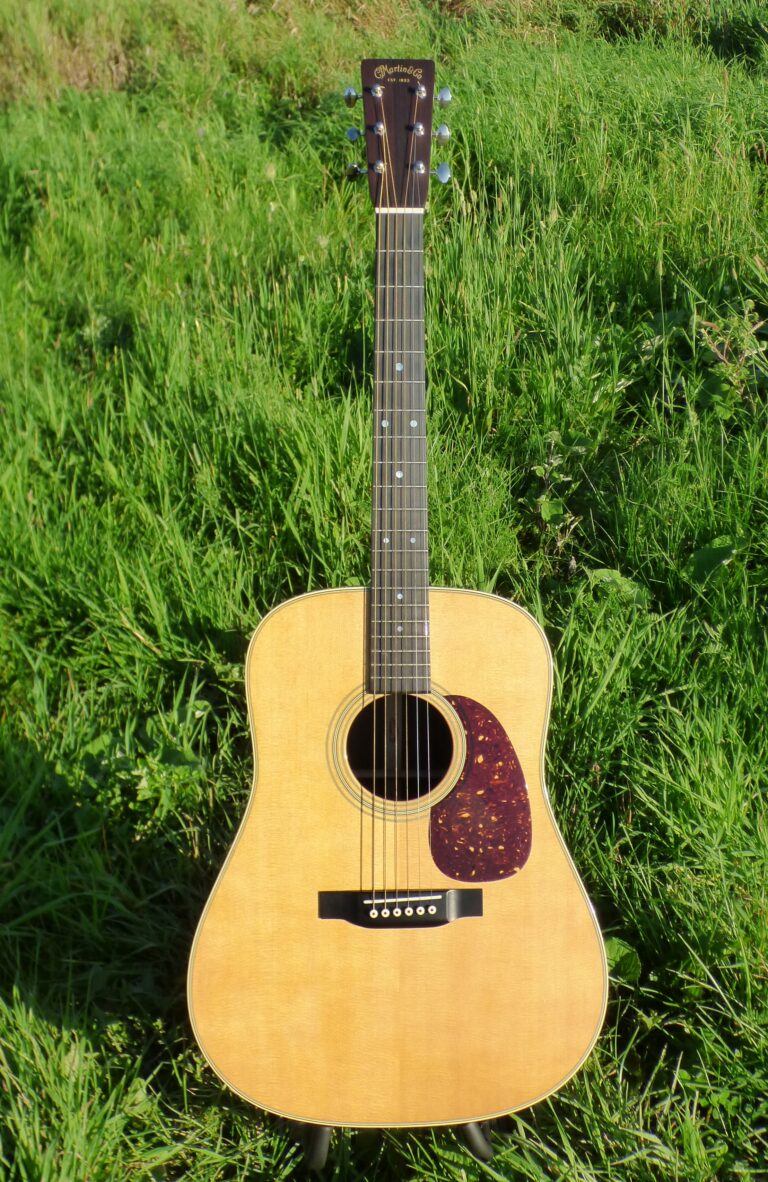
Joni Mitchell’s primary acoustic guitar through the foundational period of her career — the early albums from 1968 through approximately the mid-1970s — was a Martin D-28 dreadnought. The D-28’s specific tonal character: a large-body acoustic with East Indian rosewood back and sides and Sitka spruce top, producing the balanced, projecting, note-separation-maintaining tone that suits fingerpicking. The D-28’s scale length and string tension supported Mitchell’s use of alternate tunings, and its rosewood character complemented the specific tonalities that her various tunings produced. The standard string gauge she used in the early career was adjusted for the specific tuning being used — lighter gauges for lower-tension open tunings, maintaining proper string feel and tone across the changed intervals.
The most important “gear” in Joni Mitchell’s arsenal is not hardware but a system: fifty-one different alternate guitar tunings developed across her career, each one a specific compositional choice for specific songs. This number — confirmed in various interviews and documented comprehensively by Joel Bernstein — represents a staggering commitment to alternate tuning as a primary compositional approach. Where most guitarists use one or two alternate tunings alongside standard tuning, Mitchell used standard tuning as just one option among dozens.
Her notation system for tunings reflects her approach: she doesn’t use conventional string-name notation (E A D G B E) but rather a number-based relative tuning system. Standard tuning E A D G B E becomes “E55545” in her notation — E (the note of the lowest string), then the numbers represent fret positions at which one string is tuned to match the next. An open G tuning she notates as “D57543.” “So what is important is the relative tuning of the strings,” per the analytical documentation. This system allows her to remember the relationship between strings without memorizing absolute pitch names, focusing on the intervals rather than the notes. It is a composer’s approach rather than a guitarist’s approach — thinking in harmonic relationships rather than technical positions.
The harmonic rationale for her specific tunings is explicit in her own words: “Pure majors are like major colors; they evoke pure well-being. Anybody’s life at this time has pure majors in it, given, but there’s an element of tragedy… those chords suited me.” She called her tunings — particularly the ambiguous, unresolved-feeling ones — “chords of inquiry — they have a question mark in them.” The specific emotional quality of the harmonic language she developed from these tunings — the sense of unresolved tension, of questioning, of emotional complexity rather than simple major/minor polarity — is the direct result of the specific intervals available in her alternate tuning system.
Prominent tunings in her catalog include: Open G (D G D G B D) — “The Circle Game,” “Marcie”; Open E (E B E G# B E) — “Both Sides, Now,” “Big Yellow Taxi”; Open D (D A D F# A D) — various; C G D F C E — “Sisotowbell Lane”; and many more complex configurations that appear in only one or two songs. Her tuning for “A Case of You” is CGDGBE — C on the low string only, giving the chord shapes a specific voicing unavailable from standard tuning. “Woodstock” uses the CGDFCE tuning that creates its specific harmonic openness.
Joni Mitchell famously played a mountain dulcimer on several recordings, having one made for her by luthier Joellen Lapidus. Lapidus was a chemistry teacher who made designs with her chemistry teacher to manufacture dulcimers, eventually moving from New York to the West Coast where she handmade and sold dulcimers in Big Sur. The mountain dulcimer is a fretted string instrument played on the lap, typically with three to five strings, associated with Appalachian folk tradition. Mitchell’s use of it — specifically on “California” from Blue and related recordings — added a specific nasal, modal quality to her folk sound that was distinct from the guitar’s tonal world. It is simultaneously one of the most archaic and one of the most forward-looking instrument choices in folk music: archaic in its Appalachian tradition, forward-looking in the way it expanded the harmonic possibilities for her open-tuning compositional approach.
When Mitchell turned to electric guitar for the jazz-influenced albums of the mid-to-late 1970s, she chose the Ibanez George Benson signature model — the hollow-body, jazz-box configuration that Benson had endorsed and that Ibanez produced as a high-quality archtop jazz guitar. To facilitate the jazzier sounds of her work at the time, she began to use George Benson Model Ibanez electric guitars. These are the stereotypical jazz-boxes, featuring a hollow body, wooden bridge, and mini humbuckers — the idiomatic choice of a jazz guitarist. Five of these guitars were maintained simultaneously, each set up with a unique set of string gauges calibrated to the specific tuning that guitar was configured for. This multi-guitar approach — one instrument per tuning — was the practical solution to the touring challenge of maintaining fifty-plus different tunings across a full concert set.
The George Benson Ibanez’s specific tonal character — warm, woody, semi-hollow resonance with mini-humbucker clarity — suited the jazz context of Hejira and Don Juan’s Reckless Daughter: the self-contained, harmonically complex sound that jazz players achieve by “simply rolling the tone down” on a hollow-body to achieve vocal-like sustain without distortion. Mitchell’s alternate tunings on these guitars produced specific jazz voicings — rootless seventh chords, suspended harmonies, extensions built from the specific intervals of each tuning’s open strings — that gave the late-1970s albums their distinctive harmonic language.
The most innovative gear solution in Joni Mitchell’s career came in 1995, when Fred Walecki — the owner of Westwood Music in Los Angeles — built her a custom Stratocaster-style guitar with a body of lightweight German spruce and a maple neck. The crucial innovation: this guitar contained a hex-pickup that could be used in conjunction with a Roland VG-8 synthesizer. The hex-pickup captures each string’s signal individually, allowing the Roland synth to alter each string’s pitch independently — recreating any of her tunings electronically while the guitar’s actual strings maintain their physical tuning. “Though the guitars’ strings maintained original tuning, the synth could alter each string’s timbre and pitch. Instead of carrying around five instruments, she could now pack one guitar for her concerts, programming the Roland guitar synthesizer to match her variety of tunings.” This was a technologically sophisticated solution to the fifty-tunings touring problem: instead of multiple guitars each strung for a different tuning, one guitar with digital tuning recall.
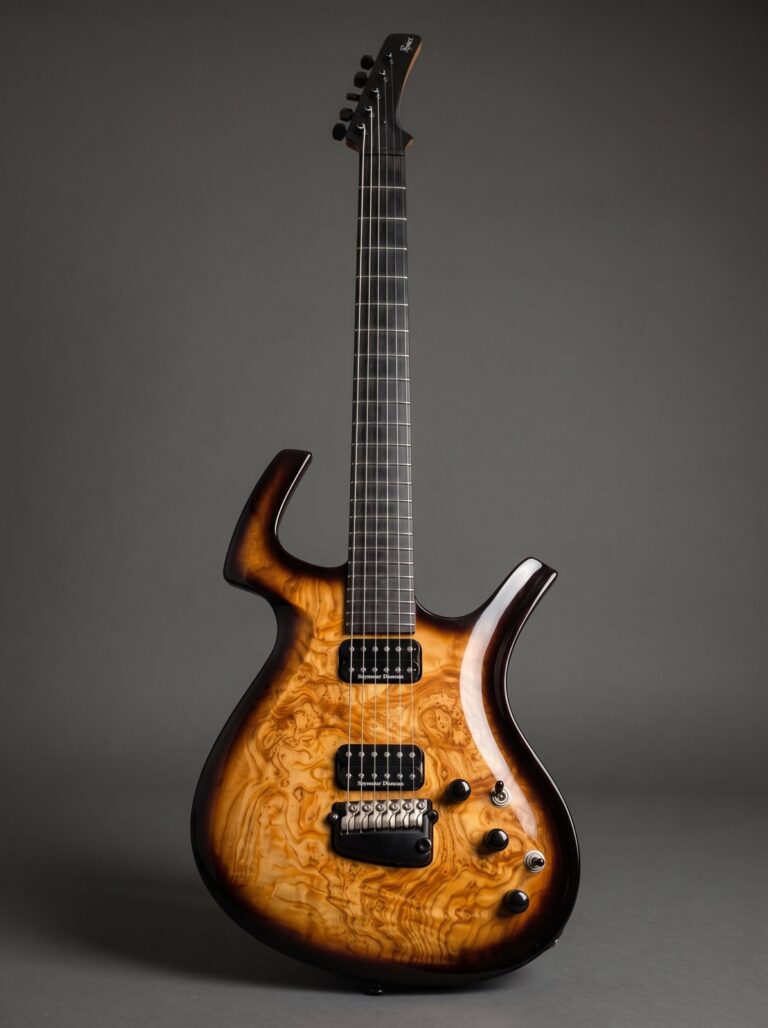
In more recent documentation, Mitchell has been seen playing a Parker Fly Mojo Flame — the lightweight, ergonomic guitar design that Parker Guitars produced in the mid-2000s. The Fly’s carbon fiber-reinforced neck and lightweight construction made it a practical touring guitar that could accommodate Mitchell’s physical requirements after her 2015 health crisis. Highlander pickups appear on her acoustic guitars for amplified performance.
The right-hand technique that Mitchell uses on acoustic guitar — the fingerpicking style she absorbed from Elizabeth Cotton’s “Freight Train” via Pete Seeger’s instruction book — is as important as any guitar model in understanding her sound. Cotton’s specific approach involves the thumb handling the lower strings while individual fingers address the treble strings, but in Cotton’s case with a crossed-hand position (Cotton was left-handed and played a right-handed guitar upside down, producing her specific picking geometry). Mitchell adapted this approach to her own technique, developing a fingerpicking style that produces self-sufficient accompaniment — bass movement, harmonic rhythm, and melody all simultaneously from a single guitar — that is integral to her songwriting. Each song’s fingerpicking pattern is specific to its tuning’s interval structure, meaning the right-hand pattern and the left-hand tuning are designed together as a compositional unit.
Mitchell uses light gauge strings on her acoustic guitars, adjusted per tuning — the specific tension requirements of each open tuning require specific gauge adjustments to maintain proper feel and intonation. On the Ibanez George Benson electrics, five separate setups were maintained with string gauges calibrated to the specific tuning tension of each instrument. Her approach to string gauge is functional rather than standardized: the string gauge serves the tuning rather than a general preference for heavier or lighter strings.
Amps
When Mitchell performed with the Ibanez George Benson electrics, she played through Roland Jazz Chorus amplifiers — the specific choice made “so that she could replicate her Hejira sound in performance.” The Roland JC-120 is the same amplifier that Andy Summers of The Police used as his constant companion, and its specific sonic character — solid-state, crystalline clean with built-in stereo chorus, famous for its pristine reproduction of the guitar’s natural character without tube coloration — suited Mitchell’s approach. The hollow-body Ibanez’s warm, woody tone needed a clean, transparent amplification system that would transmit its acoustic character faithfully. The Roland’s solid-state circuits provided exactly this: no tube saturation, no color, just the guitar’s own voice reproduced at volume. The built-in chorus added the subtle dimensional depth that gave the live electric performances their specific spatial quality.

For acoustic performance, Mitchell used Highlander pickups on her acoustic guitars — piezo-based transducers that capture string vibration directly at the saddle and transmit it to an amplification system without the coloration of a magnetic pickup or the feedback susceptibility of an acoustic microphone. The Highlander’s specific character is generally considered neutral and clear — preserving the acoustic guitar’s natural tonal character rather than imposing any electronic coloration. She also uses external microphones on stage alongside the pickup system for acoustic guitar amplification.
Tunings and Compositional Approach
Because the tuning system is the primary instrument — the actual tool through which her specific musical language is generated — it deserves more detailed treatment than any individual guitar or amplifier.
Mitchell’s approach to alternate tunings began as a practical solution to her weakened left hand but became a compositional system of extraordinary scope. The fifty-one tunings she developed represent fifty-one different harmonic universes, each with its own characteristic chord shapes, its own natural resonances (the open strings ringing against fretted notes), and its own melodic vocabulary. Conventional tuning provides one set of natural intervals from the open strings; each of Mitchell’s alternates provides a different set, creating different harmonic possibilities and different emotional colorings.
The emotional character she describes — “chords of inquiry,” “unresolved emotionality,” the question mark quality of her harmonic language — comes directly from the specific intervals available in her tunings that standard tuning doesn’t easily provide. A suspended fourth chord that resonates naturally from an open string in one of her tunings would require a complicated barre position in standard tuning; in her tuning, it’s just three open strings ringing against one fretted note. The simplicity of the fingering allows the complexity of the harmony to emerge without the physical effort of forcing a difficult chord.
The practical system for touring — five Ibanez George Benson guitars each pre-strung for a different tuning, replaced by the Roland VG-8 hex-pickup synthesizer system that replicates any tuning electronically — demonstrates the seriousness with which she treated the tuning system as the primary instrument. Other guitarists carry multiple guitars for backup or for different sonic characters. Mitchell carried multiple guitars for different tunings. The guitar is not the instrument. The tuning system is the instrument.
Playing Style & Tone Philosophy
Joni Mitchell’s playing style combines the Elizabeth Cotton-influenced fingerpicking tradition of folk guitar with a harmonic vocabulary that draws from jazz and from her own innovative tuning system. The result is something that sounds like neither folk nor jazz exclusively but like its own specific thing: a harmonic sophistication that folk musicians rarely develop, delivered with the song-service approach of a folk musician rather than the improvisational display of a jazz musician.
Her relationship with her own abilities — specifically her acknowledgment of her weakened left hand and the compensatory strategies she developed — is one of the most important examples in guitar history of limitation as creative catalyst. She didn’t pretend the limitation didn’t exist or labor to overcome it through years of strengthening exercises. She designed an instrument approach (the alternate tuning system) that made the limitation irrelevant. The tunings gave her maximum harmonic access with minimum left-hand demand. This is engineering applied to music: identifying the constraint, designing around it, and arriving at a solution that was better — more original, more expressive, more harmonically rich — than the standard solution would have been.
Her tone philosophy, in the acoustic context, centers on clarity and resonance: the specific ringing quality of open strings against fretted notes is the texture she seeks. The fingerpicking technique serves this — by plucking individual strings rather than strumming chords, she allows each string’s contribution to the harmony to be heard separately, giving the listener the ability to follow the specific voice-leading that her tunings provide. Each string is a distinct voice. The combination of voices is the harmony. The fingerpicking is the polyphonic technique that makes the harmony audible.
Her approach to composing at the guitar is worth describing specifically. She does not write lyrics first and then set them to music, or music first and then add lyrics. She works in both directions simultaneously — finding a tuning that creates the emotional environment she’s looking for, then discovering the melodic and harmonic possibilities of that tuning, and allowing the lyrics to emerge from the emotional state the tuning creates. This is why her songs feel so completely integrated: the guitar and the voice and the words are not assembled from separately developed components but developed together from a single emotional impulse. The tuning is the emotional territory; the fingerpicking pattern is how you move through it; the melody is the voice’s path through the same space; the lyrics are what that path means. All four elements are a single thing.
In the electric context, the Roland Jazz Chorus’s clean amplification was the expression of the same philosophy: preserve the specific tonal qualities of the guitar’s construction (the hollow Ibanez resonance) and the specific harmonic content of her tunings without adding the coloration that tube amplifiers introduce. She needed the amplifier to be a window, not a filter.
How to Sound Like Joni Mitchell
Getting Joni Mitchell’s acoustic tone is more about tuning and technique than about equipment. No specific guitar model is required; any quality steel-string acoustic with good tone and a responsive fingerboard will suffice. The open tunings are essential; without them, her chord vocabulary is inaccessible regardless of what guitar you play.
Guitar: A quality dreadnought acoustic with steel strings — Martin D-28 for historical authenticity, any good quality Taylor or Martin for practical purposes. Light gauge strings (.012-.053 or similar) for the standard tunings, with slight gauge adjustments for lower-tension open tunings. A fingerpicking-comfortable setup with low-to-moderate action.
Start with three tunings to understand the system:
| Tuning Name | String Configuration (low to high) | Key Song |
|---|---|---|
| Open G | D G D G B D | “The Circle Game,” “Morning Morgantown” |
| Open E | E B E G# B E | “Both Sides, Now,” “Big Yellow Taxi” |
| Open D | D A D F# A D | Various early songs |
| CGDFCE | C G D F C E | “Woodstock,” “Sisotowbell Lane” |
| CGDGBE | C G D G B E | “A Case of You” |
The fingerpicking approach: Thumb alternates on the lower strings (low E and A, or the open bass string in whatever tuning you’re using) while the index, middle, and ring fingers address individual treble strings. Practice the bass pattern separately before adding the melody. Mitchell’s patterns are generally not complex in terms of right-hand technique — the complexity is in the harmony created by the tuning. Let the open strings ring rather than muting them, because the resonance of open strings against fretted notes is the tonal texture she creates.
Influence & Legacy
Joni Mitchell’s influence on guitar playing is as broad and as deep as any guitarist’s in this series, and its breadth is partly invisible because it operates through the normalized use of alternate tunings that she did more than anyone else to establish in popular music. Before Mitchell, open tunings in folk and rock guitar were primarily associated with blues slide guitar (open G and open E for National steel and Dobro players, Robert Johnson, Duane Allman). After Mitchell, the alternate tuning vocabulary expanded enormously in both folk and rock contexts — her specific tunings appear in covers and direct influence by guitarists including Prince, David Crosby, Elvis Costello, and dozens of others, and the general cultural permission to use alternate tunings as a primary compositional approach owes more to Mitchell than to any other figure.
The specific market and cultural impact of her guitar choices also deserves documentation. Her adoption of the Ibanez George Benson model electric — a jazz archtop at a moment when rock guitarists were expected to play Stratocasters or Les Pauls — was a statement about the kind of musician she was: someone who chose instruments for their specific tonal character relative to her specific musical requirements rather than for their rock credibility. The Roland JC-120, used because it preserved the Ibanez’s tonal character faithfully — was the same decision applied to amplification. These choices, visible in her performances and documented in her interviews, communicated to other guitarists that the guitar’s role in popular music was not fixed, that jazz archtops were valid pop music instruments, and that alternate tunings were not exotic curiosities but compositional tools of genuine power.
Her specific influence on subsequent female guitarists is incalculable in the sense that her stature — Rolling Stone 9th greatest guitarist in one ranking, Gershwin Prize winner, cultural icon across six decades — established that the combination of technical guitar innovation, sophisticated harmonic vocabulary, and song-service philosophy was commercially and critically viable for a woman in popular music. This is not a small thing to have established, and it was not established effortlessly.

For context on where Mitchell fits in the broader tradition of acoustic fingerpicking that shaped her development, the comparison with Chet Atkins’ foundational fingerpicking approach illuminates the shared tradition — Mitchell absorbed the Travis-picking tradition through Elizabeth Cotton and Pete Seeger at approximately the same historical moment that Atkins was codifying it in Nashville. The fingerpicking vocabulary they share is the same tradition; their applications of it could not be more different.
The comparison with Mark Knopfler’s fingerstyle electric approach illuminates the broader category of major rock guitarists who chose fingers over pick, each arriving at genuinely distinctive and immediately recognizable results. Mitchell’s is more folk-rooted, more oriented toward accompaniment of singing; Knopfler’s is more blues-rooted, more oriented toward independent melodic voice. Both demonstrate the range of what fingerstyle contributes to rock and popular music.
And the comparison with Lindsey Buckingham’s fingerstyle approach — both of them trained in the Travis/Cotton fingerpicking tradition, each applying it to rock-adjacent contexts — illuminates how the same fundamental technique produces genuinely different musical results when applied by different musicians with different harmonic vocabularies and different compositional priorities. Mitchell’s alternate tunings give her access to harmonic colors unavailable to Buckingham’s standard-tuning approach; Buckingham’s rock energy gives his playing a physical conviction that Mitchell’s more song-service approach doesn’t always seek. Both are essential.
Joni Mitchell is eighty-two years old in 2026. She played at the Grammy Awards in 2024 with a guitar that her weakened left hand allowed her to play because she spent sixty years inventing tuning systems that required less barre chord strength. She still uses a capo. She still uses tunings no one else has discovered. The open strings still ring. The chord has a question mark in it. The emotion was always real. It still is.
The Grammy Awards performance in 2024 — her most visible return to the stage in years, following the Newport 2022 comeback — was one of the more emotionally charged moments in recent Grammy history. She played guitar. The audience stood. It was not merely nostalgia for a past achievement; it was recognition of a living artist who had survived serious illness and was still making music of genuine distinction at eighty years old. The guitar work was not reduced from what it had been. The tunings were the tunings. The open strings rang. The “chords of inquiry” were still there, still unresolved, still asking the questions that art asks when it is made with honesty rather than ease. Joni Mitchell’s gear — the Martin, the Ibanez George Bensons, the Fred Walecki custom synth guitar, the Roland amp, the fifty-one tunings — was never the story. It was always the song. The gear served the song. As it always should.
The documentary “Joni Mitchell: Both Sides Now” — and the various biographical treatments of her life and work — consistently return to the same paradox: here is a musician who changed how guitar is played, who invented a harmonic vocabulary used by dozens of major artists, who produced a body of work that stands among the most celebrated in popular music, and who did all of it partly because a childhood illness weakened her left hand and forced her to find a different way to play. The constraint produced the innovation. The polio ward produced the open tunings. The guitar that the nine-year-old couldn’t play in standard form became, in the fifty-plus different non-standard forms she invented, the instrument she played more expressively than almost anyone else in the history of popular music. This is the most complete demonstration available in this series of the principle that limitation, properly engaged with, produces art that facility cannot.
Frequently Asked Questions: Joni Mitchell Guitars & Gear
What guitar does Joni Mitchell play?
Joni Mitchell’s primary acoustic guitar through the foundational period of her career was a Martin D-28 dreadnought. For the jazz-influenced electric work of the 1970s (Hejira, Don Juan’s Reckless Daughter), she played Ibanez George Benson model hollow-body electric guitars, maintaining five of them simultaneously each tuned to a different alternate tuning. In 1995, Fred Walecki of Westwood Music built her a custom Stratocaster-style guitar with a Roland VG-8 hex-pickup system allowing electronic tuning changes. She has also played a Parker Fly Mojo Flame in later career work. All her acoustic guitars use Highlander pickups for amplified performance.
How many guitar tunings does Joni Mitchell use?
Joni Mitchell has used more than fifty different guitar tunings across her career — commonly cited as fifty-one. She developed these tunings partly as a response to her weakened left hand (from childhood polio), which made conventional barre chords difficult, and partly from a compositional curiosity about the harmonic possibilities available from different string configurations. Standard open tunings (open G, open D, open E) account for less than 19% of her songs. The remaining tunings are unique configurations discovered while retuning between standard open tunings and developed specifically for individual songs. She notates her tunings using a number-based system rather than conventional string-name notation.
Why does Joni Mitchell use open tunings?
Joni Mitchell developed her use of open tunings from two starting points. Practical: her left hand was weakened by polio contracted at age nine, making conventional barre chord-dependent standard guitar technique difficult to sustain. Open tunings provide full chord sounds with simpler fingerings and less left-hand pressure. Compositional: as she worked with open tunings, she discovered harmonic colors — specific chord voicings available from the open strings that standard tuning doesn’t provide — that suited the emotional content of her songwriting. She called these “chords of inquiry — they have a question mark in them.” The limitation became a creative advantage: the technique she invented around her physical limitation produced harmonic language more expressive and more original than standard technique would have generated.
What is the Joellen Lapidus dulcimer?
The mountain dulcimer that appears on several Joni Mitchell recordings — most famously on “California” from Blue — was made for her by Joellen Lapidus, a luthier who had studied chemistry before moving to Big Sur to handmake and sell dulcimers. The mountain dulcimer is a fretted lap instrument with three to five strings, associated with Appalachian folk tradition, that Mitchell used to expand her harmonic palette beyond the guitar’s tonal world. Its characteristic nasal, modal quality gave Blue-era recordings their specific textural variety. The Lapidus connection is historically specific: Mitchell sought out a specific craftsperson, gave her specifications for the instrument she needed, and incorporated the result into her recordings as a specific compositional color.
What amps does Joni Mitchell use?
For her electric guitar work, Joni Mitchell used Roland Jazz Chorus (JC-120) amplifiers, chosen specifically to replicate her Hejira studio sound in live performance. The Roland JC-120’s solid-state, crystalline clean amplification — with built-in stereo chorus — suited the hollow-body Ibanez George Benson guitars she was playing: the clean reproduction preserved the guitars’ acoustic resonance without the tube coloration that would have changed their character. For acoustic performance, she uses the Highlander pickup system on her acoustic guitars alongside external microphones for a blended acoustic amplification approach.
How did Joni Mitchell learn to play guitar?
Joni Mitchell taught herself to play guitar primarily from Pete Seeger’s instructional book The Folksinger’s Guitar Guide, supplemented by her own experimentation. She was particularly influenced by the fingerpicking approach of Elizabeth Cotton, the folk guitarist whose “Freight Train” demonstrated a specific thumb-and-finger alternating bass-and-melody technique. “She was so proficient that she skipped ahead of the book’s lessons and learned to fingerpick the way Elizabeth Cotton picked.” Her open tuning system was developed gradually through her early professional career as she discovered that retuning between standard open tunings produced intermediate tunings with interesting harmonic properties that she could compose in. She did not study formally until much later and considers herself largely self-taught on the instrument.
Is Joni Mitchell in the Rock and Roll Hall of Fame?
Yes. Joni Mitchell was inducted into the Rock and Roll Hall of Fame in 1997. She was also inducted into the Canadian Music Hall of Fame in 1981 and the Songwriters Hall of Fame in 1997. She received the Gershwin Prize for Popular Song in 2023 — the first Canadian and only the second woman to receive it. Rolling Stone has ranked her among the greatest guitarists of all time in multiple polls (9th in 2011, 17th in 2023). She has won nine Grammy Awards, including a Grammy Lifetime Achievement Award in 2002 and Grammy nominations and wins for recent work. Her 2022 return to live performance at the Newport Folk Festival, following her 2015 brain aneurysm, was one of the most celebrated moments in the modern folk music world.
Image credits
- Joni Mitchell: Library of Congress Life, Wikimedia Commons, CC0.
- Top image: by Capannelle, CC BY 2.0.
- Martin D-28: Niranjan Arminius, Wikimedia Commons, CC BY-SA 4.0.
- Roland JC-120: Solomon203, Wikimedia Commons, CC BY-SA 4.0.
- Joni Mitchell live: Capannelle, Wikimedia Commons, CC BY 2.0.
- Parker Fly Mojo: GuitarGangsters AI-generated reference illustration, not a photograph.