
Justin Hayward at 80: the guitars behind a songwriter’s voice
Born on October 14, 1946, Justin Hayward built more than a catalogue of songs. His guitar recollections reveal practical choices behind the familiar voice.
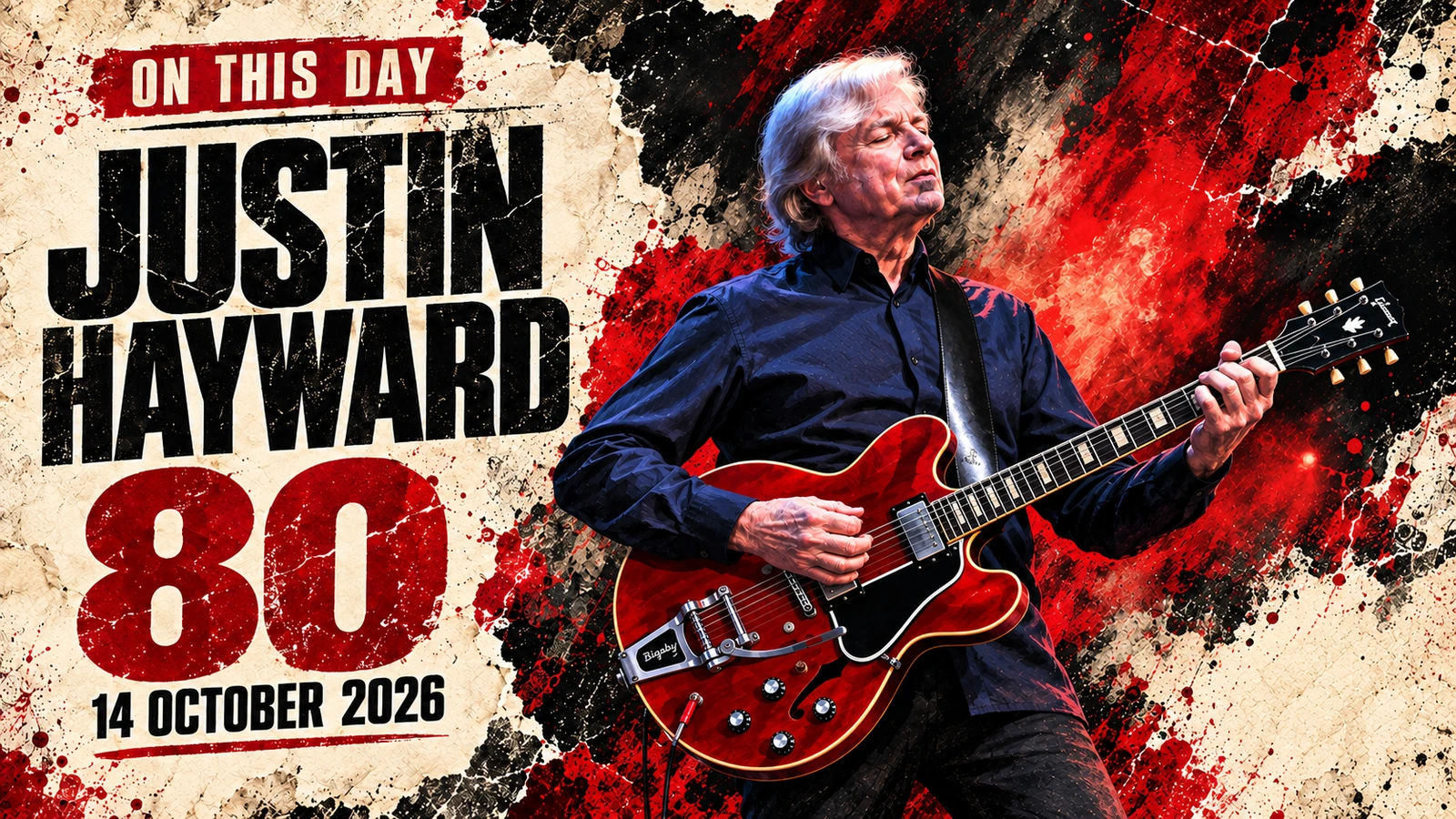
On This Day · October 14, 2026
October 14, 2026 marks Justin Hayward’s 80th birthday. The Moody Blues’ official timeline dates his birth to October 14, 1946. For guitar players, the occasion offers a good reason to look beyond the voice and separate the instruments behind it.
A songwriter who also carried the guitar parts
Hayward joined the Moody Blues in 1966. His official biography identifies him as the group’s lead guitarist as well as a singer and composer, with songs including Nights in White Satin, Tuesday Afternoon and Question. Days of Future Passed followed in 1967. That combination matters: this is a guitar story inside a songwriting career, rather than a soloist’s equipment list.
Two red Gibsons, two different histories
In his 2007 account, Hayward described buying his first cherry-red Gibson ES-335 in 1963, with a conventional stop tailpiece. Money problems later forced him to sell it before joining the Moody Blues. The familiar red-Gibson narrative therefore has a break in it.
He recalled finding another 1963 cherry ES-335 at Selmer in London in 1968. This one had a factory Bigsby. He initially rented it, then bought it in instalments for £168. Keeping those two guitars separate changes the story: a model association is not a continuous chain of ownership.
The Telecaster had a specific job
Hayward’s 2014 Telecaster recollection places a new sunburst, maple-neck Fender in his hands after he joined the band. He connected that guitar with the Ride My See-Saw riff and work on Days of Future Passed and In Search of the Lost Chord. His reason for choosing it was musical: it worked with Mike Pinder’s piano sound.
He also described using the Telecaster for Question on stage when amplifying an acoustic guitar satisfactorily was difficult. That is a live-performance solution, not evidence that every version of Question used the same instrument. It was a solution to the demands of a concert stage.
The acoustic side stayed important
Asked about his guitars in April 2014, Hayward discussed Collings instruments for home and road use, an Olson, a 1955 Martin D-28 and a McPherson twelve-string. Those comments document his choices at that time; they do not establish his present-day touring rig. They do, however, widen the picture beyond the red semi-hollow.
A birthday listening challenge
For this anniversary, choose a Hayward song and listen for the guitar’s job: the figure that introduces it, the rhythm supporting the vocal, or the line that takes over between phrases. The useful question is not simply which guitar appears in a photograph. It is what that particular part needs to do.
AI-assisted editorial illustration based on a January 14, 2018 photograph of Justin Hayward by Derek Russell (drbaseball95), CC BY-SA 2.0. Composition and rendering changed. Adapted illustration: CC BY-SA 2.0. The image reflects a 2018 reference, not a 2026 performance or current rig.
