
Pat Martino Guitars & Gear: The Complete Guide to Jazz Guitar’s Greatest Comeback
His father played his records to him so he could remember who he used to be.
In 1980, Pat Martino suffered a hemorrhaged arteriovenous malformation — a near-fatal seizure caused by an abnormal tangle of blood vessels in his brain. The surgery that saved his life removed part of his brain. The surgery took with it nearly everything: his memory, his ability to play guitar, and almost all of his awareness of who Pat Martino had been.
He moved back in with his parents. His father — Carmen “Mickey” Azzara, who had been a jazz singer in Philadelphia clubs and who had given his son his first guitar at age twelve — played El Hombre and Strings! and other recordings by his son to help him remember who he used to be.
Imagine it: listening to recordings of yourself playing music you don’t remember making, learning about yourself from the evidence of your own genius. Martino described it in his 2011 autobiography Here and Now!: “The ability to play the guitar was always there but was latent. It came down to wanting to use it, to give it significance. It’s like the guitar said to me, ‘What do you want to do with me?'”
He relearned to play. He released The Return in 1987. He became, over the following decades, one of the most celebrated jazz guitarists in the world — twice. The neurosurgeons who had removed part of his brain were as astonished as the jazz world by his recovery.
His gear story is the gear story of a man who lived three different musical lives, each with different instruments and different approaches to the guitar, connected only by the mathematical guitar theory he developed and the specific way his fingers interacted with the frets. The Les Paul Custom his father gave him as a birthday gift. The pawn shop ES-175 he bought in Chicago when the van was stolen. The Gibson L-5S on the cover of Guitar Player in 1977. The Gibson Pat Martino signature model. The Benedetto Pat Martino, built to his exact specifications in 2014. The Acoustic Image amp because a friend had one shipped to him.
He died November 1, 2021, at seventy-seven years old. He never stopped playing.
Background: Philadelphia, Les Paul’s House, Jack McDuff, and the Stolen Van
Patrick Carmen Azzara was born August 25, 1944, in Philadelphia, Pennsylvania. His father Carmen sang in local jazz clubs and briefly studied guitar; his mother Jean was musically supportive. The household was saturated with music from the beginning.
At twelve, his father gave him a standard Les Paul in gold color. As his facility progressed, the father provided better models as birthday gifts — a black Les Paul Custom, then the same model with three pickups. The guitar as birthday gift is a motif that runs through the jazz guitar tradition: Mike Peak gave Joe Pass an ES-175 on his birthday; Carmen Azzara gave his son Les Pauls as he outgrew the previous model.
He studied with Dennis Sandole — the legendary Philadelphia jazz teacher whose students included John Coltrane, James Moody, and McCoy Tyner. He began playing professionally at fifteen after moving to New York City. He lived for a period with Les Paul — the inventor of the Les Paul guitar, the solid-body electric pioneer, and one of the most significant guitarists in American music — at Paul’s home. Paul was a neighbor and mentor in the New York period.
His apprenticeship years were with organ groups — Jack McDuff, Don Patterson, Trudy Pitts. The organ-guitar combination gave him the specific groove education that George Benson received from the same Jack McDuff: the sense that jazz must be physically felt, that the body responds to music before the mind does.
The van theft incident — one of the most consequential gear accidents in this series — occurred while on tour with Jack McDuff. After a performance at Philadelphia’s Showboat jazz club, the entire van was stolen between dates. His black Les Paul Custom was in the van. When Martino got to Chicago for the next engagement, McDuff took him to a pawn shop. The guitar was so cheap that Martino had to use a matchbook to hold the pickup to the body under the strings, otherwise it would have fallen into the guitar. He used it for one night. The next day he called home, borrowed money, and went to a guitar store.
He bought a Gibson ES-175. “It was like the one pictured on Wes Montgomery’s second album, The Incredible Jazz Guitar.” From that point forward he began to use carved-top hollow-body guitars.
The chain: his beloved Les Paul Custom is stolen. He cannot replace it — “since my original Les Paul Custom was my closest friend, I didn’t even try to find another to replace my memory of it.” In its place, he buys a guitar like Wes Montgomery’s. He enters the tradition of the jazz archtop, which he would inhabit and transform for the next fifty years.
Tone note: The matchbook held the pickup to the body. That’s the lowest possible production standard for an instrument being played in a professional jazz context. And Martino played it. He played one night on the worst guitar imaginable. The next day he went out and bought something worthy of what he was doing. The contrast between the matchbook guitar and the ES-175 that replaced it defines the story: you play what you have, and as soon as possible you find what you need.
The Rig: Pat Martino’s Guitars, Amps & Gear
Guitars: From Les Pauls to Archtops to Signature Models
Gibson Les Paul Standard and Custom (Early Career) — The Birthday Gifts
At the age of 12, the first guitar my father got for me was a standard Les Paul, gold in color, to be precise. Then, as my facility progressed, he provided me with better models, like birthday gifts, the black Les Paul Custom or that same model with three pickups.
The Les Paul Custom — the “Black Beauty” in its three-pickup configuration — was his primary guitar until the van theft. His later recollection confirms its central importance: In 1973, studying with him, one of his students asked if he had a favorite guitar. Without hesitation, he said his Les Paul Custom Black Beauty that was unfortunately stolen earlier in his career.
The Les Paul Custom’s specific qualities that suited his early playing: the thick, sustained humbucker tone; the mahogany body’s warm resonance; the specific neck profile of the early 1960s examples that his father had provided. He was one of the few jazz players who seemed to prefer solid-body-style guitars — a preference that would recur throughout his career after the archtop period.
Gibson ES-175 — The Pawn Shop Guitar That Changed His Direction
The Gibson ES-175 bought in Chicago after the van theft was the guitar that shifted Martino’s approach from solid-body to hollow archtop. He described it as “like the one pictured on Wes Montgomery’s second album, The Incredible Jazz Guitar” — acknowledging the specific significance of Montgomery’s instrument as a model for his own transition.
The ES-175’s qualities that suited his developing approach: the hollow archtop’s natural resonance and acoustic warmth, the humbucker pickup’s smooth upper register, the feedback potential that required specific playing discipline in high-volume contexts. From the ES-175 he moved through the archtop tradition — Johnny Smith model, then L-5 — before returning to something solid-body-adjacent with the Gibson L-5S.
Gibson Johnny Smith Model and Gibson L-5 — The Archtop Progression
In time it went on to become a Johnny Smith model, and then an L-5, until 1976. The progression from ES-175 through the Johnny Smith (a full-body archtop with floating pickup, famed for its warmth and refinement) to the L-5 (Gibson’s flagship full archtop, the most prestigious Gibson in the jazz tradition) reflects a natural escalation — as his career and recognition grew, he moved toward more sophisticated instruments within the hollow archtop tradition.
Sam Koontz Custom Archtop — The Philadelphia Luthier’s Gift
In 1973, while studying with him, students saw him playing a Koontz archtop. Sam Koontz was a Philadelphia luthier who built custom instruments for regional jazz musicians. Martino described the relationship: “I no longer have the beautiful instrument that Sam Koontz built for me. After Sam passed away, I chose to move on to new interactions.”
The Koontz connection — a local luthier building specifically for a Philadelphia musician — reflects Martino’s deep roots in the Philadelphia jazz community and his relationships within that community.
Gibson L-5S — The Guitar Player Cover (1977)
While touring with my fusion group Joyous Lake in 1976, Gibson contacted me to see if I’d be interested in endorsing a new model that they were getting ready to release called an L-5S, which finally brought me back to something similar to the original type of instrument that I started with.
Martino played Gibson L-5S in the late ’70s and was featured on the cover of Guitar Player in 1977 with one. The L-5S is an unusual instrument — a fully solid-body guitar (no chambering) using the L-5 archtop body shape, with maple body and neck and ebony fingerboard. It was heavy (maple body, maple neck, and ebony board) and it was not very well balanced on a strap. But it brought Martino back to the solid-body territory he had always preferred — the L-5S’s solid-body sustain and feedback resistance combined with the L-5 body shape’s visual elegance.
The L-5S also preceded the Gibson Pat Martino signature model’s development — the signature guitar took many cues from the L-5S in its semi-solid design approach.
Abe Rivera Custom (“Scepter”) — The Return Guitar
I went back to New York City to play the Bottom Line, using the Polytones. At that concert, luthier Abe Rivera came backstage and told me he would love to build an instrument for me, as a gift. And he did. I named it Scepter, like a regal wand.
The Rivera guitar appears on the cover of the 1987 album The Return — the recording that documented his comeback after the brain surgery and relearning process. The name “Scepter” carries the weight of the recovery: a regal wand, an instrument of authority, belonging to the ruler of a domain reclaimed. The guitar was heavy, made of exotic woods with pearl inlay, and was his primary instrument through the early 1990s.
Gibson Pat Martino Signature Custom (1999) — The Semi-Solid Design
The Gibson Pat Martino Custom was designed to the specs of its namesake, with a single cutaway, contoured mahogany back, solid tiger flame maple top, and twin f-holes. The body is semi-hollow carved out of a single piece of mahogany. The design reflects Martino’s preference for compact solidbody jazz guitars: the semi-hollow chambering provides acoustic resonance while the mahogany body provides the solid-body sustain and feedback resistance he preferred.
Key specifications:
- Body: Semi-hollow — carved mahogany with chambering; not a full hollow archtop
- Top: Tiger flame maple
- Headstock: “Snakehead” style with straight string pull across the nut — the same approach used in the innovative Paul Jackson Jr. model Gibson
- Neck: Custom medium C profile with compound radius
- Fretboard: 22-fret ebony
- Pickups: Original ’57 Gibson humbuckers with black covers that Pat had custom painted
- Finish: Black nitro
The snakehead headstock with straight string pull was a specific Martino specification — he had observed that angled headstocks (which require string bends around the nut) add friction that affects tuning stability. The straight string pull eliminates this friction, producing better tuning consistency. This is the same engineering insight that PRS, Steinberger, and other builders have applied.
Benedetto Pat Martino Signature (2014) — The Final Guitar
Pat Martino emerged from the jazz-rich Philadelphia music scene in 1961 and established himself over the subsequent fifty years as one of the most important and prolific jazz guitarists of all time. As he entered his 50th year in the music profession, Benedetto built him a signature instrument: a smaller 14½-inch, thinner 1⅝-inch body with carved maple top, chambered mahogany back, mahogany neck with 24⅝-inch scale, 22-fret ebony classical fretboard, stop tailpiece, Sperzel locking tuners, black hardware, and Benedetto A6 pickups.
This guitar reflects Martino’s preference for compact solidbody jazz guitars — smaller than most traditional archtops, lighter than the earlier solid-body Gibsons, designed for the working touring life of a professional jazz musician in his seventh decade.
Other Key Instruments
- Gibson ES-335-12 (12-string semi-hollow) — Used on Barry Miles’ White Heat album and Desperado
- 12-string acoustic ($90, wife’s birthday gift) — Used on Desperado recordings; replaced by the ES-335-12
- Gibson L-5 (archtop, full) — Part of the archtop progression before the L-5S
- Various Gibson ES-175s (multiple) — Continued use through various periods
Complete Guitar List (Key Instruments)
- Gibson Les Paul Standard (gold) → Les Paul Custom Black Beauty (3-pickup) — Father’s birthday gifts; primary until van theft; “my closest friend”
- Pawn shop guitar ($90 equivalent, matchbook pickup holder) — One night in Chicago; immediately replaced
- Gibson ES-175 — Bought in Chicago post-theft; “like Wes Montgomery’s”; first archtop; starting point of archtop progression
- Gibson Johnny Smith model — Archtop progression stage 2
- Gibson L-5 — Archtop progression stage 3; flagship Gibson archtop
- Sam Koontz custom archtop — Philadelphia luthier; no longer owned
- Gibson L-5S (solid-body) — Guitar Player cover 1977; fusion period
- Gibson ES-335-12 — 12-string semi-hollow; specific recording use
- Abe Rivera custom “Scepter” — Return period (1987+); exotic woods; heavy; cover of The Return album
- Gibson Pat Martino Custom (1999) — Semi-hollow mahogany; ’57 humbuckers; snakehead headstock; black nitro
- Benedetto Pat Martino signature (2014) — Final guitar; compact archtop; Benedetto A6 pickups; 14½-inch body
Amps: Whatever Was Available — and Then Acoustic Image
The Pragmatic Approach
Martino’s amplifier philosophy is the most pragmatically adaptive in this series. His description: “Keep in mind, there’s a difference between my relationships with all of these realities than most guitar players. In my case whatever comes up from social opportunity is useful. I adapt to it. If a Roland JC-120 is available to me, it’s because Tom Glenn from Roland Corporation, a good friend and former student, had one shipped to me as a gift. And therefore that’s what I used.”
The amplifier came via friendship and circumstance, not specification. Whatever was available became the right amplifier. This is the opposite of the vintage-amp-fetishism that drives much of the gear world — Martino accepted what arrived and made it work.
Gibson Stereo Reverb Amplifier (Early Career)
One of the first unique ones was a stereo reverb amplifier released by Gibson. It was a 2×12 spring reverb amplifier that caused me to include reverb in my overall sound from then on, to this very day.
The Gibson stereo reverb amp — a 2×12 spring reverb unit from the 1960s — established reverb as a permanent element of Martino’s sound. Unlike Tal Farlow (who used no reverb) or Charlie Christian (who had no access to reverb effects), Martino became a reverb advocate from his first experience with it and maintained that commitment throughout his career.
Various Amps — Polytone, Lexicon, Roland JC-120, Fender Twin
Although I’ve used various systems of amplification since then, including Polytone, Lexicon and Roland, for the last 15 years or more I’ve been using and endorsing systems that have been provided by Acoustic Image.
The progression: Polytone Mini-Brute (the standard jazz amp, same as Joe Pass); Lexicon (studio signal processing / reverb); Roland JC-120 (clean solid-state, received as gift from Roland representative Tom Glenn); Fender Twin Reverb (most available touring backline).
His later live rig: Acoustic Image Clarus amp head into a Mesa Boogie 4×12 cabinet — documented in a Seattle Jazz Alley performance review. The combination of the boutique solid-state Acoustic Image (known for exceptional transparency with acoustic and jazz instruments) with a rock-oriented Mesa Boogie 4×12 cabinet is unusual for jazz — jazz guitarists almost never use 4×12 cabs — but reflects Martino’s preference for physical volume and power.
No Consistent Effects Chain
Martino did not maintain a consistent effects pedal chain in the way that rock or blues guitarists in this series do. His signal chain varied by period and by available equipment. The reverb from the early Gibson amp established a permanent preference for reverb in his signal chain, but the specific reverb unit varied — from the Gibson’s spring reverb to studio reverb processors to amplifier reverb.
His mathematical approach to the guitar — the theory of minor thirds and major thirds as the guitar’s fundamental architectural intervals — does not require specific signal processing. The theory operates independently of what amplifier or effects are available. This is the philosophical basis of his pragmatic gear approach: when the theory is the constant, the equipment is genuinely interchangeable.
Strings, Picks & Setup
The mathematical theory as approach: Martino developed a mathematical framework for understanding the guitar’s architecture — the “minor third system” that reduces all chord shapes and scale patterns to two fundamental interval relationships. He described it: “There are elements within an instrument’s architecture that initiate a continuous source of valuable information. For the guitar, there are two. The first is the major third interval, and the second is the minor third interval. Once we view their repetitive information, they begin to appear as a series of automatic functions.”
This theory — which Martino used as the basis for his re-learning after the brain surgery — is part of the gear story because it represents the “equipment” that survived the surgery when the conventional musical memory did not. The mathematical relationships were still there; the specific musical content had to be rebuilt on that foundation.
Picks and strings: Not prominently documented with the same specificity as some artists in this series. Martino was not a guitarist who discussed picks and strings in detail in available interviews. His preference for solidbody-style jazz guitars suggests standard jazz guitar string gauges (medium to heavy) appropriate to the guitar’s character.
The reverb constant: From the Gibson 2×12 spring reverb amp of the early 1960s onward, reverb was a constant in Martino’s signal chain. It defined his recorded sound. It remains audible on every recording as a spatial quality — the notes inhabit a defined acoustic space rather than existing dry and immediate.
Playing Style & Tone Philosophy: The Minor Third and the Return
Pat Martino’s guitar philosophy is the most explicitly mathematical in this series. Where other guitarists discuss emotional approach or tone philosophy, Martino built a formal theoretical framework that could survive the loss of his musical memory and serve as the foundation for rebuilding his musical identity.
The Minor Third System
Martino’s “minor third system” organizes the guitar’s fretboard through the repetitive structure of minor and major third intervals. Every chord shape, every scale pattern, every harmonic relationship can be derived from these two interval types as they repeat across the guitar’s fretboard. This system — which Martino documented in instructional materials and teachings — provided the mathematical skeleton on which he rebuilt his playing after the surgery.
The system’s specific value for relearning: unlike scale patterns or specific chord shapes (which require memorization of specific finger positions), the minor third framework provides a generative principle — a way of understanding WHY the patterns work, not just what the patterns are. When the specific patterns were gone, the generative principle remained. He rebuilt the patterns from the principle.
The Organ Trio Education
The years with Jack McDuff, Don Patterson, and Trudy Pitts gave Martino a specific groove education — the same Jack McDuff lesson that formed George Benson. Jazz must be felt in the body. The organ trio’s specific rhythmic vocabulary, with the Hammond B-3’s sustained bass pedal and the drummer’s locked groove, demanded that the guitarist both provide harmonic support and contribute to the physical momentum of the music.
The Speed and the Architecture
Martino was known for extraordinary speed in bebop lines — single-string lines executed at tempo faster than most contemporaries could manage. Joe Satriani described encountering a Martino tune at a jam session as something that “expanded his consciousness.” The bebop vocabulary delivered at Martino’s speed — with his mathematical harmonic architecture generating the lines — produced music that operated simultaneously at the technical and the theoretical edge.
The Three Lives
In his journey, Martino has lived three lives. He emerged from the highly competitive East Coast scene and became a sought-after sideman by 1962. As band leader beginning in the late ’60s, he redefined the sound of jazz guitar on a series of ambitious albums. Tragedy struck in 1980, with a life-threatening brain aneurysm. The Return (1987) represented the beginning of the next phase. Though tentative by comparison with later works, it testified to Martino’s resilience and presaged a triumphant re-entry to music.
The three lives require three different gear philosophies: the early career (father’s Les Pauls → pawn shop ES-175 → archtop progression); the pre-surgery period (L-5S, Koontz archtop, fusion instruments); the post-surgery return (Rivera Scepter → Gibson signature → Benedetto signature). The instruments trace the biographical arc.
How to Approach Pat Martino’s Style
The Guitar
A semi-hollow or solid-body jazz guitar in the Gibson tradition — the Pat Martino signature philosophy preferred compact, solidbody-oriented instruments over traditional full archtops.
- Gibson Pat Martino Custom (vintage, 1999-era) — The production signature model; semi-hollow mahogany; specific snakehead headstock
- Benedetto Pat Martino signature — The final collaboration; compact archtop; Benedetto A6 pickups
- Gibson ES-175 (or equivalent hollow archtop) — The pawn shop guitar that started the archtop journey; a valid starting point
The Amp
Whatever is available — the Martino philosophy. More specifically: Acoustic Image Clarus (his late-career preference) for maximum transparency; Roland JC-120 as the most available jazz touring amp; Fender Twin Reverb as the standard touring backline. Always with reverb.
| Control | Setting | Notes |
|---|---|---|
| Volume | Working level for ensemble | Martino used a 4×12 cab — more physical volume than typical jazz |
| Reverb | Moderate spring reverb | “The stereo reverb amp caused me to include reverb in my overall sound from then on, to this very day” |
| Treble | 5–6 | Balanced; the semi-hollow body provides natural warmth |
| Bass | 5 | Natural response; the snakehead straight-pull tuning keeps intonation precise |
The Mathematical Foundation
Study the minor third system. Martino’s instructional materials document the framework: begin with the minor third relationship (three frets) and the major third relationship (four frets) as they repeat across the fretboard. Identify how all chord shapes are configurations of these two intervals. Then identify how all scale patterns are sequences of these intervals. The framework generates patterns rather than requiring memorization of individual shapes.
This is the most intellectually rigorous approach to guitar technique in this series. It is also the approach that survived brain surgery when everything else was gone. That is the most compelling possible argument for its value.
Budget vs Authentic
Budget:
- Guitar: Gibson ES-175 (used, various eras) or any hollow archtop with humbucker pickups; or any semi-hollow Gibson (ES-335, ES-339)
- Amp: Roland JC-120 (used) or Fender Twin Reverb (used); spring reverb on
Authentic:
- Guitar: Gibson Pat Martino Custom (1999 era) or Benedetto Pat Martino signature
- Amp: Acoustic Image Clarus into Mesa Boogie 4×12 (his documented late-career live rig)
- Always use reverb
Influence & Legacy: The Man Who Became a Guitarist Twice
Pat Martino’s influence on jazz guitar is the influence of someone who demonstrated the art twice — first in the early career that established him as one of the most significant beboppers of his generation, and second in the return that demonstrated that musical genius is not lost with the memory of the music, because it lives in the hands and the theoretical understanding, not in the specific songs remembered.
The documented connections:
- Joe Satriani — At a jam session, someone played a Martino composition and it “expanded his consciousness”; this encounter with jazz complexity changed Satriani’s approach to guitar at a formative moment
- Dennis Sandole — The Philadelphia teacher whose student roster also included Coltrane and Tyner; the pedagogical tradition that produced Martino places him in the most sophisticated jazz education context of the era
- Two generations of jazz guitarists — The Benedetto press describes him as “a MAJOR influence to at least two generations of guitarists”; his pre-surgery work established one influence, his post-surgery return established a second
- The neurosurgeons who saved his life — Astonished by his recovery as much as the jazz world was; his case is cited in neurological literature as an example of musical memory’s resilience
- Multiple Grammy nominations — Best Jazz Instrumental Album (Live at Yoshi’s, 2002) and Best Jazz Instrumental Solo on “All Blues” (2002), among others
He died November 1, 2021. He had been performing for sixty years. He had survived brain surgery that removed part of his temporal lobe. He had learned to play again from his own records. He had made the mathematical theory of the guitar — the minor third system — a foundational pedagogical tool for a generation of students.
His father played El Hombre to him so he could remember who he used to be. The guitar said: “What do you want to do with me?” He said: “Everything. Again.”
Tone note: The reverb. The Gibson 2×12 spring reverb amp established reverb in his sound from then on, to this very day, he said. He lived three musical lives. In all three, the reverb was there. The mathematical system survived. The fingers remembered before the mind did. The guitar was patient. “The ability to play the guitar was always there but was latent. It came down to wanting to use it, to give it significance. It’s like the guitar said to me, ‘What do you want to do with me?'” The answer — in each of his three lives — was the same.
His father gave him a gold Les Paul at twelve. As he got better, his father gave him better Gibsons. When the van was stolen and the Les Paul Custom was gone, Jack McDuff took him to a pawn shop. He used a matchbook to hold the pickup in the body. One night. The next day, a Gibson ES-175, like Wes Montgomery’s.
He lived through brain surgery in 1980. He moved back in with his parents. His father played El Hombre and Strings! to him so he could remember who he used to be. He listened to his own records and rebuilt himself from the evidence. The guitar said: “What do you want to do with me?” He said: everything. Again.
The Acoustic Image amp. The Mesa Boogie 4×12. The Gibson Pat Martino Custom with the snakehead headstock. The Benedetto signature. Always reverb, from the first Gibson 2×12 to the last gig. The minor third system that survived when the music didn’t.
He died at seventy-seven. He never stopped playing. The guitar was patient. So was he.
If Pat Martino’s mathematical approach to the guitar — the minor third system, the semi-hollow Gibson signature, the pragmatic amp philosophy, the three-life career — has you exploring the bebop jazz guitar tradition, check our complete guide to Tal Farlow’s guitars and gear — the bebop guitarist from the previous generation whose ES-350 vocabulary and artificial harmonics technique established the technical standard Martino’s generation inherited.
And for a guitarist whose British rock approach to the electric guitar occupies the complete opposite end of the spectrum from Martino’s jazz sophistication — but whose Kinks-defining work is equally foundational in its tradition — don’t miss our breakdown of Dave Davies’s complete gear guide.
FAQ: Pat Martino Guitars & Gear
- What guitars did Pat Martino play?
- His guitar progression spanned three distinct phases. Early career: Gibson Les Paul Standard (gold, age 12, father’s gift), then progressively better Les Paul Customs — the three-pickup Black Beauty being his “closest friend” until the van theft. After the theft, he bought a Gibson ES-175 in Chicago (“like Wes Montgomery’s”) which started his archtop phase: ES-175 → Johnny Smith model → Gibson L-5 → Sam Koontz custom archtop → Gibson L-5S (Guitar Player cover, 1977). Post-surgery return: Abe Rivera custom “Scepter” (appeared on The Return album cover), then Gibson Pat Martino Custom (1999, semi-hollow mahogany, ’57 humbuckers, snakehead headstock), then Benedetto Pat Martino signature (2014, 14½-inch compact archtop, Benedetto A6 pickups). He was one of the few jazz players who preferred solid-body-style guitars throughout his career.
- What happened to Pat Martino’s brain and how did it affect his guitar playing?
- In 1980, Martino suffered a hemorrhaged arteriovenous malformation (AVM) — a near-fatal seizure caused by an abnormal tangle of blood vessels. The resulting surgeries removed part of his left temporal lobe. He lost most of his memory, including his ability to play guitar and his awareness of his career as Pat Martino. He moved back with his parents, where his father played El Hombre and his other recordings so he could remember who he was. He slowly relearned to play — partly through his own recordings, partly through the mathematical framework (the minor third system) that had survived when the specific musical content had not. He described it: “The ability to play the guitar was always there but was latent… It’s like the guitar said to me, ‘What do you want to do with me?'” The Return (1987) documented his comeback. His playing was described as astonishing neurosurgeons as much as jazz fans.
- What is Pat Martino’s minor third system?
- A mathematical framework for understanding the guitar’s fretboard based on the repetition of minor third (three frets) and major third (four frets) intervals. Martino explained: “There are elements within an instrument’s architecture that initiate a continuous source of valuable information. For the guitar, there are two. The first is the major third interval, and the second is the minor third interval. Once we view their repetitive information, they begin to appear as a series of automatic functions.” All chord shapes and scale patterns can be derived from these two interval types as they repeat across the fretboard. The system’s specific value: it provides a generative principle rather than a memorized pattern, meaning it survived his brain surgery when specific musical content was lost and served as the foundation for rebuilding his playing.
- What amplifiers did Pat Martino use?
- His amplification philosophy was pragmatically adaptive: “In my case whatever comes up from social opportunity is useful. I adapt to it.” The progression: Gibson stereo reverb amp (2×12 spring reverb, established reverb as a permanent element of his sound) → Gibson, Fender, Ampeg (various early career) → Polytone Mini-Brute → Lexicon → Roland JC-120 (received as gift from Roland’s Tom Glenn) → Fender Twin Reverb (most available touring backline) → Acoustic Image Clarus (for the last 15+ years of his career). His late-career live rig was the Acoustic Image Clarus head into a Mesa Boogie 4×12 cabinet — unusual for jazz. He always used reverb, from the first Gibson amp onward.
- What is the story of Pat Martino’s stolen Les Paul?
- While on tour with Jack McDuff, after a performance at Philadelphia’s Showboat jazz club, the band’s entire van was stolen between dates. His black Les Paul Custom Black Beauty — described later as “my closest friend” — was in the van and was never recovered. In Chicago for the next engagement, McDuff took Martino to a pawn shop where he bought a guitar so cheap he had to use a matchbook to hold the pickup to the body. He used it for one night. The next day he borrowed money from home and went to a guitar store, buying a Gibson ES-175 “like the one pictured on Wes Montgomery’s second album.” This ES-175 started his archtop phase. He never sought to replace the Lost Les Paul Custom — “I didn’t even try to find another to replace my memory of it.”
- What is the Gibson Pat Martino signature model?
- The Gibson Pat Martino Custom, introduced in 1999, is a semi-hollow guitar carved from a single piece of mahogany with a tiger flame maple top and twin f-holes. It reflects Martino’s preference for solid-body-style jazz guitars: the semi-hollow chambering provides acoustic resonance while the mahogany construction provides solid-body feedback resistance and sustain. Distinctive features include a “snakehead” style peghead with straight string pull (eliminating nut friction for better tuning stability), a contoured body, 22-fret compound-radius ebony fingerboard, and original ’57 Gibson humbuckers with black covers that Martino had custom painted. The straight string pull headstock was adopted from the Paul Jackson Jr. model and represents Martino’s specific engineering approach to tuning stability.
- How do I approach Pat Martino’s guitar technique?
- Start with the minor third system: study how minor third (3 frets) and major third (4 frets) intervals repeat across the fretboard and how all chord shapes and scale patterns derive from these two relationships. This framework generates patterns rather than requiring memorization of specific shapes. For equipment: a semi-hollow or solid-body jazz guitar (Gibson Pat Martino Custom or Benedetto signature for authenticity; ES-175 or any hollow archtop as accessible starting point). Through a clean amp with spring reverb (Roland JC-120, Fender Twin, or Acoustic Image) — always use reverb, from his first Gibson amp onward. Practice bebop lines at the tempo the music requires, not the tempo your current technique allows. Martino’s approach: study the architecture before the patterns, understand the generative principles rather than memorizing outcomes.
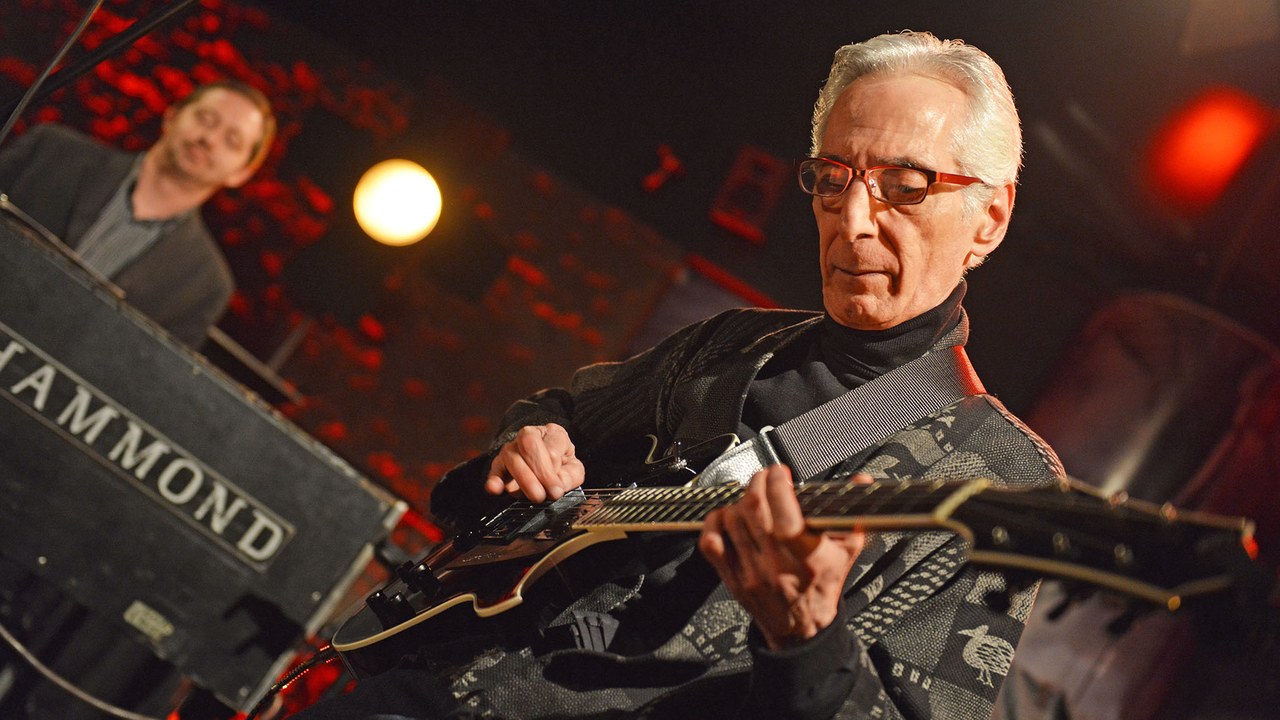
Pat Martino performing at Bielska Zadymka Jazzowa (Lotos Jazz Festival), Poland. Photo: Pat Martino Trio during Lotos Jazz Festival by Piotr Bieniecki / www.fototeo.pl / CC BY-SA 4.0. Source previously processed in Adobe Photoshop. Cropped to 16:9, resized and JPEG re-encoded; adapted photograph also CC BY-SA 4.0.