
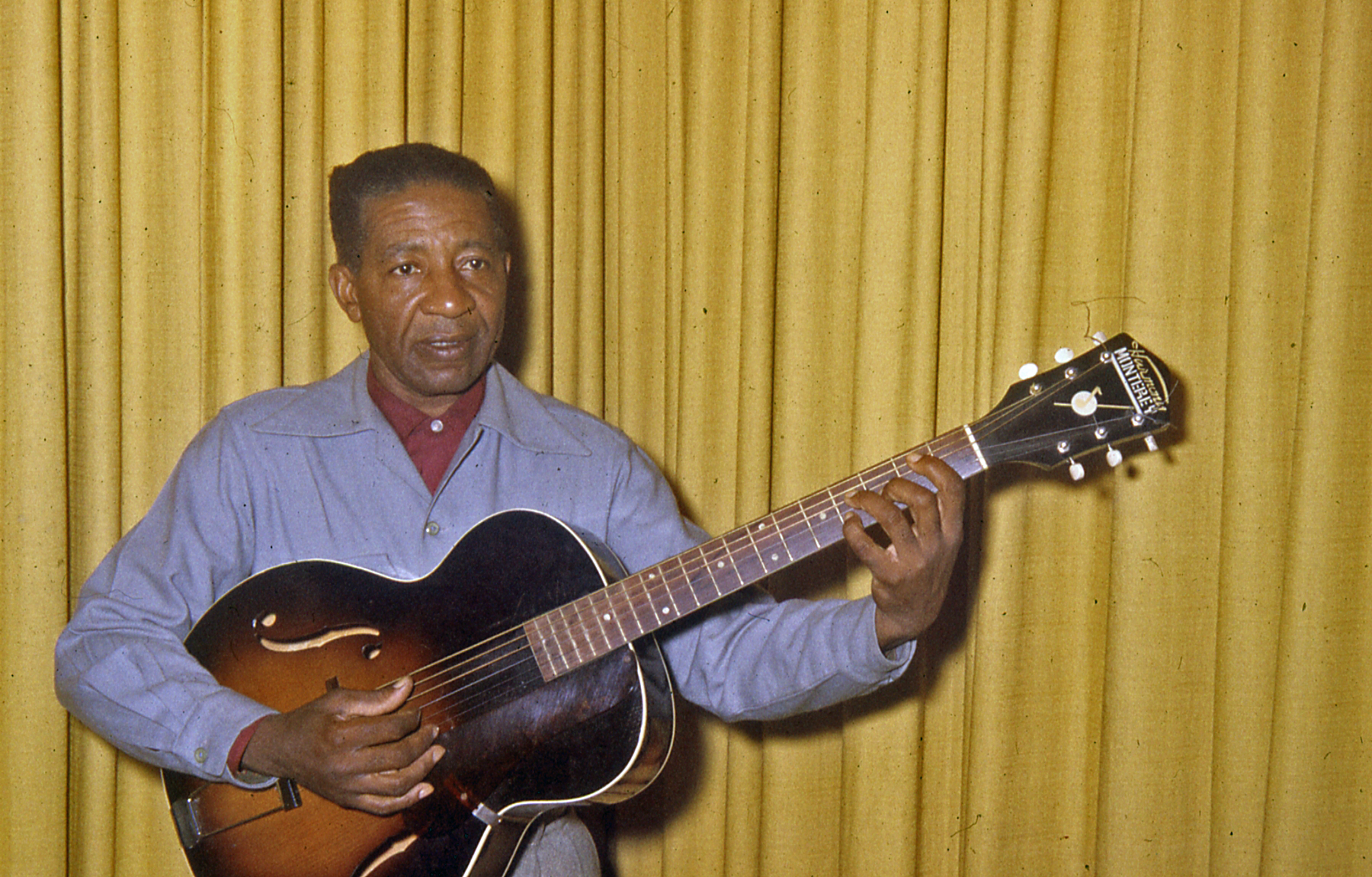
Lonnie Johnson guitars gear is the subject of one of American music’s most genuinely foundational and most chronologically remarkable careers — the equipment and approach of a guitarist whose recordings from the mid-1920s onward established the single-string lead guitar solo as a viable and expressive musical statement years before the concept had any established vocabulary, whose collaborations with Eddie Lang (recording together as “Blind Willie Dunn” for contractual reasons related to the era’s racial recording categories) produced some of the earliest documented examples of sophisticated jazz-blues guitar duets, and whose career — extending from the 1920s through the 1960s with periods of obscurity and rediscovery along the way — touched virtually every major development in American guitar music’s transition from accompaniment instrument to lead voice. Johnson’s specific combination of technical virtuosity, harmonic sophistication drawing from both blues and jazz vocabularies, and his role in essentially inventing the guitar solo as a recognisable musical statement gave him an influence whose breadth is difficult to overstate even as his specific name recognition, relative to his actual historical importance, remains limited outside dedicated blues and jazz history circles.
His specific innovations — particularly his single-string lead playing, which demonstrated that the guitar could generate extended melodic statements with the kind of phrasing, articulation, and harmonic sophistication that horn players brought to their solos — gave subsequent guitarists (including Tampa Red, documented two articles previous, whose own single-string lead work developed in overlapping historical context) a model for what the guitar’s melodic capabilities could encompass. This is the complete breakdown of Lonnie Johnson guitars gear, technique, and tonal philosophy.
Background
Alonzo “Lonnie” Johnson was born on February 8, 1899, in New Orleans, Louisiana — a city whose specific musical environment, combining the foundational jazz tradition that was developing in New Orleans during Johnson’s childhood and youth with the broader blues and popular music traditions circulating through the city’s specific cultural environment, gave him a musical formation that crossed genre boundaries from the outset in ways that would characterise his entire career. His family was musically active — multiple family members played various instruments — and Johnson himself was reportedly proficient on multiple instruments (violin and piano among others, in addition to guitar) before guitar became his primary focus.
A devastating family tragedy — the 1918 influenza pandemic killed multiple members of his family — gave his early adulthood a context of loss that shaped his subsequent career path, including his eventual move toward Saint Louis and then to the broader recording industry that would document his guitar innovations. His recording career, beginning in the mid-1920s, placed him at the center of the developing “race records” industry during the period when recorded blues and jazz were establishing themselves as commercially significant categories — and Johnson’s specific combination of technical ability and stylistic range gave him a position within this industry that crossed the blues/jazz categorical boundary more completely than most of his contemporaries.
His collaborations with Eddie Lang — a white jazz guitarist whose own reputation was substantial within the jazz guitar tradition — produced recordings released under the pseudonym “Blind Willie Dunn” (a naming convention reflecting the era’s specific and often troubling racial categorisations within the recording industry, where interracial collaboration required obscuring at least one participant’s identity for commercial and social reasons). These recordings — sophisticated guitar duets demonstrating both musicians’ technical command and their genuine musical rapport — represent some of the earliest documented examples of the kind of guitar-duet sophistication that would influence subsequent generations of both jazz and blues guitarists. Johnson’s subsequent career included periods of significant commercial success (particularly during the late 1940s and early 1950s, when he had R&B chart success with material that moved toward the popular ballad style of the period), periods of relative obscurity, and a late-career rediscovery connected to the broader blues revival that brought renewed attention to prewar blues figures during the 1960s, continuing until his death in 1970.
Lonnie Johnson Guitars Gear: The Complete Rig
Guitars
Lonnie Johnson’s primary instruments across much of his career were acoustic archtop guitars — the carved or pressed arched-top, f-hole or round-hole acoustic guitars that, developed primarily for jazz and dance band guitarists seeking sufficient volume and a specific tonal character for ensemble playing, gave Johnson’s playing a tonal foundation appropriate to both his blues and jazz applications. Archtop guitars’ specific tonal character — generally brighter and more percussive in their attack than flat-top dreadnought-style acoustic guitars, with a tonal quality often described as having more “bark” or “punch” — suited both Johnson’s single-string lead playing (where note articulation and clarity mattered for melodic lines to be clearly heard) and his chord-based accompaniment work.
As Johnson’s career extended into the postwar era — particularly during his late-1940s and early-1950s commercial success period — electric guitars appeared in his setup, consistent with the broader transition to electric instrumentation that was occurring across blues, jazz, and popular music during this period. His postwar electric work, particularly the more pop/R&B-oriented material of his commercial success period, would have used electric archtop or similar instruments appropriate to the smoother, more produced sound of that material.
Twelve-string guitars appeared in Johnson’s documented work for specific applications where the fuller, doubled-course texture suited the material — consistent with the broader prewar acoustic blues tradition’s use of twelve-string instruments.
Johnson, like other guitarists of his era, would have used heavier-gauge strings appropriate to acoustic archtop instruments of the period — giving the tonal projection and the specific physical feel that his technically demanding single-string lead playing required.
Amps
For the majority of Johnson’s prewar career, his archtop acoustic guitars’ natural acoustic projection — enhanced by the archtop design’s specific tonal character, which was developed partly to give acoustic guitars greater volume and projection in ensemble and dance band contexts — provided his amplification, in the sense that no electronic amplification was involved.
During his postwar commercial success period, electric amplification — standard amplifiers appropriate to the smoother, more produced R&B and popular ballad style of his hit recordings from this period — would have been part of his setup, consistent with the broader electrification of popular music during this era.
Effects
Lonnie Johnson’s single-string lead guitar technique — playing extended melodic lines on individual strings with the kind of phrasing, articulation, vibrato, and harmonic sophistication that horn players brought to their solos — represented his most significant and most influential technical innovation. This technique, demonstrated on his recordings from the mid-1920s onward, established the guitar solo as a recognisable and musically substantial statement at a time when the concept had no established vocabulary or precedent within American popular music more broadly. The technique required: precise fretting-hand control for clean single-note articulation; a melodic conception that drew from both blues vocabulary (bent notes, blue notes, call-and-response phrasing) and the more harmonically sophisticated vocabulary of jazz (chord-tone-based melodic construction, chromatic approach notes, and the kind of harmonic awareness that jazz improvisation requires); and the physical technique to execute extended melodic statements with consistent tone and articulation.
Johnson’s single-string lead playing employed vibrato — controlled pitch oscillation applied to sustained notes — giving his lead lines an expressive quality analogous to vocal or horn vibrato. This vibrato, combined with his note choice and phrasing, gave his lead playing its specific vocal, “singing” quality that distinguished it from more mechanically executed melodic lines.
Consistent with the largely acoustic nature of his prewar recordings, Johnson’s tone during this period was the natural tone of his archtop acoustic instruments, shaped by his specific technique, without electronic processing.
Playing Style & Tone Philosophy
Lonnie Johnson is, in a meaningful sense, the guitarist from whom the entire concept of “lead guitar” as subsequent generations would understand it most directly descends — not merely an early practitioner of single-string melodic playing (Tampa Red, documented two articles previous, was also an early practitioner in overlapping historical context) but a guitarist whose specific combination of technical command and harmonic sophistication gave single-string lead playing a vocabulary and a level of musical substance that established it as a viable foundation for everything that followed. His recordings from the mid-1920s demonstrate lead guitar playing that, in its combination of melodic invention, harmonic awareness, and expressive phrasing, would not sound fundamentally “primitive” or “early” to a listener familiar with subsequent decades of lead guitar development — the specific vocabulary has obviously expanded enormously since, but the fundamental conception (the guitar as a melodic, soloistic voice capable of the kind of expressive statement that vocalists and horn players make) is recognisably the same conception that subsequent lead guitarists would develop within.
His harmonic vocabulary drew from both blues and jazz traditions in ways that gave his playing a sophistication beyond what purely blues-based vocabulary (the pentatonic-and-blue-note vocabulary that would become foundational to subsequent blues-rock lead guitar) could provide alone. His melodic lines incorporated chord-tone-based construction (outlining the harmony of the underlying chords through his melodic note choices, in the manner that jazz improvisation requires), chromatic approach notes (notes outside the underlying scale that resolve, by half-step, into notes within the scale — a fundamental element of jazz melodic vocabulary), and the kind of harmonic awareness that allowed his lines to navigate chord changes with genuine harmonic logic rather than relying on a single scale pattern applied indiscriminately across changing harmony.
His collaborations with Eddie Lang — the “Blind Willie Dunn” recordings — demonstrated a level of guitar-duet sophistication that required both musicians to have not just individual technical command but genuine ensemble awareness: the ability to play interlocking parts, to trade melodic and accompaniment roles, and to create the kind of musical conversation between two guitars that these recordings document. This guitar-duet sophistication — two guitarists creating a complete musical texture through their combined parts — represented an early and influential model for subsequent guitar-duet and dual-guitar approaches across both jazz and blues/rock traditions (the dual-guitar partnerships documented throughout this series, from Moore/Ranaldo through Coxon/Albarn-adjacent contexts, all exist within a tradition whose early sophisticated examples include these Johnson-Lang recordings).
His vocal career — Johnson was also a significant blues vocalist, with his own vocal recordings representing a substantial part of his catalogue alongside his guitar innovations — gave him, like Tampa Red and Big Bill Broonzy, a complete musical identity in which guitar technique served vocal performance as much as it existed as an independent instrumental statement. His postwar commercial success, built on more pop/R&B-oriented vocal material, demonstrated his ability to adapt his musical approach to commercial contexts quite different from his prewar jazz-blues guitar innovations — a versatility across his decades-long career that parallels the versatility documented for Big Bill Broonzy.
Tonally, Lonnie Johnson guitars gear philosophy was built on the acoustic archtop guitar’s bright, articulate, percussive tonal character — giving single-string lead lines the clarity and projection that made them effective as melodic statements, whether in solo performance or in the guitar-duet context of the Lang collaborations. As with Tampa Red and Big Bill Broonzy, the sophistication of his sound came overwhelmingly from technique and musical conception rather than from equipment-based tonal shaping — though the archtop’s specific tonal character (distinct from both the resonator guitars documented for Tampa Red and the flat-top acoustics more associated with Broonzy) gave his playing a specific tonal foundation appropriate to the jazz-influenced harmonic and melodic vocabulary his playing employed.
The archtop guitar’s development history — and its specific relationship to the jazz and dance band context that Johnson’s playing emerged from — deserves examination because the archtop represents a parallel development to the resonator guitar (documented for Tampa Red) as a solution to the same fundamental problem: acoustic guitars of the standard flat-top design lacked sufficient volume and projection for ensemble and dance band contexts where banjos, horns, and other louder instruments could easily overwhelm a conventional acoustic guitar. The archtop’s arched top and back (carved from solid wood in the finest examples, or pressed/laminated in more affordable instruments), combined with f-holes (adapted from violin family instruments) rather than the round sound hole of flat-top guitars, gave archtop guitars a brighter, more focused, more percussive tonal projection that could hold its own in ensemble contexts where flat-top acoustic guitars would have been inaudible. Gibson’s L-5 model, introduced in 1922 (just a few years before Johnson’s earliest significant recordings), represented one of the most influential early archtop designs, establishing a template that subsequent archtop guitars (including those used by generations of jazz guitarists) would follow and develop. For Johnson, working within a musical environment where jazz and blues categories overlapped considerably and where dance band and ensemble contexts were common, the archtop’s specific tonal projection gave his playing — both his accompaniment work and his innovative single-string lead playing — the audibility within ensemble contexts that flat-top acoustic instruments might not have provided as effectively. Lonnie Johnson guitars gear’s archtop foundation, in this sense, reflected the same practical and tonal considerations that shaped the broader development of jazz guitar during this period.
The specific harmonic vocabulary that Johnson’s playing demonstrated — chord-tone-based melodic construction and chromatic approach notes, mentioned in the playing style section — deserves more detailed technical explanation because these concepts represent foundational elements of jazz improvisation vocabulary whose presence in guitar recordings from the mid-1920s is genuinely remarkable. Chord-tone-based melodic construction means that a melodic line’s important notes (particularly notes that fall on strong rhythmic positions, or notes that are sustained) correspond to the notes of the underlying chord — if the harmony is a G7 chord, a melodic line constructed this way would emphasise the notes G, B, D, and F (the chord’s root, third, fifth, and seventh) at structurally important moments, giving the melodic line a quality of harmonic “rightness” — the melody and harmony feel unified rather than merely coexisting. Chromatic approach notes are notes outside the underlying scale or chord that resolve, typically by half-step, into notes that are within the scale or chord — a melodic technique that creates a brief moment of harmonic tension immediately resolved, giving melodic lines a quality of forward motion and harmonic sophistication beyond what diatonic (scale-only) melodic construction provides. Both techniques are foundational to how jazz improvisation works — they represent the basic vocabulary through which improvising musicians navigate chord changes with genuine harmonic logic. That Johnson’s mid-1920s recordings demonstrate this vocabulary on guitar — an instrument whose role in popular music at that time was overwhelmingly rhythmic and accompanimental rather than melodic — represents a genuinely early and genuinely sophisticated application of vocabulary that would become central to jazz (and subsequently to jazz-influenced blues and rock) for decades afterward.
The personal tragedy of the 1918 influenza pandemic’s impact on Johnson’s family — mentioned briefly in the background section — deserves acknowledgment as part of the broader historical context that shaped not just Johnson’s individual biography but the demographic and social landscape of the era more generally. The 1918 influenza pandemic (sometimes called the “Spanish flu,” though its origins were not specifically Spanish — the name reflects wartime censorship dynamics that allowed Spanish newspapers, in a then-neutral country, to report on the pandemic more openly than combatant nations’ censored press) killed an estimated 50 million people worldwide, with mortality rates that, in some populations and locations, were genuinely devastating at the family and community level. For a New Orleans family in 1918, losing multiple members to this pandemic was a personal tragedy that occurred within a broader context of similar tragedies affecting countless families across the world during this period — Johnson’s specific loss was part of a global catastrophe whose scale is sometimes underappreciated relative to other historical events of the same general period (the First World War, occurring simultaneously, often receives more historical attention despite the pandemic’s substantially higher mortality). This personal context — loss on this scale during early adulthood — shaped Johnson’s subsequent life path in ways that connect his individual biography to this broader historical catastrophe, giving Lonnie Johnson guitars gear’s foundational innovations a human context shaped by genuinely catastrophic personal and historical circumstances.
How to Sound Like Lonnie Johnson
Guitar Approach
An acoustic archtop guitar (Gibson L-5 or similar period-appropriate archtop for historical accuracy, or any quality acoustic archtop as an accessible alternative) is the foundational Lonnie Johnson guitars gear instrument — the archtop’s bright, percussive tonal character gives single-string lead lines the clarity and projection appropriate to this approach. Medium-to-heavy gauge strings appropriate to archtop acoustic instruments.
The technical and conceptual approach: develop single-string lead playing that draws from both blues vocabulary (bent notes, blue notes, expressive vibrato) and jazz harmonic vocabulary (chord-tone-based melodic construction, chromatic approach notes, navigating chord changes with genuine harmonic awareness rather than single-scale-pattern approaches). Study the specific combination of expressive, vocal-like phrasing (the vibrato, the “singing” quality of sustained notes) with harmonic sophistication (the chord-tone awareness) that gave Johnson’s lead lines their combination of emotional directness and musical substance. For guitar-duet applications: develop ensemble awareness — interlocking parts, trading melodic and accompaniment roles, genuine musical conversation between two guitars rather than one guitar simply accompanying another’s lead.
Amp Approach
No amplifier for historically accurate prewar Lonnie Johnson guitars gear — the acoustic archtop’s natural projection is the foundation. For contemporary performance requiring amplification: a quality acoustic pickup or microphone appropriate to archtop instruments, run through a clean amplification system that preserves the archtop’s specific bright, percussive tonal character.
| Element | Approach | Notes |
|---|---|---|
| Instrument | Acoustic archtop guitar | Bright, percussive tonal character — gives single-string lead lines clarity and projection |
| String gauge | Medium-to-heavy, archtop-appropriate | Period-appropriate tonal projection and physical feel for demanding single-string technique |
| Melodic vocabulary | Blues + jazz synthesis | Bent notes and vibrato (blues) combined with chord-tone construction and chromatic approach (jazz) |
| Vibrato | Controlled, expressive | Vocal/horn-like quality on sustained notes — gives lead lines their “singing” character |
| Duet/ensemble approach | Interlocking parts, role-trading | For guitar-duet applications — genuine musical conversation, not simple lead/accompaniment hierarchy |
| Amplification | None (historical) or clean acoustic (practical) | Archtop’s natural projection is the foundation — avoid coloration |
The single-string lead technique combining blues expressiveness with jazz harmonic sophistication is the single most essential and most historically significant element of Lonnie Johnson guitars gear — this combination, demonstrated on recordings from the mid-1920s, established the conceptual and technical foundation for “lead guitar” as subsequent generations would develop it. Acoustic archtop guitar for tonal foundation. Expressive vibrato. Chord-tone-aware melodic construction. For duet applications, genuine ensemble musical conversation. No amplification for historically accurate approach — the sophistication comes from technique and musical conception, not equipment.
Influence & Legacy
Lonnie Johnson’s influence on the development of lead guitar — as a recognisable musical concept and technical vocabulary — is genuinely foundational in a way that few musicians in any genre can claim with equal justification. His mid-1920s recordings demonstrated single-string lead guitar playing of a sophistication that established the guitar solo as a viable musical statement, giving subsequent guitarists (across blues, jazz, and eventually rock) a foundational model whose basic conception — the guitar as melodic, soloistic voice — remains the foundation of how lead guitar is understood today, even as the specific vocabulary has expanded enormously.
His specific synthesis of blues and jazz vocabularies — demonstrated both in his solo work and in the Eddie Lang collaborations — gave subsequent guitarists working across genre boundaries (a category that includes a substantial portion of the guitarists documented throughout this series, whose blues-rock, jazz-influenced, and genre-crossing approaches all exist within a tradition that Johnson’s early synthesis helped establish) a foundational example of how these vocabularies could combine productively.
The comparison with Tampa Red — whose own single-string lead innovations developed in overlapping historical context, giving prewar blues guitar two foundational sources for its lead guitar vocabulary — illuminates how multiple prewar guitarists independently and collectively established the foundations that subsequent generations would build upon. The parallel with Big Bill Broonzy — whose own technically sophisticated prewar career, though built on a different technical foundation (fingerstyle accompaniment rather than single-string lead), represents another example of prewar guitar virtuosity whose influence extended across the decades-long transition this series has documented — shows the broader landscape of technically advanced prewar guitarists from which subsequent traditions developed. And the connection to Charlie Byrd — whose own jazz guitar career, developed in a subsequent generation but within a tradition that Johnson’s jazz-blues synthesis helped establish, demonstrates the continuing development of the jazz guitar vocabulary that Johnson’s Eddie Lang collaborations represent an early and influential example of — places Lonnie Johnson guitars gear at a genuine point of origin for multiple subsequent guitar traditions simultaneously.
Frequently Asked Questions: Lonnie Johnson Guitars & Gear
What guitar did Lonnie Johnson play?
Lonnie Johnson’s primary instruments across much of his career were acoustic archtop guitars — the carved or pressed arched-top instruments developed primarily for jazz and dance band guitarists, whose bright, percussive tonal character gave his single-string lead playing the clarity and projection appropriate to his innovative melodic approach. Twelve-string guitars appeared for specific applications. During his postwar commercial success period, electric guitars appeared in his setup, consistent with the broader electrification of popular music during this era.
What is single-string lead guitar and why was Johnson’s approach significant?
Single-string lead guitar refers to playing extended melodic lines on individual strings, with the kind of phrasing, articulation, and expressiveness that vocalists and horn players bring to melodic statements — as distinct from chord-based or primarily rhythmic guitar playing. Lonnie Johnson’s recordings from the mid-1920s demonstrated this approach with a sophistication — combining blues expressiveness (bent notes, vibrato) with jazz harmonic awareness (chord-tone-based melodic construction, chromatic approach notes) — that established the guitar solo as a viable and substantial musical statement, years before this concept had any established vocabulary within American popular music. This makes Johnson a genuinely foundational figure for “lead guitar” as subsequent generations would understand and develop the concept.
Who was Eddie Lang and what were the “Blind Willie Dunn” recordings?
Eddie Lang was a white jazz guitarist whose own reputation was substantial within the jazz guitar tradition. His collaborations with Lonnie Johnson were released under the pseudonym “Blind Willie Dunn” — a naming convention reflecting the racial categorisations of the era’s recording industry, where interracial musical collaboration required obscuring at least one participant’s identity for commercial and social reasons specific to that historical period. These recordings represent sophisticated guitar duets demonstrating both musicians’ technical command and genuine musical rapport — interlocking parts, role-trading between melodic and accompaniment functions, and the kind of musical conversation between two guitars that represents an early and influential model for subsequent guitar-duet traditions across jazz and blues/rock.
How did Lonnie Johnson’s career trajectory differ from other prewar blues guitarists?
Johnson’s career included a notable late-1940s and early-1950s commercial success period built on pop/R&B-oriented vocal material — a more mainstream commercial direction than many prewar blues guitarists achieved during this period. His career also included periods of significant obscurity and a late-career rediscovery connected to the 1960s blues revival, giving him a career arc with more distinct “peaks and valleys” of commercial recognition than guitarists whose careers followed more consistent trajectories. This combination — genuine prewar innovation, postwar commercial success in a different style, later rediscovery — reflects the same kind of decades-long career adaptation documented for Big Bill Broonzy, though with different specific commercial outcomes at different career stages.
What is an archtop guitar and why did it suit Johnson’s playing?
An archtop guitar is an acoustic guitar with a carved or pressed arched top (and often an arched back as well), typically featuring f-holes (violin-style sound holes) rather than the round sound hole of flat-top acoustic guitars. Archtop guitars were developed primarily for jazz and dance band guitarists, who needed sufficient volume and a specific tonal character — generally brighter and more percussive, with more “bark” or “punch” in the attack — to project in ensemble contexts before amplification became standard. For Johnson’s single-string lead playing, this bright, percussive character gave individual notes clarity and projection appropriate to melodic lines intended to be heard distinctly, whether in solo performance or alongside other instruments.
What was the broader historical context of “Blind Willie Dunn” and racial categorisation in the recording industry?
The recording industry of Johnson’s era operated within the broader racial categorisations of American society during this period — “race records” as a marketing category for recordings aimed at Black audiences, and various conventions (including pseudonyms like “Blind Willie Dunn” for interracial collaborations) that reflected the era’s specific racial dynamics. These conventions shaped how musicians like Johnson and Lang could present collaborative work — their genuine musical partnership required a pseudonymous framing that obscured the interracial nature of the collaboration, reflecting commercial and social realities of the period rather than the musicians’ own preferences. Understanding this context is important for understanding both the specific recordings and the broader industry structure within which prewar musicians like Johnson operated.
What are Lonnie Johnson’s most important recordings?
His mid-1920s recordings demonstrate his foundational single-string lead guitar innovations — recordings that, despite their age, document lead guitar playing whose basic conception remains recognisable to listeners familiar with subsequent decades of lead guitar development. The “Blind Willie Dunn” recordings with Eddie Lang represent the guitar-duet sophistication documented above. His postwar commercial recordings (particularly his late-1940s/early-1950s R&B chart material) document a different but commercially significant phase of his career. His 1960s rediscovery-era recordings, connected to the blues revival, give a late-career perspective on a musician whose career touched virtually every major development in American guitar music’s transition from accompaniment instrument to lead voice across more than four decades.
Johnson’s postwar commercial success — particularly his R&B chart hits in the late 1940s and early 1950s with material in a smoother, more pop-ballad-oriented style than his prewar jazz-blues guitar innovations — represents a career pivot that deserves examination because it illuminates how musicians of his generation navigated changing commercial landscapes across decades-long careers. The late 1940s and early 1950s saw significant changes in popular music’s commercial landscape: the big band era was waning, R&B was developing as a distinct commercial category with its own specific stylistic expectations, and the broader popular music audience’s tastes were shifting in ways that required musicians to adapt or risk commercial irrelevance. Johnson’s specific adaptation — moving toward smoother, more vocal-ballad-oriented material that found commercial success on R&B charts — demonstrated the same kind of career-spanning adaptability documented for Big Bill Broonzy, though Johnson’s specific adaptation moved toward more mainstream commercial success (chart hits) rather than toward the folk-revival direction that characterised Broonzy’s late career. This commercial success period, while less celebrated in retrospective accounts that emphasise Johnson’s prewar guitar innovations, represented a genuine and significant phase of his career — demonstrating that the same musician whose mid-1920s recordings had established foundational lead guitar vocabulary was also capable of achieving mainstream commercial success in a quite different stylistic context two decades later. Lonnie Johnson guitars gear, across this complete career arc, encompassed both the foundational prewar innovations and this quite different postwar commercial chapter — a breadth that gives his career genuine complexity beyond the “lead guitar pioneer” framing that, while accurate, doesn’t capture his career’s complete range.
The 1960s blues revival’s rediscovery of Johnson — occurring toward the end of his life and career — connects to the broader pattern of prewar blues musicians receiving renewed attention during this period, a pattern that intersects with (and sometimes complicates) the broader narrative about which prewar musicians received this kind of rediscovery and why. As discussed in relation to Big Bill Broonzy’s European folk revival reception, the blues revival audience of the 1950s and 1960s brought specific expectations and interests to their engagement with prewar blues musicians — interests that didn’t always align neatly with the full range of any individual musician’s actual career and output. For Johnson specifically, a musician whose career had included substantial postwar commercial success in styles quite different from his prewar innovations, the blues revival’s rediscovery may have emphasised his prewar work (the guitar innovations, the Eddie Lang collaborations) in ways that, while genuinely significant, represented a selective framing of his complete career — similar to the selective framing discussed for Broonzy, though with different specific consequences given Johnson’s different career trajectory. This pattern — prewar blues musicians’ complete careers being selectively framed by revival-era rediscovery in ways that emphasise certain periods or aspects over others — represents a recurring dynamic in how this entire generation of musicians has been historically documented and understood, with consequences for how subsequent listeners and historians have access to and understand these musicians’ complete contributions.
The “Blind Willie Dunn” recordings’ guitar-duet sophistication deserves a final technical examination because the specific ensemble skills they demonstrate — interlocking parts and role-trading between melodic and accompaniment functions — represent a genuinely demanding collaborative achievement that requires both musicians to maintain awareness of the complete musical texture rather than focusing solely on their individual parts. In a guitar duet where both musicians are capable of both lead and accompaniment roles, the music can move fluidly between configurations: one guitarist playing a melodic line while the other provides harmonic and rhythmic accompaniment, then trading roles, or both guitarists playing interlocking melodic fragments that combine to form a complete melodic statement that neither guitarist’s individual part fully represents alone. This kind of playing requires not just individual technical command (which both Johnson and Lang clearly possessed) but a specific kind of musical listening — each musician needs to hear what the other is doing and adjust their own contribution in response, in real time, during the performance. The “Blind Willie Dunn” recordings’ historical significance partly lies in demonstrating that this level of guitar-duet sophistication was achievable and had been achieved at this early date — giving subsequent guitarists working in duet contexts (across jazz, blues, and the dual-guitar rock traditions documented throughout this series) a foundational example of what guitar-duet music could be when both musicians brought genuine individual sophistication and genuine ensemble awareness to the collaboration. Lonnie Johnson guitars gear, in its Eddie Lang collaborative dimension, represents not just individual innovation but collaborative innovation — a different but equally significant kind of foundational achievement.
Considering Lonnie Johnson guitars gear as the conclusion to this series’ three-article exploration of foundational prewar Chicago and New Orleans-formed blues guitarists (alongside Tampa Red and Big Bill Broonzy) gives an opportunity to summarise what these three articles, taken together, establish about the foundations of the entire subsequent tradition this series has documented. Tampa Red’s slide guitar on the National Tricone established a clean, precise approach to slide technique and demonstrated single-string melodic playing in its earliest forms. Big Bill Broonzy’s fingerstyle thumb-and-fingers technique established a polyphonic approach to solo acoustic accompaniment that gave the guitar the capacity to function as a complete musical ensemble in a single performer’s hands. Lonnie Johnson’s single-string lead playing, combining blues expressiveness with jazz harmonic sophistication, established the guitar solo as a substantial melodic and harmonic statement, and his Eddie Lang collaborations established guitar-duet sophistication as an achievable creative format. Together, these three approaches — slide/lead, fingerstyle accompaniment, and lead-guitar-as-soloistic-statement — represent foundational technical traditions that, in various combinations and subsequent developments, underlie virtually every guitar approach this entire 100-article series has documented, from the West Side Chicago blues guitarists whose tremolo-soaked tone built on these foundations, through the British blues-rock guitarists who absorbed Chicago blues vocabulary, through the heavy metal, punk, shoegaze, and experimental guitarists whose approaches, however far removed from prewar acoustic blues they might seem, ultimately exist within a tradition whose foundational vocabulary these three musicians — working in the 1920s, ’30s, and ’40s with equipment of remarkable simplicity by any subsequent standard — established through genuine musical innovation rather than equipment-driven tonal distinctiveness.
For contemporary guitarists seeking to develop a genuine understanding of where lead guitar’s foundations actually lie — as distinct from the more commonly cited but chronologically later foundational moments (the British blues-rock guitarists of the mid-1960s, or even the postwar Chicago blues guitarists whose influence on those British musicians is increasingly recognised) — Lonnie Johnson’s mid-1920s recordings represent a genuinely essential listening experience. The specific combination of techniques and harmonic vocabulary documented throughout this article can be heard directly, nearly a century after their recording, in performances that remain musically compelling on their own terms rather than merely as historical curiosities. This is, ultimately, the most important point about Lonnie Johnson guitars gear: not merely that it represents an early example of subsequently-developed concepts, but that the musical achievement itself — the combination of technical command, harmonic sophistication, and expressive depth that Johnson’s playing demonstrates — remains genuinely impressive and genuinely worth hearing on its own musical merits, independent of its historical significance. The foundations of lead guitar were laid by a musician whose actual playing, encountered directly, continues to reward attention nearly a century later — a testament to genuine musical substance that historical distance hasn’t diminished.
Johnson’s reported proficiency on multiple instruments beyond guitar — violin and piano among others, as mentioned in the background section — also deserves brief consideration for what it suggests about his approach to the guitar specifically. A musician whose musical formation included substantial experience on instruments with fundamentally different technical and conceptual frameworks (the violin’s continuous pitch control through bowing and fingering, the piano’s polyphonic capability through two independent hands) may bring perspectives from those instruments to their guitar playing that a guitar-only musical formation wouldn’t provide. The violin’s continuous pitch control and its tradition of expressive vibrato may have informed Johnson’s specific vibrato approach on guitar; the piano’s harmonic and polyphonic capabilities may have informed his harmonic sophistication and his approach to combining melodic and accompanimental functions. While this connection between Johnson’s multi-instrumental background and his specific guitar innovations is necessarily somewhat speculative (without more detailed documentation of how his musical thinking specifically developed across these different instruments), it’s consistent with a broader pattern documented throughout this series: guitarists whose musical formation included exposure to other instruments and traditions (Bernard Butler’s classical training, Jonny Greenwood’s multi-instrumental and compositional background, and others) often bring specific qualities to their guitar playing that reflect this broader formation. Lonnie Johnson guitars gear, in this light, may represent not just guitar innovation in isolation but guitar innovation informed by a genuinely multi-instrumental musical intelligence — an early example of the cross-instrumental musical thinking that this series has documented in various forms across subsequent generations.
Saint Louis’s specific role as a stop in Johnson’s early career trajectory — between his New Orleans origins and his subsequent broader career — also reflects the broader geography of Black American musical migration during this period, a geography that didn’t always follow the single “South to Chicago” pattern that the Great Migration narrative most commonly emphasises (and that shaped Tampa Red’s, Broonzy’s, and Magic Sam’s specific trajectories to Chicago). Saint Louis, situated on the Mississippi River and historically significant as a transportation and commercial hub, had its own significant Black musical communities and its own connections to the broader networks through which blues, ragtime, and early jazz musicians moved and developed their careers. Johnson’s path — New Orleans to Saint Louis to the broader recording industry — represents one of several geographic trajectories that prewar Black American musicians followed, each shaped by the specific economic and social opportunities (and constraints) of different American cities during this period. This geographic diversity in how musicians’ careers developed — not a single uniform path but multiple overlapping networks and trajectories — gives the broader prewar blues and jazz landscape a complexity that the most commonly told historical narratives sometimes simplify, and Lonnie Johnson guitars gear’s specific historical context reflects this broader complexity: a New Orleans-formed musician whose career, via Saint Louis, ultimately touched the same Chicago-centered recording industry that shaped Tampa Red’s and Broonzy’s careers, while also extending into New York (where many of his most significant recordings, including the Eddie Lang collaborations, were made) and beyond — a genuinely national career trajectory that reflects the broader national scope of how prewar American blues and jazz actually developed, beyond any single city’s specific story.
Related stories
Vernon Reid Guitars & Gear: The Complete Guide to Living Colour’s Guitar Genius’s Rig
Vernon Reid's guitars, amps, and effects — the complete guide. Parker MaxxFly, PRS Vela VR, Mesa Dual Rectifiers, Roland VG-99, Eventide H9, Living Colour gear guide.

Warren DeMartini Guitars & Gear: The Complete Guide to Ratt’s Torch Guitarist’s Rig
Warren DeMartini guitars & gear: Ratt's Torch guitarist. Charvel Bomber, snakeskin, Jose-modded Plexi, Fender Super Champ, RTM pickup, slapback echo — the complete rig.

Warren Haynes Guitars & Gear: The Complete Guide to Gov’t Mule’s Guitar Master’s Rig
Warren Haynes' guitars, amps, and effects — the complete guide. Gibson Les Paul Chester, Soldano SLO-100 modified, Klon Centaur, Emma Discombobulator, and how to nail that Gov't Mule blues-rock tone.