Tampa Red Guitars & Gear: The Guitar Wizard of Chicago Blues Complete Rig Guide
Tampa Red guitars gear — National Tricone resonator, slide technique deep-dive for the foundational "Guitar Wizard" of prewar Chicago blues.
Tampa Red guitars gear is the subject of one of American blues guitar’s most foundational and most chronologically distant stories — the equipment and approach of a guitarist whose career, beginning in the 1920s and extending across more than four decades, gave him the nickname “The Guitar Wizard” among his contemporaries and gave subsequent blues guitar a vocabulary of slide technique, single-string lead playing, and the specific transition from acoustic to electric instrumentation that shaped everything that followed. Tampa Red’s career bridges the prewar acoustic blues era and the postwar electric Chicago blues era so completely that understanding his guitar approach means understanding the actual mechanics of how blues guitar made the transition from the rural acoustic tradition to the urban electric tradition that subsequent generations (including every Chicago blues guitarist documented in this series) would inherit.
His specific technical innovations — particularly his slide guitar technique on the National steel-bodied resonator guitar, which gave him a clean, precise, almost horn-like slide sound that distinguished his playing from rougher contemporary slide approaches — and his role as a session musician and bandleader who worked with and influenced multiple generations of Chicago blues musicians gave him an influence that extends through figures who themselves became foundational to subsequent blues and rock guitar. This is the complete breakdown of Tampa Red guitars gear, technique, and tonal philosophy.
Background
Hudson Woodbridge — known professionally as Tampa Red, derived from his light (“red”) complexion and his early-career association with Tampa, Florida — was born on January 8, 1904 (some sources suggest 1903), in Smithville, Georgia, and raised by his grandmother in Tampa, Florida, after his parents’ deaths during his childhood. His formative musical environment in Tampa exposed him to the specific blend of musical traditions — blues, ragtime, and the various popular musics circulating through Florida’s railroad and migrant labor circuits — that would inform his eventual stylistic range.
His move to Chicago in the early 1920s placed him at the centre of the city’s developing blues recording industry during the period when Chicago was establishing itself as the primary recording centre for what was then called “race records” — recordings marketed specifically to Black American audiences, a category that included blues, gospel, and various other genres. His professional partnership with pianist Georgia Tom Dorsey (who would later become the foundational figure of modern gospel music as Thomas A. Dorsey) gave him his earliest major commercial success — the duo’s “It’s Tight Like That” (1928) was a major hit that established both musicians’ careers and demonstrated the commercial viability of the specific blend of blues and the more playful, double-entendre-laden “hokum” style that the recording represented.
Tampa Red’s subsequent career — extending across the 1930s and into the postwar era — included an extraordinarily prolific recording output (estimates suggest several hundred recordings across his career), a role as a bandleader whose Chicago apartment served as both a recording and rehearsal space and a kind of informal training ground for younger musicians arriving in Chicago, and a gradual transition from acoustic to electric instrumentation that paralleled and helped shape the broader transition of Chicago blues itself. His influence on subsequent generations — including direct mentorship relationships with musicians who would become major figures in postwar Chicago blues — gave him a foundational position whose full extent is sometimes obscured by the relatively limited contemporary recognition his prewar-era recordings receive compared to the postwar electric blues that followed and that he helped enable.
Tampa Red Guitars Gear: The Complete Rig
Guitars
Tampa Red’s most historically significant instrument was a National Tricone resonator guitar — the steel-bodied acoustic instrument, manufactured by the National String Instrument Corporation beginning in the late 1920s, that used three interconnected aluminum resonator cones inside the guitar’s metal body to amplify the strings’ vibration mechanically (acoustically, before electric amplification became available) to volumes far exceeding what a conventional wood-bodied acoustic guitar could produce. The Tricone’s specific tonal character — bright, sustained, with a distinctive metallic shimmer from the resonator cones’ interaction with the string vibration — gave Tampa Red’s slide playing its specific clean, precise, almost bell-like quality. The instrument’s steel body and resonator cones also gave slide playing a specific sustain and clarity that wood-bodied acoustic guitars (the more common instrument for Delta blues slide playing) didn’t produce in the same way — a quality that gave Tampa Red’s slide technique its distinctive “Guitar Wizard” character relative to rougher, more wood-toned slide approaches.
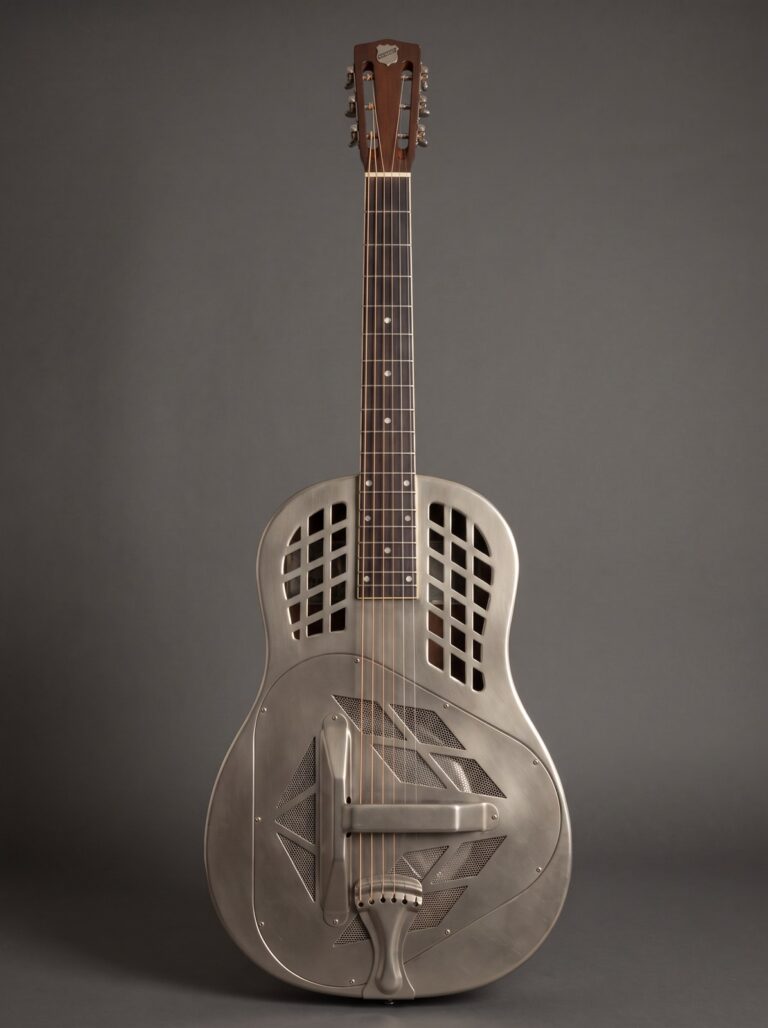
The National Tricone’s specific construction — a metal body (typically nickel-plated brass or German silver) housing three aluminum resonator cones connected by a T-shaped bridge that transferred string vibration to all three cones simultaneously — represented one of the most significant acoustic guitar innovations of the pre-amplification era, designed specifically to give acoustic guitars sufficient volume to compete with horns and other louder instruments in ensemble settings (the National company’s resonator design was developed partly in response to Hawaiian guitar players’ need for greater volume in ensemble contexts, with blues musicians subsequently adopting the instruments for the same volume advantages plus the specific tonal qualities the resonator design produced).
As Tampa Red’s career extended into the postwar era and Chicago blues made its broader transition to electric instrumentation, various electric guitars appeared in his setup — consistent with the general pattern of musicians of his generation adapting to the new electric instruments that the postwar Chicago blues scene increasingly required for performance in larger, louder venues. His specific electric guitar choices during this transitional period are less precisely documented than his iconic National Tricone, reflecting both the relative scarcity of detailed equipment documentation for blues musicians of this era and the practical reality that electric guitar adoption for musicians of his generation was often a matter of using whatever instruments were available and affordable rather than a carefully considered tonal choice in the way later generations approached instrument selection.
Tampa Red’s slide technique used a slide — likely a glass or metal slide of the type common to blues guitarists of his era, worn on a finger of the fretting hand and moved along the strings to produce the continuous pitch glides and sustained notes that characterised slide guitar playing. The specific material of his slide (glass versus metal versus other materials, all of which were used by blues guitarists of the period and each of which gives a slightly different tonal character to the slide sound) is not precisely documented, but the clean, precise quality of his slide playing — audible on his recordings — suggests a slide and technique combination that prioritised clarity and control over the rougher, more textured slide sounds that some contemporary slide guitarists favored.
Tampa Red, like virtually all guitarists of his era, would have used the heavier-gauge strings standard for the period — acoustic guitar strings of the 1920s through 1940s were generally heavier than even the “heavy” gauges that became standard for later electric guitar playing, giving period acoustic instruments (particularly resonator guitars, whose metal construction and resonator mechanism required adequate string tension to drive the resonator cones effectively) their characteristic tonal fullness and the specific physical resistance that shaped period playing techniques.
Amps
For the majority of Tampa Red’s prewar career, “amplification” meant the National Tricone’s resonator mechanism — the mechanical amplification provided by the three aluminum cones, rather than any electronic amplification. This mechanical amplification gave the instrument sufficient volume for the recording technology and performance contexts of the 1920s and 1930s, which generally didn’t require or accommodate the kind of electric amplification that would become standard in the postwar era.
As Tampa Red’s career extended into the postwar era, electric amplification — whatever amplifiers were available and standard for Chicago blues musicians of the period — would have become part of his setup as the broader Chicago blues scene transitioned to electric instrumentation. The specific amplifiers used during this transitional period are not precisely documented for Tampa Red specifically, but would have been consistent with the general amplifiers available to working Chicago blues musicians of the late 1940s and 1950s — likely various American tube amplifiers from manufacturers including Fender, Gibson, and others that were becoming standard equipment for electric blues guitarists during this period.
Effects
Tampa Red’s slide technique was, in the sense that subsequent guitarists would understand “effects,” his primary tonal modification tool — the slide’s continuous pitch glides, combined with the National Tricone’s specific resonator tone, gave his recordings their distinctive sound without any electronic processing whatsoever. The combination of steel-bodied resonator guitar and slide technique represented one of the earliest and most influential “guitar plus technique equals signature sound” combinations in American music history — a combination that subsequent generations of blues guitarists (including those who moved to electric instruments) would continue to reference and adapt.
Beyond his slide playing, Tampa Red was also recognised for his single-string lead guitar technique — playing melodic lines on individual strings rather than the chord-based or primarily rhythmic approaches that characterised much early blues guitar. This single-string lead approach, applied without slide, gave his playing a melodic and harmonic vocabulary that prefigured the lead guitar approaches that would become central to electric blues and subsequently rock guitar — Tampa Red’s “Guitar Wizard” reputation among his contemporaries reflected this combination of slide mastery and single-string melodic facility, both of which were technically demanding and relatively unusual among his contemporaries.
For the majority of his career’s most historically significant recordings, Tampa Red’s tone was entirely acoustic/mechanical — the National Tricone’s resonator tone, shaped by his slide and fingering technique, without any electronic processing of any kind. This represents the most fundamentally “unprocessed” guitar tone documented anywhere in this series — a tone determined entirely by the physical instrument and the player’s technique, with none of the amplifier, pedal, or electronic processing considerations that define virtually every other article in this complete series.
Playing Style & Tone Philosophy
Tampa Red is the most chronologically foundational guitarist in this entire series — a player whose career began in the 1920s, predating not just electric guitar amplification but in significant ways predating the development of “blues guitar” as a recognised and codified tradition with established techniques and vocabulary that subsequent musicians could learn and build upon. His “Guitar Wizard” nickname, bestowed by contemporaries who were themselves working at the foundations of this tradition, reflected genuine technical achievement that was unusual even within a field where technical achievement was less systematically documented and less widely disseminated than it would become in subsequent decades.
His slide technique — clean, precise, with the National Tricone’s specific bright, sustained resonator tone giving the slide’s pitch glides a clarity that distinguished his playing from rougher contemporary approaches — represented a specific technical achievement: slide guitar, by its nature, involves continuous pitch variation that can easily become imprecise or “sloppy” if the player’s control isn’t exceptional. Tampa Red’s slide playing maintained precision and clarity even at the rapid tempos and complex melodic figures his recordings demonstrate — a level of control that gave his slide playing a quality some commentators have compared to horn playing, where the continuous pitch control of brass and woodwind instruments (achieved through breath control and embouchure rather than slide movement) produces similarly precise pitch glides.
His single-string lead playing — distinct from his slide work — demonstrated melodic and harmonic facility that prefigured the lead guitar vocabulary that would become central to electric blues. Playing individual melodic lines on single strings, rather than the chord-based strumming or simple riff-based approaches that characterised much early blues guitar, required a specific kind of fretting-hand dexterity and a specific kind of melodic conception — thinking of the guitar as capable of generating melodic lines analogous to vocal melodies or horn lines, rather than primarily as a rhythmic and harmonic accompaniment instrument.
His role as a bandleader and informal mentor — his Chicago apartment serving as a gathering place and informal training ground for younger musicians — gave his influence a direct, person-to-person transmission quality that the recordings alone don’t fully capture. Musicians who passed through this environment absorbed not just specific techniques but a broader sense of professional musicianship, recording studio practice, and the specific Chicago blues community’s norms and expectations — giving Tampa Red’s influence a depth that extended well beyond what his recordings, however numerous and however influential, could transmit on their own.
Tonally, Tampa Red guitars gear philosophy — to the extent the concept of “tone” as subsequent generations would understand it even applies to his prewar work — was built on the National Tricone’s specific resonator character: bright, sustained, with the metallic shimmer that distinguished resonator guitars from wood-bodied acoustics. This tonal foundation, combined with his specific slide and single-string techniques, gave his recordings their distinctive sound using equipment that, by the standards of every subsequent article in this series, was extraordinarily simple — a single acoustic instrument, no amplification beyond the instrument’s own mechanical resonator system, and no electronic processing of any kind. The complete sound came entirely from the instrument and the player’s hands.
The National String Instrument Corporation’s history — and the specific circumstances that gave the resonator guitar its place in American music — deserve examination because the instrument’s development represents one of the most significant pre-electric solutions to the volume problem that acoustic guitars faced in ensemble and recording contexts. John Dopyera, a Slovak-American instrument maker, developed the resonator guitar design in the late 1920s, founding the National String Instrument Corporation with George Beauchamp to manufacture instruments using this design. The Tricone design — three interconnected aluminum cones — represented the most elaborate and most expensive of National’s resonator configurations, with single-cone designs (developed slightly later and marketed under both National and the related Dobro brand, founded after a split between Dopyera and Beauchamp) offering a different and generally louder but less complex tonal character at a lower price point. For recording purposes specifically — and Tampa Red’s career was substantially a recording career, given the “race records” industry’s centrality to how prewar blues reached audiences — the resonator guitar’s volume advantage mattered enormously: recording technology of the 1920s and 1930s (acoustic recording through the mid-1920s, early electrical recording from approximately 1925 onward) had specific requirements for how much acoustic energy an instrument needed to produce to register adequately on recording equipment, and the resonator guitar’s mechanical amplification gave it a significant advantage over conventional acoustic guitars in this context. Tampa Red guitars gear, in this sense, was shaped not only by aesthetic and technical considerations but by the specific practical requirements of the recording technology through which his music reached its audience.
The “hokum” style that “It’s Tight Like That” represented — and its specific place within the broader landscape of prewar Black American recorded music — deserves examination because it illuminates a dimension of Tampa Red’s career that is sometimes treated as a footnote relative to his guitar technique but that was commercially and culturally significant in its own right. Hokum music — characterised by its playful, often double-entendre-laden lyrical content, its generally upbeat and danceable musical character, and its specific appeal to audiences seeking entertainment rather than (or in addition to) the more emotionally weighty content that “blues” in its more serious modern connotation often implies — represented a major commercial category within prewar race records. “It’s Tight Like That,” with its sexually suggestive title and lyrics delivered with comic timing over an upbeat, danceable musical setting, exemplified this hokum approach, and its commercial success demonstrated the genre’s appeal. For Tampa Red specifically, hokum success gave him the commercial foundation that allowed his subsequent prolific recording career — hundreds of recordings across multiple decades — to be commercially viable in a way that purely “serious” blues, however artistically significant, might not have sustained to the same degree. Understanding Tampa Red guitars gear’s complete context means understanding that his guitar technique, however technically impressive, was deployed within a commercial entertainment context whose specific demands (danceable, engaging, often playful material) shaped what kinds of guitar playing were commercially valuable, even as his specific technical innovations (the precise slide technique, the single-string lead playing) had consequences that extended well beyond the specific hokum context in which much of his commercial success was achieved.
The transmission of technique through informal apprenticeship and community — the specific mechanism by which Tampa Red’s influence reached younger Chicago blues musicians through his apartment serving as a gathering and informal training space — represents a mode of musical education that predates and differs significantly from the more formal instructional resources (method books, recorded lessons, transcriptions, and eventually online instruction) that subsequent generations of guitarists would have access to. For a young musician arriving in Chicago during the 1930s or 1940s, seeking to develop as a blues guitarist, the available resources for learning technique were primarily: direct observation of established musicians performing, informal instruction from musicians willing to share their knowledge, and the recordings themselves (which, while informative, couldn’t convey physical technique in the way direct observation and instruction could). Tampa Red’s apartment, serving as a gathering place for musicians, gave younger players direct access to an established master’s technique through observation and informal instruction — a mode of transmission that was, in its way, more intimate and more complete than recordings alone could provide, even as it was less systematically documented and therefore less visible to subsequent historical analysis than the recordings themselves. Tampa Red guitars gear’s influence, transmitted through this informal apprenticeship mechanism, reached musicians whose own subsequent careers and recordings carried forward elements of his technique without always explicitly crediting the specific source — a pattern of influence transmission that this series has encountered repeatedly but that is particularly significant for understanding prewar blues guitar’s relationship to its postwar developments.
How to Sound Like Tampa Red
Guitar Approach
A National resonator guitar (Tricone for the most historically accurate specification, or the more common and more affordable single-cone National/Dobro-style resonators as accessible alternatives) is the foundational Tampa Red guitars gear instrument for the slide playing that defines his most historically significant recordings. A glass or metal slide, worn on the third or fourth finger of the fretting hand. Heavy-gauge strings (period-appropriate would be quite heavy by contemporary standards — .013 or heavier on the high E for acoustic resonator instruments, giving the resonator cones adequate string tension to drive properly).
The technical approach: develop slide technique that prioritises precision and clarity — controlled, accurate pitch glides rather than loose or imprecise slide movement. Practice single-string melodic lines (without slide) to develop the lead guitar vocabulary that complemented his slide playing. Study recordings closely for the specific combination of slide precision and single-string melodic facility that gave Tampa Red his “Guitar Wizard” reputation.
Amp Approach
For historically accurate Tampa Red guitars gear: no amplifier at all — the National resonator’s mechanical amplification is the complete “amplification” system. For practical contemporary performance requiring amplification: a microphone placed appropriately relative to the resonator guitar’s sound holes and cone assembly, run through a clean PA system or acoustic amplifier that doesn’t colour the resonator’s specific tonal character.
| Element | Approach | Notes |
|---|---|---|
| Instrument | National Tricone resonator (or single-cone alternative) | The resonator’s bright, sustained, metallic tone is the foundational element — irreplaceable by any other instrument type |
| Slide material | Glass or metal, period-appropriate | Different materials give different tonal character — glass tends toward warmer, metal toward brighter |
| String gauge | Heavy (.013+ on high E for resonator) | Resonator cones need adequate string tension to drive properly — light strings won’t produce the characteristic tone |
| Slide technique | Precise, controlled pitch glides | Clarity and control distinguish Tampa Red’s approach from rougher contemporary slide styles |
| Single-string lead | Melodic lines, non-slide | Develop independently from slide technique — complementary lead vocabulary |
| Amplification (historical) | None — resonator mechanical amplification only | For period-accurate sound, no electronic amplification at all |
| Amplification (practical performance) | Clean microphone/PA, no coloration | Preserve the resonator’s natural tonal character — avoid amplifier coloration |
The National Tricone resonator guitar is the single most essential and most historically specific element of Tampa Red guitars gear — without the resonator’s specific mechanical amplification and bright, sustained, metallic tone, the characteristic “Guitar Wizard” sound cannot be approximated regardless of slide technique quality. Precise, controlled slide technique. Complementary single-string lead vocabulary. Heavy strings appropriate to the resonator mechanism’s requirements. No electronic processing of any kind for historically accurate reproduction — this is, in the context of this entire series, the single most “unplugged” approach documented.
Influence & Legacy
Tampa Red’s influence on subsequent blues guitar operates at the deepest foundational level — his slide technique and single-string lead approach contributed to the basic vocabulary that virtually every subsequent blues guitarist, electric or acoustic, would inherit in some form. His specific role in the transition from acoustic to electric Chicago blues — both through his own career’s transition and through his influence on younger musicians during the period when this transition was occurring — gave him a position at the literal hinge point between the prewar and postwar blues traditions that every electric blues guitarist documented in this series ultimately descends from.
His “Guitar Wizard” reputation among contemporaries — earned during a period when blues guitar technique was still being developed and codified — gave him a specific historical position as someone whose technical achievements were recognised by the musicians who were themselves establishing what blues guitar technique would become, even if broader public recognition of his specific contributions has been less complete than for guitarists working in more recent and more thoroughly documented eras.
The comparison with Big Bill Broonzy — his contemporary whose own prewar Chicago blues career and subsequent influence on the folk and blues revival audiences gave a parallel example of how prewar blues guitar techniques and repertoire were transmitted to subsequent generations — illuminates the broader prewar Chicago blues environment from which both musicians’ approaches developed. The parallel with Lonnie Johnson — whose own foundational single-string lead guitar innovations, developed in a related but distinct prewar blues and jazz context, gave subsequent guitarists another foundational source for the lead guitar vocabulary that Tampa Red was simultaneously developing — shows how multiple prewar guitarists independently contributed to the lead guitar tradition’s foundations. And the connection to Magic Sam — whose postwar West Side Chicago blues guitar represents one of the eventual destinations of the tradition Tampa Red helped establish — places Tampa Red guitars gear at the genuine point of origin for a tradition whose subsequent developments were electric, amplified and effects-laden.
Frequently Asked Questions: Tampa Red Guitars & Gear
What guitar did Tampa Red play?
Tampa Red’s most historically significant instrument was a National Tricone resonator guitar — a steel-bodied acoustic guitar using three interconnected aluminum resonator cones to mechanically amplify the strings’ vibration, giving the instrument a bright, sustained, metallic tonal character that distinguished his slide playing. As his career extended into the postwar electric blues era, various electric guitars appeared in his setup, though these are less precisely documented than his iconic National Tricone.
What is a National Tricone resonator guitar?
A National Tricone is a steel-bodied acoustic guitar manufactured by the National String Instrument Corporation beginning in the late 1920s, using three interconnected aluminum resonator cones inside the guitar’s metal body to mechanically amplify string vibration to volumes far exceeding conventional wood-bodied acoustic guitars. The Tricone’s bright, sustained, metallic tonal character — distinct from both conventional acoustic guitars and from the single-cone resonator designs that followed — gave slide guitar playing a specific clean, precise quality. The design was originally developed partly for Hawaiian guitar players’ volume needs in ensemble contexts, subsequently adopted by blues musicians for both volume and tonal qualities.
What does “Guitar Wizard” mean and why was Tampa Red called that?
“The Guitar Wizard” was a nickname given to Tampa Red by his contemporaries, reflecting his combination of technically demanding and relatively unusual skills: precise, controlled slide guitar technique (giving clean pitch glides rather than rougher, less controlled slide sounds) and single-string melodic lead playing (giving guitar lines a melodic facility that prefigured later lead guitar traditions). The nickname reflected genuine peer recognition of technical achievement within the prewar Chicago blues community, at a time when blues guitar technique itself was still being developed and codified.
Who was Georgia Tom Dorsey and what was his connection to Tampa Red?
Georgia Tom Dorsey was Tampa Red’s musical partner during the late 1920s, with the duo’s “It’s Tight Like That” (1928) becoming a major commercial hit that established both musicians’ careers. Dorsey would subsequently become Thomas A. Dorsey, the foundational figure of modern gospel music — composer of “Take My Hand, Precious Lord” and other gospel standards, and generally credited as the “Father of Gospel Music.” The Tampa Red-Dorsey partnership represented an early example of the close connections between blues and gospel music in Black American musical traditions — connections that, despite the genres’ subsequent separate institutional development, reflected shared musical roots and, in this case, shared individual musicians moving between the genres.
How did Tampa Red influence the transition from acoustic to electric Chicago blues?
Tampa Red’s career spanned the actual historical transition from acoustic prewar blues to electric postwar Chicago blues — both through his own gradual adoption of electric instrumentation as his career extended into the postwar era, and through his role as a bandleader and informal mentor whose Chicago apartment served as a gathering and informal training space for younger musicians arriving in Chicago during the period when this transition was occurring. Musicians who passed through this environment absorbed both specific techniques and broader professional and community norms, giving Tampa Red’s influence on the transition a person-to-person transmission quality beyond what his recordings alone documented.
What is the difference between Tampa Red’s slide technique and Delta blues slide playing?
While both traditions used slide technique, Tampa Red’s specific approach — using the National Tricone resonator guitar’s bright, sustained, metallic tone, combined with precise, controlled pitch glides — produced a notably cleaner and more precise slide sound than the rougher, more textured slide approaches common in Delta blues (often played on wood-bodied acoustic guitars, sometimes with bottleneck slides, producing a grittier, more raw tonal character). Tampa Red’s slide playing was sometimes compared to horn playing for its precision and clarity — a quality that distinguished his “Guitar Wizard” reputation from the equally important but tonally distinct Delta slide tradition.
What are Tampa Red’s most important recordings?
“It’s Tight Like That” (1928, with Georgia Tom Dorsey) represents his earliest major commercial success and the “hokum” style’s commercial breakthrough. His extensive subsequent catalogue — estimates suggest several hundred recordings across his career — includes numerous recordings demonstrating his slide guitar technique on the National Tricone and his single-string lead playing. His specific recordings are less individually celebrated in popular blues canon discussions than his overall historical influence and reputation among contemporaries, reflecting the broader pattern of prewar blues recordings receiving less popular attention than the postwar electric recordings that followed and that built on the foundations prewar musicians like Tampa Red established.
The “race records” industry’s broader structure — and how it shaped the documentation (and consequent historical visibility) of musicians like Tampa Red — deserves examination because it explains both why his recordings exist in the relatively substantial numbers they do and why his broader historical recognition has been less complete than his actual influence might suggest. “Race records” was the music industry’s own terminology for recordings marketed specifically to Black American audiences — a category that major labels (including subsidiaries of larger companies) and smaller independent labels both participated in during the prewar era, recognising a substantial commercial market that mainstream marketing and distribution channels generally ignored. This industry structure meant that musicians like Tampa Red, working within and for this specific commercial category, could build substantial recording careers — his hundreds of recordings reflect a genuinely active and commercially viable career within this industry structure — while remaining largely invisible to the broader (white, mainstream) audience and to the music criticism and journalism establishment that would, in subsequent decades, shape which prewar musicians received sustained scholarly and popular attention. The blues and folk revival of the 1950s and 1960s — which brought renewed attention to some prewar blues musicians, particularly those whose Delta-rooted acoustic styles aligned with the revival audience’s specific aesthetic interests — gave some prewar musicians (including some of Tampa Red’s contemporaries) a kind of posthumous or late-career recognition that Tampa Red’s specific combination of Chicago urban context, hokum commercial orientation, and resonator-guitar slide technique didn’t align with as directly. Tampa Red guitars gear, despite its genuine foundational importance, consequently received less of this revival-era rediscovery than some other prewar musicians whose specific styles better matched what the revival audience was specifically seeking.
The relationship between Tampa Red’s single-string lead playing and the subsequent development of “lead guitar” as a recognised role distinct from rhythm or accompaniment guitar deserves a final examination because this distinction — lead versus rhythm guitar as separate functional roles — is so fundamental to how subsequent guitar music (and indeed this entire series) is organised that its prewar origins are easy to take for granted. In much early blues and folk guitar playing, the guitar’s role was primarily to provide rhythmic and harmonic accompaniment to vocals — chord-based strumming or simple repetitive figures that supported the vocal melody without competing with it for melodic attention. The development of “lead guitar” — guitar playing that took on a melodic role comparable to (and sometimes alternating with) the vocal melody, playing actual melodic lines rather than merely chordal or rhythmic support — represented a significant expansion of the guitar’s musical function. Tampa Red’s single-string lead playing was among the earliest documented examples of this expanded guitar function within the blues tradition specifically, giving guitarists a model for how the instrument could take on this melodic, “lead” role. The subsequent development of this lead guitar role — through the postwar electric blues guitarists, through the British blues-rock guitarists who absorbed Chicago blues lead guitar vocabulary, and through the rock guitar tradition more broadly that this entire series has documented — represents, in a real sense, the continuing development and elaboration of a guitar function that Tampa Red’s prewar single-string playing was among the first to demonstrate. Tampa Red guitars gear, understood in this light, represents not merely a historical curiosity from the distant prewar era, but the genuine origin point of a guitar function — lead guitar — that has subsequently become so central to popular music that its absence would be unimaginable, even as its specific historical origins remain less widely known than the function itself has become ubiquitous.
A final reflection on Tampa Red guitars gear concerns what this article represents within the broader structure of this complete series: a deliberate inclusion of the chronologically earliest and technologically simplest equipment documented across one hundred articles otherwise dominated by electric guitars, amplifiers, and the elaborate effects chains that define modern guitar tone. Including Tampa Red — whose “gear,” in the fullest sense, amounted to a steel-bodied acoustic guitar and a slide, with no amplifier, no pedals, and no electronic processing of any kind — alongside guitarists whose signal chains include dozens of pedals, multiple amplifiers, and recording techniques of extraordinary sophistication, makes a specific point: the guitar’s capacity for musical expression was never dependent on the technological elaboration that subsequent decades made available. Tampa Red’s “Guitar Wizard” reputation was earned using equipment that, by any subsequent standard, was minimal — and the musical achievement that earned that reputation remains audible and impressive on recordings made nearly a century ago, using nothing but a resonator guitar, a slide, and genuine technical mastery. For guitarists working today with access to equipment options that would have been unimaginable to musicians of Tampa Red’s generation, this is worth remembering: the equipment, however elaborate or however minimal, is always in service of what the player does with it — and Tampa Red did more with less than almost any other guitarist documented in this series.
The chronological span of Tampa Red’s career — beginning in the early 1920s and extending across more than four decades — also positions him as a direct living link between musical worlds that subsequent history tends to treat as more separated than they actually were experienced by the musicians who lived through the transition. A musician whose career began before electric amplification existed and continued into the era when electric Chicago blues was an established commercial genre experienced that entire transformation not as history but as their own ongoing career — adapting, in real time, to changes in technology, audience expectation, and the commercial music industry’s structure. This lived experience of transition gave musicians of Tampa Red’s generation a perspective that younger musicians, entering the scene after electric instrumentation was already standard, couldn’t directly share — an understanding of what blues guitar had been before amplification, what amplification specifically changed and what it didn’t, and how the fundamental techniques (slide playing, single-string lead, the call-and-response structures documented in the Magic Sam article) translated or didn’t translate across this technological transition. Tampa Red guitars gear, considered across his complete career, documents not a single fixed approach but an approach that itself evolved across one of the most significant technological transitions in the history of any instrument — and his ability to remain musically relevant and influential across that transition, rather than being rendered obsolete by it, reflects a depth of musical understanding that transcended any specific technological configuration.
For readers of this series who have followed the development of guitar tone from Tampa Red’s unamplified National Tricone through nearly a century of subsequent innovation — humbuckers, Marshall stacks, fuzz pedals, digital processing, and every other element documented across these one hundred articles — the journey back to this starting point offers a useful perspective: every subsequent innovation was, in some sense, an attempt to give guitarists new tools for the same fundamental goal that Tampa Red pursued with a steel-bodied acoustic guitar and a slide — the goal of making the instrument say something genuinely musical, something that connects with listeners at an emotional level. The tools changed enormously; the goal did not. Tampa Red guitars gear represents both the historical foundation and the conceptual touchstone for everything else this series has documented — a reminder that, whatever equipment a guitarist uses, the equipment’s value is ultimately measured by what it enables the player to express, and that genuine expression has always been possible, as Tampa Red demonstrated nearly a century ago, with remarkably little equipment at all.
Image credits
- National Tricone resonator guitar: GuitarGangsters AI-generated reference illustration, not a photograph.