
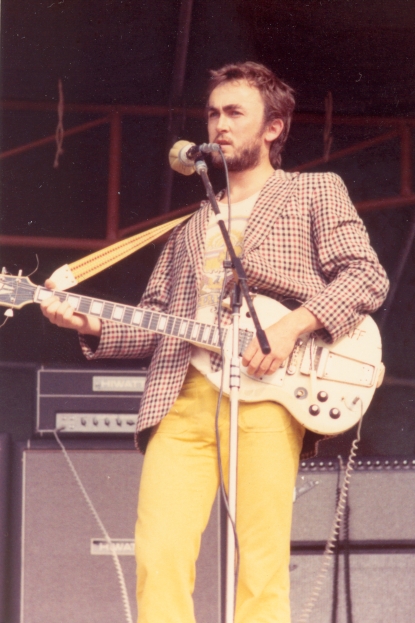
Dig into Ollie Halsall guitars gear and you find yourself in the presence of one of British rock’s most extraordinary and most obscure talents — a guitarist whose technical range, musical intelligence, and sheer improvisational speed made him a legend among the musicians who played with him and a near-complete mystery to the broader public who never heard his name. Halsall was the kind of guitarist other guitarists talk about in hushed tones: a player whose facility on the instrument was so complete that he could move between jazz, rock, blues, and avant-garde playing within a single solo without appearing to change gear, whose speed was measured in categories that most players don’t reach, and whose musicality was sufficiently advanced that he never needed to resort to mere technical display.
The Journey
This guide covers Halsall’s equipment through his work with Timebox, Patto, Kevin Ayers, and his later career projects: the guitars that suited his extraordinary technique, the amplification he used, the effects chain that coloured his playing without constraining it, and the musical approach of a player who was simultaneously one of Britain’s most technically accomplished guitarists and one of its most determinedly uncommercial. Understanding Halsall’s gear is one step toward understanding why a musician of his calibre remained so far outside the mainstream — and why his posthumous reputation has grown so substantially among serious guitarists.
Background
Peter Ollie Halsall was born on March 14, 1949, in Southport, Lancashire, in the northwest of England. He came to the guitar after initial training as a vibraphone and percussion player — an unusual background for a rock guitarist that left permanent marks on his approach to the instrument, particularly his conception of pitch accuracy, his understanding of harmony, and his relationship with time and rhythm. The vibraphone, as a melodic percussion instrument that requires both hands to execute independent lines, develops a specific kind of musical coordination that translates productively to guitar when the player makes the transition.
His professional guitar career began in the late 1960s with Timebox — a British pop and soul group that evolved over several years from a fairly conventional R&B outfit into something considerably more adventurous, as the talent of its members — particularly Halsall and vocalist Mike Patto — became too large to contain within the pop format the band had originally occupied. The band released material on Deram Records and built a following through relentless live work without ever achieving the commercial breakthrough their quality suggested was possible.
The transition to Patto — the band formed from the Timebox nucleus when the original lineup dissolved in 1970 — gave Halsall his most creatively productive context. Patto, named for vocalist Mike Patto, was a four-piece British jazz-rock band that operated from 1970 to 1973, releasing four albums that are now considered among the finest and most under-appreciated British rock recordings of the era. The band’s music combined the energy and volume of rock with the harmonic sophistication and improvisational freedom of jazz, and Halsall’s guitar was at the centre of this synthesis — providing both the rock electricity and the jazz harmonic intelligence that the combination required.
Patto’s albums — Patto (1970), Hold Your Fire (1971), Roll ‘Em Smoke ‘Em Put Another Line Out (1972), and Monkey’s Bum (1973) — received critical acclaim without commercial success, a pattern that characterised Halsall’s entire career. The band was too sophisticated for the mainstream rock audience and too rock-oriented for the jazz audience, occupying the space between formats that British music of the early 1970s didn’t quite know what to do with.
After Patto disbanded in 1973, Halsall joined Kevin Ayers’ backing band — a position that gave him exposure to a wider audience through Ayers’ connections to the Canterbury scene and the wider British progressive rock community. He remained associated with Ayers intermittently through the following years while also working with John Halsey as Rutles guitarist Neil Innes in the Beatles parody project, recording and performing in various combinations with musicians from the Canterbury scene.
Halsall’s personal life was marked by struggles with drug addiction that affected his output and ultimately contributed to his death on May 29, 1992, in Madrid, Spain, where he had relocated in his later years. He was 43 — another premature loss of a musician whose best work suggested unlimited further development. His reputation has grown substantially in the decades since his death, as musicians who played with him or heard him live have described his abilities with a consistency and intensity that has prompted subsequent generations of guitarists to seek out his recordings and discover what they had been missing.
Ollie Halsall Guitars Gear: The Complete Rig
Guitars
Ollie Halsall’s guitar choices throughout his career reflected his specific technical requirements — instruments that could accommodate his extraordinary speed, his harmonic sophistication, and his tendency to play in ways that conventional guitar technique doesn’t readily support.
His most distinctive instrument association is with the Fender Telecaster — specifically late-1960s and early-1970s examples that he played throughout the Patto period. The Telecaster’s specific properties suited Halsall’s technique in several important ways. Its relatively low action (when set up correctly) and the bright, articulate character of its bridge pickup allowed his fast single-note lines to speak clearly at speed — the individual notes remaining distinct even in very rapid passages rather than blurring into an undifferentiated wash of notes. The Telecaster’s shallow neck profile and relatively narrow nut width (1.625 inches in standard configuration) facilitated the left-hand speed that his playing required.
The bridge pickup on a vintage Telecaster — a single-coil unit with a metal cover and a distinctive mounting that presses the pickup against the bridge plate — has a specific character: very bright, with a strong upper-midrange emphasis and a pronounced attack transient that makes individual notes sound sharp and defined even in complex, rapid passages. For a player whose technique required every note in a fast run to be heard as a distinct event rather than as part of an indistinct flurry, this pickup character was a practical asset.
He also used a Gibson Les Paul — Standard and Custom variants — for applications where the warmer, more sustained tone of mahogany construction and PAF humbucker pickups suited the musical context better than the Telecaster’s bright attack. The Les Paul’s longer sustain and thicker midrange character complemented his more lyrical, sustained lead passages, where the Telecaster’s faster decay was less appropriate. The PAF humbucker in the late-1950s configuration — 7.5k to 8.5k ohms DC resistance, Alnico II or Alnico V magnets — provided the dynamic sensitivity that Halsall’s varied picking attack required: soft notes remaining clean and sweet, harder attacks pushing the amplifier into natural overdrive.
A Fender Stratocaster appeared in his arsenal for specific applications — its three-pickup configuration and the in-between positions giving tonal options that neither the Telecaster nor the Les Paul provided. The Stratocaster’s vibrato system also offered performance possibilities that fixed-bridge instruments didn’t provide, and Halsall incorporated the vibrato arm into his technique in ways that added an additional dimension to his already comprehensive expressive vocabulary.
His most unusual guitar association was with a custom guitar built to his specifications that incorporated features not found in standard production instruments. Halsall experimented with various luthiers to produce instruments that accommodated his specific technical requirements — particularly neck profiles and fret specifications optimised for high-speed playing. The specific dimensions of neck profile, fret height, and string spacing that work best for very fast playing are different from the dimensions that work best for rhythm playing or slide, and a player of Halsall’s technical sophistication had every incentive to seek out the specific combination that served his approach.
String gauges for Halsall ran lighter than typical British rock players of his era — he favoured .009–.042 or similar light gauge sets that reduced left-hand effort for the rapid position shifts and wide interval jumps his playing required. Lighter strings are more easily fretted and bent, which facilitates speed at the cost of some tonal mass and sustain. For a player whose primary virtue was fluency and speed, this trade-off was clearly worth making.
Amps
Halsall’s amplification during the Patto period was rooted in the British valve tradition but approached with the pragmatic adaptability of a musician who needed his amplifier to serve a wide range of musical demands within a single performance — from jazz-inflected clean passages to fully driven rock leads, sometimes within the same song.
His primary amplifier was a Marshall JMP 50-watt head — the smaller-wattage variant of the Marshall head that, at comparable volume levels, drives its EL34 output valves harder than the 100-watt version, producing a richer, more compressed drive character. For Halsall’s purposes, this earlier saturation was musically useful: it allowed him to access the Marshall’s natural overdrive character at somewhat lower volume levels than the 100-watt head required, which gave him more control over the point at which the amplifier began distorting in a live performance context.
He ran the Marshall into Marshall 4×12 cabinets loaded with Celestion G12M Greenback speakers — the 25-watt ceramic-magnet Celestion with its characteristic midrange emphasis and natural compression. For Halsall’s fast, articulate playing style, the Greenback’s specific frequency character was productive: its moderate treble response prevented the Telecaster’s inherent brightness from becoming harsh at high volumes, while its midrange emphasis allowed individual notes to project clearly in a band context.
He also used Vox AC30 Top Boost amplifiers — particularly for cleaner, more jazz-influenced material where the EL84-driven AC30’s natural compression and chimey midrange character suited the harmonic complexity of his chord voicings better than the Marshall’s more aggressive character. The AC30’s different tonal signature — warmer in the midrange, with a more musical top end and a different compression character from the EL34 Marshall — complemented the clean Telecaster playing that characterised his most jazz-influenced work.
For recording, Halsall occasionally used a Fender Deluxe Reverb — the 22-watt, 1×12 combo running 6V6 output valves — which produced a warm, American character that suited specific studio applications. The Deluxe’s 6V6 saturation character is different from both the Marshall EL34 and the Vox EL84 — rounder, with a softer top end and a specific compression that makes clean and lightly driven playing particularly expressive. For the more introspective, quieter passages in Halsall’s recorded work, the Deluxe provided an appropriate tonal environment.
Effects
Halsall’s effects chain was focused and purposeful — he was not a player who used effects to compensate for limitations in his fundamental tone but a player who used specific tools to add specific colours to a tone that was already fully formed without them.
A wah pedal — typically the Vox Clyde McCoy or an early Cry Baby variant — was central to his live and studio work. Halsall’s wah technique was particularly sophisticated: he used the pedal not just as a simple filter sweep but as a precision instrument for shaping individual notes within a rapid passage, adding vowel-like articulation to fast single-note lines in a way that gave them a vocal quality that pure picking attack couldn’t achieve. His ability to synchronise wah movement with fast picking technique was a specific skill that required considerable coordination and practice.
A fuzz pedal — germanium-transistor-based units with the warm, soft clipping character that suited his playing style — appeared in his chain for heavier passages where the additional distortion texture complemented the Marshall’s natural drive. Halsall preferred the germanium fuzz character to silicon-based alternatives, consistent with his general preference for the warm, organic quality of analogue signal processing over harder, more aggressive digital equivalents.
A phaser — typically an MXR Phase 90 in its original script-logo configuration — added swept modulation to specific passages, particularly to clean chord work where the phase shifting gave harmonic chord voicings a dimensional quality that complemented the jazz-influenced harmonic language Halsall was working in. The Phase 90’s single-stage phase shift circuit uses operational amplifiers to create a sweeping notch filter that produces the characteristic rotating quality without the pitch variation of a chorus or vibrato effect.
A Roland RE-201 Space Echo tape delay unit appeared in his studio work for specific echo and reverb applications, providing the warmth and slight pitch variation of real tape delay rather than the clinical precision of digital delay. The RE-201’s tape echo was particularly useful for the psychedelic and Canterbury-influenced material he worked on with Kevin Ayers, where spatial dimension and atmospheric decay were musical requirements rather than optional additions.
Playing Style & Tone Philosophy
Ollie Halsall’s playing is one of the most technically remarkable in the history of British rock guitar, and discussing it purely in terms of speed — though his speed was genuinely extraordinary — misses the more important qualities that made him special. His speed was in service of his musical intelligence, which was the actual defining characteristic of his playing. He was fast because he had things to say that required speed to express; speed was the tool, not the product.
His technique combined elements that are rarely found together in a single player. His bebop vocabulary — drawn from Charlie Parker and Dizzy Gillespie’s bop vocabulary, filtered through the guitar-specific approaches of players like Wes Montgomery and Joe Pass — gave him harmonic options that most rock guitarists of his era didn’t have access to. His ability to outline chord changes with single-note lines, to imply harmonic movement through melodic contour, and to use chromatic approach notes and passing tones with the precision of a jazz improviser was extraordinary in a rock context and would have been impressive in any context.
He combined this jazz vocabulary with the energy and physicality of rock — the aggressive pick attack, the blues bends that occasionally appeared within otherwise jazz-inflected lines, the rock rhythm playing that provided the foundation for Patto’s heavier material. This synthesis was not superficial — he wasn’t a jazz guitarist playing rock or a rock guitarist playing jazz; he was a musician who had genuinely integrated both traditions and could draw on both simultaneously without the seams showing.
His rhythmic precision was another distinguishing quality. Halsall’s fast lines were metrically exact in ways that even technically accomplished players often aren’t — the subdivision of beats into rapid note sequences remained accurate across long phrases in a way that suggested either innate rhythmic precision or extensive development of it, possibly both. His percussion background presumably contributed to this rhythmic accuracy, giving him an internal sense of subdivision that guitar-trained players develop differently.
Tonally, Halsall’s philosophy was transparency — the guitar and amplifier should get out of the way of the music as much as possible, and effects should add colour without imposing character. He was not a tone-hunter in the equipment-obsessive sense; he was a musician who needed adequate tools and used them efficiently. The specific equipment he chose was chosen to serve his playing rather than to create a signature sound, which is why his tone varied more across different recordings and contexts than the tones of more equipment-focused players.
How to Sound Like Ollie Halsall
Guitar Approach
A late-1960s or early-1970s Fender Telecaster with the bridge pickup as your primary sound is the most direct route to Halsall’s characteristic tone. Set up with low action and light strings (.009–.042), the Telecaster’s bright, articulate character gives the fast single-note lines the clarity and definition they require. A Les Paul is appropriate for slower, more sustained material where warmth is more important than articulation speed.
The more important element is the vocabulary: if you want to play like Halsall, you need to learn jazz harmony and bebop vocabulary as well as rock technique. Study Charlie Parker solos on guitar — literally transcribe and learn to play Parker’s alto saxophone lines on guitar — and you’ll begin to understand where Halsall’s harmonic language came from. The technical speed can be developed through conventional practice; the harmonic intelligence requires a different kind of study.
Amp Approach
A Marshall JMP 50-watt or equivalent, set at a volume where the EL34s are working but not fully saturated, gives the foundation. A clean Telecaster through this setup produces the bright, responsive tone that characterised his rock playing; adding fuzz or additional gain stages gets you to the heavier end of his range. For jazz-influenced material, the AC30 is more appropriate — cleaner, warmer, more compressed in its response to picking dynamics.
| Control | Setting | Notes |
|---|---|---|
| Volume | 5–7 | Working volume — EL34s starting to breathe |
| Treble | 6–7 | Bright — Telecaster benefits from amp treble |
| Middle | 6 | Moderate mids for presence without harshness |
| Bass | 4 | Controlled bass — fast lines need definition |
| Presence | 5–6 | Moderate presence for live projection |
| Wah (optional) | Active | Synchronised with fast picking for vocal articulation |
| Phase 90 (optional) | Medium speed | For clean chord work and atmospheric passages |
Influence & Legacy
Ollie Halsall’s legacy operates almost entirely through word of mouth — the testimonies of musicians who worked with him or saw him play, passed down through generations of guitarists who then sought out his recordings and discovered what the fuss was about. This transmission mechanism is slow but durable: it builds a reputation based on the musical reality rather than on marketing or media coverage, and the reputation it builds tends to be genuinely accurate.
Musicians who played with Halsall — including Kevin Ayers, Mike Patto, and various Canterbury scene associates — consistently describe him as among the most impressive guitarists they encountered, using language that suggests he was in a different category from other technically accomplished players. The specificity of these accounts — they tend to describe particular musical moments rather than offering general praise — gives them credibility, and the consistency across different sources over different decades gives them weight.
His influence on subsequent British guitarists is difficult to trace directly because his recordings are not widely known enough to have been the primary influence on many documented players. But the approach he embodied — the synthesis of jazz harmonic intelligence and rock energy, the prioritisation of musical content over technical display, the transparency of equipment choices — represents an ideal that many subsequent British guitarists have approached from different directions without necessarily knowing his work.
The Patto albums, now available on various reissue labels, have attracted growing attention from guitarists who find in them a model of how jazz vocabulary and rock energy can be genuinely integrated rather than awkwardly combined. Hold Your Fire in particular is frequently cited as one of the finest British rock albums of the early 1970s, and Halsall’s guitar work throughout it is the primary reason for that assessment.
For players interested in the jazz-rock fusion tradition that Halsall inhabited and extended, the rigs of Alan Holdsworth — who pursued the most extreme version of the jazz-vocabulary-through-rock-amplification synthesis — and Dave Gregory, who brought comparable technical range to a more song-oriented context, offer illuminating comparison. The Canterbury scene that provided Halsall’s later context is explored through his own recordings with Kevin Ayers, though the broader tradition is better understood by also examining Uli Jon Roth‘s approach to classical-influenced guitar within a rock context.
Patto: The Albums That Should Have Made Him Famous
The four Patto albums represent the most sustained document of Halsall’s playing at its most fully developed, and they reward close listening in ways that casual exposure doesn’t reveal. Each album shows a different facet of the band’s musical range while maintaining the consistent quality of playing — and specifically of Halsall’s guitar work — that gives the catalogue its coherence as a body of work.
The debut album Patto (1970) established the band’s basic character: energetic, rhythmically sophisticated, harmonically more complex than typical British rock of the era, with a front line of Halsall’s guitar and Mike Patto’s distinctive vocal that gave the band its specific identity. The guitar tone on the debut has the brightness of Telecaster through Marshall that characterised Halsall’s core sound, with the natural drive of the amp at working volume adding grit to the heavier passages without obscuring the note definition that his fast lines required.
Hold Your Fire (1971) is generally considered the band’s masterpiece — a more ambitious, more varied record that showed the full range of the band’s musical intelligence. Halsall’s guitar work throughout is extraordinary: the opening tracks demonstrate his jazz vocabulary in a rock context with particular clarity, while the heavier material shows how naturally the jazz-inflected approach could be deployed at higher gain levels without losing its harmonic sophistication. The solo sections are among the most musically interesting guitar improvisation on any British rock record of the era — fast when speed serves the music, slow and lyrical when sustain is more appropriate, harmonically varied in ways that most contemporaries simply didn’t attempt.
Roll ‘Em Smoke ‘Em Put Another Line Out (1972) showed the band incorporating influences from American funk and rhythm and blues into their jazz-rock foundation, and Halsall’s rhythm guitar work on this record — often overshadowed by the lead playing in discussions of his guitar work — is particularly impressive. The funk-influenced rhythm playing requires a different technical approach from his jazz-rock lead playing: shorter, more percussive notes, a more consistent rhythmic subdivision, a different relationship with the rhythm section. Halsall made this transition without apparent difficulty, which speaks to the breadth of his technique and his musical adaptability.
Monkey’s Bum (1973), recorded as the band was breaking up and released after their dissolution, has a slightly different character from the previous three — rawer in places, more experimental in others — that reflects the circumstances of its creation. But the guitar playing throughout is consistently excellent, and certain tracks show Halsall operating in territory that even the earlier albums hadn’t fully explored: extended, complex improvisations that push the jazz-rock synthesis toward something more adventurous and less categorically definable.
What the four albums collectively demonstrate is a guitarist who was developing consistently over the band’s three-year existence — becoming more harmonically adventurous, more rhythmically sophisticated, more willing to take risks in live and studio performance — and whose development was cut short by the band’s commercial failure and subsequent dissolution rather than by any exhaustion of creative resources. The tragedy of Patto is not merely that they didn’t sell more records; it’s that the dissolution of the band removed from Halsall the musical context that was most productive for his development, and the subsequent decades of his career — while containing good work in various configurations — never quite recaptured the sustained creative momentum of the Patto period.
Kevin Ayers and the Canterbury Connection
Halsall’s work with Kevin Ayers — which began after Patto’s dissolution and continued intermittently through the late 1970s and into the 1980s — placed him in a very different musical context from the jazz-rock intensity of Patto. Ayers was a founding member of Soft Machine and a central figure in the Canterbury scene — the loose community of British musicians centred on Canterbury who developed a distinctive approach to progressive rock that emphasised eccentricity, humour, and musical sophistication over the more grandiose progressive rock mainstream.
The Canterbury aesthetic was in many ways the perfect environment for Halsall’s musical personality. The scene’s combination of jazz harmony, rock energy, and distinctly British wit — the willingness to take musical ideas seriously without taking the music too seriously — suited a guitarist whose technical sophistication was always deployed in service of musical ideas rather than as an end in itself. Ayers’ own music, with its gentle surrealism and melodic warmth, provided a context in which Halsall’s more lyrical side could develop alongside the technical virtuosity that Patto had showcased.
His guitar work on the Kevin Ayers albums — including Sweet Deceiver (1975) and Yes We Have No Mananas (So Get Your Mananas Today) (1976) — shows the range of his musical personality in ways that the Patto records don’t fully document. The Ayers context required a different kind of musical intelligence: less about sustained intensity and more about appropriateness of tone and phrasing to the specific musical moment. Halsall’s ability to play softly and lyrically when the song required it — to subordinate his technical gifts to the needs of a specific musical context — is demonstrated throughout the Ayers recordings and represents an aspect of his musicianship that the Patto recordings, with their emphasis on jazz-rock energy, don’t fully reveal.
The Canterbury connection also brought Halsall into contact with musicians from the broader Canterbury scene — including members of Hatfield and the North, National Health, and other bands associated with the Wilde Flowers / Soft Machine lineage — whose musical sophistication and harmonic language were compatible with his own. The mutual influence between Halsall and these musicians, while difficult to trace specifically in recordings, contributed to the development of his already advanced harmonic vocabulary in the period following Patto’s dissolution.
The equipment Halsall used in the Ayers context was broadly similar to his Patto-era choices, but deployed more gently — the AC30 replacing the Marshall as the primary amplifier for much of this work, and the effects chain used more atmospherically to create the specific sonic environments that Ayers’ music required. The Roland Space Echo in particular appears more prominently in this period, adding the kind of spatial dimension and dreamy ambience that suited the Canterbury aesthetic better than the direct, unprocessed character of the Patto-era work.
Technique in Detail: What Made Halsall Different
Any serious account of Ollie Halsall’s playing needs to engage with what specifically distinguished his technique from other fast British rock guitarists of the 1970s — because speed alone doesn’t explain why musicians who heard him described the experience in terms usually reserved for encounters with something genuinely exceptional.
The first distinguishing element was his use of the full harmonic range of the guitar. Where most rock guitarists of the era worked primarily in the minor pentatonic scale with occasional chromatic additions, Halsall operated across a much wider harmonic territory: major scales, Dorian mode, bebop scales with their characteristic chromatic passing tones, and the full range of jazz harmony including altered dominants, tritone substitutions, and complex chord-tone outlining that required knowledge of jazz theory to execute correctly. This broader harmonic vocabulary gave his improvised lines a variety and unpredictability that pentatonic playing, however skillfully executed, doesn’t provide.
The second distinguishing element was his rhythm and timing. Halsall’s fast lines were not merely rapid — they were metrically precise in the way that a bebop saxophonist’s lines are precise: the subdivision of the beat into sixteenth notes, triplet sixteenth notes, and quintuplets was exact and consistent, giving his playing a rhythmic authority that most rock guitarists don’t achieve at high speeds. This rhythmic precision was probably related to his percussion background — vibraphone playing develops a specific sense of beat subdivision that guitar-trained players develop differently — and it gave his guitar playing a quality that jazz musicians recognised as authentic rather than approximate.
The third distinguishing element was his note choice within the harmonic framework. Fast playing that consistently lands on the harmonically correct notes at the metrically correct moments requires both technical control and harmonic knowledge simultaneously — the two have to be working together rather than sequentially. Many technically fast players solve this problem by reducing their harmonic language to patterns that can be executed mechanically; Halsall’s harmonic language was too varied and context-specific to be reduced to patterns, which meant that his technical speed had to coexist with genuine harmonic thinking in real time. This combination is what set him apart from players who were merely fast, and it is what gave his playing its lasting musical interest.
The specific equipment that supported all of this — the Telecaster’s bright articulation, the Marshall’s responsive drive, the wah pedal used as a precision articulation tool — was chosen because it served these specific technical and musical requirements. A different guitar with different pickup characteristics would have blurred the note definition that his fast lines required. A different amplifier with different dynamic response would have obscured the variation in his picking attack that communicated his phrasing. His equipment choices were not accidents of availability but the result of a sophisticated musician’s understanding of what his playing required and why specific tools provided it. That understanding, as much as his technique itself, is the lesson in Ollie Halsall’s rig.
One final dimension of Halsall’s guitar work that deserves specific mention is his rhythm playing, which has been largely overshadowed by the attention paid to his lead technique but which was equally accomplished. The jazz-rock context of Patto required a rhythm guitarist who could function harmonically as both a rock rhythm player and a jazz comping player simultaneously — laying down the rhythmic foundation that the drummer and bassist needed for the rock material while also supplying the harmonic richness that the jazz-influenced compositions required. Halsall’s chord voicings in this role were sophisticated without being showy: he used extended voicings (ninths, elevenths, thirteenths) where they served the harmonic context, but he deployed them in rhythmic patterns that maintained the energy and forward drive of the rock tradition rather than the more static, held-chord patterns of jazz comping. This combination of harmonic sophistication and rhythmic vitality in the rhythm guitar role is as rare as the lead guitar qualities that received more attention, and the rhythm guitar tracks on the Patto albums repay detailed study by anyone interested in how jazz harmony and rock energy can be genuinely integrated in a guitar context.
The guitar community’s growing awareness of Halsall in the era of streaming music and online guitar forums — where recordings that were previously difficult to find have become accessible, and where musicians can discuss and share information about obscure players in ways that were impossible before the internet — suggests that his reputation will continue to grow in the coming decades. The players who discover him typically respond with the same intensity that musicians who knew him personally reported: the recognition that this was something genuinely different, genuinely exceptional, genuinely worth the attention of any serious guitarist. The equipment tells part of the story. The recordings tell the rest. And both rewards are available to anyone willing to look for them.
The Telecaster that Halsall favoured through much of the Patto period also merits a more detailed technical examination in the context of his playing style. The late-1960s Telecaster — produced in the CBS era, with the larger CBS headstock but retaining the basic circuit design and pickup character of the earlier pre-CBS instruments — has a specific set of characteristics that differentiate it from both earlier Telecasters and later versions. The pickups, wound to slightly different specifications than the earliest 1950s examples, maintain the basic single-coil Telecaster character — bright, direct, attack-forward — while the slightly different winding density and magnet charge of the CBS-era units produces a marginally different harmonic balance. The neck pickup in particular on late-1960s Telecasters has a warmth that earlier examples sometimes lacked, which made it viable as a primary jazz-influenced clean tone without the clinical thinness that earliest Tele neck pickups could produce. This tonal combination — bridge pickup for fast, articulate lead work; neck pickup for warm, jazz-influenced clean material — gave Halsall a range of tonal options from a single instrument that complemented rather than duplicated what the amplifier and effects were contributing to the overall sound. It was a complete, self-sufficient tonal system that required nothing to be added to it to function musically — the effects were additions to an already complete sound, not components required to make an incomplete sound work. That distinction, between equipment that completes a fundamentally incomplete tone and equipment that adds colour to a fundamentally complete one, is the most important lesson in Ollie Halsall’s rig and arguably in professional guitar tone more broadly.
His legacy is modest in breadth and enormous in depth — exactly the legacy one would expect from a musician who prioritised musical quality over commercial calculation at every decision point in his career. The right way to honour it is to find the Patto albums and listen to them carefully.
Frequently Asked Questions: Ollie Halsall Guitars & Gear
Who was Ollie Halsall?
Ollie Halsall was a British guitarist, born in 1949 in Southport, Lancashire, who worked primarily with Timebox, Patto, and Kevin Ayers’ band. He is regarded by musicians who heard him as one of the most technically accomplished and musically intelligent British rock guitarists of the 1970s, combining jazz harmonic vocabulary with rock energy and speed in a synthesis that has rarely been matched. He died in 1992 at the age of 43.
What guitars did Ollie Halsall play?
Halsall’s primary instruments were Fender Telecasters — late-1960s and early-1970s examples — which suited his fast, articulate playing style through their bright, defined single-coil character. He also used Gibson Les Pauls for warmer, more sustained material, Fender Stratocasters for specific applications, and custom-built guitars incorporating features optimised for his high-speed technique. He favoured light string gauges (.009–.042) to facilitate the rapid left-hand movement his playing required.
What amp did Ollie Halsall use?
His primary amplifier during the Patto period was a Marshall JMP 50-watt head, which drove its EL34 output valves harder at comparable volume levels than the 100-watt variant, producing a richer drive character. He ran this into Marshall 4×12 cabinets with Celestion G12M Greenback speakers. He also used Vox AC30 amplifiers for cleaner, more jazz-influenced material and Fender Deluxe Reverb combos for specific studio applications.
What was Patto?
Patto was a British jazz-rock band formed in 1970 from the nucleus of the earlier Timebox, named for vocalist Mike Patto. The band released four albums between 1970 and 1973 — Patto, Hold Your Fire, Roll ‘Em Smoke ‘Em Put Another Line Out, and Monkey’s Bum — that are now considered among the finest and most under-appreciated British rock recordings of the era. Ollie Halsall’s guitar work was the central musical force of the band.
What effects did Ollie Halsall use?
His key effects included a Vox or Cry Baby wah pedal used with particular sophistication to articulate fast single-note lines, a germanium fuzz pedal for heavier material, an MXR Phase 90 for clean chord work, and a Roland RE-201 Space Echo tape delay for studio and atmospheric applications. His effects use was purposeful rather than extensive — he was not a pedalboard-dependent player.
Why isn’t Ollie Halsall more widely known?
Halsall’s obscurity is partly a consequence of his career context — Patto and the other bands he worked with never achieved commercial success despite critical acclaim — and partly a consequence of his personal struggles, which limited his recorded output and his ability to maintain consistent public presence. The music he made was too complex for mainstream acceptance and too rock-oriented for jazz audiences, leaving him in a commercially difficult middle ground. His reputation has grown significantly in the decades since his death as his recordings have become more widely available.
How fast was Ollie Halsall?
Accounts from musicians who worked with him consistently describe his speed as extraordinary — in a category that set him apart from other technically accomplished players of his era. But speed alone doesn’t capture what made him special; his fast playing was harmonically informed, rhythmically precise, and musically purposeful in ways that mere velocity isn’t. He could play very fast lines that were also harmonically interesting, which is significantly harder than playing very fast lines that are merely rapid.
Genre:
Jazz Rock / Progressive Rock
Decades:
1960s | 1970s | 1980s