
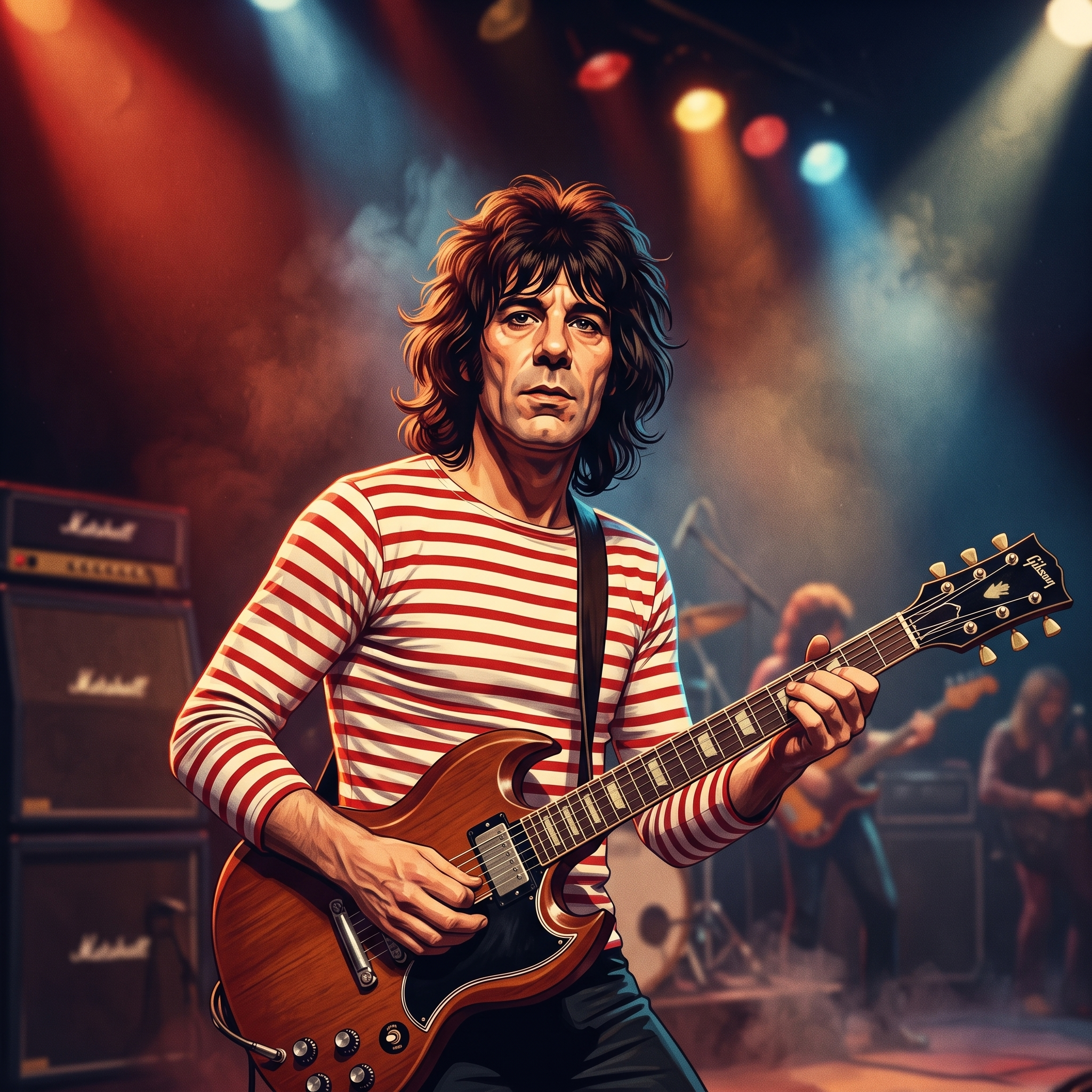
Investigate Alex Harvey guitars gear and you find the equipment of one of British rock’s most theatrically distinctive and most genuinely original performers — a Glaswegian musician who spent the early part of his career in relative obscurity before the Sensational Alex Harvey Band exploded onto the British rock scene in the early 1970s with a theatrical hard rock approach that was unlike anything else available: simultaneously funnier and scarier than glam rock, harder and stranger than pub rock, more theatrically ambitious than punk before punk existed, and driven by guitar work from Zal Cleminson that served Harvey’s theatrical vision with complete and committed musical conviction. Harvey himself was a rhythm guitarist and theatrical frontman rather than a lead guitar virtuoso, but his specific guitar contribution — the rhythmic foundation, the specific chord voicings that suited the SAHB’s theatrical rock, and the overall sonic character of his playing — was as central to the band’s specific identity as his theatrical persona.
This guide covers Harvey’s guitar equipment in the SAHB context, Zal Cleminson’s lead guitar contributions that were inseparable from the band’s complete sound, the amplification that served the theatrical hard rock approach, and the playing philosophy of a musician who understood that rock and roll was theatre and that the guitar was as much a theatrical prop as a musical instrument — without that understanding diminishing the music’s genuine power. Understanding Alex Harvey’s gear is understanding how theatrical commitment and musical authenticity served the same vision rather than competing with each other.
Background
Alexander James Harvey was born on February 5, 1935, in the Gorbals district of Glasgow, Scotland — one of Britain’s most economically deprived urban areas, a background that gave his theatrical rock a specific quality of working-class authenticity that distinguished it from the more middle-class theatrical rock of the glam era. He worked through multiple musical phases — skiffle, beat music, soul, R&B — across two decades of professional musical activity before the formation of the Sensational Alex Harvey Band in 1972 gave him the specific musical context that suited both his theatrical vision and his musical gifts.
The SAHB’s specific lineup — Harvey’s theatrical frontman role and rhythm guitar, Zal Cleminson’s visually distinctive mime-faced lead guitar, Chris Glen’s bass, Hugh McKenna’s keyboards, and Ted McKenna’s drums — created a specific ensemble chemistry that was immediately distinctive and immediately recognisable. The band’s visual identity — Harvey’s theatrical costume and makeup, Cleminson’s Pierrot-style face paint and Gibson SG — was as carefully considered as the music and served the theatrical rock vision with the same completeness.
Their most important period — the albums Framed (1972), Next (1973), The Impossible Dream (1974), Tomorrow Belongs to Me (1975), and SAHB Stories (1976) — produced some of the most distinctive and most genuinely original hard rock of the 1970s. Harvey died on February 4, 1982, the day before his forty-seventh birthday.
Alex Harvey and Zal Cleminson Guitars Gear: The Complete Rig
Guitars
The guitar work of the SAHB was fundamentally a two-guitar picture — Harvey’s rhythm guitar providing the foundation and Cleminson’s lead guitar providing the most visually and sonically distinctive element.
Harvey himself played primarily rhythm guitar — various electric guitars including Fender and Gibson models served his specific role of rhythmic and harmonic foundation for the SAHB’s theatrical rock. His specific rhythm guitar approach was characterised by the specific chord voicings and rhythmic patterns that suited the SAHB’s blend of hard rock, vaudeville, cabaret, and genuine menace — a wider harmonic vocabulary than most hard rock rhythm guitarists deployed, reflecting his decade-plus of professional experience across multiple musical styles before the SAHB.
Zal Cleminson’s signature instrument was a Gibson SG Standard — the double-cutaway solid body that gave his lead playing its specific combination of lighter weight for theatrical performance movement and the warm, sustaining humbucker character that suited the SAHB’s driven hard rock. The SG’s distinctive shape and its association with theatrical rock players (Tony Iommi, Eric Clapton’s Cream period) made it visually appropriate for the SAHB’s theatrical approach, and its specific tonal character — somewhat brighter and slightly more aggressive than the Les Paul’s warmer character — suited the lead guitar role in the band’s specific musical context.
Cleminson’s SG was equipped with Gibson T-Top humbuckers — the production humbuckers that replaced the PAF in the mid-1960s — with their specific output level (approximately 7.4k to 7.8k ohms, Alnico V magnets) giving the SG’s mahogany neck and body its specific combination of warmth and presence. The T-Top’s character was somewhat more consistent than the PAF’s handwound variation, and its slightly higher-than-PAF output level suited the driven rock context of the SAHB’s live performance approach.
The Pierrot-style face paint and theatrical costume that Cleminson wore during performances — one of the SAHB’s most visually distinctive elements — was as much a part of his guitar “setup” as the SG’s specifications, since the theatrical visual identity and the musical identity were genuinely inseparable in the SAHB’s complete theatrical rock vision.
Amps
The SAHB’s amplification was primarily Marshall — the British EL34 designs that gave the theatrical hard rock its specific combination of warmth and driven authority, appropriate for both the heavier hard rock passages and the more atmospheric theatrical passages across the band’s diverse musical range.
Cleminson’s primary amplifiers were Marshall Super Lead heads — the Plexi-panel and early aluminium-panel designs that provided the EL34 natural saturation at working volume that gave the SAHB’s lead guitar its specific driven character. At the stage volumes of mid-1970s British hard rock touring, the Marshall at working volume produced the natural output stage saturation that gave the SG’s T-Top output its specific warm, harmonically enriched driven character.
provided the acoustic projection and the Celestion speaker character appropriate for the large venue touring that the SAHB’s mid-1970s commercial success required. The specific combination of Marshall head driving Celestion Greenback or Vintage 30 speakers gave the lead guitar its characteristic British hard rock tonal signature.
Harvey’s rhythm guitar amplification was similarly Marshall-centred — the rhythm guitar and lead guitar in the same fundamental amplifier framework giving the overall guitar sound its consistent British hard rock character even as the specific playing roles were quite different.
Effects
The SAHB’s guitar effects were used purposefully rather than habitually — consistent with the theatrical approach that valued deliberate effect over constant presence.
A wah pedal appeared for Cleminson’s specific expressive lead passages — the vocal quality of the swept filter suited to the theatrical rock context where the guitar’s ability to approximate vocal expression was as valued as its purely musical content.
Various fuzz and overdrive pedals supplemented the Marshall’s natural saturation for specific heavier passages — the period-appropriate fuzz character adding a specific harmonic density to specific moments where the natural EL34 saturation alone wasn’t adequate for the desired effect.
The natural character of the SG through the Marshall Super Lead at working volume was the primary tonal statement — T-Top warmth driving EL34 natural saturation producing the specific driven British rock guitar character that suited the SAHB’s hard rock foundation.
Playing Style & Tone Philosophy
The playing style of the SAHB was characterised by the specific division of roles between Harvey’s rhythmic and theatrical guitar work and Cleminson’s lead guitar contribution — a division that served the theatrical rock vision more completely than either player’s individual approach alone could have achieved.
Harvey’s rhythm guitar approach reflected his decades of professional experience across multiple musical styles — the chord voicings drawing on blues, R&B, cabaret, and vaudeville traditions alongside the hard rock that was the primary context. This breadth of harmonic vocabulary gave the SAHB’s rhythm guitar a specific character that was wider and more harmonically diverse than most hard rock rhythm guitar, and it was part of what gave the band their distinctive quality of being both recognisably hard rock and simultaneously something quite different from any other hard rock band.
Cleminson’s lead guitar approach showed the specific qualities that suited the theatrical context: dramatic, physically committed, and theatrically expressive rather than merely technically accomplished. His specific combination of blues-rooted pentatonic vocabulary and the specific theatrical quality of his physical performance — the mime-faced visual character serving as a constant reminder that the guitar playing was simultaneously a musical and a theatrical statement — gave the lead guitar a character that was as visually as musically distinctive.
Tonally, the SAHB’s philosophy was the theatrical rock band’s philosophy: British warmth and drive from the SG-through-Marshall combination, with effects deployed purposefully for specific theatrical or musical moments rather than as constant tonal additions. The natural character of the guitar and amplifier at working volume was the foundation; the theatrical context gave that foundation its specific meaning.
How to Sound Like Alex Harvey and the SAHB
Guitar Approach
For Cleminson’s lead guitar: a Gibson SG Standard with T-Top humbuckers — the SG’s specific character of lighter weight and slightly brighter aggression than the Les Paul suited the theatrical performance approach. The lead vocabulary was blues-rooted pentatonic with theatrical physical commitment. For Harvey’s rhythm guitar: a wide harmonic vocabulary drawing on blues, R&B, and the diverse musical background that preceded the SAHB.
Amp Approach
A Marshall Super Lead at working volume into a 4×12 — the natural EL34 output saturation of the vintage Plexi at stage performance volumes was the primary tonal character. The SG’s T-Top output driving the Marshall’s natural saturation produced the SAHB’s specific driven British rock character.
| Control | Setting | Notes |
|---|---|---|
| Volume (Input 1) | 7–9 | EL34 working saturation — where theatrical hard rock lives |
| Treble | 6–7 | Moderate-high — SG brightness needs treble presence |
| Middle | 6 | Present mids for British hard rock authority |
| Bass | 4 | Controlled — SG mahogany adds warmth without excessive bass |
| Presence | 5–6 | Moderate definition for theatrical dramatic quality |
Influence & Legacy
Alex Harvey’s legacy was the specific legacy of a musician whose theatrical rock vision was so genuinely original and so precisely calibrated to his specific personality and specific artistic gifts that it couldn’t be directly replicated by any subsequent musician without becoming mere imitation. The SAHB’s specific combination of Harvey’s theatrical charisma, Cleminson’s distinctive visual and musical identity, the dark humour, the genuine menace, and the musical range that moved from cabaret to hard rock to genuine eeriness within a single album — all of this was a vision that died with Harvey and that subsequent attempts to revive the SAHB in various forms could only approximate rather than replicate.
His influence on subsequent British rock musicians — particularly those who worked at the intersection of theatre and rock — was substantial if sometimes unacknowledged. The SAHB’s specific combination of genuine musicianship and theatrical commitment showed that rock and roll could be simultaneously funny, frightening, and genuinely musical — that theatrical ambition and rock integrity were not merely compatible but could be genuinely complementary when the theatrical vision was as genuine and as intelligent as Harvey’s was.
For players exploring the theatrical hard rock tradition that Harvey helped define, the rigs of Zal Cleminson — whose Gibson SG through Marshall approach was the primary guitar voice of the SAHB’s theatrical rock — and Mick Ronson, whose Bowie work showed how similar theatrical rock conviction and similar British hard rock equipment produced a different but equally distinctive theatrical result, provide illuminating comparison. The dark theatrical dimension of Harvey’s approach connects to Michael Bruce‘s Alice Cooper work, which shows how similar theatrical rock ambition developed in an American context with different specific aesthetic values but comparable theatrical seriousness.
Next: The Album That Defined the SAHB
Next (1973) — the SAHB’s second album and the recording most consistently cited as their definitive statement — was one of the most genuinely original hard rock albums of the decade: simultaneously musically accomplished, theatrically ambitious, darkly funny, and genuinely frightening in ways that no other British rock band had achieved or subsequently replicated. Understanding what specifically the album achieved, and how the guitar work served its specific theatrical and musical vision, gives the most complete picture of what the SAHB was doing at its peak.
The album’s title track — a setting of Jacques Brel’s “Au Suivant” that Harvey had first performed in the early 1960s and that he brought to the SAHB with a new hard rock arrangement — showed the band’s specific approach at its most completely realised. The song’s subject matter (a young soldier’s experience with a prostitute’s assembly-line sexual service) was handled with a combination of black comedy and genuine empathy that was simultaneously shocking and humane — exactly the emotional complexity that the best SAHB material achieved and that most rock of the period was too simplistic to attempt.
Cleminson’s guitar on the album — the SG through the Marshall at working performance volume, with the T-Top’s warmth driving the EL34’s natural saturation — served this specific emotional complexity with complete musical conviction. The guitar was never merely driving the rhythm section but was always responding to the specific theatrical and emotional content of each specific moment, which was the specific quality of playing that made it appropriate for Harvey’s theatrical vision rather than merely competent hard rock guitar.
The Gorbals Background: Working-Class Theatrical Vision
Alex Harvey’s Gorbals origin — the notoriously rough Glasgow district whose specific working-class character was as far from the middle-class theatrical traditions of British theatre as geographically possible — gave his theatrical rock a specific quality of authenticity that distinguished it from both the art school theatricality of Bowie and the middle-class eccentricity of other British theatrical rock approaches. Harvey’s theatre was the theatre of the music hall, the working men’s club, the seaside variety show — the specifically working-class entertainment tradition that had its own specific humour, its own specific melodrama, and its own specific relationship with its audience.
This working-class theatrical background gave Harvey’s approach a specific directness and a specific lack of pretension that distinguished it from other theatrical rock. The SAHB was theatrical without being precious about it — the comedy was broad enough to work in a working men’s club, the menace was direct enough to frighten without requiring art school decoding, and the musical quality was good enough to hold up against any other British hard rock band of the period without requiring the theatrical frame to justify it.
The guitar work that served this vision — Cleminson’s SG through Marshall, Harvey’s rhythm guitar foundation — was hard rock that needed no theatrical justification for its musical quality, even as the theatrical context gave it additional meaning and additional resonance. The equipment was right for the music; the music was right for the theatre; and the theatre was genuine enough and intelligent enough to be worthy of the music’s quality.
Zal Cleminson’s Pierrot Character
The visual identity that Zal Cleminson developed for the SAHB performances — the Pierrot-style mime-face makeup, the theatrical costume, the specifically non-rock visual character — was as important to understanding his guitar role as any specific instrument or amplifier choice. The visual identity was not separate from the musical identity but an expression of the same theatrical vision that gave the guitar playing its specific character.
The Pierrot character — traditionally a melancholy, lovesick clown figure from the Italian commedia dell’arte tradition — gave Cleminson’s visual presence a specific quality of tragicomic pathos that suited the SAHB’s specific combination of comedy and menace. A Pierrot could be funny and sad simultaneously; a Pierrot could be threatening in specific ways that were different from the straightforward intimidation of more conventional hard rock visual identities. The Pierrot makeup gave the guitar playing a visual dimension that the music alone couldn’t provide.
The Gibson SG’s specific visual character — the distinctively shaped double-cutaway body, the devil’s wings association with Tony Iommi’s Black Sabbath imagery — complemented the Pierrot visual identity in a specifically interesting way. The SG was simultaneously a serious hard rock guitar (Iommi’s primary instrument, the guitar associated with heavy metal’s defining band) and a somewhat theatrically overstated instrument whose extreme shape had always made it a visual statement as well as a tonal one. In Cleminson’s Pierrot hands, the SG’s visual character was part of the theatrical statement — the serious hard rock guitar played by a theatrical clown figure creating a specific visual and conceptual tension that served the SAHB’s specific approach.
The Musical Range: From Hard Rock to Cabaret
The SAHB’s specific musical range — the ability to move convincingly between driving hard rock, quasi-cabaret theatrical passages, genuine menace, and dark comedy within a single album or a single performance — was the primary quality that distinguished them from all their contemporaries and that made them impossible to categorise within any single genre.
This musical range required Cleminson’s guitar to serve very different specific musical contexts within the same performance: the driving hard rock passages required the full SG-through-Marshall Marshall saturation at working volume; the more atmospheric theatrical passages required a cleaner, more restrained character; the blues-influenced passages required the pentatonic vocabulary of the blues rock tradition; and the specific moments of genuine menace or dark comedy required whatever specific tonal character served the theatrical moment most appropriately. The ability to serve all of these different specific contexts without losing the specific character of any of them was a demanding musical achievement that required both genuine technical range and genuine theatrical intelligence about when each specific approach was appropriate.
Harvey’s rhythm guitar served this range with the same versatility — his decades of professional experience across multiple musical styles giving him the specific harmonic vocabulary for each different musical context, and his theatrical intelligence about when to use each specific harmonic approach giving the rhythm guitar its appropriate character in each specific theatrical moment. Together, the two guitars served the SAHB’s complete theatrical and musical vision as completely as any two-guitar partnership in British rock.
Alex Harvey’s death in 1982 ended one of British rock’s most genuinely original visions at a moment when the culture was finally beginning to recognise what the SAHB had been doing throughout the 1970s. The band’s specific combination of working-class Glaswegian authenticity, theatrical intelligence, genuine musical quality, and completely original aesthetic vision was the product of Harvey’s specific personality and specific gifts in a way that couldn’t be sustained without him. The equipment that served this vision: Cleminson’s SG through the Marshall Plexi, Harvey’s rhythm guitar providing the harmonic foundation, and the entire ensemble in service of a theatrical rock vision that was simultaneously funnier, darker, and more musically accomplished than any of its contemporaries — was exactly right for exactly this music. The gear served the theatre; the theatre served the music; and the music served a vision of what rock and roll could be when it was intelligent enough, committed enough, and theatrically ambitious enough to do something genuinely new.
The Gibson SG’s specific acoustic properties in the theatrical hard rock context — and why this instrument suited the SAHB’s specific musical requirements better than the Les Paul that was Cleminson’s obvious alternative — reflected genuine acoustic understanding of what each instrument contributed. The SG’s thinner, lighter mahogany body (without the Les Paul’s carved maple cap) gave it a slightly different tonal character from the Les Paul: slightly brighter in the upper midrange due to the absence of the maple cap’s specific high-frequency contribution, slightly different in the bass response due to the different body mass and construction. The SG’s neck joint was also different from the Les Paul’s — the set neck joining the body at the higher fret position due to the double-cutaway design, giving better upper-fret access for the dramatic theatrical lead playing that Cleminson’s role required. These practical advantages — lighter weight for theatrical physical performance, better upper-register access for dramatic single-note work, and the specific slightly brighter SG character — made the SG acoustically appropriate for Cleminson’s specific role within the theatrical hard rock context.
The T-Top humbucker’s specific character in the SG context — and how its specific combination of output level and frequency response served the Marshall’s natural saturation at working performance volumes — was as central to the specific SAHB guitar tone as any other element of the signal chain. The T-Top’s Alnico V magnets and specific winding specifications gave it a somewhat harder, more consistent magnetic field than the original PAF’s more variable handwound character — producing a slightly more focused, slightly more present top-end character that suited the SG’s already somewhat brighter overall character. In the Marshall Super Lead context at working volume, the T-Top’s output drove the amplifier’s input stage to a specific operating point that placed the preamp gain in the early stages of natural saturation — not the full output stage saturation of maximum volume Marshall playing, but the specific combination of preamp and output stage character that gave 1970s British hard rock its characteristic warm, harmonically rich driven tone. Understanding this specific operating point — and why it was the most musically appropriate for the SAHB’s specific theatrical hard rock — gives the most complete picture of why the SG-through-Marshall combination at specific working volumes produced exactly the right guitar character for this specific music.
The Jacques Brel connection — Harvey’s adaptation of the Belgian chansonnier’s specifically theatrical, often dark, and often musically complex compositions — was one of the most musically distinctive elements of the SAHB’s repertoire and showed Harvey’s cultural range beyond the usual British hard rock reference points. Brel’s music was simultaneously melodically accessible and theatrically complex, combining strong melodic hooks with lyrics of genuine emotional depth and theatrical settings of genuine dramatic sophistication. Harvey’s rock adaptations of Brel material — “Next,” “Next,” and other Brel songs in the SAHB repertoire — showed his understanding that the theatrical rock he was pursuing needed musical sources of comparable theatrical and musical quality rather than merely conventional rock song structures. The guitar work that served these Brel adaptations required the same versatility as the rest of the SAHB repertoire — the hard rock passages driven by the SG’s T-Top warmth through the Marshall’s EL34 natural saturation, the more theatrical passages finding their appropriate tonal character within the same fundamental equipment framework.
The SAHB’s live performance approach — one of the most theatrical in British rock — was the context within which the guitar equipment was primarily deployed and within which its specific tonal character was most important. Unlike a studio-focused band whose recorded sound was the primary product, the SAHB’s most complete expression was in live performance where the theatrical and musical elements could be fully integrated in the presence of an audience whose response was part of the performance. The Marshall stacks’ physical presence on stage, the visual impact of Cleminson’s SG and Pierrot makeup, Harvey’s theatrical costume and physical performance — all of these elements worked together to create the complete theatrical rock experience that the recordings could only partially document. Understanding the equipment in this live theatrical context — where the physical presence and acoustic volume of the Marshall at working performance volume was as theatrically significant as any musical characteristic — gives the most accurate picture of what the SAHB’s guitar setup was actually for and how it achieved its specific theatrical as well as musical results.
The Impossible Dream album (1974) — the SAHB’s third major album and the recording that showed the widest range of their stylistic diversity — documented the guitar work across a musical range that extended from hard rock to pseudo-orchestral theatrical passages to genuine folk influences to hard driving rock and roll. Cleminson’s SG through the Marshall served this range with the same flexibility that characterised the best theatrical rock guitar playing: not rigidly imposing a consistent tonal character across diverse musical contexts but adapting the fundamental equipment character to the specific requirements of each specific musical moment. The theatrical context — the SAHB’s specific combination of comedy, menace, musical range, and theatrical ambition — required this flexibility not as a luxury but as a musical necessity, and the equipment’s fundamental character (the SG’s warmth and presence, the Marshall’s natural drive) was versatile enough to serve the diverse specific requirements within the single consistent tonal framework that gave the band its recognisable identity across all the musical territory it inhabited.
The Scottish cultural dimension of Harvey’s theatrical vision — the specific qualities of Scottish working-class culture, Scottish humour, and Scottish theatrical traditions that informed both his persona and the SAHB’s specific aesthetic — gave the band a regional cultural identity that was as distinctive and as specifically rooted as any regional rock identity in British music. Glasgow in particular had a specific cultural character — the dark humour that was a product of genuine economic hardship, the theatrical tradition of variety and music hall, and the specific quality of Glasgow tough combined with Glasgow wit — that Harvey’s theatrical rock expressed with complete authenticity. The SAHB’s music sounded like Scotland — specifically like Glasgow — in ways that were as genuine as the Chicago blues sound like the South Side of Chicago or the Texas blues sounded like the Lone Star state. This cultural rootedness gave the music its specific quality of authenticity even within the theatrical artifice of the performance, because the theatrical frame was serving a genuinely felt cultural identity rather than constructing one from scratch.
The Harvey-Cleminson partnership at the SAHB’s centre — Harvey’s theatrical vision and rhythm guitar providing the framework, Cleminson’s lead guitar and visual character providing the most immediately striking musical and visual element — was one of the more successful creative partnerships in British rock for the specific reason that each partner’s contributions were genuinely complementary rather than competing. Harvey’s theatrical vision required a guitarist who could serve it with complete musical commitment rather than pursuing a parallel personal musical vision; Cleminson’s specific combination of visual theatricality and genuine musical capability gave Harvey the specific guitar partner that this theatrical rock vision required. The equipment that each brought to the partnership — Harvey’s rhythm guitar through Marshall foundation, Cleminson’s SG through Marshall lead voice — served the combined theatrical and musical vision as completely as either element could serve it independently. The gear served the partnership; the partnership served the vision; and the vision was one of British rock’s most genuinely original and most genuinely distinguished creative achievements of the 1970s.
The SAHB Stories album (1976) — the final album of the band’s classic period before Harvey’s health problems and subsequent lineup disruptions altered the group’s character — showed both the full range of their theatrical rock vision and the specific qualities of guitar work that had given the band its distinctive character across four albums of the classic period. The album’s title suggested both the band’s theatrical and narrative orientation (rock music as storytelling, as character study, as theatrical narrative rather than merely as rock song) and the specific quality of the SAHB’s approach that had always distinguished them — the sense that each song was a small theatrical drama with specific characters, specific settings, and specific emotional content rather than merely a collection of words and music. Cleminson’s guitar served these theatrical dramas with the same musical intelligence that had characterised the earlier recordings, finding the specific tonal character and the specific playing approach for each specific theatrical moment within the fundamental SG-through-Marshall framework that was the band’s primary musical identity. The gear served the stories; the stories served the theatre; and the theatre was one of British rock’s most unusual and most distinctive achievements.
The wah pedal’s specific theatrical application in Cleminson’s SAHB lead guitar work — deployed for the moments where the guitar’s vocal quality served the theatrical drama most directly — illustrated the specific way that effects became theatrical tools in the SAHB context rather than merely musical ones. The wah’s ability to give guitar notes a quality of vocal articulation — the consonant-vowel approximation of the filter movement — was particularly appropriate in a theatrical context where the guitar was understood as a dramatic voice within the theatrical narrative rather than merely as a musical instrument. In a Harvey performance context, where the theatrical and the musical were genuinely integrated rather than merely adjacent, the wah’s vocal quality contributed to the theatrical dimension of the performance as directly as its musical dimension. Cleminson’s selective use of the wah — for specific theatrical moments rather than as a constant presence — reflected theatrical intelligence about when this specific effect served the drama most completely, and this theatrical intelligence was as important to his role in the SAHB as any specific guitar technique or equipment choice.
The Harvey career before the SAHB — the two decades of professional musical activity that preceded the band’s formation in 1972 — gave the SAHB’s musical approach a specific historical depth that bands without this extended pre-fame period rarely had. Harvey had played skiffle, beat music, soul, R&B, and various other musical styles across a professional career that began in the late 1950s, and the specific musical knowledge and the specific professional experience this gave him were as important to the SAHB’s musical quality as any individual technical skill. The rhythm guitar work that he brought to the SAHB reflected this specific depth of professional experience — the chord voicings drawing on blues, soul, and the music hall and cabaret traditions that preceded rock and roll, the rhythmic approach reflecting decades of professional performance experience across multiple musical styles, and the overall musical intelligence reflecting someone who had genuinely learned music through extensive professional practice rather than through the more limited formation of musicians who had developed within a single stylistic tradition. The gear served this depth; the depth served the music; and the music was better for it.
Alex Harvey’s legacy — sustained by the recordings that document the SAHB’s peak period and by the continued recognition from musicians and listeners who discovered the band in the decades after Harvey’s death — was one of the more quietly distinguished in British rock history. The specific combination of working-class authenticity, theatrical intelligence, musical range, and genuine rock power that the SAHB achieved at their best was as complete an artistic achievement as any in the British rock tradition, even as the commercial success that should have accompanied it remained elusive during Harvey’s lifetime. The equipment that served this achievement: Cleminson’s SG through the Marshall Plexi at working saturation volume, Harvey’s rhythm guitar providing the harmonic foundation, and the complete theatrical setup that made the guitar playing part of a larger theatrical statement — was exactly right for exactly this music. The gear served the theatre and the music simultaneously; that simultaneity was the SAHB’s specific achievement; and that achievement deserved more recognition than it has consistently received.
The fuzz pedal’s role in Cleminson’s SAHB guitar work — supplementing the Marshall’s natural EL34 saturation for specific heavier passages where the additional harmonic density served the theatrical drama — reflected the period-appropriate understanding of how different gain structures served different specific musical contexts. 1970s British hard rock fuzz pedals — the Tonebender, the Colorsound Overdriver, and similar period designs — produced a specific harmonic character that was different from both the Marshall’s natural valve saturation and the more modern transistor overdrive pedals that followed. The fuzz’s specific asymmetric clipping character, with its higher proportion of odd-order harmonic content compared to valve saturation’s more even-order predominance, gave specific passages a quality of harmonic density and edge that the Marshall alone didn’t produce in the same way. Cleminson’s selective use of this additional gain for specific theatrically appropriate moments — not as a constant presence but as a specific dramatic tool for specific dramatic moments — reflected the same theatrical intelligence about when specific effects served the drama most completely that characterised every other aspect of his SAHB guitar approach. The equipment served the drama; the drama was the point; and the point was one of the most genuinely original and most distinctively British contributions to the international hard rock tradition of the 1970s.
The Framed debut (1972) introduced the SAHB to the wider British rock audience and showed the band at their most directly hard-rocking, with the theatrical vision present but not yet as fully realised as on the subsequent peak recordings. Cleminson’s SG through the Marshall at working saturation gave the debut its solid hard rock foundation, and understanding how the band’s theatrical ambition developed from this foundation through Next and The Impossible Dream gives the most complete picture of what the SAHB were doing across their classic period — a development that was musical as well as theatrical, reflecting the growing confidence of both Harvey and Cleminson in what the specific combination of theatrical vision and musical quality could achieve when working together at their most complete level.
Frequently Asked Questions: Alex Harvey Guitars & Gear
What guitar did Alex Harvey play?
Alex Harvey primarily played rhythm guitar in the SAHB — various Fender and Gibson electric models served his foundational role of rhythmic and harmonic support for the band. The lead guitar role — and the most visually and sonically distinctive guitar identity — belonged to Zal Cleminson, whose 1968 Gibson SG Standard with T-Top humbuckers was the SAHB’s primary guitar voice.
What guitar did Zal Cleminson play?
Zal Cleminson’s signature instrument was a Gibson SG Standard — a solid-body double-cutaway with T-Top humbuckers (approximately 7.4-7.8k ohms, Alnico V). The SG’s visual distinctiveness and its specific combination of lighter weight and brighter-than-Les-Paul aggression suited Cleminson’s theatrically physical performance approach and the SAHB’s hard rock musical context.
What amp did the SAHB use?
The SAHB’s amplification was primarily Marshall Super Lead heads into Marshall 4×12 cabinets — the vintage Plexi designs whose EL34 natural saturation at working volume provided the primary driven character of the band’s theatrical hard rock. Both Harvey’s rhythm guitar and Cleminson’s lead guitar worked within the same fundamental Marshall amplifier framework.
What was the Sensational Alex Harvey Band’s musical approach?
The SAHB’s specific approach was a genuinely original synthesis of British hard rock, vaudeville, cabaret, dark comedy, and theatrical performance that was unlike any other rock band of its era. The band could move from genuinely frightening menace to broad comedy within a single song, from driving hard rock to quasi-theatrical ballads within a single album, and from blues-rooted guitar playing to arranged theatrical passages within a single performance — all while maintaining a specific identity that was immediately recognisable as the SAHB.
What effects did the SAHB use?
Cleminson’s primary effects included a wah pedal (for expressive theatrical lead passages) and period-appropriate fuzz and overdrive pedals (for specific heavier passages). The natural character of the SG through the Marshall at working volume was the primary tonal statement, with effects deployed purposefully for specific theatrical or musical moments rather than as constant additions.
What are the SAHB’s most important albums?
The SAHB’s most musically complete recordings were Next (1973), The Impossible Dream (1974), and Tomorrow Belongs to Me (1975) — the middle period of the band’s career when their theatrical vision was most fully realised and their musical range was most completely demonstrated. The debut Framed (1972) introduced the band’s specific character; the later SAHB Stories (1976) showed them at their most melodically accessible.
Why is Alex Harvey not better known?
Harvey’s specific theatrical vision — the combination of dark humour, genuine menace, vaudeville, and hard rock — was too individually distinctive to translate easily into commercial chart success in the mainstream rock market that valued either straightforward hard rock or straightforward theatrical pop. His specific genius was not the kind that lent itself to easy commercial packaging, and his death in 1982 cut short a career that might have found a wider audience if the commercial landscape had been more receptive to his specific combination of artistic gifts.
Genre:
Hard Rock / Theatrical
Decades:
1970s | 1980s
Related stories
Sylvain Sylvain Guitars & Gear: The Complete Guide to the New York Dolls’ Gretsch, Les Paul Junior & Automatic Guitar Proto-Punk Rig
Sylvain Sylvain guitars & gear: New York Dolls guitarist. Les Paul Junior 'automatics', Gretsch Golden Anniversary, white Les Paul Custom stolen by Steve Jones — proto-punk tone.
Ted Nugent Guitars & Gear: The Complete Guide to the Motor City Madman’s Byrdland Rig
Ted Nugent guitars & gear: the Motor City Madman's Byrdland rig. 12 vintage Gibson Byrdlands, Fender Twin Reverbs, Peavey 6505, zero effects, and the Stranglehold tone.
Ted Turner Guitars & Gear: The Complete Guide to Wishbone Ash’s Twin Guitar Pioneer’s Rig
Ted Turner guitars & gear: Wishbone Ash's twin-lead pioneer. Stratocasters, Firebird, Orange amps, and the Argus-era tone fully explained.