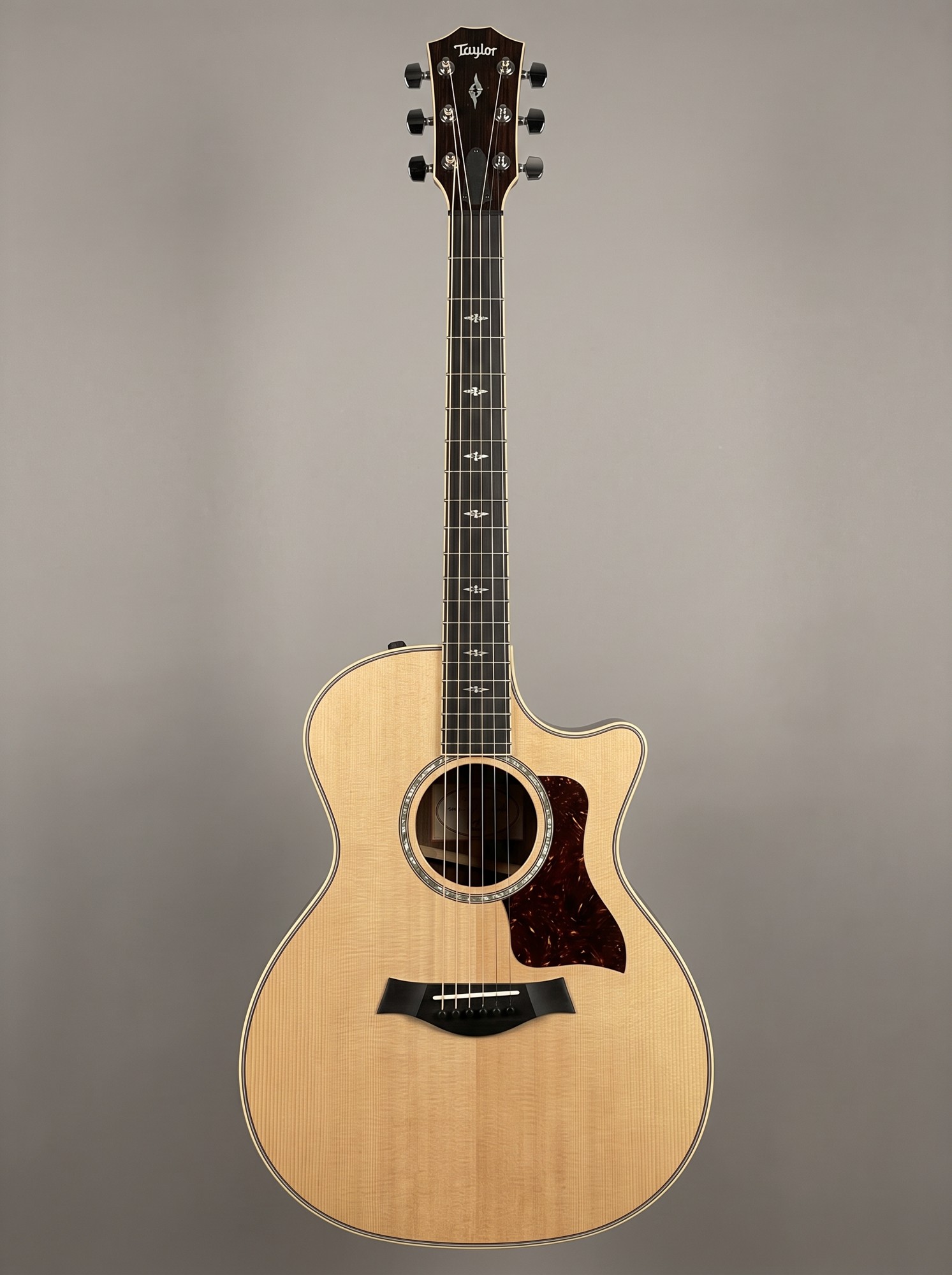
Taylor 814ce: The Modern Acoustic Benchmark That Redefined the Flat-Top
An AI-generated representative illustration of the Taylor 814ce grand auditorium cutaway, made from reference photos of the model.
The definitive guide to the Taylor 814ce: history, V-Class bracing explained, full specs, Grand Auditorium body, ES2 electronics, famous players, 814ce vs Martin D-28, and expert buying advice for 2025.
For most of the 20th century, the conversation about great acoustic guitars began and ended with vintage Martins and Gibsons. Then Bob Taylor and, later, master luthier Andy Powers did something remarkable: they built a thoroughly modern acoustic guitar so good that it forced the entire industry to take notice. The result is the Taylor 814ce — a guitar that, at one point, outsold every other guitar model in the industry, acoustic or electric, in terms of dollars spent. It is, by Taylor’s own description, their most acclaimed instrument.
Where a Martin D-28 or D-18 represents the deep traditions of American flat-top building, the 814ce represents something different: the relentless pursuit of acoustic perfection through engineering and innovation. From its versatile Grand Auditorium body to its game-changing V-Class bracing to its built-in stage-ready electronics, the 814ce is the acoustic guitar reimagined for the modern player.
This guide covers the complete story: the history of the model and its body shape, the revolutionary V-Class bracing that changed acoustic guitar design, the full spec breakdown, the players who favor it, how it compares to the great Martin dreadnoughts, and a clear-eyed assessment of whether the 814ce is the right premium acoustic for you in 2025.
The History: How Taylor Built a Modern Classic
Taylor Guitars was founded in 1974 by Bob Taylor and Kurt Listug in El Cajon, California. From the start, the company distinguished itself through precision manufacturing, consistency, and a willingness to rethink how acoustic guitars were built. Where traditional builders revered heritage and old-world methods, Taylor embraced CNC machining, bolt-on necks, and engineering solutions to age-old guitar problems — and they made instruments that played beautifully right out of the box.
The Birth of the Grand Auditorium
The 814ce’s foundation is the Grand Auditorium body shape, which first appeared in 1994 when Taylor marked its 20th anniversary with this new design. Bob Taylor sought to create a “Swiss Army knife” of acoustic guitars — an instrument that could succeed across many styles of playing. The Grand Auditorium combined dynamic elements of the larger dreadnought with the more focused, comfortable feel of the smaller Grand Concert size.
The result was a medium-sized body, 16 inches wide and 4-5/8 inches deep, large enough to take serious strumming yet braced to respond beautifully to gentle fingerpicking. Its powerful midrange, pronounced trebles, and deep but well-defined bottom end made it instantly versatile. When the Grand Auditorium entered Taylor’s regular catalog in 1996, it quickly became the company’s most popular body size — and the 814ce became the most popular guitar of all in that shape.
The Andy Powers Revolution
The 814ce’s trajectory changed dramatically when Andy Powers became Taylor’s master luthier. In 2014, the redesigned 800 Series arrived with a host of Powers innovations: a thinner high-gloss finish, tonewood thicknesses tailored to each specific body size, and a new bracing approach. That year, the 814ce outsold all other guitar models in the entire industry by dollar value — a stunning achievement for any single instrument.
But Powers was just getting started. His most consequential innovation was still to come, and it would change not just the 814ce but the fundamental architecture of the acoustic guitar.
V-Class Bracing: The Innovation That Changed Everything
To understand why the 814ce is such an important guitar, you have to understand V-Class bracing — arguably the most significant structural innovation in acoustic guitar design in decades.
The Problem With Traditional X-Bracing
For roughly 175 years, virtually every quality steel-string acoustic guitar used some variation of X-bracing — the system Martin pioneered in the 1840s, where two main braces cross in an X pattern beneath the soundboard. X-bracing works through a compromise: the top needs to be stiff enough to withstand string tension but flexible enough to vibrate and produce sound. Traditional bracing balances these competing demands, but there’s an inherent trade-off between volume and sustain, and between volume and intonation accuracy.
How V-Class Works
Andy Powers’ V-Class bracing, introduced in 2018, rethinks this 175-year-old paradigm. Instead of an X, two braces run lengthwise down the soundboard in a V configuration. This design makes the top simultaneously more rigid along its length (for sustain and volume) and more flexible across its width (for responsiveness).
The practical benefits are threefold. First, V-Class boosts volume evenly across the entire tonal spectrum. Second, it dramatically increases sustain. And third — perhaps most remarkably — it improves the guitar’s intonation. Because the top vibrates in a more orderly, synergistic way, notes ring truer against one another. Players and dealers consistently report that V-Class Taylors sound more in tune than conventionally braced guitars, a benefit that becomes obvious when playing chords up the neck.
The Evolution: Scalloped V-Class
Taylor has continued refining the concept. The Next Generation 814ce introduced Scalloped V-Class bracing, which opens up the low-end response with a deeper, richer character — splitting the difference between V-Class’s precise balance and the warmer, more traditional tone of X-bracing. This shows Taylor’s ongoing commitment to evolving the design rather than resting on the original breakthrough.
Taylor 814ce: Full Specifications
Body and Tonewoods
The 814ce is built around the classic premium tonewood pairing: a solid Sitka spruce top over solid East Indian rosewood back and sides. This is the combination that builders have gravitated toward for centuries, and for good reason. Sitka spruce offers a combination of strength and elasticity that delivers broad dynamic range and crisp articulation, suiting everything from delicate fingerpicking to aggressive flatpicked strumming.
East Indian rosewood, used for the back and sides, brings an extended frequency range and rich, musical tonality that has elevated it to premium status. Its potent low end can growl, while its treble notes ring with bell-like clarity. Crucially, rosewood produces a slightly scooped midrange compared to mahogany — and that scoop is a feature, not a bug. It leaves space in the mix for vocals or other instruments, making the 814ce ideal for solo performance, vocal accompaniment, and recording in sparse arrangements.
The Grand Auditorium body wears Taylor’s UV-cured high-gloss finish — a very thin, very hard finish that contributes to the clarity and brightness of the signature Taylor sound. The instrument is dressed with premium appointments: a genuine rosewood pickguard, an abalone rosette, maple binding, and elegant mother-of-pearl inlays.
The Comfort Features
The modern 814ce includes ergonomic refinements that distinguish it from traditional acoustics. A radiused (curved) rosewood armrest softens the edge of the body where your forearm rests, dramatically improving comfort during long playing sessions. The Venetian cutaway provides easy access to the upper frets — letting acoustic players travel up the fretboard in ways usually reserved for electric guitars.
Neck and Fretboard
The 814ce features a tropical mahogany neck with a 25-1/2-inch scale length and a 1-3/4-inch nut. The fretboard is West African Crelicam ebony with mother-of-pearl inlays and 20 frets. Two Taylor neck innovations are central to the experience: the patented Taylor Neck (introduced in 1999) offers exceptional playing comfort, intonation, and easy adjustability, while newer models include an Action Control neck system that lets the neck angle be set with the simple turn of a bolt — making future setups and adjustments remarkably straightforward.
The playability is consistently described by reviewers as among the best in the business: perfectly dressed frets, spot-on neck relief, and excellent low action with no buzzing, right out of the case. This factory-fresh playability is one of Taylor’s defining strengths.
Electronics: Expression System 2
The “e” in 814ce stands for electronics, and the guitar ships stage-ready. The standard 814ce uses Taylor’s Expression System 2 (ES2) — an innovative pickup that, instead of sitting under the saddle in the traditional way, is positioned behind the saddle to better capture its vibration. This placement delivers impressive clarity and authentic acoustic character when amplified. Volume, bass, and treble controls on the upper bout let you shape your plugged-in tone.
The newest Next Generation 814ce introduces Taylor’s Claria System — a single under-saddle piezo transducer paired with a powerful preamp, refined over two years of touring with major acts, designed to deliver warm, accurate amplified tone with minimal fuss and soundhole-mounted Volume, Tone, and Mid-Contour controls.
A deluxe hardshell case is included, and the guitar carries Taylor’s limited lifetime warranty.
The Sound: What the 814ce Actually Delivers
The 814ce produces what many consider the quintessential modern acoustic voice: lush, balanced, and articulate, with warm lows, pristine trebles, and that signature slightly-scooped midrange that leaves room for a singer. The rosewood-and-spruce combination, amplified by V-Class bracing, gives the guitar voluminous projection and ringing overtones.
Its greatest strength is versatility. The Grand Auditorium body responds equally well to fingerstyle, flatpicking, and strumming. Cowboy chords ring out full and shimmering across the upper mids and treble; single-note lead lines have a round, present midrange; fingerpicked passages reveal delicacy and nuance. This adaptability is exactly why the 814ce has become the default “one guitar to do everything” choice for so many players.
It is worth noting the tonal evolution across recent versions. The classic Taylor sound was famously bright and “coppery” — the unmistakable ’90s and 2000s Taylor zing. The V-Class-era 814ce has deliberately moved toward a smoother, warmer top end and a more sculpted midrange, making the modern version a superb fingerpicker’s guitar that still strums beautifully. Some traditionalists miss the old zing; many more appreciate the richer, more refined modern voice.
Taylor 814ce vs. Martin D-28: Modern vs. Traditional
The most common comparison a prospective 814ce buyer makes is against the Martin D-28 — the other titan of the premium rosewood acoustic world. The two guitars share tonewoods (spruce and rosewood) but represent fundamentally different philosophies.
Body Shape and Feel
The D-28 is a dreadnought — bigger, boomier, with a powerful low end built for projection and cutting through a bluegrass ensemble. The 814ce’s Grand Auditorium is more medium-sized, more balanced, and more comfortable for most players, with a cutaway and armrest that the traditional D-28 lacks. For sheer ergonomic comfort and modern playability, the 814ce wins decisively.
Tonal Character
The D-28 delivers a more traditional, organic, “vintage” voice — warm, woody, with a slightly looser and more open low end. The 814ce delivers a more precise, balanced, and articulate sound with the added benefits of V-Class sustain and intonation. The Taylor is cleaner and more even across the spectrum; the Martin is rootsier and more characterful. Neither is objectively better — they suit different ears and different music.
Playability and Practicality
This is where the 814ce pulls ahead for many buyers. It comes with a cutaway for upper-fret access, built-in premium electronics for gigging, an armrest for comfort, and Taylor’s famously easy, low action straight from the factory. The D-28, in standard form, is a pure acoustic with no cutaway and no electronics. If you plan to perform amplified, the 814ce is gig-ready out of the box.
Which Should You Choose?
Choose the 814ce if you value modern playability, versatility across styles, built-in electronics, ergonomic comfort, and a clean, balanced, precisely-intonated voice. Choose the D-28 if you prefer traditional dreadnought power, a vintage-flavored organic tone, and the heritage of the most iconic acoustic guitar in American music. Many players who try both find the choice comes down to whether their heart lives in tradition or innovation — and there’s no wrong answer.
For those weighing other options in this tier, the mahogany Martin D-18 offers a drier, punchier alternative, while the Gibson J-45 brings a warmer, rounder singer-songwriter character.
Famous Players and the 814ce’s Reputation
Taylor guitars in general, and the Grand Auditorium 814ce in particular, have become ubiquitous on modern stages and in studios. Their consistency, playability, and excellent amplified sound make them a natural choice for touring professionals across pop, country, Americana, and singer-songwriter genres.
Among fingerstyle virtuosos, Leo Kottke — one of the most influential acoustic guitarists of all time — has long association with Taylor instruments, and his fingerstyle mastery exemplifies the kind of nuanced, dynamic playing the 814ce handles so beautifully. The guitar’s even response and clear note separation suit complex fingerstyle work exceptionally well.
The broader appeal of the 814ce extends to countless contemporary artists who value its plug-and-play reliability for live performance. Pop, country, and Americana performers gravitate toward it precisely because its well-sculpted midrange sits perfectly in a live mix without fighting the vocals — a direct benefit of that slightly scooped rosewood midrange. Even artists primarily known for electric work, like the genre-crossing Prince, understood the value of a premium, versatile acoustic in their arsenal.
The 814ce’s most telling endorsement, though, is commercial: a guitar does not become the best-selling instrument in the entire industry by dollar value without an enormous base of working musicians and serious amateurs voting with their wallets. The 814ce earned its reputation one satisfied player at a time.
The Builder’s Edition and Other Variants
The 814ce exists in several configurations worth understanding before you buy.
Standard 814ce
The core model: Grand Auditorium, spruce/rosewood, V-Class bracing, ES2 electronics, radiused armrest, Venetian cutaway. This is the flagship that most people mean when they say “814ce,” typically priced around $4,000.
814ce Builder’s Edition
The Builder’s Edition treatment, applied by Andy Powers, adds boutique-level refinements: a beveled Venetian cutaway echoing the armrest’s contour, antique gold Gotoh 510 tuners, a Kona edgeburst finish, and — notably — a four-piece Adirondack spruce top, the first time Taylor used a four-piece top, a sustainability-driven innovation given dwindling supplies of large tonewood sets. The build quality is described by reviewers as “simply unimpeachable,” with a stunningly playable neck carve. The Builder’s Edition adds roughly $500 to the standard price for features often seen on five-figure boutique instruments.
Next Generation 814ce
The newest evolution introduces Scalloped V-Class bracing for a fuller, warmer low end and the road-proven Claria electronics system, along with the Action Control neck system for easy adjustability. This represents Taylor’s current thinking on where the flagship should go.
Care, Setup, and Ownership Considerations
Humidity Management
Like all fine solid-wood acoustics, the 814ce needs humidity control. Keep it in the 45–55% relative humidity range using a case or soundhole humidifier, especially in dry climates or winter heating season. Too dry and the top can crack; too humid and the tone and action suffer. This is the single most important aspect of ownership.
Setup Advantages
One of the 814ce’s genuine practical advantages is how easy it is to maintain. The Taylor Neck and the newer Action Control system make neck angle adjustments dramatically simpler than the traditional dovetail neck reset that other acoustics may eventually require. Combined with Taylor’s excellent factory setup, the 814ce is one of the lowest-maintenance premium acoustics you can own. Most owners find the factory action and intonation excellent, though a personal setup can dial it further to your preference.
Strings and Electronics
The 814ce ships with quality strings; most players use light or medium phosphor bronze. For the electronics, the ES2 (or Claria on newest models) is genuinely stage-ready — it captures the guitar’s acoustic character faithfully and resists the thin, quacky “piezo” sound that plagues lesser systems. Plug into a good acoustic amp or PA and the 814ce performs as confidently amplified as it does acoustically.
Value Retention
Premium Taylors hold their value reasonably well on the used market, helped by the lifetime warranty (for original owners in the US/Canada) and Taylor’s strong reputation for build quality and customer service. A well-cared-for 814ce remains desirable for years.
Frequently Asked Questions
What does “814ce” actually mean?
Each part of the name carries meaning in Taylor’s numbering system. The “8” indicates the 800 Series (rosewood/spruce, premium appointments). The “1” indicates a 6-string (a “4” would indicate 12-string). The “4” indicates the Grand Auditorium body shape. The “c” means it has a cutaway, and the “e” means it has electronics. So an 814ce is an 800 Series, 6-string, Grand Auditorium with cutaway and electronics.
Is the Taylor 814ce worth the price?
At roughly $4,000 for the standard model, the 814ce is a serious investment, but it sits within reach of anyone ready to step up to a professional-level instrument. For that money you get premium solid tonewoods, V-Class bracing, stage-ready electronics, exceptional playability, a cutaway and armrest, a hardshell case, and a lifetime warranty. For a working musician or a serious player who wants one do-everything acoustic, it represents strong value in the premium segment. Whether it’s “worth it” depends on your budget and how much you’ll play it.
What is V-Class bracing and why does it matter?
V-Class bracing is Andy Powers’ 2018 redesign of the 175-year-old X-bracing system. Two braces run lengthwise in a V shape, making the top both stiffer (for volume and sustain) and more responsive. The three key benefits are more even volume across the tonal range, greater sustain, and — uniquely — improved intonation, so the guitar plays more in tune, especially in chords up the neck. It’s one of the most significant acoustic guitar innovations in modern times.
How does the 814ce compare to the Martin D-28?
Both use spruce and rosewood, but they’re different philosophies. The D-28 is a traditional dreadnought with a bigger, boomier, vintage-flavored voice and no cutaway or electronics in standard form. The 814ce is a modern Grand Auditorium with a balanced, precise voice, V-Class bracing, a cutaway, an armrest, and built-in electronics. The Taylor wins on playability, comfort, and gig-readiness; the Martin wins on tradition and rootsy character.
Is the 814ce good for fingerstyle or strumming?
Both. The Grand Auditorium body is specifically designed to be a “Swiss Army knife” that handles all styles. The modern V-Class versions, with their smoother top end and sculpted midrange, are particularly excellent for fingerstyle while still strumming beautifully. The guitar’s versatility across playing styles is one of its defining selling points.
Does the 814ce sound good plugged in?
Yes — this is one of its strongest features. The Expression System 2 (and the newer Claria system) is among the best factory acoustic pickup systems available, capturing the guitar’s true acoustic character with clarity and resisting the artificial “piezo quack” common in cheaper systems. The 814ce is genuinely gig-ready out of the box, which is a major reason touring professionals favor it.
What’s the difference between the 814ce and the Builder’s Edition 814ce?
The Builder’s Edition adds premium refinements: a beveled cutaway, antique gold Gotoh tuners, an edgeburst finish, often a four-piece Adirondack spruce top, and overall boutique-level fit and finish — for roughly $500 more. The standard 814ce is already an exceptional guitar; the Builder’s Edition is for those who want the absolute top-tier version with the most refined appointments and playability.
Final Verdict: Should You Buy a Taylor 814ce?
The Taylor 814ce is the acoustic guitar that proved a modern, engineered instrument could stand toe-to-toe with — and in many practical respects surpass — the revered vintage designs that defined the category for over a century. With its versatile Grand Auditorium body, revolutionary V-Class bracing, premium spruce-and-rosewood construction, stage-ready electronics, and famously effortless playability, it is arguably the most complete do-everything acoustic guitar available today.
If you want one premium acoustic that handles fingerstyle, flatpicking, and strumming with equal grace, that plugs in and performs flawlessly on stage, that feels comfortable for hours and stays in tune up the neck, the 814ce is very likely the guitar for you. It is the choice for the player who values innovation, versatility, and modern refinement over the romance of vintage tradition.
If your heart belongs to the rootsy, organic voice of a vintage Martin or Gibson, you may prefer a D-28 or D-18. But if you want the future of the acoustic guitar — a guitar that does everything, beautifully — the Taylor 814ce remains the benchmark by which all modern flat-tops are measured. There’s a reason it became the best-selling guitar in the industry. It earns it every time you pick it up.
Image credits
- A luthier workshop with instruments on the wall: Baden de, Wikimedia Commons, CC BY 3.0.
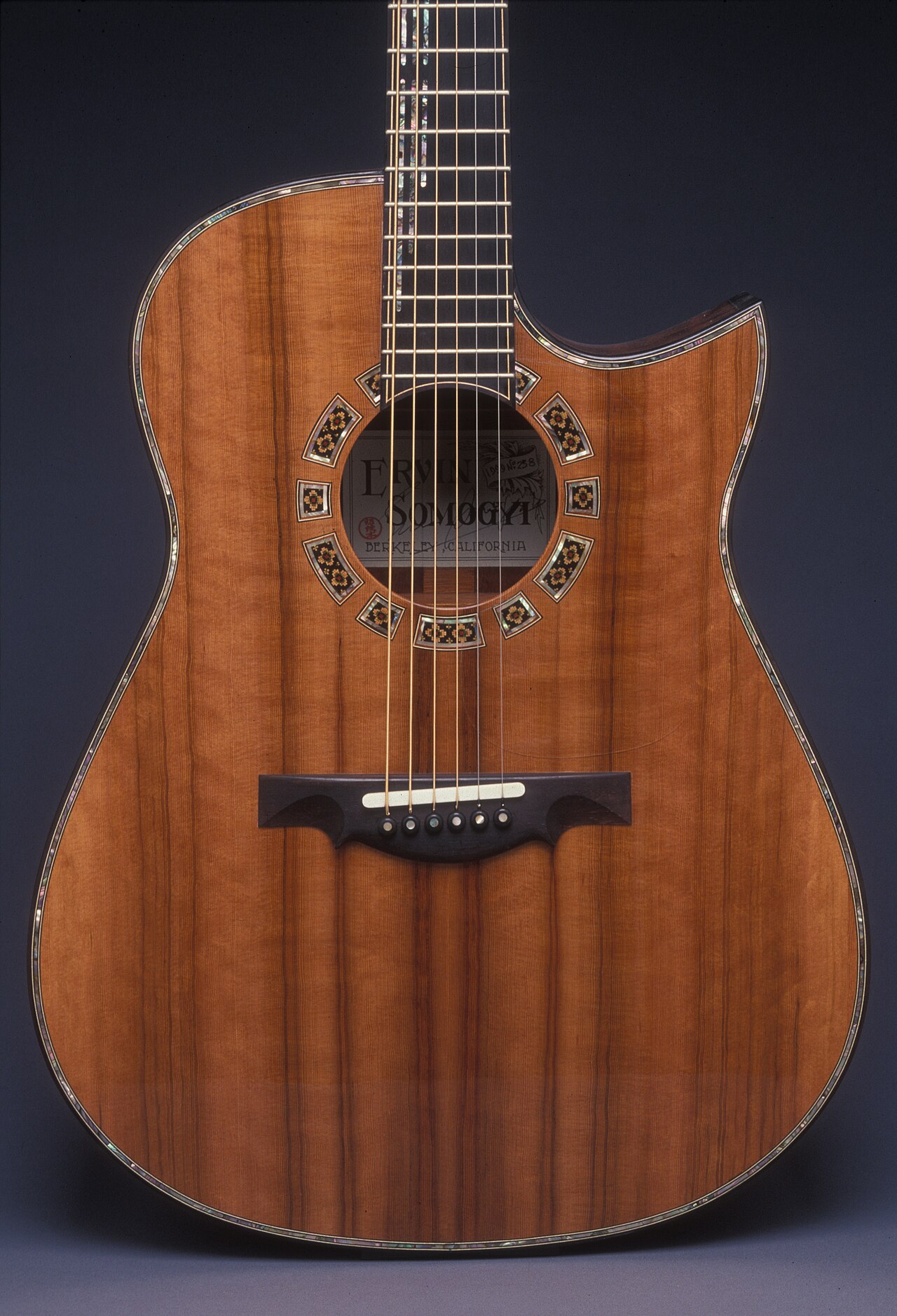
- A cutaway acoustic guitar with a warm wood top: Ervinsomogyi, Wikimedia Commons, CC BY-SA 3.0.
- Top image: GuitarGangsters AI-generated reference illustration, not a photograph.


Latest News
On This Day
Monday 9 November
From this week: