
Vince Gill Guitars & Gear: The Complete Guide to Nashville’s Most Respected Guitar Voice
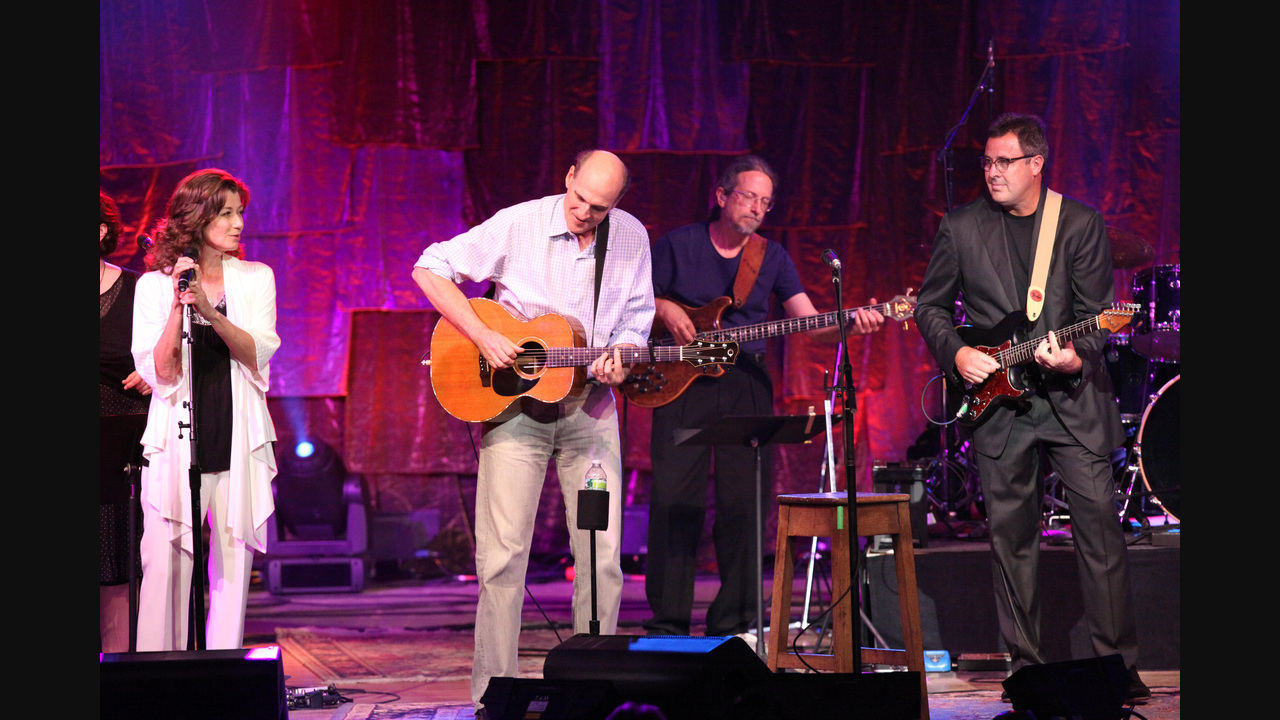
Well-known Nashville luthier Joe Glaser looked at Vince Gill’s 1953 blackguard Telecaster and called it “the best one he’s ever seen.”
This is not a casual assessment. Joe Glaser is one of the most respected guitar repairmen and evaluators in Nashville — a city where more fine vintage Telecasters pass through luthiers’ hands than almost anywhere else on earth. When Glaser says a 1953 blackguard Tele is the best he’s ever seen, he is speaking from a reference pool of hundreds of the most celebrated examples of the model in existence.
Vince Gill bought that guitar in 1979 in Del City, Oklahoma. He’s played it ever since. It is his number one. Everything is original except for a Seymour Duncan pickup in the neck position. He’s had it refretted a few times. The wear — documented in photographs showing extreme player wear across the body — is the evidence of how consistently and how seriously Gill has played this one guitar for nearly fifty years.
Gill is, by common consensus in Nashville and among guitarists across genres, one of the finest electric guitar players working in any style of American music. Eric Clapton has invited him to play at his Crossroads Guitar Festival multiple times. Mark Knopfler included him in Guitar Heroes. Guitar Player named him to their lists repeatedly. He is simultaneously the most commercially successful country singer-songwriter of the 1990s (multiple CMA Entertainer of the Year awards, more than thirty number one country singles) and a guitarist so respected by technical players in other genres that his name consistently appears in lists of the greatest living guitarists.
He plays a 1953 blackguard Telecaster he bought in a small Oklahoma music store when he was twenty-two years old. He plays some of his guitars because their owners are gone. He plays a 1960 Telecaster Custom that belonged to his writing partner Will Owsley, who died by suicide. He uses it on “I Still Believe in You” and “Take Your Memory.” He plays the 1952 Tele that used to belong to Larry Black. He tunes a mid-1960s thinline Telecaster down to open G, Keith Richards style, because the instrument invites that tuning.
He is the most complete guitarist in country music. He would probably say he’s still learning.
Background: Norman, Oklahoma, Pure Prairie League, and Nashville
Vincent Grant Gill was born April 12, 1957, in Norman, Oklahoma. His father Stan Gill was a judge and an amateur guitarist who recognized Vince’s musical talent early. At ten, his parents gave him his first electric guitar: a Gibson ES-335 and a Fender Super Reverb amplifier. He still has both.
“I can assure you my dad didn’t know that 10-inch speakers might sound better than 12-inch speakers, or that a blackface Super Reverb would be a great amplifier to have,” he told Vintage Guitar Magazine. “Gibson has always had a great tradition in its name; they build great instruments. It also probably had something to do with Chet [Atkins] and my love for the way he played.”
His parents gave him a Gibson ES-335 at age ten. His father didn’t know what he was buying. He still has it forty-plus years later. This is the Vince Gill gear story in miniature: the right instrument at the right time, kept and used rather than sold and upgraded, understood more deeply over decades of playing.
He moved to Los Angeles in his early twenties and played in various country-rock bands before joining Pure Prairie League in 1979 — the year he also bought the 1953 blackguard Telecaster in Del City, Oklahoma. After PPL, he moved to Nashville and signed with RCA Records. The solo career that followed was one of the most commercially and critically successful in country music history: “When I Call Your Name,” “Don’t Let Our Love Start Slippin’ Away,” “I Still Believe in You,” “Pocket Full of Gold,” thirty-plus number ones, five Grammy Awards, twenty-one CMA Awards including four Entertainer of the Year.
Through all of it, his guitar playing was recognized as exceptional not just by country standards but by the broader standards of American guitar playing. He is a regular guest guitarist for artists across genres. He replaced Glen Campbell in the Eagles for a period. He has played at the Crossroads Guitar Festival multiple times by Clapton’s invitation.
Tone note: His parents gave him an ES-335 at age ten. The first electric guitar was a semi-hollow jazz guitar — not a starter-level instrument but a sophisticated archtop. The choice was made partly in connection with Chet Atkins, whose playing had already influenced the ten-year-old in Norman, Oklahoma. The ES-335 and Super Reverb are still in his possession. Gear acquired with genuine care tends to stay.
The Rig: Vince Gill’s Guitars, Amps & Gear
Guitars: A Wall of Telecasters and More
The 2023 Premier Guitar Rig Rundown described seeing a wall of Telecasters in the background of Gill’s Nashville studio. This is the most efficient description of his guitar collection: Telecasters are the dominant instrument, in multiple eras and configurations, each assigned to specific songs on the setlist.
1953 Fender Telecaster (Blackguard) — The Number One
Vince Gill’s primary guitar — the instrument Joe Glaser calls “the best one he’s ever seen” — is a 1953 Fender Telecaster in the original “blackguard” configuration: black pickguard, alder or ash body, maple neck, the vintage single-coil pickups of the earliest Telecaster design.
The Premier Guitar Rig Rundown confirmed it: This 1953 Fender Telecaster is Vince’s No. 1 guitar. He picked up the guitar at Del City Music in Del City, Oklahoma, nearly 30 years ago. According to Gill’s tech, Benny Garcia, everything is totally original except for a Seymour Duncan pickup in the neck position.
He described his relationship with the guitar to Guitar Player: “In the studio I want to get the amp to do the right thing just plugged straight in.” The blackguard Tele’s specific qualities — the original single-coil bridge pickup’s snap and twang, the maple neck’s bright, direct attack, the alder body’s balanced warmth — are the character that informed everything he’s played in Nashville for five decades.
Guitar Player called it the “definitive guitar in his life.” The confirmation is every recording he’s made: the 1953 Tele’s voice is present across thirty-plus number one country singles.
Other Key Telecasters — Each Assigned to Specific Songs
Gill maintains a collection of vintage Telecasters, each used for specific songs based on their specific tonal character, tuning, or personal significance:
- 1952 Fender Telecaster (ex-Larry Black) — Formerly owned by Larry Black; Gill acquired it a few years before the Rig Rundown and uses it on “Which Bridge to Burn.” The 1952 — the first year of the Telecaster — predates the ’53 blackguard and has a slightly different character
- 1960 Fender Telecaster Custom (ex-Will Owsley) — This 1960 Fender Tele Custom used to belong to Gill’s writing partner Will Owsley. Tragically he took his own life. Gill tunes it down a half step and uses it on “I Still Believe in You” and “Take Your Memory.” The specific assignment of this guitar to these songs — a collaboration with a dead friend, songs about belief and memory — is not incidental. He plays his friend’s guitar for the songs that carry the most emotional weight
- 1960s Fender Thinline Telecaster (open G tuning) — A mid-1960s Thinline Telecaster: this guitar survived the Nashville flood in 2010, thanks to Joe Glaser. In the Rig Rundown, Gill discusses his 60s Fender Thinline Telecaster, noting that it was once in poor condition but has been restored to working order. He expresses his preference for its sound over that of an old Blackguard Telecaster. Tuned down to open G (D-G-D-G-B-D) — the same Keith Richards configuration that Lowell George used for slide and that runs through the Delta blues tradition. Gill removes the sixth string and plays it five-string in the Richards fashion
- Sunburst-finish Telecaster with rosewood fretboard — “These were kinda very rare with the sunburst finish and the binding. I like that look as well as the sound of rosewood fingerboard on a Telecaster.” A rarer Telecaster variant (sunburst was not a common Telecaster finish in most eras); the rosewood fingerboard’s warmth suits specific tonal applications
1959 Fender Stratocaster (Ex-Duane Eddy’s Son)
This all-original 1959 Fender Stratocaster was purchased by Gill from Duane Eddy’s son. Each night, Gill changes his set list, and even what guitars he uses on each song, but recently he has been using this on “Pretty Little Adriana.” The Strat’s specific tonal contribution — the in-between pickup positions’ quacky character, the three-coil versus two-coil versatility — provides colors unavailable from the Telecaster collection.
The ES-335 and Gibson Collection
- Gibson ES-335 (first guitar, age 10) — Still owned; father’s gift; the guitar that started everything
- Gibson 1960 ES-335 (dot neck, stop tailpiece) — A second ES-335, specifically the 1960 dot-neck model
- Gibson Les Paul Deluxe (mid-2000s, chambered mahogany) — Additional electric Gibson in the touring collection
- Gibson Super 400 archtop — Full archtop in the collection; jazz-oriented
Acoustic Guitars — The Martin and Gibson Collection
- 1939 Martin D-18 Sunburst — Front and center in the 2023 Premier Guitar Rig Rundown; the D-18 was manufactured with a spruce top and mahogany back and sides for the first time in 1931, and very few were done in sunburst. This is one of the rarest Martin configurations
- Martin OOOO-18 — A stripped-down version of the OOOO-28; documented in “Vince Gill’s Touring Gear”
- Martin D-28s, D-18s, 0000 and 000-21 — Multiple Martin acoustics; the D family is the foundation of his acoustic arsenal
- Gibson J-200 (1950s) — The Gibson jumbo; visible in several live performances
- Gibson CF-100 (1950s) — A rare small-body Gibson acoustic
- Gibson F-5 Lloyd Loar mandolin (1925) — One of the most historically significant mandolins ever made; the F-5 mandolin designed by Lloyd Loar in 1922-1924 is to the mandolin what the Les Paul is to solid-body guitars. Gill pulled it from a case during a Vintage Guitar Magazine interview and “flashed through a dazzling riff”
- McPherson acoustics with L.R. Baggs custom pickup systems — Contemporary luthier instruments for live acoustic work
Complete Guitar List (Key Instruments)
- 1953 Fender Telecaster (blackguard, Seymour Duncan neck pickup) — No. 1 guitar; Del City Oklahoma 1979; “best one Joe Glaser has ever seen”; all-original except neck pickup
- 1952 Fender Telecaster (ex-Larry Black) — “Which Bridge to Burn”
- 1960 Fender Telecaster Custom (ex-Will Owsley, tuned down half step) — “I Still Believe in You,” “Take Your Memory”; in memory of Owsley
- 1960s Fender Thinline Telecaster (open G, Nashville flood survivor) — 5-string open G tuning
- Sunburst Telecaster (rosewood fretboard) — Rare finish; “I like that look as well as the sound of rosewood”
- 1959 Fender Stratocaster (ex-Duane Eddy’s son) — “Pretty Little Adriana”
- Gibson ES-335 (original, age 10 gift) — First guitar; still owned
- 1939 Martin D-18 Sunburst — Rarest acoustic; 2023 Sweet Memories recordings
- Gibson F-5 Lloyd Loar mandolin (1925) — Historic mandolin; demonstrated in Vintage Guitar interview
Amps: Little Walter VG-50 and the Vintage Fenders
Little Walter VG-50 — The Current Primary
Gill routes his signal through a pair of Little Walter VG-50 amps. Each head contains a pair of 50-watt Little Walter amps that are built into a special chassis that fits in a standard size head. Each amp has a Volume, Bass Roll Off, and Tone controls and are powered by a pair of Octal tubes in the preamp section (a 6SC7 and a 6SL7 Phase Inverter), and 6L6s in the power tube section. The top head is used for his Teles, with all the other guitars going through the bottom head. Each amp goes to its own Little Walter 1×12 cabinet, which were built to the exact dimensions of a Fender Deluxe Reverb, and loaded with Celestion G12T-75 speakers.
The Little Walter VG-50 is a boutique Nashville-built amplifier designed specifically as a Vince Gill signature — “VG” in the model name. The 6L6 power tubes and simple controls produce a clean, warm tone characteristic of American tube amplifiers. The dual-amp setup — Teles through one head, other guitars through the other — reflects Gill’s awareness of the specific tonal requirements of each instrument type.
Fender Blackface Deluxe Reverb — The Secondary and Studio Amp
The vintage Fender Deluxe Reverb is Gill’s secondary and studio amplifier — used for recording and for specific tonal applications where the Little Walters’ character is different from what’s needed. His Deluxe Reverb has been modified: equipped with a Celestion Vintage 30 speaker, and bright cap clipped on the vibrato channel — the bright cap modification is a standard old-school Fender mod that adds sparkle to the vibrato channel’s top end.
The Fender ’65 Deluxe Reverb reissue was also documented at the 2010 Eric Clapton Crossroads Guitar Festival performance.
Other Documented Amplifiers
- Rivera R100 amps (×2) — Used for a long time; visible in several live photos circa 2003
- Fender Super Reverb (Blackface, parents’ gift) — Original childhood amp; still owned
- Fender ’59 Bassman — Used for specific tonal applications
- Fender Tweed Deluxe — Additional vintage Fender amp
- Goodsell Super 17 — Boutique small-format amp
Pedals: Specific and Purposeful
Vince Gill’s pedalboard philosophy: “I really like this pedal made by Hermida Audio called a Zendrive, which I think is really great. I have another pedal that is really just a boost. It kicks it just a hair and doesn’t alter the tone drastically and adds just a little sparkle.” He described his studio approach: “In the studio I want to get the amp to do the right thing just plugged straight in.”
His documented primary pedalboard (Premier Guitar Rig Rundown):
- Hermida Audio Zendrive — Primary overdrive; “really great”; warm, amp-like transparent overdrive
- Creation Audio Labs MK.4.23 Clean Boost — “Just a boost. It kicks it just a hair and doesn’t alter the tone drastically and adds just a little sparkle” — the most restrained description of a boost pedal in this series
- Boss CS-3 Compression Sustainer — Compression; documented with specific settings visible in close-up photos
- Robert Keeley-Modified Boss DD-3 Digital Delay — Primary delay; Keeley’s modifications to the DD-3 improve its sound quality and add features
- Boss DD-3 Digital Delay (stock) — Second delay unit; different delay settings
- EBS UniChorus — Chorus effect; the EBS is a bass-oriented chorus pedal that produces a specific warm, clear chorus character on guitar
- Boss TR-2 Tremolo (Keeley-Modified) — Tremolo; Keeley-modified for improved tonal character
- Wampler Faux Spring Reverb — Reverb pedal
- Boss TU-2 (×2, one for electric, one for acoustic) — Stage tuners
- Voodoo Lab Pedal Power 2 — Pedal power supply
- Audiotech Guitar Systems A/B splitter — Routes signal to all four amp inputs
- Strymon Deco — Tape saturation/slap-back; “I spoke to him post soundcheck and he uses it for a bit of slap back effect”
- Voodoo Labs Sparkle Drive — Additional overdrive option
- EHX Memory Man TT1100 — Tape echo-style delay
- Pigtronix Philosopher’s Tone Compressor — Additional compression
- Benado Effects board — Secondary board with reverb, delay, overdrive, distortion, and compressor
Strings, Picks & Setup
Strings: D’Addario .010-.046 on standard-tuned guitars; D’Addario .0105-.048 for guitars tuned down a half step. The endorsement with D’Addario is long-standing — he has used D’Addario strings for an extended career period. For acoustic: D’Addario light phosphor-bronze acoustic sets; medium gauge for bluegrass.
Picks: Planet Waves medium picks for standard playing; fat tortoise-shell pick for bluegrass. The different picks for different styles reflects the specific technical requirements of each — bluegrass flat-picking benefits from the firmer attack of a heavier pick, while standard country playing uses the medium’s balance of flexibility and definition.
The hybrid picking technique: Gill is one of the most accomplished practitioners of hybrid picking in country music — using the pick for bass strings while the middle and ring fingers simultaneously pluck treble strings. This technique is the foundation of the country “chicken-picking” approach and is what gives Gill’s electric guitar work its specific combination of authority and articulation. The pick provides drive; the fingers provide sensitivity. Neither alone achieves the specific Gill character.
The guitar-and-song assignment: Gill doesn’t play the same guitar every night regardless of the setlist. Each night, Gill changes his set list, and even what guitars he uses on each song. The specific assignment of specific guitars to specific songs — the 1960 Owsley Custom for the songs about memory and belief, the open-G thinline for the country shuffle material, the blackguard Tele for the core repertoire — reflects a sophisticated understanding of how specific instruments contribute to specific emotional contexts.
Playing Style & Tone Philosophy: Country as the Complete Guitar Language
Vince Gill’s guitar philosophy is the most technically comprehensive in the American country tradition. He does not compartmentalize his musical influences — jazz, blues, country, rock, bluegrass — but integrates them into a single vocabulary that expresses whatever the song requires.
The Chet Atkins Foundation
Chet Atkins was Gill’s primary guitar influence from childhood. Atkins’s approach — the “Nashville Sound” fingerpicking that combined country melody with jazz chord voicings and classical technique — established Gill’s fundamental understanding of what the guitar can do. Where most country guitarists of his era approached the instrument from the flat-picking tradition, Gill’s Atkins background gave him a hybrid technique that could move between fingerstyle and flat-pick without compromising either.
The Buck Owens / Bakersfield Influence
“You saw Buck Owens and Don Rich playing Telecasters, and Roy Nichols with [Merle] Haggard.” The Bakersfield tradition — the raw-boned, Telecaster-forward country rock that Buck Owens and Don Rich perfected — was the second major influence on his Telecaster approach. The 2013 album Bakersfield (with Paul Franklin) is the most explicit statement of this connection; the 2023 Sweet Memories returns to the same tradition via Ray Price.
The Player’s Player Reputation
Gill’s cross-genre recognition — Eric Clapton’s Guitar Crossroads Festival, Mark Knopfler’s Guitar Heroes, consistent placement on “greatest guitarists” lists by non-country publications — reflects the specific quality that makes him exceptional beyond any single genre’s standards. His tone: clean, clear, and direct. His technique: equally accomplished in flat-picking, hybrid picking, and fingerstyle. His musicality: everything serves the song, nothing is gratuitous. He is the complete guitar player in the American tradition.
How to Sound Like Vince Gill: The Nashville Country Telecaster Tone
The Guitar
1950s Fender Telecaster — blackguard or equivalent vintage single-coil character. Maple neck, original-style bridge pickup, and a warmer neck pickup (Seymour Duncan or equivalent in the neck for fuller sound).
- Vintage 1952-1954 Fender Telecaster (blackguard) — The authentic No. 1; rare and expensive
- Fender American Vintage II 1951 Telecaster — Modern production with vintage specifications
- Any vintage-spec Telecaster with original-style single-coil bridge and warmer neck pickup
The Amp
Little Walter VG-50 (Gill’s specific boutique signature amp) or Fender Blackface Deluxe Reverb — clean tube amplification with natural compression at working volume.
| Control | Setting | Notes |
|---|---|---|
| Volume | 5–7 (light breakup) | Gill wants “the amp to do the right thing just plugged straight in” |
| Treble | 6–7 | The Telecaster’s bridge pickup needs treble to express its snap and twang |
| Bass | 4–5 | Controlled; the country Tele tone is treble-forward |
| Reverb | 2–3 (light spring) | Present but not dominant; spring reverb is part of the country guitar sound but shouldn’t overpower |
The Essential Pedals
- Hermida Audio Zendrive (or equivalent transparent overdrive) — Light drive for solo boost
- Creation Audio Labs MK.4.23 (or equivalent clean boost) — “Just a hair” of boost without tone alteration
- Boss CS-3 Compression Sustainer — Consistent note compression for the clean country sound
- Robert Keeley-Modified Boss DD-3 — Warm delay with tape-like character
- Strymon Deco — Slapback echo for the rockabilly-influenced material
Budget vs Authentic
Budget:
- Guitar: Squier Classic Vibe ’50s Telecaster (butterscotch) or Fender Player Telecaster
- Amp: Fender Blues Junior or Fender Deluxe Reverb (reissue)
- Pedals: Boss CS-3 + Ibanez TS-9 (as transparent boost) + Boss DD-3
- Strings: D’Addario .010-.046
- Picks: Medium planet waves or equivalent
Authentic:
- Guitar: 1953 Fender Telecaster (blackguard) or equivalent vintage 1950s Tele
- Amp: Little Walter VG-50 (×2) into Little Walter 1×12 cabinets
- Pedals: Hermida Zendrive + Creation Audio MK.4.23 boost + Boss CS-3 + Keeley-Mod Boss DD-3 + Strymon Deco
The Technique
Develop hybrid picking: hold the pick normally but add the middle finger for treble string articulation. Practice banjo-style rolling patterns: thumb on bass string, pick on middle string, middle finger on high string, creating three-part simultaneous attack. This is the foundation of the Chet Atkins-derived country technique that Gill inherited. Study Atkins’s recordings as much as Gill’s — the Atkins source explains the Gill vocabulary.
Influence & Legacy: The Guitar Player’s Country Guitarist
Vince Gill’s influence is simultaneously commercial (thirty-plus number one country singles that maintained the Telecaster as the central country guitar instrument through the 1990s) and technical (the guitarist that guitarists across genres cite as exceptional). The combination is rare: most technically exceptional guitarists are not commercially dominant, and most commercially dominant artists are not cited by their technical peers as exceptional.
The documented connections:
- Eric Clapton — Multiple Crossroads Guitar Festival invitations; one of the few country guitarists Clapton has specifically highlighted as exceptional
- Mark Knopfler — Guitar Heroes collaboration; peer recognition from the guitarist who defines British fingerpicking excellence
- Chet Atkins tradition — The most direct musical continuation of the Nashville Sound fingerpicking tradition into the contemporary era
- The Bakersfield tradition — His Bakersfield album with Paul Franklin is the most serious contemporary engagement with the Buck Owens/Don Rich Telecaster tradition
- The wall of Telecasters in his Nashville studio — The visual evidence of a lifetime’s commitment to one instrument’s specific vocabulary
- Will Owsley’s guitar — Playing a dead friend’s guitar for songs about memory and belief is the most specific statement of what a guitar can mean beyond its sound
He bought the 1953 blackguard Tele in 1979 in Del City, Oklahoma. Joe Glaser calls it the best he’s ever seen. He plays it every night. He assigns specific guitars to specific songs. He plays Will Owsley’s Telecaster Custom for “I Still Believe in You” and “Take Your Memory” because they were friends and now they aren’t.
His parents gave him an ES-335 and a Fender Super Reverb when he was ten years old. He still has both.
The wall of Telecasters in his Nashville studio. The 1925 Lloyd Loar F-5 mandolin. The 1939 Martin D-18 Sunburst. The most complete country guitarist working in America. Learning every day.
Tone note: “In the studio I want to get the amp to do the right thing just plugged straight in. After the fact, you can add delay or whatever you want on it. I use some pedals, not a lot. It’s usually something to give it a little more gas.” This is the most direct statement of a guitar tone philosophy in this series: the amp does the work, the pedals give it a little more gas when needed. The 1953 blackguard Tele and the Little Walter VG-50 do the work. The Zendrive adds gas when the solo needs it. The rest is the guitar player. The guitar player is exceptional.
He bought the 1953 blackguard Telecaster in Del City, Oklahoma, in 1979, when he was twenty-two. Everything on it is original except the neck pickup. Joe Glaser — Nashville’s most respected guitar repairman — called it the best he’s ever seen. He plays it every night.
He plays the 1960 Telecaster Custom that belonged to Will Owsley on the songs about memory and belief. Will Owsley took his own life. Gill plays his guitar now.
He runs through Little Walter VG-50 boutique amps — the VG is him — through Celestion G12T-75 speakers. A Hermida Zendrive for drive. A Creation Audio boost that adds just a hair of sparkle. A Keeley-modified DD-3 for delay. A Strymon Deco for slapback.
His parents gave him an ES-335 and a Fender Super Reverb when he was ten. He still has both.
The most respected country guitarist working in America. He would tell you he’s still learning.
If Vince Gill’s 1953 blackguard Telecaster and Nashville country philosophy — Little Walter VG-50 boutique amps, Hermida Zendrive, hybrid picking from the Chet Atkins tradition — has you exploring the country guitar tradition, check our complete guide to Susan Tedeschi’s guitars and gear — the previous guitarist in this series, whose Caribbean Mist Telecaster shares the same instrument platform from a completely different blues-soul approach.
And for a guitarist in this series whose relationship with heavy guitar tone is as far from Gill’s clean country elegance as possible — but whose passion for the guitar is equally undeniable — don’t miss our breakdown of Leslie West’s complete gear guide.
FAQ: Vince Gill Guitars & Gear
- What is Vince Gill’s main guitar?
- A 1953 Fender Telecaster in the original “blackguard” configuration — black pickguard, vintage single-coil pickups — that he purchased in 1979 at Del City Music in Del City, Oklahoma, for approximately $200. Well-known Nashville luthier Joe Glaser has called it “the best one he’s ever seen.” Everything on the guitar is original except a Seymour Duncan pickup in the neck position. He has had it refretted several times. The guitar appears on the cover of the Premier Guitar Rig Rundown and is his consistent No. 1 for virtually all his normal country repertoire. He has described his studio philosophy: “I want to get the amp to do the right thing just plugged straight in.”
- What amplifier does Vince Gill use?
- A pair of Little Walter VG-50 amplifiers — boutique Nashville-built amplifiers with “VG” in the model name referencing Gill. Each head contains a pair of 50-watt amplifiers in a single chassis; each runs specific guitars (the top head for Telecasters, the other for additional guitars). The VG-50 uses a 6SC7 and a 6SL7 Phase Inverter as Octal tube preamp sections and 6L6 power tubes, feeding into Little Walter 1×12 cabinets loaded with Celestion G12T-75 speakers. Earlier in his career he used Rivera R100 amps (documented circa 2003). He also uses vintage Fender Blackface Deluxe Reverbs (modified with Celestion Vintage 30 speaker and bright cap on the vibrato channel) for specific applications.
- Why does Vince Gill play the 1960 Telecaster Custom?
- That guitar belonged to his writing partner and friend Will Owsley, who died by suicide. Gill tunes it down a half step and uses it specifically on “I Still Believe in You” and “Take Your Memory.” The assignment of Owsley’s guitar to these specific songs — songs about memory and belief — is a deliberate act of musical tribute. Playing his friend’s guitar for the songs most connected to loss and memory is the specific way Gill honors the relationship. It is one of the most moving examples in this series of a guitar carrying personal meaning beyond its tonal character.
- What pedals does Vince Gill use?
- His primary pedalboard: Hermida Audio Zendrive (transparent overdrive — “really great”), Creation Audio Labs MK.4.23 Clean Boost (just enough boost to “add a little sparkle without altering the tone drastically”), Boss CS-3 Compression Sustainer, Robert Keeley-Modified Boss DD-3 Digital Delay (primary delay), stock Boss DD-3 (secondary delay), EBS UniChorus, Boss TR-2 Tremolo (Keeley-modified), Wampler Faux Spring Reverb, two Boss TU-2 tuners (one for electric, one for acoustic), Strymon Deco (slapback), and Voodoo Lab Sparkle Drive. He also uses a Benado Effects secondary board. His philosophy: “I use some pedals, not a lot. It’s usually something to give it a little more gas.”
- What was Vince Gill’s first guitar?
- A Gibson ES-335 and a Fender Super Reverb amplifier — a birthday gift from his parents when he was ten years old. He described the moment to Vintage Guitar Magazine: “I can assure you my dad didn’t know that 10-inch speakers might sound better than 12-inch speakers, or that a blackface Super Reverb would be a great amplifier to have!” The guitar choice was partly influenced by Chet Atkins, who played a similar big-bodied instrument. Gill still owns both the ES-335 and the Super Reverb.
- How did Vince Gill acquire his vintage Telecaster collection?
- Through deliberate acquisition over decades. His No. 1 (1953 blackguard) was purchased in 1979 in Del City, Oklahoma. The 1952 Tele was acquired from Larry Black’s estate. The 1960 Telecaster Custom belonged to his writing partner Will Owsley. The 1959 Stratocaster was purchased from Duane Eddy’s son. The 1960s Thinline Telecaster survived the 2010 Nashville flood and was restored by Joe Glaser. Each guitar in his collection has a specific story and is assigned to specific songs on his setlist — a system of instrument-song pairing that reflects both the practical tonal differences between guitars and the personal meanings each carries.
- How do I get Vince Gill’s country Telecaster tone?
- A vintage-specification Fender Telecaster (1950s-style blackguard or equivalent: original-style bridge single-coil, Seymour Duncan or warmer pickup in neck, maple neck). Through a clean tube amp at moderate volume — Fender Deluxe Reverb or equivalent; Little Walter VG-50 for the authentic boutique choice. D’Addario .010-.046 strings; Planet Waves medium picks. Pedal chain: Boss CS-3 compression → Hermida Zendrive (light overdrive setting) → Keeley-modified DD-3 (warm delay) → Strymon Deco (slapback for appropriate songs) → amp. The essential technique: develop hybrid picking by learning to use the middle finger for treble string plucking while the pick handles bass strings simultaneously — the Chet Atkins-derived technique that gives Gill his specific combination of authority and delicacy.
Vince Gill, at right, performing with Amy Grant and James Taylor at Tanglewood, 3 July 2011. Photo: Amy Grant, James Taylor, and Vince Gill by Hilary Scott / Weekly Dig (digboston) / CC BY 2.0. Source previously processed with Digital Photo Professional. Entire original resized proportionally with neutral dark side margins and JPEG encoded; no crop, stretch or retouching. Full head, both playing hands and entire guitar of Vince Gill retained.
