Epiphone ES-335: The Semi-Hollow That Even Gibson Owners Envy
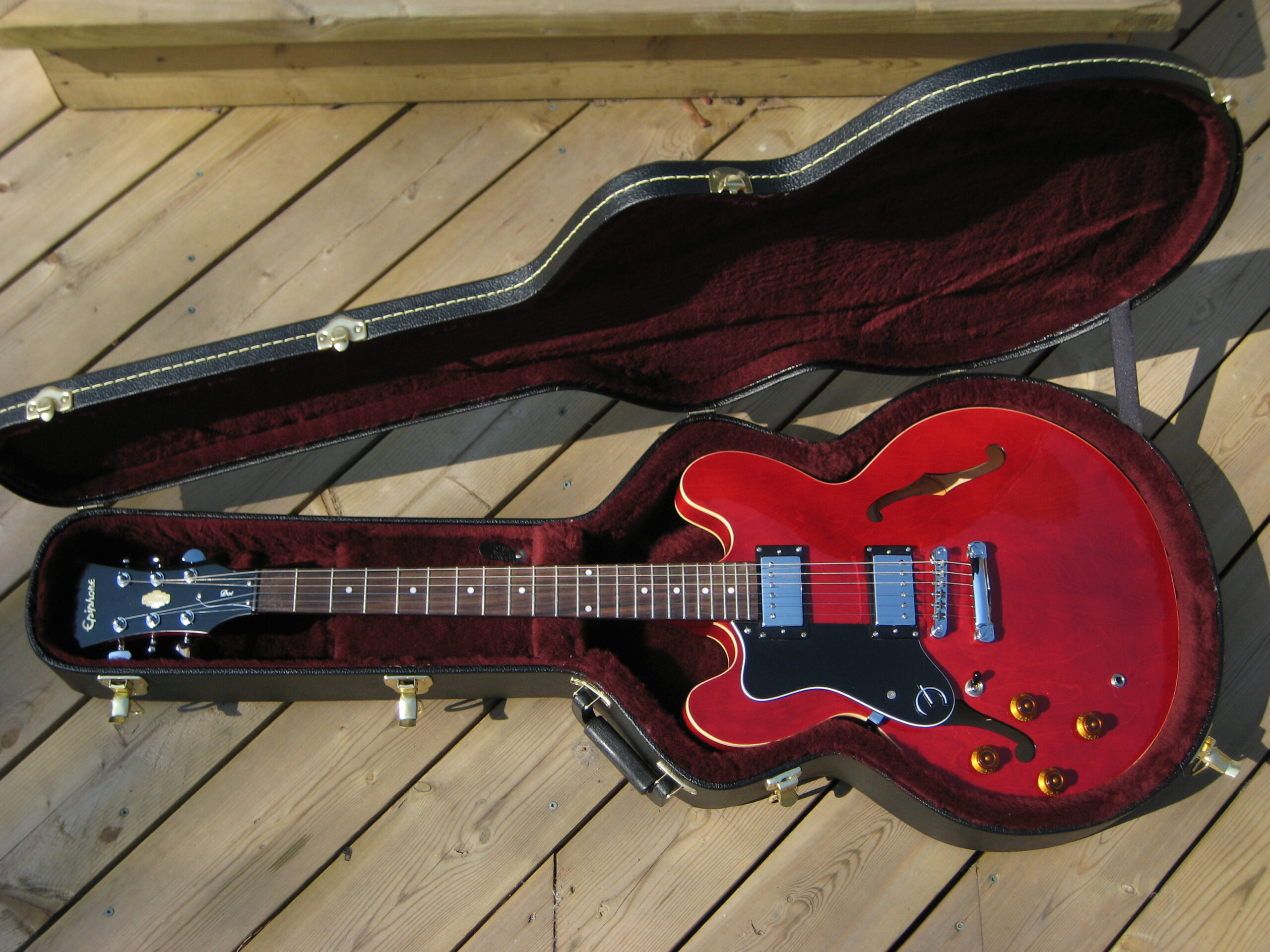
Left-handed Epiphone Dot in its open case, photographed 28 March 2009. Photo: Gary J. Wood. CC BY-SA 2.0 (https://creativecommons.org/licenses/by-sa/2.0/). Full source frame resized for web; no cropping or retouching. Web version: CC BY-SA 2.0. Source: https://www.flickr.com/photos/garyjwood/3395149814/
Why Josh Homme prefers the Epiphone ES-335 over a real Gibson, and how this semi-hollow legend delivers Chuck Berry to Larry Carlton tone on a budget.
There’s a particular kind of guitar-store moment that has become a running joke among semi-hollow enthusiasts: someone picks up an Epiphone ES-335, plays a few bars, and asks, only half-joking, whether it’s actually the Gibson. It happens often enough that it’s become part of the model’s identity. The ES-335 shape — two f-holes, a solid center block running through a hollow maple body, twin cutaways for full fretboard access — is one of the most universally loved designs in electric guitar history, and Epiphone’s version has closed the gap to the real thing so effectively that some of the guitar’s most respected modern players genuinely prefer it.
That’s not marketing spin. Queens of the Stone Age’s Josh Homme — a guitarist who has spent decades in the studio with vintage Gibsons, boutique custom builds, and every tone-chasing tool in between — has publicly stated a preference for Epiphone’s Dot 335 over the USA-made Gibson equivalent. When a player with that level of access and experience picks the “budget” version by choice, it’s worth understanding exactly what Epiphone got right.
From Ted McCarty’s Middle Ground to Epiphone’s Best Value
The Gibson ES-335 arrived in 1958 under the direction of Gibson president Ted McCarty, solving a problem nobody had quite cracked before: how to combine the resonant, airy tone of a hollow-body archtop with the feedback resistance and sustain of a solidbody electric. McCarty’s solution was elegantly simple — a solid maple center block running through the middle of an otherwise hollow body, giving players the best of both worlds. The design was immediately embraced by everyone from blues and rock pioneers to jazz players who wanted a bit more edge, and it’s remained one of Gibson’s most consistently beloved shapes for nearly seven decades.
Epiphone’s relationship with semi-hollow construction actually predates the ES-335 itself — the brand built well-regarded semi-hollow instruments like the Riviera and Sheraton in the 1950s and 60s, giving Epiphone a genuine pedigree in the category rather than just a licensing arrangement. That history matters, because it means Epiphone’s modern ES-335 isn’t simply a budget copy chasing someone else’s design — it’s a company with decades of relevant construction experience applying that knowledge to a legendary shape at a dramatically lower price point.
The current “Inspired by Gibson” ES-335 lineup represents the most significant leap in Epiphone quality the model has ever seen, moving decisively away from the older “Dot” era toward genuine spec-matching: the correct Kalamazoo open-book headstock, hand-wired CTS control pots, and — on the top-tier reissue — actual Gibson-made pickups and hardware pulled straight from the Gibson Custom Shop parts bin.
It’s worth understanding just how significant that “Dot” nickname was to the model’s earlier identity. For years, Epiphone’s entry-level ES-335 was colloquially known simply as “the Dot,” a nod to its dot-inlay fretboard and its position as the accessible, no-frills version of the shape. That guitar earned a loyal following of its own — plenty of gigging musicians built entire careers on the Dot without ever feeling like they were missing something — but it never quite closed the gap to a real Gibson the way the current Inspired by Gibson generation does. The rebrand away from “Dot” and toward the model’s proper “ES-335” name signals Epiphone’s own confidence that this generation deserves to be judged on its own terms, not as a budget nickname.
Full Specifications
| Spec | Standard ES-335 | ES-335 Figured | IGC 1962 Reissue |
|---|---|---|---|
| Body | Layered maple/poplar, solid maple center block | Layered maple, AAA flame veneer top/back | 5-ply laminated maple/poplar, solid maple center block |
| Neck | Mahogany, rounded C profile | Mahogany, rounded C profile | One-piece mahogany, 1960s Slim Taper C |
| Fingerboard | Indian laurel, dot inlays | Indian laurel, small block inlays | Bound rosewood, mother-of-pearl small block |
| Scale length | 24.75″ / 628.65mm | 24.724″ / 628mm | 24.75″ / 628.65mm |
| Pickups | Alnico Classic PRO humbuckers | Alnico Classic PRO or Gibson USA T-Type | Gibson Custombuckers (USA) |
| Controls | 2 Vol, 2 Tone, CTS pots | 2 Vol, 2 Tone, CTS pots | 2 Vol, 2 Tone, CTS pots, Black Beauty PIO caps |
| Bridge/Tailpiece | LockTone Tune-O-Matic, stopbar | LockTone Tune-O-Matic, stopbar | Gibson ABR-1, Historic Reissue aluminum stopbar |
| Tuners | Epiphone Deluxe | Grover Rotomatic | Epiphone Deluxe, double ring |
| Typical price | ~$599–650 | ~$699–799 | ~$1,499–1,599 |
Why the Center Block Changes Everything
The solid maple block running through the ES-335’s body is the entire reason the design works as well as it does. Without it, a fully hollow guitar loaded with humbuckers at gig volume would howl with feedback the moment you approached a loud amp. With it, the guitar gains the sustain and feedback resistance of a solidbody while the surrounding hollow wings still resonate enough to color the tone with genuine acoustic character — a slightly airy, “breathing” quality that a true solidbody simply can’t replicate. Reviewers consistently describe the sweet spot of the design as the middle pickup position: blend the neck and bridge together, roll the neck volume back slightly, and you land on what players call the “quack point” — a vocal, expressive tone that’s become a signature ES-335 sound in its own right.
Across the three tiers, the fundamental design stays consistent, but the details tell the real story. The entry-level ES-335 uses Alnico Classic PRO humbuckers that deliver a wide, vintage-leaning tonal range at an exceptionally accessible price. The Figured model steps up with a genuinely eye-catching flame maple veneer and, in some configurations, Gibson USA T-Type humbuckers for a more articulate, dynamically responsive voice. At the top, the Inspired by Gibson Custom 1962 Reissue goes all the way — actual Gibson Custombuckers built in the USA, hand-wired electronics with Black Beauty paper-in-oil capacitors, and a genuine Gibson ABR-1 bridge, all details that reviewers say bring it remarkably close to guitars costing several times more.
The unplugged, acoustic character of a semi-hollow guitar is worth understanding on its own terms, separate from what happens once you plug in. Reviewers of the current Inspired by Gibson models note that while the unplugged tone rings bright and sustains impressively, it leans a bit closer to “loud solidbody” than the deep, woody mellowness of a genuinely vintage ES-335 — a reasonable trade-off given the laminate construction methods that keep production costs manageable. The moment you plug into an amp, though, that distinction mostly disappears; the pickups are voiced to deliver the classic ES-335 experience regardless of how the guitar behaves acoustically, and most players never notice the difference in a live or recorded context.
Famous Players
The ES-335’s classic-era mythology runs deep and belongs largely to the Gibson original: Chuck Berry made the shape a rock and roll icon from its earliest years, while Eric Clapton leaned on his ES-335 for some of the most influential blues-rock playing of the 1960s. Fusion great Larry Carlton built such a close identity with the model that he’s still nicknamed “Mr. 335” decades into his career, and his liquid, jazz-inflected lead tone remains a benchmark for the semi-hollow format.

But the Epiphone version’s most compelling modern endorsement belongs to Josh Homme of Queens of the Stone Age, who has openly professed a genuine preference for Epiphone’s Dot 335 over the USA-made Gibson — a remarkable statement from a guitarist with the resources and studio access to play absolutely anything he wants. It’s not a signature model or a paid endorsement deal; it’s a working musician choosing the Epiphone on its own merits, which is about as strong an Epiphone-specific credibility signal as this model family gets.
The ES-335’s influence has also spread into closely related descendant models — Dave Grohl’s Trini Lopez signature guitar, for instance, is a direct offshoot of the ES-335 platform, adapted with a diamond-shaped soundhole and distinctive headstock, showing how far the core design’s DNA has traveled well beyond the original shape.
Other British Invasion-era players cemented the shape’s reputation before Homme ever picked one up — the ES-335 and its Epiphone semi-hollow cousins were fixtures among 1960s UK guitarists chasing a tone that could handle both clean, chiming rhythm work and biting overdriven leads within the same song. That dual-purpose reputation is exactly why the shape has endured across so many genres and generations: it was never really a specialist’s instrument, but a genuine all-rounder that happens to excel in several different styles simultaneously.
Tone Recipes
- Blues-rock lead: Bridge pickup, amp pushed into light-to-medium breakup, dig in with the pick for that classic “quack” bite.
- Jazz-fusion warmth: Neck pickup, tone rolled back to 6, clean amp with a touch of compression — chase Larry Carlton’s liquid legato tone.
- Classic rock rhythm: Middle position, both volumes near max, moderate gain — open chords ring with genuine acoustic-adjacent shimmer.
- The “quack point” solo tone: Middle position, roll the neck volume back to about 7, amp on the edge of breakup — a vocal, expressive lead voice that’s uniquely ES-335.
How It Compares
Against its smaller sibling, the ES-339, the full-size 335 offers slightly more acoustic resonance and a broader, airier low end, while the 339 trades some of that openness for a tighter, more focused midrange and a body size some players find easier to handle. Against a Les Paul Standard, the 335 gives up some sustain and low-end punch in exchange for that distinctive hollow-body airiness and dramatically better feedback control at lower volumes — a genuinely different playing and recording experience, not just a cosmetic variation. Against Gibson’s own USA-made ES-335, even reviewers testing the Epiphone side-by-side with genuine Gibsons have struggled to identify meaningful differences in a blindfold playing test, particularly at the Inspired by Gibson Custom tier.
Buying Guide
- Standard ES-335: The most accessible entry point at around $599–650 — Alnico Classic PRO humbuckers, dot inlays, genuinely solid build quality for the price.
- ES-335 Figured: A visual and tonal step up around $699–799, with flame maple veneer, small block inlays, and in some configurations, Gibson USA pickups.
- Inspired by Gibson Custom 1962 Reissue: The premium option near $1,499–1,599 — genuine USA Gibson Custombuckers, hand-wired electronics, and period-correct hardware that closes the gap to a real Gibson almost entirely.
- Smaller alternative: Consider the ES-339 if the full-size 335’s larger lower bout feels unwieldy — same construction principles in a more compact body.
Practical Ownership Notes
Semi-hollow guitars are more prone to feedback at high stage volumes than solidbodies, even with the center block in place — be mindful of amp placement and consider a soundhole cover for high-gain, loud-stage situations. The hollow body wings also make these guitars noticeably lighter than a comparable solidbody Les Paul, a genuine ergonomic advantage for long gigs, but one that also means the guitar resonates differently against your body — some players need an adjustment period coming from solidbody instruments.
Because the ES-335 shape is deep and somewhat top-heavy, a properly adjusted strap and strap locks are worth the investment; neck dive can be an issue on some units, particularly with heavier tuning machines. If you’re buying the standard or Figured tier and considering an upgrade path, swapping to Gibson USA pickups later is a well-trodden route that several players use to bridge the gap toward the premium reissue’s tone without the full price jump.
Climate and humidity deserve a bit more attention than they would on a solidbody guitar. While the laminate construction is more stable than a solid-wood acoustic top, the hollow chambers still respond to significant humidity swings over time, and long-term owners recommend a case humidifier in particularly dry climates or seasons. Fret and setup maintenance is otherwise identical to any other electric guitar — the ES-335 doesn’t demand any unusual specialist care beyond standard string changes and periodic truss rod checks.
Read our guide to the Gibson ES-335 for the wider history of this semi-hollow design.
FAQ
Is the Epiphone ES-335 a good alternative to a Gibson?
Yes, increasingly so — reviewers and even professional players have noted that the current Inspired by Gibson tier closes much of the historical quality gap, and the Custom 1962 Reissue uses genuine Gibson-made pickups and hardware.
What’s the difference between the ES-335 and ES-335 Figured?
Primarily cosmetic — the Figured model adds a flame maple veneer top and back along with small block fretboard inlays, and in some configurations upgrades to Gibson USA pickups. Both share the same fundamental construction.
Is a semi-hollow guitar harder to maintain than a solidbody?
Not dramatically — the main extra consideration is feedback management at high volumes and slightly more attention to humidity if the guitar has any exposed hollow chambers, though the maple laminate construction is fairly stable compared to solid-wood acoustic instruments.
What genres suit the ES-335 best?
Blues, classic rock, jazz-fusion, and indie are its strongest homes, though the model’s versatility means it shows up convincingly across nearly every genre except the most extreme high-gain metal styles.
Should I choose the 335 or the smaller ES-339?
Choose the 335 for maximum acoustic resonance and that classic “airy” character; choose the 339 if you find the larger lower bout uncomfortable or want a slightly tighter, more focused midrange in a Les Paul-sized footprint.
Does the ES-335 work well for recording?
Exceptionally well — the semi-hollow design’s natural compression and harmonic complexity make it a favorite in the studio across genres, often requiring less additional processing to sound full and present in a mix than a comparable solidbody.
Image credits
- Larry Carlton: Kenneth C. Zirkel, Wikimedia Commons, CC BY-SA 4.0.
- Top image: Left-handed Epiphone Dot in its open case, photographed 28 March 2009. Photo: Gary J. Wood. Source photograph · CC BY-SA 2.0. Full source frame resized for web; no cropping or retouching. Web version: CC BY-SA 2.0.
Latest News
Related

On This Day
Tuesday 10 November
From this week: