Dimebag Darrell – The Cowboy From Hell and His Razor‑Sharp Tone
GuitarGangsters Editorial 11 min read Updated 18 October 2026
There’s a sound that makes your spine tingle before you even know what you’re hearing. A piercing squeal, a slithering divebomb, a riff so tight it feels like steel cables snapping in half. That sound belongs to Dimebag Darrell Abbott, the Cowboy from Hell who rewrote the rules of heavy guitar.
Imagine a Texas kid with a blue Dean ML slung low, covered in KISS stickers and a lightning bolt streak. He grew up on ZZ Top, KISS and Van Halen, but by the time Pantera kicked down the doors of the ’90s, he was blazing a trail no one else dared to walk. He didn’t just play guitar – he attacked it. Every pinch harmonic was a shriek, every vibrato a growl. And that mix of groove and chaos became the backbone of modern metal.
Dimebag’s story is the stuff of legend: winning his first ML at a guitar contest, modding it into the infamous “Dean From Hell,” selling it for a car and later getting it back in a stranger-than-fiction twist. He built his tone around solid-state Randall amps, Bill Lawrence pickups and a Floyd Rose tremolo – simple tools pushed to extremes by sheer will. When Pantera hit with “Cowboys from Hell,” metal’s landscape changed overnight.
But behind the larger-than-life image and the lightning-bolt guitar was a guy who just loved to play. His laugh was as loud as his riffs, his heart as big as his vibrato. Even after tragedy cut his life short on stage in 2004, his influence only grew. Today, guitarists still chase that razor‑sharp tone and that fearless attitude
Before the world knew the name Dimebag Darrell, he was just Darrell Abbott, a teenage kid from Arlington, Texas, obsessed with loud guitars and louder riffs. His father, country producer Jerry Abbott, ran a small studio, so Darrell grew up surrounded by tape machines, microphones, and the smell of tube amps heating up. While other kids were learning chords from books, Darrell was dissecting Eddie Van Halen solos by ear and jamming along to KISS and Judas Priest records.
By the time he was sixteen, Darrell’s hands moved faster than his friends could count. He entered local guitar contests — and destroyed the competition so consistently that organizers eventually asked him to stop showing up, because nobody else would enter. That’s when Dean Guitars came calling, awarding him the now-famous 1981 Dean ML that would become his lifelong companion.
But in the early ’80s, the music scene in Texas was rough and unglamorous. Darrell’s band Pantera was still wearing spandex and cranking out glam-inspired riffs. Then came the moment of evolution — when Phil Anselmo joined the band and the sound turned meaner, heavier, and hungrier. The transformation from glam to groove metal wasn’t just aesthetic; it was a war cry.
And at the center of it all was Dimebag — the smiling assassin with lightning-fast runs and a right hand built from steel and barbecue grease. He blended precision with swagger, and his riffs hit like engine pistons — mechanical, relentless, and perfectly tuned to the rage of the 1990s.
When “Cowboys from Hell” dropped in 1990, it wasn’t just another metal record. It was a manifesto. Dime’s tone was unlike anything out there — dry, biting, and crystal clear, cutting through even the densest rhythm sections. He turned his solid-state Randall setup into a weapon, proving that “tube snobs” didn’t have a monopoly on good tone.
“It’s not about tubes or transistors,” he once said. “It’s about what’s in your hands.”
From that moment on, the legend was sealed. Dimebag Darrell didn’t just play metal — he defined what heavy meant for an entire generation.
The Rig – Dimebag’s Dean From Hell, Randall Fury, and Tone Secrets
Few guitarists have ever had a setup as iconic — or as misunderstood — as Dimebag Darrell. His rig wasn’t about expensive boutique gear or fancy signal chains. It was a raw, unapologetic arsenal built to deliver one thing: pure aggression with surgical precision.
The Guitar – Dean From Hell
The heart of Dime’s tone was his legendary 1981 Dean ML, nicknamed the Dean From Hell.
Originally a plain blue ML covered in KISS stickers, the guitar was customized by his friend Buddy Blaze with lightning-bolt graphics, a Bill Lawrence L-500XL bridge pickup, and a Floyd Rose tremolo — three upgrades that would change metal guitar forever.
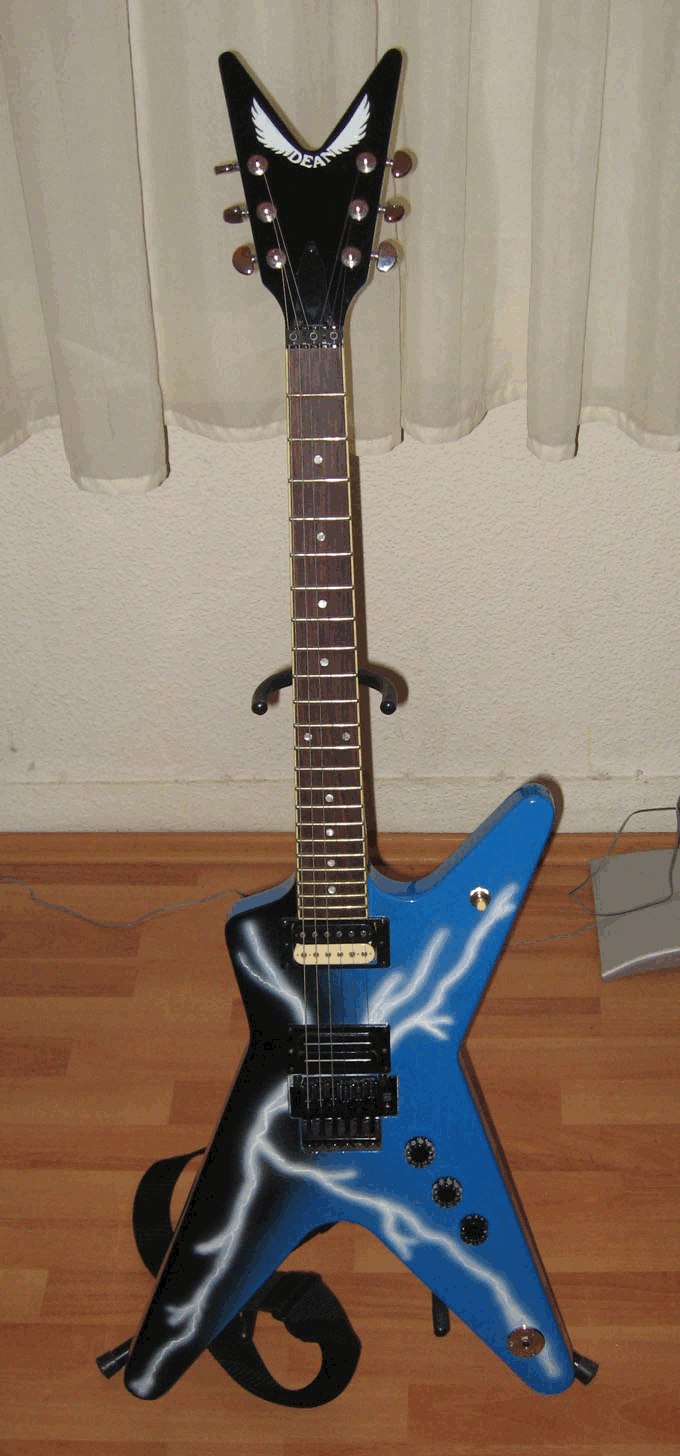
The L-500XL gave Dime that explosive midrange snarl and glassy top end that sliced through Pantera’s dense mix.
He later added a Seymour Duncan SH-6 Distortion in some of his backup guitars for a thicker, meatier tone during the Far Beyond Driven era.
His strings? DR High Voltage .010–.046, tuned anywhere from standard to drop D depending on the song. His picks were Dunlop Tortex 0.73mm, which gave him that perfect balance between snap and flexibility for his signature harmonic squeals.
“It’s gotta feel like it’s alive,” Dime once said. “If it ain’t fighting back a little, it’s not the right guitar.”
The Amps – Randall Power, No Apologies
While most guitar heroes swore by tube amps, Dimebag doubled down on solid-state power.
His main live amp was the Randall RG100ES, and later the Randall Century 200 and Randall Warhead. These amps delivered brutal clarity and percussive tightness — exactly what Dime needed to pair with Vinnie Paul’s machine-gun drumming.
For studio work, he sometimes blended the Randall’s raw output with a Furman PQ-3 preamp, sculpting that signature scooped EQ that became the Pantera hallmark:
-
Bass: 6
-
Mid: 3
-
Treble: 8
-
Presence: All the way up to 10 (because, of course).
Behind it all, he used Celestion G12T-75 and Electro-Voice EVM12L speakers, wired into custom Randall 4×12 cabinets, producing a wall of tone so fierce it could peel paint.
The Pedals – Controlled Chaos
Dimebag’s pedalboard was surprisingly compact — but every stompbox earned its place.
He was one of the earliest and most creative users of the Digitech Whammy pedal, using it for his signature divebombs, squeals, and pitch-shifting madness.
He also swore by the Dunlop Cry Baby From Hell — a wah pedal customized to his specs, with adjustable range and boost control.
Add to that an MXR ZW-44 Overdrive to tighten his rhythm tone and a Furman EQ for shaping frequencies, and you had the sound of Cowboys from Hell in a box.
“You don’t need 20 pedals,” Dime would say. “You need five that you know like your best friends.”
The Rest of the Arsenal
Over the years, Dime expanded his collection to include:
-
Washburn Dime 333 – used after Dean’s original company shut down in the ’90s.
-
Dean Razorback – a co-design released posthumously, based on his own sketches.
-
Dean ML 79 – his go-to backup for tours.
He was loyal to his tone and never chased trends. When everyone else went digital, Dime stayed analog — and louder than everyone else on the bill.
(Read also Tony Iommi – The Godfather of Heavy Riffs for the story of another player who built metal tone from raw determination and simple tools.)
The Sound – Groove, Harmonics, and Controlled Mayhem
There’s heavy — and then there’s Dimebag heavy.
His tone was more than distortion; it was a living, snarling thing that breathed groove and chaos in equal measure. The man didn’t just riff — he grooved harder than most drummers.
Groove Metal: The Art of the Riff
When Pantera shifted from glam to groove metal, Dimebag rewrote the rulebook.
Instead of chasing speed for its own sake, he built riffs that hit. Songs like “Cowboys from Hell,” “Walk,” and “Domination” weren’t just brutal — they swung. Every chug, every syncopation locked perfectly with Vinnie Paul’s drumming, creating that engine-like pulse that defined a generation of metal bands.
He combined down-picked precision with lightning-fast bursts, alternating groove and chaos like a switchblade rhythm machine. His right hand was the heartbeat of Pantera — and the reason even casual listeners could nod along to the heaviest riffs on Earth.
“It’s not about how fast you play. It’s about how deep it hits.”
Pinch Harmonics: The Scream of Metal
Nobody made a guitar scream like Dimebag Darrell.
His pinch harmonics were legendary — high-pitched, animalistic shrieks that could slice through the loudest mix. He mastered the technique so completely that every squeal became part of his vocabulary. You could hum his solos from memory — not because they were melodic, but because they sounded alive.
The secret wasn’t just in his hands; it was in how he felt the note. He’d pluck near the bridge, twist the pick slightly, and hit with just enough gain to make it sing instead of squeal. Add a Whammy pedal dive or Floyd Rose pull, and you got that unmistakable Dimebag chaos.
Solos: Violence Meets Melody
For all his fire and ferocity, Dimebag’s solos were built on emotion. Listen to “Cemetery Gates” — he goes from soft, soulful bends to banshee wails in a heartbeat. His phrasing had more in common with blues legends than shred technicians. Every note told a story, and every bend hurt in the best possible way.
He didn’t chase speed records. He chased feel — that gut-punch connection between the guitar and the listener.
His influences ranged from Eddie Van Halen to Ace Frehley, and you can hear both in his phrasing: one part technical fireworks, one part pure rock ’n’ roll joy.
Studio Sound: Chaos, Sculpted
In the studio, Dimebag layered his tone like a mad scientist. He used multiple amps, EQs, and even mic placements to get that perfect wall of controlled mayhem. His go-to trick? Record the same riff twice — one slightly looser than the other — to create that stereo spread that felt both massive and human.
Every album, from “Cowboys from Hell” to “The Great Southern Trendkill,” evolved his sound — tighter, angrier, but always undeniably Dime.
(Check out Slash – Les Paul Fire and the Guns N’ Roses Tone for another player who made emotion and power collide through pure touch.)
The Legacy – Brotherhood, Tragedy, and Immortality
Dimebag Darrell didn’t just change guitar playing — he changed what it meant to be a guitarist.
For him, it wasn’t about ego or image; it was about brotherhood, volume, and fun. Every note he played came from a place of joy, even when his riffs sounded like the apocalypse. That duality — brutal yet joyful — is what made Dimebag one of the most beloved figures in metal history.
The Brotherhood: Dime and Vinnie
At the heart of it all was Vinnie Paul, Dime’s brother, drummer, and best friend.
They weren’t just bandmates; they were blood. Together they forged the unstoppable core of Pantera — one of the tightest rhythm-guitar duos in metal history. When Pantera fell apart, they didn’t waste time sulking. They founded Damageplan, ready to build something new from the ashes.
Their synergy onstage was electric. You could see it in the smiles they exchanged mid-set, the locked-in grooves that only siblings could share. It wasn’t technical — it was telepathic.
The Tragedy
Then came December 8th, 2004 — the night the music stopped.
During a Damageplan show in Columbus, Ohio, Dimebag was shot onstage by a deranged fan. The event shocked the world and ripped the heart out of the metal community. It wasn’t just that a great guitarist was gone — it was that one of the kindest, most down-to-earth souls in the scene had been stolen from it.
Yet even in tragedy, Dime’s spirit refused to fade. Fans built shrines, tattooed lightning bolts on their arms, and cranked “Cowboys from Hell” until their speakers smoked. His legacy became louder than ever.
Immortality in Tone and Spirit
Today, Dimebag’s DNA runs through every heavy band worth its salt.
From Lamb of God to Gojira, his influence is in every palm-mute, every harmonic squeal, every riff that dares to groove instead of sprint.
Dean Guitars and Dunlop still carry his name proudly — the Dean Razorback, the Cry Baby From Hell, and the DR High Voltage Strings keep his tone alive for new generations to discover.
His message was simple: Play loud. Play from the gut. Make it count.
He lived that creed every night, and in doing so, he became immortal.
“Be yourself, stay true, and don’t let anyone tell you how your guitar should sound.” — Dimebag Darrell
(Also read James Hetfield – Downpicking King of Metallica for another titan who turned right-hand power into an art form.)
FAQ – Dimebag Darrell’s Gear, Tone, and Legacy
What guitar did Dimebag Darrell play?
Dimebag’s main guitar was the iconic 1981 Dean ML, later known as the Dean From Hell.
It featured a Bill Lawrence L-500XL pickup, Floyd Rose tremolo, lightning-bolt graphics, and a battle-worn blue finish. He also used Washburn Dime 333s in the ’90s and co-designed the Dean Razorback before his passing.
What amps did Dimebag use?
He was famous for breaking the “tube rule” — using solid-state Randall amplifiers instead of tube heads. His main models were the Randall RG100ES, Century 200, and Warhead, often paired with Furman PQ-3 EQs and Randall 4×12 cabs loaded with Celestion G12T-75s and Electro-Voice EVM12Ls.
What effects pedals did Dimebag use?
His board was simple but lethal:
-
Dunlop Cry Baby From Hell (his custom wah with adjustable boost)
-
Digitech Whammy (for his signature pitch dives and screams)
-
MXR ZW-44 Overdrive (to tighten low end)
-
Furman EQ (for tone shaping)
He didn’t rely on effects — he used them as weapons to amplify emotion.
How did Dimebag get his tone?
The secret was his hands.
His heavy right-hand attack, aggressive pick angle, and precise muting created that signature “chainsaw” rhythm sound. Combined with the L-500XL pickup and Randall’s razor-sharp clarity, he achieved a tone that was both brutal and articulate.
What strings and picks did Dimebag use?
He played DR High Voltage .010–.046 strings and Dunlop Tortex 0.73 mm picks — bright, flexible, and perfect for pinch harmonics. His tuning varied between standard and drop D depending on the song.
Why is Dimebag considered one of the greatest guitarists ever?
Because he fused groove, feel, and ferocity like no one else.
He redefined what metal guitar could be — fast yet soulful, technical yet human.
He made shredding fun again, and his personality offstage matched his intensity on it.
What is Dimebag’s lasting influence?
Every modern metal player who values tone, feel, and groove owes something to Dimebag.
From Zakk Wylde to Mark Tremonti, his fingerprints are everywhere. His tone, attitude, and kindness made him more than a guitarist — he became a blueprint for how to live loud and play louder.
He may be gone, but when those first notes of “Walk” hit — that low, stomping riff that feels like a freight train — you can still feel him in the room.
Because legends don’t die. They just keep playing on every amp turned up to eleven.
Image credits
- Dean From Hell replica: MuzafferB, Wikimedia Commons, CC BY-SA 3.0.