Home Rock History 70’s Rock Joan Jett – Punk´s Coolest Babe

Joan Jett – Punk´s Coolest Babe

16
0

It’s 1977 in a smoky West Hollywood club. A kid with black bangs and a leather jacket drags a beat‑up white Melody Maker across a stage sticky with spilled beer. She plugs straight into a Music Man combo and counts in – four downstrokes later the room erupts. The guitar is dripping with stickers and history; the hands are calloused from years of fighting to be heard in a world that told her girls didn’t play rock ’n’ roll. That kid is Joan Jett, and she has never looked back.

You remember the first time you heard “I Love Rock ’n’ Roll.” That riff didn’t just play – it carved itself into the inside of your skull. Simple, raw, relentless. It didn’t need a wall of pedals or a virtuoso solo; it needed attitude, a Velvet Hammer humbucker, and the right hand of a woman who had been told “no” too many times. Jett built her empire on the strength of three chords and a truth: if you want it bad enough, you don’t wait for permission.

Today, Joan Jett stands as the godmother of punk and the queen of DIY. She’s a Hall of Famer, a label owner, a producer of riot‑grrrl classics and a voice for equality. At 60‑something she still straps on that same guitar, cranks her amp to ten and hits the stage like it’s 1979. In this article we’re going to dive into the rig, the riffs, and the rebel spirit that keep Joan Jett’s fire burning. Ready to break some rules? We are too.

From the Runaways to the Blackhearts – Building a Legacy on Pure Defiance

Before the world called her a legend, Joan Jett was just another kid trying to start a band no one wanted her to be in.
When she co-founded The Runaways in the mid-’70s, rock was still a boys’ club – and Jett kicked the door off its hinges.

The Runaways weren’t polished, they weren’t polite, and that was the whole point.
Songs like “Cherry Bomb” and “You Drive Me Wild” were raw, fast, and unapologetically female. Jett’s rhythm guitar wasn’t about finesse – it was about force.
She attacked her Gibson Melody Maker like it had personally insulted her, running straight into a Music Man HD-130 combo amp that howled back with the perfect blend of grit and clarity.

When the band fell apart, the industry assumed she’d fade away.
Instead, Jett doubled down. She scraped together money, started her own label — Blackheart Records — and built a career the same way she built her tone: loud, honest, and without compromise.

By the time “I Love Rock ’n’ Roll” hit number one in 1982, she wasn’t just another rocker on MTV — she was the proof that authenticity could beat the system.
The leather jacket, the DIY ethic, the raw downstroke rhythm — all of it became a blueprint for generations of women with guitars.

“I learned early that no one’s gonna hand you your dream. You have to make it, play it, and fight for it.”

And fight she did. While trends came and went, Joan stayed Joan — a power chord prophet preaching that simplicity and attitude will always outlive fashion

The Rig – Joan Jett’s Melody Maker, Velvet Hammer, and the Sound of Rebellion

Joan Jett’s guitar setup is the embodiment of her philosophy — simple, raw, and indestructible.
No racks. No boutique pedals. No unnecessary knobs. Just a single guitar, one amp, and decades of sweat.
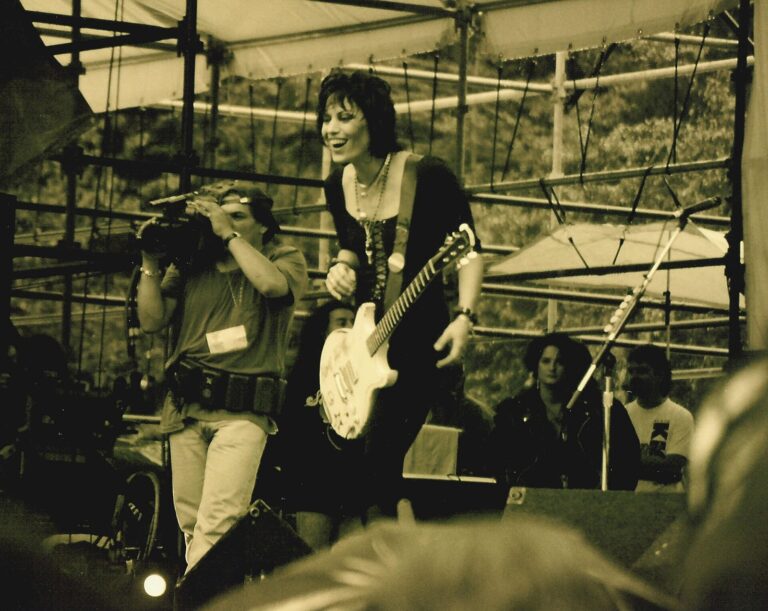
The Guitar – Gibson Melody Maker (The White Warrior)

If you’ve seen Joan Jett live, you’ve seen the guitar: a beaten-up white Gibson Melody Maker, plastered with stickers, scratches, and history.
This isn’t a collector’s piece — it’s a weapon.

The guitar features a single Red Rhodes Velvet Hammer humbucker in the bridge position — a pickup known for its punchy mids, searing highs, and surprising warmth.
It gives her the perfect tone balance: aggressive enough to cut through a mix, but rich enough to groove alongside her rhythm section.

She strings it with D’Addario .010–.046, keeping tension tight enough for those relentless downstrokes. The action? Low, fast, and mean — exactly how she plays.
Her signature model, the Joan Jett Signature Melody Maker, honors that simplicity. No frills, no fancy top wood, no extra electronics — just rock in its purest form.

“You don’t need ten guitars. You need one you can trust — and play the hell out of.”


The Amp – Music Man HD-130

Behind every Jett riff is the unmistakable roar of a Music Man HD-130, a tube-driven beast that bridges Fender-style clarity with Marshall-like grit.
She runs it clean but loud, letting her humbucker and right hand do all the heavy lifting.
There’s no distortion pedal in sight — the breakup comes straight from the tubes gasping under her relentless attack.

The EQ settings? Straightforward and brutal:

  • Bass: around 7

  • Mid: 6

  • Treble: 8

  • Volume: 10, always.

Paired with her Marshall 4×12 or Music Man 2×12 combo, it creates that signature wall of sound — sharp, percussive, and dripping with attitude.


The Pedals – None, Mostly

Joan Jett doesn’t believe in pedalboards.
The closest she gets to an effect is a touch of natural spring reverb from the amp. Everything else is in her hands — that snappy right-hand rhythm and that no-BS touch that turns three chords into an anthem.

Where other players stack overdrives and chorus pedals, Jett stacks conviction.
It’s punk minimalism at its finest — proof that tone comes from intent, not gear catalogs.


(Also check out James Hetfield – Downpicking King of Metallica to see another master of right-hand power and raw precision.)
The Sound – Three Chords, a Truth, and the Spirit of Rebellion

Joan Jett’s sound isn’t about perfection — it’s about conviction.
Every chord she hits feels like a statement, every riff like a middle finger raised in perfect rhythm.

Her philosophy? “If it sounds good loud, it’s good.”
That’s why her tone has never changed. From “Bad Reputation” to “I Hate Myself for Loving You,” it’s the same unmistakable crunch — tight, mid-heavy, unapologetically analog.

Three Chords and the Truth

When you strip away the hype, Jett’s entire guitar approach is built on three ingredients:

  1. Downstrokes. Fast, hard, relentless.

  2. Open power chords. Ringing with just enough sustain to sound dangerous.

  3. Dynamic control. She doesn’t use gain knobs — she uses her picking hand.

That’s what gives her rhythm its swagger. She’ll dig in to make a chorus explode, then ease up to make a verse breathe — all without touching a single dial.


The Runaways Sound

In the Runaways era, her tone was rawer, thinner, more punk. Plug straight into a Music Man combo, crank it, and you’re there.
There’s no studio trickery — it’s the sound of five teenage girls making history one downstroke at a time.

That early attitude became the DNA of her later career. She kept that live energy, but over time it evolved — tighter low end, slightly more compression, but still pure Joan.


The Blackhearts Sound

When The Blackhearts came along, she refined her tone into a wall of rhythm.
Dual-tracked Melody Makers through cranked HD-130s gave her records that enormous stadium punch.
Producer Kenny Laguna captured it with a blend of close-miked attack and room ambience, keeping the mix human — loud, imperfect, and real.

It’s punk roots with arena muscle.
That’s why Foo Fighters, Green Day, and even The Distillers still borrow from her sound.
Every one of them owes a nod to Joan’s three-chord gospel.

“You don’t need to play fast. You need to play like you mean it.”


(Read also Dave Grohl – Grohl Power and the Sound of Foo Fighters to see how her spirit of raw rhythm carried into the next generation.)


The Legacy – Breaking Barriers and Redefining Rock’s Attitude

There are legends — and then there are forces of nature.
Joan Jett belongs to the latter category. She didn’t just play rock ’n’ roll; she redefined what it looked like, sounded like, and who was allowed to play it.

From the very beginning, the music industry tried to box her in — “too aggressive,” “too masculine,” “too punk.”
So she built her own box, labeled it Blackheart Records, and filled it with the kind of noise that terrified executives and inspired generations.

The Rebel Blueprint

Joan Jett became a living blueprint for independence.
She was DIY before DIY had a name — recording, producing, and releasing her own records when every major label turned her down.
The success of I Love Rock ’n’ Roll wasn’t a fluke — it was the sound of defiance paying off.

Her legacy extends far beyond guitar tone and stage attitude.
She kicked open doors that were welded shut. Without Joan, there’s no L7, no Hole, no Bikini Kill, no Paramore.
And she didn’t stop there — mentoring, producing, and standing beside countless young women who saw her and thought, “If she can do it, I can too.”


Still Loud, Still Proud

Today, Joan Jett tours harder than artists half her age.
She still straps on that same battered Melody Maker, still plugs straight into her Music Man, and still fills arenas with nothing but raw human volume.
No tracks. No samples. No apologies.

Even off stage, she’s the same fighter — an advocate for animal rights, gender equality, and individuality in every form.
She’s proof that rebellion doesn’t age; it evolves.

“People keep asking when I’m gonna slow down.
I tell them — when it stops being fun. So… not yet.”


There’s a reason Joan Jett is called The Queen of Rock ’n’ Roll — not because she chased the crown, but because she earned it one chord at a time.
She didn’t follow the rules; she became the rulebook for every guitarist who ever decided to plug in and turn up anyway.


FAQ – Joan Jett, Her Gear, and Her Unbreakable Legacy

What guitar does Joan Jett play?
Joan Jett’s main weapon is her white Gibson Melody Maker, fitted with a Red Rhodes Velvet Hammer humbucker.
It’s the same guitar she’s played since the late ’70s — covered in stickers, battle scars, and history.

What amp does Joan Jett use?
She’s been loyal to her Music Man HD-130 combo amp for decades.
It delivers the perfect mix of clarity and bite — think Fender sparkle meets Marshall growl.
She runs it clean and loud, relying on her right hand for dynamics and drive.

Does Joan Jett use pedals?
Almost never.
Her entire signal chain is guitar → cable → amp.
Occasionally, she’ll use a touch of built-in spring reverb, but otherwise, it’s all pure tone and attitude.

How does Joan Jett get her tone?
Her tone comes from attack and intent.
She plays with hard, percussive downstrokes, keeping rhythm tight and aggressive.
That right hand is her secret weapon — she strums like a drummer, turning rhythm guitar into a lead instrument.

Why is Joan Jett considered a trailblazer?
Because she refused to accept “no” as an answer.
She built her own label, produced her own records, and made rock music accessible to women everywhere.
Her success rewrote the rules of who gets to hold a guitar — and how loud they’re allowed to play it.

What strings and setup does she use?
Joan Jett typically strings her Melody Maker with D’Addario 10–46 and keeps the action low for fast, aggressive rhythm work.
Her rig hasn’t changed in decades — if it isn’t broken, she’s not fixing it.


There’s something poetic about the way Joan Jett’s music still rattles the same amps, the same guitars, and the same emotions that started it all.
In an era obsessed with plugins and presets, she’s living proof that attitude will always outlast algorithms.

She didn’t just sing “I Love Rock ’n’ Roll.”
She reminded the world why we fell in love with it in the first place.