
Fender Jazzmaster: The Jazz Guitar That Became the Sound of Indie
J Mascis playing a Fender Jazzmaster at the Virgin Music Festival in Halifax, Nova Scotia, in 2009. Photo: Alex Ramon, J-mascis.jpg, via Wikimedia Commons; CC BY-SA 3.0 (https://creativecommons.org/licenses/by-sa/3.0/). Source image unchanged by GuitarGangsters. Source: https://commons.wikimedia.org/wiki/File:J-mascis.jpg
The definitive guide to the Fender Jazzmaster: full history from 1958, offset design, rhythm circuit explained, specs, famous players (J Mascis, Kevin Shields, Robert Smith), tone recipes, Jazzmaster vs Jaguar, and expert buying advice for 2025.
The Fender Jazzmaster might be the most gloriously wrong guitar in history. Fender designed it in 1958 to win over jazz guitarists — sophisticated players who would appreciate its mellow tone, its comfortable offset body, and its clever lead/rhythm switching. The jazz world took one look at this space-age slab with its bewildering array of switches and dials, turned up its collective nose, and walked away. By the measure of its own name and intended purpose, the Jazzmaster was an abject failure.
And yet — this is the magic of the Jazzmaster — it became one of the most important guitars in alternative music history. Surf bands embraced it in the 1960s. New wave players grabbed it in the 1970s. And then, most consequentially, the indie, shoegaze, and alternative rock generation made it their own: J Mascis made it roar like a hurricane, Kevin Shields reinvented what it could sound like with his glide-guitar walls of sound, and Robert Smith made it sound nervy and gothic. The guitar that jazz rejected became the definitive voice of counterculture.
This guide covers the full Jazzmaster story: the ambitious 1958 origins, the offset design and its quirks, the famous rhythm circuit, the specs, the players who reinvented it, tone recipes, the crucial Jazzmaster-versus-Jaguar question, and whether this offset icon belongs in your hands.
The Origins: Fender’s Ambitious Bid for the Jazz World
To understand the Jazzmaster, you have to understand Fender’s ambition in the late 1950s. By 1958, Leo Fender had already changed the world twice. The Telecaster (1950) had established the solidbody electric as a serious working instrument. The Stratocaster (1954) had perfected the concept into a stylish, ergonomic masterpiece that was starting to lead a musical revolution.
But there was one market Fender hadn’t cracked: serious jazz guitarists, who still favored big-bodied hollow archtops and viewed solidbody electrics with suspicion. Leo Fender and sales director Don Randall set out to design the company’s new top-of-the-line flagship — an instrument that would sit above even the Stratocaster and finally win over the jazz crowd. The Jazzmaster, introduced at the 1958 NAMM Convention, was that bid.
The Design Innovations
The Jazzmaster broke new ground for Fender in several ways. For the first time on a Fender, it featured a separate rosewood fingerboard glued to the maple neck, rather than the all-maple necks of the Tele and Strat — a more “upscale” look aimed at the sophisticated jazz player. It had a bigger headstock, an exaggerated new “offset-waist” body shape, and large, flat single-coil pickups (often called “soapbar” pickups) unlike anything Fender had made before.
The offset body was a genuine ergonomic innovation. The waist of the guitar is positioned closer to the neck on the bass side and set back more on the treble side, specifically designed to balance comfortably when played seated — exactly how jazz and blues players prefer to perform. It remains, to this day, one of the most comfortable electric guitars to play sitting down.
The Rejection
Despite all this thoughtful design, the jazz world simply wasn’t interested. Suspicious of the solid body, the space-age looks, and the unfamiliar control layout, jazz guitarists stuck with their hollow archtops. The Jazzmaster, named for a market that rejected it, did not live up to Fender’s lofty commercial expectations in its early years. It was, on its own terms, a flop.
The Unlikely Comeback(s): How the Jazzmaster Found Its People
What makes the Jazzmaster’s story extraordinary is that it didn’t just find a second life — it found three or four of them, across completely different musical eras.
Surf Rock: The First Adopters
The Jazzmaster’s first unexpected home was surf music. Bands like The Ventures and The Surfaris loved the brightness, twang, and jangle they could coax from the guitar, and its unique floating tremolo system was perfect for the shimmering, wet sound of early-1960s surf. The mellower-voiced soapbar pickups and the expressive vibrato made the Jazzmaster a surf staple, and Fender leaned into this, featuring the guitar prominently in its famous “You won’t part with yours either” advertising campaign.
New Wave and Post-Punk: The Second Wave
After the Jazzmaster was discontinued from standard production in 1980, something ironic happened: it surged in popularity just as it left the lineup. New wave and post-punk musicians, drawn to its offset cool and its affordability on the used market, picked it up. Elvis Costello used a Jazzmaster on his 1977 debut My Aim Is True and made it part of his angular, literate new-wave image. Ric Ocasek of The Cars wielded one. The guitar that jazz snubbed became a symbol of the era’s restless, art-school energy.
Indie, Alternative, and Shoegaze: The Defining Era
The Jazzmaster’s most consequential reinvention came with the alternative and indie rock explosion of the late 1980s and 1990s. This is the era that truly defined the Jazzmaster’s modern identity, and it’s where the guitar became genuinely iconic.
J Mascis of Dinosaur Jr. made his Jazzmaster sound like a hurricane — a wall of melodic fuzz and squalling leads that became the template for indie guitar heroics. Fender eventually honored him with a signature model (the famous purple sparkle Jazzmaster). Kevin Shields of My Bloody Valentine essentially reinvented what a Jazzmaster could do, using the floating tremolo to create his signature “glide guitar” — vast, woozy, shuddering walls of feedback and pitch-bent texture. The blurry image on the cover of MBV’s seminal 1991 album Loveless is, fittingly, a Jazzmaster.
Robert Smith of The Cure made his Jazzmaster sound both nervy and gothic, a key ingredient in the band’s atmospheric sound. Thurston Moore and Lee Ranaldo of Sonic Youth used Jazzmasters (and heavily modified offsets) as platforms for their radical alternate tunings and drone explorations — both received signature models. Nels Cline of Wilco wielded the Jazzmaster for his experimental, genre-defying playing.
The list of Jazzmaster-toting alternative icons reads like a who’s-who of inventive guitar music: members of Stereolab, Cocteau Twins, Pavement, Yo La Tengo, Wilco, The Flaming Lips, Swervedriver, Portishead, Radiohead, and many more. The Jazzmaster’s offset shape and unique midrange voice became, paradoxically, the sound of musicians pushing rock’s boundaries — a tradition that continues with modern bands like The 1975 and Arctic Monkeys.
Fender Jazzmaster: Full Specifications
Body and Construction
The Jazzmaster features an alder body in its distinctive offset-waist shape, typically finished in gloss. The offset design isn’t just visual — it genuinely improves seated playing comfort, with the body’s asymmetry balancing the guitar naturally on the leg. The classic finish is sunburst, though custom colors like Fiesta Red, Olympic White, and Lake Placid Blue are highly prized, especially with matching headstocks.
Neck and Fretboard
The Jazzmaster uses Fender’s full 25.5-inch scale length — the same as the Stratocaster and Telecaster — paired with a bolt-on maple neck and a separate rosewood fingerboard. This full scale length is one of the key things that distinguishes the Jazzmaster from its short-scale cousin the Jaguar, giving it standard Fender string tension and a “big,” full sound. Vintage models have 21 frets and dot inlays (block inlays appeared on later 1960s models); modern versions often have 22 frets. Neck profiles vary by era and model, from the chunky vintage necks of the late ’50s to modern “C” and “Deep C” shapes.
Pickups: The Soapbars
The Jazzmaster’s pickups are central to its character. These are large, wide, flat single-coil pickups — often confused with P-90s, but a distinct design. Their broad coil produces a warmer, mellower, more rounded tone than a Stratocaster’s bright single-coils, with a rich midrange and a slightly darker, smoky character. This was the “jazz” voice Fender was chasing — but it’s exactly this warm, full single-coil tone, capable of both jangle and (with fuzz) glorious roar, that made the guitar so versatile for alternative music. Early “black bottom” pickups have a slightly darker tone than the later “grey bottom” versions.
The Floating Tremolo and Bridge
The Jazzmaster’s floating tremolo system is one of its defining features. Unlike the Stratocaster’s synchronized tremolo, the Jazzmaster uses a separate floating vibrato unit with a longer travel and a gentler, more subtle action — perfect for the shimmering surf wobble and the dramatic pitch-bends of shoegaze. It also includes a “trem-lock” button to help maintain tuning if a string breaks.
The original floating bridge is famously both a blessing and a quirk. It allows the strings to vibrate freely for that distinctive resonant tone, but it’s also prone to issues: strings can pop out of the shallow saddle slots during aggressive playing, and the bridge can rock or buzz. Many players love the character; others swap in upgraded bridges (like a Mustang bridge or aftermarket offset-specific bridges) to solve these quirks. Modern models like the American Professional II address this with redesigned bridges.
The Rhythm Circuit: The Mysterious Switches
The Jazzmaster’s most distinctive and misunderstood feature is its dual-circuit wiring — the “lead/rhythm” switching system. A slider switch on the upper bout toggles between two completely separate circuits. The “lead” circuit is the standard setup: three-way pickup selector, master volume, master tone. The “rhythm” circuit (engaged by the slider) activates the neck pickup only, routed through a separate set of roll-knob controls for volume and tone, preset to a warmer, bassier voice.
The original idea was that a jazz player could set a mellow rhythm tone on the rhythm circuit, then flick to the brighter lead circuit for solos — preset switching before the era of pedalboards. In practice, many players ignore the rhythm circuit entirely, while others treat it as a beloved quirk. Notably, Fender’s 2025 American Professional Classic Jazzmaster launched without a rhythm circuit at all — a controversial move among purists who consider those mysterious extra switches part of the Jazzmaster’s soul.
The Sound: What Makes a Jazzmaster Special
The Jazzmaster’s sonic signature is a warm, full, slightly dark single-coil voice with a distinctive midrange punch and a chiming, complex high end. It’s brighter and janglier than a humbucker guitar but warmer and rounder than a Stratocaster. This unique tonal space — neither as bright as a Strat nor as fat as a Les Paul — is exactly why it sits so well in dense, textural music.
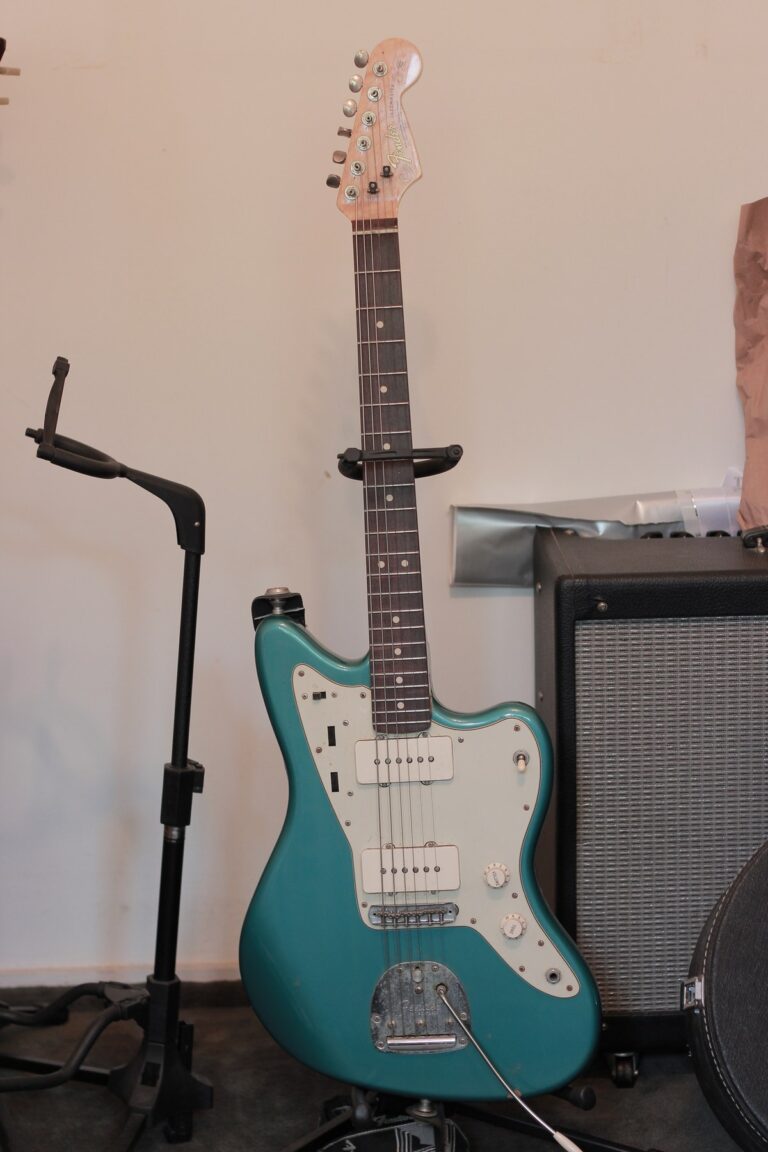
Clean, the Jazzmaster shimmers and jangles, ideal for arpeggiated indie textures and surf twang. The floating tremolo adds expressive wobble and dive. But the Jazzmaster truly comes alive with fuzz and overdrive: the soapbar pickups interact with distortion in a way that produces a thick, articulate, singing roar — the J Mascis hurricane, the Kevin Shields wall of sound. The guitar’s resonant, slightly loose character (partly from the floating bridge) lends itself to feedback manipulation and textural experimentation that tighter guitars can’t match.
Its mid-range punch remains as relevant in 2026 as it was in the surf-rock 1960s — a versatile platform for shimmering cleans, textured overdrive, and expansive ambient tones.

Tone Recipes: Dialing In Classic Jazzmaster Sounds
Recipe 1: J Mascis Indie Fuzz Hurricane
The Dinosaur Jr. sound is a massive wall of melodic fuzz with singing sustain — loud, thick, and gloriously over-the-top.
- Guitar: Jazzmaster, bridge pickup, volume and tone at 10
- Fuzz/Overdrive: A big muff-style fuzz is the key (stacked fuzz pedals for true Mascis excess)
- Amp: Loud, clean-ish Fender or Marshall headroom (Mascis uses walls of Marshalls)
- Gain (amp): 4–5, letting the fuzz do the work
- Bass: 6
- Mids: 6
- Treble: 6
- Effects: Fuzz into a bit of reverb; volume is part of the tone
Recipe 2: Kevin Shields Shoegaze Glide Guitar
The My Bloody Valentine sound is about the floating tremolo creating constant, woozy pitch movement under a wall of distortion and reverb.
- Guitar: Jazzmaster, both pickups or bridge, with constant gentle use of the floating trem arm
- Distortion: Thick overdrive/distortion, often layered
- Reverb: Heavy reverb for the wash
- Amp: Clean-to-edge with lots of headroom
- Gain: 5–6
- Bass: 6
- Mids: 5
- Treble: 6
- Technique: The “glide” comes from riding the trem arm continuously while strumming — the secret weapon
Recipe 3: Robert Smith Gothic Jangle (The Cure)
The Cure’s nervy, atmospheric tone is bright, chorused, and chiming with a touch of unease.
- Guitar: Jazzmaster, bridge or middle position, volume at 8–10
- Amp: Clean Fender or Roland with headroom
- Gain: 2–3 (clean)
- Bass: 5
- Mids: 6
- Treble: 7
- Effects: Chorus (essential), flanger, delay, and reverb for the atmospheric gothic shimmer
Recipe 4: Surf Twang (The Ventures Era)
Classic 1960s surf is all bright twang, heavy spring reverb, and that wet floating-trem wobble.
- Guitar: Jazzmaster, bridge pickup, volume and tone at 10
- Amp: Fender amp with built-in spring reverb (Twin or Deluxe)
- Gain: 2 (clean)
- Bass: 5
- Mids: 5
- Treble: 7
- Effects: Maximum spring reverb; use the floating trem for the surf wobble and dips

Jazzmaster vs. Jaguar: The Offset Showdown
The Jazzmaster’s closest sibling is the Fender Jaguar (1962), with which it shares the offset body silhouette and floating tremolo. But despite looking similar, they are quite different instruments — and choosing between them is one of the most common decisions offset buyers face.
Scale Length
The biggest difference is scale length. The Jazzmaster uses the full 25.5-inch Fender scale, giving it standard string tension and a big, full sound. The Jaguar uses a shorter 24-inch scale, which makes the strings feel slinkier and easier to bend, and gives it a more compact, immediate feel. If you like the looser feel of a short scale, the Jaguar appeals; if you want standard Fender tension and a fuller voice, the Jazzmaster wins.
Pickups and Tone
The Jazzmaster’s large, wide soapbar pickups produce a warm, full, rounded tone with rich midrange. The Jaguar’s pickups are narrower and feature metal shielding “claws,” giving them a brighter, sharper, more percussive and trebly voice. The Jazzmaster is the warmer, “rhythm” voice; the Jaguar is the brighter, more cutting “lead” voice. This tonal distinction is arguably more significant than the scale-length difference for many players.
Which Should You Choose?
Choose the Jazzmaster for a fuller, warmer tone, standard Fender scale and feel, and that versatile midrange that works for everything from jangle to fuzz. Choose the Jaguar for a brighter, snappier sound, a slinkier short-scale feel, and a more compact body. Both are offset icons; the choice comes down to scale-length feel and whether you prefer warm or bright.
Jazzmaster vs. Stratocaster: Two Different Fenders
Players sometimes weigh the Jazzmaster against the Stratocaster, since both are full-scale Fender single-coil guitars. The Strat is brighter, snappier, and more versatile in a “mainstream” sense, with its three pickups and famous quack positions. The Jazzmaster is warmer, darker, and more characterful, with its wide soapbar pickups and unique controls.
The Strat is the more conventional choice — the do-everything workhorse. The Jazzmaster is the more idiosyncratic instrument, with a distinct voice and offset comfort that suits players seeking something with more character and alternative credibility. Many players own both for their complementary voices.
Best Years and Models to Buy: A Buyer’s Guide
1958–1965 Pre-CBS Vintage — The Golden Era
Pre-CBS Jazzmasters (before CBS bought Fender in 1965) are the most coveted vintage examples. The 1958 models — the only full year with the anodized aluminum pickguard — are particularly prized, as are early examples with “black bottom” pickups and slab rosewood fingerboards. These command premium vintage prices, with custom-color examples especially valuable. The 1959 switch to a celluloid tortoise pickguard and the various transitions through the early ’60s each have their devotees.
1966–1980 — Block Inlays and CBS Era
Mid-1966 saw block inlays and binding replace the dot markers. CBS-era Jazzmasters are more affordable than pre-CBS examples and remain excellent players’ guitars with genuine vintage character. The model was discontinued from standard production in 1980.
Made in Japan (MIJ) Reissues
When Fender Japan launched in 1982, it produced highly regarded Jazzmaster reissues (the JM66 and others). MIJ Jazzmasters from this era have a strong reputation for quality and value, and are sought after on the used market.
Modern American Models
The American Professional and American Professional II Jazzmasters brought the model back to Fender’s USA standard lineup with modern refinements — improved bridges, updated pickups, and comfortable modern necks that solve many traditional offset quirks. The American Vintage II series painstakingly recreates specific vintage years for purists. The American Ultra offers the most modern, high-performance take with noiseless pickups and a compound-radius fingerboard.
Player Series and Vintera (Affordable Options)
For players on a budget, Fender’s Mexico-made Player Series and Vintera Jazzmasters offer the offset experience at accessible prices, with modern playability and good pickups. Squier also makes excellent affordable Jazzmasters, including the beloved J Mascis signature model. A used Made-in-Mexico Jazzmaster is one of the best value offset guitars available.
Signature Models
The Jazzmaster has an unusually rich signature-model history: the J Mascis (purple sparkle), Elvis Costello, Thurston Moore and Lee Ranaldo (Sonic Youth), Jim Root (Slipknot), and others each offer specific tweaks for those chasing a particular artist’s sound.
Living With a Jazzmaster: Practical Considerations
The Bridge Quirks
The single most discussed practical issue with vintage-style Jazzmasters is the bridge. The original floating bridge, combined with the shallow break angle over the bridge, can allow strings to pop out of their saddle slots during aggressive playing, and the bridge can buzz or rock. Solutions include swapping to a Mustang bridge, fitting an aftermarket offset-specific bridge (Mastery and others are popular), using heavier strings, or adjusting the setup. Modern American models have largely engineered these issues away.
String Gauge
The Jazzmaster’s floating tremolo and shallow break angle work best with slightly heavier strings — many players use .011 or even .012 gauge sets rather than .009s. Heavier strings increase the downward pressure on the bridge, reducing buzz and string-slip and improving tuning stability. This also suits the warmer, fuller tone the guitar is known for.
The Floating Tremolo
The floating trem is expressive but takes some getting used to. Its longer, gentler travel is ideal for subtle wobbles and dramatic shoegaze dives, but it’s not built for the divebomb antics of a locking system. The trem-lock feature helps maintain tuning. Once set up properly, it’s stable and hugely expressive.
The Rhythm Circuit Learning Curve
New owners are often baffled by the rhythm circuit’s extra slider and roll knobs. The simplest approach: leave the slider in the “lead” position to use the guitar conventionally, and explore the rhythm circuit later once you’re comfortable. Many players never use it; others build it into their sound.
Frequently Asked Questions
Why is it called a Jazzmaster if jazz players didn’t use it?
Fender designed and named the Jazzmaster in 1958 specifically to appeal to jazz guitarists, marketing it as the company’s sophisticated, top-of-the-line flagship with a mellow tone suited to jazz. The plan failed completely — jazz players preferred their hollow archtops and rejected the solidbody Jazzmaster. The name stuck even though the guitar found its real audience among surf, new wave, and especially indie and alternative musicians. It’s one of music’s great ironies.
What is the rhythm circuit on a Jazzmaster?
The rhythm circuit is the Jazzmaster’s distinctive dual-wiring system. A slider switch on the upper bout toggles between the “lead” circuit (standard three-way selector, master volume and tone) and the “rhythm” circuit (neck pickup only, with separate roll-knob controls preset to a warmer, bassier voice). It was designed so jazz players could preset a mellow rhythm tone and switch to a brighter lead tone — preset switching before pedalboards existed. Many modern players ignore it; others love the quirk.
What’s the difference between a Jazzmaster and a Jaguar?
Though they share the offset body, they’re quite different. The Jazzmaster has a full 25.5″ scale length (standard Fender tension, fuller sound) and large warm soapbar pickups. The Jaguar has a shorter 24″ scale (slinkier, easier bending) and narrower, shielded pickups that are brighter and more percussive. The Jazzmaster is the warmer “rhythm” voice; the Jaguar is the brighter “lead” voice.
Why do Jazzmaster strings pop out of the bridge?
The original vintage-style Jazzmaster bridge has a shallow break angle and shallow saddle slots, which can let strings slip out during aggressive playing. The common fixes are using heavier strings (.011 or .012) to increase downward pressure, swapping to a Mustang bridge, or fitting an aftermarket offset-specific bridge like a Mastery. Modern American Jazzmasters have redesigned bridges that largely solve this.
Is the Jazzmaster good for metal or heavy music?
The Jazzmaster isn’t a traditional metal guitar — its single-coil voice and floating bridge suit alternative, shoegaze, indie, and noise rock better than tight modern metal. That said, players like Jim Root of Slipknot use Jazzmaster-shaped guitars with humbuckers for heavy music, and the guitar excels at the thick, textural distortion of shoegaze and noise. For djent-style metal, a humbucker-loaded guitar is more appropriate, but the Jazzmaster is a fantastic platform for fuzz and wall-of-sound heaviness.
Are Jazzmasters good for beginners?
A Jazzmaster can be a great guitar to learn on, especially the affordable Player Series, Vintera, or Squier versions. It’s comfortable to play seated thanks to the offset body. The main learning curve is the bridge quirks and the unusual control layout, but neither is a dealbreaker. Just leave the rhythm circuit slider in the “lead” position to start, and you have a straightforward, great-sounding guitar.
Why did the Jazzmaster become so popular in indie and alternative music?
Several reasons converged. After being discontinued in 1980, Jazzmasters were cheap and plentiful on the used market just as alternative music was emerging, making them accessible to indie musicians. Their warm, full single-coil voice interacts beautifully with fuzz and reverb for textural walls of sound. The floating tremolo enables expressive pitch effects (Kevin Shields’ glide guitar). And the offset shape carried an anti-establishment, art-school cool that suited bands pushing rock’s boundaries. J Mascis, Kevin Shields, Sonic Youth, and The Cure cemented it as the alternative guitar.
Final Verdict: Should You Buy a Fender Jazzmaster?
The Fender Jazzmaster is one of the great underdog stories in guitar history — an instrument that failed at its intended purpose and went on to become the defining voice of surf, new wave, indie, and shoegaze. It is a guitar with genuine character: a warm, full single-coil tone that does jangle and roar with equal conviction, an expressive floating tremolo, a comfortable offset body, and an unmistakable, art-school cool that no other guitar quite matches.
If you play indie, alternative, shoegaze, surf, or any music that values texture, atmosphere, and character over conventional brightness, the Jazzmaster is very likely the guitar for you. It connects you to the lineage of J Mascis, Kevin Shields, Robert Smith, and Sonic Youth — musicians who used it to push rock forward. The main considerations are the bridge quirks (solvable) and the learning curve of its unusual controls.
If you want a more conventional, do-everything Fender, a Stratocaster or Telecaster may serve you better. But if you want a guitar with a soul, a story, and a sound that’s all its own, the Jazzmaster delivers like nothing else. The jazz world’s loss became alternative music’s greatest gain — and six decades on, that offset shape still defies convention. Strap one on and find out why the most inventive players in rock keep coming back to it.
Image credits
- Kevin Shields: Julio Enriquez, Wikimedia Commons, CC BY 2.0.
- J Mascis: Bene Riobó, Wikimedia Commons, CC BY-SA 3.0.
- Top image: J Mascis playing a Fender Jazzmaster at the Virgin Music Festival in Halifax, Nova Scotia, in 2009. Photo: Alex Ramon; J-mascis.jpg, via Wikimedia Commons; CC BY-SA 3.0. Source image unchanged by GuitarGangsters.
- Fender Jazzmaster: ligia diniz, Wikimedia Commons, CC BY 2.0.


Latest News
On This Day
Tuesday 10 November
From this week: